


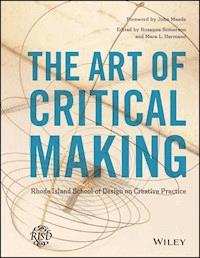
The Art of Critical Making E-Book
19,99 €
Mehr erfahren.
- Herausgeber: John Wiley & Sons
- Kategorie: Fachliteratur
- Sprache: Englisch
Describes the world's leading approach to art and design taught at Rhode Island School of Design
At Rhode Island School of Design students are immersed in a culture where making questions, ideas, and objects, using and inventing materials, and activating experience all serve to define a form of critical thinking—albeit with one's hands—i.e. "critical making." The Art of Critical Making, by RISD faculty and staff, describes fundamental aspects of RISD's approach to "critical making" and how this can lead to innovation. The process of making taught at RISD is deeply introspective, passionate, and often provocative.
This book illuminates how RISD nurtures the creative process, from brief or prompt to outcome, along with guidance on the critical questions and research that enable making great works of art and design.
- Explores the conceptual process, idea research, critical questions, and iteration that RISD faculty employ to educate students to generate thoughtful work
- Authors are from the faculty and staff of the Rhode Island School of Design, which consistently ranks as the number one fine arts and design college in the United States
The Art of Critical Making shows you how context, materials, thought processes, and self-evaluation are applied in this educational environment to prepare creative individuals to produce dynamic, memorable, and meaningful works.
Das E-Book können Sie in Legimi-Apps oder einer beliebigen App lesen, die das folgende Format unterstützen:
Seitenzahl: 338
Veröffentlichungsjahr: 2013
Ähnliche




















Contents
Foreword
Preface
The Art of Critical Making: An Introduction
Groundwork
Lesson #1: Begin by looking at options, which is different from acting at random
Lesson #2: Learn to see by thinking more complexly about visibility
Lesson #3: Use everything that you know and record everything
Lesson #4: Don’t try to get to the end without taking all the steps necessary to get there
Lesson #5: Understand that what you are learning is not the same thing as what is being taught
Text and Context: Outward in All Directions
Conversation: Drawing
Thingking
Object Lessons
Conversation: Materials
Anais Missakian, Professor and Department Head, Textiles
Jocelyne Prince, Assistant Professor, Glass
Eric Anderson, Assistant Professor, History of Art and Visual Culture
Mark Pompelia, Visual + Material Resource Librarian, Fleet Library at RISD
Graphic Design, Storytelling, and the Making of Meaning
The Nature Imperative
Hands-on Learning and Personal Taxonomies
Biological Guides: Inspiration and Innovation
Scientific Methods: Microscopy and Mental Imaging
The Human-Nature Connection and Our Future
Conversation: Critique
Christina Bertoni, Professor, Foundation Studies
Elliott Romano, BFA 2013 Photography
Norm Paris, Assistant Professor, Foundation Studies
Ian Stell, MFA 2012 Furniture Design
Daniel Hewett, Critic, Landscape Architecture
Eva Sutton, Professor, Photography
Acting into the Unknown
1. Beware generalization
2. Attention coexists with intention
3. Guessing is a valid form of logic
4. Expect uncertainty
5. Communicate toward joint action
6. Practice, practice, practice
7. Don’t be afraid to fail/be afraid to fail
Afterword
Acknowledgments
Contributors
Illustrations
Index
Cover images: Elish Warlop (MFA 2013 Furniture Design), studies for Rings of Fire and Hoop Skirts lighting, 2013, steel and brass, each 4 × 4 in.
Publication design: Julie Fry
Copyright © 2013 by Rhode Island School of Design. All rights reserved.
Published by John Wiley & Sons, Inc., Hoboken, New Jersey.
Published simultaneously in Canada.
No part of this publication may be reproduced, stored in a retrieval system, or transmitted in any form or by any means, electronic, mechanical, photocopying, recording, scanning, or otherwise, except as permitted under Section 107 or 108 of the 1976 United States Copyright Act, without either the prior written permission of the Publisher, or authorization through payment of the appropriate per-copy fee to the Copyright Clearance Center, 222 Rosewood Drive, Danvers, MA 01923, (978) 750-8400, fax (978) 646-8600, or on the web at www.copyright.com. Requests to the Publisher for permission should be addressed to the Permissions Department, John Wiley & Sons, Inc., 111 River Street, Hoboken, NJ 07030, (201) 748-6011, fax (201) 748-6008, or online at www.wiley.com/go/permissions.
Limit of Liability/Disclaimer of Warranty: While the publisher and author have used their best efforts in preparing this book, they make no representations or warranties with respect to the accuracy or completeness of the contents of this book and specifically disclaim any implied warranties of merchantability or fitness for a particular purpose. No warranty may be created or extended by sales representatives or written sales materials. The advice and strategies contained herein may not be suitable for your situation. You should consult with a professional where appropriate. Neither the publisher nor the author shall be liable for damages arising herefrom.
For general information about our other products and services, please contact our Customer Care Department within the United States at (800) 762-2974, outside the United States at (317) 572-3993, or fax (317) 572-4002.
Wiley publishes in a variety of print and electronic formats and by print-on-demand. Some material included with standard print versions of this book may not be included in e-books or in print-on-demand. If this book refers to media such as a CD or DVD that is not included in the version you purchased, you may download this material at http://booksupport.wiley.com. For more information about Wiley products, visit www.wiley.com.
ISBN 978-1-118-51786-4 (cloth); ISBN 978-1-118-76395-7 (ebk); ISBN 978-1-118-76403-9 (ebk)
Foreword
John Maeda
I spent a large part of the ’90s getting a PhD at Tsukuba University Institute of Art and Design, a largely closed-off, pristine educational enclave of Japanese master makers and thinkers. There were no computers to speak of, and the web hadn’t really happened yet. It was a happy time, unfettered by the e-mails and other e-disruptions that fill all of our days today. I often found myself in the library — intently learning about the history of design through old publications from Ulm (a kind of post-Bauhaus school) and of course the Bauhaus itself.
Conversely, I had spent the decade prior affixed to a computer, at MIT. The ’80s was the time when the first “undo” action was invented. Imagine a world without undo; I remember after I began studying at Tsukuba, I was in an ink-drawing class where I noticed that whenever I made an error, my hand would reach for command-Z on an invisible keyboard in my mind. I had to “unlearn” being digital. In doing so, I learned to truly appreciate the advantages of being a student — to get the chance to unlearn what I knew, in order to learn anew. This wonderful educational experience inspired me to become a teacher myself. I returned to MIT as a junior professor at the Media Lab, where I could bring some of my art and design education to bear.
While I was cloistered in Japan, the computer really started to take off. It was fast. And it kept getting faster, cheaper, and better. Digital art and design were largely panned by the art and design establishment because of their “lack of the human hand.” In retrospect, I can see that this was a normal reaction to a dehumanizing technology going mainstream — much the same as John Ruskin’s and William Morris’s proud questioning of the Industrial Revolution. What I could see upon my return from Japan, having been traditionally educated in Bauhaus-style thinking, was that there was opportunity in this new medium, which, like others before it, could help harness unbelievable amounts of expressive power and creative energy. I felt that the tool — in this case the computer — had to be mastered for it to do the biddings of the artist and designer’s hand, head, and heart.
As an advocate in the late ’90s for artists and designers writing their own computer programs, I often got a lot of flack. The prevailing sentiment was, “Why should artists learn to code when there are tools like Photoshop?” My goal was to simply follow what I learned from my materials-based education at Tsukuba — that we needed to treat the computer as a new kind of material, and to master it deeply. This interest led me to develop a variety of systems for teaching computer programming to artists and designers, culminating in the Design by Numbers system in 1999. My graduate students Ben Fry and Casey Reas then built an even better system called Processing, which has vastly eclipsed my own work — suitably and proudly so. Today there are thousands of artists and designers programming with Processing to advance their ideas computationally.
And so, after twelve years teaching at MIT, my post as the 16th President of Rhode Island School of Design has been a homecoming back to the world of rigorous art and design. This book is all about the kinds of things I learned at Tsukuba, and frankly way, way more. Having stood in the same ultra-hot studios of our Glass department where alumnus and teacher Dale Chihuly forged his first physical thoughts, which would come to define evanescence, and in the same drawing studio where alumnus Gus Van Sant came as a RISD freshman, later making major movies like Good Will Hunting and Milk, I know I stand on the hallowed grounds of a kind of creative education “dojo” unlike any other place on earth.
At RISD, the integrity of the work comes from a place of criticality and materiality. Why does it exist? What existed before? What has influenced it? How is it made? Can it be made? Can we will it to be made? I find that the process of making work at RISD involves a kind of questioning that rivals a grand jury combined with a six-sigma manufacturing audit. Every stone, speck of dirt, and atom of oxygen must be turned over and examined in the light of the day in its present, past, and future. It is this kind of intensity that makes our unique brand of “critical making” so relevant to this day and age. We are all hungry for authenticity — the studied touch of a human hand, the thoughtfulness of a brilliant human mind, and a heart replenished with the warmth of another human heart.
In this digital age, there is a renewed curiosity about humanity, materiality, and all things physical, simply because much of the world has lost sight of them. You see little bits of this in the incongruity of putting faux wood-grain digital veneers on software apps. We are still in the very early days of art, design, and the computer — we have yet to have that “aha” moment when the physical world and the virtual world truly click together. For now, I see tremendous opportunity in studying and understanding traditional media — for in these materials is the root of all that we know and can truly believe.
At the same time, I know that a deeper understanding of computer code and computer-aided design and fabrication is also important. At RISD we have those efforts underway, led by Provost Rosanne Somerson and her advanced critical making initiatives. I’m not surprised by the number of corporations that have begun to knock on our door to ask for what a business or technology school can no longer do for them — which is to help them envision the future by engaging with some of the most creative thinkers and makers of our times.
After a life spent traversing the fields of technology, art, and design, my foremost conclusion is that there is great power in both fields taken separately, and in both fields put together. Reading this book, you will see why RISD is a symbol for art, design, and creativity the world over, and as such, can play a role as their advocate on national and international stages. That is why we have taken a leadership role in the movement to turn STEM (Science, Technology, Engineering, and Math) into STEAM in the United States by adding the “Arts,” broadly defined. STEAM advocates for the federal government to integrate art and design with its growing emphasis on STEM education and research. By doing so, we will develop the creativity needed to drive our innovation economy forward and keep America competitive throughout this century. The critical making we teach here at RISD is what enables designers and artists to create objects, devices, and services that are more engaging, more efficient, and more human.
So, STEAM is embodied naturally at RISD. Nowhere is this more evident than at the 75-year-old Edna Lawrence Nature Lab. Filled with more than 80,000 samples of animal, plant, and mineral materials, it’s a beautiful repository of everything from a taxidermied turkey to Brazilian butterflies to human bones. At RISD we teach students to understand humanity and nature from the core essence and architecture of life — by observing it and reproducing it on paper or in clay. Science is taught the way it was taught centuries ago, when artists and scientists were often the same person.
We have all seen that in the battle over education funding, the arts have been cut to make way for STEM education in public schools. As a lifelong STEM student, I know the possibilities inherent to those disciplines, but I also know that the way they are taught doesn’t always lead to creative thinking, nor do they enable vitality and humanity to shine through. STEAM got on the federal government’s radar when Rhode Island Congressman James Langevin introduced a House Resolution in 2011 in support of STEAM research and education. Around the same time, a Conference Board study was released, which said that nearly all employers view creativity as increasing in importance in the workplace, yet 85 percent say they can’t find the creative applicants they seek. Leaders in both business and policy circles have begun to recognize the criticality of integrating the arts and design with the STEM fields.
Since then, pardon the expression, the movement picked up steam and has found its place on Sesame Street, at South by Southwest, and on the agendas of the National Science Foundation and the National Endowment for the Arts. Please visit http://stemtosteam.org to learn more about how you can be a part of this important effort to reveal the importance of art and design. I am proud to lead an institution that knows that art isn’t just a “nice to have,” but a “need to have.”
I believe that art and design have critical roles to play in innovation in this next century, much like science and technology did in the last. The very methods revealed in this book will drive the new ideas, movements, and solutions to help us tackle the complex problems of our day. RISD students understand this: 71 percent of students surveyed from the RISD Class of 2011 responded that they are or want to be entrepreneurs; they are pioneering a new kind of “artrepreneurship” for our country.
It’s heartening to watch our students and graduates rise to this challenge and to witness the ever-growing stream of visitors on campus who recognize that artists and designers will be the next change agents. We have greatly broadened the kind of employers that come to RISD now from our home base of creative industries to include technology companies, financial services, healthcare solutions providers, and even venture capital firms looking for artists and designers to propel new ideas. In 2012, we launched the inaugural class of Maharam STEAM Fellows in Applied Art and Design, which funds RISD students to pursue internships in the public and nonprofit sectors. Michael Maharam, the company’s CEO, himself a visionary in the broader cultural implications of design, expressed it well when he said, “Maharam believes that creativity demonstrated through the arts and design will play an increasingly critical role in America’s ongoing efforts to remain a dominant global force through both culture and commerce.”
So much of RISD’s inspiration and humanity fill these pages — but words pale in comparison to what we experience every day on our campus. So in closing, I invite you to take a train, car, or plane to visit us here in Providence, Rhode Island. If you are a lifelong creative person — knowing that you are if you’ve read this far — you will feel like you are truly at home. It’s my honor to get to see that satisfaction every day in our students’ faces, here at RISD.
Preface
Frank R. Wilson
All humans are born biologically gifted learners — recipients of a host of inheritances from ancestors we will never meet. This claim is not one of those plastic verbal posies tossed lightly from a Preface writer to inspiration-hungry readers. It is a straightforward fact about the strength of every person’s connection to genetic heritage, and the reason for our astonishing capacity to acquire skill, knowledge, and understanding through physical experience, fulfilling the deepest instinctive intentions of the human mind itself. No matter who our forebears were or where they lived as individuals, as a group they learned to see beneath surfaces, to read meaning into the unfamiliar, and to adapt and survive not simply as a species, but as living individuals, in a future than could not be foreseen. But how did they do it?
The sources of our readiness are unimaginably remote, as the roots of human physical skill and intelligence extend into the past by millions of years. It seems likely that widespread climate and vegetation changes in Africa at the end of the Miocene epoch, more than 5 million years ago, increasingly forced tree-dwelling apes there to take their chances as bipedal ground dwellers. When this happened, the hand and the brain that we inherit were not what they are today. Much of what we know about the evolution of the human wrist and hand we owe to Lucy, who lived in the Afar region of Ethiopia 3 1/4 million years ago.1 A chimpanzee-size ape whose existence became known because her fossilized skeletal remains were discovered by anthropologist Donald Johanson in November 1974, Lucy the matriarch together with the species named after her, , stand very near the dawn of human evolution.
Lesen Sie weiter in der vollständigen Ausgabe!
Lesen Sie weiter in der vollständigen Ausgabe!
Lesen Sie weiter in der vollständigen Ausgabe!
Lesen Sie weiter in der vollständigen Ausgabe!
Lesen Sie weiter in der vollständigen Ausgabe!
Lesen Sie weiter in der vollständigen Ausgabe!
Lesen Sie weiter in der vollständigen Ausgabe!
Lesen Sie weiter in der vollständigen Ausgabe!
Lesen Sie weiter in der vollständigen Ausgabe!
Lesen Sie weiter in der vollständigen Ausgabe!
Lesen Sie weiter in der vollständigen Ausgabe!
Lesen Sie weiter in der vollständigen Ausgabe!
Lesen Sie weiter in der vollständigen Ausgabe!
Lesen Sie weiter in der vollständigen Ausgabe!
Lesen Sie weiter in der vollständigen Ausgabe!
Lesen Sie weiter in der vollständigen Ausgabe!




