


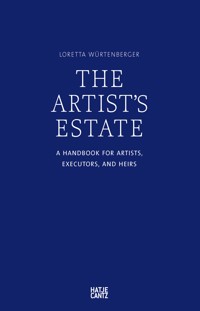
The Artist's Estate E-Book
29,99 €
Mehr erfahren.
- Herausgeber: Hatje Cantz Verlag
- Kategorie: Geisteswissenschaft
- Sprache: Englisch
Andy Warhol bequeathed us the words "Death can really make you look like a star." But death per se is not a catalyst for the relevance of an artist. What is of crucial importance is the proper management structure for the posthumous preservation and development of an artistic estate. The handbook by Loretta Würtenberger presents the possible legal framework, appropriate financing models, as well as the proper handling of the market, museums, and academia. Her business, Fine Art Partners, has advised artists and artists' estates for many years in their structuring and development of estate concepts as well as in operative questions. Based on numerous international examples, the author explains the different alternatives for maintaining an artist's estate and makes recommendations on how to ideally handle work, archives, and mementos following the death of an artist.
Das E-Book können Sie in Legimi-Apps oder einer beliebigen App lesen, die das folgende Format unterstützen:
Seitenzahl: 478
Veröffentlichungsjahr: 2021
Ähnliche




















THE ARTIST’S ESTATE
THE ARTIST’S ESTATE
A HANDBOOK FOR ARTISTS, EXECUTORS, AND HEIRS
EDITED BY
LORETTA WÜRTENBERGER
for
Ascan, Philomene & Artemis and
Maja Stadler-Euler & Engelbert Büning
Editor
Loretta Würtenberger
Authors
Loretta Würtenberger and Karl von Trott
Editorial assistance
Sonja Claser
Editing
Aaron Bogart
Translations
Amy J. Klement, Sarah McGavran, Cordula Unewisse
Graphic design
Andreas Platzgummer, Hatje Cantz
Typesetting Ulrike Poppe
Typeface
Sabon Next, The Sans
Production
Anja Haering, Hatje Cantz
Reproductions Johann Hausstätter
© 2021 Hatje Cantz Verlag, Berlin, and authors
© 2021 for the reproduced works by Hans Arp and Max Beckmann: VG Bild-Kunst, Bonn; by Louise Bourgeois: The Easton Foundation, VG Bild-Kunst, Bonn; by Donald Judd: Art Judd Foundation. Licensed by VAGA, New York / VG Bild-Kunst, Bonn; by Robert Motherwell: Dedalus Foundation, Inc. / VG Bild-Kunst, Bonn; by Robert Rauschenberg: Robert Rauschenberg Foundation / VG Bild-Kunst, Bonn; by Philippe Vandenberg: VG Bild-Kunst, Bonn; by Eva Hesse: The Estate of Eva Hesse; by Martin Kippenberger: Estate of Martin Kippenberger, Galerie Gisela Capitain, Cologne; by Robert Mapplethorpe: Robert Mapplethorpe Foundation; by Dieter Roth: Dieter Roth Estate; the artists, and their legal successors
Published by Hatje Cantz Verlag Mommsenstr. 27
10629 Berlin Germany
Tel. +49 30 3464678-00
Fax +49 30 3289042-48
www.hatjecantz.com
A Ganske Publishing Group company
ISBN 978-3-7757-5173-5
(E-book English)
ISBN 978-3-7757-5172-8
(E-book German)
ISBN 978-3-7757-4133-0
(English edition)
ISBN 978-3-7757-4132-3
(German edition)
On Dealing with Artists’ Estates
By Loretta Würtenberger and Karl von Trott
Introduction
I.WhatIsanArtist’sEstate?
1.AnArtist’sEstateintheLegalSense
2.AnArtist’sEstateintheCommonlyUnderstoodSense
II.HowShouldEstateWorkBegin?
1.StrategyDevelopment
2.SecuringtheOeuvre
3.CategorizingtheStockofArtworks
III.InWhatFormsCananArtist’sEstateBeAdministered?
1.TheImperativeoftheArtist’sWill
2.AdministeringanEstatePrivately
3.AdministeringanEstateinanInstitutionalForm
4.ConsiderationsinSelectingtheTypeofEstateStructure
5.AspectsofNonprofitStatus
6.Art,Taxes,andStructuralOptionsforEstates
a)ContinentalEurope
(1)Germany
(2)Austria
(3)Spain
(4)France
(5)Switzerland
b)UnitedStatesofAmericaandUnitedKingdom
(1)Inheritance-RelatedLawsintheAnglo-AmericanLegalSphere
(2)Trusts
(3)FoundationsandArtist-EndowedFoundations
IV.WhoShouldAdministeranArtist’sEstate?
1.InternalAdministration
a)FamilyMembers
b) Third Parties Unrelated to the Family
c) Advisory Bodies and Supervisory Boards
2.ExternalAdministration
a)Galleries
b)AuctionHouses
c)Museums
(1)AcquisitionofanEstatebyaMuseum
(2)The DreamofOne’sOwn Museum
(3)TheArtist’sStudioasaPlaceofRemembrance
d)OtherInstitutionalizedAdministrators
e)SpecializedServiceProvidersandIndependentEstateAdministrators
V.HowtoKeepanArtist’sWorkAlive?
1.ScholarlyResearch
a)TheArchive
(1)ArchivalOrganization
(2)InternalandExternal Custodyofthe Archive
b)TheCatalogueRaisonné
(1) TheHistoricalDevelopmentof CataloguesRaisonnés
(2) Standards,Methods,andCosts
(3) Catalogues Raisonnés Compiled during the Artist’s Lifetime
c)EstatesandAuthentication
d)TheArtist’sEstateasaStimulusforAcademicResearch
2.ActiveCollaborationwithMuseums
a)InitiatingExhibitions
b)TargetedDonations
3.EnteringtheArtMarket:BrandingandtheMarketplace
a)FormingActiveRelationshipswithGalleries
b)MarketStrategy
c)ParticipationintheSecondaryArtMarket
VI.ShouldanArtist’sEstateLiveForever?Investments,Returns,andtheFuture
1.SunsetandEternityModels
2.EstateExpenditures
3.SourceofIncomeforArtist’sEstate
a)SellingArt
b)Copyright
(1)ReproductionandDistributionRights
(2)PosthumousEditions
(3)ResaleRights
c)RealEstate
d)AdditionalSourcesofIncome
Summary
Interviews
MichaelBaumgartner
Zentrum Paul Klee
MayenBeckmann
Max Beckmann Estate
RichardCalvocoressi
Henry Moore Foundation
JerryGorovoy
Easton Foundation / Louise Bourgeois
DavidNash
Gallerist of the Roy Lichtenstein and the Willem de Kooning Estate
Jack Flam
Dedalus Foundation / Robert Motherwell
ChristyMacLear
Robert Rauschenberg Foundation
RainerJudd
Judd Foundation
BarryRosen
Eva Hesse Estate
MichaelWardStout
Robert Mapplethorpe Foundation
GiselaCapitain
Martin Kippenberger Estate
HélèneVandenberghe
EstateofPhilippeVandenberg
Introduction
Most people who assume responsibility for an artist’s estate happen upon the role: they become custodians of a deceased artist’s oeuvre because they are his or her son, daughter, or grandchild, or because they were the artist’s spouse, partner, or friend. My own experience was no different. In 2009, my father-in-law passed away. Alongside his career as an art history professor, he had managed the estate of his father, Wolfgang Tümpel, a silversmith and industrial designer who had trained at the Bauhaus. This task fell to my husband, who after his father’s death found himself surrounded by portfolios and boxes that he had no idea what to do with. Although Wolfgang Tümpel’s work had been included in exhibitions every now and then, the estate had found no real structure in the thirty years since the artist’s death. We gained first-hand experience of just how hard it is, even for members of the second generation, to distance oneself emotionally from such sensitive family matters. Yet, gaining a sense of objectivity is precisely what is needed to develop a sensible approach to the estate. My husband decided that an institutional setting would provide the best context for his grandfather’s work, and set about finding a museum that would be interested. In the end, he transferred the estate to the Museum Huelsmann in Bielefeld, the city in which Wolfgang Tümpel had lived and worked for many years.
For us, this experience provided an introduction to the fascinating work with artists’ estates. In 2008, we assumed joint responsibility for the sculptor Hans Arp’s estate, and those of Sophie Taeuber-Arp and Keith Arnatt followed. Today we work together with several artists’ estates. In addition, we founded the Institute for Artists’ Estates (artists-estates.com) in order to provide estates worldwide with research findings, to facilitate networking, to make our archive on artists’ estates accessible, and to provide expert advice.
From the very beginning of our work with artists’ estates, I have been reaching out to other artists’ estates. I wanted to learn from them just what makes an artist’s estate successful. What topics are important for artists’ estates to consider? What options do they have? These conversations were the starting point for the present volume. Fifty-plus conversations ensued with estates large and small, privately managed and entrusted to museums, as well as with those whose holdings eventually formed the basis of wealthy foundations. Twelve of these conversations have been incorporated into the second part of this book. These examples make it abundantly clear that estates are as diverse as artists are brilliant and unique. The common thread among them is their commitment to keeping the artist’s work alive.
Despite differences among artists’ estates, the living artist planning for the future or the estate itself must ask the same questions in order to develop a successful strategy. How should the estate be managed? Who should manage it? How should the estate work with museums, galleries, and academia? How will it be financed? These questions provide the structure of this book. We have attempted to provide a range of possible answers to these key questions, because we understand that each estate must draw its own conclusions. Another central assumption is that estates have life cycles that may be divided into three phases:
1.Strategic and Safeguarding Phase
2.Operational Phase
3.Expansion or Final Phase
Each phase poses challenges and questions. During the first phase of strategy and safeguarding, those surviving the artist must ask which goals the estate wishes to achieve and by which means. At the same time, the estate must be evaluated, sorted, and appraised in order to ascertain what there is to build upon. Once these questions have been answered, the operational phase begins, during which the focus is on the art as art. The estate should assemble the catalogue raisonné, open its archive to outside researchers, and focus on shaping the artist’s posthumous reception. At a certain point, the estate will have had its art historical context relatively fixed, and will be positioned well enough that it no longer needs to rely upon the estate’s ongoing advocacy. The estate must then ask whether the work on behalf of the artist is finished. The work of the estate is not an end in itself; its purpose cannot be keeping roofs over its employees’ heads. In this phase, those managing the estate should ask what else they hope to achieve above and beyond the direct care of the artistic bequest.
This book attempts to help estates to find their own answers to these complicated questions. We hope to demonstrate that good management can go a long way for the artist and his or her legacy, even when the means are slim. The examples drawn from various estates, both large and small, are meant to promote dialogue between estates. When we touch upon the art market, we are referring to the structures and rules of the global art market, which is the appropriate frame of reference for most estates. Our discussion of legal questions pertains tothe EU and the United States. Nevertheless, I would like to emphasize that this book does not provide legal advice. Rather, it concentrates on the substantive questions surrounding artists’ estates. We wanted to address what comprises successful estate management, and are convinced that the answer to this question is influenced by factors above and beyond legalities. In order to consider the topic in relation to a wide range of artists’ estates, it was necessary to generalize in matters of law. However, we have attempted to mitigate this choice by providing references to relevant legal sources. The explanations found here provide an initial overview of many of the pertinent legal issues, allowing readers to enter more confidently into discussions with lawyers and tax advisors. These professionals should be consulted on all legal and tax questions.
This book came about through collaboration with Karl von Trott and my husband, Daniel Tümpel. I thank both of them for our sustained dialogue on artists’ estates, which continually challenged, expanded, and refined my own thinking—it was and is my pleasure. I am equally grateful to the many artists, their children, husbands, wives, and grandchildren as well as other estate stewards who spoke so openly with us. In the process, they discussed not only the managerial issues surrounding estates, but also the personal and emotional ones, which was a great gift. These conversations resulted in an enriching experience that we hope to carry on by maintaining similarly high standards through our work at the Institute for Artists’ Estates.
Loretta Würtenberger
Spring 2016
On Dealing with Artists’ Estates
By Loretta Würtenberger and Karl von Trott
Every Scribble on a Piece of Paper!
Or, What Is an Artist’s Estate?
“A scribble before breakfast can be worth $ 10,000 after breakfast.”1
Helena Brack
I.What Is an Artist’s Estate?
Before turning to the question of how the estate of an artist should be administered, it is important to understand what an artist’s estate is. Naturally, it comprises the artworks bequeathed. But does it also include drafts, notes, or perhaps even a can of paint left in the studio? And what about copyrights or inconvenient matters such as inheritance tax? Are they also part of an artist’s estate? And is a foundation established by an artist and furnished with his or her artistic legacy also part of the artist’s estate in the narrower sense of the word? To answer these questions, it makes sense to take a look at the wording of the law2 and to consider how the legal and the commonly understood sense of the term differ.
1.An Artist’s Estate in the Legal Sense
The law provides the first answer to the question of what an artist’s estate is. Generally, the estate of an artist is assigned the general definition of an “estate,” where this is understood to include the assets and any debts left behind by the deceased. This means that the sum of all the assets and liabilities of a natural person do not die with the deceased, but will instead be transferred to his or her heirs. In relation to heirs, an estate is referred to as an inheritance.3 From a legal perspective, this includes everything the artist leaves on death: the car in the garage and the pans in the kitchen, just as much as the canvas in the studio. In the context of succession, the law does not differentiate between art and other assets of an estate nor between the estate of an artist and that of another person. For the law, the only relevant question is organizing the restructuring of financial assets—including corresponding rights and obligations—that becomes necessary due to the death of an individual.
With respect to the legal definition of the term “artist’s estate,” it is important to differentiate between the Anglo-Saxon and continental European jurisdictions. In the Western world, these two legal systems dominate the allocation of assets on death. Correspondingly, this also explains the partially different understanding of the term estate. A distinction needs to be made between the legally separate estate as it commonly exists in the Anglo-Saxon jurisdiction (e.g., the United Kingdom und the United States) and the system of universal succession, which prevails in continental Europe (e.g., Germany and France). Depending on the laws governing the succession of the deceased, the transfer of assets takes place in different ways and at different points in time.
In Anglo-American common law, the estate as such is central to the inheritance and not the heirs or the community of heirs. Accordingly, heirs are not per se liable for debts or tax liabilities, but rather the estate itself is taxable via its executors or administrators. Lawyers in Anglo-Saxon jurisdictions normally refer to beneficiaries of an estate rather than heirs when describing individuals who benefit from an estate. In the Anglo-Saxon tradition, the estate first has to be administered by a person appointed to do so (usually an executor), who may simultaneously also be a beneficiary.4 It is only at the end of this process that property is handed over to the beneficiaries, who may be natural persons or, in the case of artists’ estates, often, additionally, a charitable organization.5
During this interim period when the estate is being administered, the period of administration, the surviving relatives are very limited in their powers of disposal, even though interim distributions and bequests are possible.
In the case of “universal succession” in continental European legal domains (like Germany, France, Italy, and Spain), by contrast, the estate as a whole is already transferred to one or more heirs upon death. In this European tradition, several heirs as a community of heirs and / or a single heir take the place of the deceased. The succession includes assets as well as liabilities. An individual item can be allocated to one heir by means of a bequest, but not inherited in a legal sense. A joint heir only obtains sole ownership of individual items in the estate by means of a separate partition agreement. If the artistic body of work was organized in the form of a business, in some countries there is also the possibility of a tax-saving continuation of operations, which we will look at later.
In practice, the legal differences between estates in the two legal spheres can mean an immediate, shared right of disposal over the works bequeathed, coupled with the person- and the portion-of-the-estate-related (tax) liabilities, as it did for the heirs of Sigmar Polke for example. After the death of Willem de Kooning, the executors who had been appointed (attorney John Eastman and daughter Lisa de Kooning) first had to clarify tax-related questions on behalf of the estate with the American Internal Revenue Service (IRS) and have the estate as such pay taxes, before Lisa de Kooning and the Willem de Kooning Foundation were able to obtain ownership of the works intended for them. In the case of Donald Judd, it took four years for inheritance-related matters to be clarified and assets permitted to be transferred to the ownership of the Judd Foundation, which had been established according to his wishes.
According to the legal classification in the two legal realms, the term“estate” is also subject to a time limitation. Under Anglo-Saxon common law the period of administration ends when the net assets have been transferred to the beneficiaries. After the estate’s liabilities have been settled and administered, the beneficiaries assume the legal position of owner by virtue of the transfer, which supersedes the preferential treatment. From a legal perspective, the Rauschenberg or Judd Foundation, for example, are also not artists’ estates. One speaks here instead of an artist-endowed “foundation.” In the continental European system, the transfer takes place by means of universal succession upon the death of the decedent. Here, the term estate becomes legally obsolete at the latest with the expiry of the period for disclaiming an inheritance. Accordingly, in a strict sense, each individual who calls an artistic legacy his or her own is therefore no longer an administrator of an estate, but rather of his or her own legal circumstances as inherited from an estate. But what child of an artist really wants to say that he or she manages the “inherited material assets” of his or her mother or father—even though this would actually be accurate?
2.An Artist’s Estate in the Commonly Understood Sense
In everyday language, the term “artist’s estate” refers to the artistic legacy, hence to the physical products of the artistic process and the intangible rights to them, as well as any accompanying documentation. All other components of the estate, such as other material assets or purely private items, play no primary role for the public examination of an artist and his or her work. Rather, insofar as present, either serve as financial protection for the heirs and /or the artistic estate or are ascribed to the private sphere of the artist and his or her dependents. In everyday language, these components are therefore not included under the term artist’s estate.
With respect to terminology, this understanding follows that of the field of archiving, which comprehends an estate as comprising all unofficial documents of a physical person that have arisen from their private, social, artistic-literary, or official activities and are acquired by an archive as a deposit or through donation or purchase.6 Correspondingly, the estate of a visual artist is regarded as all of his or her works as well as working materials and tools, notes, sketches, journals, and other documents.7 At the same time, the colloquial use of the term artist’s estate strains the legal definition factually as well as linguistically. In English-speaking countries, outside of specialist circles, a difference is only rarely made between the, in itself, temporally limited estate and the artist-endowed foundation that can follow from it in the eyes of the law.8
In continental Europe, many different forms of organizing an artistic legacy are also referred to in this respect as an artist’s estate. The spectrum of conceivable structures ranges from purely private-purpose, non-institutionalized administration to the purely charitable foundation set up for perpetuity, with strict legal provisions regarding the individuals who are active in it.
As a result of the conflating of artistic legacy and artist’s estate in colloquial speech, an artist’s estate is given its own, post-mortal identity, in which the aura of the artistic genius is still inherent. This can happen independently of whether this artistic aura receives an independent legal identity, by establishing an artist’s foundation for example. In this spirit, the American artist Jill Magid poses the question of what the character of an artist’s estate is. What is it really? Is it perhaps also a work of art? And do the individuals who administer an estate contribute to it creatively? In her own artistic practice, she tries to reconceptualize this question through making artists’ estates the subject of her work. With her Luis Barragán Project, she is attempting to convince the Fehlbaums, the Swiss husband-and-wife collectors and the owners of the furniture producer Vitra, to return the estate of the Mexican architectural icon Luis Barragán to his home. This estate is currently found in the Barragán Foundation in Switzerland, which is controlled by the Fehlbaums.9 Meant to assist in the decision is the offer of a diamond that the artist had pressed from a portion of Barragán’s ashes, for which the Mexican parliament had to grant special permission. Whether she will be successful with her offer remains to be seen. Magid has already examined aspects of the estate artistically in a previous work: with Auto Portrait Pending,10 she bequeathed her future mortal remains in diamond form to an art-collecting ring wearer. The term “body of work,” which is always an essential part of an artist’s estate, receives an entirely new, equivocal connotation. The German artist Peter Piller works from a different perspective. In the eponymous Archiv Peter Piller, he creates photo archives assembled from estate holdings and private collections and sorts them based on design elements as well as content-related similarities. They therefore become the work. Such approaches—as far removed as they are from precise legal definitions—can be very inspiring when one is responsible for an artist’s estate. If one regards the estate as an artwork per se, one dares consider one’s own role and possibilities more freely. This can be relieving, especially for the children of artists who might also see responsibility for the estate as a burden.
1 Helena Brack, in Katrina Strickland, Affairs of the Art: Love, Loss and Power in the Art World (Melbourne, 2013), p. 12.
2 In this book, we concentrate on the legal systems of Europe and the United States of America. Insofar as that is the case, generalizing statements are only made with reference to these legal systems. When specific statements concern individual legal systems within these geographical limitations, this is indicated.
3 See Palandt. Bürgerliches Gesetzbuch, edited by Peter Bassenge, Gerd Brudermüller, Uwe Diederichsen, Wolfgang Edenhofer, Jürgen Ellenberger, Christian Grüneberg, Helmut Heinrichs, Hartwig Sprau, Karsten Thorn, Walter Weidenkaff, 68th edition (Munich, 2008), § 1922, Rn. 7.
4 http://www.cross-channel-lawyers.de/tag/englisches-erbrecht-erbfolge-pflichtteil/ (accessed March 19, 2016).
5 On this see, for example, the US standard work on art law: Ralph E. Lerner and Judith Bresler, Art Law: The Guide for Collectors, Investors, Dealers & Artists (New York, 2005) or also the extensive information material of the Aspen Institute Artists-Endowed Foundations Initiative (AEFI); http://www.aspeninstitute.org/policy-work/nonprofit-philanthropy/artist-endowed/foundations (accessed March 19, 2016).
6 As defined in the glossary of selected archive-specific terms of the der Universitätsbibliothek Frankfurt am Main; http://www.ub.uni-frankfurt.de/archive/glossar.html (accessed March 19, 2016).
7 Roger Fayet and Deborah Favre, Umgang mit Künstlernachlässen in der Schweiz, SIK-ISEA study of March 17, 2014, p. 6.
8 Details on legal distinctions in the United States are named, for instance, in the information material of the Aspen Institute Artists-Endowed Foundations Initiative (see note 5); for generalized usage / use of the term in the United States, see for example Magda Salvessen and Diane Cousineau, Artists’ Estates: Reputations in Trust, (New Brunswick, New Jersey, 2005).
9 http://www.barragan-foundation.org/;http://www.welt.de/print-welt/article526454/ Luis-Barragan-das-Phantom-von-Mexiko.html (accessed March 19, 2016).
10 http://www.raebervonstenglin.com/index/artists/Jill-Magid/images.html (accessed March 19, 2016).
Types of Estate Administration: Between Attics, Museum Plans, and Other Desires for Perpetuity
“Give me a museum and I’ll fill it!”30
Pablo Picasso
III.In What Forms Can an Artist’s Estate Be Administered?
The question of the form in which an estate should be administered is initially the most important one since the framework conditions for answering all other questions are derived from it. There are two basic models to discuss: private administration of the estate and institutionalized administration of it as a separate legal entity. It is also necessary to decide who should receive income from estate work. This will determine whether the estate will be managed for the financial benefit of the heirs or for charitable purposes. Which concrete form an artist’s estate should be given therefore depends on the objectives and requirements connected with it.
1.The Imperative of the Artist’s Will
The form in which an artist’s estate will be administered is determined by the artist, whether he or she wants to or not, by leaving behind a last will and testament—or through not doing so. Dealing with one’s own mortality can be unpleasant. Nevertheless, dealing with one’s estate during one’s lifetime and formulating what will later serve administrators as a guide and instructions is recommended. This occurs either by means of a will or through establishing an entity, like a foundation, to administer the estate while one is still alive. Choosing one of the two possibilities is generally based on considerations relating to tax law. In either case, how important seeking tax and legal advice is cannot be emphasized enough, since there is a wide range of possible options as well as pitfalls. I cannot, however, go into the inheritance and tax law-related details here, since they would go beyond the scope of this handbook in their complexity and differences with respect to legal systems.31 Rather, let us concentrate on the content-related aspects of an artist’s last will and testament.
Leaving behind a will has a range of benefits. Besides arranging inheritance procedures such as the correct use of tax exemption, et cetera in a tax-optimized way, the author of the will is able to specify who will take care of his or her work in the future. They can also define many details that are not directly accessible, like answering questions such as: Do I want to provide for the children differently in the case that my spouse remarries; should they be given access to their inheritance only at a particular age; or, do I want to give art to specific individuals?
With a will, artists have the ideal opportunity for self-stylization and personal mythmaking.32 Through intentions expressed in the will, they can, for example, have all their works shown only together, as Clyfford Still stipulated: “I give and bequeath all the remaining works of art executed by me in my collection to an American city that will agree to build or assign and maintain permanent quarters exclusively for these works of art and assure their physical survival with the explicit requirement that none of these works of art will be sold, given, or exchanged, but are to be retained in the place described above exclusively assigned to them in perpetuity for exhibition and study.”33
Another, more modest possibility, is to link one’s self with an artist one chooses, as the German painter Karl von Pidoll did with that of his revered mentor, Hans von Marées. He bequeathed his paintings to the “Bavarian Crown,” under the condition that they would always only be shown next to those of von Marées.34 For the purpose of their own posthumous sacralization, artists can also have a monument worthy of an emperor erected, as Antonio Canova did with his temple in Possagno.35 There are many other examples of instructive artists’ wills in the history of art: In the sixteenth century, the miniaturist Don Giulio Clovio prepared a will containing a total of three fastidious estate inventories.36 In 1973, sixteen years prior to her death, Lucia Moholy-Nagy drafted: “My literary estate as well as my work material may be utilized after my demise … the rest of my estate goes—without public mention of my name—in equal parts to the following two entities: (a) Stiftung Kinderdorf Pestalozzi, Trogen AR … ., (b) International Rescue Committee … New York … .”37 The stipulations of the English sculptor Barbara Hepworth were also very concrete: no posthumous castings, private administration, no levying of copyright fees, and the financing of work on her estate
Despite such examples, legally secure documentation of the artist’s will nevertheless remains the exception, as is the case with most wills. Martin Kippenberger, for example, did not want to be confronted with the topic and as a result of his passivity left it to his legal heirs to decide how to regulate his estate. The inheritance provisions that legally apply in such a case leave the question of how the estate should be up to the heirs. Considered optimistically, this can mean that the artist gives those who survive him or her complete control in dealing with the oeuvre. But it can also mean that he or she is indifferent to the fate of the work, as in the sense of Eva Hesse, who said: “Art doesn’t last, life doesn’t last, it doesn’t matter.” And the less clear statements, written documents, or wills are, the more likely inheritance disputes are. Perhaps considering the estate as a “final major work” can help to motivate many artists to address the details of his or her estate while still alive. Those who tend to shy away from the topic might then understand that a will can preserve the artistic aura that is inherent in their life’s work.
2.Administering an Estate Privately
Whether during one’s lifetime or post mortem, a decision as to whether the estate should be maintained privately or through a separate legal entity has to be made.
Private administration of an estate means that the heirs make the parts of the estate their private property, keep them, and can dispose of them just like any other object that belongs to them. If they sell an artwork, they do so as private individuals. If there is income from copyrights or resale rights, they receive it as private individuals. If they decide to publish a catalogue raisonné, they pay for the costs from their private assets.
Most artists’ estates are managed in this form. This form is the least complicated from an administrative perspective. No foundation or capital stock is needed and there are no expenses incurred through running a separate legal entity. In this private form, however, income from the estate is taxed just like all the owners’ other income. This means that the heirs have to pay the inheritance tax immediately, depending on the legal system,38 and pay income tax on on-going sales and revenues from immaterial assets. In exchange, although the proceeds can be used privately, there are altogether fewer liquid funds available for estate work than if the income were tax-exempt. Another advantage of this form of estate administration is the freedom it gives the heirs. They can dispose of the estate with all the freedoms that private ownership entails: they can, for instance, divide up the holdings if there are multiple heirs; they can administer them jointly and make alterable civil law agreements; there are no supervisory bodies with which they have to come to be answerable to; and there are no legal provisions applicable beyond general civil law that have to be taken into consideration—as is the case with US foundation law’s very strict rules on insider dealing or the specifications regarding a supervisory authority in German law. From the perspective of the artist bequeathing an estate, this freedom can, however, also have disadvantages. Particularly in the case of multiple heirs there is a danger that the estate will be broken up. Moreover, there will not be a clear entity that is visible to outsiders on an ongoing basis and able to present itself as the long-term contact concerning questions about the oeuvre.
3.Administering an Estate in an Institutional Form
Administration by a separate legal entity means that the estate is transferred to a separate legal “person” and they become the owner of the assets found in the estate. The most well-known form for this is the foundation, but other legal forms, such as the GmbH in Germany or the limited company in the United Kingdom, are also conceivable. This is particularly so if the respective legal system also permits charitable variants of such entities to be established.
The advantage of an institutionalized structure is that artists are able to give the content-related structure of the estate work a legal basis. Added to this is the fact that nearly every legal system offers nonprofit variants substantial tax benefits, and that in the case of income more liquidity is available for estate work. A disadvantage is the fact that becoming a separate legal entity, whether for profit-oriented or charitable purposes, results in a loss of flexibility and freedom. Foundations in particular are regularly subject to considerable intervention options on the part of the state. These might comprise not only preventative measures, such as requests for information or authorization requirements, but also repressive instruments, such as the annulment of measures or the dismissal of board members. The founding of a corporation has the advantage of systematically limiting liability, but this also goes hand in hand with disclosure obligations. The German charitable GmbH (or charitable company in the United Kingdom) is also a very suitable institution for managing an artist’s estate because it allows greater freedom of action than a foundation and is not subject to the monitoring of a foundation supervisory authority. Another variant is the registered association, which, in its charitable variant, is not permitted to engage in economic activities—in contrast to the charitable GmbH. Associations managing an art estate aren’t usually formed until after an artist passes away, at the initiative of friends and collectors.39
Unlike a GmbH, an association is not required to disclose figures. While a foundation belongs “to itself,” an association is supported by members as decision-makers. Associations are also allowed to use up their existing assets. In practice this means that they—if no provisions in the articles of association preclude it—can decide to dissolve the association and turn all its assets to account in advance through donations or sales. A foundation, on the other hand, always has to obtain approval from a supervisory authority in order to dissolve itself. This is so even if an objective that facilitates dissolution according to the foundation charter has been achieved—that is, if a non-perpetual endowment foundation has not been established.
Establishing an independent legal entity for administering an artist’s estate gained in importance in the second half of the twentieth century. While estates were mostly managed and disposed of by gallery owners, if not bequeathed to museums in their entirety until World War II, estate administration in the form of a separate legal entity such as a foundation became the norm afterward. The motivations for such a decision and the options for structuring such an entity are manifold and revolve around the topics of money, family, self-image, and memory, as well as increasingly around the topic of benefit to the public. This approach to administering and organizing an estate naturally suggests itself for artists without descendants, although a lack of family members is the reason for institutionalization in only six of ten cases.40 In the remaining four, what frequently plays a role is the idea of also wanting to continue to influence the work with one’s own oeuvre post mortem by means of content-related provisions anchored in legal structures. This limits the heirs’ scope of action, but it does not, however, mean that all possibilities to influence the estate are denied. Donald Judd and Louise Bourgeois, for example, both defined the establishment of their respective foundation in their wills, and both also made their two children, among other individuals, trustees of the foundation.
The more well-known and economically successful an artist is, the higher the likelihood that a foundation or comparable independent legal entity will be brought into being by natural persons in order to administer the artist’s estate. In the United States in particular, many artists choose a foundation as the way to administer their estate and already regulate it during their lifetime. Tax issues often play a role in this, as the attorney and President of the Robert Mapplethorpe Foundation, Michael Ward Stout, confirms in the case of Mapplethorpe: “Originally, the Foundation was tax motivated, but it was also motivated by his [Mapplethorpe’s] sharp business mind and his determination to shape his own legacy.”41 Utilizing the potential tax privileges that result from foundations, associations, and other institutions is quite frequently accompanied by a desire for posthumous recognition. Successful artists today are comparatively independent and in a position to make decisions on the fundamental disposition of assets as a result of the money that can be earned during their lifetime. Such artists are able to establish and finance institutions that possibly also bear their own name and pursue their own goals in the long term. Presented with the choice of paying taxes that finance the purposes of the state or directly supporting the community in one’s own name and based on one’s own ideas, the decision would appear straightforward. Lawmakers in most countries also seem to prefer this. The United States, for example, has played a pioneering role in allowing artists to set up foundations within their own lifetime. Here, the state motivates its citizens more powerfully by means of generous tax advantages, but is also more reserved in its support of social and cultural objectives. This is no doubt a result of the extensive financing of “public” cultural institutions by private individuals. Legal thinking that favors the community and the benefactor or testator finds a place in most legal systems, however.
The American Aspen Institute,42 a nonprofit policy studies organization and a global leader in research on nonprofit artist foundations,43 has, under the directorship of Christine J. Vincent, compiled extensive data relating to this topic in recent years. According to one study by the institute, approximately fifty percent of nonprofit artist foundations are structured by artists during their lifetime in the US, but first realized after their death; thirty percent are realized during their lifetime; and twenty percent are first set up by descendants and /or heirs after the artist’s death.44 Foundations that were established based on provisions in the artist’s will include the Joan Mitchell Foundation, the Roy Lichtenstein Foundation, the Willem de Kooning Foundation, the Judd Foundation, the Calder Foundation, the Barnett Newman Foundation, and the Judith Rothschild Foundation. Foundations established during the artists’ lifetime include the Keith Haring Foundation, the Cruz-Diez Foundation, the Sam Francis Foundation, and the Mark Rothko Foundation.45 Henry Moore established the trusts that today manage his oeuvre in the United Kingdom in the nineteen-seventies; just a short time ago, the French sculptor Bernar Venet46 and the Japanese photography artist Hiroshi Sugimoto47 each established a foundation in their home country.




