


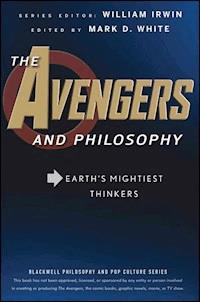
The Avengers and Philosophy E-Book
17,99 €
Mehr erfahren.
- Herausgeber: John Wiley & Sons
- Kategorie: Geisteswissenschaft
- Serie: The Blackwell Philosophy and Pop Culture Series
- Sprache: Englisch
An engaging look at the philosophical underpinnings of Earth's Mightiest Heroes Avengers assemble! Tackling intriguing dilemmas and issues that no single great philosopher can withstand, this powerful book enlists the brainpower of an A-list team of history's most prominent thinkers to explore the themes behind the action of Marvel Comics' all-star superhero team. * Arms you with new insights into the characters and themes of The Avengers * Deepens your appreciation both of The Avengers comics and the Joss Whedon movie adaptation * Answers the philosophical questions you've always had about Earth's Mightiest Heroes, including: Can a reformed criminal become a superhero? Can an android love a human? If a hero beats his wife, is he still a hero? * Helps you think differently about the members of the superhero team--Captain America, Iron Man, Thor, and the others This thought-provoking book will help you understand this band of superheroes better, whether you've followed the Avengers for years or are a Joss Whedon fan just getting to know them.
Sie lesen das E-Book in den Legimi-Apps auf:
Seitenzahl: 344
Veröffentlichungsjahr: 2012
Ähnliche




















CONTENTS
Introduction: Earth’s Mightiest Philosophers
Part One: What Would an Avenger Do?
Chapter 1: Superhuman Ethics Class with the Avengers Prime
The Utilitarian Iron Man
Captain America: Duty above all Else
Convicted Heroes
Verily, a Fine Segue!
Ethicists Assemble!
Chapter 2: Shining the Light on the Dark Avengers
Plato and the Ancient Greek Avengers
Does Might Make Right?
Are the Dark Avengers Evil or Simply Bold?
No One Needs to Know
Being Just
Just How Dark are the Dark Avengers?
Chapter 3: The Avengers: Earth’s Mightiest Family
Of Father and Ultron
Sometimes the Apples Do Fall Far from the Tree
Journey to the Center of the Ant
The Ties that Bind
The Torch is Passed
Sins of the Father?
Let there be an Ending!
Part Two: Who is an Avenger?
Chapter 4: Superhero Identity: Case Studies in the Avengers
It’s all about Bodies, Right?
I like you for your Mind, Honest
Unmasking the Mantle Theory of Superhero Identity
Case Study 1: The Supersoldier
Case Study 2: Pym Particles
Are you the Next Goliath?
Chapter 5: I am Made of Ink: She-Hulk and Metacomics
What is a Metacomic?
Your Cover is Blown, Jen
“There’s a Reader Out There Now!”
Gutter-Hoppin’ and More Amazing Stories
Don’t Make the She-Hulk Angry . . .
What are the She-Hulk’s Powers?
Maybe Jen’s Reading this Chapter Right Now
Chapter 6: The Self-Corruption of Norman Osborn: A Cautionary Tale
Osborn’s Oratory and the Dark Reign
The Split Osborn Identity
Wag the Goblin
Hoist by his Own Petard
Part Three: Should the Avengers Do More Than Avenge?
Chapter 7: Forgivers Assemble!
Time Travel, Retcons, and Forgiveness
Can Cap Forgive the Rest of his Kooky Quartet?
Who will Forgive the Mutants?
Forgive Me!
Forgiveness in the House Of M
The Paradox of Forgiveness
Avengers, Forgive!
Chapter 8: Gods, Beasts, and Political Animals: Why the Avengers Assemble
Assembling for Necessity or Perfection?
Elementary Greek Lessons (Approved by the Comics Code)
Ms.-Sing her Friends
Getting her Arête Together
The Original Irredeemable Ant-Man
Neither Gods nor Beasts But Political Animals
Chapter 9: Cap’s Kooky Quartet: Is Rehabilitation Possible?
Can an Archer Change his Trick Arrows?
Finding a Balance with Hawkeye
Maybe it Really is in the Blood
Old Dogs and New Tricks
Avenging or Saving?
Hope for the Future?
Avengers Rehabilitate!
Part Four: Do the Avengers Ever Go Too Far?
Chapter 10: Fighting the Good Fight: Military Ethics and the Kree-Skrull War
Entry Point to the Kree-Skrull War
There’s an Intergalactic War Going on and You’re Invited
Was Ronan in the Right?
Those Sneaky Skrulls
Tortured Logic
And the war Rages on
Chapter 11: Secrets and Lies: Compromising the Avengers’ Values for the Good of the World
Figuring out the Rules
Occulting the Truth
Sorcerer Supreme Emergency
Shhhhh—Avengers Assemble (in Secret)!
Being Wikileaked On
“This is the Kind of Thing that is Going to Bite US in the Butt”
Chapter 12: The Avengers and S.H.I.E.L.D.: The Problem with Proactive Superheroics
The Ultimates, the Avengers, and Nick Fury’s S.H.I.E.L.D.
Red and Gold Helicarriers?
I Didn’t Mean it, Honest
This Changes Everything (Until it Changes Back)
But I Want to Help!
Captain America’s mighty S.H.I.E.L.D. . . . Well, Sort Of
Part Five: What Kind of World do the Avengers Live In?
Chapter 13: Can Kang Kill his Past Self? The Paradox of Time Travel
The Science of Bending Time
Breaking Time
Building a Time Machine
Closed Timelike Kang
Time to End
Chapter 14: “No Other Gods Before Me”: God, Ontology, and Ethics in the Avengers’ Universe
God, the One-Who-Is-Above-All—or “Stan,” For Short
“Gods are a Bit Different”
Ontology Comics #1
Does Godliness Imply Goodness?
Equal Opportunity—for Deities?
Chapter 15: Love Avengers Style: Can an Android Love a Human?
What is Love, Anyway?
Friends, Lovers, and Significant Others
Unreciprocated Love
“No Sister of Mine May Become Involved with a—a—a Robot!”
Love: American Style
Chapter 16: The Way of the Arrow: Hawkeye Meets the Taoist Masters
Don’t Try So Hard, Clint
When is a Butcher Like an Archer?
Hawkeye, Humble?
The Life and Death of a Hero
The Way of the Archer
Appendix: Why are there Four Volumes of Avengers?
Contributors: Avengers Academy
Index: From Jarvis’s Secret Files
The Blackwell Philosophy and Pop Culture Series
Series Editor: William Irwin
South Park and Philosophy
Edited by Robert Arp
Metallica and Philosophy
Edited by William Irwin
Family Guy and Philosophy
Edited by J. Jeremy Wisnewski
The Daily Show and Philosophy
Edited by Jason Holt
Lost and Philosophy
Edited by Sharon Kaye
24 and Philosophy
Edited by Jennifer Hart Weed, Richard Davis, and Ronald Weed
Battlestar Galactica and Philosophy
Edited by Jason T. Eberl
The Office and Philosophy
Edited by J. Jeremy Wisnewski
Batman and Philosophy
Edited by Mark D. White and Robert Arp
House and Philosophy
Edited by Henry Jacoby
Watchmen and Philosophy
Edited by Mark D. White
X-Men and Philosophy
Edited by Rebecca Housel and J. Jeremy Wisnewski
Terminator and Philosophy
Edited by Richard Brown and Kevin Decker
Heroes and Philosophy
Edited by David Kyle Johnson
Twilight and Philosophy
Edited by Rebecca Housel and J. Jeremy Wisnewski
Final Fantasy and Philosophy
Edited by Jason P. Blahuta and Michel S. Beaulieu
Alice in Wonderland and Philosophy
Edited by Richard Brian Davis
Iron Man and Philosophy
Edited by Mark D. White
True Blood and Philosophy
Edited by George Dunn and Rebecca Housel
Mad Men and Philosophy
Edited by James South and Rod Carveth
30 Rock and Philosophy
Edited by J. Jeremy Wisnewski
The Ultimate Harry Potter and Philosophy
Edited by Gregory Bassham
The Ultimate Lost and Philosophy
Edited by Sharon Kaye
Green Lantern and Philosophy
Edited by Jane Dryden and Mark D. White
The Girl with the Dragon Tattoo and Philosophy
Edited by Eric Bronson
Arrested Development and Philosophy
Edited by Kristopher Phillips and J. Jeremy Wisnewski
Inception and Philosophy
Edited by David Johnson
The Big Lebowski and Philosophy
Edited by Peter S. Fosl
Spider-Man and Philosophy
Edited by Jonathan Sanford
The Big Bang Theory and Philosophy
Edited by Dean Kowalski
The Hunger Games and Philosophy
Edited by George Dunn and Nicolas Michaud
Game of Thrones and Philosophy
Edited by Henry Jacoby
This book is printed on acid-free paper.
Copyright © 2012 by John Wiley & Sons. All rights reserved
Published by John Wiley & Sons, Inc., Hoboken, New Jersey
Published simultaneously in Canada
Chapter opener design by Forty-five Degree Design LLC
No part of this publication may be reproduced, stored in a retrieval system, or transmitted in any form or by any means, electronic, mechanical, photocopying, recording, scanning, or otherwise, except as permitted under Section 107 or 108 of the 1976 United States Copyright Act, without either the prior written permission of the Publisher, or authorization through payment of the appropriate per-copy fee to the Copyright Clearance Center, 222 Rosewood Drive, Danvers, MA 01923, (978) 750-8400, fax (978) 646-8600, or on the web at www.copyright.com. Requests to the Publisher for permission should be addressed to the Permissions Department, John Wiley & Sons, Inc., 111 River Street, Hoboken, NJ 07030, (201) 748-6011, fax (201) 748-6008, or online at http://www.wiley.com/go/permissions.
Limit of Liability/Disclaimer of Warranty: While the publisher and the author have used their best efforts in preparing this book, they make no representations or warranties with respect to the accuracy or completeness of the contents of this book and specifically disclaim any implied warranties of merchantability or fitness for a particular purpose. No warranty may be created or extended by sales representatives or written sales materials. The advice and strategies contained herein may not be suitable for your situation. You should consult with a professional where appropriate. Neither the publisher nor the author shall be liable for any loss of profit or any other commercial damages, including but not limited to special, incidental, consequential, or other damages.
For general information about our other products and services, please contact our Customer Care Department within the United States at (800) 762-2974, outside the United States at (317) 572-3993 or fax (317) 572-4002.
Wiley also publishes its books in a variety of electronic formats and by print-on-demand. Some content that appears in standard print versions of this book may not be available in other formats. For more information about Wiley products, visit us at www.wiley.com.
The Avengers and philosophy : Earth’s mightiest thinkers / edited by Mark D. White.
pages cm. — (The Blackwell philosophy and pop culture series; 46)
Includes bibliographical references and index.
ISBN 978-1-118-07457-2 (paper); ISBN 978-1-118-22253-9 (ebk); ISBN 978-1-118-23645-1 (ebk); ISBN 978-1-118-26138-5 (ebk)
1. Avengers (Fictitious characters) 2. Comic books, strips, etc.—Moral and ethical aspects. 3. Superheroes in literature. 4. Superhero films—History and criticism. 5. Philosophy in literature. 6. Philosophy in motion pictures. I. White, Mark D., 1971- editor of compilation.
PN6728.A9A93 2012
791.43’652—dc23
2011043329
INTRODUCTION: EARTH’S MIGHTIEST PHILOSOPHERS
If you like superheroes—and you wouldn’t be reading this book if you didn’t—you love superhero teams, and the Avengers are the preeminent team in the Marvel Universe. The best thing about the Avengers is that not only do you get to see all your favorite heroes banding together to defeat formidable threats against incredible odds, but you also get to see them interact both as superheroes and as people. Whether they’re cooped up in Avengers Mansion or exploring the deepest realms of space, you get to see how they work together and play together, both when they get along and when they don’t. That’s what we love about the Avengers, whether in the comics, the animated series, or the feature film—it’s equal parts superhero epic and soap opera.
Just as the Avengers assemble to confront threats no single hero can handle himself or herself, the contributors to The Avengers and Philosophy assembled to discuss a range of topics so broad that no single philosopher could possibly handle it all. Have you ever wondered how the “big three” Avengers—Captain America, Iron Man, and Thor—compare in terms of their moral philosophies? Has the Kree-Skrull War ever made you consider the ethics of war itself? What about the Avengers’ peculiar tendency to welcome former criminals into their ranks, such as Hawkeye, Quicksilver, and the Scarlet Witch? We didn’t forget to ask questions about the great Avengers villains: Can Kang actually go back in time to kill himself? Do we actually admire Norman Osborn and his Dark Avengers? And finally, speaking of soap opera, can the Scarlet Witch and the Vision truly love each other?
No matter what Avengers lineup you prefer, or which Avenger is your favorite, there’s a chapter in The Avengers and Philosophy for you. (Why no Squirrel Girl, you ask? Wait for volume two—it’s all her.) So until Avengers Academy opens a branch near you, this book is the best way to learn from Earth’s Mightiest Philosophers—until we get our own movie, that is!
I would like to thank Bill Irwin for his constant support, encouragement, and hard work on this book and the Blackwell Philosophy and Pop Culture series as a whole; Connie Santisteban at Wiley, who saw this book through from beginning to end; and my fellow contributors, who came through with insights into philosophy and the Avengers I would never have imagined. I also want to give special thanks to Christine Hanefalk, who was incredibly supportive, especially in the stressful final weeks of this project. Finally, I would like to thank all the creators who have made the Avengers shine for half a century, starting with Stan Lee and Jack Kirby, through Kurt Busiek and George Pérez, and all the way up to Brian Michael Bendis, and Joss Whedon for bringing Earth’s Mightiest Heroes to life on the silver screen.
PART ONE
WHAT WOULD AN AVENGER DO?
Chapter 1
SUPERHUMAN ETHICS CLASS WITH THE AVENGERS PRIME
Mark D. White
At Avengers Academy, where veterans like Hank Pym and Tigra teach younger heroes in the ways of Avengerdom, one of the required courses is Superhuman Ethics Class. In this class, superpupils are presented with ethical dilemmas that crop up in the day-to-day “routine” of an Avenger, and then they are asked how they would handle them and why. We may recoil at the thought of Hank Pym teaching this class—the poster child for “Do what I say, not as I’ve done myself time and time again”—but such a class is essential to teach young heroes how to exercise the great responsibility that comes with great power.1
If you ask me, the most obvious teachers for Superhuman Ethics Class would be Captain America, Iron Man, and Thor, who were christened the “Avengers Prime” in a recent miniseries.2 I’m not claiming that these three are necessarily the most ethical Avengers, but they do serve as examples of the three most popular systems of ethics: utilitarianism, deontology, and virtue ethics. While each of these three classic heroes exemplifies his particular moral compass in his solo adventures, it is through their interactions—especially their conflicts—within the Avengers that they best illustrate their different ethical approaches. Let’s start with Iron Man because his ethical framework is in many ways the simplest, and also because he sets the stage for introducing the other two in contrast.
Lesen Sie weiter in der vollständigen Ausgabe!
Lesen Sie weiter in der vollständigen Ausgabe!
Lesen Sie weiter in der vollständigen Ausgabe!
Lesen Sie weiter in der vollständigen Ausgabe!
Lesen Sie weiter in der vollständigen Ausgabe!
Lesen Sie weiter in der vollständigen Ausgabe!
Lesen Sie weiter in der vollständigen Ausgabe!
Lesen Sie weiter in der vollständigen Ausgabe!
Lesen Sie weiter in der vollständigen Ausgabe!
Lesen Sie weiter in der vollständigen Ausgabe!
Lesen Sie weiter in der vollständigen Ausgabe!
Lesen Sie weiter in der vollständigen Ausgabe!
Lesen Sie weiter in der vollständigen Ausgabe!
Lesen Sie weiter in der vollständigen Ausgabe!
Lesen Sie weiter in der vollständigen Ausgabe!
Lesen Sie weiter in der vollständigen Ausgabe!
Lesen Sie weiter in der vollständigen Ausgabe!
Lesen Sie weiter in der vollständigen Ausgabe!
Lesen Sie weiter in der vollständigen Ausgabe!
Lesen Sie weiter in der vollständigen Ausgabe!
Lesen Sie weiter in der vollständigen Ausgabe!
Lesen Sie weiter in der vollständigen Ausgabe!




