


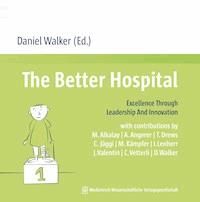
The Better Hospital E-Book
59,99 €
Mehr erfahren.
- Herausgeber: MWV Medizinisch Wissenschaftliche Verlagsgesellschaft
- Kategorie: Fachliteratur
- Sprache: Englisch
Around the year 2000, several hospitals in the American Northwest started implementing the Toyota production system. The silent revolution began to take its course. Today, virtually any new hospital in the United States is designed and built according to Lean principles. Hospitals which follow a Lean Hospital strategy are more successful: Patients are always put first, and patient experience and patient safety are main objectives. This leads to an increase in motivation and commitment on the part of the employees, as well as an increase in medical quality and cost effectiveness. Lean Hospital is a philosophy, a proven and comprehensive way of thinking. Those who embrace Lean in a holistic way to operate, advance and lead their organization will be successful. Lean Hospital is new, exciting and fascinating. Lean really works in a hospital context and is thus the prime choice for any hospital that needs to sustain its position in the face of economic pressure and competition. This book introduces its readers to the world of Lean Hospital, step by step. Easy to read and precise, it shows how to successfully apply and implement the Lean Hospital philosophy.
Das E-Book können Sie in Legimi-Apps oder einer beliebigen App lesen, die das folgende Format unterstützen:
Seitenzahl: 223
Veröffentlichungsjahr: 2015
Ähnliche




















Daniel Walker (Ed.)
The Better Hospital
Excellence Through Leadership And Innovation
with contributions byM. Alkalay | Dr.A. Angerer | T. Drews | C. Jäggi | M. Kämpfer | I. Lenherr | J. Valentin | C. Vetterli | D. Walker
Preface
Better is the enemy of good. With this book, we want to provide food for thought, give pause, spark change, and trigger development. Things that were impossible become possible with a Lean Hospital approach.
There are many reasons to choose and implement a Lean Hospital strategy. In my opinion the main reason is: The patients’ needs are consistently taken seriously. In the long run, everyone profits from this approach. If you put the patient first, you get a better hospital. You make faster progress in several aspects: patient centricity, employee commitment, patient safety, cost effectiveness, and medical quality. And progress in all these areas is sustainable and lasting.
The patient always comes first. You are going to hear this sentence over and over again in a Lean Hospital environment. And it is not just being spoken about, it is a reality. It is fascinating to witness this in practice.
Things are different in many traditional hospitals. Their glossy brochures may say that the patient takes center stage, but in reality, that is often not the case. Sometimes the patient seems to be in the way of this central spot. Hospital routine comes up with clever strategies of evasion and circumvention. That is no longer possible in a Lean Hospital: everything is focused on the patient.
Lean Hospital is new, exciting and inspiring. Because Lean really works in a hospital environment, the philosophy draws more and more followers. In the manufacturing industry Lean has been employed for decades. And in the hospital context various interesting applications are being developed. Of course it is not possible to adopt all aspects of Lean Manufacturing entirely. Neither does everything work all at once in a hospital. The principles have to be adapted and interpreted in new ways. What, for example, does “overproduction” mean in the context of patient treatment?
Many things are in flow: there are dead ends and detours, and the road to success is not a straight path. Successful applications draw a lot of interest, and are copied immediately. Lean Hospital is not merely a collection of good ideas and tools. It is a philosophy, a new way of thinking. The main thing we have learned from its pioneers is this: only those who declare Lean the overarching mindset for their institution are successful with it. We have written this book to facilitate your entry into this world.
It is the collaborative effort of a group of authors drawn from walkerproject, the Zürich University of Applied Sciences (Zürcher Hochschule für Angewandte Wissenschaften), H+ Bildung (a vocational and management college maintained by the Swiss hospitals), and the architectural firm FSP Architekten. Bringing together experts from different fields was an exciting process. We have asked ourselves many questions, and have found quite a few answers. This is the result: a confident – and hopefully convincing – plea for the hospital of the future.
St. Gallen, May 2015
Daniel Walker
The Authors
Miriam Alkalay
walkerproject ag
Prime Center 1
8060 Zürich Airport
Switzerland
Dr. oec. Alfred Angerer
Zürcher Hochschule für Angewandte
Wissenschaften
School of Management and Law
Gertrudstrasse 15
8401 Winterthur
Switzerland
Thomas Drews
H+ Bildung
Die Höhere Fach- und Führungsschule von H+
Die Spitäler der Schweiz
Rain 36
5000 Aarau
Switzerland
Christoph Jäggi
walkerproject ag
Prime Center 1
8060 Zürich Airport
Switzerland
Micha Kämpfer
walkerproject ag
Prime Center 1
8060 Zürich Airport
Switzerland
Ivo Lenherr
Fugazza Steinmann Partner AG
Dipl. Architekten ETH/FH/SIA
Rotzenbühlstrasse 55
8957 Spreitenbach
Switzerland
Josefin Valentin
walkerproject ag
Prime Center 1
8060 Zürich Airport
Switzerland
Christophe Vetterli
walkerproject ag
Prime Center 1
8060 Zürich Airport
Switzerland
Daniel Walker
walkerproject ag
Prime Center 1
8060 Zürich Airport
Switzerland
Contents
Cover
Title
Preface
The Authors
1 The Silent Revolution
Daniel Walker and Christophe Vetterli
2 It Starts With Management
Daniel Walker and Micha Kämpfer
3 The Patient Always Comes First
Christophe Vetterli and Christoph Jäggi
4 Lean Philosophy in Practice
Dr. Alfred Angerer
5 Safety First
Miriam Alkalay and Josefin Valentin
6 The Achievement of a Generation
Micha Kämpfer and Daniel Walker
7 Building Lean Competencies
Thomas Drews, Daniel Walker and Christophe Vetterli
8 The Opportunity of New Construction
Daniel Walker, Christophe Vetterli and Ivo Lenherr
APPENDIX
Excerpt from the British Future Hospital Commission report Future hospital: Caring for medical patients (2013)
9 Well-Equipped For the Future
Christoph Jäggi and Miriam Alkalay
Author Profiles
Imprint
Annotations
1The Silent Revolution
Daniel Walker and Christophe Vetterli
The people of Switzerland are content with their healthcare system. In fact, they are so content that they do not want to change anything about it. In its Health 2020 report1, the Federal Council stresses that “its own” healthcare system is one of the best in the world. This assessment is shared by the OECD and others. Additionally, it is not even among the most expensive systems anymore. The satisfaction with the system is exceptional, because in many countries, the population is very critical when it comes to their healthcare system. The Swiss electorate outvoted any proposed changes to its system several times in the recent past. It is tried and tested: Availability and accessibility for all demographic groups are excellent. The education in the medical professions is very good as compared to international standards. Everyone has health insurance and is well-covered.
So why did we write this book? What more do we want?
Although everyone is happy with the status quo, there is still potential for improving quality, while lowering costs at the same time. The aforementioned report admits that the quality is not transparent enough; sound quality data is not available. Maybe there is something more we could want. And if there is not, well, even a satisfactory situation can always become a better one.
Lesen Sie weiter in der vollständigen Ausgabe!
Lesen Sie weiter in der vollständigen Ausgabe!
Lesen Sie weiter in der vollständigen Ausgabe!
Lesen Sie weiter in der vollständigen Ausgabe!
Lesen Sie weiter in der vollständigen Ausgabe!
Lesen Sie weiter in der vollständigen Ausgabe!
Lesen Sie weiter in der vollständigen Ausgabe!
Lesen Sie weiter in der vollständigen Ausgabe!
Lesen Sie weiter in der vollständigen Ausgabe!
Lesen Sie weiter in der vollständigen Ausgabe!
Lesen Sie weiter in der vollständigen Ausgabe!
Lesen Sie weiter in der vollständigen Ausgabe!




