


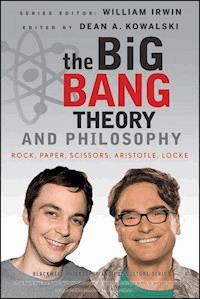
The Big Bang Theory and Philosophy E-Book
14,99 €
Mehr erfahren.
- Herausgeber: John Wiley & Sons
- Kategorie: Geisteswissenschaft
- Serie: The Blackwell Philosophy and Pop Culture Series
- Sprache: Englisch
A lighthearted meditation on the philosophical quandaries of the hit television show The Big Bang Theory Ever wonder what Aristotle might say about the life Sheldon Cooper leads? Why Thomas Hobbes would applaud the roommate agreement? Who Immanuel Kant would treat with "haughty derision" for weaving "un-unravelable webs?" And--most importantly--whether Wil Wheaton is truly evil? Of course you have. Bazinga! This book mines the deep thinking of some of history's most potent philosophical minds to explore your most pressing questions about The Big Bang Theory and its nerdy genius characters. You might find other philosophy books on science and cosmology, but only this one refers to Darth Vader Force-chokes, cloning Leonard Nimoy, and oompa-loompa-like engineers. Fo-shizzle. * Gives you irresistibly geek-worthy insights on your favorite Big Bang Theory characters, story lines, and ideas * Examines important themes involving ethics and virtue, science, semiotics, religion, and the human condition * Brings the thinking of some of the world's greatest philosophers to bear on The Big Bang Theory, from Aristotle and Plato to Nietzsche, Wittgenstein, Simone de Beauvoir, and more Essential reading for every Big Bang Theory fan, this book explores whether comic-book-wielding geeks can lead the good life, and whether they can know enough science to "tear the mask off nature and stare at the face of God."
Sie lesen das E-Book in den Legimi-Apps auf:
Seitenzahl: 396
Veröffentlichungsjahr: 2012
Ähnliche




















CONTENTS
Acknowledgments
Introduction: “Unraveling the Mysteries”
Part One: “It All Began on A Warm Summer’s Evening in Greece”
Chapter 1: Aristotle on Sheldon Cooper
The Life of the Mind
The Ancient Greek and the Modern Geek
The Joy of Geekdom
Geeky Fun and the Purpose of Life
Trial of a Nerd
The Aristotle-Cooper Evaluation
Chapter 2: “You’re a Sucky, Sucky Friend”
“Do You Have Any Books about Making Friends?”
“Did You Ever Consider Making Friends by Being . . . Pleasant?”
“Kripke! What’d You Say of the Idea of You and I Becoming Friends?”
“To Make Friends . . . Take an Interest in Their Lives”
“That’s Insane on the Face of It”
“There Is No Algorithm for Making Friends!”
Chapter 3: The Big Bang Theory on the Use and Abuse of Modern Technology
Some Healthy Webcam-ing
Unhealthy Interactions
Virtual Vengeance
Aristotle’s Mean
Aristotle in Television
Bright and Shiny Penny
Where Do We Go?
Part Two: “Is it Wrong To Say I Love Our Killer Robot?”
Chapter 4: Feeling Bad about Feeling Good: Is It Morally Wrong to Laugh at Sheldon?
Lorre and Prady on Sheldon Cooper
Diagnosing Sheldon III: Functionality
What Is a Disability?
Chapter 5: . . . But Is Wil Wheaton Evil?
The Wheaton Occurrences
The Theodicy Corollary
Beyond Good and Evil Wil—or, the Wrath of Sheldon
The Name-Calling and Line-Cutting Topologies
The Comic Book Paradigm
The Inscrutability Factor
Chapter 6: Do We Need a Roommate Agreement?
The Giant “Hedon” Collider
The Egoism Polarization
The Social Contract Instability
The Aristotelian Virtue Vortex
The Dennis Kim Conundrum
Part Three: “Perhaps You Mean A Different Thing Than I Do When You Say ‘Science’”
Chapter 7: Getting Fundamental about Doing Physics in The Big Bang Theory
Studies in Sheldonology
A Unified Theory of Sheldon?
Resolving a “Nonlovers” Quarrel (about Science)
The Pragmatics of the Special Sciences
Chapter 8: Sheldon, Leonard, and Leslie
The Methods of Science
Theoretical “Discoveries”
The String Theory Paradigm
Hang-Ups, Breakups, and New Beginnings
Chapter 9: The One Paradigm to Rule Them All
The Data
The Background
The Controversy
The Ramifications
The Analysis
Chapter 10: Cooper Considerations
Magic Maharaja Macs?
Scientist Sons Scolded
Monumental Math Mysteries
Lifelong Lessons
Part Four: “I Need Your Opinion on A Matter of Semiotics”
Chapter 11: Wittgenstein and Language Games in The Big Bang Theory
“The Philosophy Is Theoretical, but the Fun Is Real”
“So, What Does That Mean?”
“Be Serious, We’re Playing a Game Here”
“Figured Out the Magic Trick Yet?”
“It’s a Nonoptional Social Convention,” Stupid!
“Believe in Magic, You Muggle!”
Chapter 12: “I’m Afraid You Couldn’t Be More Wrong!”
“More Wrong?”
“In None of Them Am I Dancing”
“I Think You Mean I’m Improbable”
The Cooper-Wrongness Paradox
“Of Course I’m Right—What Are the Odds I’d Be Wrong Twice in One Week?”
“Throw All the French around You Want, It Doesn’t Make You Right.”
Chapter 13: The Cooper Conundrum
Who’s Tolerating Whom?
Worlds Apart or Words Apart?
The Mutual Exclusion Dogma
World Speak or Person Speak
The Tolerance Tally
Chapter 14: The Mendacity Bifurcation
Should We Be Learning How to Lie Better?
Should We Listen to What Sheldon Has to Say about Lying?
Is Sheldon Really a Bad Liar?
Does Lying Require Intending to Deceive?
Does Lying Require Intending to Violate a Social Convention?
Part Five: “The Human Experience That Has Always Eluded Me”
Chapter 15: Mothers and Sons of The Big Bang Theory
Raj: The “Selective Mutism” Mutant
Sheldon: Roots in Fundamental(ist) Particles
Howard: A Sociological Cliché
Leonard: Hofstadter’s Monkey
Aristotle, Justice, and Special Obligations
Cognitive Dissonance and Psychological Courage
Chapter 16: Penny, Sheldon, and Personal Growth through Difference
Are Penny and Sheldon Really Friends?
Penny’s and Sheldon’s Friendship and the Importance of Difference
Modern and Classical Friendship
Good Friendship and Good Friends
Chapter 17: Deconstructing the Women of The Big Bang Theory: So Much More Than Girlfriends
The Big Bang Gender Theory
“It’s a Warm Summer Evening in Ancient Greece . . .”
The Big Bang Performativity
“Come for the Breasts—Stay for the Brains.”
Knock Knock . . . Manhood? Knock Knock . . . Manhood? Knock Knock . . . Manhood?
White and Fisher Productions #1
The Episode Compendium: “Hey, It’s a Big Menu—There’s Two Pages Just for Desserts”
Contributors: “But If We Were Part of the Team . . . We Could Drink for Free in Any Bar in Any College Town”
Index: “Cornucopia . . . Let’s Make That Our Word of the Day”
The Blackwell Philosophy and Pop Culture Series
Series Editor: William Irwin
South Park and Philosophy
Edited by Robert Arp
Metallica and Philosophy
Edited by William Irwin
Family Guy and Philosophy
Edited by J. Jeremy Wisnewski
The Daily Show and Philosophy
Edited by Jason Holt
Lost and Philosophy
Edited by Sharon Kaye
24 and Philosophy
Edited by Jennifer Hart Weed, Richard Davis, and Ronald Weed
Battlestar Galactica and Philosophy
Edited by Jason T. Eberl
The Office and Philosophy
Edited by J. Jeremy Wisnewski
Batman and Philosophy
Edited by Mark D. White and Robert Arp
House and Philosophy
Edited by Henry Jacoby
Watchmen and Philosophy
Edited by Mark D. White
X-Men and Philosophy
Edited by Rebecca Housel and J. Jeremy Wisnewski
Terminator and Philosophy
Edited by Richard Brown and Kevin Decker
Heroes and Philosophy
Edited by David Kyle Johnson
Twilight and Philosophy
Edited by Rebecca Housel and J. Jeremy Wisnewski
Final Fantasy and Philosophy
Edited by Jason P. Blahuta and Michel S. Beaulieu
Alice in Wonderland and Philosophy
Edited by Richard Brian Davis
Iron Man and Philosophy
Edited by Mark D. White
True Blood and Philosophy
Edited by George Dunn and Rebecca Housel
Mad Men and Philosophy
Edited by James South and Rod Carveth
30 Rock and Philosophy
Edited by J. Jeremy Wisnewski
The Ultimate Harry Potter and Philosophy
Edited by Gregory Bassham
The Ultimate Lost and Philosophy
Edited by Sharon Kaye
Green Lantern and Philosophy
Edited by Jane Dryden and Mark D. White
The Girl with the Dragon Tattoo and Philosophy
Edited by Eric Bronson
Arrested Development and Philosophy
Edited by Kristopher Phillips and J. Jeremy Wisnewski
Inception and Philosophy
Edited by David Johnson
The Big Lebowski and Philosophy
Edited by Peter S. Fosl
This book is printed on acid-free paper.
Copyright © 2012 by John Wiley & Sons. All rights reserved
Published by John Wiley & Sons, Inc., Hoboken, New Jersey
Published simultaneously in Canada
No part of this publication may be reproduced, stored in a retrieval system, or transmitted in any form or by any means, electronic, mechanical, photocopying, recording, scanning, or otherwise, except as permitted under Section 107 or 108 of the 1976 United States Copyright Act, without either the prior written permission of the Publisher, or authorization through payment of the appropriate per-copy fee to the Copyright Clearance Center, 222 Rosewood Drive, Danvers, MA 01923, (978) 750-8400, fax (978) 646-8600, or on the web at www.copyright.com. Requests to the Publisher for permission should be addressed to the Permissions Department, John Wiley & Sons, Inc., 111 River Street, Hoboken, NJ 07030, (201) 748-6011, fax (201) 748-6008, or online at http://www.wiley.com/go/permissions.
Limit of Liability/Disclaimer of Warranty: While the publisher and the author have used their best efforts in preparing this book, they make no representations or warranties with respect to the accuracy or completeness of the contents of this book and specifically disclaim any implied warranties of merchantability or fitness for a particular purpose. No warranty may be created or extended by sales representatives or written sales materials. The advice and strategies contained herein may not be suitable for your situation. You should consult with a professional where appropriate. Neither the publisher nor the author shall be liable for any loss of profit or any other commercial damages, including but not limited to special, incidental, consequential, or other damages.
For general information about our other products and services, please contact our Customer Care Department within the United States at (800) 762-2974, outside the United States at (317) 572-3993 or fax (317) 572-4002.
Wiley also publishes its books in a variety of electronic formats and by print-on-demand. Some content that appears in standard print versions of this book may not be available in other formats. For more information about Wiley products, visit us at www.wiley.com.
Library of Congress Cataloging-in-Publication Data
The big bang theory and philosophy: rock, paper, scissors, Aristotle, Locke / edited by Dean A. Kowalski.
pages cm.—(The Blackwell philosophy and pop culture series; 44)
Includes bibliographical references and index.
ISBN 978-1-118-07455-8 (pbk.); ISBN 978-1-118-22252-2 (ebk.);
ISBN 978-1-118-23641-3 (ebk.); ISBN 978-1-118-26137-8 (ebk.)
1. Big bang theory (Television program) 2. Philosophy—Miscellanea. I. Kowalski, Dean A., editor of compilation.
PN1992.77.B485B54 2012
791.45’72—dc23
2011043333
ACKNOWLEDGMENTS
When I Write My Memoirs, You Can Expect a Very Effusive Footnote—and Perhaps a Signed Copy
—Dr. Sheldon Cooper, “The Electric Can Opener Fluctuation”
I would like to thank all of the contributing authors. Each was a pleasure to work with, and many of them participated in voluminous e-mail exchanges and provided multiple drafts. Not one of them called me a giant “dic-tator,” even though I may have come close to deserving that Sheldon-esque moniker on occasion. I would also like to thank my wife, Patricia, for indulging me in yet one more philosophy and pop culture book. Her patience knows no bounds. I must note Nicholas and Cassie; although they interrupted their dad’s “research” numerous times, they also inspired me (and now flawlessly use the term Bazinga). And Joseph Foy continues to inspire me as a colleague and a (complete) friend.
I am especially indebted to series editor Bill Irwin. Working on a book with him was one of my professional goals, and he was incredibly gracious to make it just that—a collaborative effort. He gives generously of his time, enthusiasm, and expertise to make these books the best they can be. In fact, the whole Wiley team is deserving of recognition, especially Connie Santisteban.
As I was composing this volume, I was often reminded of the countless hours I had spent with my siblings in front of the television, giggling at shows like The Big Bang Theory. I dedicate this book to them and all the happy memories we shared as kids:
To Amber, Beth, and Corey
INTRODUCTION
“Unraveling the Mysteries”
Dean A. Kowalski
It took nearly fourteen billion years, but you finally hold in your hands The Big Bang Theory and Philosophy. Other bookstore browsers are perusing volumes such as Bernie Bunny Has Two Daddies Now or Jerry the Gerbil and the Bullies on the Bus, but they lack the basic social skills that you and I take for granted. Those dumbasses will probably buy a different book. But not you. You’ll buy this one because you sit at the cool table—fo’ shizzle. With receipt in hand, you’ll run home like the Flash, pour your favorite bowl of cereal (with a quarter cup of milk), and find your favorite spot on the couch.
There are books that debate math, science, and history; there are books that help you build walls or even pyramids; there are even books that discuss Neanderthals with tools and autotrophs that drool. This book discusses philosophy, but you don’t need an IQ of 187 to enjoy it. I swear to cow! As you’ll see, the philosophy is theoretical, but the fun is real.
Philosophers ponder the “big questions” about what is “really real,” how we ought to behave, and whether we know anything at all. Philosophers tend to reexamine what intellectual greats of the past have said about such “big questions.” Yet not quite like this. In this book, you’ll have the chance to ponder what Aristotle might say about the life Sheldon leads, why Thomas Hobbes would applaud the roommate agreement, and whom Immanuel Kant would treat with haughty derision for weaving “un-unravelable webs.”
Yes, some philosophy books attempt to explain the nature of science and why it’s so important to study, but, inexplicably, they do so without references to Darth Vader Force-chokes, spherical chicken jokes, or oompa-loompas. Go figure. Rarely do philosophy books explore whether comic book–wielding geeks can lead the good life, or whether they can know enough science to tear the mask off nature and stare at the face of God. Rarer still are explorations into how socially awkward, Superhero-loving brainiacs meaningfully interact with down-to-earth beauties from India or the Cheesecake Factory. I know of none that investigate the evilness of Wil Wheaton. This book is a Saturnalia miracle!
No, I am not sassing you in Eskimo talk. Begin turning pages to see what I mean. As you continue to explore your new favorite philosophy book, you’ll learn that regardless of our differences and Sheldon-like idiosyncrasies, we are not merely atoms randomly banging into one another. We are persons, none of us perfect, who seek meaningful relationships with others, even if doing so doesn’t always make perfect scientific sense. (No, Sheldon, that’s not sarcasm—even you cannot completely avoid the “inexplicable need for human contact.”)
Okay, I admit that there are some things this book won’t do for you. It won’t help you clone your own Leonard Nimoy, build a “Kwipke Kwipplah,” or single-handedly win a Physics Bowl. It may not help you pick up Summer Glau on a train or make you forget the betrayal you still feel over FOX canceling Firefly. But it will make you laugh. Just as important, it will help you begin to unravel some of life’s most profound mysteries—as you bask in the comforting glow of your luminescent fish nightlight.
So, what’s your hesitation? Pull that fifty dollar bill you have stashed in Green Lantern’s firm buttocks and start reading! Oh, wait—the humanities. Please donate the remainder of your fifty dollars to the National Endowment for the Humanities. Bazinga!
PART ONE
“IT ALL BEGAN ON A WARM SUMMER’S EVENING IN GREECE”: ARISTOTELIAN INSIGHTS
Chapter 1
ARISTOTLE ON SHELDON COOPER: ANCIENT GREEK MEETS MODERN GEEK
Greg Littmann
If I may be permitted to speak again, Doctor Sheldon Cooper for the win.
—Dr. Sheldon Cooper, “The White Asparagus Triangulation”
Should you live like Sheldon Cooper? Think hard, because you don’t have the luxury of not making a choice. Fourteen billion years after the Big Bang, evolution has finally produced a type of animal, human beings, that must choose how it will live. As Sheldon himself points out in “The Cooper-Hofstadter Polarization,” “We have to take in nourishment, expel waste, and inhale enough oxygen to keep our cells from dying. Everything else is optional.” Should we devote ourselves to learning more about the world around us? Is it alright to spend vast amounts of time reading comics or watching television? Would it be better to neglect our social lives so that we can spare more time for other things? The geeky life of a Sheldon may be a new option in human history, but the question of how we should live is a very ancient one.
In this chapter, we’ll examine the question of how we should live by asking how the life of Sheldon stacks up against the ideal set forth by the ancient Greek philosopher Aristotle, one of the most influential thinkers of all times. The interesting thing about looking at Sheldon from Aristotle’s perspective is the degree to which this ancient conception of living well is fulfilled by a very modern geek such as Sheldon. The goal here is not to take Aristotle as a guru whose answers must be accepted, but to cast light on our condition to help us consider for ourselves the most important question we face: “How should we live?” Before we bring on Aristotle, though, we had better start with the question “What is it to live the life of Sheldon?”
Lesen Sie weiter in der vollständigen Ausgabe!
Lesen Sie weiter in der vollständigen Ausgabe!
Lesen Sie weiter in der vollständigen Ausgabe!
Lesen Sie weiter in der vollständigen Ausgabe!
Lesen Sie weiter in der vollständigen Ausgabe!
Lesen Sie weiter in der vollständigen Ausgabe!
Lesen Sie weiter in der vollständigen Ausgabe!
Lesen Sie weiter in der vollständigen Ausgabe!
Lesen Sie weiter in der vollständigen Ausgabe!
Lesen Sie weiter in der vollständigen Ausgabe!
Lesen Sie weiter in der vollständigen Ausgabe!
Lesen Sie weiter in der vollständigen Ausgabe!
Lesen Sie weiter in der vollständigen Ausgabe!
Lesen Sie weiter in der vollständigen Ausgabe!
Lesen Sie weiter in der vollständigen Ausgabe!
Lesen Sie weiter in der vollständigen Ausgabe!
Lesen Sie weiter in der vollständigen Ausgabe!
Lesen Sie weiter in der vollständigen Ausgabe!
Lesen Sie weiter in der vollständigen Ausgabe!
Lesen Sie weiter in der vollständigen Ausgabe!
Lesen Sie weiter in der vollständigen Ausgabe!
Lesen Sie weiter in der vollständigen Ausgabe!
Lesen Sie weiter in der vollständigen Ausgabe!




