


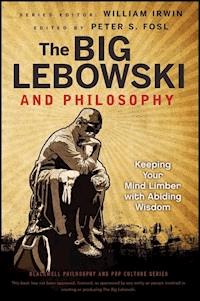
The Big Lebowski and Philosophy E-Book
17,99 €
Mehr erfahren.
- Herausgeber: John Wiley & Sons
- Kategorie: Geisteswissenschaft
- Serie: The Blackwell Philosophy and Pop Culture Series
- Sprache: Englisch
Celebrate the Dude with an abiding look at the philosophy behind The Big Lebowski Is the Dude a bowling-loving stoner or a philosophical genius living the good life? Naturally, it's the latter, and The Big Lebowski and Philosophy explains why. Enlisting the help of great thinkers like Plato and Nietzsche, the book explores the movie's hidden philosophical layers, cultural reflection, and political commentary. It also answers key questions, including: The Dude abides, but is abiding a virtue? Is the Dude an Americanized version of the Taoist way of life? How does The Big Lebowski illustrate the Just War Theory? How does bowling help Donny, Walter, and the Dude oppose nihilism? Yes, the Dude is deep, and so is this book. Don't watch the movie--or go to Lebowski Fest--without it. * Explores many of The Big Lebowski's key themes, such as nihilism, war and politics, money and materialism, idealism and morality, history, and more * Gives you new perspective on the movie's characters--the Dude, the Big Lebowski, Walter Sobchak, Donny, Maude Lebowski, Bunny Lebowski, and others * Helps you appreciate the Coen Brothers classic even more with the insights of Aristotle, Epicurus, Kant, Derrida, and other philosophical heavyweights
Sie lesen das E-Book in den Legimi-Apps auf:
Seitenzahl: 425
Veröffentlichungsjahr: 2012
Ähnliche




















CONTENTS
Acknowledgments
Introduction
Part One: First Round Robin: Tying it All Together, or Not
Chapter 1: What Would the Dude Do?
Deconstruction, Dichotomies, and the Dude
Walter’s Generalism vs. Dieter’s Particularism
The Virtues of the Dude
Chapter 2: The Big Lebowski and Mathematical Logic
Jeffrey Lebowski ≠ Jeffrey Lebowski
Can the Dude’s Room Actually Be Tied Together?
What If You Really Care about the Rules?
Is Consistency unDude? Is Completeness?
Abiding Axioms
Part Two: Second Round Robin: Thousands of Years of Philosophical Tradition, or from Socrates to Sandy Koufax
Chapter 3: The Dude Abides, but Does He Flourish?
“How’s the Smut Business, Jackie?”
“He Looks Like a Fuckin’ Loser”
“With Friends Like These, Huh, Gary?”
“I Like Your Style, Dude”
Chapter 4: “Man Down!”
Aristotle: Social Beings and the Key to Pasadena
Epicurus: Natural Pleasures and Taking It Easy
The Dude: Eudaimonia, Ataraxia, and League Play
Chapter 5: Epicurus and “Contented Poverty”
Real Epicureanism
Enough Is Enough
Love, Sex, and His Dudeness
The Simple Life
Money
True Wealth
Chapter 6: Buddhism, Daoism, and Dudeism
The Dude and the Dao
Dharma and the Dude
Zen Dudeism?
Part Three: Third Round Robin: Over The Line!
Chapter 7: Drawing a Line in the Sand
Just War Theory: Jus ad Bellum
Just War Theory: Jus in Bello
Why We Should Give a Shit about the Rules of Aggression
Chapter 8: “That Ain’t Legal Either”
Tumbling Tumbleweeds, What Have You, and Being “Very UnDude”
Rule Rigidity 1: “Am I the Only One around Here Who Gives a Shit about the Rules?”
Rule Rigidity 2: “Okay, but How Does All This Add Up to an Emergency?”
Rule Rigidity 3: “Dude, Chinaman Is Not the Preferred Nomenclature”
The Big Lebowski’s Hypocrisy: “Every Bum’s Lot in Life Is His Own Responsibility”
Exclusion: “Donny, You’re Out of Your Element”
The Virtues of Perspective: “No Funny Stuff”
Part Four: Fourth Round Robin: Nothing to be Afraid of
Chapter 9: Bowling Our Way out of Nihilism
“What the Fuck Is He Talking About?”
The Exhaustion of Nihilism
Achievers Anonymous
Credence in Modernity
Bowling Abides
What Form Does Our Abiding Take?
Chapter 10: Existentialism, Absurdity, and The Big Lebowski
Camus on Absurdity
Sartre on Absurdity
Camus vs. Sartre on Existentialist Art
The Existentialist Character of The Big Lebowski
Chapter 11: Bowling, Despair, and American Nihilism
Sic Semper Deadbeats
A Tale of Two Lebowskis
Sisyphus Was a Bowler
The Wisdom of Abiding Repetition
Part Five: Fifth Round Robin: What Makes A Dude?
Chapter 12: The Big Lebowski’s Oedipal Complex
Getting into the Unconscious
Superego
Anal and Oral Fixations
Life and Death Drives: Bunny and the Nihilists
Pedophiles and Schizophrenia
Why We Love The Big Lebowski
Chapter 13: In the Dude, I Abide
“I’m an Achiever, Man”
Where’s the Fucking Irony, Lebowski?
“The Story Is Ludicrous”
“They’re the Little Lebowski Urban Achievers”
“Come On, You’re Being Very Un-Dude”
What Does an Achiever Achieve?
In the Dude, I Abide
Chapter 14: “Mr. Treehorn Treats Objects Like Women, Man”
“I’m Not Mr. Lebowski; You’re Mr. Lebowski”
“I’m Talkin’ about the Dude Here”
“Takin’ Her Easy for All of Us Sinners”
“First of All, Dude, You Don’t Have an Ex”
“Mr. Treehorn Treats Objects Like Women, Man”
“Jeffrey . . . Love Me”
Heroes and Allies
To Find the Man in Me
Chapter 15: “Well, I Do Work, Sir”
How Slow Can We Go?
Our Right to Live Slow and Die Bowling
Who Wins the Race? Slow and Steady Does!
The Dude’s Manifesto
The Fable of the Ant and the Dude
Part Six: Sixth Round Robin: Mark it Zero!
Chapter 16: “Am I Wrong?”
“You See What Happens, Larry!”
“At Least It’s an Ethos”
“Shomer Fucking Shabbas”
Walter’s Wager
Jumping to a Conclusion
Chapter 17: “That’s Just Like, Uh, Your Opinion, Man”
Opinion, Knowledge, and Justification
Are All Opinions about “Matters of Opinion”?
A Look at Jesus’s Claim
Part Seven: Seventh Round Robin: Livin’ in The Past
Chapter 18: Hippies, Jews, and the Philosophy of Memory
We All Live in the Past
Stuck in the Past
Doesn’t the Dude Also Live in the Past?
Rooted in the Past
Chapter 19: “I Don’t Roll on Shabbas!”
History and Philosophy
History and Identity
History, Self, and Commitment
Jews among Others
History, Nihilism, and Death
Take Real Comfort in That
Contributors
Index
The Blackwell Philosophy and Pop Culture Series
Series Editor: William Irwin
Copyright © 2012 by John Wiley and Sons. All rights reserved
Published by John Wiley & Sons, Inc., Hoboken, New Jersey
Published simultaneously in Canada
Chapter opener design by Forty-Five Degree Design LLC
No part of this publication may be reproduced, stored in a retrieval system, or transmitted in any form or by any means, electronic, mechanical, photocopying, recording, scanning, or otherwise, except as permitted under Section 107 or 108 of the 1976 United States Copyright Act, without either the prior written permission of the Publisher, or authorization through payment of the appropriate per-copy fee to the Copyright Clearance Center, 222 Rosewood Drive, Danvers, MA 01923, (978) 750-8400, fax (978) 646-8600, or on the web at www.copyright.com. Requests to the Publisher for permission should be addressed to the Permissions Department, John Wiley & Sons, Inc., 111 River Street, Hoboken, NJ 07030, (201) 748-6011, fax (201) 748-6008, or online at http://www.wiley.com/go/permissions.
Limit of Liability/Disclaimer of Warranty: While the publisher and the author have used their best efforts in preparing this book, they make no representations or warranties with respect to the accuracy or completeness of the contents of this book and specifically disclaim any implied warranties of merchantability or fitness for a particular purpose. No warranty may be created or extended by sales representatives or written sales materials. The advice and strategies contained herein may not be suitable for your situation. You should consult with a professional where appropriate. Neither the publisher nor the author shall be liable for any loss of profit or any other commercial damages, including but not limited to special, incidental, consequential, or other damages.
For general information about our other products and services, please contact our Customer Care Department within the United States at (800) 762-2974, outside the United States at (317) 572-3993 or fax (317) 572-4002.
Wiley also publishes its books in a variety of electronic formats and by print-on-demand. Some content that appears in standard print versions of this book may not be available in other formats. For more information about Wiley products, visit us at www.wiley.com.
Library of Congress Cataloging-in-Publication Data:
ISBN 978-1-118-07456-5 (paper); ISBN 978-1-118-18097-6 (ebk); ISBN 978-1-118-18098-3 (ebk); ISBN 978-1-118-18099-0 (ebk)
To Richard Fleming, who makes me laugh, as well as think
ACKNOWLEDGMENTS
Thanks to Some Real Achievers
I offer my thanks to Bill Irwin, whose guidance, editing skill, and friendship made this a better volume than it would have been in my hands alone. I don’t know if it’s proper to call Bill my hero (’cause what’s a hero, anyway?), but I do recognize that Bill’s talent and hard work in establishing and cultivating this series of books on philosophy and pop culture have promoted philosophical thinking across the world in deeply important ways. Thanks, too, of course, to the editors and the staff at Wiley for their vision in supporting the series. I am especially grateful to associate editor Constance Santisteban for her good counsel and to Kimberly Monroe-Hill and Patricia Waldygo for their proofreading and editing skills.
I have been in this business for some time now but have never before worked with a group of writers as thoughtful, generous, and collegial as those appearing in this volume. It’s been my privilege to help bring their thinking to press. I thank my spouse, Cate Fosl, for her patience and support through the long days of editing and reading that produced these essays, and I remain always grateful to my sons, Isaac and Elijah, for the pleasant hours we’ve shared screening this film and riffing off the Dude and his cohort. I am grateful to Will Russell, Scott Shuffit, and the other organizers of Lebowski Fest for stoking the spirit of the Dude and thereby rendering ours less a world of pain, as well as for helping to keep my beloved Louisville weird. Transylvania University and my students have been indispensable in establishing the necessary conditions for the possibility of philosophy in my life. My gratitude to them is unspeakable. Of course, thanks finally go to the Coen brothers for their sharp and thoughtful filmmaking, as well as to the cast of The Big Lebowski for absolutely unforgettable performances.
INTRODUCTION
Sometimes There’s a Film
What makes a book or a film philosophical? Is it being prepared to argue arcane conceptual minutiae? Whatever the cost? No matter how many people it bores? Is that what makes a philosophical text?
Well, it’s certainly not a pair of testicles.
The editors and the contributors to this volume are committed to the idea that topics of philosophical interest can be found just about anywhere. Sure, in ancient Athens and contemporary universities but also in homes and bars, on iPods, and in movie theaters. When it comes to questions of truth, goodness, beauty, reality, and meaning, frankly, it’s hard to find a time ’n a place they don’t apply.
To some extent, the ubiquity of philosophical considerations in life is both philosophy’s strength and its weakness. Because matters of philosophical interest are everywhere and involve pretty much everyone, it often seems as if anything goes in philosophy. It seems just as right to say to philosophers about their output what the Dude aptly tells the Jesus: “Well, like, uh, that’s just your opinion, man.”
Yet then again, just as not everyone who picks up a bowling ball is a golfer, not just anything a bunch of bums might say or do at a bowling alley can count as philosophy. ’Course, I can’t say I seen London (recently), and I ain’t been to France (as often as I’d like), but it seems to me that thinking philosophically about something, even a movie, means at least thinking carefully about it—means thinking about how it fits right in or doesn’t fit right in with established philosophical theories and principles. Not every child who wanders into the middle of a movie can achieve that kind of thinking. The essays in this volume, however, even those that might sometimes seem stupefyin’, really do.
Still, it might seem a stretch to take seriously the idea of examining The Big Lebowski philosophically. It can look like just a lighthearted comedy, a guy movie, kind of juvenile, really, something silly and escapist. The Big Lebowski may indeed have seemed that way to moviegoers when it was first released in 1998, because it proved to be a box office disappointment. Yet when you start to think about The Big Lebowski, and over time lots of people have, more and more new shit comes to light.
Obviously, the film confronts issues of sex, violence, and death. The action of the film is initiated by the escapades of a nymphomaniacal porn actress, an assault, rug peeing, and an apparent kidnapping. Donny dies. Maude conceives. Children are threatened with castration. Guns are drawn on old friends. Cars are burned. Cocktails are drugged. Money and rugs are stolen. Marmots are nearly drowned. That’s enough by itself to lead any ethicist to put down the Thai stick and crack open the Plato.
Of course, there’s more. In the twin Lebowskis, one finds the legacies of both leftist hippies (still quoting Lenin, or is it Lennon?) and Barry Goldwater’s minions, still locked in struggle. There’s class war between unemployed bums and capitalist achievers, too. Then there’s the Dude’s pacifism and Walter’s Vietnam warrior ethic. There’s Walter’s inflexible certainty and the Dude’s laid-back . . . well . . . Dudeness. There’s religion in Jesus and Moses, as well as gestures toward things Eastern. Even the twelfth-century Jewish philosopher from Islamic Andalusia, Maimonides (aka Rambam) makes a brief appearance.
Stalking across the terrain of the film, too, is European nihilism. Important currents of recent philosophy have focused on the threat (or the absurdity) of nihilism in modern culture, and a number of the philosophers in this volume have undertaken to consider seriously the film’s response to it.
Perhaps most compelling of all, however, is simply the Dude and the way he “abides.” Somehow, this silly, unemployed, developmentally arrested, pot-addled loser captures our imaginations. People are drawn to him as an exemplar of something. They have written about “Dudeism,” and he’s been called “the Duddha.” Perhaps it’s his stoic reaction to being attacked in his own home and having his head shoved down a toilet. Perhaps it’s his simple, nonmaterialistic lifestyle. Perhaps it’s his wit, his passion for bowling, his solidarity with his friends, or just his utterly convincing goodwill.
None of the philosophical dimensions of the film, of course, should be surprising because Ethan Coen graduated from Princeton University in 1979 with a bachelor’s degree in philosophy, having written a senior thesis on “Two Views of Wittgenstein’s Later Philosophy.”
Whatever the source of it all, people have discovered a lot that’s of philosophical interest among the ins-and-outs and what-have-yous of The Big Lebowski. The contributors here draw on Kant, Aristotle, Mill, Derrida, Butler, phenomenology, Epicurus, existentialism, Augustine, ordinary language philosophy, the philosophy of history, and even modern logical theory to unpack the film and explore its resonances.
I don’t know about you, but I take comfort in that, in knowing that thinkers such as those collected in this book are out there, waxing philosophical for all of us sinners, all of us readers—and all of us fans of The Big Lebowski.*
Aw, look at me. As my students might say, I’m ramblin’ again. Wal, I hope you enjoy the book.
* A note about quotations, which are so important to fans: the standard for quotations in this volume is the film as it was released, rather than the published script or the script as it appears online. That’s because the actors often deviated from the script when performing, and the online versions of the script differ from the film, from one another, and from the published script. The script as published in book form, however, has been used to guide matters of punctuation, spelling, and so on. Ethan Coen and Joel Coen, The Big Lebowski (London: Faber & Faber, 1998).
PART ONE
FIRST ROUND ROBIN: TYING IT ALL TOGETHER, OR NOT
Chapter 1
WHAT WOULD THE DUDE DO?
Deconstructing the Dude
Joseph A. Zeccardi and Hilda H. Ma
From the opening scene in Ralphs supermarket to his final commiseration with the Stranger at the bowling alley bar, we feel a strong affinity for the Dude. Of course, as the victim of various beatings, mistaken identity, and circumstances beyond his control, the Dude engenders sympathy pretty easily. Indeed, it’s easy to feel sorry for him as Jackie Treehorn’s goons micturate on the wrong Lebowski’s rug and jam his head into the john. Beyond feeling bad for him, however, we find ourselves feeling a somewhat surprising admiration and a certainly stupefying respect for el Duderino. As the feller says, “I like your style, Dude.”
Consider, for example, how he calmly but firmly counters the crude brutality of the carpet-pissers with simple toilet-seat logic. The Dude doesn’t answer violence with violence, as the hotheaded Walter probably would. Neither does he merely lie or cower meekly on the bathroom floor, as the diffident Donny might. Instead, he patiently points out inconsistencies between the reasonable (but false) assumption that he is the wealthy husband of Bunny Lebowski, on the one hand, and the reality of his aging hippie bachelor pad, on the other. This is not to suggest that the Dude is a hero (because what’s a hero?), but insofar as the carpet-pissers are swayed by his logic and depart relatively peacefully, the scene demonstrates that the Dude’s pacifistic, deliberative demeanor helps him navigate morally challenging and treacherous situations such as this. As we confront our own carpet-pissers, then, we would do well to ask, “What would the Dude do?”
Lesen Sie weiter in der vollständigen Ausgabe!
Lesen Sie weiter in der vollständigen Ausgabe!
Lesen Sie weiter in der vollständigen Ausgabe!
Lesen Sie weiter in der vollständigen Ausgabe!
Lesen Sie weiter in der vollständigen Ausgabe!
Lesen Sie weiter in der vollständigen Ausgabe!
Lesen Sie weiter in der vollständigen Ausgabe!
Lesen Sie weiter in der vollständigen Ausgabe!
Lesen Sie weiter in der vollständigen Ausgabe!
Lesen Sie weiter in der vollständigen Ausgabe!
Lesen Sie weiter in der vollständigen Ausgabe!
Lesen Sie weiter in der vollständigen Ausgabe!
Lesen Sie weiter in der vollständigen Ausgabe!
Lesen Sie weiter in der vollständigen Ausgabe!
Lesen Sie weiter in der vollständigen Ausgabe!
Lesen Sie weiter in der vollständigen Ausgabe!
Lesen Sie weiter in der vollständigen Ausgabe!
Lesen Sie weiter in der vollständigen Ausgabe!
Lesen Sie weiter in der vollständigen Ausgabe!
Lesen Sie weiter in der vollständigen Ausgabe!
Lesen Sie weiter in der vollständigen Ausgabe!
Lesen Sie weiter in der vollständigen Ausgabe!
Lesen Sie weiter in der vollständigen Ausgabe!
Lesen Sie weiter in der vollständigen Ausgabe!
Lesen Sie weiter in der vollständigen Ausgabe!
Lesen Sie weiter in der vollständigen Ausgabe!




