


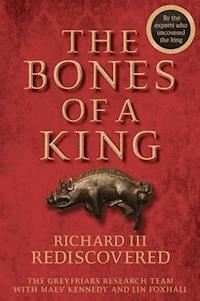
The Bones of a King E-Book
17,99 €
Mehr erfahren.
- Herausgeber: John Wiley & Sons
- Kategorie: Geisteswissenschaft
- Sprache: Englisch
The dramatic story of Richard III, England's last medieval king, captured the world's attention when an archaeological team led by the University of Leicester identified his remains in February 2013. The Bones of a King presents the official behind-the-scenes story of the Grey Friars dig from the team of specialists who discovered and identified his remains
- The most extensive and authoritative book written for non-specialists by the expert team who discovered and analysed the remains of Richard III
- Features more than 40 illustrations, maps and photographs
- Builds an expansive view of Richard's life, death and burial, as well as accounts of the treatment of his body prior to burial, and his legacy in the public imagination from the time of his death to the present
- Explains the scientific evidence behind his identification, including DNA retrieval and sequencing, soil samples, his wounds and his scoliosis, and what they reveal about his life, his health and even the food he ate
- A behind-the-scenes look at one of the most exciting historical discoveries of our time
Sie lesen das E-Book in den Legimi-Apps auf:
Seitenzahl: 377
Veröffentlichungsjahr: 2015
Ähnliche




















CONTENTS
Cover
Title page
Illustrations
Figures
Maps
Plates
The Greyfriars Research Team
Acknowledgements
1 Investigating the Bones of a King
2 So How Did He Get There? (RB, MM)
Imagine … A Walk in the Garden
The ‘Lost’ Friary
How It All Began
Finding the Friary
Laying the Groundwork
Where to Dig
The Search for the Friary
Excavating King Richard’s Grave
Following Up: The 2013 Excavation
Why Greyfriars?
King Henry VII’s Monument
The Epitaph
The Latin Epitaph
English translations
Further reading
3 The Bigger Picture
Imagine …
Friaries in Medieval England and Wales (DOS)
Greyfriars, Leicester (
DMO, RB, MM
)
Life in the Medieval Town (
RB, MM
)
Richard’s Arrival in Leicester, His Departure … and His Return
Further reading
4 The Bones Tell Their Tale
The Slow Reveal …
Finding a Home: Preparing for Analysis
Skeletal Analysis: Unlocking the Secrets of the Bones (
JA, GR, BM, SH, RW-S
)
The 3D Printouts
The Towton Mass Grave
Battle Wounds (
JA, R-WS, SH, GR
)
Modelling the Bones (
JA, RB, RH, BM, PM
)
Dating Richard
III
and Tracking His Life: Radiocarbon Dating and E Isotope Analysis (
RB, AL JE, JA
)
Parasites (
PM
)
Further reading
5 Who was Richard?
Imagine …
Richard’s Early Years
A Baby Comes to the Throne
A Disrupted Childhood
Time for Another Boy King?
Richard’s Accomplishments
The Last Battle
After Richard
Further reading
6 The Cousins in the Swabs (TK, KS)
The Slow Reveal …
Who is Related to Richard III?
DNA and the Identification of Richard
Tracing the Lines
Finding the Modern Relatives
The Initial DNA Results
Checking the Lines
Cousins in the Swabs
The Final DNA Results
Further reading
7 What Did Richard Look Like?
Imagine …
Representing Richard
Descriptions of Richard in Life (
SK, MAL
)
Portraits of a Long Dead King
Are the Later Paintings Based on a Lost Original?
Richard’s Head Reconstructed
Further reading
8 The Big Announcement
The Slow Reveal …
A Momentous Phone Call (
AM, PT, CV, RT
)
The Media over the Car Park
The Quiet before the Storm
Announcing the Bones
Waiting for the Results
The Big Day Dawns (
AM, PT, RB
)
Viewing the Bones
The Press Conference Begins
The Aftermath
The Morning after the Night Before and Later
Further reading
9 The Afterlife of Richard III and the City That Never Forgot
Imagine …
A Hasty Burial in a Modest Church
A City where Richard Lived on in Legend
Rethinking History (
NH, PM, ML, BWS
)
Further reading
10 Richard Laid to Rest
The Slow Reveal …
Where to Bury Richard?
When Bones are Found (
RB, MM LF
)
The Cathedral Prepares to Receive Richard
A Streetscape to Celebrate a King
A King Reburied
Further reading
Appendix 1
Close Maternal-line Relatives of Richard III
Appendix 2
The Male Line
Index
Supplemental Images
End User License Agreement
List of Illustrations
Chapter 02
Map 2.1 Reconstruction of the centre of Medieval Leicester.
Figure 2.1 Section of the Rous manuscript showing description of Richard III’s burial place. British Library, MS Cotton Vespasian A XII, folio 137r.
Figure 2.2 Section of medieval stone wall in New Street car park that may have belonged to the friary.
Figure 2.3 Plan of the Greyfriars excavations.
Figure 2.4 Epitaph from Richard III’s gravestone set up by Henry VII, in Ellesmere 1129 manuscript, written in Latin in late sixteenth-/early seventeenth-century secretary hand on four leaves of paper, folded into folio format. The epitaph to Richard III is the longest verse on the last page.
Chapter 03
Figure 3.1 Plan of Greyfriars friary, Walsingham.
Figure 3.2 Plan of Greyfriars friary, Carmarthen.
Figure 3.3 Section of Harley manuscript 433, showing the promise of a chantry college of 100 priests to York Minster.
Chapter 04
Figure 4.1 Diagram showing the angle of entry of the weapons used in attacking Richard III.
Chapter 05
Figure 5.1 Fotheringhay castle mound, with the church in the background.
Figure 5.2 Fotheringhay church.
Map 5.1 Key places in the Wars of the Roses.
Figure 5.3 Simplified genealogy of the families of York and Lancaster.
Map 5.2 Survey finds in the area of Bosworth.
Figure 5.4 Fotheringhay church, the monuments of Duke Richard (L) and Duke Edward (R), either side of the high altar.
Figure 5.5 Fotheringhay church, monument of Duke Edward.
Figure 5.6 Fotheringhay church, bronze tassel on Duke Edward’s original monument, underneath the Elizabethan monument.
Figure 5.7 Talbot Inn, Oundle, the staircase down which Mary Queen of Scots is said to have walked.
Chapter 06
Figure 6.1 Genealogical links between Richard III and modern-day relatives who participated in the project.
Supplemental Images
Plate 1 Thomas Roberts’s eighteenth-century map of Leicester.
Plate 2 The initial stages of the Greyfriars excavation, August 2012.
Plate 3 Greyfriars excavation, the east end of the church showing the difference in level between presbytery and choir.
Plate 4 Greyfriars excavation, Jo Appleby and Turi King excavating Skeleton 1. The anti-contamination suits they are wearing are designed to prevent modern DNA from coming into contact with the bones.
Plate 5 Greyfriars excavation, the skull emerging from the soil.
Plate 6 Greyfriars excavation, Skeleton 1 in the grave.
Plate 7 Reconstruction of medieval Leicester.1. Greyfriars Precinct 2. St Martin’s Church 3. Guildhall 4. Leicester Castle 5. The Newarke 6. St Mary de Castro7. Southern suburb 8. Austin Friars 9. Little Bow Bridge 10. Bow Bridge 11. Blackfriars 12. St Nicholas’s 13. Jewry Wall 14. Butchers’ area 15. Tanneries 16. Hot Gate 17. The medieval high street (= modern Highcross Street) 18. Blue Boar Inn 19. St Margaret’s 20. St Michael’s 21. St Peter’s
Plate 8 Scan of the spine.
Plate 9 Skeleton of Richard III.
Plate 10 Wound to the upper jaw.
Plate 11 Injuries on the dome of the skull.
Plate 12 Injury on the saggital suture of the skull.
Plate 13 Wounds to base of skull.
Plate 14 Cut injury to rib.
Plate 15 Cut injury to pelvis.
Plate 16 Vertebrae showing signs of asymmetry.
Plate 17 Memorial wall plaque to Anne, Duchess of Exeter, and Sir Thomas St Leger, in the Rutland Chantry Chapel, St George’s Chapel, Windsor.
Plate 18 Michael Ibsen and Wendy Duldig.
Plate 19 Labwork on the DNA.
Plate 20 Richard III and his wife, Anne, from the Salisbury Roll.
Plate 21 Richard III, oil on panel, English School, 1520.
Plate 22 Richard III, oil on panel, English School, sixteenth century.
Plate 23 A facial reconstruction of King Richard III, unveiled by the Richard III Society on 5 February 2013 in London, England.
Plate 24 Press conference 4 February 2013, the view from the platform.
Guide
Cover
Table of Contents
Begin Reading
Pages
iii
iv
vi
vii
viii
ix
x
xi
xii
1
2
3
4
5
6
7
9
10
12
8
14
15
11
16
13
18
19
20
21
17
22
23
24
25
26
28
29
30
31
27
32
33
34
35
36
37
38
39
40
41
42
43
44
45
46
47
48
49
50
51
52
53
54
55
56
57
58
59
60
61
62
63
64
65
66
67
68
69
70
71
72
73
74
75
76
77
78
79
80
81
82
83
84
85
86
87
88
89
90
91
92
93
94
95
96
97
98
99
100
101
102
103
104
105
106
107
108
109
110
111
112
113
114
115
116
117
118
119
120
121
122
123
124
125
126
127
128
129
130
131
132
133
134
135
136
137
138
139
140
141
142
143
144
145
146
147
148
149
150
151
152
153
154
155
156
157
158
159
160
161
162
163
164
165
166
167
168
169
170
171
172
173
174
175
176
177
178
179
180
181
182
183
184
185
186
187
188
189
190
191
192
193
194
195
196
197
198
199
200
201
202
203
204
205
206
207
208
209
210
211
219
212
213
214
215
216
217
218
THE BONES OF A KING
RICHARD IIIREDISCOVERED
The Greyfriars Research Teamwith Maev Kennedy and Lin Foxhall
This edition first published 2015© 2015 University of Leicester
Registered OfficeJohn Wiley & Sons, Ltd, The Atrium, Southern Gate, Chichester, West Sussex, PO19 8SQ, UK
Editorial Offices350 Main Street, Malden, MA 02148-5020, USA9600 Garsington Road, Oxford, OX4 2DQ, UKThe Atrium, Southern Gate, Chichester, West Sussex, PO19 8SQ, UK
For details of our global editorial offices, for customer services, and for information about how to apply for permission to reuse the copyright material in this book please see our website at www.wiley.com/wiley-blackwell.
The right of The Greyfriars Research Team with Maev Kennedy and Lin Foxhall to be identified as the authors of this work has been asserted in accordance with the UK Copyright, Designs and Patents Act 1988.
All rights reserved. No part of this publication may be reproduced, stored in a retrieval system, or transmitted, in any form or by any means, electronic, mechanical, photocopying, recording or otherwise, except as permitted by the UK Copyright, Designs and Patents Act 1988, without the prior permission of the publisher.
Wiley also publishes its books in a variety of electronic formats. Some content that appears in print may not be available in electronic books.
Designations used by companies to distinguish their products are often claimed as trademarks. All brand names and product names used in this book are trade names, service marks, trademarks or registered trademarks of their respective owners. The publisher is not associated with any product or vendor mentioned in this book.
Limit of Liability/Disclaimer of Warranty: While the publisher and authors have used their best efforts in preparing this book, they make no representations or warranties with respect to the accuracy or completeness of the contents of this book and specifically disclaim any implied warranties of merchantability or fitness for a particular purpose. It is sold on the understanding that the publisher is not engaged in rendering professional services and neither the publisher nor the author shall be liable for damages arising herefrom. If professional advice or other expert assistance is required, the services of a competent professional should be sought.
Library of Congress Cataloging-in-Publication data is available for this title.
ISBN: 9781118783146 (hardback)
A catalogue record for this book is available from the British Library.
Cover image: Boar badge of Richard III, discovered at Bosworth Field © Leicestershire County Council Museums Service; Background image © clearviewstock / iStockphoto.Cover design by Simon Levy
Illustrations
Figures
2.1
Section of the Rous manuscript showing description of Richard III’s burial place. British Library, MS Cotton Vespasian A XII, folio 137r.
Lesen Sie weiter in der vollständigen Ausgabe!
Lesen Sie weiter in der vollständigen Ausgabe!
Lesen Sie weiter in der vollständigen Ausgabe!
Lesen Sie weiter in der vollständigen Ausgabe!
Lesen Sie weiter in der vollständigen Ausgabe!
Lesen Sie weiter in der vollständigen Ausgabe!
Lesen Sie weiter in der vollständigen Ausgabe!
Lesen Sie weiter in der vollständigen Ausgabe!
Lesen Sie weiter in der vollständigen Ausgabe!
Lesen Sie weiter in der vollständigen Ausgabe!
Lesen Sie weiter in der vollständigen Ausgabe!
Lesen Sie weiter in der vollständigen Ausgabe!
Lesen Sie weiter in der vollständigen Ausgabe!
Lesen Sie weiter in der vollständigen Ausgabe!
Lesen Sie weiter in der vollständigen Ausgabe!
Lesen Sie weiter in der vollständigen Ausgabe!
Lesen Sie weiter in der vollständigen Ausgabe!
Lesen Sie weiter in der vollständigen Ausgabe!
Lesen Sie weiter in der vollständigen Ausgabe!




