


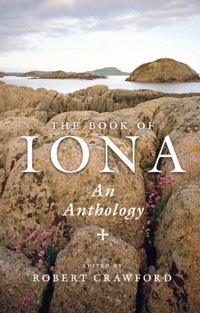
The Book of Iona E-Book
Erhalten Sie Zugang zu diesem und mehr als 300000 Büchern ab EUR 5,99 monatlich.
- Herausgeber: Polygon
- Kategorie: Sachliteratur, Reportagen, Biografien
- Sprache: Englisch
This brand new anthology is comprised of creative prose, non-fiction and poetry that ranges from St. Columba to the present day, all linked by the isle of Iona. Featuring specially commissioned work by Meaghan Delahunt, Jennie Erdal, Sara Lodge, Victoria Mackenzie, Candia McWilliam, Ruth Thomas, and Alice Thompson this wonderful collection will have broad historical and contemporary appeal. The Book of Iona is a celebration of one of Scotland's most beautiful islands and follows on from the success of The Book of St. Andrews (Polygon, 2007).
Sie lesen das E-Book in den Legimi-Apps auf:
Seitenzahl: 433
Veröffentlichungsjahr: 2016
Das E-Book (TTS) können Sie hören im Abo „Legimi Premium” in Legimi-Apps auf:
Ähnliche




















THE BOOK OF IONA
for Blyth Iona,
for Lewis,
and for Alice
with love
First published in Great Britain in 2016by Polygon, an imprint of Birlinn Ltd
Birlinn LtdWest Newington House10 Newington RoadEdinburgh EH9 1QS
www.polygonbooks.co.uk
ISBN 978 1 84697 351 2eISBN 978 1 78027 447 8
Selection and Introduction copyright © Robert Crawford 2016
The editor and publisher gratefully acknowledge the permission granted to reproduce the copyright material in this book. Every effort has been made to trace copyright holders and to obtain their permission for the use of copyright material. If there are any errors or omissions the publisher would be grateful if notified of any corrections that should be incorporated in future reprints or editions of this book.
British Library Cataloguing-in-Publication DataA catalogue record for this book is available on request from the British Library.
Typeset in Verdigris MVB by 3btype.comPrinted and bound by Gutenberg, Malta
Contents
Introduction
CANDIA McWILLIAM The Loopholes of Retreat
ADOMNÁN Planks
Communion
The Gift
The Drowned Books
ANON Fil Súil nGlais / A Blue Eye Glancing Back
THOMAS PENNANT from A Tour in Scotland
ADOMNÁN War
Sithean
EDWIN MORGAN Columba’s Song
VICTORIA MACKENZIE Crex Crex
ST COLUMBA Altus Prosator
The Maker on High
Adiutor Laborantium
All Labourers’ Helper
GEORGE BUCHANAN from The History of Scotland
WILLIAM SHAKESPEARE from Macbeth
ROBERT CRAWFORD Icolmkill
ADOMNÁN The Coof
The Copyist
The Light House
I
MICK IMLAH The Prophecies
DAVID KINLOCH Between the Lines
MEG BATEMAN Peploe and Cadell in Iona
ROBERT LOUIS STEVENSON Dining at the Argyll Hotel
ROBERT LOUIS STEVENSON The Islet
ANON Meallach Liom Bheith i n-Ucht Oiléan
Delightful to Be on the Breast of an Island
ADOMNÁN A Gaelic Quatrain
ANON La Chaluim-Chille / The Day of St Columba
Achlasan Chaluim-Chille / Saint John’s Wort
SEAMUS HEANEY Gravities
FIONA MACLEOD The Sin-Eater
FIONA MACLEOD The Sun-Chant of Cathal
ADOMNÁN Acts
Among the Picts
ADOMNÁN Broichan
SAMUEL JOHNSON In the Morning Our Boat Was Ready
ADOMNÁN Dùn I
Forecast
Iona Fragments
Blessing
Pilgrim
LOUISE IMOGEN GUINEY Columba and the Stork
ALICE THOMPSON Hologram
ALAN DEARLE The Iona Machine
QUEEN VICTORIA On Visiting Staffa
ANON A Traditional Gaelic Prophecy
KENNETH STEVEN Iona Poems
ROBERT CRAWFORD The Marble Quarry
AMY CLAMPITT Westward
SARA LODGE The Grin Without the Cat
NORMAN MacCAIG Celtic Cross
ADOMNÁN Columba’s Deeds
Cronan the Poet
Neman
Day
Raiders
JAMES BOSWELL Tuesday 19 October 1773
ROBERT CRAWFORD Iona
ST COLUMBA An I Mo Chridhe
BECCÁN MAC LUIGDECH Tiugraind Beccáin do Cholum Cille
The Last Verses of Beccan to Colum Cille
ADOMNÁN The Excommunicant
The Loch Ness Monster
The Whale Blessing
The Trudge
JENNIE ERDAL Listening in the Loose Grass
CHRISTABEL SCOTT from Iona: A Romance of the West
ADOMNÁN Bed
The Cry
Mother
The Foster-Mother
Erc
JOHN MACGILVRAY from Elegy on Donald McLean, Esq. of Coll (1787)
WILLIAM WORDSWORTH Iona
RUTH THOMAS All the Treasures We Can Have
MICK IMLAH I
ROBERT CRAWFORD MC
HERMAN MELVILLE Clarel, XXXV
ST COLUMBA Noli Pater
ADOMNÁN Calm
Fifty Yards
LIONEL JOHNSON Saint Columba
ADOMNÁN Lightning
Old
Retreat
WALTER SCOTT from The Lord of the Isles, Canto IV
JOHN KEATS Letter to his Brother, while travelling with Charles Brown, 23 and 26 July 1818
MEAGHAN DELAHUNT To Pick Up a Stone
ADOMNÁN Machair
Script
Diarmait
Columba’s Death
Drought
The Work
Notes on Contributors
Acknowledgements
Introduction
Iona is an island of lives and afterlives. Some families have lived there for generations; the lie of the land is enriched by genealogies. For the many visitors – pilgrims, tourists, walkers, painters, photographers, birders, bathers or paddlers – who travel by ferry from Oban on the western mainland of Scotland to the large island of Mull, then by car, bus or arduous bike ride across to the hamlet of Fionnphort on Mull’s south-west coast before proceeding on a further small ferry over the Sound of Iona to the jetty at St Ronan’s Bay, the experience of arriving on Iona in a present-day crowd often turns into a haunting encounter with long-gone individuals. Almost no one can catch sight of, let alone set foot on, the island without a stirring of the imagination. Eyeing the abbey from the approaching ferry, modern tourists come thinking of the sixth-century Saint Columba and his monks, or of later, determined visitors including Samuel Johnson, James Boswell, and John Keats. Iona’s many elaborately crafted medieval sculpted stones, and the heroic tale of the modern rebuilding of its abbey by unemployed Glaswegians marshalled by George MacLeod, Kirk minister and founder of the Iona Community, mean that afterlives on this island are insistent presences. Iona is a site where spirit, imagination, and physical exertion mingle.
Under snow or summer heatwave, it’s a vivid place. Emerald, turquoise and viridian tides passing over sunlit sand towards the north end are as striking as the lash of Atlantic rain when storm clouds scud across the sky above the machair. Iona’s light – brilliant, windswept, strong yet often fleeting – has attracted generations of painters, best known among whom are those early twentieth-century Scottish colourists S. J. Peploe and F. C. B. Cadell, conjured up in this book by Meg Bateman and David Kinloch. The sensory intensity of being on Iona involves not just that light which heightens a sense of inhabiting what George MacLeod called ‘a thin place’ where this world and a world beyond seem to intersect; it also involves Iona’s distinctive simplifying smallness. However great its reputation, this island is only about three miles by one and a half in size; its fame derives from focus, not from vastness; it is, in several senses, a place of concentration.
To most folk today, Iona can seem remote; but for many centuries it has been richly connected. For Columba, sailing from Ireland to Iona in the year 563 AD, and for his medieval monastic successors the island was at the heart of a navigable archipelago extending as far as Ireland to the west, Mull to the east, and with the rest of the Hebrides on all sides. Through the language of Latin, the earliest, Gaelic-speaking writers associated with Iona were linked not just to the surrounding islands and the mainland but also to Europe and international Christendom. When Adomnán, the seventh-century abbot of Iona (whose Gaelic name is pronounced ‘A-gov-nan’) authored his prose account of Columba’s life, he wrote in the international lingua franca of the day, confident that his Latin prose could and would be read in many countries. Adomnán tells of Columba’s founding of the monastery on Iona, of his development of a religious community throughout the surrounding islands (a community whose influence went on to extend far across Europe), and of Columba’s mission to convert the Picts in mainland Scotland. Even today, Adomnán’s Life of Saint Columba remains arguably the most important Iona text, but its extended assembly of hagiographical anecdotes and narratives can strain the patience of modern readers. Since worshipful medieval audiences may have given Adomnán’s string of stories the sort of attention that today is associated more with poetry than with prose, in The Book of Iona passages from Adomnán’s Latin are recast throughout as English verse. Often this recasting results in a free translation which nonetheless stays close to the original trajectory. My aim is to preserve something of the direct, visionary clarity of the original, but also to present the content as patterned matter for poetic contemplation.
Though it includes memoir material, The Book of Iona is an anthology given over to literary imagination, not to historiography, ecclesiastical chronicling or journalism. Just as several of the Adomnán passages in this book fuse together kinds of remoteness and connectedness, so many of the contemporary pieces included operate in related imaginative territory. The new, specially commissioned stories and some of the recent poetry were produced as part of Loch Computer, a project which (thanks to generous support from the Scottish Government and the Royal Society of Edinburgh) assembled in St Andrews and Edinburgh between 2014 and 2016 a rum crew of fiction writers, poets, computer scientists, digital humanities specialists, and visual artists to ponder the meaning of remoteness and connectedness in the digital era. Most but not all of the participants have visited Iona. In this book several of them take small imaginative liberties with its topography. After Loch Computer’s discussions between computer scientists and creative practitioners, the writers were asked to produce an imaginative piece centred on Iona and involving both remoteness and connectedness. A few pieces in this book, such as Alice Thompson’s story ‘Hologram’ and Al Dearle’s scientifically inventive account of ‘The Iona Machine’, explicitly engage with digital technology; most of the contributors deal with remoteness and connectedness more tangentially, yet frequently in ways true to earlier Iona texts: so, present-day writers ponder spirituality, interpersonal distance and closeness, as well as aspects of what it means to experience on an island an intense sense of concentration.
Often modern visitors’ awareness of Iona as a place of concentration and contemplation has been heightened by a realisation that getting there involves giving up technology. Only local people can bring their cars on to the island; tourists have to leave their vehicles on Mull. For most folk, Iona is a place to walk or to cycle, not to drive. On arrival, strangers are unsettled to realise that few mobile phone networks provide coverage, and internet access is at best patchy. A physical slowing down and a deliberate or enforced exile from some of the most insistent distractions of technological modernity accompanies many people’s sense of Iona, though for year-round residents getting or losing a phone signal can have a different, sometimes biting, importance. To city dwellers, Iona looks depopulated: few houses, surprising amounts of space. If you head in the right direction, then, even if you arrive as part of a group, it is easy on the island to achieve both solitariness and communion with nature and with God. Pilgrims come seeking this, making their own peregrinatio, their testing voyage of contemplation; others, however, come from far places to experience human communion, working and praying for a sense of common purpose. Whatever their journeys’ purpose, large numbers of people ponder on Iona the relation between remoteness and connectedness. That seems one of the things Iona is for.
Clustered throughout this book, the verse versions of sections from Adomnán’s biography of Iona’s most famous saint give readers a sense of Columba’s life. They show, too, how this revered figure, who was among other things a writer, became an icon for the meditations of later generations. Other medieval texts associated with Columba – some in Latin, others in Gaelic – enhance this sense, helping to explain why Iona was so important to medieval imaginations. Though, as both George Buchanan and Shakespeare attest, the island was not forgotten by the time of the Renaissance, its buildings were ruined, its treasures dissipated. By the Enlightenment era, travellers including Thomas Pennant, James Boswell and Samuel Johnson knew of Iona’s allure and evoked it with eloquence. Grandly, Johnson wrote of how ‘That man is little to be envied, whose patriotism would not gain force upon the plain of Marathon, or whose piety would not grow warmer among the ruins of Iona!’ Yet he was aware, too, of the island’s antiquities being ‘incumbered with mud and rubbish’. The ruinous state of Iona’s ecclesiastical heritage, however, heightened the appeal of the place to the Romantic imagination. Visitors as different and distinguished as Walter Scott, William Wordsworth, John Keats and Felix Mendelssohn made the journey to view the ruined abbey, sanctifying Iona as a site of imagination as well as religious pilgrimage. By the time Romanticism metamorphosed into the late nineteenth-century dreams of the Celtic Twilight, Iona had become for some a sleepy haven, and for others a locus of troubled imaginings. William Sharp, better known by his penname ‘Fiona Macleod’, made the island central to his finest story, ‘The Sin-Eater’, while Robert Louis Stevenson, unimpressed by local cuisine, presented the lights of sacred Iona as longed for but unattainable when glimpsed from a more threatening shore in his 1886 novel Kidnapped.
Just as modern visitors see a very different abbey, so contemporary writers view Iona differently from their Romantic and Victorian predecessors. The poet Mick Imlah’s treatment of Adomnán and Columba is inflected with present-day irony as well as with fascination; for short-story writers Sara Lodge and Alice Thompson, Iona is a location where the politics of gender are to the fore in a way that might have startled the island’s earlier inhabitants. The Iona of several contributors to this book is very much a place of twenty-first-century people; yet it is haunted, too, by afterlives, memories and longing.
Sometimes that longing has a markedly spiritual quality. However, the point of this anthology is not to hoard religious texts. Rather, The Book of Iona offers in a kaleidoscopic yet coherent design imaginative works that resonate together and may prompt reflection on secular as well as spiritual ideas. The focus on an island that is a site both of concentration and contemplation makes pondering the shifting relationship between remoteness and connectedness unavoidable. It takes a long time to get to know Iona in thorough detail, and Iona is a place where detail always counts. I have been visiting the island for over forty years, and have come to associate it with all the people I have loved – both living and dead. This book is an attempt to share in literary form several aspects of Iona’s beauty, and to provide some refreshing perspectives on places and prospects that may have come to seem over-familiar.
A note on form: in The Book of Iona works originally written in Latin or Gaelic verse are presented in parallel text, in order to give the poetry the dignity of its original shape, and to allow readers to experience just a little of the ‘otherness’ of the untranslated text in addition to the translated version. Where texts were originally written in prose in a language other than English, only an English translation is given. Unless otherwise specified, versions of Latin and Gaelic texts in this book are by the editor; readers seeking the original Latin prose of Adomnán’s Vita Sancti Columbae can find it in several editions, including that of A. O. and M. O. Anderson (Edinburgh, 1961; second edition, Oxford, 1991); readers who wish to read a prose translation of the whole of Adomnán’s Life of Saint Columba can find several versions on the internet, including one that is part of the site called the Internet Archive (where a digital copy of William Reeves’s 1874 translation, originally published in Edinburgh by Edmonston and Douglas, is available free of charge); there are also a number of translations available as printed books, the most recent and most authoritative being the 1995 Penguin Classics edition translated by Richard Sharpe. The present anthology’s editor and several of the other contributors have found these earlier works of great help, not least as starting points for the imagination. Bringing together for the first time such a wealth of imaginative writing associated with Iona from the early Middle Ages until the twenty-first century, The Book of Iona returns repeatedly to notions of remoteness and connectedness. I hope it will appeal to lovers of a very special island, to lovers of imaginative writing, and to those who have a passion for both.
Robert Crawford,St Andrews, 2016
CANDIA McWILLIAM
The Loopholes of Retreat
We knew the veil was thinning for Nana Effie after the drookit handbag in the Post Office.
Peggy, who took a shift at the busy times, called me down from the old house where I was spreading seaweed on the lazy-beds we’d made Nana agree to. I was over from my place of work to bide awhile with my mother’s mother who had mostly raised me, as far as ever I did grow.
It was odd having the dulse in slippy limpet-buttoned armfuls not in leaves like dried-out summer salty handkerchiefs off the washing line. I’ve grown used to those where I live now.
It turned out Nana’d put her milk-thermos for the morning cup she had now to take alone into the depths of her good handbag. She only found out the thermos-top was loose when she’d had to pull forth in the Post Office, some days later, from out the soor dook in her bag, the sticky banknotes, with that thin line of metal through them, a vein now of cheesy green. She took them out from the soggy pastry of her wallet.
Coin was unaffected.
There’s the swollen-up clam of compact. She thought of that powder puff as a teacher might of the board-duster. This was clear to any who had chummed Nana forth the island. By the time she was at any destination but the first her face would be sifted with powder white as a morning roll.
She was postcarding me, Peggy insisted, though there I was, staying with her in the house where she’d lived with all us children and our mother and sometimes our father, till he wasn’t, and Granda Niall till he went.
She was looking for the money to pay for the stamp to reach the place where I was not, for I was with her, in that house that had held the clutch of us, but that now felt right tight for just two, even though it was distance I’d filled up on in my life, not space; my next island being crammed as a sack of roe. She was looking for the money to exchange for the stamp that would ensure the flight of words so they might reach me, all those miles away, where I was not. The unposted picture postcard, showing a blushing sky and the old cross against, it read on the reverse, under the instruction ‘Correspondence’, ‘I wish you were here.’
It had clearly been written some time before. Most likely the words were those she thought most suited for the open craft of a postcard. I had received several such cards from her over the years and thought of it as not much more than one half of the antiphonal affection we held for one another.
I looked at the address. All was as it should have been, the effective exact numbers, too big to grasp, and the concrete nouns, Sago, Marina Fort, all pre-written-out by me on my last visit to spare her trouble. Where my name was, though, she had overwritten, ‘to GOD’.
Leather-infused cheese, somewhat set, holding the shy essentials of the days of this woman who had once known that everything had its pigeonhole within her own mind, was what tipped us children, in our thirties and forties, the wink that she was maybe readying herself for flight.
I did keep the postcard’s addressee to myself.
The texture of the curd, when she showed it to me, was gelatinous, a bit shiny; to do with the chemicals for tanning the handbag, reacting with proteins in milk. You’d think I’d know the science; but, though I’ve cooked many things, I’d not at any point tried slow-seething small sums of money in milk.
The substance in the handbag was blueish whiteish, something like the frost-glow of a zinc bucket or, then again, of sashimi cut from the head of the squid. A squid’s tentacles retain a flirty pinkness. Little bunched rosy-tinted fingers, those tentacles are most prized when the head of the squid itself is the size of a strawberry.
To eat these sea-strawberries feels like a purr; the sort you might offer before announcing warmly anticipated news. The modest sound of justifiable satisfaction. Announcing a good exam result, say, in a subject once discouraged on account of its perceived difficulty; remembering the name of your father’s reputedly drowned first love without sounding dismissive or even at all angry; revealing that although you are not tall you are well able to use the hands.
In my work, texture is important. Among my customers, texture is considered and debated. Cool-slippery, sticky, ointment-tacky, unctuous, warm-dense, half-resistant, gelatinous, glutinous, bubble-quivering, rubbery, cornflour-custardy, eggy-decided, fungus-cloudy, woody-granular, soft-shred curdling, hot-melting, glass-silken, satin-sweet, tongue-answering, dusty-spicy, all these are terms with which I have become familiar as I placate the circling appetites of the Hungry Ghosts, those dead who cannot rest on account of their disorderly or violent passing, in their season of going forth, at its height on the fifteenth day of the seventh month of the Chinese calendar, and to fulfil also the appetites of those not yet departed who would assuage them; and beyond that season, for all the other exaltations, celebrations and observances of my new home, the island republic of Singapore.
It was Nana Effie who taught me to cook; most importantly, for the formation of my sixth and seventh senses, timing and knowing when to finish things off, on the girdle, a utensil that asks a precise calibration of what heat may achieve. Cooking with her I learned what I did not know I knew until I had took it across the seas to another set of islands. That I could steer and control heat; which is everything in cooking; cooking itself, or the offering of a prepared repast, with its suggestion of leisure and a life beyond fight and flight, being all that removes the raw from its primitive state. Where there is cooking there is gratitude and may be grace.
Sashimi is raw you’re thinking?
Think again; of the application required to shape the uncooked fish such that it is not only palatable but beautiful. That thought, that attention, that filleting, that sectioning, that feathering, that eliciting from the texture of the lately-living fish how it may fan its petals of muscle or fat so as to flower best on the human tongue, that investment of time – they are all forms of heat, being work.
Work is heat, heat work, we were told it at the secondary school on the mainland as we clamped our retorts over the clean blue Bunsen flame that roared thin so you could see clear through it as it rushed up to its licking limit, shivering the air around itself with a motion not felt as warmth.
‘Watch for the rise and the bubbles that tell you the other side of the round is making ready to be uplifted’, said Nana, showing me how, by letting me do. The weight in the air around the range changed from the babyish puff of flour to the swell of breathable fat, hot iron. Reliable magic took its course. Flipping the drop-scones without leaving batter-trail on the girdle was like skimming stones on the blue water’s thin top, loch or sea-lip; something I just could do. It was in my wrist-bone, Nana said. It was like taking but the one crack to snap the jouncing mackerel still.
I knew at what angle to cleave wood; I used less energy than others to achieve set tasks by knowing the point of entry. I cracked nuts with my hands and could tell where the hen had laid when she made off to a new place to attempt her flustered notion of raising chicks beyond the shell. I could crack an egg and separate it with one hand. I was eye level with the range-top when Nana took me on in the kitchen.
I was bringing what I could to family life; day by day, she seemed assured, and thereby to assure us, things could not break if the daily steps were taken; pancakes or porridge twice a day, harsh reddish tea morn and eve, potatoes boiled in the skin left to divulge themselves under a bunched-up cloth held down by the pot lid, a stone to hold it firm. You could read words through the slim, summer skin that you rolled off the tatties, silken to the fingers over the nude yellow inside. The skin over the white burst baked spud in winter was dry like an unwaxed boot and full with the taste of the ground: peat, iron, bog-myrtle, the spongy heart of the rush.
Not stone; our water tasted of stone; fresh cut stone, cool stone that was to time as ice to water.
I ate skin as a boy. Birled alphabets of apple skin from the cookers that came over on the boat; no trees would fruit for us though they had once for the monks, in an orchard that seemed like a book of another country; you could see the cupped pink and white petals inside your head, stamens furry with gold pollen fallen from the tip of the monk’s brush, bees with belted belly hovering fat against the taut margin of gold that was braced against the enclosed garden of letters it fanked.
I ate the rolled or cobbled potato skin. The burned skin of crust fruitcake left in the baking tin. The rusk of loaves. The shiny outer body of a boiled dumpling, glistening with suet that had lately cradled animal innards, and held in the shape of the binding-cloth’s folds hard now like a nail to the teeth.
I ate the salt skin of the water when I swam the bays. Through it all, as I did not grow, I read, a kind of skin-eating in some manner. I could not but know that until very recently – mere hundreds of years – reading had to be a transaction with the skin of a creature, imparting to you the words you hunted and wished to eat with a wide open hunger of the head.
We ate our potatoes with salt. Butter was an infrequent cold ingot, troubled into becoming in the worked churn; the girls had the feel for it, could spot the moment before the surrender of the cream to splitting. When first I met shop butter, away at the college, I gorged on its mutable luxury, the stirred richness it gave porridge, the cool dose of it under black treacle after a late night, even the salt on salt of roll, butter, bacon with bootlace of rind. I put myself right off butter in my plashings and sookings, just as I put myself off being a man of law by the gorging indigestible way I read then.
I learned my own way was not to be smooth.
I cannot now touch butter without breaking into salty, uneasy sweat, having lived half my life among people who mostly prefer edible softness not to change its nature halfway through the intimate process of eating.
Yes, bean curd is soft, but it keeps its shape until you have decided what to make of it. Cutting bean curd is like alterations were when I was small; the girls’ frocks, our breeks, were made of cut-down clothes refettled by Nana and our mother. Once you had cut into the stuff, that was the size of it. You couldn’t uncut. Once you had set out to make the one frock into the two frocks or the one shirt into rags for the cherry-red hearth polish or the dubbin, that was it.
We are asked to believe you can bring the cut edges of things together, kiss it better and have things as before, a healing that tells you the cut never was, like a cut made in water with a knife, forgotten, not even a scar under the water, not inside its surface at the depth of the tides, not within the fat swell of the shifting waters under their keel-sliced skin.
I’m not so sure. I’m not sure that doesn’t mean that people think hurt can be withdrawn, on second thoughts, because it wasn’t what was meant. It’s at the wrong weight, damage, just now; we’ve seen the copy of it too often to know its first imprinting. Damage will not be seen away by second thoughts. Damage will out. It is, for good. There’s no unmaking the deeper partings.
With the potatoes? Salt, as I say, from the earthenware salt-pig, and not yet then monitored for the health of the heart. For sweetness we had rusty sugar in clumps, crystals aggregated yet distinct, resembling one another strictly at different sizes, replicating without limit the principal allotted form, grown onto strings close as mussels or the stacked hexagonal stone pipes out at Staffa, rock sugar sent in chests nailed shut, writing on them that was made in bits like broken biscuits, not flowing like the lettering taught in the school; you’d the sense the letters on the tea-chests that arrived on the boat had been put there flat with a swipe through a grid, not written but declared at the behest of some function that drove what was not still. What was the propulsive force we felt, Agnes and I and the other children? What the stillness?
We thought it to be music, but I have since thought it may have been God in one of the guises He can take on when you live where every stone and star had been looked upon, counted, beseeched and thanked in prayerful words for longer than our own lifetimes many times over and again.
You can learn things about a place from what it discourages. I am not talking about chewing gum or jaywalking. Those are the things everyone knows about the Lion City, Singapore; they touch only the film of skin the tourists see. On the MRT train, smooth and neat in its function, disturbingly reliable to one accustomed to the isles of the west, are graphics that forbid, in the accepted way, encircling what is forbidden in a scarlet ring, drawing a line of veto across it, the carriage anywhere on the Mass Rapid Transport system the fruit of the durian. The durian has a skin it is impossible to eat. Bitter gourd, preserved melon, kumquat, salted plum, resourceful Singaporeans have found ways to enjoy, but the sachets of flesh in the durian are defended by a skin of armorial defensiveness; the fruit is guarded too by its stench, of sweat, of the pit, the latrine. There are no fresh words for it.
The fruit appeals maybe to those without an innate tragic sense, which means knowing the disgust within delight and the impossibility of much simplicity but pain. It drives home a point some are born knowing; mercy can be brutal, it does not exaggerate, and the times event spares us are what we know of peace; ambiguity is rich and kind.
There was a rumour the Mull ferry was to carry a sign with a squeezebox in that red circle with the red line through, signifying the discouraging of accordion-playing aboard. The place for a squeezebox to go unheard might be high weather, on the emptied swilling deck, the waters fraying above and over it, the land bouncing out of sight / into sight so you’d leave your guts in the air for the gulls to catch.
A gull will eat till it is sick then eat that.
Nana thought I was a musician. I’d to practise hard at last to show her I was not. This was good for Agnes, who was, it turned out, the musician among us all; seven of us eight play the fiddle, and Euan Malcolm played the silver whistle; all the boys but me the pipes; I’d not the length of breath though I’d the fingering. Agnes could get on unobserved with her secret work of talent. No one took out their own hopes on her. Her voice ripened, taking the shade my nature afforded, growing as a melon might under sheltering leaves in a hot-frame once well dug with dove-dung in an old garden long neglected, giving accidental shelter to the exotic. She took up the little harp, the clarsach, as you might take up talking to yourself; it answered the sounds she threaded with her own voice into its strings, holding the instrument cooried into her.
Music had for us the glamour. We laughed to learn music was a tongue not much admired by a visitor from England who accounted it a method of employing the mind without the labour of thinking and with some applause too from a person’s self. We did applaud ourselves, for, being so numerous, this was near to applauding one another.
I was first to scoot the coop. After that, they clattered and flounced and fell and tumbled free, the brothers and sisters and my pigeon-pair twin Agnes. Now, when I think of the fine rebellion I had undertaken, I see that it was the flight my grandmother commenced to make possible for me when I was eye to eye with the winking drop scones on the high-handled girdle and didn’t threaten to take that much more of a stretch. She’d thought books might wing me ready for my fledge, failing to understand that it was in her own gift that my flight feathers hardened and set fair a warmer piety for my life than that to which I had thought myself born.
I confused one thing for the other. It’s easy done. I had the one great shame, so I believed, and it could be elided or relieved by escape or distance. These were other days than now. Though you may be certain the old mistakes are there ready to be made again, sheep paths under the snow.
A man in the town ran a firm, agency was the word, supplied waiters for occasions when a Scotsman was wanted. You are not, in this case, right if you have leapt to the obvious, kilted, conclusion. It wasn’t the legs, but the voice. In some parts of the world, to this day, a Scotsman’s voice speaks louder than words. I will not insult you by reminding you of all we Scots have invented, from probity in banking to the, so they say, psychological novel.
I settled in Singapore after a few years when they shipped me in just for what they call the Caledonian season through from the Yacht Club Balls to the staggered Burns Nights that fill January full as a pluck through to the end of February.
I married Eithne Tang from front of house at her family’s crab place, just past the end of the bus route. In the tank that forms the back wall of the restaurant, which is popular with families, are clams called geoduck, more prized even than what is left after the angel’s share has gone from the maturing malt. The clams resemble a harvest of heaping grey dildos sighing at shocking length from a set of castanets that has been slammed about their bases and fixed in place with a band of thick grey rubber that could strap a breakdown to a flatbed.
That wall of homed geoduck seemed inauspicious to my courtship of a daughter of the house. They represented sullen but portable wealth in seafood form. They resembled the reprisals of shameful coarse battle. They were gloomy and lewd. Panic, or embarrassment, was their effect. I am quiet and of sanguine nature, which is one of the reasons I have survived the fact I never grew past where I stopped short.
I said sanguine.
I decided that the geoduck were only the clown in the serious play, there to draw off the ugly natural nature of man, leaving behind our better selves, free to act as well as we may; they gave me no trouble after that. To my wife, or so it seemed, they had never resembled what they resembled to me. Or perhaps it was that she had no place for shame and disgust.
I fell for her, in the first degree, when I saw her clipping the paper kerchiefs around the necks of a large family who were attacking several steaming black-pepper-sauced crabs, clacking legs long and thick as deer-femur, not only jointed and chopped into leaking sub-joints but equipped with fastidious pincers like billhook-heads; she was attentive and kind as she clipped the paper bibs with the little metal toggle and pincer, like a librarian whose books are nestlings to her, needing settled in their place, needing their feathery pages stroking, needing to know the information sufficient unto the day, assured they may always fly to a settled place, a good home.
I grew to love her in the ways I suspected I might over my first summer of my new job, planning and catering for funerals of many faiths, occasions that, in want of space or gardens, things few have here in the Lion City, take place mainly in the neutral communal space at the foot of public housing apartments here, known to Singaporeans as the void deck, the space where you might host a ping-pong night, a school reunion, a musical evening, a public meeting, or a funeral, nondenominational, Taoist Buddhist, Buddhist, Roman Catholic, Protestant or several other options offered in our firm’s prospectus; including freethinking.
My preference shifts between the options. Perhaps I should not confide that to you lest it give you the impression that for me faith is skin deep; not so; it is as far in me as the weather and the horizon. But I have not yet hauled my coracle up the chosen beach or turned my back upon any other islands or views out to sea; it is not that I am wandering from hawker to hawker in matters of the spirit so much as that I am looking for the niche in which I may most accurately and well prepare myself for dying and for its only end.
I am a not-luxurious man born of an isle steeped with God; one who would provide for those he has loved; and atone for his misdeeds.
I slip sometimes to Little India in pursuit of ecumenism in the city of the Merlion, a beast doodled in the margin of an apocryphal text if ever there was one. Maybe the pragmatic heterodoxy of Singapore has met the certainties I grew among in the packed doocot that was my family’s life on the far island and set the lion among some of the pigeons.
I believe that all the feral pigeons, all the utility pigeons, all the bosomy squabs and tatty bands and flocks of the world were once inhabitants of its dovecotes and tended columbaria, and, yes, its doocots, or are descendants of the inhabitants thereof, and that all the fancy birds, the trumpeters whose calls come like low laughter, the collared doves, the imperially coloured birds like Venice glass and Indian sweeties for brightness and sugar-seethed voice, all the trained carriers of love-letters to lyric poets, all the decorated wing-weary hero pigeons of war, the very dove that brought the branch of grey olive to Noah, signifying landfall, each of these has its place in what we could with patience and close work make around us, a place for each. Starting with the end, and concluding with the beginning, shifting our thoughts around their locations within the chambered shelter, we may come to know that simply to be silted into place where you have been put is to lose compassion for the one who is not, apparently, you yourself, alone.
There are those who will try to hard-boil this hope of faith to sterility, or cast it in cold clay, and place it chill and full of deceit beneath the brooding mind to discourage further thought, or specifically to discourage the thought that there must be more than fighting for your place and sticking to it in the cold comfort of your own waste, a bird in lime. But it is not enough; can it be?
Eithne’s name came in two parts. Her western name, Eithne, had been selected by her at the age of eighteen, at baptism, as one form of the many-limbedness, the mermaid, or if you’d prefer hydra-headed, or even crablike, quality of the city in which she was born. Why not have, should you be, as she was and I was, an islander from birth, that amphibiousness, with a sail of fin stowed as well as the scales and the strong capacity to swim – and for that matter feet on the ground? It is maybe a matter of evolution after all.
The name Tang was but a Romanisation of the original form of her name, as close as might be made with the components of another way to set down language, bent into new shapes, ovals and pot-hooks, where there might more happily have been not letters but marks made deriving from the form of a sheltering tree or a sipping deer, or a chambered house for pigeons bred to carry secret scrolls in sealing-wax-stoppered sections of bamboo, tied to the pink bird-foot with a red thread.
I watched the dim-sum makers at their work between my shifts when I was first resident here without my full residency paperwork.
The expertise consists in a kind of waking sleep akin to some kinds of prayer, that allows no break in the rhythm, the pinching of the dumpling dough, the contrary rolling with the palms of the elastic pale plum, the flour-dusting of the hands quiet and frequent as wing-dips, the rolling with the white-wood pin to make the dough light and transparent as petal of poppy, fingers never smirching it till the maker’s hand thumbprints the filling into that light disc, pleats up the juncture, making of plum plump creamy-jade fig, twisting it sealed, raises and sets it, the first of a clutch, into the woven steaming-basket nest. Each dumpling of as much or of as little interest as it was in those moments when, like an egg, it was most perfectly made.
I like before I sleep to fold my hands into the dove-shadow-making position understood the world over as the sign of concession, intercession, prayer.
New graves here in Singapore lie undisturbed – at the moment – for fifteen years. A limited duration of peace in earth, quite unlike matters back at home in the corridor of the kings or where the monks lie under turf embroidered by toadflax and germander speedwell that stitch themselves across the green under the treadling needles of rain.
At the end of those fifteen years, the graves are exhumed. For those whose religion permits cremation, the exhumed remains will be cremated and stored within the columbarium; within whose niches rest not doves but the ashes of the dead.
Eithne and I make a respectable living catering the funeral services held below the tall apartment blocks. It was a relief to me to discover that the knacks I had had in the kitchen of my grandmother could be of the same weight here. I turned my eye for the measure of bubble in a pancake to the making of black sesame cakes; I offered them with longan fruit, screwpine-leaf juice and rock sugar, a translation of the crystal sugar that had come to us on the island down sea-lanes taken by the Vikings; I cooked winter melon and white sesame durian puffs; I presented them with the same dailiness as I had the pancakes off the island girdle. This assisted in the forbearance from tears and the saving of face. Occasionally it led to mistakes, such as the time when a widow wished me to weep for good fortune, a sort of private rain for her dead man, and I could not, but usually my impassivity was understood to be a form of exotic good manners.
We Scots are known to be inscrutable.
Eithne prefers to pray alone. She likes to go, in the wet especially, to the broken and remade stones and crosses of Iona, whose history has resulted in their being broken and repaired so often that there is a thickness to their story.
I like to pray in her own birth-island after the Taoist funerals; there will be joss sticks and joss papers burning, in the for-once cool concrete bareness of a void deck, with to come the light moment when paper versions of the empty sweets of life are set afire so that the departed may be sent out upon that last voyage, that cannot surely be as jointed and contingent as the journey even from mainland Scotland to the island, with its stages and changes.
Neither may this passage to the afterlife be as apparently direct as the journey from our mainland to Singapore, with the one change only.
This last journey commences with the setting alight of two clothing chests made of bright paper, one paper mountain of silver, one of gold, a paper house of air and, last, two thin paper servants. The sky pulls up the facsimiles into its hungering mouth and scatters their remains, the flame having eaten all shape, all colour, even the air they once held, that filled them with a bulk of nothing.
I am returned to the thin place where it began, from where it is best to fly up as the sparks fly up.
Would you hear my confession now?
You have?
ADOMNÁN
Planks
Pine
And oak planks
Are being hauled
From riverbanks
Along the cold
Sea road
To Mull,
And to Iona,
Towed
By small boats
That stay afloat
Because we place
The saint’s books
And arrange his fine
Vestments
To face
The altar
In the shrine,
Intoning a psalm
To ensure
The wind will
Soon falter
Then peter out,
The sea stay calm
So those stout,
Sawmilled
Pine
And oak planks
Can come over
Under cover
Of the name
Of Columba
As proof
There’s enough
Faith here still
To build a roof.
ADOMNÁN
Communion
One Iona winter’s day Columba wept.
Diarmait asked, ‘Why are you crying?’
‘I see the monks worn out with work
Building the monastery at Durrow.’
Just at that moment, far away
At Durrow, Columba’s friend, Prior Lasren,
Anxiously turned to his monks,
‘Ease up. Eat. Wait for good weather.’
And Columba, distant and communing,
Blessed Lasren, for letting them rest.
ADOMNÁN
The Gift
Heaven
Has given
Only a few
This right,
This gift
To gaze
On everything at once
In the clear,
Sheer blaze
Of day,
As if a shaft
Of bright light lit
Each detail,
So the heft
Of the earth might fit
Into a glance,
And all
The whole
Mile-high
Sky
Be taken in
By the human eye
As easily
As angels dance
On a pin.
ADOMNÁN
The Drowned Books
After the message boy
Fell from his horse
And lay
Twenty days
In the Boyne,
A man, passing by
On a nag
On his way
To a fair,
Saw the boy’s leather bag
There
Underwater
Still with the body,
And the man yelled
Till he was hoarse,
So that same day,
While dark clouds roiled
Overhead,
Folk fished the boy out
Like a coin,
And when he lay
On his back
On the bank
They undid his bag
Full of books –
Ruined, spoiled
By the water,
Except for one page
Royal
Among the rest,
Dry
As dry land,
Unspoiled.
Why?
It was written
In the hand
Of Columba.
ANON (Eleventh Century)
Fil Súil nGlais (A Blue Eye Glancing Back)
(Columba sets sail for Iona)
Fil súil nglais
Fégbas Érinn dar a hais;
Noco n-aceba íarmo-thá
Firu Érenn nách a mná.
A blue eye glancing back
Sees Ireland fading in the wake,
Destined not to see again
Ireland’s women, Ireland’s men.
THOMAS PENNANT
from A Tour in Scotland and a Voyage to the Hebrides
9–11 July 1772
Towards evening arrive within sight of Jona, and a tremendous chain of rocks, lying to the south of it, rendered more horrible by the perpetual noise of breakers. Defer our entrance into the Sound till day-light.
About eight of the clock in the morning very narrowly escape striking on the rock Bonirevor, apparent at this time by the breaking of a wave: our master was at some distance in his boat, in search of sea fowl, but alarmed with the danger of his vessel, was hastening to its relief; but the tide conveyed us out of reach of the rock, and saved him the trouble of landing us; for the weather was so calm as to free us from any apprehensions about our lives. After tiding for three hours, anchor in the sound of Jona, in three fathoms water, on a white sandy bottom; but the safest anchorage is on the East side, between a little isle and that of Mull: this sound is three miles long and one broad, shallow, and in some parts dry at the ebb of spring-tides: is bounded on the East by the island of Mull; on the West, by that of Jona, the most celebrated of the Hebrides.
Multitudes of gannets were now fishing here: they precipitated themselves from a vast height, plunged on their prey at least two fathoms deep, and took to the air again as soon as they emerged. Their sense of seeing must be exquisite; but they are often deceived, for Mr. Thompson informed me, that he had frequently taken them by placing a herring on a hook, and sinking it a fathom deep, which the gannet plunges for and is taken.
The view of the Jona was very picturesque: the East side, or that which bounds the sound, exhibited a beautiful variety; an extent of plain, a little elevated above the water, and almost covered with the ruins of the sacred buildings, and with the remains of the old town, still inhabited. Beyond these the island rises into little rocky hills, with narrow verdant hollows between (for they merit not the name of vallies), and numerous enough for every recluse to take his solitary walk, undisturbed by society.
The island belongs to the parish of Ross, in Mull; is three miles long, and one broad; the East side mostly flat; the middle rises into small hills; the West side very rude and rocky: the whole is a singular mixture of rock and fertility.
The soil is a compound of sand and comminuted sea shells, mixed with black loam; is very favorable to the growth of bear, natural clover, crowsfoot and daisies. It is in perpetual tillage, and is ploughed thrice before the sowing: the crops at this time made a promising appearance, but the seed was committed to the ground at very different times; some, I think, about the beginning of May, and some not three weeks ago. Oats do not succeed here; but flax and potatoes come on very well. I am informed that the soil in Col, Tir-I, and North and South Uist, is similar to that in Jona.
The tenants here run-rig, and have the pasturage in common. It supports about a hundred and eight head of cattle, and about five hundred sheep. There is no heath in this island: cattle unused to that plant give bloody milk; which is the case with the cattle of Jona transported to Mull, where that vegetable abounds; but the cure is soon effected by giving them plenty of water.
Servants are paid here commonly with a fourth of the crop, grass for three or four cows, and a few sheep.
The number of inhabitants is about a hundred and fifty: the most stupid and the most lazy of all the islanders; yet many of them boast of their descent from the companions of St. Columba.
A few of the more common birds frequent this island: wild geese breed here, and the young are often reared and tamed by the natives.
The beautiful Sea-Bugloss makes the shores gay with its glaucous leaves and purple flowers. The Eryngo, or sea-holly, is frequent; and the fatal Belladonna is found here.
The Granites durus rubescens, the same with the Egyptian, is found in Nuns-isle, and on the coast of Mull: a Breccia quartzosa, of a beautiful kind, is common; and the rocks to the South of the Bay of Martyrs is formed of the Swedish Trapp; useful to glass-makers.
Jona derives its name from a Hebrew word, signifying a dove, in allusion to the name of the great saint, Columba




