


6,99 €
Mehr erfahren.
- Herausgeber: Allen & Unwin
- Kategorie: Ratgeber
- Sprache: Englisch
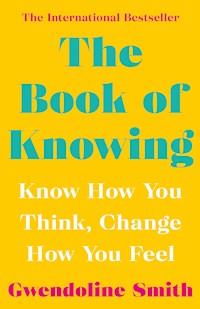
Written in an accessible and humorous style, this book teaches you to know what's going on in your mind and how to get your feelings under control. It'll help you adapt and feel better about your place in the world. Psychologist Gwendoline Smith uses her broad scientific knowledge and experience to explain in clear and simple language what's happening when you are feeling overwhelmed, anxious and confused.
Das E-Book können Sie in Legimi-Apps oder einer beliebigen App lesen, die das folgende Format unterstützen:
Veröffentlichungsjahr: 2021
Ähnliche

















Gwendoline Smith is a clinical psychologist, speaker, blogger and the author of the books The Book of Knowing, Depression Explained and Sharing the Load. She also goes by the name Dr Know. Born and raised in Chatham, Kent, she now lives in Auckland, New Zealand.
First published in Australia and New Zealand in 2017 by Allen & Unwin. This revised edition published in 2019.
First published in Great Britain in 2021 by Allen & Unwin, an imprint of Atlantic Books Ltd.
Copyright © Gwendoline Smith, 2017
The moral right of Gwendoline Smith to be identified as the author of this work has been asserted by her in accordance with the Copyright, Designs and Patents Act of 1988.
All rights reserved. No part of this publication may be reproduced, stored in a retrieval system, or transmitted in any form or by any means, electronic, mechanical, photocopying, recording, or otherwise, without the prior permission of both the copyright owner and the above publisher of this book.
10 9 8 7 6 5 4 3 2 1
A CIP catalogue record for this book is available from the British Library.
Paperback ISBN: 978 1 83895 280 8
E-book ISBN: 978 1 83895 281 5
Text design by Megan van Staden
Illustrations by Georgia Arnold, Gabrielle Maffey and Megan van Staden
Printed in Great Britain
Allen & Unwin
An imprint of Atlantic Books Ltd Ormond House
26–27 Boswell Street
London
WC1N 3JZ
www.allenandunwin.com/uk
To my dear friend Bill Worsfold
CONTENTS
AUTHOR’S NOTE
INTRODUCTION
CHAPTER ONE:
Figuring things out AKA Philosophy
CHAPTER TWO:
It’s all connected
CHAPTER THREE:
Simple as ABC
CHAPTER FOUR:
The part reality plays
CHAPTER FIVE:
Thought content
CHAPTER SIX:
How to recognise a thought virus
CHAPTER SEVEN:
What now? How does all this theory work for me?
CHAPTER EIGHT:
Skills from the cognitive tool kit
CHAPTER NINE:
More helpful stuff
CHAPTER TEN:
Which track would you choose?
CHAPTER ELEVEN:
Winding down
IN THE END
GREAT MINDS THAT I HAVE QUOTED
GLOSSARY
AUTHOR’S NOTE
Four years ago I started a blog on Tumblr, askdoctorknow.tumblr.com. The idea came from a wonderful woman and poet, Lang Leav. She asked me one evening what thoughts I had on how to deal with young adult females writing on her blog about self-harm.
I put my psychologist’s hat on and gave her some direction. Lang said, ‘You should have a blog. There are so many young people out there in cyberspace looking for help.’ So that was when Doctor Know was conceived.
My blog continued to gain momentum, and in one morning I received 11,000 questions. It was like an avalanche of young people wanting to know which way to turn. I was overwhelmed.
It was wonderful, but difficult to get back to everyone needing help. One day a colleague said to me that Doctor Know seemed to have tapped into the main vein of unmet need in youth mental health services worldwide. I realised that I needed to construct another way of addressing the issues facing young people.
That was how this book, The Book of Knowing, came to be written.
—Gwendoline Smith (AKA Doctor Know), 2019 B. Soc. Sci., M. Soc. Sci. (Hons), Dip. Clin. Psych.
INTRODUCTION
The Book of Knowing will teach you how to adapt and feel better about your place in the world.
Have you ever wondered why you don’t seem to have any control over your feelings? How they can turn up and whack you in the back of the head when you thought you were having a reasonable sort of a day?
What about those times when you are just trying to blend in with a group and your face turns bright red—what’s that about?
Or those times when you finally pluck up the courage to go and talk to your teacher or your boss, then your stomach fills with butterflies, you blush, your heart pounds so loud you can’t hear yourself think, and then you have to sit down because you feel like your legs have turned to jelly? Does this all sound familiar?
The Book of Knowing sets out to explain clearly what is happening to you in these situations. It helps you understand yourself better and learn ways to manage your feelings more effectively.
The Book of Knowing achieves this by educating you in a practical way about how you think. It is a book full of life skills. It is about learning the way of thinking that fosters resilience, which enables you to deal with many of the unnecessary anxieties that plague you.
This is not a book about illness. It does not encourage you to announce to the world, ‘Hey, look at me, I have social anxiety!’ It is a book that says:
‘I am learning about how I think and, as a result, how I feel.’
The essence of The Book of Knowing is taken from the school of cognitive behavioural therapy (CBT), founded by Dr Aaron Beck. CBT is recognised as a highly effective, evidence-based therapeutic approach for the treatment of mood disorders, depression, anxiety and general dissatisfaction with life.
Utilising this method will help those of you with diagnosed conditions. It will also be both preventative and remedial for those of you who experience life as just too difficult.
The tone of The Book of Knowing is intended to be practical, educational and informative, with humour and fabulous illustrations throughout. So I hope that you enjoy and learn and have a laugh.
CHAPTER ONE
I never quite made it to the Philosophy Department at university. A psychology major allowed me more time to pursue my other passion—playing eight-ball.
In recent years, since studying cognitive behavioural psychology, I have become quite keen on a guy called Socrates. I would have to say he is my favourite philosopher. He was saying really interesting stuff way back in circa 470 bc. (Yes, long before the internet.)
He was committed to the concept of reason. He believed that, properly cultivated, reason can and should be the all-controlling factor in life. Not surprisingly, being such a pioneering and brilliant mind, he was sentenced to death by poisoning, because of his refusal to acknowledge the gods recognised by the state and for his supposed ‘corruption of youth’—I would have referred to it as enlightenment!
Socrates was probably the most extraordinary mind of the time. He was responsible for the conception of the Socratic dialogue, his method of teaching. He never wanted to ‘teach at’ his students. That would be to instil doctrine. His pet hate.
Instead, he wanted to guide his students to discover their answers for themselves. He did this through a method called ‘Socratic questioning’ which set out to uncover assumptions and unexamined beliefs, and then to think about the implications of those beliefs—all this to really test whether the answers made sense.
This form of questioning became the backbone of law studies (and Suits script writers) and was later picked up by the world of psychotherapy, including cognitive behavioural therapy, in the 1960s—which is how I became interested in the technique.
As prescribed by Socratic dialogue, I focus on the ‘When?’, ‘What?’, ‘How?’ and ‘Where?’ questions in my clinical work. I choose not to delve into the ‘Why?’ question because in my experience it often leads down a path that goes both everywhere and nowhere:




