


1,99 €
Mehr erfahren.
- Herausgeber: DigiCat
- Kategorie: Geisteswissenschaft
- Sprache: Englisch
In "The Byzantine Achievement," Robert Byron presents a compelling exploration of the intricate tapestry of Byzantine civilization, melding acute historical analysis with vivid, almost poetic prose. Byron's literary style oscillates between erudite and engaging, offering readers both scholarly insights and a vivid sense of place. Contextually, the book emerges during a period of renewed interest in Byzantine studies, as scholars sought to illuminate this often-overlooked civilization's contributions to art, architecture, and governance, making it a significant addition to the rich canon of 20th-century historical literature. Robert Byron, an esteemed travel writer and art historian, possessed a deep fascination with the cultural legacies of ancient civilizations, which greatly influenced his perspectives. His extensive travels through the Mediterranean and his previous works imbued him with a unique appreciation for the architectural and artistic achievements that characterized Byzantine society. Byron's passion for visual aesthetics, paired with his insight into the socio-political complexities of the era, culminated in this substantial homage to Byzantine culture. For those intrigued by the intersections of art, history, and culture, "The Byzantine Achievement" serves as an essential resource. Readers will find in Byron's narrative not only a profound understanding of a once-mighty empire but also an invitation to appreciate the enduring beauty and influence of Byzantine art and thought on contemporary civilization. In this enriched edition, we have carefully created added value for your reading experience: - A succinct Introduction situates the work's timeless appeal and themes. - The Synopsis outlines the central plot, highlighting key developments without spoiling critical twists. - A detailed Historical Context immerses you in the era's events and influences that shaped the writing. - A thorough Analysis dissects symbols, motifs, and character arcs to unearth underlying meanings. - Reflection questions prompt you to engage personally with the work's messages, connecting them to modern life. - Hand‐picked Memorable Quotes shine a spotlight on moments of literary brilliance. - Interactive footnotes clarify unusual references, historical allusions, and archaic phrases for an effortless, more informed read.
Das E-Book können Sie in Legimi-Apps oder einer beliebigen App lesen, die das folgende Format unterstützen:
Veröffentlichungsjahr: 2023
Ähnliche


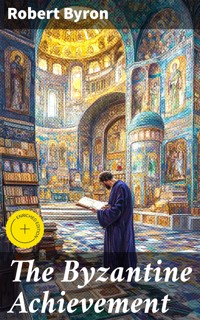











The Byzantine Achievement
Table of Contents
Introduction
Between shimmering mosaics and contested histories, Robert Byron asks how a civilization’s art can reshape the story of Europe. In The Byzantine Achievement, he undertakes a revaluation of the Eastern Roman world, arguing that its visual forms are not peripheral curiosities but central strands in the fabric of European culture. Without rehearsing chronicles of emperors in detail, Byron privileges the testimony of buildings, images, and styles to illuminate a mind and society often misread through Western prejudice. The result is a work that invites readers to look rather than label, treating aesthetic experience as historical evidence and preparing a reassessment of what Europe inherited from Byzantium.
As nonfiction that blends cultural history with art criticism, Byron’s study situates Byzantium within the geography of the Eastern Mediterranean and the long arc from late antiquity to the fall of Constantinople. Written and first published in the early twentieth century, amid the interwar reassessment of European traditions, the book addresses an Anglophone audience that had often relegated Byzantine art to a narrow specialist niche. Byron instead frames the empire as a continuing Roman polity whose center, Constantinople, radiated influence across neighboring regions. The genre’s emphasis on interpretation rather than narrative allows him to foreground form and meaning over dates, battles, and dynastic minutiae.
The reading experience is shaped by an eloquent, argumentative voice that pairs close attention to surfaces with sweeping cultural claims. Byron writes in measured yet insistent prose, moving from observation to inference with a critic’s confidence and a historian’s restraint. Rather than piling on references, he favors clarity, rhythmic sentences, and deft comparisons that link architecture, imagery, and ritual to ideas about authority and beauty. The tone is assured but never ponderous, inviting readers who may know little of Byzantium to follow a sustained case built on what can be seen and sensed. The result is persuasive without demanding specialist training.
A central theme is synthesis: the transformation of classical inheritance through Christian imagination into new artistic languages that organized space, light, and symbol. Byron maintains that such forms reveal a social and intellectual order, making aesthetics a primary archive for understanding power, worship, learning, and daily life. He challenges hierarchical stories that isolate the medieval East from the making of Europe, instead tracing lines of transmission, adaptation, and reciprocity. Continuity and renewal become paired motifs, as the empire remakes Roman concepts while shaping emerging neighbors. In this telling, style is not decoration; it is a structure of thought and a record of exchange.
For contemporary readers, the book matters because it models how to revise inherited narratives without abandoning standards of evidence or aesthetic judgment. In a world negotiating plural identities and contested pasts, Byron’s focus on the Eastern Mediterranean as a dynamic crossroads clarifies how cultures borrow, resist, and reinvent. His insistence that visual culture encodes ideas anticipates current interdisciplinary methods in art history, anthropology, and media studies. The work also counters complacent West‑centric timelines by restoring a longer, more intricate continuity. That perspective bears on debates about heritage stewardship, museum practice, and education, where recognizing intertwined lineages can widen sympathy while sharpening critique.
Readers encounter a sequence of arguments that move from the built environment to the imagination it sustains, always returning to what patterns, proportions, and materials communicate. The book’s premise is simple yet potent: if we learn to read form, we uncover a civilization’s priorities, tensions, and aspirations. Along the way, Byron distinguishes between imitation and creation, attending to how artistic choices mediate theology, governance, and communal life. The tone remains analytical rather than antiquarian, avoiding romantic nostalgia while preserving awe. Without requiring prior expertise, the prose encourages patient looking, so that domes, icons, and ornamental rhythms become legible as thought in stone and pigment.
Ultimately, The Byzantine Achievement stands as a clear, disciplined invitation to recalibrate cultural memory by placing Byzantium at the heart of Europe’s developing imagination. Its arguments endure because they rest on attentive seeing and reasoned comparison, methods that remain vital across the humanities. In urging readers to confront neglected evidence and question conventional hierarchies, the book offers a template for responsible revisionism—one that balances admiration with scrutiny. Approached today, it opens paths toward a more connected history of art and ideas, equipping us to read the past with steadier eyes and to meet the present with a broadened sense of inheritance.
Synopsis
Robert Byron’s The Byzantine Achievement presents a concise yet wide-ranging reassessment of Byzantium’s place in the history of European civilization. Beginning from the observation that Western readers often inherit a dismissive view, Byron argues that the Eastern Roman Empire nurtured a distinctive synthesis of classical inheritance and Christian purpose. He outlines a program that moves between political chronology and aesthetic analysis, emphasizing how doctrine, ritual, architecture, and diplomacy formed a coherent culture. The book’s guiding question is how Byzantium created meanings that were neither merely Roman nor merely medieval, and why those meanings continue to shadow or illuminate modern judgments about the past.
Byron sketches the origins of the empire around the refounding of the capital at Constantinople, defining a polity that carried Roman law, Greek learning, and Christian theology into a new urban and liturgical environment. He follows how the imperial court and church collaborated and contested in shaping public life, from ceremonial to city planning. The narrative stresses the formation of a spiritualized civic order, in which basilicas, domed churches, and mosaics were not decorations but instruments of doctrine and community. Through this lens, the state’s continuity appears less as political inertia and more as cultural strategy aimed at binding faith, authority, and daily experience.
Religious controversies become a central engine of artistic and intellectual development. Byron examines the disputes that tested the limits of representation, most notably the conflicts over images that reshaped theology and the visual field. The defense of sacred images, grounded in specific interpretations of Incarnation and matter, yields a disciplined aesthetic with precise purposes. Monasticism and scholarship deepen this orientation, training viewers to read symbols rather than chase illusion. In Byron’s account, these struggles refine rather than stifle creativity, producing an art that privileges clarity, hierarchy, and presence, and a literature and liturgy designed to direct attention from imperial splendor to spiritual realities.
Alongside theological currents, the book traces statecraft, commerce, and diplomacy as arts in their own right. Byron emphasizes the empire’s capacity to negotiate shifting frontiers, absorb or neutralize invasions, and maintain a complex bureaucratic machine without surrendering cultural identity. He highlights the strategic use of alliances, tribute, and ceremony, and the ways urban prosperity depended on exchange with neighboring worlds. The result is a portrait of resilience: the court and provinces hold together through ritual and law as much as through arms. This stability, in turn, provides the quiet conditions under which schools, workshops, and patrons consolidate a coherent artistic language.
The core of Byron’s thesis lies in his analysis of architecture and the visual arts. He reads the great domed church as a metaphysical instrument, ordering light, surface, and space to embody doctrine. Mosaics and icons, organized by strict conventions, pursue a clarity that transforms materials into signs of transcendence. He contrasts this inward orientation with Western tendencies toward narrative or structural display, not to rank traditions but to distinguish aims. In his telling, the Byzantine achievement is a union of building, image, chant, and rite, where form serves meaning and the worshiper becomes the measure of aesthetic success.
As the chronology advances, Byron follows Byzantium’s changing relations with Latin Christendom, Islamic polities, and the Slavic and Russian worlds. He notes episodes that strained trust across confessional lines and moments of fruitful exchange in trade, technique, and learning. The analysis attends to the dispersion of scholars and texts, and to the diffusion of styles beyond imperial borders. Rather than a simple tale of decline, the later centuries appear as a period of transmission and adaptation, with Byzantine methods informing neighboring courts and, eventually, contributing to intellectual shifts that reshape the cultural map of Europe.
The book closes by reframing judgments inherited from earlier historians, urging a balanced view that grants Byzantium agency in shaping the continent’s spiritual and artistic horizons. Byron’s argument is finally about ways of seeing: how to approach a civilization whose priorities do not mirror modern or Western medieval norms. Without reducing complexity to slogans, he proposes criteria for appreciating a tradition where continuity and transformation coexist. The enduring resonance of his study lies in its invitation to reconsider cultural value, to recognize alternative paths to sophistication, and to measure achievement by intelligible purpose rather than by familiarity alone.
Historical Context
The Byzantine Achievement, published in 1929 by the British writer Robert Byron, emerged in an interwar milieu that was reassessing Eastern Mediterranean history after World War I. The Ottoman Empire had collapsed, the Republic of Turkey was proclaimed in 1923, and reforms were reshaping Istanbul’s religious landscape. Byron had recently traveled in Greece and to Mount Athos and Constantinople, experiences recorded in The Station (1928). At the same time, academic Byzantinology was expanding in Europe, challenging narratives derived from Edward Gibbon. This environment, combining new field observation with fresh scholarship, frames Byron’s defense of Byzantium’s cultural coherence and artistic originality.
Byron’s subject is the Eastern Roman Empire from the refoundation of Byzantium as Constantinople in 330 to its fall in 1453. He situates the empire’s institutions—an emperor crowned in a Christian rite, a sophisticated bureaucracy, and a powerful patriarchate—within a Greek-speaking world that preserved Roman law and Hellenic learning. Constantinople’s strategic position linked Black Sea, Aegean, and overland routes, enabling control of trade and diplomacy. The Orthodox liturgy and monastic life shaped daily rhythms and artistic patronage. This setting allowed a distinctive synthesis of classical heritage and Christian theology to mature in architecture, painting, and ceremonial.
The reign of Justinian I (527–565) anchors Byron’s historical canvas. Justinian codified Roman jurisprudence in the Corpus Juris Civilis (529–534), a foundational legal monument for later Europe. He sponsored the rebuilding of Constantinople after the Nika riots of 532, culminating in Hagia Sophia, completed in 537 with its revolutionary pendentive dome. His generals Belisarius and Narses reconquered territories in North Africa and Italy, temporarily restoring imperial frontiers. These achievements provided a model of imperial ambition and religious orthodoxy that Byron sees reverberating through later centuries, particularly in the empire’s monumental architecture and ceremonial ideology.
Theological conflict and its artistic consequences form a central strand. Iconoclasm erupted in 726 and continued, with interruptions, until 843, challenging the veneration of images. The Second Council of Nicaea (787) sanctioned icons, and the final restoration of images in 843—celebrated as the Triumph of Orthodoxy—reaffirmed their doctrinal place. Monasticism, especially at Mount Athos where the Great Lavra was founded in 963, nurtured icon painting, hymnography, and ascetic disciplines. Later, hesychasm, defended by Gregory Palamas and endorsed by councils between 1341 and 1351, consolidated a contemplative theology that informed late Byzantine art’s luminous, abstracted spirituality.
Byron emphasizes cultural transmission alongside continuity. Under the Macedonian dynasty (867–1056), a revival of letters and classicizing art—the so‑called Macedonian Renaissance—coincided with the Christianization of the Slavs. Missionaries Cyril and Methodius developed a Slavic liturgical tradition in the ninth century, and the baptism of the Rus’ in 988 integrated Kievan Rus’ into the Byzantine ecclesiastical orbit. In the Mediterranean, Byzantine craftsmen shaped San Marco in Venice and executed mosaics in Norman Sicily, notably at the Cappella Palatina and Monreale. Italian painting of the thirteenth century adopted the maniera greca, a backdrop for later innovations by Cimabue, Duccio, and Giotto.
The Fourth Crusade’s diversion and the sack of Constantinople in 1204 fractured the empire, inaugurating the Latin Empire and successor Greek polities at Nicaea, Epirus, and Trebizond. The Palaiologan restoration in 1261 reestablished Byzantine rule in Constantinople but on diminished economic foundations. Nevertheless, the Palaiologan period saw a refined artistic flowering, with intricate mosaics and frescoes, exemplified by the Chora Monastery’s early fourteenth‑century cycle. Diplomacy, marriage alliances, and court culture attempted to compensate for territorial loss, while the city remained a symbolic center for Orthodox Christianity and a repository of classical texts.
By the fourteenth and fifteenth centuries, the empire faced mounting pressures from the rising Ottoman state and regional rivals. Manzikert (1071) had earlier opened Anatolia to Turks; later Ottoman advances constricted Byzantine territory. Church union was debated as a diplomatic strategy, culminating in the Council of Florence (1439), which achieved a contested accord never fully received in the East. Constantinople fell to Mehmed II in 1453, transforming Hagia Sophia into an imperial mosque and transferring the city’s primacy to the Ottomans. Yet Byzantine artistic and liturgical traditions endured in Orthodox lands, notably in Russia and on Mount Athos.
Byron’s book addresses Western misconceptions, especially those popularized by Gibbon’s Decline and Fall, which portrayed Byzantium as decadent. Writing in 1929, he aligns with a scholarly reassessment that foregrounds Byzantine creativity, administrative resilience, and theological sophistication. He argues that Western medieval and early Renaissance art drew heavily on Byzantine models, and that the empire’s preservation of Hellenic and Christian learning shaped Europe. Drawing authority from recent travels and contemporary research, Byron presents Byzantium as a living inheritance rather than a cautionary tale, challenging his era’s Latin‑centric narratives and inviting a broader definition of European cultural achievement.
The Byzantine Achievement
Part I. The Historical Image
Chapter 1. The Historian
Pride of the masses in birth and circumstance, termed when racially manifest, patriotism, is habitually evoked in the defense either of institutions or ideas. Since his divergence from the lesser forms of creation, man has striven to maintain not only his social organizations, tribal, municipal or imperial, but also, on occasion, the less concrete principles of religion, honor, and mental freedom. Today, as a force in the second quarter of the twentieth century, patriotism is variously regarded. While it remains the opinion of many that immolation in the furthest desert to which their country's sovereignty extends constitutes the highest form of human expression, there are others who, with parallel intemperance, dismiss every token of national existence as a kind of original sin dating from Louis XIV and George III. Mental patriotism, such as that which fought the Reformation and led England to declare war on Germany in 1914, is viewed by nationalists with less enthusiasm, by "little Englanders" with greater tolerance. But removed from these definitions is another form of pride in which the individual can permit the rest to share; a form seldom felt, more seldom given words, which transcends the consciousness of this or that tradition, the sunsets of an empire or the concept of a god; which surmounts the barriers not only of political, but of ethical, intellectual, and spiritual disagreement. World consciousness is a commonplace; European already a reality. But the supreme pride is measured not in terms of the existing earth, of temperament and social device, but in divisions of time, in terms of human development—that development, which, whether it prove ultimately progressive or retrograde, is continuous. The instinct is a pride, a patriotism in our age. Sons of fathers, fathers of children, we stand companion to a moment. Let the flag fly, not of lands and waters, morals and gods, but of an era, a generation[1q].
In communion with this apotheosis of the age, this pride in the present's relation to the past and future, there emerges from the furthest antiquity of every country and every race, the science of historical analogy. This process, commonly a mere embellishment of popular writers, makes it possible, by sorting the centennially and millennially repeated incidents and trends of history, to surmise the actual moment of our progress. Civilizations are uncommon phenomena. They are to be distinguished from transitory cultural epochs such as those enjoyed by Periclean Greece and the Italy of the Renaissance. Ours is barely come. But not only are we poised on the footboard of the encyclopedic civilization now being launched; in addition, we are gathered to the brow of infinity by the initial achievement of the scientific revolution. Thus, like Moses on Nebo, we occupy a vantage point: we look both ways: back to Darwinism, daguerreotypes and railway trains; ahead to mathematical pantheism, television and the colonization of the stars. And it is this increasing systematization of intuitive analysis, standardization of old form to produce new, and interconnection of place, which distinguishes the oncoming civilization from its precursors. Its vitality will endure, as theirs did not, from the scope and unity of its embrace.
Thus the historian, substituting for the methods of the pedagogue those of the scientist and the philosopher, is the high priest of the instant. To assimilate peacefully the, forces of the advancing epoch, as yet but faintly discernible on its distant horizon, the world must revise its conception of the past, distilling from a recoordination of essential fact, the elements that have contributed to the immensity upon which it is about to lay hold. It is the day of historical stocktaking, when all peoples must bring their achievement into line with the one universal development of the future. (Until, when that is interrupted, some classic Melanesian golden age shall raise a tiny cultured head and start again.) In place of the presentation of an unpalatable sequence of incident, sugared with romance and molded to the bias of particularist writers—in the English language usually Protestant or Liberal—the function of history in this moment of rapid evolution resolves into a dual purpose: the general, to sift from the past a philosophic and scientific understanding of the present in preparation for the future; and in particular, to enumerate and render intelligible any series of events, the consequences of which are liable to affect ensuing generations in an immediate and perceptible manner. In the whole of European history, no moment offers more relevant comparison to our own than that in which Christianity became the state religion of the Roman Empire. A new civilization was thus born, the nature and achievement of which have remained unintelligible in the centuries of Triumphant Reason that have followed its extinction. Hence, in a single, if yet uncompleted, enquiry, the alliance of Constantine's foundation with such incidents in its legacy as the sack of Smyrna in 1922[1].
Chapter 2. The Greeks
As the sapphire and the aquamarine from the turquoise, so differ the waters of the Aegean from the flat blue of the Mediterranean whole. Sail from Italy or Egypt. And as the rose-tinted shores of islands and promontories rise incarnate from the sea, a door shuts the world behind. Earth's emotion diffuses a new essence. Who are we to cut the water and cleave the air with prow and funnel?
Those who sit at home with their anthologies, their Homers and Byrons, have long grown impatient of the hackneyed eulogy. Travelers, on the other hand, know that the poet has not lived who can hackney the Greek sea itself. How lies it apart? What magnet of our stifled love hold this blue, these tawny cliffs and always the mountains framing the distance? Why does the breeze blow with a scent of hiking herbs which the misty shores echo in their colors? What is this element, hybrid of air and water, physical as a kiss, with which the night enfolds us? The islands float past, forming and reforming in goodbye, gleaming golden white against the sharp blues, or veiled in the odorous haze of evening. A silver sheen overspreads the sea as the ship moves north; the sky grows mild, hung with stationary clouds. Through the straits, all day across the Marmora brings the shadowy cones of the Princes' Islands, and the mirage of Constantinople. Then down again beside the rich soil and undulating ranges of Anatolia, to the bay of Smyrna, Rhodes, and below, in the corner, Cyprus. At the foot lies Crete; on the west, Corfu. This is the radius of the elusive essence; Byzantium, the keystone of its arc[2q]. From the southern boundary of Albania to the Asia Minor littoral, the entity is definite as Great Britain or the islands of Japan. Within it, the divinity of earth moves to the brink of tangibility. And if, in the first migrations, its custody was vouchsafed a people in whom the quest of the divine, which distinguishes man from beast, was already conscious, small wonder that this people has played a significant part in the general evolution of civilization. Who was this people, favored above others? What has become of it?
* * * * *
It were futile to deny that, in Anglo-Saxon parlance, the term "Modern Greek" is flavored with a suspicion of contempt as inevitable as that aroma of human perfection which attaches to Ancient. When it was discovered, in the opening years of the nineteenth century, that the wild tribes of the Peloponnese, among whom four centuries' alien misrule had rendered outlawry the only honorable profession, were not imbued with the heroic virtues so conspicuously absent in the contemporary states of Western Europe, the world of the Greek revival received the intelligence with pain.
Balm, however, was forthcoming in the writings of Fallmerayer[2], whose history of the Morea[3], published in the thirties, convinced a Europe anxious to believe it that the "Modern Greek" was of Slavonic origin. With sensation of relief, it was decided that the descendants of Pericles and Pheidias were extinct. The word degenerate, brandished with such potent futility by Gibbon, was borrowed from the ashes of the empire to decry the foundations of the kingdom. From then onwards the world at large, eyes riveted on the dead pillars of the Parthenon, has discounted the inhabitants beneath them as the unmoral refuse of medieval Slav migrations, sullying the land of their birth with the fury of their politics and the malformation of their small brown bodies.
But, within the last few decades there has arisen, in face of the prejudice of scholarship, the science of anthropology. It has therefore become possible to determine, without further question, the racial origins of Ancient, Byzantine, and Modern Greeks.
In the early Neolithic age the whole area of land between Great Britain and Somaliland was inhabited by a genus of delicately built brunettes, which have been termed by modern scientists the Brown or Mediterranean race. Gradually the sphere of its predominance was encroached upon by Teutons in the north, Nubians in the south; till at length it survived only in a majority on the Mediterranean littoral. Subject to that limitation, it may be classified, speaking of physical characteristics, in four main families, of which the Pelasgians—to borrow a name from Herodotusinhabited Greece, the Archipelago, and the west coast of Asia Minor. That this people, or more accurately this branch, was possessed, before the advent of the Indo-European Hellenes, of a civilization capable of high development and assimilation, is demonstrated in the artistic and domestic achievement of the Minoan era in Crete, for which it must have been mainly responsible. Additional, though less sophisticated, remains of its culture are to be found in the monuments of the Etruscans, a branch of the Pelasgians migrated to Italy.
At length, from that uncharted fount, the home of the Aryans, the magic Hellenes brought their powers of reasoning, their perception of form and their language. These they imposed on the Pelasgians. In the representational arts, the period of fusion, prior to the wholesale preponderance of the Hellenic culture, produced those colored portrait busts, superior to anything that formerly came out of Egypt, or later of Greece, which are now in the Acropolis Museum at Athens. Even Herodotus admits that the Hellenes always remained a minority in the country of their invasion; racially they were almost immediately assimilated. Nonetheless, this combination, of which, in our everyday speech, the adjective is "Greek," was a successful one. It laid one of the three foundations of that European civilization which has now engulfed the globe. Its cultural influence was felt from Gibraltar to Peking, from the wall of Hadrian to the roots of the Nile, even in the centuries of its inauguration. Where its people were predominant, there also was prosperity. With the submersion of the Greeks, poverty and misgovernment fastened on their home, the shores of the eastern Mediterranean.
Meanwhile, during the intervening years, the whole Brown Race, particularly in Italy and Spain, had become diluted with foreign stock. This process was the work of the barbarian invasions that followed the fall of the West Roman Empire, from which the Byzantine sphere, but for occasional and impermanent incursions, was immune. Thus, of the four families into which the Brown Race was originally divided, that in which the physical characteristics correspond most markedly with those exhibited by the anatomical remains of the original stock, is the Greek. The theory of Slavic origin, derived from a superficial observation of village names in the neighborhood of Athens, is as plausible as a deduction from the place terminations of -wick and -by, that all Englishmen are descended from Danes. The popularity of Fallmerayer's opinions has been heightened by the illusion of blond giants which the familiar white marble statues of Greece present. It is simultaneously forgotten that chiseled noses, proud lips, and rounded chins are still Greek features, though seldom found in coincidence, and not always easy to distinguish beneath straw hats and toothbrush moustaches.
Thus, in so far as anthropology is better qualified to offer decision than any branch of scholarship, the definition of the Greek remains in the twentieth century what it always was: a unit of the old Mediterranean stock possessing an Aryan culture, akin to that of the Scythians and Sarmatians, engrafted on its own. But beyond the identity of bones and skulls, there exists, for the man in the street, more convincing proof. Since the moment of history's earliest acquaintance with the Greeks, the essential qualities of their character have descended through the greatness of the Byzantine, and the degradation of the Ottoman Empires, unchanged. The travelling pedagogue, who admits the existence of the native population only to lament the absence of that vacuous perfection which he conceives to have been the Hellenic physiognomy, will maintain an opposite opinion. But it is doubtful whether, amid his texts and annotations, he has ever acquired sufficient acquaintance with human character to divest his heroes of their heroics and discover the men beneath. Those, however, who have drunk the humanities as a medicine rather than an intoxicant, will recognize in the modern Greek mentality and temperament, the counterpart of the ancient. The history of a people is not possible until the degree of constancy in its character is determined.
* * * * *
Fundamentally, the salient and most permanent impulse of the race is an avid curiosity. The zeal for knowledge, which inspired the first philosophers and the first scientists, differed in no way from that to which St. Paul, in an age of new necessity, cast the bait of the Unknown God. Today the "men of Athens" still greet one another with the words "[Greek characters]—what news?" and await an answer. In the country a regular formula of personal interrogation is the preliminary to all hospitality. There results from this insatiable attitude of enquiry, a universal, and to the Briton, extraordinary, respect for learning, for books as books, and for any aspect of cultural ability. From the highest to the lowest, even to the illiterate, this national trait has endured through the ages. And, as might be expected from an acquaintance with either the Ancients or the Byzantines, history is regarded as a recreation rather than a study, the leading newspapers exhibiting daily columns from the pens of its foremost professors.
The perpetual dissatisfaction with the outward semblance of things also engenders, as it always did, a depreciatory clarity of vision. The Greeks, in contrast with the English, are lacking in that quality of self-deception which so assists a moral people in its dubious enterprises. Though capable of untruth in pursuance of an aim, with themselves they are honest. They employ fact in both speech and literature, to the detriment of those decencies which Anglo-Saxons prize above truth. And it is to this exercise of semicynical, semisatirical insight into the weakness of human motive, that they owe the genuine, passionate spirit of democracy which they translated into political science, which was the foundation of the Byzantine monarchy, and with which they are still imbued. Through 3,000 years Greek history exhibits no vestige of a caste system. The pedestals of popular esteem are, and always have been, reserved for men of learning, servants and private benefactors of the state, and occasional families who have enjoyed a record of public service through two or three generations.
It is not, however, to be supposed that the Greek is inquisitive only in the manner of the savage. He is gifted, in addition, with a uniform standard of intelligent ability, such as characterizes, for instance, the Jew. In this "quick-wittedness" the contrast is especially marked between himself and the other Balkan races, Rumanian, Bulgar, Serb, and Albanian. In addition he is spurred, as a rule, by ambition. As trader and financier, it is said that "though second to the Armenian, he can surpass the Jew." In this respect one fact is certain: throughout history, the prosperity of the Levant, an area where important trade routes and natural riches coincide in astonishing profusion, has varied and will continue to vary with his political fortune.
Save when an opportunity for actual participation in the affairs of the state presents itself, their discussion constitutes, without rival, his national recreation. Those who have moved among the English working classes testify unanimously that their interest in politics is aroused only during the transitory excitement of elections. In Greece, so alive among the obscurest grades of society is the tradition of every man's partnership in the conduct of the country, that parliamentary government is rendered almost impossible, unless supported by the steadying loyalty that attaches to a throne. This latter the Byzantines possessed; while the popular vice, argument, was diverted to the less destructive province of theology. Today the political recrudescence of this vice is focused in countless newspapers, whose acrid party columns vividly recall the petty slates and infantile wars of the classical era. But, beneath the surface currents of recrimination, there flows a deep religious patriotism, a mystical faith in the Hellenic destiny, which is fundamentally different from the chauvinist imperialism of the West. Corollary of this is an insane party loyalty, which can agitate the domestic life of the country to an inconceivable degree. In both national and party causes, the Greeks are indefatigable propagandists. Hence, in these spheres, truth is often elusive. Similar tactics in business dealings lead them to excesses, which those whom they outwit term dishonesty and double dealing. In this connection, however, it is impossible to discount the effect of four centuries' misrule and insecurity, from which a large proportion of the population has been not twenty years delivered. And it may be noticed, in passing, that the corruption of public servants and members of the Government is not practiced with the open complacency that prevails among the other Balkan countries and in the United States of America.
The people are devoutly religious and devoutly superstitious; though their aspirations of soul have never been systematically diverted to the purposes of an institution by the exploitation of superstition, as in Latin countries. Towards nature, flowers, trees and birds, they feel a romantic, almost spiritual love. This, owing to its having attained widest expression in the writings of antiquity, is often termed pagan, as though it were in contradiction to Christianity.
Finally, and most essential clue to their character through the ages, the Greeks are imbued with the same conceit as they ever were—a conceit so cosmic, deified, part of the order of existence, that outward expression of it is superfluous and its ultimate discovery leaves the stranger with a sense of shock. European neither in fact nor feeling, they talk of "Europe" as somewhere else, and regard foreigners, though with tolerance and sometimes affection, as lacking in those essential qualities which have always constituted the Hellenic superiority over "the barbarians." This conceit renders them impulsive and, therefore, physically brave; it also deprives them of sound judgment in moments of crisis. Since the War of Independence they appear to have been inspired with a singular devotion towards Great Britain, which originated in gratitude, and has been maintained by the Greek appreciation of the element of justice in British character. If proof of their constancy in friendship be desired, it is forthcoming in the fact that, despite the events between 1914 and 1923, this feeling has remained.
Such in retrospect and present fact, is the Greek character. A clever, conceited and enquiring race, intensely political and intensely democratic, reserved in its friendships, conservative in its beliefs, commercially gifted, responsive to the emotions of nature and religion, the Greek people had endured, poised between East and West, child of neither, yet receptive to both. Originally an alloy, it stood like a new metal bridge from Africa and later Asia, to carry northwest the foundations of a world civilization. This work accomplished, it has preserved the identity of which that world then strove to rob it. But how is it that the world, the barbarians, contemptuous as they are contemptible, are still concerned with the existence of the Greeks at all? Whence has the flood of their misrepresentation been unloosed? The source is found in that curious mixture of sincere and artificial enthusiasm, Philhellenism.
* * * * *
The most frequent manifestations of this peculiar mental state, both in print and life, are the outcome of that jejune philosophy of living, which is the last heritage of the classical scholar. Student, ultimately interpreter, of Greek texts; endowed with a kindred love of exact reasoning and exact representation, together with a kindred absence of historical perspective and emotional outlet; he has fabricated from literature and stones an ideal of humanity, which he and his following have pronounced applicable to eternity. It is the singular odium of this eternal comparison, for centuries the bane of European culture, which necessitates, once and for all, the relegation of classicism to its just place in the tale of human development.




