


1,99 €
Mehr erfahren.
- Herausgeber: Quickie Classics
- Kategorie: Geisteswissenschaft
- Sprache: Englisch
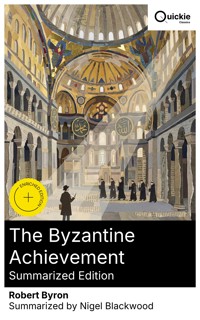
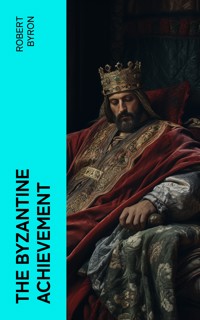
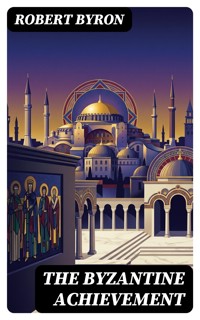
First published in 1929, The Byzantine Achievement is Robert Byron's ardent reappraisal of a culture long caricatured in English letters. Blending art history, cultural polemic, and the eyewitness verve of a traveler, he follows the thread from late antiquity to the Renaissance, showing how Byzantine theology, aesthetics, and governance sustained and fertilized Europe. With lapidary description of Hagia Sophia, Ravenna's mosaics, and the severe poise of icons, Byron overturns the cliché of decadence, marrying close visual analysis to a capacious historical argument. Educated at Eton and Oxford and hardened by journeys through Greece, Mount Athos, and the Near East, Byron wrote from the primacy of seeing. Monastic ritual, chant, and weathered stone trained his eye for structure and symbol, while a modernist taste for clarity made him receptive to Byzantine abstraction. Field notes and early essays flow into this book's plea to judge civilizations by experienced form, not inherited prejudice. Scholars of medieval and Mediterranean worlds, architects, and reflective travelers will find this a bracing corrective. Read it to widen Europe's lineage, and for prose that makes buildings visible. Quickie Classics summarizes timeless works with precision, preserving the author's voice and keeping the prose clear, fast, and readable—distilled, never diluted. Enriched Edition extras: Introduction · Synopsis · Historical Context · Brief Analysis · 4 Reflection Q&As · Editorial Footnotes.
Das E-Book können Sie in Legimi-Apps oder einer beliebigen App lesen, die das folgende Format unterstützen:
Veröffentlichungsjahr: 2026
Ähnliche













The Byzantine Achievement (Summarized Edition)
Table of Contents
Introduction
Between the stale caricature of Byzantine decadence and the vibrant reality of an art that shaped a world, Robert Byron invites a change of sight. The Byzantine Achievement is a work of criticism and cultural history from the interwar period by the British writer Robert Byron, here turned to the civilization centered on Constantinople and the Greek-speaking East. Concerned less with imperial chronicles than with visual and intellectual energies, the book asks what Byzantium made and what those forms meant. Byron writes as an advocate for attention, proposing that looking closely at architecture, images, and ceremony dissolves inherited prejudices and restores a neglected standard of value.
At its core, the book proposes a simple premise with large consequences: understand Byzantium by its own aims and methods, and much that seems opaque becomes luminous. Byron develops this case through a blend of argument and evocation, moving from principles of design and spatial order to suggestive readings of how surfaces, light, and rhythm work together. The voice is assured yet exploratory, hospitable to the reader who is curious rather than specialist. The tone is brisk, sometimes combative, yet finally celebratory of a civilization’s coherence. Without pedantry or exhaustive catalogues, the argument sketches patterns that orient the eye and set questions that carry beyond any single monument.
Central to the argument is a rehabilitation of Byzantium within the story Europe tells about itself. Byron counters the reflex that reduces the empire to mere survival, positing instead a creative continuity that transformed classical inheritances into a new language of form and thought. He treats art as a public statement of belief and order, not a private indulgence, and shows how craft, ritual, and doctrine meet in visible structures. The result is a portrait of a society that mediates between worlds, linking ancient learning to medieval practice and connecting distant regions through shared symbols, techniques, and a persistent orientation toward meaning.
Method matters here as much as conclusion. Byron proceeds by comparison and close looking, asking what particular choices of material, proportion, and surface achieve in experience. He is patient with formal questions because, for him, form is argument: an economy of line, a calculated distribution of brightness, a measured relationship between body and space. The effect is to teach the reader how to see, not only what to think. The prose carries the cadence of a practiced stylist, animated by clarity and occasional irony, yet it remains tied to concrete observation rather than abstraction for its own sake.
For contemporary readers, the book’s force lies in its invitation to reconsider the boundaries of a canon and the stories those boundaries protect. In a moment when global art histories seek to decenter familiar narratives, Byron’s insistence on meeting a tradition on its own terms reads as freshly instructive. He shows how labels can dull perception and how careful attention can restore difference without condescension. The questions he raises about cultural transmission, religious image-making, and the uses of heritage remain active, shaping debates about identity, Europe’s past, and the stewardship of monuments whose meanings are shared, disputed, and continually renewed.
The reading experience is purposeful and steady rather than exhaustive, and that restraint is part of its charm. Byron favors clear through-lines over accumulation, so that each page advances an argument while opening space for the reader’s own looking. The style is accessible to those new to Byzantine studies, yet it rewards experienced readers with crisp formulations and carefully drawn distinctions. One senses a writer committed to persuasion through evidence and example rather than authority. As a result, the book is well suited to anyone interested in how art works, how civilizations define themselves, and how eyes can be trained.
Taken together, these qualities make The Byzantine Achievement an enduring contribution to criticism and cultural history. It models a disciplined openness: a readiness to revise assumptions in the face of what the eye and mind discover. In restoring attention to a tradition often simplified or dismissed, Byron enlarges the field of what counts as formative for Europe and its neighbors without reducing differences to sameness. The book matters because it demonstrates that careful looking can be an ethical act, that evaluation can coexist with curiosity, and that the past remains most alive when we are willing to let it surprise us.
Synopsis
The Byzantine Achievement (1929) by Robert Byron advances a sustained revaluation of Byzantium’s place in European civilization. Writing as a critic and traveler, Byron addresses a readership accustomed to dismissive narratives, arguing that Byzantine culture developed a coherent visual and intellectual system that shaped the Middle Ages and beyond. The book proceeds thematically rather than as a strict chronology, using history, aesthetic analysis, and travel-based observation to set out its case. Byron’s method combines close attention to works of art and architecture with reflections on religious practice and intellectual life, seeking to show how a distinctive civilization emerged from late antique foundations.
Byron situates Byzantium as heir to Rome yet transformed by Christian doctrine, contending that its achievement lies in reconciling classical inheritance with a new spiritual purpose. He traces the gradual reorientation from naturalistic representation toward an art that privileges revelation, hieratic clarity, and symbolic order. This transition is presented not as decline but as a change in intention, where form serves theology and devotion. Through this lens, historical episodes and doctrinal debates provide context for stylistic choices, illuminating why materials, techniques, and motifs were adopted to create a consistent language oriented toward sacred vision rather than secular mimesis.
Architecture anchors the argument. Byron focuses on the domed church as a synthesis of engineering and liturgy, explaining how clustered spaces, surfaces of mosaic, and orchestrated light create an encompassing ritual environment. Structural devices are described for their aesthetic effect: the way a dome’s sweep conducts attention, the manner in which reflective tesserae dissolve mass into radiance, and the calculated progression from narthex to sanctuary. He emphasizes function over ornament, suggesting that major churches and provincial monuments express a single principle—spatial unity in the service of worship—whose clarity can be apprehended even where materials and craftsmanship vary.
Turning to painting and the icon, Byron outlines how image-making rests on theological foundations, especially beliefs about the Incarnation and sanctity of matter. He treats the icon not as portraiture but as a calibrated instrument for contemplation, defined by frontality, codified gesture, and a deliberate flattening that refuses illusionistic depth. The historical controversy over images is introduced to show the stakes of representation, while details of conflict are subordinated to its outcome for style: a disciplined canon of forms in which color, gold ground, and line articulate presence. This discipline, he argues, offers expressive power without dependence on naturalistic imitation.
Having established internal logic, the book follows Byzantine forms along the routes of commerce, diplomacy, pilgrimage, and conquest into neighboring regions. Byron maps how techniques in mosaic, fresco, ivory, and metalwork, as well as compositional schemes and building types, entered the visual vocabularies of Eastern Christian lands and Western Europe. He avoids reducing influence to simple borrowing, stressing adaptation under local conditions. The result, he proposes, is a network of related styles in which Romanesque, certain Italian developments, and later currents drew selectively upon Byzantine solutions, especially in problems of spatial articulation, liturgical imagery, and the expressive potential of light.
A polemical thread addresses the historiography that belittled Byzantium as sterile or decadent. Byron contests such judgments, arguing that critics misread purpose when measuring Byzantine art by classical naturalism. He recasts Byzantium as both conservator and innovator, the mediator of antiquity and a progenitor of medieval European aesthetics. The book also draws cautious parallels to modern art and architecture, suggesting that Byzantine abstraction, structural frankness, and emphasis on experiential space anticipate concerns of the contemporary avant-garde. These comparisons serve to clarify criteria of value, not to collapse differences, and to propose standards by which living practice might learn from historical example.
The study closes by reframing the narrative of European art to accommodate Byzantium as an essential, generative presence rather than a parenthesis between Rome and the Renaissance. Without claiming uniform excellence, Byron maintains that coherence of aim and consistency of means gave Byzantine culture unusual longevity and reach. He invites readers to look again at buildings and images with attention to function, light, and devotion, arguing for judgment grounded in understanding rather than inherited prejudice. The broader significance lies in restoring a neglected tradition to view and in recognizing how ideas about vision, space, and community continue to inform artistic creation.
Historical Context
The Byzantine Achievement, published in 1929 by the British travel writer and critic Robert Byron, emerged from the intellectual ferment of interwar Britain. Educated in the classical tradition yet drawn to the Eastern Mediterranean, Byron had recently traveled in Greece and on Mount Athos, encountering Orthodox monastic art and ritual firsthand. His book enters a scholarly landscape long dominated in Britain by classical archaeology and Renaissance taste, despite the presence of institutions such as the British School at Athens and growing museum collections of medieval objects. It addresses a persistent Western habit, inherited from Vasari and the Enlightenment, of marginalizing Byzantine civilization and its aesthetic.
Byron grounds his appraisal in the historical continuity of the Eastern Roman Empire, centered on Constantinople from the fourth century until 1453. Founded as the “New Rome” under Constantine and reshaped by Christian imperial ideology, Byzantium combined Roman law, Greek language, and Orthodox theology within durable institutions—imperial bureaucracy, court ceremonial, patriarchal authority, and monastic networks. This framework sustained a literate, urban, and legal culture able to commission architecture, mosaic cycles, and manuscripts on an imperial scale. For Byron, this political and ecclesiastical setting is essential: it explains why Byzantine art pursued an ordered, theological purpose rather than the naturalistic priorities favored in much Western criticism.
Central to his narrative is the sixth-century program of Justinian I. The emperor’s codification of Roman law in the Corpus Juris Civilis and the completion of Hagia Sophia in 537 under Anthemius of Tralles and Isidore of Miletus exemplify a state that fused legislation, theology, and monumental form. Contemporary mosaics in Ravenna, including San Vitale, project imperial sacrality through a refined, abstracted visual language. Byron treats these achievements not as isolated marvels but as foundations for a continuing aesthetic: luminous surfaces, calibrated proportion, and liturgical space designed to condition devotion. They model the coherent relation between dogma, ritual, and art that he champions.




