


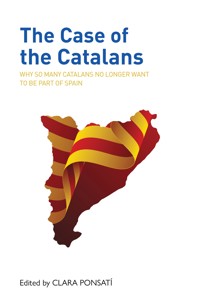
The Case of the Catalans E-Book
7,19 €
Mehr erfahren.
- Herausgeber: Luath Press
- Kategorie: Geisteswissenschaft
- Sprache: Englisch
Imagine if your country voted to become independent, that vote was then ignored and its political leaders imprisoned or exiled.Following Catalonia's independence referendum, Clara Ponsatí, Education Minister, along with Prime Minister Carles Puigdemont were charged with sedition. They had to leave Catalonia and go into self-imposed exile, and seven of their former cabinet colleagues were imprisoned. The Case of the Catalans is a landmark book that explains the injustice Catalans have faced by being marginalised with their political beliefs rendered unlawful by the Spanish government. In this book, Ponsatí and her team of influential academics discuss the future of the Catalan people and the political and social tensions that led to the controversial referendum.In a clear and accessible style, they aim to educate as many people as possible, whether interested in politics or not, about the extraordinarily backward democratic process that currently defines Spain's national identity and has defied the settled will of the Catalan people.
Das E-Book können Sie in Legimi-Apps oder einer beliebigen App lesen, die das folgende Format unterstützen:
Seitenzahl: 182
Veröffentlichungsjahr: 2020
Ähnliche




















Title page of the book, published in 1714, which inspired the title of this book, The Case of the Catalans (2020).
The Case of the Catalans was the term used in the European chanceries in discussions regarding the political destiny of Catalonia in the context of the Peace of Utrecht (1712–1714) that ended the War of the Spanish Succession. After pledging support to the Catalans siding with the Habsburg pretender in the treaty of Genoa in 1705, England pulled out of the war in 1713 signing the Treaty of Utrecht, obtaining Gibraltar and Menorca, and access to the Spanish slave market. The abandoned Catalans continued fighting but were defeated by Bourbon troops after the dramatic siege of Barcelona in 1714.
The case was a matter of heated debates in the British Parliament and a number of books were published. The Case of the Catalans consider’d praised Catalan resistance in defence of their institutions and freedoms:
‘Their Ancestors were given the privileges they enjoyed for centuries. Are they now to relinquish them without honour and leave behind them a race of slaves? No; They prefer to die all; Either death or freedom, this is their resolute choice’.
First published 2020
eISBN: 978-1-910022-27-6
Typeset in 11 point Din by Lapiz
The authors’ right to be identified as author of this work under the Copyright, Designs and Patents Act 1988 has been asserted.
© Clara Ponsatí and the contributors 2020
Catalonia will return, peacefully and anxious to be a good neighbour, if she too is shown good neighbourliness; rough, distracted, and a source of permanent trouble, if she is tortured. For the sake of all nations, and especially of Spain, one may utter the fervent hope that Catalonia is witnessing the end of her tragic interlude.
Josep Trueta, The Spirit of Catalonia (1946)
Catalonia (highlighted) and Spain (Shutterstock)
The Principality of Catalonia (1608) (Public domain)
Contents
Timeline
List of abbreviations and glossary
Introduction
1SPANISH DEMOCRACY MEETS ITS LIMITS
The genesis and legitimacy of the 1978 Constitution
A constitution for the national majority
The undemocratic roots of Spain’s judicial system
Conclusion
Bibliographical note
2THE HISTORICAL BACKGROUND
Medieval origins and early modern identity
From 1640 Secession to Catalan defeat in 1714
Disempowered Catalonia: 1714–1808
Catalonia in liberal Spain: Spanish dream
An industrial revolution and a bombed city
Catalan Renaixença
The rise of Catalanism and the collapse of the Spanish dream
A first success of Catalanism: the ‘Mancomunitat’
From failure to rebirth: Dictatorship, Republic and Independence Declaration
Franco coup d’état and Autonomous Catalonia during the Civil War years
Franco’s long-lasting repression
A window of opportunity: Transition years
Bibliographical note
3THE STORY OF A CONSTITUTIONAL DISAGREEMENT
Tensions between autonomy and recentralisation
Fishing in the Spanish Coffee Pot, 1980–2004
The reformed Catalan Statute of Autonomy
Bibliographical note
4VOTERS AND PARTIES MARCH TOWARDS INDEPENDENCE
The reasons behind the surge in support for independence
After the realignment: 2013–7
Who supports independence?
Who is leading? The role of parties and social movements
Political parties, instability
Impossible compromise
Bibliographical note
5THE ECONOMIC COSTS AND BENEFITS OF INDEPENDENCE
Greater political power means better economic opportunities
The costs of political disintegration
An uncertain transition process
Concluding remarks
Bibliographical note
6CATALONIA AND THE RIGHT OF SELF-DETERMINATION
The formalisation of the Right of Self-Determination in International Law
The permissibility of self-determination in non-colonial territories
Catalonia and the application of the Principle of Self-Determination
Internal enlargement: Self-determination within political unions
Bibliographical note
The authors
Endnotes
Timeline
From 878 – The Counts of Barcelona begin to distance themselves from the Carolingian Empire.
1137 – The Count of Barcelona marries the heir to the Aragonese Crown. It is the start of Catalonia’s history within the Aragon Crown, but with a Catalan lineage (‘Casa de Barcelona’ – the House of Barcelona). The first mentions of the term Catalonia appear during this period.
1359 – The Generalitat de Catalunya is established, with a president and one of Europe earliest parliaments.
1410 – Martí l’Humà, the last king of the House of Barcelona, dies with no heir.
1412 – In the Casp compromise representatives of Aragon, Catalonia and Valencia meet to vote in a new royal house. They decide, by majority, to appoint Ferdinand of Antequera, a member of the Trastamara house, the family that holds the Castilian crown.
1469 – Ferdinand of Trastamara, heir of Aragon, marries Isabella, the heir of Castile. He becomes king of Aragon in 1479.
1474 – First printed book in Catalan appears.
1516–7 – Ferdinand is succeeded as King of Aragon by his grandson Charles, from the Habsburg dynasty.
1517–1700 – The Habsburg monarchs rule as kings of the separate Aragonese and Castilian Crowns. Within Aragon, they swear to separate Catalan constitutions.
1640 – Catalan Revolt against the Spanish monarchy.
1641 – Pau Claris, 94th President of the Generalitat, proclaims the brief Catalan Republic under the protection of France.
1650 – War ends when Spain and France sign the Treaty of the Pyrénées, in which Catalonia loses its northern territories.
1700 – Charles II, the last Habsburg king, dies without heirs. Philip V, grandson of Louis XIV of France, is crowned king.
1705 – War of the Spanish Succession, that pitched the Bourbon Kings of France and Spain against all of Europe’s other major powers, supporting Archduke Charles, a Habsburg claimant to the Spanish throne. The Catalans side with Habsburg in defence of their traditional autonomy.
1713 – As Archduke Charles becomes Holy Roman Emperor, he loses much of his support. The British resolve to end the war and sign the Treaty of Utrecht that settles the new distribution of powers in Europe and the colonial world. Abandoned, Catalonia keeps fighting.
1714 – Barcelona falls to the Bourbons after a 14-month siege on 11 Sept – thereafter celebrated as Catalonia’s National Day.
1716 – ‘Nova Planta’ decree issued. Catalonia loses its constitutions and is administered from Madrid and in Barcelona through Captain Generals. The Catalan language is suppressed. From then on, Catalonia is ruled as a Spanish region rather than a distinctive entity.
1808–14 – Following Napoleon’s invasions of Spain, Catalonia is governed as a province of the French Empire between 1812 and 1814.
1810–27 – Spanish American Wars of Independence. Spain loses most of its colonial Empire as its colonies in Central and South America gain independence.
1868–73 – Spain seeks a new monarch, and invites King Amadeo, from the Italian Savoy dynasty, to take the throne. He rules Spain from 1871 to 1873.
1873 – The First Spanish Republic is proclaimed, but is overthrown by the army just a few months later in 1874.
1898 – Spain is defeated by the United States in the Spanish-American War. This results in Cuba gaining independence, and Puerto Rico, Guam and the Philippines being annexed by the United States.
1901 – Formation of the bourgeois Catalan Regionalist League, supporting autonomy, not independence.
1914 – Limited self-government returned to Catalonia under the leadership of Enric Prat de la Riba.
1923 – Miguel Primo de Rivera imposes a military dictatorship in Spain. Catalan self-government and language suppressed once again.
1931 – With the collapse of the Primo de Rivera dictatorship, the second Spanish Republic is proclaimed. In Barcelona, Francesc Macià briefly proclaims a Catalan Republic, but renounces it in order to lead the autonomous Catalan government.
1934 – Following the election of a right wing Spanish government new Catalan president, Lluís Companys, declares independence. However, this regime is suppressed by the army and Companys is jailed.
1936 – The left-wing Popular Front government elected in Spain. Catalan autonomy is restored.
1936–9 – The Spanish Civil War rages between the Nationalists and Republicans, supported by Catalonia. The Nationalists are victorious, allowing General Franco to establish a dictatorship.
1939–75 – Francisco Franco rules over Spain. Democracy, Catalan culture and autonomy are suppressed. The use of Catalan language is forbidden once again.
1969 – Francisco Franco appoints Bourbon Prince Juan Carlos his successor.
1975 – Francisco Franco dies and Juan Carlos I is declared King of Spain.
1976–7 – Adolfo Suárez is appointed Prime Minister and Spain begins its transition to democracy. In 1977 it holds its first democratic elections since the Second Republic.
1978 – Spain’s new democratic constitution is approved by a referendum. Catalonia’s autonomous institutions are restored.
1980 – Catalonia holds its first elections to the re-established Catalan Parliament. Jordi Pujol’s CiU win and remain in power until 2003.
2003 – The CiU loses power to a left-wing coalition of the socialist PSC (led by Pasqual Maragall) the ERC and ICV.
2005–6 – A new Catalan Statute of Autonomy is passed through the Catalan Parliament in 2005, and approved by a referendum in Catalonia in 2006. The Spanish Constitutional Court begins deliberations on the new Statute. The Popular Party organises a Spain-wide campaign against any changes to the Constitution.
2010 – Spain’s Constitutional Court rules the proposed new Catalan Statute of Autonomy unconstitutional. Large demonstrations against this decision are held in Barcelona. The CiU return to power in the Catalan government under the leadership of Artur Mas.
2012 – Catalan government makes plans for a ‘consultation’ on Catalan independence.
2014 – The Spanish Parliament and Constitutional Court both reject plans for an independence referendum. A consultative referendum is held regardless – drawing over 2.3 million votes, 1.9 of which support independence in the midst of a boycott by anti-independence groups.
2015 – The CiU and ERC form an alliance, ‘Junts pel Sí ’, to contest a snap Catalan election, which they hope to use as a plebiscite on independence. This alliance, alongside other pro-independence groups, gains 47.8 per cent of the vote and an absolute majority of seats in the Catalan Parliament. The new government declares that start of a ‘process’ towards independence.
2016 – Artur Mas steps down as President of the Catalan Generalitat in favour of Carles Puigdemont, with the support of Junts pel Sí and the far-left CUP.
2017 – Catalan referendum on independence held. 2.3 million votes are cast out of a total electoral roll of 5.3 million – anti-independence groups again boycotted the vote, with 2 million favouring independence. The Catalan Parliament declares independence. The Spanish government suspends the Catalan government and either arrests or forces into exile a number of pro-independence leaders. New Catalan elections are called, yet pro-independence groups secure another majority.
2018 – Three attempts to elect a new Catalan President fail over the course of several months as the candidates are either in exile or prison. Joaquim Torra is eventually elected as Catalan President and a new government formed. PP loses motion of no confidence and PSOE takes Spanish government.
2019 – The Spanish Supreme Court declares that nine former Catalan leaders are guilty of sedition and sentences them to 9 to 13 years in prison. The verdict sparks massive protests throughout the country, blocking Barcelona’s airport and main streets.
List of abbreviations and glossary
ANC: Assemblea Nacional Catalana (Catalan National Assembly). Grassroots civic association that seeks the political independence of Catalonia. Famous for holding mass demonstrations. Formed officially in March 2012, Carme Forcadell was its first President and was succeeded by Jordi Sànchez. Both are now in prison.
AN: Audiencia Nacional (National Audience). A special Spanish penal court with no territorial ground established for cases of particular ‘national interest’. It was established in January 1977 to replace the Tribunal de Orden Público, Franco’s special court that prosecuted political dissidents under the dictatorship.
Catalunya en Comú-Podem (Catalonia in Common-We Can!). Left-wing electoral coalition comprising Podem, the Catalan Branch of Podemos, and Catalunya en Comú, a local grouping organised by Barcelona mayor Ada Colau. It includes Iniciativa per Catalunya-Verds (ICV), the successor to the Catalan communist PSUC. Between 2015 and 2017, they ran under the name Catalunya Sí Que Es Pot (CSQEP).
CEO: Centre d’Estudis d’Opinió (Centre for Opinion Studies). Survey opinion polls office run by the Catalan Government.
CIS: Centro de Investigacions Sociológicas (Centre for Sociological Research). Survey opinion polls office run by the Spanish Government.
Congreso de los Diputados (Spanish Congress). Spanish legislative chamber. It has 350 members elected by 50 provincial constituencies by proportional representation using the D’Hondt method.
CSA: Estatut d’Autonomia de Catalunya (Catalan Statute of Autonomy). Charter regulating Catalan self-government within Spain. A first statute was approved under the Second Spanish Republic in 1932. After the Generalitat was re-established in 1977, a CSA was introduced under the Spanish Constitution of 1978. A reform of the CSA was approved by the Catalan Parliament and passed through the Spanish Congress subject to amendments, in 2006. This reformed CSA was challenged in the Constitutional Court by the PP, among others. The landmark 2010 decision by the Constitutional Court that dismissed the reformed CSA is considered the trigger of the present crisis.
Tribunal Constitucional (Constitutional Court). The arbitral body that interprets the Spanish constitution to resolve constitutional disputes, and as chamber of last appeal above the Supreme Court in cases related to fundamental rights.
Consejo General del Poder Judicial (General Council of the Judiciary). The collegiate government of Spain’s judges. It appoints magistrates and prosecutors at the Supreme Court, the regional high courts, and the Audiencia Nacional, and makes all other kinds of decisions that determine the career path of judges, from post allocations, to promotions, sanctions, or suspensions.
CIU: Convergència i Unió (Convergence and Union). Catalanist centre-right electoral alliance comprising Democratic Convergence of Catalonia and the smaller Democratic Union of Catalonia. Founded in 1978, it dissolved in 2015 upon disagreements on whether to take a pro-independence stance. Under Jordi Pujol, CIU ran the autonomous Catalan government for 23 years between 1980 and 2003. It sought to secure the greatest possible devolution of powers within Spain, rather than independence. It returned to power in 2010 under Artur Mas and took on increasingly pro-independence positions until the coalition broke.
C’s: Ciudadanos (Citizens’ Party). Spanish neo-liberal, anti-independence party launched in Catalonia in 2006 and later extended to the rest of Spain.
Ciutadans (Citizens’ Party). Catalan branch of Ciudadanos.
Convergència Democratica de Catalunya (Democratic Convergence of Catalonia). Leading Catalan autonomist party later renamed PDeCat. The largest constituent of the old CIU coalition. Its leaders included Jordi Pujol and Artur Mas.
CUP: Candidatures d’Unitat Popular (Popular Unity Candidacies). Far-left political organisation in Catalonia that favours independence from Spain. Traditionally focused on municipal politics and organised around local assemblies.
ERC: Esquerra Republicana de Catalunya (Republican Left of Catalonia). Catalan party founded in 1931 by the union of Estat Catalan (Catalan State) led by Francesc Macià and the Catalan Republican Party of Lluís Companys.
Generalitat de Catalunya (Catalan Regional Government). Name traditionally given to the Catalan government.
Guardia Civil (Civil Guard). Spanish state para-military security force founded in 1844. It maintains military discipline and draws officers from the army.
ICV: Iniciativa per Catalunya Verds (Initiative for Catalonia Greens). Merger of the PSUC, the former Catalan communists, and Green Party.
Junts per Catalunya (Together for Catalonia). Electoral front created by Carles Puigdemont’s PDeCAT to run in the December 2017 Catalan election. It included independent figures such as Jordi Sánchez, the jailed leader of the ANC.
Junts pel Sí (Together for Yes). Electoral coalition formed by pro-independence parties to run in the 2015 Catalan election, led by Artur Mas. Included PDeCAT, ERC and independents.
Òmniun Cultural. A civic association that promotes and defends the Catalan language and culture. Established in 1961 under the Franco regime when the public and institutional use of Catalan was illegal. Played a key role since 2012 in organising pro-independence demonstrations. Òmniun President, Jordi Cuixart, has been in prison since October 2017.
Parlament de Catalunya (Catalan Parliament). Catalan legislature.
PDeCAT: Partit Demòcrata Europeu Català (Catalan European Democratic Party). Catalan party founded in 2016 by Artur Mas. Direct successor of the now-defunct Democratic Convergence of Catalonia. Under Artur Mas and his successor Carles Puigdemont, it has broken with the traditionally autonomist position of its predecessor party and now openly supports independence.
PNV: Partido Nacionalista Vasco (Basque Nationalist Party). In Basque: Euzko Alderdi Jeltzalea (EAJ). Traditional, conservative Basque nationalist party founded in 1895.
Podemos (We Can!). Spanish far-left party founded in 2014 in the aftermath of the 15 May anti-austerity protests. It has been led by Pablo Iglesias since its creation.
PP: Partido Popular (People’s Party). Dominant party of the post-Franco Spanish right founded in 1989. In government in Spain from 1996 until 2004 under José María Aznar. It returned to power in December 2011 under Mariano Rajoy who was the Spanish President during the October 2017 crisis. He was removed from power by a motion of no-confidence in 2018.
PSC: Partit dels Socialistes de Catalunya (Socialist Party of Catalonia). Catalan branch of the main Spanish Socialist Party, the PSOE, in the post-Franco era. The PSC governed Catalonia in coalition with ERC and ICV from 2003 to 2010.
PSOE: Partido Socialista Obrero Español (Spanish Socialist Workers’ Party). Main Spanish centre-left socialist party, founded in 1879. Formed post-Franco governments under Felipe González between 1982 and 1996 and José Luis Rodríguez-Zapatero from 2004 until 2011. It returned to power in July 2018 under Pedro Sánchez.
Senado (Spanish Senate). The upper chamber of Spain’s Parliament. It is made up of 266 members: 208 elected by popular vote, and 58 appointed by the regional legislatures.
Spanish Constitution. The Constitution was drafted, debated and approved by the legislature that emerged from the 1977 general election, and approved in a national referendum in 1978.
Tribunal Supremo (Supreme Court). The highest court in Spain for all matters not pertaining to the Spanish Constitution.
UCD: Unión de Centro Democrático (Centre Democratic Union). Party set up by Spanish President Adolfo Suárez, a conglomerate of former Francoist reformers that led Spain’s transition to democracy. UCD won Spain’s first democratic election in 1977 and remained in power until 1982, when they were severely defeated by the PSOE. The party subsequently disintegrated.
Introduction
Why are so many Catalans no longer happy to be a part of Spain? This book reviews the historical, legal, political and economic aspects of the present conflict between Catalonia and Spain and seeks to provide answers to this question.
Catalonia is a small territory in the north – east corner of the Iberian Peninsula in southern Europe, home to 7.8 million people. This land of 32,000 square km makes up just 6.3 per cent of Spain’s territory, similar in size to Belgium, yet contains 16.2 per cent of its population. Its capital is the world-renowned city of Barcelona. Catalonia is a relatively rich region. It contributes to 20.1 per cent Spain’s total GDP, and its per capita GDP is higher than both the Spanish and EU average by 19.9 and 10.2 per cent respectively. Catalonia is the export powerhouse of Spain – over one quarter of Spanish exports are produced in Catalonia – and it is a major tourist destination. Despite this great potential for prosperity, the country’s structurally high unemployment rates, 11.5 per cent compared to 20.4 per cent in 2020, are a major constraint on its competitiveness and social cohesion.
Catalans are an old European people with their own language, a long and distinct history, and a strong sense of national identity. Yet, Catalonia is a nation without a particular ethnic component. From its medieval origins to the present day, Catalonia has always been a ‘land of through travel’, welcoming and assimilating a diversity of peoples and individuals. Catalan identity has been constructed on resistance against being assimilated by a hostile state. Present day Catalans are a complex and very diverse bunch. Since the beginning of the 20th century, Catalonia has experienced three important waves of immigration. The first two, between 1901 to 1930 and 1951 to 1975, brought people from the rest of Spain. The proportion of residents in Catalonia born elsewhere in Spain peaked in 1970 at 36.6 per cent. The third and most recent wave started in 2000 and ended abruptly with the start of the economic crisis in 2009. It was nonetheless very substantial, pushing population growth to 17.6 per cent in seven years, more than three times the 5.1 per cent growth of the period between 1981 and 2000. More importantly, migrants were not just arriving from other parts of Spain, but from the rest of the world, mostly from African and Latin American countries, as well as Europe. As a consequence of these strong immigration flows, the percentage of the population residing in Catalonia who were not born in Spain rose from 6.1 per cent in 2001 to 18.2 per cent in 2018. Undoubtedly, immigration is a crucial feature in the configuration of Catalan society that has major linguistic, social, and political implications.
Since the Industrial Revolution, Catalonia has been Spain’s main economic engine and a key agent in its modernisation. Throughout their tumultuous 19th and 20th century histories, Catalans have always longed for self-government. Yet, the dream of an independent Catalan Republic has repeatedly been confronted by strident Spanish imperial nationalism. After 40 years of harsh dictatorship and Spanish chauvinism under Franco, the constitution approved in 1978 established the legal and political basis for a regime of regional self-government whereby Catalonia was one among 17 autonomous regions throughout the whole of Spain. To the majority of Catalans, this seemed a good starting point for ensuring self-government and material progress. Opinion surveys and electoral contests consistently indicated that only a politically insignificant minority preferred independence at this point.




