


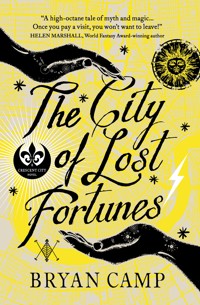
8,49 €
Mehr erfahren.
- Herausgeber: Titan Books
- Kategorie: Fantasy und Science-Fiction
- Sprache: Englisch
A captivating contemporary fantasy set in New Orleans following Jude - a man with a talent. Jude can locate anything that has been lost. But after Katrina hits, his talent becomes a curse and he finds himself at the edge of madness... Post–Katrina New Orleans is a place haunted by its history and by the hurricane's destruction. Street magician Jude Dubuisson is likewise burdened by his past and by the storm, because he has a secret: the magical ability to find lost things, a gift passed down to him by the father he has never known. Jude has been lying low since the storm, which caused so many things to be lost that it played havoc with his magic. But his retirement ends abruptly when the Fortune god of New Orleans is murdered and Jude is drawn back into the world he tried so desperately to leave. A world full of magic, monsters, and miracles. A world where he must find out who is responsible for the Fortune god's death, uncover the plot that threatens the city's soul, and discover what his talent has always been trying to show him: what it means to be his father's son.
Das E-Book können Sie in Legimi-Apps oder einer beliebigen App lesen, die das folgende Format unterstützen:
Seitenzahl: 586
Veröffentlichungsjahr: 2018
Ähnliche














CONTENTS
Cover
Title Page
Copyright
Dedication
Part One
1
2
3
4
Part Two
5
6
7
8
9
10
Part Three
11
12
13
14
15
Part Four
16
17
18
Part Five
19
20
21
22
Part Six
23
24
25
26
Part Seven
Epilogue
Author’s Note
Acknowledgments
Also Available from Titan Books
Print edition ISBN: 9781785656576
E-book edition ISBN: 9781785656583
Published by Titan Books
A division of Titan Publishing Group Ltd
144 Southwark Street, London SE1 0UP
First Titan edition: April 2018
10 9 8 7 6 5 4 3 2 1
This book is a work of fiction. Any references to historical events, real people, or real places are used fictitiously. Other names, characters, places, and events are products of the author’s imagination, and any resemblance to actual events or places or persons, living or dead, is entirely coincidental.
Copyright © 2018 by Bryan Camp. All rights reserved.
Illustrations by Digital N/Shutterstock
No part of this publication may be reproduced, stored in a retrieval system, or transmitted, in any form or by any means without the prior written permission of the publisher, nor be otherwise circulated in any form of binding or cover other than that in which it is published and without a similar condition being imposed on the subsequent purchaser.
A CIP catalogue record for this title is available from the British Library.
To New Orleans, my city; and to Beth Anne, my home
PART ONE
IN THE BEGINNING, there was the Word, and the Void, and Ice in the North and Fire in the South, and the Great Waters. A universe created in a day and a night, or billions of years, or seven days, or a cycle of creations and destructions. The waters were made to recede to reveal the land, or the land was formed from the coils of a serpent, or half of a slain ocean goddess, or the flesh and bones and skull of a giant, or a broken egg. Or an island of curdled salt appeared when the sea was churned by a spear. Or the land was carried up to the surface of the waters by a water beetle, or a muskrat, or a turtle, or two water loons. However the world was made, it teemed with life; populated by beings who evolved from a single cell, or who were molded from clay or carved out of wood or found trapped in a clam shell. They wandered up from their underworld of seven caves, or fell through a hole in the sky, or they crawled out of the insect world that lies below. All of these stories, these beginnings, are true, and yet none of them are the absolute truth; they are simultaneous in spite of paradox. The world is a house built from contradictory blueprints, less a story than it is a conversation. But it is not a world without complications. Not without conflicts. Not without seams.
* * *
One of those complications was a man named Jude Dubuisson, flesh and blood and divine all at once, who stared out at Jackson Square, at the broad white expanse of St. Louis Cathedral, at the plump, fluttering mass of pigeons, at the tidal ebb and flow of tourists on the cobblestones, and saw none of it. He was likewise deaf to his surroundings: the constant mutter of the crowd, the hooves clopping on pavement, and the hooting echo of the steamboat’s calliope coming from the river. His attention was fixed inward, on thoughts of the old life he’d done his best to forget. All those years of standing between the worlds of gods and men, of the living and the dead.
For his entire adult life, he’d straddled the seam between two worlds and brought trouble to both: a walking, breathing conflict with a fuck-you grin. That had been before the storm, though. Those memories belonged to a different man. In the six years since those fateful days in 2005, he’d tried to put it all behind him. Tried to ignore all the impossible things he knew. But the last few days, the past was like a storm cloud on the horizon, a rumble of thunder that refused to stay silent, a gloom that refused to disperse.
The past just refused to stay dead.
Jude was what the more liberal-minded in the city these days — those for whom the term “mixed race” sounded somehow offensive — would call “Creole,” and what older black folks referred to as “red-boned,” some indeterminate mix of white and African heritages along with whatever else had made it into the gumbo. All Jude knew was that he had light brown skin, a white mother, and a father he’d never met. The rest of the world always seemed more concerned about his ethnicity than he was.
He kept his hair shaved close to his scalp and a scruff of beard that was more stubble than style. He wore jeans and a long-sleeved dress shirt despite the cloying wet shroud that clung to New Orleans in the summer, the heat that made any act an effort, even breathing. The damp shirt pressed tight against his skin, the sweat tickling down the small of his back. Jude reached up, absently, to wipe off his face with the handkerchief his mother had taught him a gentleman always carries, but stopped himself, pulled from his introspection by the self-conscious awareness of the leather gloves he had on. He tucked his hand back into his lap, out of sight.
Not that anyone paid him any attention. He’d been out on the corner right across from Muriel’s since early that morning, had set up folding chairs and his rickety-ass table, laid out a chalkboard sign, a cash box, and a battered paperback atlas the same as he did most days, but in all the hours he’d been in the Square, only a few people had bothered to ask what the sign meant. None sat down. His services, unlike the tarot card readers and the brass bands and the art dealers, weren’t part of the cliché of the Quarter, and thus flew under the average tourist’s radar.
But today the lack of clients suited his mood. He’d have found it hard to feign interest in anyone’s problems with the way his thoughts had been circling nonstop. Pacing back and forth, as tense and feckless as an expectant father. Or a criminal awaiting execution.
A young street performer — Timmy? Tommy? Jude could never remember — stopped in front of Jude’s table, casting a long shadow. Jude frowned at the intrusion into his thoughts, even as he appreciated the shade. The white kid’s face, streaked with the sweaty remnants of clown paint, was split by an unguarded grin. He wore a golf cap and a tweed vest with no shirt on underneath. Less than ten years separated the two men, maybe as little as five, but to Jude’s eyes he was just a boy.
Grown more used to silence than speech, Jude had to search for his voice before he could speak. “You need something?” he asked, the words scratchy.
“About to ask you the same thing,” the boy said, pulling off the cap and swiping sweat from his forehead. “Headed to the grocery ’round the corner.” He gestured with the limp hat in the store’s direction before slipping it back onto his head.
Jude shook his head. “Thanks anyway.”
“Ain’t nothin’,” he said. He turned to go, then looked back. “You coming tomorrow night?” Jude shrugged and raised his eyebrows. The boy threw his hands into the air. “I only told you, like, twelve times already. My band finally got that gig? At the Circle Bar?”
“Oh, right,” Jude said. He imagined being crammed into a tight space with a crowd of strangers and lied to the kid. “Yeah, I’ll try to make it.”
The boy’s grin widened into a smile that took another five years off his age and made Jude feel like an older, more cynical version of himself. Tommy moved on to the next table, the sole of one of his shoes flapping, pitiful, on the street.
Jude sighed, inhaling the rich odor of the Quarter: stale beer and musky humanity and the moist, dark scent of the river. It was hard to live as he did, hidden in the seams between the life he had known and this new life he wore like a mask, but — because of those things he tried not to think about — Jude belonged there.
Or so he believed.
A short while later, Jude got his first and only customers of the day, a couple of out-of-towners. College kids, judging by the Greek letters on their T-shirts and the bright green plastic drink cups in their hands. She was a white girl who had spent hours in the sun darkening her skin, and he was vaguely West Asian, but spoke with a tap-water American accent. Lovers, Jude guessed, from the way the boy rested his hand on her shoulder, and the way the girl introduced the both of them — Mandy and Dave — like the conjunction made them a single unit. The girl seemed by far the more eager of the two. When she asked Jude what his sign meant, Dave looked toward the other side of the Square, as if searching for an escape.
“It means what it says,” Jude said. “If you’ve lost something, I can tell you where it is.”
“Like, anything?” Mandy asked, glancing at Dave to see if he was listening.
“Yeah,” Jude said, “like, anything.” She seemed not to notice the droll mockery in his voice, but Dave turned and frowned at her.
“It’s a scam,” Dave said.
“First try is free if you’re not satisfied,” Jude said. “Ten bucks if you are.”
Dave’s frown deepened, but Mandy lowered herself into one of the aluminum chairs across from Jude. “Come on, sweetie, let me at least try it. Mom’ll kill me if she finds out —” She turned a sly glance in Jude’s direction. “If she finds out I lost what I lost.” Dave made an incredulous sound in the back of his throat and checked the time on his phone, doing everything but tapping his foot to signal his impatience. His every gesture told Jude he’d been hustled before.
But Jude was no hustler, at least not today. He’d always had an affinity for lost things. Even as a child, he could point out that a friend had left a toy beneath a sofa cushion, could lead a neighbor to where her cat had stranded itself too high in a tree.
This magic was the one true gift Jude had ever gotten from the father he’d never known. As he aged, or with practice — Jude wasn’t sure which — this affinity strengthened, grew more nuanced. A brush of his fingertips against a hair left on a pillow and he knew the lost child’s name, knew that she was hungry and cold and alone, knew that she was locked in a basement in Ohio, even though she’d only vanished from her room a few days before.
The more complex the loss, though, the more cryptic his gift became. Sometimes deciphering the sensations and visions was impossible. Some things wanted to stay lost. But far more often than not, his magic worked. This power had lived at the core of him, became the foundation he’d built his life upon. He’d always been the man who could find things.
Then came the hurricane, and a rip at the seams.
The seam split between a government and its citizens when the levees that were built to protect . . . didn’t. It split between the people of New Orleans and their lives, the lucky ones cast out like dandelion seeds thrown by a fierce wind. The stitches that held together communities and families and homes strained in that wind. Some frayed, some tore. In the flood of lost things that followed, the space inside of Jude where his magic lived ripped open wide.
In the aftermath, Jude found his power had become a raw, unhealing wound. Something fundamental about his gift had changed, had turned on him. Before, he’d had to focus, to reach for the knowledge his magic could give him. After, he could barely hold it at bay. Like many after the storm, he’d done what he could to numb his senses to all the loss around him. Booze, sex, any number of bad decisions. It worked, but only for a while. His power was too much a part of him to be denied. Eventually, he’d figured out that if he didn’t touch anything or anyone — hence the gloves — and if he released a trickle of his magic every few days, he could manage, just barely, to stay sane. For six years he’d survived, though he couldn’t really call it living, not going back to his old life, unable to move on to anything new, each day nearly identical to the one before. He’d tucked himself quietly away in the seams, like a coin lost beneath the sofa cushions. Being nowhere and nothing, he’d decided, was better than feeling all that loss.
Jude slipped off his glove beneath the table and a rush of sensation flickered along his naked skin, like the pins and needles of returning circulation. He reached out and took the girl’s slender hand in his own, focusing on the single item she sought. If he had merely touched her, he would have seen and felt everything she’d lost in her young life. Even a seemingly happy and pampered girl like her would have lost enough to exhaust him.
“Your mother’s earrings are in your hotel room,” Jude said.
Dave let out a sharp, bitter laugh. “Good guess, Sherlock,” he said. “Real big leap to see that we’re tourists. Do people really fall for this?”
Jude’s first instinct was to tell Dave just how far up his patronizing ass he could put his attitude, but he held his tongue for Mandy’s sake. She was a good kid. That wasn’t just a first impression; Jude knew she was, could feel it through her skin. “Not where you’re staying in New Orleans,” Jude said. He flipped through the atlas with his free hand, opening it to the Louisiana section, flipping to the map of Baton Rouge, and dropping his finger onto a street intersection without looking. “Were you here at any point in the last few days?” Mandy gasped and pulled her hand away. Jude fought the urge to smile. He’d phrased the last part as a question, but he’d known he was right. He knew more, the name of the hotel, the room number, that the two of them had snuck away from a church youth group–sponsored protest at the Capitol Building for a day of sin in the Crescent City, but he’d learned that if he got too specific, people went from intrigued to scared. Dave took a ten out of his wallet and sat down.
“The next one is twenty,” Jude said.
Fifteen minutes and fifty dollars later, Jude said something dubious and vague enough that Dave’s cynicism returned, and they left. Jude could have kept them there all night, parceling out the answers to the little mysteries of their little lives until their cash ran out, but the money meant nothing to him. This petty game with the tourists was all about the release valve for his gift.
He’d been so much more than this, once.
Later, as he started to pack up his belongings, he saw that Mandy had left her phone behind. It looked more like a child’s toy than a piece of technology: a pink flip phone covered in rhinestones. If only she knew someone who could find lost things, he thought, smiling for what felt like the first time in days. As soon as he picked it up, as if bidden by his touch, the phone jumped and buzzed. Jude snatched it open, startled. An incoming text from an unknown number.
Meet me for a drink in an hour, the message said. The usual place, very important. Have something for you. Then, as he read, the phone twitched with another message. It read, This is Regal.
Jude started to type a reply, but sighed and snapped it closed instead. Regal wouldn’t take no for an answer.
An hour to make it Uptown. He could get there easily if he had a car — or a driver’s license, for that matter — but he didn’t. He dismissed the idea of a cab, as well. If the streetcar didn’t get him there in time, Regal could wait. Or she wouldn’t, and that would be fine, too. It wasn’t like he actually wanted to see her.
On his way out of the Quarter, he dropped the fifty dollars he’d skimmed from Mandy and Dave into the upturned hat of three kids tap-dancing on the corner. He could tell himself that meeting Regal was only professional curiosity, that he was only going to find out what magic she’d used to find him through a stranger’s phone, but he knew the truth. What gnawed at him was the more basic question of her reaching out to him at all. What could be so important that she’d track him down? What could she have for him that she wouldn’t have given him years ago? Was this why the past had been churning around in his mind lately?
Of all the things that had been lost in this city, why had she bothered to find him?
* * *
Walking into St. Joe’s bar was like descending into a cave and discovering a chapel. The shock of the colder air made Jude’s skin prickle and every hair stand on end. Dozens of crosses hung from the ceiling, not one of them resembling the next, one simple and carved out of wood, another an ornate twisting of wrought iron. The dusty scent of years of cigarette smoke and the sweet, green odor of fresh-cut mint leaves filled the tight space, coating the worn church pews and the high bar and the mirrors on the walls, dull in the dim light. Across the pool table in the back of the room, a dark hallway led past an ancient, churning ice machine and the toilets and out to a small patio. Speakers in high corners played a Rebirth song, sharp bursts of brass instruments at a frantic, exuberant beat. The whole front of the bar had been a plate-glass window once, but plywood covered it now. Boarded up since the storm.
Jude squinted against the sudden darkness, saw that he’d gotten there before Regal. The bar had only three other customers this early in the afternoon, a Vietnamese man playing a touchscreen game on the bar and a young, blond white woman talking to the scruffy Latino guy behind the counter. The bartender’s hands were busy chopping mint for the mojitos St. Joe’s was known for, but his eyes remained fixed on the girl, a slight smile on his thin lips. She stretched, her shirt pulling up and revealing the dimple of flesh where her lower back met the curve of her buttocks. Jude pushed down a sudden surge of lust. He looked away and leaned against the bar, trying to keep his distance from all of them.
The man playing the video game was middle-aged but prematurely toughened by years of smoking and hard drinking. He stared, vacant, tapping the screen and feeding it dollar bills and taking long drags off his cigarette without ever changing his expression. Jude’s fingertips tingled. Right beneath his sternum something sharp and insistent, like a fishhook piercing the core of him, yanked taut and yearned toward the man, toward his sense of loss. The man called himself Lee — the latter half of “Willy,” not Bruce — even though his parents had named him William, after his father. Lee hated William Sr. and wanted no connection to him. But he’d always felt like he’d lost something, in not having a father he could admire.
Jude cursed silently and clenched his hands into fists. Sometimes things leaked in even with the gloves, especially around strangers. This was a mistake. He shouldn’t have come here. To hell with Regal and whatever she had for him. Just as Jude decided to leave, the bartender noticed his presence and slouched over, with a curt nod and a “Whatcha need?” Jude ordered an Abita and eased onto the stool, keeping his gloved hands out of sight below the counter.
Regal’s got until I finish this beer, he told himself, and then, like she’d timed it that way, the door opened and there she was, framed by the fading sunlight.
She’d cut her hair. What he remembered as an auburn silky drape down to her shoulders was now clipped short and spiky. The rest of her hadn’t changed, though. Her deep-set eyes remained that clear, molten brown, like honey. The grin that slanted across her full lips still straddled the line between amused and mocking. She was a small white woman, both short and petite, who moved across the room with the confident glide of someone twice her size and the grace of a woman who knew how to handle herself.
“Dubuisson,” she said. “It’s been too long.” Despite everything — the sleepless nights, his unease at being out in the world, this life colliding once again with his own, the tendrils of loss twisting and curling into the cracks in his resolve, despite it all — the sound of her voice made him smile. Regal Sloan. His partner and closest friend in a life he’d left behind. Or tried to.
“Hey, Queens,” he said, the old nickname slipping unexpectedly out of his mouth. She smirked and started to speak, but the bartender interrupted with Jude’s beer. Regal ordered one for herself, and they said nothing while they waited. When the bartender returned, Regal, still standing behind him, reached over Jude’s shoulder, close enough that he could feel the warmth of her, the brush of her breath against his neck. Jude forced himself not to flinch away from her invasion of his personal space, knowing it wasn’t true flirtation so much as an attempt to make him uncomfortable, to keep him off his game. She folded a napkin in half and traced a two and a zero across it with her fingertip. Regal pushed the napkin to the bartender, who scooped it up as payment without questioning it.
“Keep the change, boo,” she said.
Jude took a sip of his Abita, savoring the crisp sharpness on his tongue. Same old Regal, he thought. He didn’t realize he’d said it out loud until she laughed.
“Way I remember it,” she said, “you taught me that particular trick.”
“Taught you all the tricks you know, rook.”
“Memory slipping in your old age?” She picked up both glasses. “Let’s talk in back.”
Jude dug a twenty out of his pocket and dropped it on the other side of the counter between a couple of bottles where the bartender would find it later, and then followed her, discomfort roiling in his gut like water about to boil. As he slid past the blonde at the other end of the bar, whose thumbs were now dancing across her cell phone, the bitter taste of blood filled his mouth. Great, he thought. Just great.
The next room seemed like a different bar, with patio tables spread across the bare concrete floor and bright paper lanterns strung above. The lanterns rustled in the breeze from the large box fan rattling in the corner, stirring the soupy air around more than providing any relief from the heat. Regal set Jude’s beer in front of him, slurping the foam off the top of her own. He wondered if she had seen his gloves yet and if the glass was safe to touch without them. He thought about taking one off under the table, unsure if he could do it without her noticing.
“So,” Regal said, after licking her lips, “you got your shit together, or you still hiding from the storm?”
Some would call Regal blunt or tactless. Some had harsher names for it. Once, a middle-aged hausfrau had called her “a gash-mouthed cunt” in front of her two young daughters. Jude knew, though, how carefully Regal chose those barbs of hers. It was how she kept people back on their heels. That same housewife had been selling the virginal menstrual blood of her eldest to a voodoo woman.
Still, it hurt that she’d jabbed at Jude’s weak spot like that, like he was just another prick in the way of her doing the job. Made him a little angry, too. But mostly it proved that she had more on her mind than a drink with an old friend.
“That guy’s gonna catch hell when his till comes up twenty bucks short,” he said. “I only ever used that trick to fuck with the kind of assholes who have it coming. Broke-ass bartenders trying to make rent money don’t exactly qualify.” He worked at keeping his voice level. It wouldn’t help anything to lose control here. His temper was something else — or so Jude’s mother had always said — that he’d gotten from his absent father.
She cocked that same grin at him, only this time it seemed insulting. “You’re a real ray of sunshine, you know that?”
“First,” Jude said, raising a finger as he counted, “I know the blonde out front will be dead sooner than not, sucked dry by the vampire that’s got her enthralled. Second, you’ve got a bit of magic hidden on you, a weapon by the feel of it, something sharp and nasty. Third? There’s a change coming, something that’s got even the boss man rattled. And fourth, you’re stalling. That’s what I know.”
She turned her head back the way they had come, squinting as if she could see through the wall that separated them. “Does it bother you?”
“What, the girl? Of course it does.”
She shook her head. “Actually, I was asking if it bothered you to be such a know-it-all prick all the time, but let’s talk about the girl. Bet you wanna go rescue her, don’t you? Gonna swoop in and save the day?” She made a disgusted noise in the back of her throat. “Not every woman is lost without her big, strong man, you know. That hero complex of yours is gonna get you in deep shit one day, bucko.”
“Thanks for the advice,” he said, taking a swallow of his beer. “Timing could be better, though.” This wasn’t the way he’d hoped this conversation was going to go. Regal seemed tense. Unsure, even. She mocked him for wanting to save the girl, but she hadn’t stopped staring in her direction, either.
“How did you know all of that?” she asked.
“Because whoever dear old dad was, I’m my father’s son,” he said. “Some things I just know.” Which was bullshit, of course. The taste-of-blood vampire warning was just a residual thing, an unintended side effect from a protection spell he’d done years ago. Everything else he’d said had been presumptions and educated guesswork, his tongue moving faster than his brain and hoping to get lucky. Regal knew a little about his father, though, so convincing her he knew a bunch of stuff he didn’t know — couldn’t know — wasn’t much of a gamble.
Tell someone you’re the bastard child of a god, and they’ll believe you’re capable of just about anything.
“So, quit with the foreplay,” Jude said. He leaned forward, the chair creaking under his weight. “Mourning sent you to talk me into coming back, didn’t he?”
“No.”
Jude raised an eyebrow. “So you just thought you’d look your old buddy Jude up after six years and knock back a few?”
“Okay, yes, Mourning sent me.” She bit her lip, uncertain. “But it’s not what you think.”
“Fuck Mourning.” Jude felt his control slipping, anger and magic threatening to wriggle free, to take shape as fire and storm. He shouldn’t have come. This was the last thing he needed.
“It’s not what you think,” she repeated. Regal stuck two fingers into her back pocket and took out an envelope sealed with red wax. The paper looked thick and old, like parchment. She glanced up, then her eyes darted away, unable to meet his. “You’re pissed, I get it. I didn’t want to get involved, but you know how it is. Mourning wants something, he doesn’t exactly ask, you know? But this message isn’t from Mourning. We were just hired to find you and deliver it.”
Jude wanted to say that he didn’t care. That he didn’t want any part in any of this, just wanted to go home and drink until he forgot all the impossible things he knew. Things that had been a part of that other life, like magicians who called things up out of the darkness to do their bidding, or hoodoo women who cast curses for a fee and then charged double for the cure, or monsters that walked the daylight pretending to be human and hunted in the night. Things that were only partly human, or not human at all. Things that even the gods had abandoned.
Instead of saying any of that, though, his curiosity won out. “That envelope isn’t ticking, is it?”
She laughed, but it was an unconvincing, desperate sound. She said nothing else, just held the message out to him, shaking it a little when he didn’t take it.
“Who sent it?” he asked.
“No idea. All I know is I’m supposed to give you this,” she said, sliding the parchment across the table, “and tell you that the favor’s being called in.”
Jude cursed under his breath. He owed a lot of debts, to more people than he’d ever be able to pay back. But only one of them would refer to his debt as a favor: Dodge Renaud, the fortune god of New Orleans. Sure enough, when he picked it up, the envelope was sealed with red wax impressed with an ornate R.
Fucking perfect, Jude thought. He started to take a sip of his beer and instead tilted it up, gulping, draining the glass, no longer concerned with whether she saw his gloves or not. He found, to his surprise, that his hands didn’t shake.
Six years. That was a decent span of time for normal human problems, hangovers and avoiding exes and pretending you were happy with your shitty pay at your shitty job. Six long years away from dancing to the whim of gods and all the nasty bullshit that came with it. For six years he’d stayed low, stayed quiet, tucked down in a seam of a life so boring, he’d convinced himself that he’d vanished entirely, that petty problems would be all he’d have to deal with for the rest of his life. He should have known better.
Six years went like the blink of an eye if you lived forever.
THE ENVELOPE HELD exactly the sort of simple, cryptic message Jude had always gotten from the fortune god: a sketched map of the edge of the Garden District closest to the Quarter, specifically the nine streets named after the Muses of Greek myth. Instead of names, though, the streets on the map were labeled with the symbols of each Muse’s domain — a scroll, a frowning mask, a smiling one, a flute — with a bright red X halfway down the block between Clio and Calliope. That told him the place, and a Polaroid of the clock on the central spire of St. Louis Cathedral told him the time: midnight.
As for Jude’s other questions — the who, what, and why — he’d have to show up to find out for sure. That was Dodge’s way.
The mention of his debt, though, first sent Jude back to his apartment — once he had endured a few barrages of Regal’s vulgarity-strewn interrogation and made a strategic retreat, leaving her at St. Joe’s — so he could collect the satchel Dodge had given him long ago. Whirls and angles of protective charms were cut into the faded brown leather, and the dozens of pockets inside bulged with magics both potent and petty: amulets and gris-gris pouches, vials of milky liquid and stones etched with ancient writing, and only a god knew what else, since it had already been full when Jude got it from Dodge. Back then, he’d thought that the satchel’s contents had been worth owing a god a favor. He’d craved the control over his own fate he’d believed it promised. Now, his only real hope was that Dodge would take the bag back — along with the odds and ends Jude had added to it while it was his — and call it square.
As plans went, it was a pretty shitty one. Power always had a cost, and the fine print never included a generous return policy. But it was all he had.
Twenty minutes or so of wandering around the Garden District while he consulted the crudely drawn map led Jude to a spot where no one else would stop: a cracked stretch of sidewalk and a fence overgrown with thick, clinging vines. On the other side of the fence, accumulated junk rose in a mound of mattress springs and broken chairs, half burying the sharp fins and graceful curves of an old car frame. The detritus and the overhanging foliage nearly hid the decrepit building lurking there. It was a shotgun house like most of the old homes in this part of the city, only one room wide but stretching four rooms back, the porch leading to the living room to the bedroom to the kitchen and then out again. This one was more ruin than structure.
After giving Jude only a brief glimpse into the yard, the streetlight overhead buzzed like a huge hornet and went out, plunging everything into darkness. Jude stepped toward the fence, and a crawling sensation along his skin told him that he’d just crossed over the threshold of a magical ward. There was a shimmer in the air, and where a moment before there had been only unbroken chain-link fence, he now saw a rusted gate swinging open. Jude couldn’t help but appreciate the craftsmanship of the spell. It was similar to the shroud he’d pulled over his own apartment, but where Jude’s magic merely kept the building out of public notice, this actively pushed people away. Any random passerby would cross the street to avoid this place, without noticing that they’d done so. Even with an invitation, it had been hard to find.
As Jude entered the yard, a shape moved in the shadows, quick and low to the ground, bursting forward in a blur of wet fangs and fierce barking.
Jude spoke a single word in a language whose name he didn’t know, and the dog’s mouth snapped shut. It slumped to the ground, lowering its muzzle to the dirt. The dog whined once, let out a deep sigh, then lay still. It was large and shaggy, with the high, pointed ears of a German shepherd. Jude grinned and shook his head. Anyone or anything powerful enough to see through Dodge’s magic would be able to handle the dog — if it was only a dog — as easily as Jude had. Which meant it was really only there to jump out and scare guests as they arrived.
Because on top of everything else, Dodge was kind of a dick.
Jude dropped to one knee and scratched the beast between its ears, hoping there were no hard feelings. Even through the gloves he could sense a deep, aching loss from the creature, so he pulled away before he could feel anything more distinct. Definitely not just a dog, then.
Jude rose to his feet and stepped onto the rot-wood porch, hesitating for only a moment before reaching for the knob. The handle turned, but the door, swollen into its frame, refused to budge. Jude put his shoulder into it and went sprawling into a dark, cramped space filled with cobwebs and the musty, nose-tickling stink of mold. Inside, entropy had long been at work, leaving behind crumbling Sheetrock and exposed brick, years of grime and dust. Jude stood in a long hallway, barely able to make out the outline of a door at the far end. When he reached it, doing his best to ignore the scuttling shapes amid the debris on the floor, he saw that it had been painted, recently, with bright red paint. He pulled it open, his pulse thundering in his ears. Light spilled out into the hallway, and Jude heard the snap and rustle of cards being shuffled, the clink of ice against glass. He smelled tobacco smoke tinged with a faint hint of cinnamon.
Inside, floral wallpaper covered the walls, faded and curling at the seams. The air in the windowless room sat thick and heavy, saturated with a haze of cigar smoke. On the wall, a clock in the shape of a cat kept time, its bulging eyes and curled tail moving in sync, a motion made somehow eerie by its wide, toothy leer.
In the center of the room, a single light bulb dangled over the green felt of a poker table. Dodge sat at the far side, fat and bald and ever smiling, his spray-tanned white face flushed with too much drink. He looked every inch a New Orleans god of fortune, his twinkling eyes the crisp green of fresh-printed hundred-dollar bills, his grin fluorescent bright.
Against his better judgment, Jude stepped inside. The door closed behind him without anyone touching it. He studied the players as Dodge dealt the next hand: a fat man with long, gaunt fingers and skin the purple bruised color of a corpse; an angel, wings soft and white as powdered sugar, eyes as blank and cold as frozen milk; a middle-aged black woman wearing a straw hat tipped at a jaunty angle, a pipe clamped between her teeth; and a brown-skinned man with the head of a bird, his beak curved and cruel as the blade of a scythe.
All this, and yet what inspired the most fear in Jude were the cards left face-down on the table. The empty seat at the game.
Waiting, it seemed, for him.
* * *
Jude dropped into the empty chair, leaving his cards face-down in front of him. It wasn’t like he didn’t have a choice. He could run. He could beg. He could demand to know what was happening. But none of those choices felt worth a damn. One god he could handle. Well, maybe — and probably not even then — but if it had only been Dodge, he could at least lie to himself that he had a chance. But a room full of gods?
“Fucked” didn’t begin to describe it.
Whatever Dodge had planned was going to play out the way the fortune god wanted it to play out, yet Jude felt oddly, impossibly, calm. There was peace, he realized, in surrender.
He looked around the table, at the inhuman, immortal eyes watching him. Waiting. Expectant. Anticipating his reaction like five cats with a new mouse. Would he cower? Murmur some polite obsequy? Prostrate himself in prayer?
Fuck that.
“Who you gotta worship around here to get a drink?” Jude asked.
Laughter came from all around the table: a thumping bass drum from the fortune god; a throaty chuckle from the woman with the pipe; a dry rasp from the bird-headed god; and from the corpse-skinned god, a high, tittering squeal like a car engine on its last gasp. The angel’s silence was equally unnerving.
Dodge pulled a flask from nowhere and poured some of its contents into his own cupped palm, then made a “there you go” gesture in Jude’s direction. Jude took a sip from the glass that appeared in his hand. Rum and Coke and a hint of lime, just what he’d have chosen if he’d been asked. The other gods, Jude saw, already had their various libations to hand. How long have they been waiting on me, he wondered.
“Anybody else got a last request?” Dodge asked, his voice deep and booming, excessively cheerful. He looked from face to face, his eyes sharp and shrewd. “Splendid,” he said, when no one answered. “Let’s begin.”
He set the deck down and swept up his own hand, fanning the five cards out and rearranging them as he spoke. “The game tonight is Fortunes. Nothin’s wild, everything’s open. Prosperity trumps calamity. Side bets are binding, so tally ’em up before the next hand. Last one standing takes home the big prize. Big and little blinds vary every hand, dealer’s choice.” He nodded to the god to his left, the one with the corpse’s skin. “Scarpelli, first bet’s to you.”
Scarpelli inclined his head, baring his teeth in an approximation of a smile. His yellowed incisors stretched long and sharp. Jude took another sip of his drink, to try to wash the sudden taste of blood out of his mouth. Vampire. This gets better and better. Emaciated fingers scooped bits of what looked to Jude like chips of broken china from the pile in front of him, tossed them onto the center of the table. Each had a single, stylized image carved into it. They clacked against one another like dice until they came to rest. They were teeth, Jude saw. Human teeth.
Then it was his turn.
The regard of the room full of deities fell on Jude, as implacable and severe as the Mississippi’s current. He had a pile of coins in front of him, big and colorful and stamped with a variety of images: Mardi Gras doubloons.
Jude did the only thing he could; he slid his cards forward, understanding enough of what Dodge had said to know that he didn’t know nearly enough about the game to play. “Fold,” he said. With all those godly eyes on him, the word came out strained, like the last breath squeezed from the lungs of a dying man. After what felt like hours, their heavy stares fell away from him.
“You got balls, little one,” Dodge said, chuckling and puffing on his cigar. “You ain’t even gonna look at your cards?”
Jude shrugged, tried to look like he had any damn idea what he was doing. He took another drink of his Cuba libre, a long swallow that slid down sweet and hot, a burning blossom in his stomach. They were playing some kind of poker, which meant Jude only had two hands to learn what was going on before he had to put some skin in the game. He regretted that phrase as soon as it occurred to him. In this game, it might be far too literal.
Dodge cleared his throat. “You’re up, Wings,” he said, that bright, sharp grin splitting his wide face. “You’re always up, though, ain’tcha?” The angel frowned and the vampire laughed, and the sound was like dirty nails scraping across Jude’s skin. The angel somehow managed to make pushing cards half an inch across a table look haughty.
“Wings folded!” Scarpelli said, his voice high and tremulous. He chuckled at his own joke.
“Why can’t you ever play nice?” the woman next to the angel asked. She had a heavy Caribbean accent, stretching “can’t” out so that it sounded like “haunt.”
“What’s it to you?” Scarpelli’s voice stayed soft, but there was no hiding the menace in his tone. “You think those pure hands would ever get dirty for you, Pops?”
Jude looked at the woman next to the angel and, instead of a human woman sitting before him, saw the god who rode within her: a slim, wizened old man, with furrows of smile lines crinkling his ochre skin. Pops, he thought. As in, Papa Legba, loa of the crossroads? Has to be. Wouldn’t be a party without a little voodoo.
“It seems to me all our hands are a little dirty, no?” Legba said, grinning around the pipe clenched in his teeth. Jude blinked and saw the woman once more. She traded two of her cards, seemed to like what she saw, and placed a small leather pouch among Scarpelli’s wagered teeth.
The last god Jude recognized, as any New Orleanian would have, from the Mardi Gras parade that used his name and image: Thoth, the ancient Egyptian god of scribes. He wore a Jazz Fest T-shirt, its open collar showing where his thin, feathered ibis neck tapered to human skin at the shoulders. He held his cards cupped in thick, meaty hands, his bird’s eyes moving in quick twitches behind a pair of round spectacles. He folded, as well.
Dodge flicked his own cards to the table as soon as Thoth laid down his. “Always deal myself rags,” Dodge said, chuckling.
As the gods showed their hands, Jude raised his glass to his lips, surprised to find himself holding it, his glass refilled, his face hot and numb. How much had he had already? Clever trick, that. He stretched and set the drink down an arm’s length away, so he couldn’t pick it up without meaning to. This game would be hard enough to survive with his wits intact.
He studied the cards flipped over on the table, only vaguely understanding the rules of the game. They used a tarot deck: swords and wands instead of spades and clubs, coins and cups instead of diamonds and hearts. The shapes, he had learned from listening to the card readers in the Quarter, were meant to be male and female, each suit one of the four elements. The rest of it lost him, though. He’d never paid enough attention to know what the other cards meant, what combinations would constitute a good fate or a bad one.
Legba won the first hand, the vampire won the second, and Jude kept folding, kept finding his drink in his hand. The cards were dealt a third time, and once again the gods turned their eyes to Jude, their attention like six feet of earth pressing down on him.
His bet.
Jude spread the doubloons out in a fan in front of him, certain that they represented more than just money. The gods played for the highest stakes. Each one he touched sent a shock along his fingertips despite his gloves, like the snap of static electricity. He still had no idea what the cards meant, didn’t even know what he’d be wagering. Fuck it, he thought. Dodge is probably stacking the deck anyway.
He chose the coin stamped with a stylized heart and tossed it to the center of the table.
“I’m in,” he said. Then the gods were laughing, all of them, laughing. At him.
Shame and the trembling suspicion that he wasn’t as sober as he’d thought burned like ice water in his veins. Dodge rolled his cigar between his fingertips, staring at the smoldering tip, the only god not laughing.
“You made too small a wager, sweetmeats,” Scarpelli said, sadistic glee in his voice. “A heart. What would we want with a broken little thing like that?” His bloodshot gaze went from Jude to Dodge, and after a moment, he clicked his tongue. “If you don’t tell him, I’ll be delighted to.”
Dodge spoke without looking up from the contemplation of his cigar. “Too small a wager means you forfeit the choice. That’s the rule.”
The vampire tittered, something dark and violent in the sound. He splayed his gaunt fingers across the skin of his dark, blotchy face, a haunting parody of reflection. “I want your blood, of course. Every last drop.” A doubloon stamped with a raindrop of crimson rose up onto its side and rolled next to the one Jude had thrown forward.
Dodge said something that sounded like “hey,” but shorter, a mere huff of breath, and the angel’s eyes closed in contemplation. When the angel’s lips moved, the words sounded to Jude like his own voice, a shout echoing back through an empty cathedral. “The Lord demands his faith,” the angel said. Another coin made its wobbling journey across the table to join the first two.
Jude glanced down at the cards he’d left face-down on the table. Part of him wanted to laugh. The whole thing was too surreal. Everything riding on a hand of poker that didn’t make a damn bit of sense. It had to be a joke. He just couldn’t figure out whether he was the audience or the punch line.
“I’ll have his speech,” Legba said. Jude saw the loa again and not the woman he rode, his kind smile twisted and hungry. Another coin.
Thoth turned one glassy bird’s eye toward Jude, a cawing gull’s screech coming from his beak. It didn’t seem to matter that Jude didn’t know what Thoth demanded, because the table did. Jude’s final coin rolled away from him.
Dodge toyed with his cards, considering, his gaze distant. The moment drew out, and Jude no longer felt like laughing. His limbs were numb, leaden; his lungs refused to fill, like he drew breath through a straw. Sweat squeezed from every pore. He couldn’t stand to look at the gods anymore, their teeth and eyes too bright, something dark and nasty slithering in the shadows, or maybe it was the shadows themselves, shifting and pregnant with something he was unable to face.
“The first wager was enough for me,” Dodge said at last. One by one the gods put their markers on the pile of coins, covering it with a burial mound of their own wagers, teeth and feathers and scraps of paper and serpent’s scales. It felt like a hole opened in Jude’s stomach. Of course they wanted to play. He had skin in the game now, and everyone wanted a taste.
Legba laid his cards down, a nonsense poker hand of jumbled suits and tarot symbols. The other gods followed, amid appreciative murmurs or sighs of disappointment. Some of the images seemed familiar, the faces of people Jude had seen before — the cashier at the place where he made groceries, a former pro athlete who sold used cars now, the local weather guy who’d lost his shit after the storm. Dodge turned his cards over one at a time: THE QUEEN OF COINS, THE QUEEN OF SWORDS, THE HIGH PRIESTESS, THE QUEEN OF WANDS, AND THE QUEEN OF CUPS — each of them wearing Regal Sloan’s face.
The vampire made a noise of disgust and flicked his own cards to the center of the table without turning them over. Between that and the fortune god’s smug grin, Jude guessed that whatever Regal’s fate was, it was a winning hand for Dodge.
Jude ran his thumb along the edge of one of his cards. He still hadn’t looked at them. What did they matter? All that mattered was what was going to happen to him next. He doubted it would be as simple as debt. Whatever these cards showed, they would decide his fate. The gods had demanded pieces of him. If they split the pot, they’d tear him apart. The best-case scenario was that one of these deities was about to own him, asshole to appetite.
Jude leaned forward, reached over his cards, and picked up his drink. “Like the song says,” he muttered, “‘drink a little poison ’fore you die.’” He drained the glass in one raw, burning swallow, let out a ragged sigh of mingled pleasure and pain, and — with a wink in Dodge’s direction — showed his hand. For a moment, he thought his vision had failed him.
They were blank.
The angel hissed like a cornered cat; Legba cursed in a language Jude didn’t know; the vampire laughed and laughed and laughed. Jude had no idea what empty cards meant, but whatever it was, it was a dead man’s hand.
He stood, staggering, fear and liquor robbing him of balance. He yanked up his satchel off the back of his chair, knocking it over onto its side, nearly followed it to the floor. The gods only watched him, waiting. He backed away, reaching for the door. They still hadn’t moved. His hand found the doorknob and twisted, felt it opening behind him, and finally he did fall, the bottom dropping out of the world.
He fell and fell into a shifting, profound darkness, a shadow that swallowed him whole.
* * *
Awareness and light came abruptly, found him tangled in sweat-heavy sheets, his muscles aching, breath coming in quick gasps. His heart pounded, and he tried to calm himself, tried to tell himself that it had only been a nightmare, even though he knew that he was lying to himself. He lay there, watching the ceiling fan as it swayed with each spin, as the predawn light revealed the room around him bit by bit, thinking about Dodge, and Regal, and Mourning, and the seams where worlds collide. He lay there, trying to divide the impossible from reality: meeting Regal in the bar, the card game, those wagers each of the gods had demanded of him circling his mind. Trying — and failing — to convince himself that it had all been just a bad dream.
He lay there until his phone rang long enough that he had no choice but to answer it, and Regal told him that Dodge had been murdered.
WHEN THEY ARE the giants who are the children of the angelic sons of God and the earthbound daughters of Men, we call them Nephilim. When they are the result of a vampire’s lust for a human woman, we call them dhampir. Ancient Egypt had Imhotep, son of a mortal and the architect god Ptah. India had Arjuna, son of the human Queen Kunti and Indra, the god of lightning and thunder. The Welsh had Cú Chulainn, the Hound of Culann. Phaethon wrecked the chariot of his father, Helios. Gilgamesh built the walls around Uruk. Theseus and the Minotaur fought in the Labyrinth, one fathered by the sea and the other descended from the sun. They are heroes and monsters; the products of lust or accident, grace or fate. They are demigods: the power of a deity bound in the fragile clay of a mortal. Always greater than those around them; always weaker than what they might become.
* * *
Even after a long, hot shower and half a pot of coffee, Jude stumbled around his apartment in the grip of the kind of hangover that would have driven him to prayer, if the only god he knew on a first-name basis wasn’t already dead. As he dressed — jeans and a worn Saints T-shirt and a thrift store suit jacket — it occurred to him that he had no memory of getting home the night before, that there was just an empty space between fleeing Dodge’s game room and waking in his own bed. Blank like the cards he’d turned over. What kind of a fate was he supposed to make with empty cards? Limitless potential, or no future at all? A winning hand or a losing one? Where would he even start to figure out something like that?
Mourning might know, he thought.
Images from the night before came back to him, like single frames snipped out of a film. Vampire. Cards. Doubloons. Angels and voodoo loa and gods. All of them hungry. He began to seriously consider the many benefits of the coward’s path: wholehearted, self-preserving flight.
He could pack a few things, magic the nearest ATM into giving up all its cash, and just go. Fuck Dodge, fuck Regal and Mourning, fuck this whole lost and ruined city. Break whatever hold New Orleans had on him and get the hell out, like he should have six years ago when it all went to shit. He’d walked away once. He should have kept walking. Should have run. He might have made it. But this wasn’t six years ago. Running from murder, from a god’s murder, would look all kinds of wrong to all the wrong sorts of people.
He found the magician’s bag buried under his crumpled clothes from the night before and was about to rummage through it for a hangover cure or an escape plan, whichever magic his fingers discovered first, when the pretty pink phone that belonged to Mandy the tourist buzzed with a text. He knew what it said before he read it. Regal, parked downstairs and waiting for him.
Somewhere in the Caribbean, that’s where he’d go. Blue water and hot white sand. Rum and native girls and a long, slow slide into oblivion. Go to Zihuatanejo, he thought, like Andy Dufresne in The Shawshank Redemption. Except not even an empty beach in the middle of nowhere would be far enough to escape Mourning’s reach. Jude couldn’t hide anywhere this side of the grave.
Maybe nowhere on the other side, either.
Regal said nothing when Jude slid into the passenger seat, barely even waited for him to close the door before she stomped on the gas and headed downtown. He tried to think of something clever to say, but he needed a few more hours of sleep before he could manage anything approaching wit. She didn’t seem to be in the mood for it either, worrying at a thumbnail with her teeth, cursing under her breath at the slightest delay.
Jude stared out the window, a hand across his brow shading his eyes from the too-bright morning, trying to remember something — anything — that had happened after he’d turned over those blank cards. The absence was maddening.
Regal turned off Canal and onto North Peters, easing over to the curb. She threw the car into park, then popped her door open and burst out of the car in one continuous motion, practically humming with nervous energy. Jude followed her out into the oven’s blast of heat and the rushing, blaring noise of traffic.
Canal Place towered overhead, thirty-two stories of concrete and glass, an upscale mall with a movie theater on the first few floors, a plush hotel higher up. And something else, something almost no one, not even those who walked on the supernatural side of the street, knew about. Something old and sly, something that wore a man’s shape and called itself Mr. Mourning. Jude had an idea who — and what — Mourning was, but it was a thought he’d never shared with anyone.
This close to the Mississippi, Jude imagined he could catch the river’s rich, brackish scent floating along on the hot summer breeze. A few minutes of walking would bring him to the Quarter, a few minutes more and he’d be back in the Square, at St. Louis Cathedral, Jackson rearing back on his horse, pointed spires and roosting pigeons and crowds of tourists. He pictured himself hiding there, claiming sanctuary, wondered if any ground was sacred enough to protect him.
Frowning, Regal led Jude up the steps to the glass doors and into the cool quiet of the shopping center. Everything about this space said wealth. Smooth marble floors swept up into massive columns; polished brass and gleaming mirrored reflections. Hushed whispers of conversation, like in church. The chilly air, the silence, the scent of bleach and air freshener — all of it made Jude feel somehow crude and soiled.
Maybe that was just the hangover.
Jude wiped his forehead with the back of his sleeve and turned to the elevators tucked away in a corner, the doors sliding open as he approached.




