


Erhalten Sie Zugang zu diesem und mehr als 300000 Büchern ab EUR 5,99 monatlich.
- Herausgeber: Editora Dialética
- Kategorie: Bildung
- Sprache: Englisch
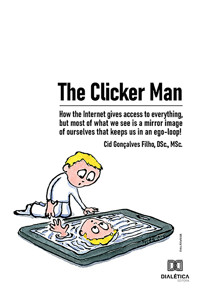
This book is about our device-oriented society, in which most of the population (including children) is online during a significant part of their lives. It relates technically the why our society should debate the way we deliver and consume information. Most of us are creating a sense of reality based on bubbles of closed-loop information and relationships. As approximately 95% of users of search engines stop their search on the first page presented, this page is (mostly) a mix of the completely standardized page (the same everybody who types a keyword receives) with a bit of personalization. Similar behavior takes place on social media, which is more loop-centered in the same groups, friends, and related content. These behaviors generate an ego-echo system that, to satisfy consumers, returns them to what they request, creating a semi-autistic process, in which new knowledge is not necessarily added. The process creates an instantaneous series of point and search activities (one search lead to the next), resulting in an unstructured learning process based on previous behavior. In this sense, this booklet aims to create a debate to improve knowledge creation and learning in the digital world, as humankind has created a spectacular knowledge base that is being improved to develop our societies.
Sie lesen das E-Book in den Legimi-Apps auf:
Seitenzahl: 32
Veröffentlichungsjahr: 2021
Das E-Book (TTS) können Sie hören im Abo „Legimi Premium” in Legimi-Apps auf:
Ähnliche














PREFACE
As approximately 95% of users of search engines stop their search on the first page presented, this page is (mostly) a mix of the completely standardized page (the same everybody who types a keyword receives) with a bit of personalization. Similar behavior takes place on social media, which is more loop-centered. It generates an ego-echo system that, in order to satisfy consumers, returns them to what they want, creating a semi-autistic process, in which new knowledge is not necessarily added, and presented under request, resulting in an unstructured learning process. This speech is a list of concerns and suggestions to improve this internet ecosystem, to contribute to the improvement of this valuable group of service providers.
SUMÁRIO
Capa
Folha de Rosto
Créditos
1. THE DEVELOPMENT OF HUMANKIND KNOWLEDGE
2. THE NETWORK EFFECT AND HOW IT CHANGES THE WAY WE LEARN AND SOCIALIZE
3. THE ERA OF VIRTUALITY: ARE WE PREPARED?
4. THE NETWORK PARADOX – I CAN LEARN AND ACCESS ALL EXISTING KNOWLEDGE: WHAT ABOUT STRUCTURED AND UNSTRUCTURED KNOWLEDGE?
5. THE EGO LOOP: EVERYTHING CONFIRMS I AM RIGHT
6. SELF-ESTEEM AND IMPULSIVE BEHAVIOR: LET’S CLICK NOW!
7. THE UNSTRUCTURED KNOWLEDGE - I LEARN EVERYTHING ONLINE, BUT NOT ….
8. THE FUTURE: QUESTIONS, ANSWERS, AND POSSIBLE SOLUTIONS
REFERENCES
Landmarks
Cover
Title Page
Copyright Page
Table of Contents
Bibliography
1. THE DEVELOPMENT OF HUMANKIND KNOWLEDGE
In the last thousand years, the development of knowledge passed through different journeys and methods. Since the beginning, families, and tribes kept their knowledge in their minds and transmitted it to new generations through habits and cultures. There was no written knowledge. As transportation was difficult, a lot of different languages, religions, and cultures were formed worldwide (i.e., Europe), as populations were not able to contact each other, with the use of the horse growing after the bronze age.
The development of this variety of cultures was disrupted by the use of papyri or papyrus (circa 300 BC), which enabled the documentation of extant knowledge of a society. This paper, as we know it, was invented by the Chinese in 105 AD. Fossils that were similar to homo sapiens date back to 300,000 years ago. This means that we began to document knowledge after 280,000 years of humankind. The printing press was invented in Germany by Johannes Gutenberg circa 1440, around 600 years ago, and the first viable electric light bulb was invented in October 1848 by Thomas Edison, approximately 170 years ago.
The recent classic model of education utilized books, physical schools, teachers, and libraries. The model was formal and education consisted (depending on the country/region/culture) of a vast array of content (from Greek philosophy to the Indian Vedas), organized in a sequence of disciplines presented by experts who used documents stored in a library. The first library in the world, built-in Nineveh in the 7th century BC., was conceived by King Assurbanipal II and held a collection of 25,000 clay plates with cuneiform texts. Possibly the most important library in history was in Alexandria, which held around 700,000 rolls of papyrus and parchments.
For many years, universities, colleges, and research institutes have been considered the greatest sources of knowledge. With knowledge stored in libraries and the experts’ minds, those who seek quality education should physically move to these places, and, regulated by governments and local entities, take structured courses that are part of a relatively stable list that includes medicine, engineering, physics, philosophy, and pharmacy. The process is sequential, structured, and formalized.




