


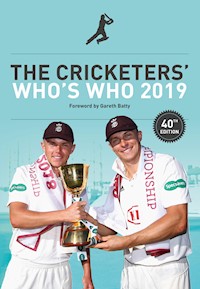
The Cricketers' Who's Who 2019 E-Book
7,99 €
Mehr erfahren.
- Herausgeber: G2 Rights
- Kategorie: Lebensstil
- Sprache: Englisch
The Cricketers' Who's Who is the essential guide to the English cricket season, and is the must-read accompaniment for anyone interested in the English game, including fans, players and journalists. Produced by All Out Cricket in association with the Professional Cricketers' Association, 2019 marks the 40th edition of the English cricket bible. Now get it on your smartphone or tablet for easy reference at the match, watching TV or listening to Test Match Special.
Das E-Book können Sie in Legimi-Apps oder einer beliebigen App lesen, die das folgende Format unterstützen:
Veröffentlichungsjahr: 2019
Ähnliche




















CONTENTS
OPENERS
FOREWORD – Gareth Batty
EDITOR’S NOTES – Benj Moorehead
THE WORLD CUP IN ENGLAND – Matt Thacker
TEN ICONIC MOMENTS OF ENGLISH T20 CRICKET
JAMES ANDERSON: A TRIBUTE – Emma John
ENGLAND MEN’S FIXTURES
KEY
THE TEAMS
THE PLAYERS
ENGLAND WOMEN
THE UMPIRES
ROLL OF HONOUR
FOREWORD
By Gareth Batty
Welcome to the 2019 edition of The Cricketers’ Who’s Who, a book which always used to be knocking around the county dressing rooms when I started playing in the 1990s and still is all these years later.
This will be my 23rd season as a professional cricketer and I am looking forward to it as much as I did my first in 1997. County cricket is a way of life. It challenges you but it gives you so much fulfilment and joy and a real sense of belonging to something bigger: the great game of cricket. After a full county season a lot of overseas pros will say: “Wow. I don’t know how you do that every year. But I’m glad I’ve done it because it’s an amazing thing to be part of.”
You could ask my Surrey colleagues from last year or the Essex boys in 2017 about what’s it’s like to go through an English season and absolutely break yourself to then win something at the end of it – particularly the County Championship. The Championship is a wonderful tradition. I understand that traditions have to change for the better, but we also have to understand we have an incredible product. Our first-class system is the best in the world.
Surrey winning the title in 2018 was a culmination of a lot of things, not least the club’s hard work to get the finances in such a good state. We have excellent coaching and facilities. Alec Stewart, Surrey’s director of cricket, also spent a lot of time making sure that young players weren’t on their own but that there was a crossover between seniors and youngsters. And he made a great effort to instil the identity of the club within the players.
Then last summer, the captain Rory Burns grabbed it by the horns. He drove the lads forward and got the best out of everybody. The best thing about Rory is that he’s a Surrey boy through and through. He’s been through the good and the bad times and understands what you need to play for the club, and he passes that down to the younger players.
Looking at the broader picture from an English spinner’s perspective, it does concern me that there is a lack of desire among counties to get spinners involved in Championship cricket. This is largely because it’s all about getting results, which I understand. Clubs think: ‘We’ll just get four big lads on a green seamer, and the ball will swing, that’s our best chance of winning.’ A lot of people complain about all the 70-75mph seamers in England, but if you’re playing in April then those sort of bowlers are going to be very successful.
The only way to change it is somehow to have more four-day cricket played in the middle of the summer. That way teams would need spinners to get results. We need to be mindful that the beauty of our game requires it to have different skillsets for it to have an attraction to everybody.
It’s the job of everybody in county cricket to produce good players and I am delighted to see my old club Worcestershire doing such a magnificent job to bring through local youngsters and create a unique bond between them. That’s why they were so successful last summer, winning the T20 Blast. I tell you what: even if all those guys at Worcester don’t see each other for 10 years, when they get together again it will be like they saw each other yesterday. That’s the bond you get and that’s the thing I will miss most when I retire.
A lot of you who have played club cricket will know exactly what I am talking about, and I wish you all the best of luck for the 2019 season. For all us England supporters, it’s shaping up to be an exciting summer, with good reason to believe the team can triumph in the World Cup and then the Ashes series which follows. Fingers crossed.
Gareth Batty
March 2019
EDITOR’S NOTES
By Benj Moorehead
Welcome to the 40th edition of The Cricketers’ Who’s Who.
That’s four decades of cajoling, nagging, pleading and blackmailing county cricketers up and down the land to fill in our unique questionnaire. Once, a pair of Surrey players, whose misfortune it was that our headquarters are located on their home ground, were frogmarched into the office a day before deadline and told they could not leave until it was done. Full, proper answers please boys. We’ll stop at nothing.
It’s a formidable operation, but one can only imagine what it was like when Iain Sproat, the Conservative MP and founder of this annual, first went about the business in the 1980s. No internet. No media managers to do all that nagging on our behalf. No formalised pre-season photo sessions to provide a picture for each player; in the preface to the first edition in 1980, Sproat thanks a “Mr. Bill Smith, F.R.P.S., who personally took most of the photographs”. We tip our hat to you sirs.
Elsewhere in that understated preface, Sproat talks about respecting the players’ wishes: “Some cricketers, for example, are prepared to give both their address and their phone number, others prefer to give one and not the other.” We live in different times. Certainly we didn’t have the gall to ask, say, Joe Root for his number or full postal address (ideally both) so that we could tell the rest of the world.
The annual has evolved over the years; where once it was more of a formal, information-gathering exercise, now it seeks to unearth an anecdote or two to embellish the facts. But the essence remains the same: to bring to life all those hundreds of cricketers who might otherwise be merely a name on a scorecard. And, who knows, to provide the odd giggle along the way.
It tells you something about a person when you know they plan “to run an international not-for-profit scaling-up development program in Sub-Saharan Africa” (see page 418); that their favourite quote comes from Roosevelt’s ‘The Man in the Arena’ speech in 1910 (page 492); that they built the local clubhouse with their own bare hands (page 247); that they cried when Alastair Cook was dismissed in his final Test innings (page 519). Or to know which book means most to them, a spectrum which includes 1984, The God Delusion, the Quran, Jack Shantry’s benefit brochure, Kama Sutra and Cats Galore: A Compendium of Cultured Cats.
We are hugely grateful to all the players who completed their questionnaire, and to all the county press officers who spurred them to do it. This book would not be what it is without them.
* * *
Our 40th edition coincides with what some have billed the biggest cricketing summer in a generation. First England host a World Cup for which they will be most people’s favourites (we kick-off our Comment section with Matt Thacker’s whistle-stop tour of the four previous World Cups held in this country). Then follows an Ashes series which, unlike recent contests between England and Australia, feels timely and hard to call. The Aussies are undergoing some sort of ethical cleansing after that ball-tampering row, with the chief culprits – Steve Smith, David Warner and Cameron Bancroft – due to come back into the fold this summer. For their part, England appear to be trying to steal the “mercurial” tag from Pakistan. Meanwhile England Women will be attempting to win back the Ashes for the first time since 2014 and avenge their home defeat of four years ago.
There is also a sense that this will be the last English summer as we know it, with the ECB’s city-based 100-ball competition due to begin next year (in case you hadn’t heard). New teams and a new format are significant changes, but the endless tweaking of the summer calendar has hardened fans and players as much as a stint at fine leg on a blustery day at Derby. We are used to the earth moving below our feet; as long as there are bowlers and batsmen – and space for some red-ball cricket – then we are content enough.
That said, the arrival of The Hundred does leave an uncertain future for the T20 Blast competition, which could be forgiven for feeling like an older sibling having to contend with a new-born rival. Surely there is space for only one upstart in English cricket’s family? With this in mind, we celebrate 10 iconic moments of our domestic T20 competition since it began in 2003, from a shirt-wielding Mark Ramprakash to a Paul Nixon wonder catch. Not forgetting the day when a jam-packed Rose Bowl crowd cheered on a man with a bucket of paint.
Our Comment section concludes with Emma John’s beautiful tribute to James Anderson, the man who has taken more wickets than any other fast bowler in the history of Test cricket and, no less uniquely, has become entrenched in English hearts and minds as Our Jimmy. Can’t you already hear it? That slurred chant on a warm evening in late summer at The Oval, the final day of the fifth Test, with the Ashes on the line and England needing one wicket to win. Oh Jimmy, Jimmy…
Benj Moorehead
March 2019
COMMENT
HOME DISCOMFORTS
It’s coming home, it’s coming home, it’s coming... cricket’s coming home. You can just hear it, can’t you? Sunday 14 July, Lord’s, packed house, the champers and beer started to kick in some time ago. The noise swells, buffeting the members’ ears in the Pavilion, subsides, then stirs again, relentless, coming from somewhere deep inside. Matt Thacker on why it’s still something of a long shot
A home win appears all very possible, despite the fact that England, famously, have never won any of the 11 editions of the cricket World Cup. We have fared marginally better in rugby (one from eight) and football (one from 21) – those solitary wins might be slim pickings but the fans of those sports don’t half go on about them. Still. Winning a World Cup is a big thing.
When I say England (and we), I mean it in a wrong-headed, sexist kind of way, i.e. the men, because it hasn’t been 44 years of hurt for our women’s cricketers, far from it. Back in 1973, before the men had the nous to multitask their way to long-form and short-form cricket, the inaugural cricket World Cup was held in England, the hosts pipping Australia on points in what was a de facto final at Edgbaston. And they won three more of the next 10 editions besides, for a more-than-handy record of four from 11.
The last of those wins, in 2017, took place on another blissful July day at Lord’s, with England overcoming India by nine runs in a thriller that has changed the course of women’s cricket in the competing nations forever. Apart from those two instances, which bookmark the history of the women’s tournament, England have been hosts on only one other occasion, 1993, when they beat New Zealand in the final at Lord’s. So, three World Cups on home soil, three wins. Easy-peasy.
Which bring us to the men. This year will be their fifth attempt at lifting the trophy at Lord’s and over the years it’s been a story, by and large, of diminishing returns. Semi-finalists; finalists; semi-finalists; laughing stocks. The only way, it would seem, is up.
Back when it all began in 1975, the world of cricket was a very different place. As Madan Lal came jogging in to John Jameson in the 19th one-day international ever played, there was little understanding that short-form cricket was anything more than a hit-and-giggle diversion from the proper first-class stuff. England’s 334 in 60 overs in that first World Cup game was monstrous, mountainous. In new money, it was probably worth 500. India’s opening bat, the great Sunil Gavaskar, was so disheartened that he didn’t bother putting on his hiking boots, preferring to carpet-slipper his was to a bat-carrying 36 not out from 174 balls. Genius.
Over a sun-kissed two weeks, things got better, but not much better. The eight competing teams included East Africa and Sri Lanka, who were blown away by West Indies but showed real fight against Australia, despite Duleep Mendis copping a sickening blow on the head from Jeff Thomson, who hospitalised Sunil Wettimuny in the same innings, leading an uncomprehending policeman to ask the latter if he wanted to press charges against his assailant.
There was only one really close game, when West Indies pulled off a one-wicket win against Pakistan at Edgbaston, and the semi-final between England and Australia at Headingley was notable for Garry Gilmour’s 6-14 from 12 overs. Gilmour went on to take five in the final but played only one more ODI. Weird game, cricket.
Clive Lloyd lit up Lord’s in that final, stroking and bludgeoning his way to a sublime hundred and following it up with 12 tidy overs. The Aussies were never quite out of it, but never quite in it either. Five run-outs, three of them effortlessly effected by Viv Richards, hardly helped their cause.
When Dennis Lillee joins Jeff Thomson at the fall of the ninth wicket, 59 are required. The pair slaps and scraps 34 of them when Thommo spoons the ball straight to a grateful Roy Fredericks at cover and the crowd invades the field. Nobody registers that a no-ball has been called. Then it dawns on Fredericks, who shies at the non-striker’s end with Lillee way out of his ground. The ball misses and is engulfed by the sea of onrushing fans. Ever the pragmatists, Lillee and Thomson simply get their heads down and keep on running. When things quieten down, the batsmen ask umpires Bird and Spencer how many runs they are going to award. “Two,” guesses Spencer. Thomson explodes and Lillee suggests to Bird that they have run about 17. The decision of four seems about right. Three balls later, it’s all over, with a run-out of course.
Four years on, we were back to do it all again. By the start of this tournament, 60 ODIs had been and gone. This edition also contained eight teams and was played in the same, two-groups-of-four, all-over-in-a-fortnight format. Why change a winning formula? It was almost as if, in the gap between the two World Cups, we had not seen the most seismic change there had ever been in the sport: Kerry Packer’s World Series Cricket, with its floodlights, helmets and coloured clothing.
Back in the land where change came more slowly (although the month before the World Cup we had just elected our first female PM), Canada came in for East Africa and had about as much success, their nadir being bowled out by the hosts in 40.3 painstaking overs for 45, then the lowest total in an ODI. India lost every game, taking their World Cup record to played six, won one. England, having squeezed past New Zealand in the semi-final, found themselves up against the mighty West Indies at Lord’s in the June showpiece. Mike Brearley opted to bowl first and West Indies were struggling at 99-4. Enter the King. Supported by King. Viv Richards was magisterial, his unbeaten 138 a lesson in one-day batting, and Collis King was even more brutal, a 66-ball 86 giving him a strike-rate that in the ’70s was pretty much unheard of. In reply to 286-9, Brearley and Boycott bedded in, took the shine off the new ball, set the platform. It took our Geoffrey 17 overs to reach double figures, at which point he was dropped by Clive Lloyd. It is not known whether Boycs wandered over to the West Indies captain to tell him he’d just dropped the World Cup. Reaching 129 runs in 38 overs left England needing another 160 in 22. Gettable. In 2019. But this was 1979 and, with Joel Garner’s yorkers spearing in from above the sightscreen, England lost their last eight wickets for 11 runs.
In 1983 there was still no real thought that the World Cup would take place anywhere other than Blighty. And there was to be no tinkering with the formula. ODIs were now a ‘thing’ but there had still been less than 200 of them by the time England and New Zealand faced off at Lord’s on 9 June. There was a definite improvement in the standard of the smaller nations – it’s often forgotten that India beat West Indies at Old Trafford in the group stage – with Zimbabwe shocking Australia and Sri Lanka beating New Zealand. And there was a dawning understanding that ODIs did not have to be played like mini-Test matches. India’s battery of miserly dibbly-dobblies squeezed the life out of England in the semi-final at Old Trafford and then did the same to West Indies at Lord’s after Roberts, Marshall, Garner and Holding had restricted them to 183. Kapil Dev’s over-the-shoulder catch to get rid of Viv, who had come to see St John’s Wood as his personal fiefdom for World Cup final day, was the pivotal moment (Richards had made just 33). And when India’s captain lifted the trophy, the cricket world changed forever. It is no exaggeration to say that the make-up of the modern game stems from 25 June, 1983, the day India fell head-over-heels in love with one-day cricket.
The balance of cricketing power now altered completely. The next World Cup took place on the subcontinent and it was to be 16 years before the trophy rocked up on these shores again, a very different beast from when we last saw it close-up. Coloured clothing, pinch-hitters, slower balls, leg-side wides, a Duke’s ball, 50 overs rather than 60, a cast list of 12 teams and, sigh, Australian dominance. The world had moved on. And there was a whole new concept to deal with – the Super Sixes, when sides carried forward points gained in the group stages. Oh, and 21 venues, including Cardiff, Edinburgh, Dublin and Amstelveen.
England started well, beating defending champions Sri Lanka in the tournament-opener (ODI No.1443) and then crushing Kenya, but it was downhill thereafter. Batterings at the hands of South Africa and India sandwiched a win against Zimbabwe, but the dawdle to their target in that match ultimately saw the home side lose out on net run-rate to the Zimbabweans, who went through to the next stage at England’s expense by upsetting South Africa at Chelmsford.
England were out. Out, in fact, before their official Word Cup song was. But the party goes on even if the host is absent and the Super Sixes saw some thrilling cricket, including a game between sub-continental superpowers India and Pakistan at a time when the two nations were officially at war. The second stage culminated in Australia’s stunning five-wicket win against South Africa, powered by an unbeaten Steve Waugh ton, and the same two sides came face to face at Edgbaston in the second semi-final (after Pakistan had breezed past New Zealand) for what may be the most tense game of ODI cricket ever played.
Australia are defending 213 and, thanks to Shane Warne’s 4-29 – including a ball to get rid of Herschelle Gibbs which recalled Gatting in ’93 – they manage to leave the last pair of Lance Klusener and Allan Donald with nine to get off the final over. Brutal boundaries from Klusener off Fleming’s first two deliveries leave the scores tied. One needed off four to send South Africa through. Dot ball (and a missed run-out). And then, the mix-up of all mix-ups. Klusener calls; Donald doesn’t respond; then does; then drops his bat; the ball is relayed back to Gilchrist; the bails are off. The match is tied and the Aussies are through, based on their superior net run-rate in the Super Sixes.
The final was a huge anticlimax, a Warne-inspired Australia routing Pakistan, their win coming in one ball over 20 overs. A taste of things to come…
And so to this year, two decades on. Personally, I can’t wait for Bastille Day, when there will be approximately 1.5 billion people tuning in to see cricket coming home… I hope it delivers.
TEN ICONIC MOMENTS OF ENGLISH T20 CRICKET
With a 100-ball domestic competition starting next summer, the T20 Blast will no longer stand alone as county cricket’s box-office attraction. The tournament has been an unqualified success since it was launched as the Twenty20 Cup in 2003, drawing bumper crowds and producing some logic-defying cricket. To celebrate its final year in the limelight, we have chosen 10 moments over the last 16 years that define what this competition is all about. Note that these are iconic moments, not necessarily best moments, so we make no apologies for including a Bumble-Flintoff duet
MARK RAMPS IT UP
Hampshire v Surrey, Southampton, 2006
Throw together Mark Ramprakash’s intense competitive instincts, a boisterous home crowd at Hampshire and a knife-edge clash between two cocksure heavyweights, and you get this: a tetchy tear-up that turned postal at the death, with Ramprakash getting shirty after running out last-man Billy Taylor to seal a 10-run win. Wound-up after sparring with the crowd all night, Ramps’ final act tipped him over the edge. He whipped off his Surrey shirt and set off around the outfield, veins throbbing, face contorted, swirling the offending garment around his head. Later regaining some semblance of the plot, Ramprakash was savvy enough to request security after the game, and though he escaped to tell the tale and triumph later that year in Strictly, the resurrected ‘Bloodaxe’ nickname, which had followed him around since his early days at Middlesex, would stick right through till the end of his garlanded career.
NAPIER’S RAPIER
Essex v Sussex, Chelmsford, 2008
Graham Napier never quite knew his own strength. He always seemed more at ease as a quality seamer and merry lower-order hitter than a bona fide county allrounder. And yet with the bat, on his day, there were few in the world who could match his explosiveness. On this occasion, Napier was blessed with two slices of fortune. One, Essex were experimenting with their line-up and just that morning had decided to throw him in at No.3; and two, this group match happened to be on TV. Striding out in the third over, Napier was quickly into his work, eyeing the short straight boundaries at Chelmsford and in particular the river behind the Tom Pearce Stand. Once he got going, he was unstoppable. His century came up in 44 balls, and the next 52 runs were pummelled from 14 deliveries. In the final analysis, his unbeaten 152 had been found to contain 16 sixes – a T20 world record and since surpassed only by Chris Gayle (twice). For a time, before Gayle got busy, Napier held perhaps the coolest record: he was the only man to have hit 16 sixes twice in a professional innings, after repeating the feat against Surrey at Guildford in 2011 – in a County Championship match.
BRING OUT THE WHITEWASH
Hampshire v Somerset, Final, Edgbaston, 2010
This was all the drama and perversion of T20 cricket rolled into the last ball of the tournament. Hampshire require one run to tie and win on fewer wickets lost, but on-strike batsman Dan Christian needs a runner. Problem: no crease lines for the runner. “Bring out the whitewash!” calls David Lloyd from the commentary box, and moments later the groundsman is painting lines on the adjacent strip, each stroke of his brush cheered by a sell-out Rose Bowl crowd. Finally the job is done, Jimmy Adams has emerged as Christian’s runner, and Somerset seamer Zander de Bruyn is ready. Thud. Huge cry for lbw. Very close. Not out. At which point Christian forgets everything and scrambles to the other end for the winning leg-bye. So does his runner.
The Hampshire team pour onto the pitch, then halt: is the game over? There are two batsmen at the non-striker’s end. Somerset need merely to break the wicket at the striker’s end to run out Christian and they will win. Yet in all the chaos, this fact does not occur to any one of the fielding side. The umpires wait to see if the penny drops, and then call time. “It’ll probably haunt me for a few years,” says Marcus Trescothick once the dust has settled.
SUPPIAH ON FIRE
Glamorgan v Somerset, Cardiff, 2011
The T20 competition has been awash with big stars over the years, but it never ceases to produce unlikely heroes. Look at Worcestershire’s Pat Brown: a virtual unknown until he bowled his club to T20 glory last summer with 31 wickets, the second-most in the competition’s history. Brown is likely to play for England, but for Arul Suppiah in 2011 it was a case of one fleeting and glorious moment on top of the world. An allrounder born in Kuala Lumpur, Suppiah was predominantly an opening batsman who bowled some left-arm spin. This was his 10th season at Somerset and he had never taken a five-for in any format of the game. His career had stuttered along at Taunton, 1,000 first-class runs in 2009 an exception to a modest record. In 2013 a chronic knee condition would force him to retire at the age of 29 with first-class batting and bowling averages of 32 and 58. But he remains the man with the best T20 figures on the planet: 6-5! No matter that it was against Glamorgan on a raging turner at Cardiff; no matter that only one of his wickets was a top-five batsman. Let no one dare topple King Suppiah and ruin a brilliant quiz question.
FANTASTIC MR FOX
Leicestershire v Somerset, Final, Edgbaston 2011 Victory and a spectacular one-handed grab to dismiss Kieron Pollard provided the perfect climax to 40-year-old Paul Nixon’s professional career in England as he helped his beloved Foxes secure their third T20 triumph by defeating Somerset at Edgbaston. Leicestershire, who had posted a modest 145-6, believed the comeback was on from the moment that edge nestled into Nixon’s mitts. Foxes skipper Matthew Hoggard would later describe the catch as a “sprinkling of magic in a fairytale”. Somerset were now 89-4 with their West Indian big gun back in the pavilion, and Josh Cobb went on to claim 4-22 with his part-time off-spin as Leicestershire won by 18 runs. It was a timely boost for the financially-stricken county, who had also triumphed in 2004 and 2006. Leicestershire’s unrivalled success in the T20 Cup is the best example of how this competition has been an inspiration for some of the humble underdogs, including Northamptonshire (2013 and 2016) and Worcestershire (2018), to overcome the swanky powerhouses.
BIG WILLEY STYLE
Northamptonshire v Surrey, Final, Edgbaston, 2013
Fondly described as a “loose cannon” by his Northants captain Alex Wakely, David Willey came out all guns blazing in a one-sided final, dishing out some verbals to Jade Dernbach – “I don’t really like the bloke, to be honest,” admitted Willey – before slamming Surrey’s attack for a 19-ball fifty. He was then a man possessed in the field, clean-bowling Jason Roy and running out Steven Davies with a direct hit from the boundary before sealing the trophy with a hat-trick, finishing with figures of 4-9 in a shock win for the unfancied Steelbacks. Willey has continued to be one of the competition’s most iconic performers and personalities, smashing a 40-ball century in the 2015 quarter-final against Sussex and hitting a club record 118 off 55 balls two years later for his new side Yorkshire versus Worcestershire, all the time displaying the sort of ferocious commitment which has been a hallmark of English domestic T20 cricket.
IT TAKES TWO
Lancashire v Yorkshire, Old Trafford, 2018
Boundary ‘relay’ fielding was once a gentler thing, one player producing a sliding save on the floor while another mopped up the loose ball and sent it back to the wicketkeeper. However, the all-action nature of T20 has stirred the players to perform the sort of acrobatics that has the crowd gasping. The ‘relay catch’ typically involves a flying fielder parrying the ball just as it sails over the rope while an accomplice stands by to pounce. Not uncommon these days, but in 2014 the same two fielders completed two of the greatest relay catches in the space of two weeks. First at Old Trafford, the Roses match no less. Tom Smith smites the ball back over the bowler’s head, and Yorkshire’s Adam Lyth leaps backward on the boundary, catches the ball and then releases it mid-air before he has crossed the line. Aaron Finch collects a simple catch. Then to Headingley against Leicestershire. Another straight hit, same Houdini act from Lyth, only this time Finch has to dive low to scoop up the rebound with his right hand. It beggared belief, just as much as the fact that Lyth has no mention on the scorecard for either dismissal.
GAYLE FORCE
Somerset v Kent, Taunton, 2015
It took the undisputed king of T20 a long time to make his way to the T20 Blast, but he looked a man determined to make up for lost time when he got there in 2015. Signed by Somerset for a three-game stint, Gayle tallied 328 runs and 29 maximums in three innings before slipping off again, presumably to some other lucrative T20 tournament in a far point of the globe. He warmed up with 92 off 59 against Kent and finished off with 85 off 49 against Hampshire, but the pièce de résistance was 151 off 62 on his Taunton debut, at the time the fifth-highest T20 score in history and still third for sixes in an innings (15). Amazingly, Somerset lost a high-scoring match, Gayle able to muster only 12 runs from the last four balls when 16 were needed. “I thought Sam Northeast [115] played a sensational innings [for Kent], but then the World Boss came in and it’s different gravy,” said Matthew Maynard, then Somerset coach. “However good Sam’s innings was, it just pales a little bit… Words can’t explain exactly what we have seen today. He makes it looks so easy and strikes the ball so cleanly.”
UH-HUH
Bumble and Freddie, Finals Day, Edgbaston, 2017 Finals Day has rarely been all, or even much, about the cricket, with three back-to-back T20s serving as a backdrop to a binge of off-pitch revelry including the annual mascot race and fire cannons galore. And, in 2017, a sing-off between David Lloyd and Andrew Flintoff, Bumble and Freddie, who dressed up as Johnny Cash and Elvis to serenade the Edgbaston crowd in the build-up the final. This may not be everybody’s cuppa, but it was quintessential T20 froth. First we had a gravelly Bumble doing Cash’s ‘Folsom Prison Blues’ and then an uneven Freddie treated us to ‘Suspicious Minds’ before the two came together for a ‘Sweet Caroline’ duet. Bumble’s Cash impression wasn’t bad at all, though the mock-guitar playing needs a bit of work, but Flintoff, moonlighting as Elvis, was never going to be put in the shade. Like an intern at karaoke night, he started nervously but grew into his performance, and soon the natural showman was on full display. A stumble over a speaker as he proceeded on a backwards lap of honour was a reminder of a famous escapade in a pedalo, but by that point the crowd were too pissed to notice.
GAME OF ROSES
Lancashire v Yorkshire, Old Trafford, 2018
It’s been said that county cricket’s local derbies have lost a little of their lustre in recent times but the rivalries are alive and kicking in the domestic T20 competition, with bumper crowds regularly turning out to watch their team lock horns with their neighbours. Matches between Middlesex and Surrey attract in excess of 25,000 fans. Last summer a crowd of 22,515 packed into Emirates Old Trafford – a record figure outside London – to watch the ‘Game of Roses’ fixture, and they were treated to yet another nail-biting thriller between two star-studded line-ups. Some early rain did nothing to dampen the spirits of the crowd, who created a cacophonous atmosphere and witnessed more than 350 runs in a 14-oversa-side smash which went down to the final delivery. Yorkshire needed four off the last ball but Kane Williamson could only scramble two as the hosts claimed a one-run victory and the local bragging rights.
FROM FROSTED TIPS TO GRIZZLED GREY
Emma John on growing up with James Anderson
I missed the wicket [pictured, right]. There are few places on earth, now, where sports scores can’t reach you, but I wasn’t strictly on earth. As I’d sat in Gatwick airport, eating my pre-flight Pret baguette, India had been 300-5, and KL Rahul was dug in like an obstinate aardvark. I’d listened as long as I could, until the air steward, wearing a surprisingly loud plaid jacket and a tight little smile, had marched down the aisle doing his take-off checks.
It was too much to hope that the flight deck might keep us clued in. I’ve flown a couple of times during football and rugby World Cups, when partisan pilots have announced their team’s victory over the public-address system and it’s been the best entertainment on offer. I was travelling Air New Zealand when the All Blacks beat France in the 2011 World Cup final and the plane broke into spontaneous applause. But I didn’t imagine that the crew of our Norwegian Air vessel, bound for Boston, Massachusetts, were pestering air-traffic control for updates from the final day of England’s fifth Test against India at The Oval.
It was the middle of the night in Britain when I landed and hastily agreed to whatever terms and conditions Logan airport’s wifi was demanding of me. There is a reckless incontinence to the sports fan unwillingly separated from an important game, and as I stood in the port-of-entry line I furiously flouted the signs forbidding cellphone use. At least, until I had the information I wanted. James Anderson had taken his 564th wicket with the last ball of the match.
A few days later I tried to explain to some American friends the significance of his achievement. It was historic, I said. No other pace bowler in Test cricket had dismissed so many batsmen. And the real significance was in overtaking Glenn McGrath because he was an Australian icon who… I had forgotten that other people’s sporting statistics are very rarely interesting. They listened politely and went back to talking about the Red Sox, who it turned out were having their own record-breaking season.
Usually I’m not that bothered about figures, and lists, and rankings. In fact, before Jimmy started making his charge, my instant recall of the all-time top-10 wicket-takers probably wouldn’t have extended far beyond Warne and Murali. The more we were told that their figures were untouchable, never to be replicated, the less attention I paid to the rest.
Anderson’s own rise through the ranks had snuck up on me. He was the solid core of a bowling attack that sometimes struggled at its periphery; the man whose return always felt the best hope of a breakthrough. But there was something about his presence in the England team that was so dependable and understated that it was easy to take his wickets for granted. But still they came. His contribution to the team – to the sport – had become so large as to be almost impossible to see any more. He wasn’t the greatest pace bowler in the world. He was just our Jimmy.
For me the best way to get some perspective on James Anderson isn’t to look at numbers on a page, but pictures on a screen. One glance at the frosted tips with which he greeted the international scene demonstrates how far he’s travelled. Nothing against that haircut, you understand (if it worked for Justin Timberlake, why would there be any reason to doubt it?). But the young face with its hedgehog topping is a powerful reminder of how sportspeople tend to grow up on the job.
For a start, it’s a reminder that his first sensational appearances came considerably before the 2005 Ashes. There’s such a sense of legacy about that series that Anderson is, rightly, deemed an inheritor of their mantle. It’s a jolt to think that two years before that series, he was one of the few England bowlers to emerge from a World Cup in credit.
I’ve always thought the narrative around his early England career was a little unfair. But then, I was biased from the start. The moment he fizzed onto my TV screen, I was a believer. His raw energy, combined with the banana splits he could perform with the ball, held me spellbound. No matter that Andy Bichel and Michael Bevan took 12 runs off his final over at Port Elizabeth, ensuring that England failed to reach the Super Sixes. If he hadn’t already taken 10 wickets in that 2003 tournament, we wouldn’t have been in with a hope.
Three months later he took a five-for on his Test debut. And yes, it was only against Zimbabwe, and yes, it was at an overcast Lord’s in May. But neither of those factors were Anderson’s choosing. He took five wickets for 73, and 17 of those came off his first over. All of them were won with his peculiar head-down bowling action, which meant that at the moment of releasing the ball, Anderson was actually looking at the ground. If Paul Adams was a frog in a blender, Jimmy was a hamster whose feet were sellotaped to the bottom of his wheel.
I remember how quickly the tide of popular opinion turned against him, and how angry I was when it did. Anderson had been propelled into the international set-up, aged 20, with only a single Second-XI season behind him; he still played many of his games for Burnley and had barely been involved in Lancashire age-group cricket. But a combination of that admittedly unsustainable bowling style, and an indisputably expensive Test account – in his first four years he went for 3.74 runs an over – were enough for many to lose patience and write him off.
Certain bona fide cricket experts, amused by my ardent defence of his natural talent, told me that he was a busted flush, and that he’d never amount to anything. Stories swirled that the England bowling coaches, in trying to correct his action, had broken him entirely. The Anderson narrative, to the gossipy outside world, became that of a precocious child-star who hadn’t got what it took for the grown-up game. Those who had been suspicious of his fashion-forward haircuts and his t-shirted James Dean ’tude were now at liberty to interpret these as the superficial trappings of a sulky teen.
* * *
Many of us fall for our sporting heroes pretty early. This footballer or that pole vaulter takes our fancy – for whatever reason – and we’re committed to them for the rest of their careers, and potentially the rest of our lives. When I started following cricket, my idols were all a good 10 to 20 years older than me. But as the years go by, the age-gap closes, descending with the slow yet ruthless inevitability of one of those stone walls threatening to crush Indiana Jones, or at least to separate him from his fedora.
And yet the men representing the team I loved always seemed so much more adult than me. You notice I don’t use the word mature – it would be hard to argue that Andrew Flintoff’s pedalo escapades or Kevin Pietersen’s, well, anything, spoke particularly well of their wisdom or decision-making at the time. But it never occurred to me, when that 2005 Ashes team were in their pomp, that we were comparable in age – I didn’t even notice that Steve Harmison and I were born a month apart.
The men I saw on the field belonged to a world far removed from my own late-20s experiences. These guys were married. They had kids. They drove Volkswagen Touaregs. They probably didn’t come home and make “vegetable surprise” with the half-an-onion and partially mouldy carrot they found in the bottom of their fridge.
So yes, James Anderson was the first England cricketer who didn’t make me feel like an ingénue (OK, fine, a student) by comparison. He was four years younger than me, and he looked it. I was sent to interview him by the Wisden Cricketer magazine in 2003, and our hour together was a slightly awkward session of fumbled questions and mumbled replies.
He had the red streak in his hair, then, and 11 Test wickets. I remember feeling very self-conscious, and sorry for him, that he’d been forced to sit in an airless hotel room talking to a woman with whom he had absolutely nothing in common.
I also remember how very hard he was trying, in the long pauses where he looked away at the flimsy beige walls surrounding us, to think about his responses, to offer something acceptable. He was nothing like as cocksure as his hair. And his reticence wasn’t sullenness, it was shyness. I wanted to tell him it would all be OK. It was possibly the first maternal twinge I’d ever had.
It was that experience with James Anderson that made me such a passionate advocate for Andy Murray too, back in the late 2000s when the common belief was that he was a grouchy, petulant kid who choked when the heat was on. It infuriated me that the very qualities that made Murray Britain’s first real contender in world tennis in 70 years – his single-minded focus, his indifference to image, his lack of interest in much outside his sport – were the very traits everyone wanted to knock.
Anderson improved, of course. Like Murray, it took years, and it took dedication. The people who knew him best weren’t surprised. Mike Watkinson, who was Anderson’s coach in the Lancashire Second XI, and one of the first to talk to him about swing, encountered a young man who was quick to listen and act on what he was told. Watkinson could recall a particular game against Middleton, when he’d discussed some bowling theories with Anderson just before play. He watched as his protégé put them into practice that very day.
“He picked things up fast,” Watkinson told me. “But he also had his own thoughts on his game, and put a lot of time into analysing the opposition. He was quietly thorough in his personal preparation – a real thinker on the game.” It’s an attribute that people are quick to credit him with today; less so back then.
Anderson has changed in very few fundamentals. The many characteristics that he is lauded for today – his aggressive intent on the field, his laidback humour off it, his lack of ego, his determination to perfect every art of swing bowling – were all there, in embryonic form, in the 25-year-old with a Test bowling average of nearly 40. The transformative element has been nothing more than time itself.
And that, I think, is why his greatness has crept up on us. Or maybe it’s just on me. I’ve always considered myself his biggest fan – short of anyone who’s got a tattoo, or a shrine, or a restraining order. I’ve always been primed to sing his praises to the unconverted – often at stages in his career when many would argue he hadn’t yet earned them.
But when you’re growing up alongside your heroes, it’s hard to spot that they’re growing up too. Just like it’s hard to recognise a golden age when you’re the one basking in its glow. I spent far too much of the past decade worrying about whether England were going to come away with a first-innings lead, or who was the best choice of fourth seamer, or why there was such a dearth of spin in the UK, to fully appreciate Anderson’s incredible journey to the top.
Swing bowling is a deceptive craft in more than one way. There’s the magic of the ball in flight and the mystery of the physics behind it. There’s the bowler’s own sleight of hand – literally, in Anderson’s case, when he hides the ball in his run-up to cloak his intent. But there’s another misleading element too – the fact that many of a bowler’s best deliveries are the ones never immortalised on the scoreboard. All those brilliant outswingers and devastating inswingers that bamboozle the batsmen too much to touch his bat or take his wicket.
Anderson may have upward of 500 scalps in his satchel but his true worth cannot be counted in those alone. His world-beating achievement in 2018 has come about because of the 148 Tests he has played, and the 32,335 balls he has delivered. Because of the 15 years that he has given, unstintingly, to his pursuit of excellence. A little less than half his life, spent in the colours of his national team. Somehow, that’s as inspiring to me as any top-10 list.
This article appeared in the 2019 spring edition of The Nightwatchman, the Wisden Cricket Quarterly which specialises in long-form articles by an array of international authors
ENGLAND
FIXTURES
CAPTAIN: Joe Root (Test), Eoin Morgan (ODI/T20I)
COACH: Trevor Bayliss
2019 SUMMER FIXTURES
May 3
Ireland vs England
Only ODI
Dublin
May 5
England vs Pakistan
Only T20I
Cardiff
May 8
England vs Pakistan
1st ODI
The Oval
May 11
England vs Pakistan
2nd ODI
Southampton
May 14
England vs Pakistan
3rd ODI
Bristol
May 17
England vs Pakistan
4th ODI
Trent Bridge
May 19
England vs Pakistan
5th ODI
Headingley
May 25
England vs Australia
ICC World Cup Warm-up
Southampton
May 27
England vs Afghanistan
ICC World Cup Warm-up
The Oval
May 30
England vs South Africa
ICC World Cup
The Oval
June 3
England vs Pakistan
ICC World Cup
Trent Bridge
June 8
England vs Bangladesh
ICC World Cup
Cardiff
June 14
England vs West Indies
ICC World Cup
Southampton
June 18
England vs Afghanistan
ICC World Cup
Old Trafford
June 21
England vs Sri Lanka
ICC World Cup
Headingley
June 25
England vs Australia
ICC World Cup
Lord’s
June 30
England vs India
ICC World Cup
Edgbaston
July 3
England vs New Zealand
ICC World Cup
Chester-le-Street
July 24
England vs Ireland
Only Test
Lord’s
August 1
England vs Australia
1st Test
Edgbaston
August 14
England vs Australia
2nd Test
Lord’s
August 22
England vs Australia
3rd Test
Headingley
September 4
England vs Australia
4th Test
Old Trafford
September 12
England vs Australia
5th Test
The Oval
KEY
THE PLAYERS
THE TEAMS
LHB – Left-hand batsman
LB – Leg-break bowler
LF – Left-arm fast bowler
LFM – Left-arm fast-medium bowler
LM – Left-arm medium bowler
LMF – Left-arm medium-fast bowler
MCCU – Marylebone Cricket Club University
MVP – Denotes a player’s presence in the top 100 places of the 2018 PCA County
MVP Rankings (the number next to ‘MVP’ denotes the player’s specific placing)
OB – Off-break bowler
R – 1,000 or more first-class runs in an English season (the number next to ‘R’ denotes how many times the player has achieved this feat)
RF – Right-arm fast bowler
RFM – Right-arm fast-medium bowler
RHB – Right-hand batsman
RM – Right-arm medium bowler
RMF – Right-arm medium-fast bowler
SLA – Slow left-arm orthodox bowler
SLW – Slow left-arm wrist-spin bowler
UCCE – University Centre of Cricketing Excellence
W – 50 or more first-class wickets in an English season (the number next to ‘W’ denotes how many times the player has achieved this feat)
WK – Wicketkeeper
* – Not-out innings (e.g. 137*)
(s) – A competition has been shared between two or more winners
C&G – Cheltenham & Gloucester Trophy (English domestic 50-over competition, 2001-2006)
CB40 – Clydesdale Bank 40 (English domestic 40-over competition, 2010-2012) CC1/CC2 – County Championship Division One/Division Two
FP Trophy – Friends Provident Trophy (English domestic 50-over competition, 2007-2009)
Gillette – Gillette Cup (English domestic limited-overs competition, 1963-1980)
NatWest – NatWest Trophy (English domestic limited-overs competition, 1981-2000)
Pro40 – NatWest Pro40 (English domestic 40-over competition, 2005-09)
REL – A player has been released by the relevant county
RET – A player has retired
RL50 – Royal London One-Day Cup
(English domestic 50-over competition, 2014-19)
T20 Cup – English domestic T20 competition (2003-19)
YB40 – Yorkshire Bank 40 (English domestic 40-over competition, 2013)
NOTES: The statistics given for a player’s best batting and best bowling performance are limited to first-class cricket. A field within a player’s career statistics which is marked with an ‘-’ indicates that a particular statistic is inapplicable, e.g. a player has never bowled a ball in first-class cricket. All stats correct as of March 11, 2019
DERBYSHIRE
TEAM PROFILE
FORMED: 1870
HOMEGROUND: The Pattonair County Ground, Derby
ONE-DAY NAME: Derbyshire Falcons
CAPTAIN: Billy Godleman (Championship and RL50), TBC (T20)
2018 RESULTS: CC2:7/10;RL50:5/9
North Group; T20:7/9 North Group
HONOURS: Championship: 1936; Gillette/NatWest/C&G/FPTrophy: 1981; Benson&Hedges Cup:1993; Sunday League:1990
THE LOWDOWN
Revamping the coaching set-up is becoming an annual tradition at Derby. Following Kim Barnett’s resignation last July, Dave Houghton has returned to the club as head of cricket, with previous T20 coach John Wright taking up an advisory role. Backroom support will ease the strain on captain Billy Godleman, who effectively ran the first team after Barnett’s departure. Houghton arrives at a time when Derbyshire are the mid-table masters, but it’s also true that the club were competitive in T20 and 50-over cricket last summer, while in Division Two they were 29 points off a third-placed finish which this season would earn promotion. As one of the game’s most respected batting coaches, Houghton should stiffen a fragile top-order which has lost Ben Slater, one of its more consistent performers, to Nottinghamshire. Wayne Madsen cannot do it on his own, while Godleman will want to channel his white-ball form into the Championship. Keeper Harvey Hosein, 22, takes the gloves on a long-term basis following Gary Wilson’s release. Hardus Viljoen has left but Kiwi allrounder Logan van Beek will sharpen the seam attack in all formats.
IN: Logan van Beek (NZ), Tom Lace (Mid, loan), Kane Richardson (Aus, T20)
OUT: Will Davis (Lei), Ben Slater (Not), Callum Brodrick, Hardus Viljoen, Gary Wilson (all REL)
HEAD OF CRICKET: DAVE HOUGHTON
A former Zimbabwe captain, Houghton averaged 43 from 22 Tests after his country acquired Test status in 1992. He has vast experience on the county circuit, with previous stints as batting coach for Derbyshire, Somerset and most recently Middlesex. He was head coach at Derbyshire between 2004 and 2007. Houghton will be supported by former Gloucestershire quick Steve Kirby, who has been appointed assistant and bowling coach. Dominic Cork is another addition to the backroom staff – the ex-Derbyshire allrounder will be head coach for the T20 campaign.
COUNTY CHAMPIONSHIP A VERAGES 2018
Catches/Stumpings:
25 Madsen, 11 Hosein (inc 1st), Smit, 9 Critchley, Hughes, Wilson, 8 Godleman, 7 Wilson, 4 Ferguson, 3 Slater, 2 Andersson, Brodrick, Dal, Ervine, Hosein, Qadri, Rampaul, Reece, 1 Footitt, Lace, Palladino, Viljoen
ROYAL LONDON ONE-DAY CUP AVERAGES 2018
Catches/Stumpings:
14 Smit, 5 Wilson, 3 Hughes, Madsen, 2 Brodrick, Olivier, Rampaul, Reece, Slater, Viljoen, 1 Critchley, Godleman, Qadri
VITALITY BLAST AVERAGES 2018
Catches/Stumpings:
11 Wilson, 8 MacLeod, 5 Critchley, Ferguson, 4 Dal, Hughes, Rampaul, 3 Madsen, 2 Godleman, Riaz, Smit (1st), Viljoen
DURHAM
TEAM PROFILE
FORMED: 1882
HOME GROUND: Emirates Riverside, Chester-le-Street
CAPTAIN: TBC
2018 RESULTS: CC2:8/10;RL50:9/9 North Group; T20: Quarter-finalists
HONOURS: Championship: (3)2008, 2009, 2013; Gillette/NatWest/C&G/FP Trophy: 2007; Pro40/NationalLeague/CB40/YB40/RL50:2014
THE LOWDOWN
In trying times, it was something for Durham to have avoided the Championship wooden spoon last summer, and there was an uplifting run to the T20 knockout stages. Little more can be expected in 2019, when the club will be without two pillars of the north-east: Paul Collingwood, who retired after 22 seasons at Chester-le-Street, and Geoff Cook, who stood down as director of cricket to end a 27-year association with Durham. Cook’s replacement is the ex-Australia batsman Marcus North, with former New Zealand and Middlesex allrounder James Franklin heading the coaching staff. Their main task is to develop, and keep hold of, the club’s emerging players. Among them are Cameron Steel, their only batsman to pass 500 Championship runs last summer, and Gareth Harte, who scored his first two hundreds in first-class cricket. The departure of Kiwi international Tom Latham is cushioned by the arrival of Cameron Bancroft, who will not be short of incentive as he returns from his ball-tampering ban ahead of this summer’s Ashes. The bowling looks capable, with Chris Rushworth still going strong and Matt Salisbury enjoying a breakthrough season in 2018. Seamer Ben Raine, who has re-signed from Leicestershire, is an excellent addition. As for Mark Wood, who knows?
IN: Alex Lees (Yor), Ben Raine (Lei), Cameron Bancroft (Aus), D’Arcy Short (Aus, T20)
OUT: Ryan Davies, Barry McCarthy (both REL), Paul Collingwood (RET)
DIRECTOR OF CRICKET: MARCUS NORTH
North, who turns 40 in July, played 21 Tests for Australia as well as scoring over 4,000 first-class runs for six different counties, including a successful season for Durham in 2004. He spent the past three seasons as CEO at South Northumberland CC. Jon Lewis has left after six rollercoaster seasons as head coach, with James Franklin taking the role of lead high performance coach as part of a structural overhaul overseen by North.
COUNTY CHAMPIONSHIP AVERAGES 2018
Catches/Stumpings:
35 Poynter (inc 1st), 12 Collingwood, 9 Clark, Steel, 8 Latham, 7 Davies, 5 Smith, 4 Harte, Markram, 3 Lees, Richardson, 2 McCarthy, Rushworth, Stokes, 1 Coughlin, Patel, Pringle, Rimmington, Salisbury, Weighell, Wood
ROYAL LONDON ONE-DAY CUP AVERAGES 2018
Catches/Stumpings:
7 Poynter (1st), 4 Richardson, 3 Rushworth, 2 Clark, Latham, Pringle, Rimmington, Smith, 1 Collingwood, Dixon, Potts, Steel, Wood
VITALITY BLAST AVERAGES 2018
Catches/Stumpings:
16 Poynter (3st), 11 Latham, 9 Clark, Trevaskis, Weighell, 5 Collingwood, Davies, 4 Smith, 3 Pringle, Whitehead, 2 Rimmington, Tahir, 1 Rushworth, Stokes, Wood
ESSEX
TEAM PROFILE
FORMED: 1876
HOMEGROUND: The Cloudfm County Ground, Chelmsford
ONE-DAY NAME: Essex Eagles
CAPTAIN: Ryanten Doeschate
2018 RESULTS: CC1:3/8;RL50: Quarter-finalists; T20:7/9 South Group
HONOURS: Championship: (7) 1979, 1983, 1984, 1986, 1991, 1992, 2017; Gillette/NatWest/C&G/FP Trophy: (3) 1985, 1997, 2008; Benson & Hedges Cup: (2) 1979, 1998; Pro40/National League/CB40/YB40/RL50: (2) 2005, 2006; Sunday League: (3) 1981, 1984, 1985
THE LOWDOWN
Winning the Championship can leave quite a hangover – just ask Middlesex – but Essex finished comfortably in the top three last summer and produced a thrilling victory at The Oval to deny the champions an unbeaten record. The rivalry with Surrey is shaping up very nicely. The Porter-Harmer axis was irresistible again in 2018 (262 wickets between them across the last two seasons), while 21-year-old seamer Sam Cook is rising fast. Peter Siddle, who signed a two-year contract in September, completes a potent attack. Runs were harder to come by, though Essex were hardly alone in that regard. Alastair Cook’s decision to play on until at least 2021 will have sent a chill through county bowlers. For such a multi-dimensional side, the Eagles’ annual T20 failure is a mystery; they won two of 14 matches in 2018. Varun Chopra led the way with 503 runs – to go with 528 in the One-Day Cup – but, Adam Zampa apart, the bowling was a collective failure. Thus the return of Zampa and Mohammad Amir is welcome. For the first time this century Essex will be without James Foster, who retired after the club did not renew his contract.
IN: Peter Siddle( Aus), Mohammad Amir (Pak, T20), Cameron Delport (Lei, T20), Adam Zampa (Aus, T20)
OUT: Matt Dixon, Callum Taylor, Ashar Zaidi (all REL), James Foster (RET)
HEAD COACH: ANTHONY MCGRATH
McGrath helped deliver back-to-back titles in Division Two and Division One as assistant coach and took over the reins in 2017 after Chris Silverwood’s appointment as England bowling coach. McGrath spent an 18-year playing career at Yorkshire, for whom he scored more than 23,000 runs and took 240 wickets in all formats. He played four Tests and 14 ODIs for England. Former South Africa and Essex fast bowler Andre Nel has replaced Dimitri Mascarenhas as assistant coach.
COUNTY CHAMPIONSHIP AVERAGES 2018
Catches/Stumpings:
24 Wheater (inc 1st), 14 Foster (inc 1st), 13 Harmer, ten Doeschate, 10 Lawrence, 8 Bopara, Browne, 7 Chopra, 6 A Cook, 3 Wagner, 2 Porter, Westley, 1 Coles, S Cook, Vijay
ROYAL LONDON ONE-DAY CUP AVERAGES 2018
Catches/Stumpings:
13 Wheater (inc 1st), 4 Bopara, Harmer, ten Doeschate, 3 Snater, Zaidi, 2 Chopra, Lawrence, Wagner, 1 Coles, S Cook, Westley
VITALITY BLAST AVERAGES 2018
Catches/Stumpings:
13 Wheater (inc 2st), 8 Harmer, 5 Lawrence, 2 Bopara, Chopra, Coles, Siddle, Walter, Zampa, 1 Pepper, Porter, Snater, Zaidi
GLAMORGAN
TEAM PROFILE
FORMED: 1888
HOME GROUND: Sophia Gardens, Cardiff
CAPTAIN: Chris Cooke (Championship and RL50), Colin Ingram (T20)
2018 RESULTS: CC2: 10/10; RL50: 9/9 South Group; T20: 6/9 South Group
HONOURS: Championship: (3) 1948, 1969, 1997; Pro40/National League/CB40/YB40/RL50: (2) 2002, 2004; Sunday League: 1993
THE LOWDOWN
Something had to give after a season in which Glamorgan finished bottom of Division Two – by 34 points – and bottom of their One-Day Cup group, losing 17 of 22 matches across both formats. Robert Croft has gone after three difficult years as coach, with Matthew Maynard stepping in on an interim basis, and former captain Mark Wallace is the new director of cricket, leaving Hugh Morris to focus on his role as chief executive. Chris Cooke has replaced Michael Hogan as the Championship and 50-over captain. Glamorgan’s faith in homegrown youngsters is admirable but patience is wearing thin – no batsman who played more than four Championship matches averaged 30 last summer and there were only six hundreds in all, three of them by Usman Khawaja. Aneurin Donald, once the great hope of Welsh cricket, is starting afresh at Hampshire while Shaun Marsh’s availability is uncertain. The bowling was the problem in 50-over cricket but that department will be boosted by a fit-again Marchant de Lange. Yorkshire-born Charlie Hemphrey, who resurrected his career in Australia after playing Second XI county cricket, will add depth to the batting. Colin Ingram, bought by Delhi Capitals for this year’s IPL, will skipper the side in the T20 Blast but is not expected to appear in four-day or 50-over cricket.
IN: Billy Root (Not), Charlie Hemphrey (unattached)
OUT: Aneurin Donald (Ham)
HEAD COACH: MATTHEW MAYNARD
Maynard had a three-year spell as Glamorgan coach between 2008 and 2010 and returned as a batting consultant last season following a stint as Somerset’s director of cricket. His appointment is on an interim basis, with a long-term replacement for Robert Croft to be sought after the season. A dashing batsman for Glamorgan during a 20-year career, Maynard made a club-record 54 centuries and was a key figure in the side that won the County Championship in 1997. He played four Tests and 14 ODI
COUNTY CHAMPIONSHIP AVERAGES 2018
Catches/Stumpings:
42 Cooke (inc 1st), 21 Selman, 8 Salter, 7 Hogan, 5 Carlson, 4 Murphy, 3 Brown, Cook, Lawlor, Lloyd, 2 Bull, Cullen, Donald, Khawaja, van der Gugten, 1 de Lange, Marsh, Morgan, Sisodiya, Smith
ROYAL LONDON ONE-DAY CUP AVERAGES 2018
Catches/Stumpings:
11 Cooke (inc 1st), 4 Lloyd, 3 Donald, Ingram, 2 Salter, Selman, 1 Brown, Carey, de Lange, Wagg
VITALITY BLAST AVERAGES 2018
Catches/Stumpings:
13 Cooke (inc 3st), 10 Donald, 6 Carlson, van der Gugten, 5 Hogan, 4 Lloyd, Salter, Smith, 3 Ingram, 2 Wagg, 1 Khawaja, Meschede, Selman
GLOUCESTERSHIRE
TEAM PROFILE
FORMED: 1871
HOME GROUND: The Brightside Ground Bristol
CAPTAIN: Chris Dent (Championship and RL50), Michael Klinger (T20)
2018 RESULTS: CC2: 5/10; RL50: 7/9 South Group; T20: Quarter-finalists
HONOURS: Gillette/NatWest/C&G/FP Trophy: (5) 1973, 1999, 2000, 2003, 2004; Benson & Hedges Cup: (3) 1977, 1999, 2000; Pro40/National League/CB40/YB40/RL50: (2) 2000, 2015




