


54,99 €
Mehr erfahren.
- Herausgeber: John Wiley & Sons
- Kategorie: Wissenschaft und neue Technologien
- Sprache: Englisch
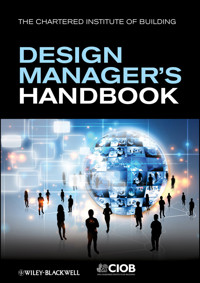
Design management as a recognised role in the built environment industry is relatively new, initially arising from the need for better co-ordination and delivery of design information from design teams to main contractors - particularly important as procurement routes involving contractor led design have become much more commonplace. The advent of design packages driven by specialist sub-contractors has also increased the need for co-ordination and management of the design process. With the growing complexity of construction projects, effective design management is increasingly central to project success. BIM, as it gains acceptance across the industry will undoubtedly have a huge impact on project delivery process and the role of the Design Manager.
The CIOB Design Manager’s Handbook covers subjects such as design process and management tools, the role of the Design Manager, value management and innovation, procurement routes and implications, people dynamics, and factors that will affect the development of the Design Manager’s role in the future, including BIM. It will ensure Design Managers understand the processes, tools and skills that are required to be successful in the role, and will assist them in delivering real value to complex construction projects.
Written for both the Design Manager practitioner and students on construction related degree courses, anyone interested in construction based design management will also find the book useful.
Sie lesen das E-Book in den Legimi-Apps auf:
Seitenzahl: 432
Veröffentlichungsjahr: 2013
Ähnliche


















Table of Contents
Title page
Copyright page
Dedication
Epigraph
Foreword
Preface – ‘My Why’
Acknowledgements
Special thanks to guest contributors
CIOB Working Group
Note to the reader
Abbreviations
1 Introduction
Introduction
Definition
So who is the Design Manager?
Consumer contractor
Design quality
The DM role
The Design Manager
Hallmarks of DM
Stages of DM
The CIOB Design Manager’s Handbook
Conclusion
2 Process
Introduction
Get some ‘TCQ’ – Time, Cost, Quality in DM
Defining the landscape
Supplementary definitions
Definition commentary
Four stage process
Roles
Titles
Starting and finishing
The overall project context
Where is the value?
Leveraging value
Integrating the team
Process models
BIM, process and the future
BS 7000: Part 4
BS1192: 2007
CIC Scope of Services 2007
The RIBA Plan of Work
Salford Process Protocol
Office of Government Commerce – The OGC Gateway™ Process
Avanti
DM and CDM – Health and Safety
DM and Cost Management
Last Planner
To sum up – A few thoughts
3 DMTCQ
The CIOB Design Manager’s Handbook
DMTCQ: The CIOB Design Management Benchmark
4 Tools
Introduction
Animations, fly-throughs
Appointment documents
Audits
BREEAM
BSRIA Framework for Design Services
Building Regulations
Carbon emissions and energy modelling
Code for Sustainable Homes
Contractor’s Proposals
Deliverables Schedule
DM Project Plan
DQI – Design Quality Indicator
Employer’s Requirements
Fire engineering
Information Required Schedule
Interface matrix
Matrix of Package Responsibilities
Meetings
Models, virtual, physical
Peer reviews
Planning (Development Control)
Programmes
Reports
Resources schedules
Risk assessments/schedules
Samples/Benchmarks/Prototypes/Mock-ups
Schedules of services
Scope documents
Simulations
Stage reviews
Status of information
Teams
Tests
Tolerance/Movement Schedule
You Yourself
5 Procurement
Introduction
Traditional
Traditional with CDP (Contractor’s Designed Portion)
Single stage D + B (Design and Build)
Two stage D + B
The Employer’s Requirements
The Contractor’s Proposals
The ERs/CPs conversation
6 Value and innovation
Introduction
What is value?
Right from the start
The Value-Management (VM) framework
DM + VM
The Kano Model – ‘The Delighter’
7 People
Introduction
Changing times
Tribes
What makes a tribe?
The tribe of design
The tribe of construct
Processes in conflict
Transition
One tribe
The tribe of solutions
It’s in the DNA
Teamthink
Dynamics
Fun and joy
Know yourself
Values
8 Training
Introduction
Training
9 Quality
Introduction
Process
Design Quality Indicator
Post-Occupancy Evaluation
The quality envelope
Design and build
Design integrity
Impact and legacy
10 Stories
Introduction
Biographies
Case studies
11 Future
Introduction
Tsunamis
And then along came BIM . . .
Afterword
Addendum – October 2012
BIS BIM strategy
Appendices
APPENDIX A: Lean Project Delivery – innovation in integrated design & delivery
Abstract
Introduction
Why is integrated project design and delivery important?
Lean Project Delivery
Value
Set-based design
Evidence-based design
Gluing it all together
Commercial terms
Insurance
Operating system
Organisation
Target Value Design
Project definition
Lean design
Lean supply
Lean assembly
Integrated Project Delivery
Issues for further research
Conclusions
Acknowledgments
APPENDIX B: The ‘ADePT’ methodology for planning and managing the design stage of projects – Paul Waskett and Andrew Newton
Introduction
The ADePT methodology
Lessons learned
Future developments
APPENDIX C: Choosing by Advantages
Why use CBA?
What is CBA?
What sort of situations call for CBA?
CBA and Value Management
How do I use CBA?
How can I learn CBA?
APPENDIX D: Delivering value – A Guidance Note for Design Managers
But first, what is Value? . . .
So how can we maximise value? . . .
What methods should Design Managers understand? . . .
And how do these methods work? . . .
How is value management deployed?
Some tips for getting started . . .
Some examples of what works . . .
Signposts for further reading . . .
APPENDIX E: Style, Behaviours & your ‘Leadership Moments’
Introduction
Individual Styles & Behaviours
Leadership Moments
Summary
APPENDIX F: Educating the Design Manager of the future
APPENDIX G: Facilitating workshops
‘The Rules’
Six Thinking Hats
Bibliography
Index
This edition first published 2013
© 2013 The Chartered Institute of Building
Blackwell Publishing was acquired by John Wiley & Sons in February 2007. Blackwell’s publishing programme has been merged with Wiley’s global Scientific, Technical and Medical business to form Wiley-Blackwell.
Registered office:
John Wiley & Sons, Ltd, The Atrium, Southern Gate, Chichester, West Sussex, PO19 8SQ, UK
Editorial offices:
9600 Garsington Road, Oxford, OX4 2DQ, UK
The Atrium, Southern Gate, Chichester, West Sussex, PO19 8SQ, UK
2121 State Avenue, Ames, Iowa 50014-8300, USA
For details of our global editorial offices, for customer services and for information about how to apply for permission to reuse the copyright material in this book, please see our website at www.wiley.com/wiley-blackwell.
The right of the author to be identified as the author of this work has been asserted in accordance with the UK Copyright, Designs and Patents Act 1988.
All rights reserved. No part of this publication may be reproduced, stored in a retrieval system, or transmitted, in any form or by any means, electronic, mechanical, photocopying, recording or otherwise, except as permitted by the UK Copyright, Designs and Patents Act 1988, without the prior permission of the publisher.
Designations used by companies to distinguish their products are often claimed as trademarks. All brand names and product names used in this book are trade names, service marks, trademarks or registered trademarks of their respective owners. The publisher is not associated with any product or vendor mentioned in this book. This publication is designed to provide accurate and authoritative information in regard to the subject matter covered. It is sold on the understanding that the publisher is not engaged in rendering professional services. If professional advice or other expert assistance is required, the services of a competent professional should be sought.
Library of Congress Cataloging-in-Publication Data
Eynon, John.
The design manager’s handbook / John Eynon, RIBA MAPM FCIOB CEnv., consultant/director, Open Water Consulting Ltd.
pages cm
Includes bibliographical references and index.
ISBN 978-0-470-67402-4 (pbk. : alk. paper) 1. Building–Planning–Handbooks, manuals, etc. 2. Building–Superintendence–Handbooks, manuals, etc. 3. Construction industry–Planning–Handbooks, manuals, etc. I. Title.
TH438.E98 2013
624.068'4–dc23
2012028579
A catalogue record for this book is available from the British Library.
Wiley also publishes its books in a variety of electronic formats. Some content that appears in print may not be available in electronic books.
Cover design by Steve Flemming
Cover image courtesy of Shutterstock
To my father, Kenneth James Eynon, 1925–2008
A gentle, private and resolute man who built his home in my heart
If you just want to do the 9–5, go home at night and not think about improving at DM at all, then this book probably isn’t for you.
However, if you want to grow in your understanding and your role, and ‘poke the box’ or push the boundaries of your thinking, then you’ll find some ideas here to get you started!
‘Those who have aimed at acquiring manual skill without scholarship have never been able to reach a position of authority to correspond to their plans, while those who relied only upon theories and scholarship were obviously hunting the shadow, not the substance. But those who have a thorough knowledge of both, like men armed at all points, have the sooner attained their object and carried authority with them.’
– Vitruvius, On Architecture, 1st century BCPerhaps the first commentator on Design Management!
Foreword
Design Management, to most, is a relatively new form of consultancy.
Its history dates back to the huge increase in Design and Build contracts in the late 1980s. During that period there was a fundamental shift away from traditional contracts, where architects ran the construction contract. D&B offered many benefits to clients, most notably a fixed price and a fixed programme. Design Managers at the time usually came from a construction background and their task was to take an existing design, already developed up to planning level, and procure the work for the best possible price with either the original architect or a new design team. However, it was often associated with erosion in terms of design quality, since finance and speed were the most important measures of success.
Over the last fifteen years there has been a significant change in the role, owing to the emergence of government-funded projects such as LIFT, BSF and other forms of PFI. These projects involved all forms of public buildings including libraries, town halls, health centres and schools amongst others. The challenge for the construction industry in these projects was that architects and the rest of the design team would now be employed from the very earliest stages by a contractor, and therefore the contractors needed to act as clients from day one.
It was in this area that the industry lacked experience. Traditional Design Managers were more used to procuring an ‘oven-ready’ design and lacked skills in briefing and the team building necessary to motivate consultants in a positive manner. On the other side, design teams lacked skills in understanding the link between design, cost and construction in the fast-track programming that accompanied these new forms of procurement. For the very first time, contractors, engineers and architects needed to work together from the very earliest stages if they were to win lucrative contracts. It was in this arena that Design Managers became a vital component of the team, forming a bridge between good design and clever construction. The new Design Managers came from all sides of the industry: architects, engineers and surveyors as well as contractors. They often became ‘translators’ for both parties, and this handbook highlights the complex set of skills needed to make the job a success.
The many well-designed public buildings procured, particularly over the last five years, are a testament to the way the construction industry has embraced these new challenges and I believe successful design management has been the vital component. Over the last few years we have seen the process become more sophisticated as the industry has learned how to improve its service to clients by embracing new technologies such as BIM, off-site manufacture and standardisation in an attempt to provide more affordable solutions in these austere years. In this sense, the role remains more important than ever.
This is the first time such a handbook has formally set out the scope and tasks necessary to perform Design Management and as such I believe it will become a ‘bible’ within the industry for many years to come.
Paul Monaghan is an Architect and a founding director of Allford Hall Monaghan and Morris (ahmm.co.uk). The practice was founded in 1989 and now works worldwide. Paul works on a wide range of projects, including masterplanning, arts, educational buildings, housing, offices, public buildings and health buildings. Recently completed projects under his direction include Kirk Balk Community College, Anne Mews, Villaggio in Ghana, Unity on Liverpool’s historic waterfront, Latitude House, Barking Central, Westminster Academy and Kentish Town Health Centre. He is currently working on a further wide range of projects, including Nine Elms, several high-profile schools and the reinvention of Liverpool’s Royal Court Theatre.
Paul has lectured throughout the UK, and has been an external examiner at several Universities, including Liverpool, Westminster and Southbank. He has been Vice Chair of the CABE Schools Design Review Panel and is currently on the CABE National Design Review Panel. Paul has been chairman of the Young Architect of the Year awards, and up until 2010 chaired the RIBA awards panel. He is also a RIBA Client Design Advisor.
Preface – ‘My Why’
Welcome to the CIOB Design Manager’s Handbook!
A while ago I read a book by Robert Pirsig called ‘Zen and the Art of Motorcycle Maintenance’. In his book he discusses the philosophy of maintaining your motorcycle and the key ingredient that you need – ‘Gumption’.
‘I like the word “gumption” because it’s so homely and so forlorn and so out of style that it looks as if it needs a friend and isn’t likely to reject anyone who comes along. I like it also because it describes exactly what happens to someone who connects with Quality. He or she gets filled with gumption!
‘A person filled with gumption doesn’t sit around dissipating and stewing about things. He’s at the front of the train of his own awareness, watching to see what’s up the track and meeting it when it comes. That’s gumption.
‘If you’re going to repair a motorcycle, an adequate supply of gumption is the first and most important tool. If you haven’t got that, you might as well gather up all the other tools and put them away, because they won’t do you any good.’
The same could be said of the Design Manager. It is an under-sung role, not for the faint-hearted, right in the fulcrum and the heat of project delivery – and gumption is a key requirement.
An alternative title for the Handbook might have been ‘Zen and the Art of Design Management’, but that probably wouldn’t have found favour with the powers that be!
So why the Design Manager’s Handbook?
From my earliest time as a site-based Design Manager I always wanted to join up the bigger picture on DM. It is so easy to become isolated on site or in an office and not be aware of wider opinion and current thinking. For myself, I find that understanding the broader context helps me to make sense of my own role and contribution.
I think I’ve always wanted to connect things or make connections, because beneath the surface, life is so much more connected and holistic than we recognise sometimes, or can imagine. My aim in working with the CIOB on Design Management is to connect – people, knowledge and experience, to enable communication and collaboration.
‘DM is intrinsically connected – to be effective, it has to be!’
It also seemed to me that ‘Design’ was looked upon as something of a ‘black art’ by many people in construction, rather like oil and water – there is this perception that they don’t mix! (Or perhaps they can … as we shall see later!) And yet as I have talked to people from across the industry, in different sectors, different businesses and organisations, the same kinds of issue have emerged: confusion about the role, limited understanding of the scope and potential of DM, lack of recognition, profile and worth for DMers.
DM can be such an intangible proposition sometimes, but you can certainly experience the results and outcomes. There is no silver bullet here. Good Design Management is not rocket science. Simply by good planning, communication, collaboration and management, combined with effective teamwork, and the use of the right tools and techniques, it is possible to achieve outstanding results and produce real value for our customers. In addition, we can have a positive experience while we’re in the process, as well as obtaining the desired end result.
This Handbook collects together much of what I’ve learned over the years, combined with the input of a few others who have joined with me on this journey.
The book is for all those brave souls engaged in the DM role on a daily basis: whatever type of business they’re in, site-based or in an office, standing in that ‘fuzzy’ zone between design and construction. It is written more from a contractor’s perspective, as that represents most of my experience now. However the processes, tools and concepts should be familiar to all, whatever seat round the project table they currently occupy.
It is my aspiration that this Handbook, together with the other thrusts of the CIOB Design Management project, will draw some threads together, ‘connect’, and enable Design Management in construction to come of age.
As we continue on this journey, I want to give everyone involved in DM some context and focus, as well as providing a platform upon which they can work, be understood, grow their roles and careers – and as a consequence to firmly plant DM on the construction sector map.
It is my hope that the CIOB DM project will give focus to everyone involved in Design Management across the industry, and enable the discussions to take place and the questions to be heard.
My experience is that most people involved in DM love to share ideas, communicate, collaborate and innovate. They are passionate about what they do.
My aim is to get people talking together about DM, sharing their experience and ideas on how to do things better than the last time around. The results of such communication and collaboration will be truly exciting, and will make a significant contribution to taking our industry forward. And to be honest, I’ve had a great time doing this, discussing DM with people across the industry, exchanging ideas and discussing how can we do things better and take the industry forward.
In writing the Handbook, and working with many people discussing Design Management over the last few months, I have been awestruck by the rich diversity of opinions and ideas – there is no vacuum, and there is never a short discussion! This Handbook is the first step in enabling that wider discussion and exchange of ideas to take place, and providing a focus for debate. In time I hope it will develop into a consensus on the activity and the role, as well as providing a best-practice model for DM within our industry.
John EynonBrightonMarch 2012
Acknowledgements
As with any project, this has been a team effort. Many people have had an input or influence on the development of the Handbook in many different ways, and here I can mention only a few.
The Board of the Faculty of Architecture and Surveying of the CIOB, particularly John Hughes, Simon Matthews, Craig Hatch and Bob Giddings. They believed in the idea of a DM project at the start and kept the momentum going forward.
Asmau Nasir-Lawal of FAS, who has worked with me on the group and also the DM conference.
Saleem Akram at the CIOB, who put me on the spot, pushed me in the right direction in producing the Handbook, and has provided ongoing support.
My ‘A team’ at the CIOB: Sarah Peace, Veronica Dunn and Una Mair, who have provided exemplary admin support, guidance and encouragement and kept me on the straight and narrow. Sarah has been a good friend, mentor and guide throughout the entire process of bringing this book together – without Sarah, we simply would not have got here!
I’d also particularly like to mention my old ‘governor’ at Carillion, Paul Shadbolt; we discussed design management all the time, and looking back I can see that Paul triggered a lot of ideas that have come together in the CIOB project.
John Rivett, who over my time in DM has been both a good friend and a mentor.
Alec Newing, who has helped ‘tend the DM garden’ with me over the last few years, and kicked around all sorts of ideas.
Alan Mossman, who has made me pause and think on many an occasion, but always for the good, and who has made several valuable contributions to the Handbook.
Saima Butt, for her perceptive insights into how as human beings we contribute to the project process and also for our many thought-provoking discussions.
Michael Graham, who has provided some distinctive perspectives on the value of design and the value-management process.
My wife Anne-Marie, who has lived with the ups and downs of putting this book together for some considerable time, but has given me the space and support to do it.
Although I don’t know them personally, Seth Godin and Simon Sinek; I have found their blogs and writings truly inspirational.
And finally for this section – to colleagues and friends at Carillion and Wates and to all the DMers, designers and constructors, and everyone else I have worked with in the last 30 years. In some way you have all shaped my thinking, which has somehow found its way into this Handbook.
Special Thanks to Guest Contributors
The Handbook and appendices include a number of contributions by others, which I have included because they are topics of interest about how our industry is developing and because they might form jumping-off points to provoke further research and learning by DMers reading the Handbook. Special thanks to them all for their time, and the effort and ideas they have contributed.
CIOB Working Group
As part of the CIOB project on Design Management, we have had a working group ‘chewing the fat’ over various aspects of DM. Many thoughts and ideas from our several meetings have found their way into the Handbook, and for that I am thankful for everyone’s input and generosity with their time. The discussions were challenging, stretching, thought-provoking, but always positive and constructive, and they brought home to me the diversity of opinion, and the depth and breadth of the impact that DM has had on the industry, businesses, projects and people.
CIOB DM Working Group members
John Eynon
FAS Board (Chair)
Asmau Nasir-Lawal
FAS Board
Alec Newing
DM Professional
Anthony Kelly
University of Greenwich
Chris Allen
Vinci Construction Group Plc.
Diane Dale
CIAT
John Rivett
Wates Group
Keith Snook
CIAT
Michael Graham
UK Value Management
Paula Bleanch
Northumbria University
Philip Yorke
DM Professional
Sam Allwinkle
CIAT
Sarah Peace
CIOB
Scott Fenton
3D Reid
Stephen Emmitt
Loughborough University
Tahar Kouidar
Robert Gordon University, Aberdeen
Tara Pickles
CIAT
Una Mair
CIOB
Veronica Dunn
CIOB
Note to the Reader
The Chartered Institute of Building, CIOB, has various Faculties, one of which is the Faculty of Architecture and Surveying (FAS). Over the last few years on FAS we have been discussing Design Management, and out of these discussions has arisen the Design Management project:
The CIOB DM project has four main objectives:
to produce The Design Manager’s Handbook
to hold a DM conference
to develop a learning and development framework for DM
to facilitate the formation of a cross-industry SIG for Design Management.
For further information, contact the CIOB.
Abbreviations
From the Preface and Acknowledgements you can see that I am using a few terms and abbreviations you may not be familiar with.
For ease of reference I am using two simple abbreviations shown below:
DM – Design Management
DMer – Design Manager
People involved in DM will all know that the roles and job titles can vary considerably. As you are reading this you could be a Design Manager, Design Co-ordinator, Technical Manager, BIM Manager or Co-ordinator, Design Leader, Project Manager, Pre-construction Manager, Bid Manager, Construction Manager, Surveyor and so on. You might be in an office or working on site, for a contractor, sub-contractor, consultant or as part of the customer’s organization. So for the purposes of this discussion I am using Design Manager, DMer, as a generic title – the person who takes the lead on Design Management activities.
Lesen Sie weiter in der vollständigen Ausgabe!
Lesen Sie weiter in der vollständigen Ausgabe!
Lesen Sie weiter in der vollständigen Ausgabe!
Lesen Sie weiter in der vollständigen Ausgabe!
Lesen Sie weiter in der vollständigen Ausgabe!
Lesen Sie weiter in der vollständigen Ausgabe!
Lesen Sie weiter in der vollständigen Ausgabe!
Lesen Sie weiter in der vollständigen Ausgabe!
Lesen Sie weiter in der vollständigen Ausgabe!
Lesen Sie weiter in der vollständigen Ausgabe!
Lesen Sie weiter in der vollständigen Ausgabe!
Lesen Sie weiter in der vollständigen Ausgabe!
Lesen Sie weiter in der vollständigen Ausgabe!
Lesen Sie weiter in der vollständigen Ausgabe!
Lesen Sie weiter in der vollständigen Ausgabe!
Lesen Sie weiter in der vollständigen Ausgabe!
Lesen Sie weiter in der vollständigen Ausgabe!
Lesen Sie weiter in der vollständigen Ausgabe!
Lesen Sie weiter in der vollständigen Ausgabe!
Lesen Sie weiter in der vollständigen Ausgabe!
Lesen Sie weiter in der vollständigen Ausgabe!
Lesen Sie weiter in der vollständigen Ausgabe!
Lesen Sie weiter in der vollständigen Ausgabe!
Lesen Sie weiter in der vollständigen Ausgabe!




