


5,49 €
Mehr erfahren.
- Herausgeber: Allen & Unwin
- Kategorie: Gesellschafts- und Liebesromane
- Sprache: Englisch
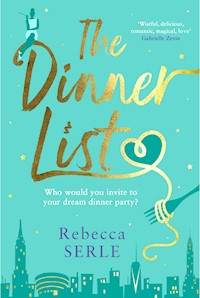
From the bestselling author of In Five Years 'We've been waiting for an hour.' That's what Audrey says. She states it with a little bit of an edge, her words just bordering on cursive. That's the thing I think first. Not, Audrey Hepburn is at my birthday dinner, but Audrey Hepburn is annoyed. What if your dream dinner party were to actually happen? For New Yorker Sabrina, fantasy becomes reality when she arrives at her thirtieth-birthday celebration to find not only her best friend but also her long-dead father, her admired philosophy professor, the love of her life - and silver-screen icon Audrey Hepburn. Unbelievable though this may seem, as the wine and conversation start to flow it becomes clear that these individuals have each played a crucial role in the course Sabrina's life has taken - and that they have come together at this moment in time for a reason... Follow Sabrina over one evening and ten years as she grapples with the definition of romance, the expectations of love - and how to navigate her way to happiness in this bittersweet romance for our times. 'wistful, delicious, romantic, magical' Gabrielle Zevin, New York Times bestselling author
Das E-Book können Sie in Legimi-Apps oder einer beliebigen App lesen, die das folgende Format unterstützen:
Veröffentlichungsjahr: 2019
Ähnliche




















First published in hardback in the United States of America in 2018 by Flatiron Books, an imprint of MacMillan Publishers.
First published in export and airside trade paperback in Great Britain in 2018 by Allen & Unwin, an imprint of Atlantic Books Ltd.
The paperback edition first published in Great Britain in 2019 by Allen & Unwin, an imprint of Atlantic Books Ltd.
Copyright © Rebecca Serle, 2018
The moral right of Rebecca Serle to be identified as the author of this work has been asserted by her in accordance with the Copyright, Designs and Patents Act of 1988.
All rights reserved. No part of this publication may be reproduced, stored in a retrieval system, or transmitted in any form or by any means, electronic, mechanical, photocopying, recording, or otherwise, without the prior permission of both the copyright owner and the above publisher of this book.
This novel is entirely a work of fiction. The names, characters and incidents portrayed in it are the work of the author’s imagination. Any resemblance to actual persons, living or dead, events or localities, is entirely coincidental.
Allen & Unwin
c/o Atlantic Books
Ormond House
26–27 Boswell Street
London WC1N 3JZ
Phone: 020 7269 1610
Fax: 020 7430 0916
Email: [email protected]
Web: www.allenandunwin.co.uk
A CIP catalogue record for this book is available from the British Library.
Trade paperback ISBN: 978-1-76052-805-8
Paperback ISBN: 978-1-91163-018-0
E-book ISBN: 978-1-76063-573-2
Internal design by Devan Norman
For my grandmother Sylvia Pesin,who taught me that first, baby,you gotta love yourself.
And for her Sam—the first person on my list.
How many miles to Babylon?
Three score miles and ten—
Can I get there by candlelight?
Yes, and back again—
If your feet are nimble and light
You can get there by candlelight.
—TRADITIONAL NURSERY RHYME
The stars you see at night are the
unblinking eyes of sleeping elephants,
who sleep with one eye open
to best keep watch over us.
—GREGORY COLBERT,Ashes and Snow
7:30 P.M.
WE’VE BEEN WAITING FOR AN HOUR.” That’s what Audrey says. She states it with a little bit of an edge, her words just bordering on cursive. That’s the thing I think first. Not Audrey Hepburn is at my birthday dinner but Audrey Hepburn is annoyed.
Her hair is longer than the image I’ve always held of her in my mind. She’s wearing what looks to be a pantsuit, but her legs are hidden under the table, so it’s hard to tell. Her top is black, with a crème-colored collar, three round buttons down the front. A cardigan is looped over the back of her chair.
I step back. I take them in. All of them. They’re seated at a round table, right in the center of the restaurant. Audrey is facing the door, Professor Conrad to her right and Robert to her left. Tobias sits on the other side of Robert, to his left is Jessica, and in between her and Tobias is my empty chair.
“We started without you, Sabrina,” Conrad says, holding up his wineglass. He’s drinking a deep red; so is Jessica. Audrey has a scotch, neat; Tobias has a beer; Robert has nothing.
“Are you going to sit?” Tobias asks me. His voice cracks a little at the edges, and I think that he’s still smoking.
“I don’t know,” I say. I’m surprised I have the ability for words, because this is insane. Maybe I’m dreaming. Maybe this is some sort of mental breakdown. I blink. I think maybe when I open my eyes it will be just Jessica seated there, which is what I’d been expecting. I have the urge to bolt out the door, or maybe go to the bathroom, splash some cold water on my face to determine whether or not they’re really here—whether we’re all really here together.
“Please,” he says. There is a hint of desperation in his voice.
Please. Before he left, that was the word I used. Please. It didn’t make a difference then.
I think about it. Because I do not know what else to do. Because Conrad is pouring Merlot from the bottle and because I can’t just keep standing here.
“This is freaking me out,” I say. “What’s going on?”
“It’s your birthday,” Audrey says.
“I love this restaurant,” Conrad says. “Hasn’t changed in twenty-five years.”
“You knew I’d be here,” Jessica says. “We’ll just make room for a few more.” I wonder what she said when she got here. Whether she was surprised or delighted.
“Perhaps we could talk,” Robert says.
Tobias says nothing. That was always our problem. He was so willing to allow silence to speak for him. The frustration I feel at him next to me overwhelms my disbelief in my situation. I sit.
The restaurant bustles around us, the diners undisturbed by what’s going on here. A father tries to quiet a small child; a waiter pours wine into glasses. The restaurant is small, maybe twelve tables total. There are red potted hydrangeas by the doorway and a soft sprinkling of holiday lights line the place where the wall meets the ceiling. It’s December, after all.
“I need a drink,” I declare.
Professor Conrad claps his hands together. I remember he used to do that right before class would let out or he’d assign a big project. It’s his way of anticipating action. “I came all the way from California for this blessed event, so the least you could do is catch me up on what you’re doing now. I don’t even know what you ended up majoring in.”
“You want an update on my life?” I ask.
Jessica rolls her eyes next to me. “Communications,” she says.
Professor Conrad puts a hand to his chest in a show of feigned shock.
“I’m a book editor now,” I say a bit defensively. “Jessica, what is going on?”
Jessica shakes her head. “This is your dinner.” My list. She knows, of course. She was there when I made it. It was her idea. The five people, living or dead, you’d like to have dinner with.
“You don’t think this is insane?” I say.
She takes a sip of wine. “A little. But crazy things happen every day. Haven’t I always told you that?”
When we lived together, in that cramped apartment on Twenty-first Street, she had inspirational quotes everywhere. On the bathroom mirror. On the Ikea desk that held our television. Right by the door. Worrying is wishing for what you don’t want. Man plans and God laughs.
“Is this everyone?” Robert asks.
Audrey flips over her wrist. “I’d hope so,” she says.
I take a sip of wine. I take a deep breath.
“Yes,” I answer. “This is everyone.”
They look at me. All five of them. They look expectant, hopeful. They look like I’m supposed to tell them why they’re here.
But I can’t do that. Not yet, anyway. So instead, I open my menu.
“Why don’t we order,” I say. And we do.
ONE
IFIRST SAW TOBIAS AT AN art exhibit at the Santa Monica Pier.
Four years later we exchanged names on the subway stuck under-ground at Fourteenth Street, and we had our first date crossing the Brooklyn Bridge. Our story spanned exactly one decade, right down to the day we ended. But as it’s been said before—it’s easier to see the beginnings of things, and harder to see the ends.
I was in college, my sophomore year. I was taking Conrad’s philosophy class. Part of the course was a weekly field trip organized by students on a rotating basis. Someone took us to the Hollywood sign, another to an abandoned house on Mulholland designed by a famous architect I had never heard of. I’m not sure what the point was except that Conrad, self-admittedly, liked to get out of the classroom. “This is not where learning takes place,” he often said.
For my outing I chose the art exhibit Ashes and Snow. I had heard about it from some friends who had gone the weekend before. Two giant tents were erected on the beach by the Santa Monica Pier, and the artist Gregory Colbert was showing his work—big, beautiful photographic images of human beings living in harmony with wildlife. There had been a giant billboard that sat on Sunset Boulevard the entire year of 2006—a small child reading to a kneeling elephant.
It was the week before Thanksgiving. I was flying home the next day to Philadelphia to spend the holiday with my mother’s extended family. My mom was contemplating a move back East, where she was from. We’d been in California since I was six years old, since right after my father left.
I was flustered. I remember cursing myself that I’d signed up to organize this event when I had so much other stuff going on. I was fighting with Anthony—my on-again, off-again business-major boyfriend, who rarely left the confines of his fraternity house except for “around the world” parties, where the only traveling was to the toilet after mixing too many different kinds of booze. The whole relationship was fiction, comprised mainly of text messages and drunken nights that we somehow cobbled into togetherness. In truth, we were biding our time. He was two years older, a senior with a finance job in New York already lined up. I thought, loosely, we’d someday transition this playing pretend into playing house, but of course we never did.
Ashes and Snow was stunning. The indoor space was dramatic and yet serene—like practicing yoga at the very edge of a cliff.
Our student group scattered quickly—mesmerized by the scale of the thing. A child kissing a lion, a little boy sleeping with a bobcat, a man swimming with whales. And then I saw him. Standing in front of a photograph I can only recall with a pull in my heart so strong I have to take a step back. The picture was of a little boy, eyes closed, eagle wings spread behind him.
I was instantly in awe. Of the photographs, the image itself, and this boy. The one outside the photograph. Brown shaggy hair. Lowslung jeans. Two brown shirts layered like dirt. I didn’t see his eyes immediately. I didn’t yet know they were the most searing shade of green, like jewels, so sharp they could cut right through you.
I stood next to him. We didn’t look at each other. For minutes. Five, maybe more. I couldn’t tell what I was seeing—him, or the boy. But I felt a current between us; the sand kicked up around us like it was charged, too. Everything seemed to converge. For one beautiful, exquisite moment there was no separation.
“I’ve been four times already,” he told me, eyes still gazing forward. “I never want to leave this spot.”
“He’s beautiful,” I said.
“The whole exhibit is pretty incredible.”
“Are you in school?” I asked.
“Mm-hm,” he said. He glanced at me. “UCLA.”
“USC,” I told him, tapping my chest.
If he were a different kind of guy—say, Anthony—he would have made a face. He would have talked about the rivalry. But I’m not even sure he knew about this ritual we were supposed to engaged in—the Trojans versus the Bruins.
“What do you study?” I asked him.
He gestured toward the canvas. “I’m a photographer,” he said.
“What kind?”
“I’m not so sure yet. Right now my specialty is being mildly bad at everything.”
He laughed; so did I. “I doubt that’s true.”
“How come?”
“I don’t know,” I said. I looked back at the photograph. “I just do.”
A group of teenage girls hovered nearby, staring at him. When I looked over they giggled and dispersed. I couldn’t blame them—he was stunning.
“What about you?” he asked. “Let me guess. Acting.”
“Ha. Hardly. Communications,” I said.
“I was close.” He extended his pointer finger out toward my chest. I wanted to grab on to the end. “Anyway, good skill to have.”
The most important thing in communication is hearing what isn’t said.
“That’s what my mom tells me.”
He turned to me then, and his eyes opened to mine. That’s the only way I know how to describe it. It was a key in a lock. The door just swung free.
The wind picked up, and my hair started flying around me. It was longer then, much longer than it is now. I tried to tame it, but it was like trying to catch a butterfly. It kept escaping my reach.
“You look like a lion,” he said. “I wish I had my camera.”
“It’s too long,” I said. I was blushing. I hoped the hair was covering it.
He just smiled at me. “I need to go,” he said. “But now I don’t want to.”
I could see Conrad behind him, lecturing four of our group near a photograph of a giraffe that appeared to be almost to scale. Conrad waved me over. “Me too,” I said. “I mean, me neither.”
I wanted to say more, or I wanted him to. I stood there unmoving, waiting for him to ask for my number. Any more information. But he didn’t. He just gave me a little salute and walked back toward Conrad and out of the tent. I didn’t even get his name.
Jessica was home when I got back to our dorm. We were two of the only sophomores on the entirety of USC’s campus who still lived in university housing. But it came out to be cheaper, and neither one of us could afford to move. We didn’t have Orange County or Hollywood money like so many of our fellow students.
Back then Jessica had long brown hair and big glasses and she wore long flowy dresses nearly every day, even in winter. Although the coldest it ever got was in the fifties.
“How was the exhibit?” she asked. “Do you want to go to Pi Kapp tonight? Sumir said they’re throwing a beach-themed party but we don’t have to dress up.”
I tossed my bag down and slumped in the living room chair. There wasn’t room for a couch. Jessica was on the floor.
“Maybe,” I said.
“Call Anthony,” she said, getting up to turn off the ringing teakettle.
“I don’t think I want to be with him anymore,” I said.
I could hear her pouring the hot water, ripping open a teabag. “What do you mean you think?”
I picked at the hem of my denim shorts. “There was this guy at the exhibit today.”
Jessica came back holding a steaming cup. She offered me some. I shook my head. “Tell me,” she said. “From class?”
“No, he was just there.”
“What’s his deal?”
“He’s a photographer; he goes to UCLA.”
Jessica blew on her tea and settled back down on the floor. “So are you going to see him?”
“No,” I said. “I don’t even know his name.”
Jessica frowned at me. She’d had exactly one boyfriend in her entire life—Sumir Bedi, the man who would a few years later become her husband. Their relationship didn’t strike me as being particularly romantic; it still doesn’t. They were both in the same dorm freshman year. He asked her to his fraternity invite, she said yes, and they started dating. They slept together a year later. It was both of their first times. She didn’t talk about him and get mushy, but they also rarely fought. I suspected it was because neither one of them drank much. She was a romantic person, though, and deeply invested in my love life. She wanted every detail. Sometimes I found myself embellishing just to give her something more to hear.
“I just don’t think I want to be with Anthony anymore.” How could I explain what had happened? That in a moment I’d given my heart to a stranger I’d probably never see again?
She set her teacup down on the coffee table. “All right,” she said. “We’ll just have to find this guy.”
My heart bloomed with affection for her. That was Jessica—she didn’t need a way, just a why. “You’re crazy,” I told her. I stood up and glanced out our twentieth-story window. Outside students were walking back and forth across campus like tiny tin soldiers sent on a mission. It all looked so orderly and intentional from up here. “He doesn’t even go USC. It’s impossible.”
“Have a little faith,” she told me. “I think your problem is you don’t believe in fate.”
Jessica came from a conservative family in Michigan. I would watch her evolution slowly, from Christian Midwesterner to full-blown liberal hippie, and then—many years later—a sharp right into East Coast conservative.
The week before she had come home with a stack of magazines, paper, and colored pencils. “We’re making dream boards,” she had announced.
I looked at the supplies and turned back to my book. “No thanks.”
Jessica had been taking this course in spirituality—some kind of “Unleash the Power Within” Tony Robbins stepchild led by a woman with a self-ascribed Hindu name.
“You haven’t done a single exercise with me,” Jessica had said, plopping herself down onto a pillow on our floor.
I surveyed her. “You have anything with a little less glitter?”
Her eyes brightened. “Swani asked us to make a list of the five people living or dead we’d like to have dinner with.” She rummaged in her supply bag and pulled out a stack of yellow Post-its. “No glitter.”
“Will this make you happy?” I asked, closing my book, already resigned.
“For about an hour,” she said, but I could see the spark in her eye. I never said yes to stuff like this, even though she always kept asking.
She started talking a lot then. About the exercise, about what it meant, about how the imagined fictional dinner was like a reckoning between parts of yourself you needed to come to terms with—yadda yadda. I wasn’t really listening; I just started drafting.
The first few were easy: Audrey Hepburn, because I was a nineteen-year-old girl. Plato, because I had read The Republic four times since high school and was riveted—and because Professor Conrad spoke of his contributions often. I wrote Robert’s name down without even thinking. As soon as I saw it I wanted to cross it out, but I didn’t. He was still my father, even if I could barely remember ever knowing him.
Two more.
I loved my mom’s mom. Her name was Sylvia, and she had passed away the year before. I missed her. I wrote her name down. I couldn’t think of a fifth.
I looked over at Jessica, intently making a list on a giant piece of parchment paper in red and gold pencil.
I handed the note to her. She looked it over, nodded, and handed it back to me. I stuck it in my pocket and went back to my book. She seemed placated.
But now, about Tobias, she was not. “I do believe in fate,” I told her. I hadn’t, but I did now. It was hard to explain. How big ideas about life and love had solidified in ten minutes of standing next to him. “I shouldn’t have said anything. It was stupid. It was a moment.”
But it was a moment I wanted to make more of, and we went looking. We couldn’t find him online (searching “green eyes” and “UCLA” on Facebook did not give us very positive results—and something told me he wasn’t the sort of guy who had a profile), so we drove up to the UCLA campus in Sumir’s Toyota Corolla, which wouldn’t go more than forty on the freeway.
“What’s your plan when we get there?” I asked Jessica. “Start yelling ‘boy with brown hair’ loudly?”
“Relax,” she told me. “I’m not yelling anything.”
She parked in Westwood and we walked to the north side of campus, where the row houses and student apartments were. They all sat on tree-lined streets that poured out onto Sunset and up into the impeccable hills of Bel Air. I followed behind, grateful that it was a sunny day, there were a lot of people around, and we were blending in well.
“I know we’re not supposed to say this,” I said. “But UCLA is way nicer than USC.”
“In location only,” Jessica said. She stopped in front of a bulletin board posted outside a campus building—library? I wasn’t sure.
“Aha,” she said. “As I’d hoped.”
I peered closer. It was a club board. The Food Club, Poetry Club. I followed Jessica’s finger. It tapped a yellow flyer lightly. “The Photography Club,” I read.
Jessica beamed. “You’re welcome.”
“I’m impressed,” I said. “But this doesn’t mean anything. He probably doesn’t belong to it. He didn’t really seem like a club kind of a guy. And what would we do, crash their meeting?”
Jessica rolled her eyes. “As charming as I find your negativity, they’re holding an open house next Tuesday, so you can just go to that.”
I shook my head. “If he was there, I’d seem crazy.”
Jessica shrugged. “Or you’d live happily ever after.”
“Right,” I said. “One of the two.” But I felt excitement spring a leak in me. What if I saw him again? What would I say?
My stomach growled then.
“Want to go to In-N-Out?” Jessica asked.
“Definitely.”
We started to wander back to the Corolla, but before we did I snatched the flyer and stuffed it into my bag.
“I saw nothing,” Jessica said, looping her arm through mine.
When we got home I took out the Post-it and added a fifth. Him.
7:45 P.M.
DOES ANYONE ELSE LIKE CARP?” Conrad is asking. We haven’t ordered yet because no one can agree on what to do. Conrad is determined to share, Robert wants to order separately, Audrey is displeased with the menu, and Jessica and Tobias have eaten two breadbaskets already. It irritates me that he has an appetite.
“I’m still breastfeeding,” Jessica says to no one in particular. “I need the carbs.”
The waiter comes over for the second time and I just jump in. “I’ll have the frisée salad and the risotto,” I say. I send Conrad a look. He nods.
“The scallops,” he says. “And some of those aphrodisiacs.”
The waiter looks confused. He opens his mouth and closes it again.
“Oysters,” Audrey clarifies wearily. “I’ll have the same, with the frisée salad.”
Professor Conrad elbows her. “Audrey, I never,” he says.
She isn’t having it. She’s still irritated.
It strikes me as everyone places their orders—pasta and soup for Jessica, steak and salad for Robert—that I didn’t really think this through. When I chose each of these five people to be on my list, it was entirely about me. My issues with each of them, and my mixed desires to be in their presence. I didn’t think of how they’d get along together.
I permit myself a glance to my left, to Tobias. I already know what he’ll order. I knew it the instant I opened the menu. I do this sometimes, now, when I’m at a restaurant. I’ll scan the menu and choose what he would want. I know he’ll get the burger and fries, extra mustard. And the beet salad. Tobias loves beets. He was a vegetarian for a while, but it didn’t stick.
“The crudo and the scallops,” he says.
I whip my head to look at him. He raises his shoulders up back at me. “The burger looked good, too,” he says. “But I just ate all that bread.”
Tobias was concerned about his health in odd ways. Sometimes I thought he had a thing for staying thin—maybe because it made him look like a starving artist? He didn’t work out, he wasn’t a runner, but he’d skip meals sometimes or he’d come home with a new juicer and declare he didn’t want to eat processed foods anymore. He was an excellent cook. The crudo. I should have figured.
The waiter takes our menus and then Audrey leans forward. For the first time I catch small little lines around her eyes. She must be in her late forties.
“I came with some conversation topics,” she tells me. She speaks in that low, hushed voice we all know so well. She’s delicate, so feminine it pains, and I have a pang of regret that she is seated at this table with us. She shouldn’t be here; it’s not worth her time.
“We don’t need topics,” Conrad says, brushing her off. “We just need wine and a theme.”
“A theme?” asks Robert. He looks up from his water. He’s a small man, short. Even seated you can tell. My mother had two inches on him. I always thought I fell somewhere in the middle based on the small pile of old photographs, but looking at him now I know I’m all his.
We have the same green eyes, the same long nose, the same crooked smile and reddish-brownish curly hair. He didn’t go to college. No one in his family did either. He got tuberculosis when he was nineteen and spent a year and a half in a hospital. Solitary confinement. His own mother could only visit through a glass wall.
My mom told me that story years later. Years after he had left, after he was already dead and I couldn’t ask him any follow-up questions myself. I never knew whether it was supposed to humanize him, or make him seem more obtuse, abstract—untouchable. But I also never knew if she kept on loving him. I still don’t.
“Theme!” Conrad calls. “Let’s have a theme.”
“Global service,” Audrey says.
Conrad nods. He takes a notebook and pen out of his breast pocket. He always kept a notebook there, should he be inspired. He used to take it out periodically during class and scribble things inside.
“Julie!” Conrad says. “You’re up.”
Jessica looks at him, a piece of baguette in her mouth. “It’s Jessica,” she says.
“Jessica, of course.”
“Family,” she says, sighing. “But I don’t think this is the point.”
“Responsibility,” Robert adds. I do an inadequate job of choking back a laugh. Responsibility. How ridiculous.
Then Tobias. He sits back in his chair. He loops his hands behind his head. “Love,” he says. He says it so simply, so easily. Like it’s obvious. Like it’s the only possible answer to Conrad’s question.
But it isn’t, of course. Because if it was I wouldn’t need him at this dinner. If that were true, we’d still be together.
I clear my throat. “History,” I say, as if to counter.
Conrad nods. Audrey sips. Jessica balks.
“We’ve been over this,” she says, glaring at Tobias and me. “You guys can’t keep living in the past.”
Let go and let God.
“Sometimes it is impossible to move forward without understanding what happened.” Conrad.
“What did happen?” Audrey says.
I keep my eyes on the table, but I still feel his on me. I wish he were seated where Conrad is. I wish I couldn’t smell him—heady and dense—or find his foot under the table, so close that if I wanted to I could hold it against mine.
“Everything,” I say after a moment. “Everything happened.”
“Well,” Conrad says. “Let’s start there.”
TWO
THE TUESDAY AFTER OUR UCLA INVESTIGATION, I was in Professor Conrad’s office trying to argue my way up to a C-plus for a written exam I had completely tanked. I was always doing terribly in his class. I couldn’t quite get there. Not that I was trying that hard. Admittedly, I had let all my grades slip. I had no good reason besides the fact that I was tired of school, of homework and lectures and tests. I didn’t want to do it anymore. And the ongoing drama with Anthony wasn’t helping things.
“Maybe you’re in the wrong major,” Jessica told me, but it was too late to change. If I did, I’d be there for another three years, and that wasn’t an option—financially or any way else.
“You’ve gotten used to the idea that outcomes are irrelevant,” Conrad said. “In my class, I do not believe that’s true.”
“Please.” I was close to tears. “Can I do extra credit?”
Conrad shook his head. “I don’t offer extra credit.”
“I can’t get a D.”
“You can,” he said. “Matter of fact, you did.”
Fear coiled in my stomach. “I’m sorry,” I mumbled.
Conrad put a hand on my shoulder. It felt fatherly. I was unaccustomed. “You can do better on the next one and raise your average up,” he told me. “This is not your final ticket.”
I gathered up my things and left his office—entitled, annoyed, angry. I checked my watch. If I left now I could make it to UCLA’s campus by seven. The crumbled piece of yellow paper at the bottom of my book bag informed me that the photography open house wasn’t until seven.
I called Jessica. “I have to study,” she said. “But Sumir is in class and I have his car keys here waiting for you.”
“Meet me downstairs.”
There was traffic on the 405. I sat and flipped between 98.7 and NPR. They were doing some special on NASA protocol. They had someone on who had just returned from a space tour. “The thing that struck me the most,” he said, “was how in some capacity of measurement the universe is actually finite. How do we possibly wrap our heads around the end of the end?”
I changed the radio back to Britney Spears.
The flyer said the show was going to be in the Billy Wilder Theater. I asked directions from a security guard when I got to UCLA and after a few wrong turns managed to find a parking spot on the street. My watch read 6:57 P.M. Just in time.
My heart started to pump as I took the sidewalk and then steps leading to the theater. What if he was actually there? What would I say? How would I explain my presence? Act surprised. A friend told me to come. That wasn’t strictly untrue. He might not even recognize me.
I found a lip gloss in my bag. I swiped it across, took a deep breath, and pulled the door open.
The show was set up onstage. Photographs hung from partition boards and people in the aisles held plastic cups filled with red wine. I made my way closer to the stage. So far, no him.
“Are you one of the artists?” a girl with a long braid said. She had on bell-bottom jeans and a peasant blouse I recognized from Forever 21. Jessica had tried on the same one at the Beverly Center last weekend.
It felt like she was onto me. “No,” I said. “No, just looking.”
She nodded, took a sip of wine.
“You?”
“That’s my stuff up there.” She gestured to a partition wall on the far left-hand side of the stage. I saw color. Tons of it.
“Mind if I go check it out?”
“Just as long as you don’t ask me to come with you. My stuff works better if I don’t speak for it.”
I left her and moved up onto the stage. I took a quick scan. Nowhere. Not in the aisles, either. The crowd wasn’t big, maybe thirty people in all. I thought about leaving, but I could see my new friend’s eyes on me, and so I decided to go over to her work.




