


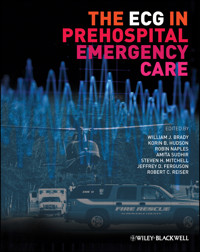
The ECG in Prehospital Emergency Care E-Book
32,99 €
Mehr erfahren.
- Herausgeber: John Wiley & Sons
- Kategorie: Fachliteratur
- Sprache: Englisch
Now that state of the art equipment can be carried in ambulances, prehospital emergency staff are able to perform an ECG soon after arrival on scene, enabling the EMS provider to gather important diagnostic information that can not only guide prehospital therapy but also direct hospital-based treatment.
This book exclusively addresses ECGs for prehospital emergencies, ranging from basic rhythm diagnosis to critical care applications of the electrocardiogram and advanced 12-lead ECG interpretation in the ACS patient. It provides self testing traces covering all these conditions seen in prehospital and hospital- based environments. It includes 200 randomly presented cases mirroring real life situations, with the answers set out separately together with additional invaluable information.
Written by highly experienced emergency physicians with EMS qualifications and experience, this text is an ideal learning tool for trainees and fully qualified staff alike, including ground EMS advanced life support providers, aeromedical staff, and inter-facility critical care transport personnel.
Sie lesen das E-Book in den Legimi-Apps auf:
Seitenzahl: 304
Veröffentlichungsjahr: 2012
Ähnliche




















Table of Contents
Title Page
Copyright
Dedication
List of Contributors
Foreword
Preface
Section 1: The ECG in Prehospital Patient Care
Chapter 1: Clinical Applications of the Electrocardiogram (ECG)
Electrocardiogram Evaluation of Rhythm Disturbances
Electrocardiograhic Evaluation in the Setting of Acute Coronary Syndrome
Electrocardiograhic Evaluation in the Setting of Non–Acute Coronary Syndrome Pathology
Chapter 2: Clinical Impact of the Electrocardiogram (ECG)
Management of the Patient with Dysrhythmia
Management of the Patient with Acute Coronary Syndrome
Management of Non–ACS Presentations
Ambulatory Electrocardiogram Monitoring
Computer Interpretation of the Electrocardiogram
Chapter 3: Interpretation of the Electrocardiogram—Single-, Multi-, and 12-Lead Analysis
Introduction
Rate
Rhythm
Axis
Intervals
Morphology
Chapter 4: Variants of the Normal, Lead Misplacement, and Electrocardiographic Artifact Encountered in Clinical Practice
Benign Early Repolarization
T Wave Inversion
Sinus Arrhythmia
Conditions Encountered in Athletes
Lead Misplacement
Artifact
Section 2: Cardiac Rhythms and Cardiac Dysrhythmias
Chapter 5: Cardiac Rhythms with Normal Rates
Acknowledgment
Further Reading
Chapter 6: Narrow QRS Complex Tachycardia
Regular Narrow Complex Tachycardia
Irregular Narrow Complex Tachycardias
Further Reading
Chapter 7: Wide QRS Complex Tachycardia
Ventricular Tachycardia—Monomorphic and Polymorphic
Ventricular Fibrillation
Supraventricular Tachycardia with Aberrant Conduction
Further Reading
Chapter 8: Bradycardia
Sinus Bradycardia
Junctional Rhythm
Idioventricular Rhythm
Sinoventricular Rhythm of Severe Hyperkalemia
Other Bradycardias
Acknowledgment
Further Reading
Chapter 9: Atrioventricular Conduction Block
First-Degree Atrioventricular Block
Second-Degree Atrioventricular Block
Third-Degree Atrioventricular Block
Atrioventricular Dissociation
Chapter 10: Intraventricular Conduction Block: Bundle Branch Block and Other Conduction Abnormalities
The Bundle Branch Blocks
The Hemiblocks (Left Anterior and Left Posterior Hemiblocks)
Bifascicular and Trifascicular Blocks
Non-Specific Intraventricular Conduction Abnormality
Chapter 11: Atrial and Ventricular Ectopic Beats
Premature Atrial Contractions
Premature Junctional Contractions
Premature Ventricular Contractions
Section 3: Acute Coronary Syndrome and the 12-Lead ECG
Chapter 12: Ischemic Heart Disease: Anatomic and Physiologic Considerations
Cardiac Anatomy and Basic Physiology of Depolarization
Coronary Anatomy and Electrocardiograhic Regional Anatomic Issues
Cardiac Pathophysiology
Chapter 13: Historical Development of the Prehospital Electrocardiogram (ECG)
Indications for Prehospital 12-Lead Electrocardiogram
Benefits of the 12-Lead Electrocardiogram in the Acute Coronary Syndrome Patient
Conclusion
References
Chapter 14: Electrocardiographic Findings in Acute Coronary Syndrome
Introduction
The 12-Lead Electrocardiogram in ST Segment Elevation Myocardial Infarction—Evolution of Electrocardiogram Abnormalities
The 12-Lead Electrocardiogram in Non-ST Segment Elevation Myocardial Infarction Presentations
Electrocardiogram ST Segment Elevation Myocardial Infarctionmimickers and Confounders
Further Reading
Section 4: Special Populations, High-Risk Presentation Scenarios, and Advanced Electrocardiographic Techniques
Chapter 15: The Electrocardiogram in the Pediatric Patient
Rate and Rhythm
QRS Axis
T Waves
Intervals
Common Dysrhythmias
Chapter 16: The Electrocardiogram in the Poisoned Patient
Potassium Efflux Blocking Agents
Sodium Channel Blocking Agents
Cardiac Glycoside Toxicity
Calcium Channel Blocker Toxicity
β-Adrenergic Blocker Toxicity
Chapter 17: The Electrocardiogram in Hyperkalemia
Electrocardiographic Manifestations
Chapter 18: Life-Threatening Electrocardiographic Patterns
Wellens' Syndrome
Brugada Syndrome
Hypertrophic Obstructive Cardiomyopathy
Long QT Syndrome
Chapter 19: The Electrocardiogram in Patients with Implanted Devices
The Paced Electrocardiogram
Pacemaker Malfunction
The Paced Rhythm and Acute Myocardial Infarction
Chapter 20: Electrocardiographic Tools in Prehospital Care
Additional Electrocardiographic Leads
Serial Electrocardiography
Chapter 21: Wolff–Parkinson–White Syndrome
Chapter 22: Cardiac Arrest Rhythms
Asystole
Pulseless Electrical Activity
Pulseless Ventricular Tachycardia
Ventricular Fibrillation
Section 5: Electrocardiographic Differential Diagnosis of Common ECG Presentations
Chapter 23: Electrocardiographic Differential Diagnosis of Narrow Complex Tachycardia
Chapter 24: Electrocardiographic Differential Diagnosis of Wide Complex Tachycardia
Ventricular Tachycardia
Ventricular Tachycardia versus Supraventricular Tachycardia with Aberrant Conduction
Chapter 25: Electrocardiographic Differential Diagnosis of Bradyarrhythmia
Chapter 26: Electrocardiographic Differential Diagnosis of ST Segment Elevation
Chapter 27: Electrocardiographic Differential Diagnosis of ST Segment Depression
Acute Coronary Syndromes
Left Bundle Branch Block
Left Ventricular Hypertrophy
Rate-Related ST Depression
Other Causes
Chapter 28: Electrocardiographic Differential Diagnosis of T Wave Abnormalities: The Prominent T Wave and T Wave Inversions
Prominent T Waves
T Wave Inversion
Index
This edition first published 2013, © 2013 by Blackwell Publishing Ltd.
Blackwell Publishing was acquired by John Wiley & Sons in February 2007. Blackwell's publishing program has been merged with Wiley's global Scientific, Technical and Medical business to form Wiley-Blackwell.
Registered office: John Wiley & Sons, Ltd, The Atrium, Southern Gate, Chichester, West Sussex, PO19 8SQ, UK
Editorial offices: 9600 Garsington Road, Oxford, OX4 2DQ, UK
The Atrium, Southern Gate, Chichester, West Sussex, PO19 8SQ, UK
111 River Street, Hoboken, NJ 07030-5774, USA
For details of our global editorial offices, for customer services and for information about how to apply for permission to reuse the copyright material in this book please see our website at www.wiley.com/wiley-blackwell.
The right of the author to be identified as the author of this work has been asserted in accordance with the UK Copyright, Designs and Patents Act 1988.
All rights reserved. No part of this publication may be reproduced, stored in a retrieval system, or transmitted, in any form or by any means, electronic, mechanical, photocopying, recording or otherwise, except as permitted by the UK Copyright, Designs and Patents Act 1988, without the prior permission of the publisher.
Designations used by companies to distinguish their products are often claimed as trademarks. All brand names and product names used in this book are trade names, service marks, trademarks or registered trademarks of their respective owners. The publisher is not associated with any product or vendor mentioned in this book. This publication is designed to provide accurate and authoritative information in regard to the subject matter covered. It is sold on the understanding that the publisher is not engaged in rendering professional services. If professional advice or other expert assistance is required, the services of a competent professional should be sought.
Library of Congress Cataloging-in-Publication Data
The ECG in prehospital emergency care / William J. Brady ... [et al.] ;
associate editors, Kostas Alibertis ... [et al.].
p. ; cm.
Includes bibliographical references and index.
ISBN 978-1-4051-8577-6 (pbk.)
I. Brady, William, 1960- II. Alibertis, Kostas.
[DNLM: 1. Electrocardiography– methods. 2. Emergency Medical Services. 3. Emergency Treatment– methods.
4. Heart– physiopathology. 5. Heart Diseases–diagnosis. WG 140]
616.1′207547– dc23
2012027338
A catalogue record for this book is available from the British Library.
Wiley also publishes its books in a variety of electronic formats. Some content that appears in print may not be available in electronic books.
Cover design by: Fortiori Design Ltd.
1 2013
William Brady—To my wife, King Brady, my partner and a truly amazing person; to my children, Lauren, Anne, Chip, and Katherine, my inspiration; and to my mother, Joann Brady, for all that she has done (and continues to do) for me.
Korin Hudson—I would like to thank my husband for his unwavering support and patience; my parents for inspiring a career in academics; and my mentors and colleagues who demonstrate excellence in clinical medicine and patient care every day
Robin Naples—To my parents for raising me, my sister for pushing me, my husband for understanding me, and my kids for being my everything.
Amita Sudhir—Thank you to my husband, Aaron, my children, Anisha and Anand, and my parents, Romila and Sudhir for their support. Thank you also to Bill Brady for his educating me about ECGs during residency, and for his continued mentorship ever since.
Steven Mitchell—Thank you to my best friend and wife, Kara, for her love and support in this process.
Jeffrey Ferguson—To my wife, Lauren, my parents, friends, and mentors for their years support and education: Thank you.
Robert Reiser—For my wife Bernie, my constant support and inspiration. Thank you.
List of Contributors
Editors
Advisory Editors
Authors
Foreword
The Prehospital ECG: It's not just about STEMIs…..
Single lead or three lead cardiac monitoring was the sole means for EMS personnel to assess cardiac rhythm in the prehospital setting for many years. Resourceful EMS providers would use all three channels to verify rhythm, check for axis abnormalities and conduction disturbances, and even attempt to identify ST-T wave abnormalities in patients at risk for acute coronary syndrome. However, for most of EMS, the primary use of cardiac monitoring was to monitor the rhythm in the stable patient, or to determine which ACLS algorithm should be followed incases of cardiopulmonary arrest.
With the advent of fibrinolysis, EMS personnel and ED staff began to recognize the importance of early identification of STEMI patients as a means to reduce the “door-to-drug” time. When patients arrived by EMS with a diagnostic ECG having already been performed, patients received fibrinolysis much more quickly than if an ECG had not been done, or if the patient had arrived by private vehicle.
Fibrinolysis required preparation of the drug and patient screening for contraindications, but was otherwise less resource intense than PCI, which became widely used in the mid to latter 1990s. Like fibrinolysis, PCI is time critical, with “door to balloon” times serving as one of the crucial process metrics. Assembling a team for PCI consumed significant resources, including opening of a catheterization laboratory and the presence of the interventional cardiologist and other personnel who could perform the PCI. Mobilizing these resources during nights and weekends had the potential to engender significant time delays. STEMI systems began to mobilize the catheterization laboratory team based solely on the prehospital ECG interpretation. Many of these systems would rely on paramedic interpretation without a physician's interpretation of the ECG, due to the excellent interpretative skills developed by many EMS providers. The ability to perform 12-lead ECGs in the field has become a required skill in most EMS systems, and is now considered standard for STEMI systems to rely on EMS ECG interpretation to determine not only the destination hospital but also to activate the catheterization laboratory.
As paramedics have become skilled at recognition of STEMI, their interpretation skills in other clinical syndromes have developed. The prehospital ECG is not only administered to patients with suspected ACS, but is also used to better define rate, rhythm, or axis abnormalities first suspected on the single lead cardiac monitor. The 12-lead ECG is better able to define varying degrees of heart block as well as other conduction disturbances. Electrolyte abnormalities can be readily identified and dysrhythmias can be better recognized, thus allowing prehospital providers to tailor treatment to the underlying disorder.
The purpose of this text is to advance the interpretation skills of prehospital providers so that the ECG can be used as a diagnostic instrument for more than just the STEMI. In the same way that prehospital ECGs has reduced the “door-to-drug” and “door-to-balloon” times for STEMI, we are now in the era when the ECG can be used to speed the time to treatment of premalignant dysrhythmias or life-threatening electrolyte abnormalities. Readers of this book will benefit from the expertise of the authors, who have devoted a significant portion of their careers to teaching others the finer points of ECG interpretation. The diagnostic utility of the 12-lead ECG is vast, and after completing this book, readers will come to understand that the prehospital ECG is not only used to diagnose STEMI, but can be used to identify many other clinical condition, which if left untreated, would seriously compromise the health of the patient.
Robert E. O'Connor, MD, MPH
Dr. O'Connor is professor and chair of Emergency Medicine at the University of Virginia in Charlottesville. He is a past President of the National Association of EMS Physicians, a past Chair of the Emergency Cardiac Care Committee for the American Heart Association, and is a current board member of the American College of Emergency Physicians.
Preface
Electrocardiographic monitoring is one of the most widely applied diagnostic tests in clinical medicine today; its first application to the patient occurs in the prehospital setting and its use continues on into the hospital. The electrocardiogram, whether in monitor mode using single or multichannel rhythm monitoring or in diagnostic mode using the 12-lead ECG, is an amazing tool; it assists in establishing a diagnosis, ruling-out various ailments, guiding the diagnostic and management strategies in the evaluation, providing indication for certain therapies, offering risk assessment, and assessing end-organ impact of a syndrome. As noted in this impressive list of applications, it provides significant insight regarding the patient's condition in a range of presentations, whether it be the chest pain patient with ST segment elevation myocardial infarction (STEMI), the patient in cardiac arrest with ventricular tachycardia, the poisoned patient with bradycardia, or the renal failure patient with rhythm and morphologic findings consistent with hyperkalemia, among many, many others…. This extremely useful tool is noninvasive, portable, inexpensive, quickly obtained, and easily performed. Yet, its interpretation is not as easily performed and, in fact, requires considerable skill and experience as well as an awareness of its use in the appropriate clinical settings and limitations of patient data supplied.
This textbook has been prepared to assist the prehospital provider with the interpretation of the electrocardiogram and a solid understanding of its use across the range of presentations and applications. This textbook is arranged into five sections. Section one is a brief introduction and review of the ECG in the clinical setting. Section two focuses on the ECG and rhythm diagnosis, considering the electrocardiographic findings from an in-depth differential diagnostic perspective—in other words, rhythms with normal rates as well as bradycardia and tachycardia, allowing for the QRS complex width and regularity. Section three reviews the 12-lead ECG in patients suspected of acute coronary syndrome, including ST segment elevation myocardial infarction. Section four discusses the range of special presentations, patient populations, and uses of the electrocardiogram. Section five is a listing of various electrocardiographic findings, again from the differential diagnostic perspective; in this section, various rhythm and morphologic presentations are discussed, such as the narrow and wide complex tachycardias and ST segment elevation syndromes.
This textbook addresses the use of the ECG in its many forms by the prehospital provider, whether 911 ground EMS response, aeromedical transport, or interfacility critical care transfer. The novice electrocardiographer can use this text as his or her primary ECG reference; additionally, the experienced interpreter can use this textbook to expand his or her knowledge base. This work stresses the value of the ECG in the range of clinical situations encountered daily by prehospital providers—it illustrates the appropriate applications of the electrocardiogram in acute and critical care EMS settings.
Most importantly, this textbook is written by clinicians for clinicians, with an emphasis on the reality of the prehospital setting. I and my coeditors, advisory editors, and authors have enjoyed its creation—we hope that you the prehospital clinician will not only enjoy its content but also find it of value in the care of your patients. We thank you for what you do every day.
William J. Brady, MD Charlottesville, USA July 2012
Lesen Sie weiter in der vollständigen Ausgabe!
Lesen Sie weiter in der vollständigen Ausgabe!
Lesen Sie weiter in der vollständigen Ausgabe!
Lesen Sie weiter in der vollständigen Ausgabe!
Lesen Sie weiter in der vollständigen Ausgabe!
Lesen Sie weiter in der vollständigen Ausgabe!
Lesen Sie weiter in der vollständigen Ausgabe!
Lesen Sie weiter in der vollständigen Ausgabe!
Lesen Sie weiter in der vollständigen Ausgabe!
Lesen Sie weiter in der vollständigen Ausgabe!
Lesen Sie weiter in der vollständigen Ausgabe!
Lesen Sie weiter in der vollständigen Ausgabe!
Lesen Sie weiter in der vollständigen Ausgabe!
Lesen Sie weiter in der vollständigen Ausgabe!
Lesen Sie weiter in der vollständigen Ausgabe!
Lesen Sie weiter in der vollständigen Ausgabe!
Lesen Sie weiter in der vollständigen Ausgabe!
Lesen Sie weiter in der vollständigen Ausgabe!
Lesen Sie weiter in der vollständigen Ausgabe!
Lesen Sie weiter in der vollständigen Ausgabe!
Lesen Sie weiter in der vollständigen Ausgabe!
Lesen Sie weiter in der vollständigen Ausgabe!
Lesen Sie weiter in der vollständigen Ausgabe!
Lesen Sie weiter in der vollständigen Ausgabe!
Lesen Sie weiter in der vollständigen Ausgabe!
Lesen Sie weiter in der vollständigen Ausgabe!
Lesen Sie weiter in der vollständigen Ausgabe!
Lesen Sie weiter in der vollständigen Ausgabe!
Lesen Sie weiter in der vollständigen Ausgabe!
Lesen Sie weiter in der vollständigen Ausgabe!
Lesen Sie weiter in der vollständigen Ausgabe!
Lesen Sie weiter in der vollständigen Ausgabe!
Lesen Sie weiter in der vollständigen Ausgabe!
Lesen Sie weiter in der vollständigen Ausgabe!




