


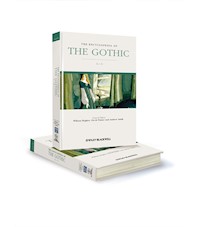
The Encyclopedia of the Gothic E-Book
34,99 €
Mehr erfahren.
- Herausgeber: John Wiley & Sons
- Kategorie: Geisteswissenschaft
- Serie: Wiley-Blackwell Encyclopedia of Literature
- Sprache: Englisch
THE ENCYCLOPEDIA OF THE GOTHIC "Well written and interesting [it is] a testament to the breadth and depth of knowledge about its central subject among the more than 130 contributing writers, and also among the three editors, each of whom is a significant figure in the field of gothic studies ... A reference work that's firmly rooted in and actively devoted to expressing the current state of academic scholarship about its area." New York Journal of Books "A substantial achievement." Reference Reviews Comprehensive and wide-ranging, The Encyclopedia of the Gothic brings together over 200 newly-commissioned essays by leading scholars writing on all aspects of the Gothic as it is currently taught and researched, along with challenging insights into the development of the genre and its impact on contemporary culture. The A-Z entries provide comprehensive coverage of relevant authors, national traditions, critical developments, and notable texts that continue to define, shape, and inform the genre. The volume's approach is truly interdisciplinary, with essays by specialist international contributors whose expertise extends beyond Gothic literature to film, music, drama, art, and architecture. From Angels and American Gothic to Wilde and Witchcraft, The Encyclopedia of the Gothic is the definitive reference guide to all aspects of this strange and wondrous genre. The Wiley-Blackwell Encyclopedia of Literature is a comprehensive, scholarly, authoritative, and critical overview of literature and theory comprising individual titles covering key literary genres, periods, and sub-disciplines. Available both in print and online, this groundbreaking resource provides students, teachers, and researchers with cutting-edge scholarship in literature and literary studies.
Sie lesen das E-Book in den Legimi-Apps auf:
Seitenzahl: 2614
Veröffentlichungsjahr: 2015
Ähnliche




















CONTENTS
Cover
The Wiley-Blackwell Encyclopedia of Literature
Title Page
Copyright
Dedication
Alphabetical List of Entries
General Editors
Notes on Contributors
Introduction
Chapter A
Abjection
Abyss, The
Adultery
African American Gothic
Aickman, Robert
Ainsworth, William Harrison
American Gothic
Amityville Horror, The
Angel (1999—2004)
Anglo-Caribbean Gothic
Anti-Semitism
Apparition
Architecture, Gothic
Architecture, Gothic Revival
Asian Gothic
Asylums
Atwood, Margaret
Australian Gothic
Chapter B
Barker, Clive
Baudelaire, Charles
Beckford, William
Benson, E. F. (Edward Frederic)
Bierce, Ambrose
Blackwood, Algernon
Blood
Bluebooks
Braddon, Mary Elizabeth
Brite, Poppy Z.
Brown, Charles Brockden
Buffy the Vampire Slayer (1997—2003)
Bulwer Lytton, Edward
Bürger, Gottfried
Burton, Tim
Byron, George Gordon, Sixth Baron
Chapter C
Cabell, James Branch
Campbell, Ramsey
Campus Gothic
Canadian Gothic
Carter, Angela
Collins, Wilkie
Comic Gothic1
Comics and Graphic Novels
Commodity Gothicism
Contemporary Gothic
Corelli, Marie
Counterfeit
Crime
Criticism
Cronenberg, David
Crowley, Aleister
Cryptonymy
Cult Fiction
Cults
Curse
Cyberspace
Chapter D
De Quincey, Thomas
Degeneration
Dickens, Charles
Disability
Domestic Gothic
Dostoevsky, Fyodor
Doubles
Drama
Dreams
Drugs and Alcohol
Du Maurier, Daphne
Dutch Gothic
Chapter E
Environment
European Gothic
Chapter F
Family
Fate
Faulkner, William
Female Gothic
Film
Film, French
Fin-de-Siècle Gothic
Folklore
French Gothic
Friday the 13th (1980)
Future Gothic
Chapter G
Games
German Expressionism
German Gothic
Ghost Stories
Godwin, William
Goth
Gothic 1900 to 1950
Gothic 1950 to the Present
Graveyard Poetry
Grotesque, The
Chapter H
Halloween (1978)
Hammer House
Hawthorne, Nathaniel
Herbert, James
Hill, Susan
Hodgson, William Hope
Hoffmann, E. T. A. (Ernst Theodor Amadeus)
Hogg, James
Horror Fiction
Hypnotism
Chapter I
Imperial Gothic
Incest
Inheritance
Inquisition, The
International Gothic Association, The
Intertext
Ireland, William Henry
Irish Gothic
Chapter J
Jackson, Shirley
James, Henry
James, M. R. (Montague Rhodes)
Japanese Gothic
Jewish Gothic
Chapter K
Kafka, Franz
King, Stephen
Kipling, Rudyard
Chapter L
Lathom, Francis
Law and the Gothic
Le Fanu, Joseph Sheridan
Lemoine, Ann
Lesbian Gothic
Lewis, Matthew
Liminality
Lovecraft, H. P. (Howard Phillips)
Lugosi, Bela
Chapter M
Macabre, The
MacDonald, George
Machen, Arthur
Magazines
Manga
Marsh, Richard
Masks, Veils, and Disguises
Matheson, Richard
Maturin, Charles Robert
McCabe, Patrick
McCarthy, Cormac
McGrath, Patrick
Medicine and the Gothic
Mediumship
Melodrama
Melville, Herman
Misogyny
Modernism
Monster Movies
Monstrosity
Mummies
Music
Chapter N
Necromancy
New England Gothic
New Zealand Gothic
Nightmare on Elm Street, A (1984)
Nodier, Charles
Chapter O
Oates, Joyce Carol
Occultism
Odoevsky, Vladimir
Opera
Chapter P
Penny Dreadfuls
Phobia
Poe, Edgar Allan
Poison
Polidori, John
Popular Culture
Portraits
Postcolonial Gothic
Postfeminist Gothic
Poststructuralism and the Gothic
Protestantism
Psychical Investigation
Psychoanalysis
Psychological Thrillers
Chapter Q
Queer Gothic
Chapter R
Race
Radcliffe, Ann
Radio
Reeve, Clara
Reynolds, G. W. M. (George William MacArthur)
Rice, Anne
Riddell, Charlotte
Rohmer, Sax
Roman Catholicism
Romanticism
Rosicrucianism
Ruins
Russian Gothic
Chapter S
Sade, Donatien Alphonse François, Marquis de
Scandinavian Gothic
Schiller, Friedrich von
Science and the Gothic
Scottish Gothic
Secret Histories
Secret Societies
Sensation Fiction
Sensibility
Sex
Shelley, Mary Wollstonecraft
Shelley, Percy Bysshe
Sinclair, May
Slasher Movies
Slavery and the Gothic
Southern Gothic
Spectacle
Spectrality
Spiritualism
Stevenson, Robert Louis
Stoker, Bram
Sturm und Drang
Sublime, The
Suburban Gothic
Supernatural, The
Chapter T
Taboo
Tales of Terror
Teaching the Gothic
Technologies
Tegg, Thomas
Television
Terror
Theory
Thompson, Alice
Twilight
Chapter U
Uncanny, The
Urban Gothic
Chapter V
Vampire Fiction
Victorian Gothic
Village Gothic
Voodoo
Chapter W
Walpole, Horace
Wells, H. G. (Herbert George)
Welsh Gothic
Werewolves
Wharton, Edith
Wheatley, Dennis
Wilde, Oscar
Wilkinson, Sarah
Williams, Tennessee
Witchcraft
Wordsworth, William
Chapter Z
Zombies
Index
End User License Agreement
Guide
Cover
Table of Contents
Begin Reading
Chapter 1
Pages
ii
iii
iv
v
vi
ix
x
xi
xii
xiii
xiv
xv
xvi
xvii
xviii
xix
xx
xxi
xxii
xxiii
xxiv
xxv
xxvi
xxvii
xxix
xxx
xxxi
xxxii
xxxiv
xxxv
xxxvi
1
2
3
4
5
6
7
8
9
10
11
12
13
14
15
16
17
18
19
20
21
22
23
24
25
26
27
28
29
30
31
32
33
34
35
36
37
38
39
40
41
42
43
44
45
46
47
48
49
50
51
52
53
54
55
56
57
58
59
60
61
62
63
64
65
66
67
68
69
70
71
72
73
74
75
76
77
78
79
80
81
82
83
84
85
86
87
88
89
90
91
92
93
94
95
96
97
98
99
100
101
102
103
104
105
106
107
108
109
110
111
112
113
114
115
116
117
118
119
120
121
122
123
124
125
126
127
128
129
130
131
132
133
134
135
136
137
138
139
140
141
142
143
144
145
146
147
148
149
150
151
152
153
154
155
156
157
158
159
160
161
162
163
164
165
166
167
168
169
170
171
172
173
174
175
176
177
178
179
180
181
182
183
184
185
186
187
188
189
190
191
192
193
194
195
196
197
198
199
200
201
202
203
204
205
206
207
208
209
210
211
212
213
214
215
216
217
218
219
220
221
222
223
224
225
226
227
228
229
230
231
232
233
234
235
236
237
238
239
240
241
242
243
244
245
246
247
248
249
250
251
252
253
254
255
256
257
258
259
260
261
262
263
264
265
266
267
268
269
270
271
272
273
274
275
276
277
278
279
280
281
282
283
284
285
286
287
288
289
290
291
292
293
294
295
296
297
298
299
300
301
302
303
304
305
306
307
308
309
310
311
312
313
314
315
316
317
318
319
320
321
322
323
324
325
326
327
328
329
330
331
332
333
334
335
336
337
338
339
340
341
342
343
344
345
346
347
348
349
350
351
352
353
354
355
356
357
358
359
360
361
362
363
364
365
366
367
368
369
370
371
372
373
374
375
376
377
378
379
380
381
382
383
384
385
386
387
388
389
390
391
392
393
394
395
396
397
398
399
400
401
402
403
404
405
406
407
408
409
410
411
412
413
414
415
416
417
418
419
420
421
422
423
424
425
426
427
428
429
430
431
432
433
434
435
436
437
438
439
440
441
442
443
444
445
446
447
448
449
450
451
452
453
454
455
456
457
458
459
460
461
462
463
464
465
466
467
468
469
470
471
472
473
474
475
476
477
478
479
480
481
482
483
484
485
486
487
488
489
490
491
492
493
494
495
496
497
498
499
500
501
502
503
504
505
506
507
508
509
510
511
512
513
514
515
516
517
518
519
520
521
522
523
524
525
526
527
528
529
530
531
532
533
534
535
536
537
538
539
540
541
542
543
544
545
546
547
548
549
550
551
552
553
554
555
556
557
558
559
560
561
562
563
564
565
566
567
568
569
570
571
572
573
574
575
576
577
578
579
580
581
582
583
584
585
586
587
588
589
590
591
592
593
594
595
596
597
598
599
600
601
602
603
604
605
606
607
608
609
610
611
612
613
614
615
616
617
618
619
620
621
622
623
624
625
626
627
628
629
630
631
632
633
634
635
636
637
638
639
640
641
642
643
644
645
646
647
648
649
650
651
652
653
654
655
656
657
658
659
660
661
662
663
664
665
666
667
668
669
670
671
672
673
674
675
676
677
678
679
680
681
682
683
684
685
686
687
688
689
690
691
692
693
694
695
696
697
698
699
700
701
702
703
704
705
706
707
708
709
710
711
712
713
714
715
716
717
718
719
720
721
722
723
724
725
726
727
728
729
730
731
732
733
734
735
736
737
738
739
740
741
742
743
744
745
746
747
748
749
750
751
752
753
754
755
756
757
758
759
760
761
762
763
764
765
766
767
768
769
770
771
772
773
774
775
776
777
778
779
780
781
782
783
784
785
786
787
788
789
790
791
792
793
794
795
796
797
798
799
800
801
802
803
804
805
806
807
808
809
810
811
812
813
814
815
816
817
818
819
820
821
822
823
824
825
826
827
828
829
830
831
832
833
834
835
836
837
838
The Wiley-Blackwell Encyclopedia of Literature
www.literatureencyclopedia.com
The Wiley-Blackwell Encyclopedia of Literature is a comprehensive, scholarly, authoritative, and critical overview of literature and theory comprising individual titles covering key literary genres, periods, and sub-disciplines. Available both in print and online, this groundbreaking resource provides students, teachers, and researchers with cutting-edge scholarship in literature and literary studies.
Published:
The Encyclopedia of Literary and Cultural Theory
, General Editor: Michael Ryan
The Encyclopedia of the Novel
, General Editor: Peter Melville Logan
The Encyclopedia of Twentieth-Century Fiction
, General Editor: Brian W. Shaffer
The Encyclopedia of English Renaissance Literature
, General Editors: Garrett A. Sullivan, Jr. and Alan Stewart
The Encyclopedia of Romantic Literature
, General Editor: Frederick Burwick
The Encyclopedia of the Gothic
, General Editors: William Hughes, David Punter, and Andrew Smith
The Encyclopedia of British Literature 1660—1789
, General Editors: Jack Lynch and Gary Day
The Encyclopedia of Victorian Literature
, General Editor: Dino Franco Felluga
Forthcoming:
The Encyclopedia of Postcolonial Studies
, General Editors: Sangeeta Ray and Henry Schwarz
The Encyclopedia of British Medieval Literature
, General Editors: Sîan Echard and Robert Rouse
The Encyclopedia of Book History: Manuscript, Print, and Digital Technologies
, General Editor: Andrew Prescott
The Encyclopedia of the Gothic
General Editors:
William Hughes, David Punter, and Andrew Smith
This paperback edition first published 2016
© 2016 John Wiley & Sons Ltd
Edition history: Blackwell Publishing Ltd (hardback, 2013)
Registered Office
John Wiley & Sons Ltd, The Atrium, Southern Gate, Chichester, West Sussex, PO19 8SQ, UK
Editorial Offices
350 Main Street, Malden, MA 02148-5020, USA
9600 Garsington Road, Oxford, OX4 2DQ, UK
The Atrium, Southern Gate, Chichester, West Sussex, PO19 8SQ, UK
For details of our global editorial offices, for customer services, and for information about how to apply for permission to reuse the copyright material in this book please see our website at www.wiley.com/wiley-blackwell.
The right of William Hughes, David Punter, and Andrew Smith to be identified as the authors of the editorial material in this work has been asserted in accordance with the UK Copyright, Designs and Patents Act 1988.
All rights reserved. No part of this publication may be reproduced, stored in a retrieval system, or transmitted, in any form or by any means, electronic, mechanical, photocopying, recording or otherwise, except as permitted by the UK Copyright, Designs and Patents Act 1988, without the prior permission of the publisher.
Wiley also publishes its books in a variety of electronic formats. Some content that appears in print may not be available in electronic books.
Designations used by companies to distinguish their products are often claimed as trademarks. All brand names and product names used in this book are trade names, service marks, trademarks or registered trademarks of their respective owners. The publisher is not associated with any product or vendor mentioned in this book.
Limit of Liability/Disclaimer of Warranty: While the publisher and authors have used their best efforts in preparing this book, they make no representations or warranties with respect to the accuracy or completeness of the contents of this book and specifically disclaim any implied warranties of merchantability or fitness for a particular purpose. It is sold on the understanding that the publisher is not engaged in rendering professional services and neither the publisher nor the author shall be liable for damages arising herefrom. If professional advice or other expert assistance is required, the services of a competent professional should be sought.
Library of Congress Cataloging-in-Publication Data
The encyclopedia of the gothic / general editors: William Hughes, David Punter, and Andrew Smith.
volumes cm. — (The Wiley-Blackwell encyclopedia of literature)
Includes bibliographical references and index.
ISBN 978-1-4051-8290-4 (hardcover : alk. paper), ISBN 978-1-119-06460-2 (pbk : alk. paper)
1. Gothic fi ction (Literary genre)—Encyclopedias. 2. Gothic revival (Literature)—Encyclopedias.
3. Gothic revival (Art)—Encyclopedias. 4. Horror in mass media—Encyclopedias. I. Hughes, William, 1964—
II. Punter, David. III. Smith, Andrew, 1964—
PN3435.E56 2013
809.3'872903—dc23
2012031784
A catalogue record for this book is available from the British Library.
Cover image: The Fall of the House of Usher (1928) by Jean Epstein. © Photo12, Alamy
Dedication
For Ben Fisher, with gratitude for over twenty years of friendship.
— William Hughes
For Gothic readers and scholars, present and future.
— David Punter
For my students.
— Andrew Smith
Alphabetical List of Entries
Abjection
Abyss, The
Adultery
African American Gothic
Aickman, Robert
Ainsworth, William Harrison
American Gothic
Amityville Horror, The
Angel
(1999—2004)
Anglo-Caribbean Gothic
Anti-Semitism
Apparition
Architecture, Gothic
Architecture, Gothic Revival
Asian Gothic
Asylums
Atwood, Margaret
Australian Gothic
Barker, Clive
Baudelaire, Charles
Beckford, William
Benson, E. F. (Edward Frederic)
Bierce, Ambrose
Blackwood, Algernon
Blood
Bluebooks
Braddon, Mary Elizabeth
Brite, Poppy Z.
Brown, Charles Brockden
Buffy the Vampire Slayer
(1997—2003)
Bulwer Lytton, Edward
Bürger, Gottfried
Burton, Tim
Byron, George Gordon, Sixth Baron
Cabell, James Branch
Campbell, Ramsey
Campus Gothic
Canadian Gothic
Carter, Angela
Collins, Wilkie
Comic Gothic
Comics and Graphic Novels
Commodity Gothicism
Contemporary Gothic
Corelli, Marie
Counterfeit
Crime
Criticism
Cronenberg, David
Crowley, Aleister
Cryptonymy
Cult Fiction
Cults
Curse
Cyberspace
De Quincey, Thomas
Degeneration
Dickens, Charles
Disability
Domestic Gothic
Dostoevsky, Fyodor
Doubles
Drama
Dreams
Drugs and Alcohol
Du Maurier, Daphne
Dutch Gothic
Environment
European Gothic
Family
Fate
Faulkner, William
Female Gothic
Film
Film, French
Fin-de-Siècle Gothic
Folklore
French Gothic
Friday the 13th
(1980)
Future Gothic
Games
German Expressionism
German Gothic
Ghost Stories
Godwin, William
Goth
Gothic 1900 to 1950
Gothic 1950 to the Present
Graveyard Poetry
Grotesque, The
Halloween
(1978)
Hammer House
Hawthorne, Nathaniel
Herbert, James
Hill, Susan
Hodgson, William Hope
Hoffmann, E. T. A. (Ernst Theodor Amadeus)
Hogg, James
Horror Fiction
Hypnotism
Imperial Gothic
Incest
Inheritance
Inquisition, The
International Gothic Association, The
Intertext
Ireland, William Henry
Irish Gothic
Jackson, Shirley
James, Henry
James, M. R. (Montague Rhodes)
Japanese Gothic
Jewish Gothic
Kafka, Franz
King, Stephen
Kipling, Rudyard
Lathom, Francis
Law and the Gothic
Le Fanu, Joseph Sheridan
Lemoine, Ann
Lesbian Gothic
Lewis, Matthew
Liminality
Lovecraft, H. P. (Howard Phillips)
Lugosi, Bela
Macabre, The
MacDonald, George
Machen, Arthur
Magazines
Manga
Marsh, Richard
Masks, Veils, and Disguises
Matheson, Richard
Maturin, Charles Robert
McCabe, Patrick
McCarthy, Cormac
McGrath, Patrick
Medicine and the Gothic
Mediumship
Melodrama
Melville, Herman
Misogyny
Modernism
Monster Movies
Monstrosity
Mummies
Music
Necromancy
New England Gothic
New Zealand Gothic
Nightmare on Elm Street, A
(1984)
Nodier, Charles
Oates, Joyce Carol
Occultism
Odoevsky, Vladimir
Opera
Penny Dreadfuls
Phobia
Poe, Edgar Allan
Poison
Polidori, John
Popular Culture
Portraits
Postcolonial Gothic
Postfeminist Gothic
Poststructuralism and the Gothic
Protestantism
Psychical Investigation
Psychoanalysis
Psychological Thrillers
Queer Gothic
Race
Radcliffe, Ann
Radio
Reeve, Clara
Reynolds, G. W. M. (George William MacArthur)
Rice, Anne
Riddell, Charlotte
Rohmer, Sax
Roman Catholicism
Romanticism
Rosicrucianism
Ruins
Russian Gothic
Sade, Donatien Alphonse François, Marquis de
Scandinavian Gothic
Schiller, Friedrich von
Science and the Gothic
Scottish Gothic
Secret Histories
Secret Societies
Sensation Fiction
Sensibility
Sex
Shelley, Mary Wollstonecraft
Shelley, Percy Bysshe
Sinclair, May
Slasher Movies
Slavery and the Gothic
Southern Gothic
Spectacle
Spectrality
Spiritualism
Stevenson, Robert Louis
Stoker, Bram
Sturm und Drang
Sublime, The
Suburban Gothic
Supernatural, The
Taboo
Tales of Terror
Teaching the Gothic
Technologies
Tegg, Thomas
Television
Terror
Theory
Thompson, Alice
Twilight
Uncanny, The
Urban Gothic
Vampire Fiction
Victorian Gothic
Village Gothic
Voodoo
Walpole, Horace
Wells, H. G. (Herbert George)
Welsh Gothic
Werewolves
Wharton, Edith
Wheatley, Dennis
Wilde, Oscar
Wilkinson, Sarah
Williams, Tennessee
Witchcraft
Wordsworth, William
Zombies
General Editors
William Hughes is Professor of Gothic Studies at Bath Spa University and a past Joint President of the International Gothic Association. His publications include Beyond Dracula (2000), That Devil's Trick: Hypnotism and the Victorian Popular Imagination (2015), and Ecogothic (2013), the latter co-edited with Andrew Smith. Hughes is also the founding editor of Gothic Studies, the refereed journal of the International Gothic Association.
David Punter is Professor of English at the University of Bristol. His range and depth of critical work has been compared with that of Mario Praz and Edward Said. He has published some twenty books on Gothic, Romantic, modern and contemporary literature, and on psychoanalytic and other literary theory; he has also published four small volumes of poetry. He is generally recognized as the founder of modern criticism of the Gothic, and as an inspiration behind contemporary Goth culture.
Andrew Smith is Reader in Nineteenth Century English Literature at the University of Sheffield. He is a past Joint President of the International Gothic Association. Publications include The Ghost Story 1840-1920: A Cultural History (2010), Gothic Literature (2007, revised 2013), Victorian Demons (2004), and Gothic Radicalism (2000). He is a series editor of “Gothic Literary Studies” and “Gothic Authors: Critical Revisions” (with Ben Fisher) and of “The Edinburgh Companions to the Gothic” (with William Hughes).
Notes on Contributors
Jane Aaron is a Professor in the School of Humanities at the University of Glamorgan, where she teaches courses on Welsh writing in English. She is the author of A Double Singleness: Gender and the Writings of Charles and Mary Lamb (1991); Nineteenth-Century Women's Writing in Wales: Nation, Gender and Identity (2007), which won the Roland Mathias Prize in 2009; and coeditor of Our Sisters' Land: The Changing Identities of Women in Wales (1994), Postcolonial Wales (2005), and Gendering Border Studies (2010). She is also the series editor of Honno Press' reprints of Welsh women writers and coeditor of two of the University of Wales Press' book series, Gender Studies in Wales and Writers of Wales.
Emily Alder is a part-time Lecturer in Literature at Edinburgh Napier University and Associate Lecturer at the Open University in Scotland. She researches intersections of literature and science, particularly in the late-Victorian and Edwardian period, but also in contemporary science fiction; she has published articles on H. G. Wells, William Hope Hodgson, and Stephen Donaldson, and is coeditor of Gothic Science Fiction, 1980—2010 (2011).
Katarzyna Ancuta is a Lecturer at Assumption University in Bangkok, Thailand. Her publications are concerned with interdisciplinary contexts of contemporary Gothic and Horror, (South)-East Asian cinema, and supernatural anthropology. She is currently working on a book on Asian Gothic, a multimedia project on Bangkok Gothic, and a number of local film projects.
Agnes Andeweg is a Lecturer at the Centre for Gender and Diversity of Maastricht University. In her PhD thesis she analyzed Gothic in contemporary Dutch novels (Griezelig gewoon. Gotieke verschijningen in Nederlandse romans, 1980—1995, forthcoming). She published on the same topic in Van Elferen, Nostalgia or Perversion (2007). Currently she is working on a project about Gothic kinship.
Lucie Armitt is Professor of Literary and Cultural Studies at the University of Salford, where she teaches nineteenth-, twentieth-, and twenty-first-century fiction, including a Master's level module on the Gothic. Her principal publications include Where No Man Has Gone Before: Women and Science Fiction (1991), Theorising the fantastic (1996), Contemporary Women's Fiction and the Fantastic (2000), George Eliot: Readers' Essential Guide to Criticism (2000), Fantasy Fiction (2005), and Twentieth-Century Gothic (2011).
John S. Bak is Professeur at Nancy-Université in France, where he teaches courses in literary journalism, American drama, and American Gothic. His books on the Gothic and on Tennessee Williams include Post/modern Dracula: From Victorian Themes to Postmodern Praxis (editor, 2006), New Selected Essays: Where I Live (editor, 2009), and Ernest Hemingway, Tennessee Williams, and Queer Masculinities (2009).
Colette Balmain is an independent scholar as well as a Lecturer in Film and Media Studies. Her area of research is horror cinema and Gothic studies, with a particular research interest in East Asian cinema and cultures. Her first book, Introduction to Japanese Horror Film, was published in 2008. She is currently working on her second book, on Korean horror cinema, and is also the editor for Directory of World Cinema: South Korea.
Mackenzie Bartlett is a Lecturer in English Literature at Mount Saint Vincent University, Canada. She completed her PhD at Birkbeck College (University of London) in 2009 and has published and presented papers on Gothic fiction and the pathologization of laughter in late Victorian Britain. Her current research is in humor theory and the expression of laughter in twentieth-century horror films.
Mark Bennett is a PhD student at the University of Sheffield, researching the relationship between travel writing and the emergence of the Gothic at the end of the eighteenth century. He is an ongoing contributor to the Routledge A. B. E. S. database and a reviewer for the journal Gothic Studies, and has produced material for The Victorian Literature Handbook (ed. Alexandra Warwick and Martin Willis, 2008).
Christine Berthin, Professor of English, Université de Paris Ouest Nanterre, has published widely on Gothic topics and on Romanticism. She is the author of Gothic Hauntings: Melancholy Crypts and Textual Ghosts (2010).
Ruth Bienstock Anolik teaches at Villanova University and Temple University. Most of her work focuses on the Gothic with a special interest in the interplay between Gothic literature and social and cultural structures. She has published essays in Modern Language Studies,Legal Studies Forum, Partial Answers, and Studies in American Jewish Literature. Her essay on Toni Morrison's A Mercy appears in the collection 21st Century Gothic (2010) She has edited three collections of essays on the Gothic: The Gothic Other: Racial and Social Constructions in the Literary Imagination (2004), Horrifying Sex: Essays on Sexual Difference in the Gothic Imagination (2007), and Demons of the Body and Mind: Essays on Disability in Gothic Literature (2010).
Francesca Billiani is Senior Lecturer in Italian Studies at the University of Manchester. She is the author of Culture nazionali e narrazioni straniere, Italia 1903—1943 (2007), editor of Modes of Censorship and Translation: National Contexts and Diverse Media (2007) and coeditor of The Italian Gothic and Fantastic: Encounters and Rewritings of Literary Traditions (2007). She has published articles on Italian literature and culture, Fascist censorship, cosmopolitanism, and several contributions on nineteenth-century Italian Gothic literature. She is currently working on a monograph on Modernism and Italian Fascism as well as on a coauthored book on post-1945 Italian intellectual engagement.
Peter Billingham is Head of the Performing Arts Department and Reader in Political Drama at the University of Winchester. He is a very experienced teacher, researcher, and writer. His monograph At the Sharp End (2008) was nominated for the Theatre Book Prize and the Writers' Guild Theatre Book Award. He is currently researching Edward Bond: A Critical Study (forthcoming in 2013). He is also an award-winning playwright and his latest play, The Pornographer of Vienna, is about the controversial artist Egon Schiele.
Linnie Blake is Principal Lecturer in Film in Manchester Metropolitan University's Department of English. She has contributed a range of papers to national and international conferences in the area of film and Gothic studies and has published widely on topics ranging from Torchwood's queer Gothic to Edgar Allan Poe and from the Situationist International to gameshow horror in recent Thai cinema. Her most recent book is The Wounds of Nations (2008), a study of the politics of national trauma as evinced in the postwar horror cinemas of America, Britain, Germany, and Japan.
Fred Botting is Professor in the School of Humanities, Kingston University, London. His two most recent books are Limits of Horror (2008) and Gothic Romanced (2008). He is coeditor (with Scott Wilson) of Bataille: A Critical Reader (1998). His research interests include cultural and critical theory (psycho- and schiz-analysis); Bataille and general economy; romanticism and postmodernism; techno-poiesis; uncanny media (Gothic technologies, cybergothic, neuromanticism); smoking; sublimity; consumption and horror; and zombies.
Benjamin A. Brabon is Senior Lecturer in English Literature at Edge Hill University. His book-length publications include (with Stéphanie Genz) Postfeminist Gothic: Critical Interventions in Contemporary Culture (2007) and Postfeminism: Cultural Texts and Theories (2009), as well as the single-authored monograph Gothic Cartography: A Literary Geography of Haunting (2011). He is currently editing a collection of essays on The Postfeminist Eighteenth Century.
Elisabeth Bronfen is Professor for English and American studies at the University of Zurich. She is the author of Over Her Dead Body: Death, Femininity and the Aesthetic (1992), The Knotted Subject: Hysteria and its Discontents (1998), and a cultural history of the night, forthcoming from Columbia University Press.
Glennis Byron is Professor of English at the University of Stirling. She has published various books and articles on Victorian and contemporary Gothic. Global Gothic, a collection of essays emerging from the AHRC Global Gothic network, is forthcoming from Manchester University Press.
James Campbell is a doctoral student at the University of Stirling, where in 2009 he completed a BA in English Studies before taking the department's MLitt in The Gothic Imagination. His thesis, begun in 2010, reframes American Gothic in the context of globalization. To date, he has presented papers on DC Comics' Batman franchise and Washington Irving's “The Legend of Sleepy Hollow,” and recently contributed an article scheduled for inclusion in Glennis Byron's forthcoming critical anthology Globalgothic.
Stephen Carver gained his PhD in English Literature from the University of East Anglia in 2000. He currently teaches creative writing online for UEA while also working as a freelance writer and editor. He is the biographer of W. H. Ainsworth, and is presently working on book projects about Tim Burton, Spiritualism, horror comics, and motorcycle movies.
Sue Chaplin is Senior Lecturer in English at Leeds Metropolitan University and works on the literature of Romanticism and Gothic literature. She has recently published Gothic Literature: Texts, Contexts, Connections (2011) and has coedited with Professor Joel Faflak the Romanticism Handbook (2011). Her monograph Gothic and the Rule of the Law (2007) interrogates the relation between juridical discourses and emerging forms of Gothicism in the eighteenth and nineteenth centuries. Her previous monograph, Law, Sensibility and the Sublime in Eighteenth-Century Women's Fiction (2004), is an interdisciplinary study of women's writing and women writers from 1740 to the early nineteenth century.
Anna Chromik is a Lecturer in Cultural and Literary Theory at the Institute of English Cultures and Literatures, University of Silesia, Poland. Her research and previous publications focus on the discourses of corporeality in the contemporary critique of modern subjectivity, as well as the notion of “liquid subjectivities” in Gothic fiction.
Gavin Cologne-Brookes is Professor of American Literature at Bath Spa University and teaches modules on the nineteenth- and twentieth-century European novel in translation. He is the author of The Novels of William Styron: From Harmony to History (1995) and Dark Eyes on America: The Novels of Joyce Carol Oates (2005), and has written essays on Styron and Tolstoy, and Oates and Dostoevsky.
L. Andrew Cooper is Assistant Professor of Film and Digital Media at the University of Louisville. His first book, Gothic Realities: The Impact of Horror Fiction on Modern Culture (2010), discusses the reality-shaping effects of Gothic horror over three centuries. His next book, Dario Argento (2012), focuses on the titular Italian director of cult horror films.
Neil Cornwell, in addition to his work writing on and translating Odoevsky, has translated works by Daniil Kharms and Vladimir Mayakovsky. His other authored books include The Literary Fantastic (1990), James Joyce and the Russians (1992), Vladimir Nabokov (1999), and The Absurd in Literature (2006). He has also edited the Reference Guide to Russian Literature (1998) and The Routledge Companion to Russian Literature (2001), as well as having been (until 2011) the Russian editor for The Literary Encyclopedia. He is now Professor Emeritus (Russian and Comparative Literature) at the University of Bristol (having lectured previously at Queen's University, Belfast, from 1973 to 1987).
Charles L. Crow is Professor Emeritus of English at Bowling Green State University, where he taught for over 30 years. He is the author of American Gothic (2009), and essays on such writers as Mark Twain, W. D. Howells, Frank Norris, Jack London, Edith Wharton, Willa Cather, Janet Lewis, and Maxine Hong Kingston. He edited A Companion to the Regional Literatures of America (2003) and American Gothic 1787—1916: An Anthology (1999), and coedited (with Howard Kerr) The Occult in America (1983) and (with Howard Kerr and John W. Crowley) The Haunted Dusk: American Supernatural Fiction, 1820—1920 (1983).
James Stevens Curl, Professor Emeritus, has held chairs in Architectural History at two universities. He is currently Visiting Professor at the Faculty of Art, Design, and the Built Environment, University of Ulster, and Honorary Senior Research Fellow, The Queen's University of Belfast. He read for his Doctorate at University College London, and in 1991—2 and 2002 was Visiting Fellow at Peterhouse, University of Cambridge. In 2010 he was inducted a Member of the Royal Irish Academy, and he is also a Fellow of the Royal Incorporation of Architects in Scotland, a Member of the Royal Institute of the Architects of Ireland, and a Member of the Royal Institute of British Architects. His many publications include the Oxford Dictionary of Architecture and Landscape Architecture (2000), Victorian Architecture: Diversity & Invention (2007), The Victorian Celebration of Death (2004), Death and Architecture (2002), and, most recently, Freemasonry & the Enlightenment: Architecture, Symbols, & Influences (2011).
Nicholas Daly is Chair in Modern English and American Literature at University College Dublin. He is the author of three monographs on nineteenth- and twentieth-century literature and culture, most recently Sensation and Modernity in the 1860s (2009). He is currently working on a study of the circulation of narratives and images of the urban among Paris, London, and New York.
Carol Margaret Davison is Professor of English Literature at the University of Windsor, Canada. Her published books include Anti-Semitism and British Gothic Literature (2004) and History of the Gothic: Gothic Literature 1764—1824 (2009). She is currently at work on a casebook of criticism relating to the British Gothic from 1764 to 1824 and a study of the Scottish Gothic.
Justin D. Edwards is Professor of English at the University of Surrey. He is the author of several books, including Gothic Passages: Racial Ambiguity and the American Gothic (2003), Gothic Canada: Reading the Spectre of a National Literature (2005), Postcolonial Literature (2008), and Mobility at Large (2012).
Gary Farnell is a Senior Lecturer in English at the University of Winchester. A member of the International Gothic Association, he has published a number of articles and book chapters on the Gothic. He has also published on Walter Benjamin's “Gothic Marxism” in New Formations and in Historical Materialism.
Max Fincher is the author of Queering Gothic in the Romantic Age: the Penetrating Eye (2007). He has also edited Francis Lathom's The Fatal Vow (2011), and is the author of Ambrosio, a screen adaptation of Matthew Lewis' The Monk. He is currently completing his first novel, The Pretty Gentleman, a queer historical thriller. See www.maxfincher.com.
Benjamin F. Fisher, Emeritus Professor of English, University of Mississippi, has published widely on Gothic topics, is author or editor of eight books on Poe, a contributor of chapters to many books in American or Victorian studies, serves on editorial boards for six professional journals, and is a member of the Executive Board for the International Gothic Association.
Matt Foley is a final-year doctoral student at the University of Stirling where he is completing a thesis on “Haunting Modernisms.” He has published articles on D. H. Lawrence's ghost stories and the poetry of T. S. Eliot. He has also published, along with Aspasia Stephanou and Neil McRobert, an edited collection Transgression and its Limits (2012). His general interests include modernist literature, the Gothic, and psychoanalysis.
Caroline Franklin is a Professor of English at Swansea University. She has written three books and many articles on Byron, and recently edited The Longman Anthology of Gothic Verse (2011), where many of the poems mentioned in this entry may be found.
Nick Freeman is Senior Lecturer in English at Loughborough University. He has published widely on the literature and culture of the fin de siècle and is the author of two books, Conceiving the City: London, Literature and Art 1870—1914 (2007) and 1895: Drama, Disaster and Disgrace in Late Victorian Britain (2011).
Katie Garner is a PhD student and Postgraduate Tutor in English Literature at Cardiff University. Her doctoral thesis explores women writers' creative and scholarly responses to the medieval revival in the late eighteenth and early nineteenth centuries. Her publications include an essay-length entry on “Feminism” in The Encyclopedia of Literary and Cultural Theory: Literary Theory from 1966 to the Present (2010) and a forthcoming article on Angela Carter and the visual arts.
Greg Garrard is Reader in Literature and the Environment at Bath Spa University. He is the author of Ecocriticism (2011) and the editor of The Oxford Handbook of Ecocriticism (forthcoming).
Ken Gelder is a Professor of English at the University of Melbourne. His books include Reading the Vampire (1994), Uncanny Australia: Sacredness and Identity in a Postcolonial Nation (1998), Popular Fiction: The Logics and Practices of a Literary Field (2004), and Subcultures: Cultural Histories and Social Practice (2007).
Stéphanie Genz is Senior Lecturer in Media at Edge Hill University. Her publications include (with Benjamin A. Brabon) Postfeminist Gothic: Critical Interventions in Contemporary Culture (2007) and Postfeminism: Cultural Texts and Theories (2009), as well as the single-authored monograph Postfemininities in Popular Culture (2010).
Monica Germanà is Senior Lecturer in English Literature and Creative Writing at the University of Westminster. Her research interests include the Gothic, women's writing, and Scottish literature. Her publications include Scottish Women's Gothic and Fantastic Writing (2010) and a special issue of Gothic Studies dedicated to contemporary Scottish Gothic (November 2011).
Matthew Gibson is the author of Yeats, Coleridge and the Romantic Sage (2000) and Dracula and the Eastern Question: British and French Vampire Narratives of the Nineteenth Century Near East (2006). He is currently working on a new book about the counter-revolutionary Gothic.
Ruth Gilbert is Senior Lecturer in English at the University of Winchester. She is currently completing Writing Jewish: Contemporary British-Jewish Literature.
Terry Hale's main research interest relates to literary translation. In recent years, he has published widely on such issues as the extent to which French plays were altered and adapted for the British stage; the role translation has played in the development of genres such as the detective story, the Gothic novel, science fiction, and the Western; and on the relationship of translation to the British and North American publishing industries. As a practicing translator, he is also interested in all aspects of preparing translations for publication or performance. His other research interests include nineteenth-century fantasy writing, the fin-de-siècle novel (particularly the work of J.-K. Huysmans), Dada and Surrealism, French film, and international crime writing.
Faye Hammill is Professor of English at the University of Strathclyde. She is the author of Sophistication: A Literary and Cultural History (2010), Women, Celebrity and Literary Culture Between the Wars (2007), Canadian Literature (2007), and Literary Culture and Female Authorship in Canada (2003, winner of the International Council for Canadian Studies Pierre Savard award).
Richard J. Hand is Professor of Theatre and Media Drama at the University of Glamorgan, Wales. He has research interests in adaptation and popular horror cultures. He is the author of Terror on the Air: Horror Radio in America, 1931—52 (2006) and the coauthor of two books on Grand-Guignol horror theater (2002 and 2007).
Elaine Hartnell-Mottram lectures in English Literature at Liverpool Hope University. Her current research interests include the Gothic (especially her own theory, the Gothic of the Normal); domestic fiction (all periods); nineteenth-century popular fiction, especially that by women; Poe; and Hawthorne. She has published in these areas. She is also interested in new approaches to Jane Austen and in the poetry of George Herbert.
Ruth Heholt is a Senior Lecturer in English at University College Falmouth. Her PhD was on masculinity and her research interests involve the supernatural, ghost stories, folklore, and the Gothic. Her work ranges from Victorian literature on ghosts to popular ghost hunting programs on television today.
Diane Long Hoeveler is Professor of English at Marquette University, Milwaukee, Wisconsin. She is the author of Romantic Androgyny (1990), Gothic Feminism (1998), and Gothic Riffs: Secularizing the Uncanny in the European Imaginary, 1780—1820 (2010).
Jerrold E. Hogle is Professor of English, University Distinguished Professor, and Director of Undergraduate Studies and Honors in English at the University of Arizona. He is also a Past-President of the International Gothic Association and the Chair of the General Editors for the International Gothic book series at Manchester University Press. The winner of multiple teaching awards and Guggenheim, Mellon, and other fellowships for research, he has published widely on English Romantic literature, literary theory, and, more recently, the Gothic in many forms. His books in that area include The Cambridge Companion to Gothic Fiction (2002) and The Undergrounds of The Phantom of the Opera (2002), and he is now putting together, among other projects, The Cambridge Companion to the Modern Gothic.
Michael Hollington is a retired former Professor at the University of New South Wales in Sydney, Australia and the University of Toulouse in France. He is still active in writing and research, especially on Dickens, and is currently editing The Reception of Charles Dickens in Europe for Continuum Press.
Avril Horner is Emeritus Professor of English at Kingston University, London. Her research interests focus on Gothic fiction and women's writing. She has coauthored many articles and books with Sue Zlosnik, including Daphne du Maurier: Writing, Identity and the Gothic Imagination (1998) and Gothic and the Comic Turn (2005). She is editor of European Gothic: A Spirited Exchange, 1760—1960 (2002) and coeditor with Sue Zlosnik of Le Gothic: Influences and Appropriations in Europe and America (2008), with whom she also published a scholarly edition of Eaton Stannard Barrett's The Heroine (2011). She is coeditor (with Anne Rowe) of Iris Murdoch and Morality (2010) and Iris Murdoch: Texts and Contexts (2012). She is currently working with Anne Rowe on Living on Paper: The Letters of Iris Murdoch 1945—1995, to be published in 2014. With Janet Beer she has published three essays on Edith Wharton's fiction and a book on Wharton's late novels entitled Edith Wharton: Sex, Satire and the Older Woman (2011). She was Joint-President of the International Gothic Association 2005—9.
Chiung-Ying Huang is a final-year PhD candidate in the English Department, University of Bristol. Her PhD thesis is titled “Illuminating Passions: Portraits of (Wo)Men's Passions in Victorian Painting and Poetry.” Her research interests mainly center on the interconnections between visual arts and literature in the nineteenth century. She has delivered conference papers on a variety of nineteenth-century related topics, and has also published articles on John Keats, J. W. Waterhouse, and Algernon Charles Swinburne.
Charles Inouye is a Professor of Japanese at Tufts University. He is the author of Japanese Gothic Tales (1996) and In Light of Shadows: More Gothic Tales by Izumi Kyōka (2005), for which he won the Japan—US Friendship Commission Prize for the best English translation of a work of Japanese literature. Other publications include “Unburying Figurality: Japan's Contributions to the Globalgothic,” in Glennis Byron (ed.), Globalgothic (2012).
Timothy Jones received his PhD from Victoria University of Wellington and teaches at Victoria and Massey Universities. He has published in Gothic Studies and reviewed for The Irish Journal of Gothic and Horror Studies and New Zealand Books. His research interests include genre as a practice and experience, and the New Zealand Gothic.
Jeffrey Kahan completed his PhD at the Shakespeare Institute, University of Birmingham in 1993. He is the author of Reforging Shakespeare (1998), The Cult of Kean (2006), and Bettymania and the Birth of Celebrity Culture (2010), and is coauthor of Caped Crusaders 101 (2006), now in its second edition (2010). His scholarly editions include Shakespeare Imitations, Parodies and Forgeries, 1710—1820 (2004), The Poetry of William-Henry Ireland (2004), Robert Southey's Epic Poetry (2006), Much Ado About Nothing (2006), Pericles (2009), and Coriolanus (2012). He has also edited a variety of nineteenth-century Gothic novels, including Gondez the Monk (2005), Rimauldo (2006), and The Abbess (2007). Kahan edited King Lear: New Critical Essays (2008) and has guest-edited many journals, including Cithara and The Ben Jonson Journal; he is a board member of Shakespeare Yearbook, Studies in Gothic Fiction, The Dark Man, and the fledgling Udolpho Press.
Jarlath Killeen is a Lecturer in Victorian Literature in Trinity College Dublin. He is the author of four monographs: The Faiths of Oscar Wilde (2005), Gothic Ireland (2005), The Fairy Tales of Oscar Wilde (2007), and Gothic Literature, 1825—1914 (2009). He has most recently edited Oscar Wilde: Irish Writers in Their Time (2010).
Tanya Krzywinska has been Professor in Screen Studies at Brunel University since 1996. She is the author of several books and many articles on different aspects of videogames and on representations of the occult and of sex/sexuality. Currently she is working on a book on the Gothic in games and on a Gothic iPad app. She convenes a Masters and PhD program entitled “Digital Games: Theory and Design” at Brunel University.
Yvonne Leffler is Professor of Comparative Literature at the University of Gothenburg in Sweden. She has published several books and articles about the rise of the novel in Scandinavian literature, Gothic literature, and horror fiction, for instance I skräckens lustgård. Skräckromantik i svenska 1800-talsromaner (1991) and Horror as Pleasure. The Aesthetics of Horror Fiction (2000).
Conny Lippert is working on her PhD thesis concerning Gothic topographies at the University of Bristol. She completed her BA at the University of Bayreuth, Germany, and her MA at the University of Nottingham. Her wider field of interests focuses on the Gothic and horror genres in different media.
Rebecca Lloyd is a Senior Lecturer in English at University College Falmouth. Her research interests and work explore the Victorian theater and music hall and comedy, as well as the supernatural and the Gothic.
Tricia Lootens is Josiah Meigs Distinguished Teaching Professor and Associate Professor of English at the University of Georgia. Her publications include Lost Saints: Silence, Gender, and Victorian Literary Canonization (1996) and essays on teaching Gothic literature.
Roger Luckhurst is Professor of Modern Literature at Birkbeck College and author of The Invention of Telepathy (2002) and The Mummy's Curse (2012).
Anthony Mandal is Senior Lecturer in English Literature at Cardiff University. His research interests focus on nineteenth-century literature and print culture, the history of the book, and the Gothic. He is the author of Jane Austen and the Popular Novel: The Determined Author (2007) and coeditor of The English Novel, 1830—1836 (2003) and The Reception of Jane Austen in Europe (2007). He is one of the general editors of the New Edinburgh edition of the collected works of Robert Louis Stevenson (2009—), and coauthor of The Palgrave Guide to Gothic Publishing: The Business of Gothic Fiction, 1764—1835 (to be published in 2014).
Diane Mason is an Associate Lecturer in Children's Literature with the Open University. She gained her PhD at Bath Spa University in 2003 and has contributed numerous articles and essays to journals and edited collections. Her monograph, The Secret Vice: Masturbation in Victorian Literature and Medical Culture, was published by Manchester University Press in 2008. Her research interests include Gothic and Victorian literature, medical history, nineteenth-century pornography, gender and sexuality, children's literature, and popular culture.
Anneleen Masschelein is a Lecturer in Literary Theory and Cultural Studies at the KU Leuven, Belgium and a research fellow at the Flanders Research Fund. Her monograph The Unconcept: The Freudian Uncanny in Late-Twentieth-Century Theory was published by SUNY Press in 2011. Her current research project focuses on the creative writing of contemporary theoretical authors.
Stacey McDowell is a PhD candidate at the University of Bristol.
Emma McEvoy lectures in the Department of English, Linguistics and Cultural Studies at the University of Westminster. She has published various articles on Gothic and Romantic texts and is coeditor, with Catherine Spooner, of The Routledge Companion to Gothic (2007).
Ellen McWilliams is a Senior Lecturer in English Literature at the University of Exeter and has teaching and research interests in contemporary women's fiction and twentieth-century Irish writing. She is the author of Margaret Atwood and the Female Bildungsroman (2009). Her second book, Women and Exile in Contemporary Irish Fiction, is forthcoming with Palgrave Macmillan.
Gilles Ménégaldo is Professor of American Literature and Film Studies at the University of Poitiers. He set up the Film Studies department and was from 2002 to September 2008 President of SERCIA, a European research association on film studies. He is coauthor of Dracula, la noirceur et la gròce (with A. M. Paquet-Deyris, 2006) and has published over a hundred articles on varied topics (including many on Gothic literature and film). He has edited or coedited twenty-seven collections of essays, among them Frankenstein (1999), H. P. Lovecraft (2002), R. L. Stevenson et A. Conan Doyle, Aventures de la fiction (2003, with J. P. Naugrette), Dracula (2005), Jacques Tourneur (2006), Film and History (2008), Manières de Noir (on contemporary crime fiction) (2010), Gothic NEWS: Studies in Classic and Contemporary Gothic Cinema (2011), and Persistences gothiques dans la littérature et les arts de l'image (with Lauric Guillaud, 2012).
HeleneMeyers is Professor of English and McManis University Chair at Southwestern University. She is the author of Femicidal Fears: Narratives of the Female Gothic Experience (2001), Reading Michael Chabon (2010), and Identity Papers: Contemporary Narratives of American Jewishness (2011).
Alison Milbank is Associate Professor of Literature and Theology at the University of Nottingham. She is the author of Daughters of the House: Modes of the Gothic in Victorian Fiction (1992), Dante and the Victorians (1998), and Chesterton and Tolkien as Theologians: The Fantasy of the Real (2007). She has edited Ann Radcliffe's The Castles of Athlin and Dunbayne and A Sicilian Romance for the Oxford World Classics Series and recent articles have concentrated on the Gothic grotesque and on Joseph Sheridan Le Fanu. She is currently working on a theological history of the Gothic novel.
Robert Miles is Professor and Chair of the Department of English at the University of Victoria. He is the author of Ann Radcliffe: the Great Enchantress (1995), Gothic Writing 1750—1820: A Genealogy (2nd edn. 2002), Jane Austen (2003), and Romantic Misfits (2008). He is a Past-President of the International Gothic Association.
Meredith Miller is Senior Lecturer in English at University College Falmouth. Her most recent book is Female Subjects in the Fin de Siècle Novel: Modernity, Will and Desire (2013). Her Historical Dictionary of Lesbian Literature was published in 2006. She has published numerous scholarly articles on gender, sexuality, and popular fiction, and is also an active short story writer, whose work has appeared recently in Stand, Short Fiction, Prole, and The View From Here.
Nicholas Monk is Assistant Professor at the University of Warwick's Institute for Advanced Teaching and Learning. His research interests include literatures of the American Southwest, Native American literature, and literature and pedagogy. He has recently edited a collection for Routledge on intertextual and interdisciplinary approaches to Cormac McCarthy.
Nema Montezero is an independent scholar of the Gothic.
Aris Mousoutzanis is a Visiting Lecturer at the Faculty of Arts and Social Sciences, Kingston University. He has researched and published on areas such as critical and cultural theory (especially psychoanalysis and trauma theory); technoculture and cyberculture; media and globalization; popular culture; science fiction; and the Gothic.
Marie Mulvey-Roberts is a Reader in Literary Studies in English at the University of the West of England, Bristol, UK. She is the editor of The Handbook to the Gothic (2009), coeditor with Alison Milbank and Peter Otto of Gothic Fiction (2002—3), and author of Gothic Immortals (1990) and Dangerous Bodies: Corporeality and the Gothic (forthcoming).
Rebecca Munford is a Senior Lecturer in English Literature at Cardiff University. She has published essays on women's writing and the Gothic, neo-Victorianism, and the relationship between feminism and popular culture. The editor of Re-visiting Angela Carter: Texts, Contexts, Intertexts (2006) and coeditor of Third Wave Feminism: A Critical Exploration (2007), she is also the author of a forthcoming monograph, Decadent Daughters and Monstrous Mothers: Angela Carter and the European Gothic.
Barry Murnane graduated with a PhD from the University of Göttingen in 2006 and is currently Assistant Professor for German Literature at the Martin-Luther-Universität Halle-Wittenberg. He has published on Gothic writing from the eighteenth to the twentieth century and is author of “Verkehr mit Gespenstern”: Gothic und Moderne bei Franz Kafka (2008). He is currently preparing two edited volumes on German Gothic for publication: Populäre Erscheinungen. Der deutsche Schauerroman um 1800 (2011) and Popular Revenants. German Gothic and its International Contexts (2012).
Siobhán Ní Chonaill is a graduate of the University of Cambridge, where she completed a doctorate on constructs of immortality in the work of William Godwin. She is the author of several published papers on William Godwin and combines her academic interests with a career in policy research, where she focuses on research impact and evaluation.
Janina Nordius is Associate Professor of English Literature at the University of Gothenburg, Sweden, where she has taught for many years. She has published a book on John Cowper Powys, “I Am Myself Alone”: Solitude and Transcendence in John Cowper Powys (1997), and several articles on Gothic works, such as Sophia Lee's The Recess and Cynric Williams' Hamel, and has edited Anna Maria Mackenzie's Swedish Mysteries for Valancourt Books (2008).
Ciarán O'Keeffe is an Applied Psychologist from Bucks New University operating on science's fringe. He has been involved in many unusual projects: the physiological effects of infrasound, ghost investigation of Hampton Court, an exorcism “training day,” and lie detecting for the movie Spy Game. Aside from research in parapsychology and forensic psychology, he provides a skeptical voice to “paranormal” shows such as Travel Channel's Most Haunted and Living TV's Jane Goldman Investigates. His paranormal research has focused on testing mediums and psychics in the laboratory and also fieldwork examining haunting experiences. Additional research has included psychic criminology and “Christian” parapsychology (i.e., exorcism, possession, and stigmata). Aside from academic research, which he has published and presented at numerous conferences, more recently he has participated in various documentaries with National Geographic and Discovery examining the use of psychics in criminal investigations and the role of infrasound in understanding haunting experiences, and provided accounts of his daily activities in order to inform the lead in a UK-based popular paranormal TV drama about the afterlife.
Tomos Owen is Postdoctoral Fellow in English Literature at Cardiff University. He has published articles on London-Welsh literary culture at the turn of the twentieth century, and on riots in literature.
Jimmy Packham is a research student at the University of Bristol. His primary research interest is in British and American Romanticism and the Gothic, with a particular concern for mythic and psychoanalytical readings. He is currently researching a thesis on the symbolism of the sea voyage, focused especially on the works of Samuel Taylor Coleridge, Mary Shelley, Edgar Allan Poe, and Herman Melville.
Paulina Palmer taught as a Sessional Lecturer for the MA in Sexuality and Gender at Birkbeck College, University of London, and before that was Senior Lecturer in the English Department at the University of Warwick, where she helped to establish and teach the MA in Women's Studies. She now works as an independent scholar. Her publications include Contemporary Women's Fiction: Narrative Practice and Feminist Theory (1989), Lesbian Writing: Dreams, Desire, Difference (1993), Lesbian Gothic: Transgressive Fictions (1999), and The Queer Uncanny: New Perspectives on the Gothic (2012). She is on the steering committee of the Contemporary Women Writers' Association.
Patrick Parrinder is the author of several books on H. G. Wells and science fiction, including Shadows of the Future, which won the 1996 Eaton Award. His Nation and Novel: The English Novel from its Origins to the Present Day was published by Oxford University Press in 2006. He is currently General Editor of the twelve-volume Oxford History of the Novel in English, and has coedited volume four in the series The Reinvention of the British and Irish Novel 1880—1940 (2011), with Andrzej Gasiorek. He is an Emeritus Professor of English at the University of Reading.
Maria Parrino




