


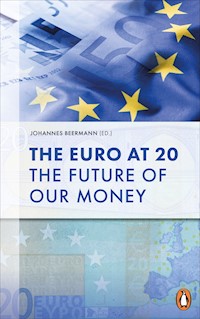
The Euro at 20 E-Book
29,99 €
Mehr erfahren.
- Herausgeber: Penguin Verlag
- Kategorie: Fachliteratur
- Sprache: Englisch
33 Perspectives on the future of cash from a political, economic and philosophical viewpoint
Over the past 20 years, euro cash has become a tangible symbol of economic integration and cohesion in Europe. It stands for stability and trust, especially in times of crisis. However, a look ahead at what the future holds for Europe’s single currency suggests there are some specific challenges looming. For example, the new forms of payment and so-called cryptocurrencies that the digital turn has ushered in have cast fundamental doubt on the status of cash and government-issued currencies. The authors of this book provide a nuanced overview of the topic by looking at multiple aspects of money and currency from different angles. This affords a new sense of perspective in the often vehement debate over the future of our money.
With essays by Otmar Issing, Clemens Fuest, Hans-Jürgen Papier, Peter Sloterdijk, Barry Eichengreen, Viviana Zelizer and Gaspard Koenig.
Das E-Book können Sie in Legimi-Apps oder einer beliebigen App lesen, die das folgende Format unterstützen:
Seitenzahl: 722
Veröffentlichungsjahr: 2022
Ähnliche




















Johannes Beermann (Ed.)
THE EURO AT 20
THE FUTURE OF OUR MONEY
For the Deutsche Bundesbank
The contents of this ebook are protected by copyright and contain technical safeguards to protect against unauthorized use. Removal of these safeguards or any use of the copyrighted material through unauthorized processing, reproduction, distribution, or making it available to the public, particularly in electronic form, is prohibited and can result in penalties under criminal and civil law.If this publication contains links to third party websites we assume no liability for the contents of such sites as we are not endorsing them but are only referring to their contents as of the date of first publication.
First published in 2022
Copyright © Penguin Verlag, Munich
A member of Penguin Random House Verlagsgruppe GmbH
Neumarkter Strasse 28 · 81673 Munich
All rights reservedEditor: Johannes Beermann for the Deutsche Bundesbank
Project Coordinator: Alexander KadowProject Management Penguin Random House: Sarah Kirchner, Elke Posselt
Translator: Deutsche Bundesbank, Frankfurt am Main
Editing and proofreading of English version: Simon Cowper, Greece
Graphic Design: Peter Palm, Berlin
Cover Design: Büro Jorge Schmidt, Munich
Typesetting: Uhl + Massopust, Aalen
ISBN 978-3-641-29779-4V002
Contents
Foreword Johannes Beermann
I: Money and currencyin the euro area
Trust in fiat money Antti Heinonen
The euro: Global currency model and masterpiece of banknote technology Wolfram Seidemann
The role of cash in the economy and society Otmar Issing
Statutory limitations on cash payments considered in the light of relevant aspects of constitutional and European Union law Hans-Jürgen Papier
The role of euro banknotes as legal tender Yves Mersch
The reform of fiscal governance in the euro area Clemens Fuest
The need for financial equalisation in the euro area and greater integration in the EUHans Eichel
From the East German mark to the euro: Cash brings people together Theodor Waigel
The Monetary Union of 1990 Richard Schröder
The real side of the “integration coin”: Germany’s participation in the global economy as a trading nation Dalia Marin
Three official ties to the euro under one roof Oldřich Dědek
II: Cash cycle in Germany and other G20 countries
The path money takes: Fundamentals, developments and the prospects for cash in Germany Johannes Beermann
The path money takes outside the euro area
Contribution by the Banco Central de la República Argentina
Contribution by the Reserve Bank of Australia Rochelle Guttmann
Contribution by the Banco Central do Brasil Ricardo Danziger
Contribution by the Reserve Bank of India
Contribution by Bank Indonesia David Sipahutar
Contribution by the Bank of Japan Hiroyuki Kanno
Contribution by the Banco de México Antonio Noriega
Contribution by the South African Reserve Bank Pearl Kgalegi
Contribution by the Bank of England Nick Butt and Lydia Reid
Contribution by the Federal Reserve Bank of San Francisco Roger Replogle
III: Perspectives for cash
Thousand years of paper currency, and what comes next Barry Eichengreen
Homo aquisitor: Observations on the contemporary individual as a holder of purchasing power Peter Sloterdijk
Cash usage in Switzerland: Between stability and change Fritz Zurbrügg
Often imitated, never duplicated: The enduring role of U.S. currency Mark Gould
Cash, Covid and the prospects for a Canadian digital dollar Walter Engert and Kim Huynh
Policy implications of digital currency as part of the monetary base Fan Yifei
The digital euro from a geopolitical perspective: Will Europe lag behind? Philipp Sandner and Jonas Gross
Central bank digital currency: The quest for minimally invasive technology Raphael Auer and Rainer Böhme
Pandemic money puzzles Viviana A. Zelizer
The Soul and the Sign Gaspard Koenig
In dubio pro euro note: On the psychological value of cash Julia Pitters
IV: Final remarks
In lieu of concluding remarks: Some thoughts on the future of cash Johannes Beermann
Authors
Foreword Johannes Beermann
The euro has become an integral part of the daily lives of more than 340 million people in Europe. Nowadays, you are unlikely to find many people asking themselves how Europe’s single currency, in the form of banknotes and coins, found its way into ATMs and the cashier’s till at the supermarket around the corner 20 years ago. This is, no doubt, in part because the launch of euro cash on 1 January 2002 went so smoothly.
In Germany, the Deutsche Bundesbank, in its capacity as the country’s national central bank, was responsible for gradually withdrawing the Deutsche Mark currency circulating in Germany from the cash cycle and at the same time bringing the newly produced euro cash into circulation in sufficient quantities. While this “double changeover process” was a mammoth logistical task, the Bundesbank took it in its stride. In order to ensure that everyone in the German economy – from businesses to consumers – had enough euro cash on hand to see them through the first few days of 2002, roughly three billion euro banknotes worth €57 billion were distributed to commercial banks in Germany alone in the run-up to the switchover.
Today, euro banknotes are legal tender in 19 Member States of the European Union. The euro is a stable currency, which has played a part in the acceptance and high level of support that the single currency enjoys. Euro cash has now matured into a tangible symbol of economic integration and stability and, alongside the US dollar, is an important means of payment worldwide.
However, looking ahead, the euro area faces major challenges: inflation in Germany reached its highest level in over 40 years in the spring of 2022, general government debt ratios in the euro area spiked higher again in the wake of the coronavirus pandemic, and digital transformation has given rise to new forms of payment and crypto assets that could fundamentally call into question the importance of cash and government-issued currency. With all that in mind, how important will the euro be in the 20 years to come as a symbol of integration and stability, on the one hand, and as government-issued central bank money on the other?
In times of such pronounced social upheaval and macroeconomic challenges, it is impossible to provide conclusive answers to this question. In any case, that is not what this book sets out to do. Instead, its aim is to give readers food for thought and to look at the topics of money and currency from a broader perspective, encompassing their various historical, political and, not least, economic dimensions.
The varied contributions to this book can be divided into three parts. The first covers money and currency in Europe. The essays shed light on aspects of European integration, put cash into an economic and legal context and explore the history of money. As we all know, economic and monetary history are closely linked. In Germany, for example, we established a monetary union back in 1990 with the introduction of the Deutsche Mark in what was still, at the time, the German Democratic Republic – driven not least by the East German population’s aspirations for economic participation, expressed in their desire for hard Deutsche Mark currency. Back then, as now, the Bundesbank played a key role in supplying cash to the public. The second part of the book takes a closer look at the special significance of central banks in their countries’ cash cycles. After a detailed picture has been painted of the situation from the German perspective, international points of view are also presented. Central banks from outside the euro area explain important processes within their national cash management operations for the secure and ample supply of cash to the general public. In addition, they describe how they assess the importance of cash for their countries’ economies and how they see the future of payments in an era of digital transformation. Particular attention is devoted to this forward-looking perspective in part three. Examined through the interdisciplinary lens of economics, philosophy, sociology and psychology, ideas about the role of cash and the money of tomorrow are aired and discussed in depth. One strong focus here is on the importance of digital forms of money, including the possibility of central bank digital currency.
I would like to thank all the authors for their valuable contributions to this book. With their insightful and balanced texts, they provide crucial, objective input to inform the often emotional debate about the foundations upon which our money is based and about what its future holds. I would also like to thank a great many colleagues from the Directorate General Cash Management, who have provided invaluable support over the course of this book project. I am grateful to the Bundesbank’s Language Services, which has done a great job in translating the contributions. Last but not least, special thanks go to my Head of Office Dr Alexander Kadow, who has coordinated and supervised this project from day one and has been instrumental in making this book a success.




