


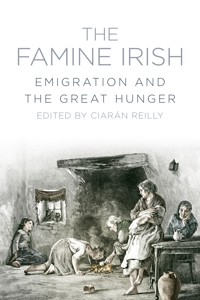
The Famine Irish E-Book
Erhalten Sie Zugang zu diesem und mehr als 300000 Büchern ab EUR 5,99 monatlich.
- Herausgeber: THP Ireland
- Kategorie: Geisteswissenschaft
- Sprache: Englisch
From a range of leading academics and historians, this collection of essays examines Irish emigration during the Great Famine of the 1840s. From the mechanics of how this was arranged to the fate of the men, women and children who landed on the shores of the nations of the world, this work provides a remarkable insight into one of the most traumatic and transformative periods of Ireland's history. More importantly, this collection of essays demonstrates how the Famine Irish influenced and shaped the worlds in which they settled, while also examining some of the difficulties they faced in doing so.
Sie lesen das E-Book in den Legimi-Apps auf:
Seitenzahl: 498
Veröffentlichungsjahr: 2016
Das E-Book (TTS) können Sie hören im Abo „Legimi Premium” in Legimi-Apps auf:
Ähnliche




















Acknowledgements
This collection of essays emanates from the Third Annual International Famine Conference, which was held at the Irish National Famine Museum at Strokestown Park House, County Roscommon in July 2013. Fittingly, to mark the year-long celebration, ‘The Gathering’, the theme of the conference examined ‘The Famine Irish’ and their experience of emigration during the 1840s and after. Bringing researchers together with a network of international experts, the conference approached the theme from the broadest possible historical perspective. Over the course of two days, the conference heard thoughtful and wide-ranging analysis of emigration and the diaspora during and after the Great Irish Famine. The quality of the papers delivered highlighted that the proceedings added significantly to the growing corpus of Famine and diaspora studies. The essays included in this volume demonstrate that where once distance may have hindered the study of Irish Famine emigrants, a new generation of scholars are making use of the wide availability of sources online and elsewhere. Indeed, the use of sources is particularly noteworthy, opening up as it does the individual experience of Irish Famine emigrants. Using these myriad of ‘new’ sources, the essays challenge long-held assumptions about the Famine Irish and provide a remarkable insight into the personal and family circumstances of some of those who were scattered across the globe. Moreover, they also lay the foundation for similar studies of the Irish émigré in locations not covered in the present volume.
A number of people are owed thanks for facilitating the conference in 2013 and for ensuring the completion of this collection of essays. Firstly, my sincere thanks to the contributors for their patience, expertise and diligence in the preparation of their essays. Likewise, thanks is owed to Professor Marian Lyons and Professor Terence Dooley of the Department of History, Maynooth University; Tim O’Connor, chairman of The Gathering Ireland 2013; Nollaig Feeney, Roscommon Heritage Officer; Michael Blanch, Committee for the Commemoration of the Irish Famine Victims and Pat McCarrick, Botháir. At Strokestown, the efforts of Jim Callery, Patrick Kenny, Caroilin Callery and Declan Jones have contributed immeasurably to the various conferences that have been held there annually since 2011. Likewise, John O’Driscoll, curator and general manager at Strokestown Park House, deserves special mention and thanks for his assistance in organising the Annual Famine Conference and other events. I am very grateful to Ronan Colgan, Beth Amphlett and the staff of The History Press Ireland for their dedication and willingness to publish this volume of essays. Lastly, the continued support of my family is greatly appreciated and in particular a special mention to Tara, Donnacha and Odhrán.
In his opening remarks to the conference in July 2013, and which follow, Tim O’Connor, chairman of The Gathering, complimented the speakers for their efforts, reminding them that their scholarship was a means of connecting with the thousands who left Ireland in the 1840s and after. It is in that spirit, then, that this book is offered.
Ciarán Reilly
Contents
Title
Acknowledgements
Notes on Contributors
Abbreviations
Preface:
Opening remarks by Tim O’Connor, chairman of The Gathering and former Irish Consul General in New York, at the Third Annual International Famine Conference at Strokestown Park House,
19
July
2013
1. ‘Shovelling out the paupers’: The Irish Poor Law and assisted emigration during the Great Famine
GERARD MORAN
2. The mechanics of assisted emigration: From the Fitzwilliam estate in Wicklow to Canada
FIDELMA BYRNE
3. The experience of Irish women transported to Van Diemen’s Land (Tasmania) during the Famine
BLÁTHNAID NOLAN
4. Reporting the Irish Famine in America: Images of ‘Suffering Ireland’ in the American press, 1845–1848
JAMES M. FARRELL
5. Widows’ and dependent parents’ American Civil War pension files: A new source for the Irish emigrant experience
DAMIAN SHIELS
6. From emigrant to Fenian: Patrick A. Collins and the Boston Irish
LAWRENCE W. KENNEDY
7. The women of Ballykilcline, County Roscommon: Claiming new ground
MARY LEE DUNN
8. Constructing an immigrant profile: Using statistics to identify Famine immigrants in Toledo, Ohio, 1850–1900
REGINA DONLON
9. ‘The chained wolves’: Young Ireland in Exile
CHRISTINE KINEALY
10. ‘There is no person starving here’: Australia and the Great Famine
RICHARD REID
11. The Irish in Australia: Remembering and commemorating the Great Famine
PERRY MCINTYRE
12. ‘
Une voix d’Irlande
’: Integration, migration, and travelling nationalism between Famine Ireland and Quebec
JASON KING
13. Languages of memory: Jeremiah Gallagher and the Grosse Île Famine Monument
MICHAEL QUIGLEY
Copyright
Notes on Contributors
FIDELMA BYRNE is an Irish Research Council Postgraduate Scholar. Her research interests include nineteenth- and twentieth-century social history, landed estates and assisted emigration. She is currently completing her doctoral thesis entitled ‘Estate management practices on the Wentworth-Fitzwilliam estates in Yorkshire and Ireland: a comparative study, 1815-65’ at Maynooth University.
REGINA DONLON graduated with a PhD from Maynooth University in 2014. She is currently working as an Irish Research Council Postdoctoral Research Fellow at the National University of Ireland, Galway where her work examines assisted emigration from the west of Ireland to the American Midwest during the period from 1880 to 1930. Her research interests include Irish and European diasporas, American history in the Reconstruction era and transnationalism.
MARY LEE DUNNMA, whose Roscommon ancestors came from Kilglass parish and Elphin, is an independent scholar, former journalist, and a founder of the Ballykilcline Society. She is author of Ballykilcline Rising: From Famine Ireland to Immigrant America (2008) and continues her Irish research. She lives in Maine.
JAMES M. FARRELL is a Professor of Rhetoric and Chairperson in the Department of Communication at the University of New Hampshire, where he teaches classes in argumentation, propaganda, rhetorical theory, rhetorical criticism, and American public address. He received his PhD from the University of Wisconsin-Madison in 1988, and has published numerous critical and historical studies of eighteenth- and nineteenth-century American discourse.
LAWRENCE W. KENNEDY is a professor of history at the University of Scranton where he has taught since 1992. He earned his undergraduate and graduate degrees at Boston College and is the author of Planning the City upon a Hill: Boston since 1630 (1992) and co-author of Boston: A Topographical History 3rd edition (2000). He has also written Bricklayer Bill and the Workingman’s Boston Marathon with his son Patrick L. Kennedy (anticipated publication 2017) and is working on another book, Patrick A. Collins: Irish Emigrant and American Politician, 1844-1905.
CHRISTINE KINEALY has published extensively on nineteenth-century Irish history, particularly on the Famine era. Her publications include, Charity and the Great Hunger: The Kindness of Strangers (Bloomsbury, 2013) and Repeal and Revolution: 1848 in Ireland (Manchester University Press, 2009). She is founding Director of Ireland’s Great Hunger institute at Quinnipiac University.
JASON KING is an Irish Research Council Postdoctoral Researcher in the Moore Institute at the National University of Ireland, Galway. He was previously a lecturer at the University of Limerick, Maynooth University, and an Assistant Professor of Canadian Irish Studies at Concordia University. His research specialises in Irish Famine memory and migration in past and present literary representations and performance. He is the curator of the digital Irish Famine Archive: http://faminearchive.nuigalway.ie.
PERRY MCINTYRE is an Adjunct Lecturer at the University of New South Wales and has worked as a genealogist, freelance historian and archivist for over twenty years. She has served on the committees of the History Council of New South Wales, the Society of Australian Genealogists, the Royal Australian Historical Society, the Australian Catholic Historical Society and the Great Irish Famine Commemoration Committee (chair 2012-15). She has published and spoken extensively on immigration and family history in Australia and Ireland. Her PhD on convict family reunion was published in 2010 by IAP as Free Passage: The Reunion of Irish Convicts and their Families in Australia, 1788–1852. She is a director of Anchor Books, Australia, formed to publish history, particularly relating to colonial Australia.
GERARD MORAN is Co-ordinator of History at the European School, Lacken, Brussels and has been a lecturer in the Department of History at NUI Galway and Maynooth University, where he established and was the Director of its MA in Irish History programme. His research interests include the Irish diaspora, the Great Famine and landlord and tenant relations in Ireland. He is the author of Sending out Ireland’s Poor: Assisted Emigration from Ireland in the Nineteenth Century (2004), and joint editor of Galway: History and Society (1996) and Mayo: History and Society (2014).
BLÁTHNAID NOLAN graduated with a PhD from the School of Social Justice, UCD in 2013. Her thesis was titled Power, Punishment and Penance: An Archival Analysis of the Transportation of Women from Grangegorman in Dublin to Hobart Town in Van Diemen’s Land (Tasmania) 1844–1853. She is an Honorary Associate of the University of Tasmania and has presented papers nationally and internationally. Her research interests include convict transportation, social history, history of criminology, penal history, colonial history, the British Empire, prosopography, and nineteenth-century history.
TIM O’CONNOR runs his own advisory business providing strategic advice and support to companies and organisations. His clients cover a range of sectors from financial services to renewable energy. He has also held several voluntary positions, including Chairmanship of the Advisory Board of The Gathering Ireland 2013. He worked in the Irish public service from 1972 to early 2010, most recently as Secretary General (Chief of Staff) to the President of Ireland. His career also includes almost thirty years in the Irish diplomatic service, in the Department of Foreign Affairs. A large portion of his career was spent working on the Northern Ireland Peace Process, including the Good Friday Agreement. He was the inaugural joint secretary of the North/South Ministerial Council (based in Armagh, Northern Ireland), established under the Agreement. He has also served terms as Director of the Africa Unit and of the Human Rights Unit in the Department of Foreign Affairs. His foreign postings included the embassies of Ireland in Bonn and Washington DC and most recently, from 2005–2007, he was Consul General of Ireland in New York, USA, with the rank of ambassador. From Killeedy in West Limerick, and educated at St Munchin’s College, Limerick, Tim was awarded honorary doctorates from Maynooth University, the University of Ulster and Quinnipiac University (Connecticut, USA).
MICHAEL QUIGLEY is editor of the Canadian Association for Irish Studies Newsletter, formerly historian for Action Grosse Île, author of numerous essays on Grosse Île and the Great Hunger, and on local history subjects in Hamilton, Ontario. He holds a doctorate from McMaster University.
RICHARD REID is a graduate of Trinity College, Dublin and emigrated from Ireland to Australia in 1972. Until retirement in 2013 he worked as a high school teacher, museum education officer, exhibition curator and as a senior historian for an Australian federal government department. He gained his doctorate from the Australian National University in 1992 for a study of Irish assisted emigration to New South Wales from 1848 to 1870. Between 2007 and 2011 he was the National Museum of Australia’s Senior Curator for the major exhibition – ‘Not Just Ned: A True History of the Irish in Australia, 1788 to the present’. He is currently working, with others, on projects relating to Irish emigration to nineteenth-century Australia including the story of the 4,114 Famine orphans sent to that country from Irish workhouses between 1848 and 1850.
CIARÁN REILLY is a Postdoctoral Research Fellow at the Centre for the Study of Historic Irish Houses & Estates, Maynooth University. His publications include The Irish Land Agent, 1830–1860: The case of King’s County (2014); Strokestown and the Great Irish Famine (2014) and John Plunket Joly and the Great Famine in King’s County (2012).
DAMIAN SHIELS is an archaeologist and historian. Formerly one of the curators of the ‘Soldiers & Chiefs’ Military History Exhibition at the National Museum of Ireland, he is currently a Director with Rubicon Heritage Services Ltd and author of The Irish in the American Civil War (2013). In addition, he hosts a website on the Irish experience of that conflict at www.irishamericancivilwar.com.
Abbreviations
AOH
Ancient Order of Hibernians
CLEC
Colonial Land and Emigration Commissioners
CRF
Convict Reference File
NLI
National Library of Ireland
NAI
National Archives of Ireland
NARA
National Archives Records Administration
NYPL
New York Public Library
NSW
New South Wales
SA
Sheffield Archives
SRNSW
State Records New South Wales
NOTE ON MONEY
£ pounds
s shillings
d pence
Preface
Opening remarks by Tim O’Connor, chairman of The Gathering and former Irish Consul General in New York, at the Third Annual International Famine Conference at Strokestown Park House, 19 July 2013
I am delighted and honoured to open this timely and important conference which is taking place this year as part of our Gathering Ireland 2013 Initiative, which I have the privilege to chair. My thanks to Dr Ciarán Reilly for inviting me to make the opening remarks and to Ciarán and his colleagues at Maynooth University, particularly Professor Marian Lyons and Professor Terence Dooley, for their great support for The Gathering project generally. In the beautiful environs of Strokestown Park House, I must also make honourable mention of the Callery family, in particular Jim and Adeline, and to Caroilin for the fantastic work she has done in organising the overall Strokestown Gathering, which also begins today, and in which this Conference plays a key part. Could I also pay tribute to the great work of all involved in the Strokestown Famine Museum, a tremendous national asset, where our conference is taking place – General Manager John O’Driscoll and also Declan Jones and Patrick Kenny from the Westward Group, who have put so much into giving us this wonderful facility. I call the conference timely and important because it is both; timely because it sits right in the middle of The Gathering year, in which there is higher focus than ever before on the relationship between Ireland and its global family, and important because the subject matter of your deliberations shines a light right at the heart of that episode in Irish history which more than any other contributed to the reality that the Irish became an emigrant people, the Great Famine.
Firstly, however, a quick word about The Gathering Ireland 2013 initiative itself. A major feature of its origins was the need for a boost to our tourism industry. And it is certainly doing that. The Gathering, which is a government initiative and enjoys the strong support of the Taoiseach and the Tánaiste, was formally unveiled as a project by the Minister for Transport, Tourism and Sport, Leo Varadkar in October 2011. A project team was established in Fáilte Ireland, and Roscommon’s own Jim Miley, the project director, and his team have been doing a great job getting the project up and out there, under the overall political direction, and with the strong personal support of Minister Varadkar and Minister of State at the Department of Tourism, the West’s own Michael Ring. The overseas promotion and marketing for The Gathering is being expertly done by Tourism Ireland. I have the honour to serve in a voluntary capacity as the chairman of the Project Advisory Board. This is a group of people drawn from government, industry, academia, local government and the arts, and our role is to provide support and counsel to the project. It also includes Frank Dawson, the esteemed Roscommon County Manager and I want to take this opportunity to thank Frank for his wisdom and support. A word also about the great contribution being made by Frank’s colleagues in the city and county councils, local development networks and Ireland Reaching Out in the roll-out of the project around the country, and indeed that of the insurance company Irish Public Bodies, who put €1 million into a community fund, which the government matched, and which has helped greatly also in terms of supporting that community engagement.
However, the real heroes of the project are the people of Ireland who have embraced The Gathering in their thousands. As we speak, we have 4,200 Gatherings registered on our website. These are drawn from parishes, communities, groups, clubs, educational, cultural and sporting organisations, companies and families, all around the country – all stepping up to the plate to do their bit, to make their contribution – and extending an invitation to our people around the world to return and gather with us sometime during 2013. And as I keep reminding people, 4,200 Gatherings isn’t just 4,200 events and weekends. No, like this one in Strokestown, it is 4,200 committees meeting for months on end, planning, preparing, organising, thinking through, worrying, caring, inviting. The Gathering has been an enormous exercise in community engagement and endeavour, with big implications for the future. And the diaspora has responded. In their tens of thousands. As matters stand, visitor numbers are up over 6 per cent for the first five months of the year and over 15 per cent from North America, which is a great achievement at a time when tourism out of America as a whole is down 3 per cent. This is all very encouraging in tourism terms, and at The Gathering we are delighted about that. The tourism sector is a vital part of our economy, employing over 200,000 people and contributing 4 per cent to our national GNP. Of course, The Gathering goes beyond tourism, important as that sector is. In its essence it is about the enduring nature of the bond and connection that exist between those of us who stayed and those who left Ireland.
Having been part of The Gathering project for three years now, I have enjoyed a particular vantage point in terms of being able to observe it all close up and to reflect on the new insights about the nature of our relationship with the diaspora that are emerging as a result of the project. In doing so, I stress that I am not an academic scholar and these observations are personal ones of my own. Think of them as findings from the field, some of which may have validity in your eyes and some which may not – I will leave that to your own good judgement as scholars of the area. The other point I would make is that this is an evolving story and our understanding of its essence is changing as we learn more. What I do know for sure is that The Gathering has injected a significant new dynamic into the diaspora space in the Ireland context and I think it is only right that those of us who care about the relationship between us and our scattered kith should try to draw as much as we can from what it is telling us.
One obvious feature that The Gathering has served to shine a particular light on is the question of why 70 million people around the world regard their identity as Irish – what is such a sense of connection by so many people, including after several generations, all about? I suppose one of the thoughts that I have had on this as the year has progressed is that it may perhaps have to do with the DNA of the Irish. I asked a scholar friend of mine to put a number on the length of time Irish had been the spoken language of the people of the island of Ireland until its decline and loss in the nineteenth century. He said about 2,500 years. So the case can be made that the Irish – and I know there can be a big debate about that term, but let’s at least say ‘the people living on this island’ – were a communal, clan-centred, cohesive, close-knit society with our own language for over two and a half millennia. And then, less than 200 years ago, two seismic events intervened to change everything – the dramatic decline in the use of Irish as a spoken language, and the Great Famine, which resulted in a huge portion of our people either dying or emigrating. As we know, that process of emigration has continued apace in the 170 years or so since then, accelerating in the decades after independence in 1922. As a result, there are now multiple times more people of Irish identity living overseas than there are in Ireland itself, a remarkable reality.
A thought occurred to me from all of that – it could be argued that the 170 years or so since the Famine is actually a very brief block of time in the context of two and half millennia and not enough to alter the fundamental DNA of the Irish in terms of being a people of community and kinship. And that therefore, whether we are aware of it or not, that context has meant that the process of separation involved in emigration over the generations has resulted in a sense of, can I call it, psychic loss, for both sides – both for those who left and for those who stayed. A bit like the sensation for twins who are separated at an early stage in life and experience during their subsequent lives apart a sense of not being quite fully whole.
Before I’m taken to task by the scholars, let me fully acknowledge that there is a further dimension of course in the Ireland story in the form of the relationship with England and the consequences of that, including through the plantations of the northern part of the island during the seventeenth century. The story of the Ulster Scots in the Ireland narrative and the significant numbers of that community who emigrated during the eighteenth and nineteenth century, particularly to North America, is an important piece of our demographic and diaspora jigsaw in its own right and deserving of a full study of its own. However, I don’t believe it takes from the basic point I’m making above about what I would call the indigenous Irish.
I have two other interesting fragments from the field to share with you, both taken from The Irish Times. Firstly, in an interesting article on emigration on 21 March 2013 in TheIrish Times, Irial Glynn from University College Cork included a quote from a great Maynooth professor of my era, Fr Liam Ryan, and it went like this: ‘Emigration is a mirror in which the Irish nation can always see its true face’. A fascinating observation by a great scholar. Secondly, on 29 June 2013, The Irish Times reported on the Kennedy Gathering in Wexford the previous day. This involved the visit by over thirty members of the Kennedy clan commemorating the visit to Ireland fifty years ago of President Kennedy. The report quoted two comments from one of the Kennedy delegation, Douglas Kennedy, the youngest son of Bobby. He said that those four days of the visit to Ireland were the happiest days in the life of JFK – a pretty remarkable statement given the context. And secondly and even more profoundly, Douglas Kennedy observed that during those four days, JFK ‘came to himself’. A remarkable claim and, if true, what an amazing insight – and certainly one for the scholars to ponder!
I wanted to make an attempt to add a thought of my own to Douglas Kennedy’s great insight: if JFK came to himself during the four days of that iconic visit, then perhaps so did we, the people of Ireland. Four decades after independence, with little to show for it in terms of progress, and coming out of a further episode of mass and brutal emigration in the 1950s, with a real question mark about whether we could make it as an independent country, there came into our midst this extraordinary man, the most powerful person in the world – and he was one of us. The national lift was palpable. In the face of one who had left we saw the potential of our own possibility. That is why I say perhaps in those four days we also came to ourselves. Reading Douglas Kennedy’s comment certainly put Liam Ryan’s great insight into a new context. Perhaps that mirror Liam Ryan talked about was on full display in that farmyard in Wexford in June 1963.
However, I suppose my biggest learning in the course of The Gathering was about our role here at home. My biggest exposure to the diaspora issue was during my two years as Consul General of Ireland in New York from 2005 to 2007. I was frankly astonished by the scale of Irish America – their impact in the US, the way they shaped New York and still do today, exemplified by how the city becomes demonstrably Irish on St Patrick’s Day, not as a sop to the Irish but as a true reflection of the centrality of our people to the place. Truly amazing. I left New York to return to Ireland in 2007 with a huge sense of the possibility of the diaspora space for Ireland. But the big shift for me as a result of The Gathering was the dawning of the realisation over the last year or so that the centre of gravity of the relationship does not lie out there but rather here at home. And that if the relationship between Ireland and its diaspora is to go to another level, the onus of first mover rests with us, the people living here in Ireland. Why? Because we are the custodians of the shared home place, the place where all the journeys began, theirs and ours. It is we, the people living here today, not those who left, who get to decide the wording of the notice on the gate of the home place – whether ‘Keep Out’, ‘Don’t Care’ or ‘Welcome Home’.
By the generous way they have embraced The Gathering, the people of Ireland have given their emphatic answer to that question and to what that notice should say. They have demonstrated in a powerful and moving way that they are willing and indeed eager to take up that role of custodian of the shared home place and extend the hand of authentic welcome to their kith around the world. The response of the diaspora has been tremendous, as the number of visitors shows. Even more profound has been the kind of engagement that has been happening at The Gatherings, when those who stayed come together with those who left. In a new way, what we are doing through The Gathering is assuming, this time in a very conscious and thoughtful way, our role on behalf of those who left as ‘custodians of the shared home place’, taking responsibility for doing the inviting and saying to the scattered: ‘We welcome you back home, tell us your story and we celebrate you’. The result, as I say, has been moving and powerful and I have experienced several examples of this myself over the past weeks and months.
As we enter the decade of centenaries, and move towards Ireland at 100, I’m excited, therefore, about the new era which could be opening up in the relationship between Ireland and our remarkable diaspora. Despite the distances of geography and generation, the reality is that we remain muintir to each other and that is something of potentially huge value for both sides. What is now available is the possibility of a new understanding in the relationship between those who stayed and those who left, which could have major implications for both of us. We who live in Ireland have the opportunity to offer ourselves in a very particular way, as I have just suggested, as the ‘custodians of the shared home place’ of the heritage we share with the diaspora and their children – and indeed as custodians of the graves of the ancestors of those who left. They in their turn could serve as our pathfinders and support in a complex and globalised world, something that could have huge implications in terms of investment in Ireland, support for Irish companies and tourism.
Speaking of a globalised world, could I mention one other very important group in all of this, in my view – the 17 per cent of the population of Ireland who today are foreign-born; the New Irish, as they are called. The story of these people, also emigrants, who have come from other lands and chosen Ireland as their new home, is an exact parallel of the narrative of our people making theirs in other worlds. They bring with them the same energy and ambition and will to prevail that our people did to their adopted lands and thereby enrich our country just as our people enriched their new worlds. They are also very committed to Ireland and their future among us. I feel strongly that our discourse on and vision of diaspora should include them also in light of the powerful and rich contribution they have to make to our country.
So there we have it. It is over to you now, the scholars and practitioners in this fascinating world. As I said at the beginning, your role is central. For any dimension of the human journey, it makes sense that we understand it as fully as we can, both for its own sake but also so that we can decide on the wisest possible basis what to do with that knowledge. In relation to diaspora, as to any other issue of the human journey, good understanding is the pre-requisite of good action. Historically, emigration has sat in the Irish psyche as a major negative. And, without question, many of its dimensions in the Irish context have been deeply tragic for reasons we all know well. But now, almost 200 years after it began on the enormous scale that we know only too well, this is a timely moment, in the year of The Gathering and in the first year of the decade of centenaries, to take further stock of what the issue means in all its dimensions and in particular to further unpack what I think we all agree is the epicentre of the scattering, the Great Famine. One of the most moving dimensions of the Strokestown Gathering for instance is the visit of Richard Tye from Canada, a direct descendant of young Daniel Tighe, who emigrated from here during the Famine in 1847.
In that regard, I pay great tribute to you, the scholars. I see that work as a kind of ‘CSI’ on the linkage between the Famine and emigration. I think the work you are doing in following the stories and journeys of the Famine Irish is particularly fascinating, including in the way the threads of those stories and journeys continue all the way down to the present day, as exemplified by the Richard Tye story. If you combine that work with what is unfolding here in Ireland during The Gathering, perhaps we are moving towards an understanding that while the narratives of those who left were and are different to those who stayed, there is also a way in which they remain connected throughout in one over-arching narrative as well – back to Liam Ryan’s mirror.
1
‘Shovelling out the paupers’: The Irish Poor Law and assisted emigration during the Great Famine
Gerard Moran
Irish emigration in the nineteenth century was not a homogeneous experience for the estimated 8 million Irish people who left the country in search of a new life abroad. While the broad push and pull factors are used to indicate why the people departed, their emigrant experiences are as numerous as the numbers who left. The magnitude of the exodus was such that until recently historians have not categorised and examined the regional variations of those who emigrated. As David Fitzpatrick points out, the sheer scale of the exodus in the second half of the nineteenth century discouraged historians from standing back in order to appreciate the complexity and diversity of the emigration.1 In recent years this apprehension has dissipated and historians have begun to examine the various subgroups that comprised this massive exodus, taking on board their background, the voyages to foreign destinations and what became of them after they reached the new lands they travelled to. This has led to a more diverse emigration experience being uncovered between those who had the finances to fund their exodus, such as migrants from Ulster and the surrounding counties in the 1815–1845 period, to those who were assisted by landlords, philanthropists, the government and the Poor Law guardians.2
In the nineteenth century nearly 500,000 were assisted by official bodies to emigrate from Ireland, with over 67,000 being aided by the Poor Law.3 In 1838 the Irish Poor Law came into existence, based on the system introduced into England four years previously. It was the first attempt to provide a structure in Ireland to deal with local poverty and destitution. While its principle function was to cater for the needs of the destitute population, mainly through the workhouse system, it was also empowered to deal with issues such as assisting people to emigrate, as had been suggested by various parliamentary commissions and select committees in the 1820s and 1830s. In the decades prior to the Great Famine opinion was divided as to the merits of assisting the Irish poor to emigrate. As early as 1817 Col. Robert Torrens had advocated emigration as a solution to the problem of poverty and destitution in Ireland, and by the 1820s other prominent economists such as Thomas Malthus had accepted the principle of sending Ireland’s surplus population to the colonies, but only if it was part of an overall package to promote a social ‘transition in Ireland’. On the other side George Strickland, a Yorkshire landowner, rejected assisted emigration as the panacea for Irish pauperism, stating that it would only create a vacuum that would be quickly filled up.4 George Nicholls, the architect of the Irish Poor Law, recommended that some form of assisted emigration be incorporated into the Poor Law with the expense being shared between central government and the Poor Law unions. It was argued the government should contribute its share because the empire would benefit by having a surplus population settle in those colonies with population deficiencies, and individual landowners who assisted their poorer tenants to leave should be given financial assistance through the Poor Law.5 However, this was rejected by the government because of cost and the only emigration provision that became part of the Poor Law was a clause permitting the boards of guardians, subject to the sanction of a special meeting of the ratepayers, to levy an emigration rate. This could only assist people who had been workhouse inmates for at least three months to settle in a British colony.6
There was much disappointment that the Poor Law was not enabled to provide large-scale pauper emigration. Some Poor Law unions bent the rules in order to facilitate emigration, as in Cork where the guardians were prepared to assist destitute paupers in the early 1840s to leave. Their involvement was probably due to a tradition in the city whereby paupers were helped by public and private charity, as in 1835 when 150 girls from the parish of St Mary’s, Shandon, were sent to New South Wales. In March 1841 the Cork guardians were in the process of sending 191 paupers to various destinations when they were forced by the Poor Law Commissioners to cancel the plan because of opposition from local ratepayers, who stated that the guardians were exceeding their authority.7
In August 1843 the rule relating to Poor Law involvement in assisted emigration was modified, and under section eighteen, if two thirds of the guardians of a union agreed, they could assist people who had been pauper inmates for three months to emigrate to a British colony with the expense being charged to the union or the electoral division where the pauper had originally resided.8 While this amendment made emigration easier, most unions were still reluctant to participate for financial reasons. Between 1844 and 1846 only 304 people were assisted, 184 leaving in 1846, involving sixteen unions: eight in Ulster (which sent out 244 paupers), four in Leinster, three in Munster and Manorhamilton in Connacht. Many of these were female orphans and single young mothers with children who were sent to Canada. Some received better treatment than others, getting landing money and assistance upon their arrival. Few of the workhouses along the western seaboard participated, the exceptions being Kanturk, Manorhamilton and Kilrush.9 Most unions were reluctant to become involved in the emigration process because of the increased expenditure, especially those along the western seaboard, many of whom had only recently opened and incurred major debts, and who were seeking ways of cutting funding and were resisting further financial burdens being placed on them. It was also argued that providing assistance would make the workhouses more attractive to every person who wanted to leave, leading to a breakdown in the efficiency of the Poor Law. As one witness, Col. W.A. Clarke, the Poor Law Inspector for Killarney and Kenmare, told the Select Committee of the House of Lords Inquiry into the Poor Law in April 1849, ‘… every man would conceal his means and come into the workhouse, because he would say, “It gives me title to a free passage”’.10 Where emigration was introduced it was often at the urgings of Poor Law Inspectors, as in the case of Captain Kennedy in Kilrush, or from local landowners as with Robert Small of Newmarket and Major Ball of Fortfergus. The Poor Law Extension Act of 1847 extended the assisted emigration provisions to all paupers, including those receiving relief outside of the workhouse, but few unions availed of it and the take-up was least in those areas where it was most needed, in particular along the west coast. As Alfred Power, the Assistant Poor Law Commissioner, stated in March 1849, money would have to be made available from outside funds rather than from the resources of the most distressed unions.11 In some unions there was an ignorance of the emigration provisions, in particular where unelected vice-guardians were in charge. It had to be pointed out to the Galway vice-guardians in November 1848 by Revd Peter Daly and Thomas Birmingham that provision could be made for the ninety-three people that had been evicted in the Kinvara region, with the union at large paying one-third of the cost and the rest coming from the electoral divisions to which the individuals belonged.12 However, it was virtually impossible for most Poor Law unions to engage in large-scale emigration programmes before 1849 as they were restricted by a cap of 6d in the £ for emigration purposes. The amount raised was negligible as it was pointed out it would only result in £100 being available for the Cappaghmore Electoral Division in the Limerick Poor Law Union.13
The onset of the Famine in 1845 and 1846 did result in the adoption by the Poor Law of schemes to help people to leave, but the overall figure was negligible. In August 1846, the Sligo guardians selected fifty-six paupers for emigration to Canada at a cost of £4 each, but it is unclear if the plan proceeded for they do not appear on the returns for 1844–6.14 At this stage the Poor Law guardians throughout the country were looking for increased funding for assisted emigration as a way of dealing with the rapid rise in destitution and their inability to cope with the massive increase in pauper inmate numbers. By late 1846 many unions were experiencing massive financial difficulties, due to the upsurge in the numbers seeking admission to the workhouses and their inability to collect the rates. By this stage many unions were insolvent and over the coming months nearly one quarter had to be replaced by paid vice-guardians.15
It was during this period that assisted emigration was given serious consideration as a solution to the problem of over population, destitution and famine. In March 1847, John Robert Godley, the son of a landowner with estates in counties Leitrim and Meath, presented the Prime Minister, Lord John Russell, with a memorial signed by eighty-three noblemen, gentlemen and landed proprietors, which favoured the implementation of assisted emigration to Canada. A number of prominent individuals signed the memorial, including the Church of Ireland Archbishop of Dublin, Richard Whatley; the Earl of Clanricarde; the Marquis of Sligo; and the Earl of Ormonde. This led to a major debate as to the merits of assisted emigration, and the government was forced to establish the Select Committee on Colonization from Ireland, which was chaired by Lord Monteagle, a strong advocate of emigration to the colonies. While the committee amassed an enormous amount of evidence and statements in favour of assisted emigration, the government was not prepared to fund a large-scale emigration programme because of the cost, and it was against the political economic theory of the day – that of laissez-faire. Nevertheless, it did open up the debate as to ways of assisting the poor to leave.16
By this stage the Poor Law guardians were examining every avenue to get rid of their long-term pauper inmates, especially females and children and over the next twelve years assisted emigration was one of the major approaches that were used to reduce the number of inmates and cut expenditure. In 1849, Denis O’Connor, the clerk of Limerick Union, said there was no other way of dealing with the large number of servants boys and girls in the workhouse, otherwise they would remain a permanent burden on the rates, while John Walsh, a Poor Law guardian from Kilkenny, argued that it would be better for the workhouse inmate and the economic well-being of the local community if the female pauper inmate was assisted to emigrate as it was costing £5 per year for her upkeep and better use of this money could be made by helping her to leave.17 The financial argument was also put forward by Mr Minnitt, a Poor Law guardian in Nenagh, when he stated in October 1851 that if the union assisted 1,000 inmates they could recoup the money over two years and in the long term the union would save £3,000 annually.18 John Vandeleur Stewart, chairman of the Letterkenny Board of Guardians, stated the annual cost of keeping a pauper in the workhouse was £6 1s, while the cost of sending that inmate to North America would be £4 10s, including provisions and clothing, ‘and therefore a pauper family might be placed in a position in the colonies in which he might earn an independent livelihood at a cost which would little exceed his maintenance in the workhouse’.19
The people that caused the authorities most concern were the women and children as they were the largest groups within the workhouses with little short-term prospect of leaving the institutions. By February 1847 there were 63,000 young children in the workhouses and by mid-1849 there were 90,000; in Ulster they comprised 52 per cent of the total inmate population.20 In May 1850 one-third of the adult inmates in Gort were women, and another 973 were girls aged between 9 and 15 years. In Galway, females represented 34 per cent of the total pauper population, and another 18 per cent were girls aged between 9 and 15.21 Many children entered the workhouses because they were orphaned, but others were abandoned. Between March 1848 and August 1850, 31 per cent of the children in Cork workhouse were classified as having been deserted by their parents.22 Ellen Griffin deserted her five children, placed them in Kilmallock workhouse and was on her way to North America when she was apprehended and brought before the guardians. She abandoned the children because she was unable to bring the whole family with her.23 Parents left their children in the workhouses in the hope that they would be provided for, not realising that they could succumb to disease and death; for example, in Ballinrobe workhouse between February and March 1849 there were 428 deaths, including members of the Reed family from Castlebar. After the death of the husband, Lord Lucan evicted the family and the mother decided to go to England, but did not have the passage fares for the three children, who were sent to the workhouse. One of the children died shortly after entering the workhouse.24 Many parents deserted their children, hoping that at some stage in the future they would be in a position to send back the fares for the children to join them, but such intentions did not always work out, as the parents died on the crossing to North America or at the quarantine stations such as Grosse Île.25 With no other sanctuary, many children ended up in the workhouses, but this created its own problems as their long-term prospects were bleak and the authorities feared they would remain a permanent burden on the ratepayers. These orphaned and deserted children were regarded as a ‘dead weight’ by the authorities as it was believed their future prospects were poor.26
Women were the other group that caused most concern. Women were more likely than men to have to resort to the safety net of the workhouse in times of need, and their stay tended to be longer. Men could emigrate in search of work and leave their wives to look after the children. Even before the full impact of the potato failure was realised, the number of female inmates greatly outnumbered those of males. Throughout 1846 women comprised about 75 per cent of the adult inmate population in the Cork workhouse and they continued to be the main group over the next five years, while by March 1847 three quarters of the adult inmates in Nenagh workhouse were women.27 However, the figures for widows in the workhouses are sometimes distorted, as many women entered the workhouse on the basis that their husbands had died, even though they had not. Women also became inmates claiming that they had been deserted by husbands leaving for the USA. According to the Poor Law Inspector, Col. W.A. Clarke:
… they are not heard of for months, and a great many when they are out there marry again; they forget that they have wives and families at home, and their wives and families remain as permanent paupers in the workhouse.28
An examination of alleged desertion indicates that necessity drove many women into the workhouses when their husbands left for Britain or North America or stayed outside, hoping to secure employment. The workhouse thus became the safety net for women in the struggle for survival. For example, Thomas Nestor’s wife told Tuam Petty Sessions that her husband had always supported her when he was able to, but in recent times he had been unable to. Edward Grady also appeared before Tuam Petty Sessions on the charge of desertion and not having supported his family for the previous twelve months. Grady told the court his wife had to seek refuge in the workhouse as he was unable to provide for himself, let alone his family, and he would support them if he had employment. He was sentenced to one month’s imprisonment.29 Likewise, Anne Grady applied for admittance to Parsonstown workhouse for herself and her family, stating her husband had deserted her and gone to England.30 While many females can be legitimately classified as abandoned, others claimed so to gain admittance into the workhouses, but believed their husbands would come for them when their circumstances improved. Thus it was not surprising that a majority of the inmate population were women, comprising 59.5 per cent of the workhouse population in 1851.31
This vast female pauper population created problems for the authorities. The unions attempted to keep the women occupied, but given the numbers this was difficult to achieve. In June 1849, the Galway vice-guardians, on the matron’s suggestion, employed some of the female inmates making fishing nets.32 In March 1852 the master of the union called the board’s attention ‘to the evils likely to arise from the idleness of so many of the adult females’.33 The absence of work created problems with the female inmates being disorderly and insubordinate and engaging in rioting in a number of workhouses. In December 1848, the paupers in Parsonstown workhouse, led by the women, rioted when the daily rations were reduced, and ransacked the stores. The constabulary were brought in to restore order. Disturbances were also reported in Carrickmacross, Nenagh, Enniscorthy, Castlebar and Tullamore workhouses when the inmates, mainly women, rioted.34 In 1848, young females were so disruptive in the South Dublin Union that it was decided that the matron could use solitary confinement as a punishment.35 While the issues that brought this disorder to a head were changes in diet or a reduction in the daily rations, it was also believed that the underlying causes were boredom and the feeling of hopelessness that the women had about their future. Limited employment opportunities were available for the workhouse paupers, and the idleness of the majority only ‘increased the sense of desolation, uselessness and shame they experienced’.36 Some who sought admission to the workhouses were so shocked by the conditions they witnessed that they left immediately. The employment of the female paupers and keeping them occupied within the workhouses was to remain a major concern for the authorities throughout the 1850s. While education and training were provided within the workhouses for children aged up to 13 years, it was felt that those between 13 and 19 had little to gain and the longer they remained as inmates the more their prospects of being rehabilitated outside the workhouse diminished. The plight of women who were long-term inmates was summed up by George P. Place, a witness before the 1861 Select Committee on the Poor Law, when he said, ‘I think six or seven months’ residence in a workhouse would be enough to demoralise the angels’.37 It was thus not surprising that the Poor Law unions throughout the country sought a solution to the large number of long-term female inmates, as they would otherwise remain a permanent burden on the unions’ finances, and posed a threat to the peace and order of the day-to-day running of the workhouses. For them emigration became the panacea to their problems. However, the impetus for emigration came not from within the Poor Law unions, but from the colonies.
With the workhouses full to capacity with a largely redundant population and an increasing demand for labour in the colonies, it seemed only natural that the problem of the population imbalance could be ameliorated by transferring the surplus population out of Ireland to Canada and Australia. That much of this surplus population was female only added to the solution as the colonies needed women. Throughout the 1820s and 1830s it was frequently suggested that Ireland’s surplus population should be sent to the colonies to address their problems: in Australia the ratio was eight men for every woman. In 1833 the Chief Emigration Agent for Upper Canada, James Buchanan, told Lord Monteagle that the problem of overpopulation in Ireland was such that ‘parents are daily constrained to say to their children, “we can no longer support you in idleness, go to America and earn your bread”’.38
Buchanan asked if the imperial parliament could help these people to go to Upper Canada, as depots could be established for the integration of the paupers in the colony. He suggested that if such a scheme was sanctioned, the people could be moved on a county or parish basis by the following autumn.39 Similar views were also expressed by Lt Col. Edward MacArthur, a witness before the Select Committee of the House of Lords on Colonization from Ireland in 1847, when he said that any system which allowed large numbers of women to come to Australia would be a great advantage to the colonies and the colonial authorities were prepared to fund the transport of girls from Britain and Ireland.40
There were those who saw the infrastructural development in the colonies as a way of employing the workhouse male population, by sending them to those areas where there was a demand for labour. One such scheme was the Halifax to Quebec Railway in Canada, which was under construction in the late 1840s, and John Stewart suggested that the able-bodied paupers be sent there.41 With the exception of the Peter Robinson emigration project from the Blackwater region of north Munster to Peterborough, Ontario between 1823 and 1825 none of these suggestions ever came to fruition, largely because of inadequate funding.42 This changed in 1848 when the colonial authorities in Australia decided to provide the finances to bring female paupers from the workhouses to the colony. While the Australians were initially reluctant to accept female workhouse inmates, they eventually relented due to government pressure and the failure to attract pauper inmates from England and Wales to the colony. Between 1848 and 1850, 4,114 girls were sent from 118 workhouses in Ireland, with the first group of 185 girls leaving on the Earl Grey on 3 June 1848 from ten unions in Ulster. While there was some hostility in Australia to the bringing-out of Irish paupers, which was the reason for the termination of the schemes in 1850, the overall outcome was positive as the girls met the demands for the much-needed female domestic labour and the demand for wives for the colonists. At the same time the workhouses were getting rid of a section of the inmate population who were regarded as a long-term burden on the unions’ resources.43
The importance of the Female Orphan Schemes was that structures and procedures were put in place that were adopted for the other emigration schemes which involved Poor Law unions. The girls were to be between 14 and 18 years, preferably between 16 and 18 years, be free of any mental or bodily defects likely to impair their usefulness as settlers, their character for industry be satisfactory, be able to read and write and have some experience in domestic service as housemaids or nurses. Unlike the groups sent out from the workhouses and other institutions prior to 1848, the Australian authorities had complete control as to the candidates that came to the colony. While the Poor Law union officials drew up a list of suitable candidates the final decision rested with the Emigration Commissioners’ Agent in Dublin, Lieutenant Henry, after he visited the workhouses and interviewed the candidates.
The Female Orphan Scheme to Australia was attractive to both the Poor Law unions and the female inmates. While most boards of guardians had been reluctant to engage with emigration prior to this the unions now saw it as an opportunity to get rid of a section of the young female inmate population at little expense to the ratepayers. As the Australian authorities paid the passage fares from Plymouth, the only expense for the Poor Law unions was to provide the emigrants with new clothing and their travel costs to the port of embarkation. The cost of sending the thirty-one girls from Killarney workhouse to Plymouth in April 1848, who were orphans and aged between 14 and 18 years, was £4 15s whereas it would have cost £155 to keep them in the workhouse for a year.44 The positive attitude by the unions towards the schemes can be seen in that by May 1848, when the schemes came into force, eighty-six unions had forwarded lists of suitable girls for consideration, with each union using different criteria as to who should be selected: the Naas guardians chose forty of the healthiest workhouse orphans, Killarney initially wanted to send both male and female inmates, while Parsonstown selected those who were most likely to get a husband.45 Government officials also had their own views as to who should be sent, with Thomas Reddington stating that only young female orphans who had been resident in the workhouses for a long period should be assisted.46
The enthusiasm for the emigration schemes amongst the female inmate population can be seen by the demand for assistances. When the scheme to Australia was first announced in February 1848 it resulted in large numbers of workhouse girls, as in the case of Nenagh, applying to be sent to the colony. When it was temporarily suspended later that year the guardians in most unions were inundated by the female inmates who wanted to leave, and this was a major factor in the Russell administration pressurising the Australian authorities to reopen the scheme. There is evidence that in the 1840s and early 1850s women were more receptive to emigration, especially when they had few prospects in Ireland. Some of the landlord emigration schemes of the 1840s were initiated by women who appealed directly to the landlord or his agent to be sent to North America.47 Free emigration to the colonies was attractive to those with no future prospects. Even those who were not inmates sought admission to the workhouses so they could be assisted. For example, Jane Lane made repeated attempts to be admitted to Limerick workhouse so that she could be considered for assistance to North America, while in January 1850 a number of females entered Naas workhouse hoping they would be assisted to emigrate.48 When the Ennis guardians decided in 1851 to send out pauper females from the workhouse, a number of girls left their employment in the town and sought admission in the workhouse so they could be included in an emigration scheme, while in the same year girls entered the Kilrush workhouse so that they could be eligible to be sent to North America.49
The success of the Female Orphan Scheme to Australia resulted in a more pragmatic approach being taken in relation to emigration from the workhouses. Under the 1843 and 1847 legislation the paupers had to be sent to the colonies, and no assistance could be provided to other destinations. This was in line with the view in the 1830s that the emigrants who went to such locations adopted anti-English sentiments. In 1849 two new measures were introduced which made emigration more attractive to the Poor Law unions and intending emigrants. The Poor Law unions were now allowed to extend the assisted emigration schemes to the USA. As it was a more attractive destination than the colonies, it was hoped that more of the pauper inmates would travel to that country. In his evidence to the Select Committee on the Poor Laws, the Earl of Clancarty had argued that the boards of guardians should be allowed to send paupers to destinations outside of the colonies.50 In May 1849 the Prime Minister, Lord John Russell, came to an agreement with William Monsell, the MP for County Limerick, whereby boards of guardians were permitted to borrow money for emigration purposes. Aubrey de Vere, a Limerick landowner, had told the Select Committee on the Poor Law that the provisions under the existing legislation were inadequate and especially in those areas where there was great poverty, as the guardians were unable to collect money to fund the maintenance of the poor, and there was little enthusiasm among ratepayers to pay an additional tax for emigration.51 However, under the new legislation a provision was inserted which increased the residency requirement in the workhouse from three months to one year. This was to ensure that the workhouses did not become emigration depots for the poor to use up their time before leaving for North America.




