


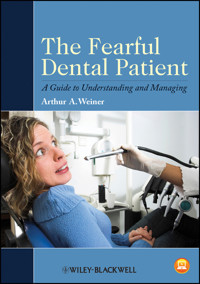
The Fearful Dental Patient E-Book
64,99 €
Mehr erfahren.
- Herausgeber: John Wiley & Sons
- Kategorie: Fachliteratur
- Sprache: Englisch
The Fearful Dental Patient: A Guide to Understanding and Managing helps dental professionals understand the basics of fear, anxiety and phobias and the role these emotions play in creating negative behavior within the dental environment. The text contains a variety of modalities that help identify dental fear and phobia, as well as chair-side techniques and practical advice aimed at improving patient cooperation and ensuring treatment compliance. Chapter topics include the basic origins of patient fear and anxiety, how to indentify dental anxiety and varied approaches to managing fearful patients of any age. Approaches discussed employ behavioral, pharmacological, sedation and even hypnotic techniques, specifying combinations where required. Chapters also include coverage of a wide range of patients, including those with psychiatric comorbidities and special healthcare needs. The entire dental team will greatly benefit from the proven methods and practical guidance presented to better understand and treat fearful dental patients.
Sie lesen das E-Book in den Legimi-Apps auf:
Seitenzahl: 534
Veröffentlichungsjahr: 2011
Ähnliche




















Contents
Foreword
Preface
Acknowledgments
About the Author
Contributor List
1 The basic principles of fear, anxiety, and phobia: past and present
INTRODUCTION
MAJOR ETIOLOGICAL MODELS TO EXPLAIN ANXIETY4–6,10–12,16
BEHAVIORAL INDICATORS OF ANXIETY4,16–18
NATURE OF DENTAL ANXIETY
ECHELONS OF EXPRESSION
TIMING OF DENTAL ANXIETY
SEVERITY
DIFFERENTIATING PSYCHOLOGICAL (EXOGENOUS) ANXIETY FROM MEDICAL (ENDOGENOUS) ANXIETY
NATURAL HISTORY OF ENDOGENOUS ANXIETY26–28,31,33–35
PHOBIAS1,2,5–7,16–18,45–48
CAUSES OF PHOBIAS1,2,6,9,11,12,37,45–48
SUMMARY
NOTE
REFERENCES
2 Determinants associated with creating fearful dental patients
INTRODUCTION
PREVALENCE OF DENTAL FEAR
DIRECT CONDITIONING
THE APPROACH–AVOIDANCE CONFLICT THEORY
EXPLORING THE LITERATURE CATALOGING THE COMMON FINDINGS OF EACH OF THE DETERMINANTS OF DENTAL FEAR
PATIENT CONTROL
GENDER, AGE, SOCIOECONOMIC, LIFE STATUS DETERMINANTS OF DENTAL FEAR
PRACTITIONERS’ DETERMINANTS OF DENTAL FEAR
ORAL HEALTH, QUALITY OF LIFE, AND THE IMPACT OF DENTAL ANXIETY
SUMMARY
REFERENCES
3 Factors affecting the psychological collection and identification of the fearful dental patient
INTRODUCTION
PREREQUISITE COMPONENTS FOR ENHANCED COMMUNICATION SKILLS
ESTABLISHING A POSITIVE PATIENT–DENTIST RELATIONSHIP2
TWO-WAY COMMUNICATION2,13–16
ACCOMMODATING PATIENT–DENTIST PRIORITY DIFFERENCES
THE INITIAL PATIENT–DENTIST CONSULTATION
PRACTITIONER’S VERBAL INQUIRY AND COLLECTION OF PAST AND PRESENT HISTORY
SUMMARY
REFERENCES
4 Chairside management of the fearful dental patient: behavioral modalities and methods
INTRODUCTION
THE CONCEPT OF THE DENTAL PRACTITIONER A S A “FACILITATOR OF CHANGE”
STEP-BY-STEP CHAIRSIDE MODEL FOR FEAR AMELIORATION IN THE FRIGHTENED DENTAL PATIENT
CHAIRSIDE MANAGEMENT RESULTING FROM PATIENT’S CONSULTATION AND DETERMINANTS OF FEARS ELICITED
DOCTOR–PATIENT RELATIONSHIP AND ITS ROLE IN REDUCING ANXIETY AND GAINING TREATMENT ACCEPTANCE
ALTERNATIVE BEHAVIOR MODIFICATION AND TREATMENT MODALITIES11,48
REFERENCES
5 The pharmacological basis of pain and anxiety control
INTRODUCTION
LOCAL ANESTHESIA
SUMMARY
REFERENCES
6 Hypnosis in dentistry
INTRODUCTION
WHAT IS HYPNOSIS?
THE HYPNOSIS SESSION
HYPNOSIS IN DENTISTRY—“HYPNODONTICS”
“INFORMAL” HYPNOTIC TECHNIQUES IN DAY-TO-DAY DENTAL PRACTICE
AN ANCHORING TECHNIQUE FOR CHILD DENTAL PATIENTS—” THE HIGH FIVE ANCHOR”
CONCLUSIONS
SUGGESTED HYPNOSIS SOCIETIES, TRAINING PATHWAYS, AND CONTACTS FOR DENTISTS
REFERENCES
7 Management of complicated, high-risk patients with psychiatric comorbidities
INTRODUCTION
OVERVIEW: BEHAVIORAL SCIENCE AND THE COMPLICATED PATIENT
POSTTRAUMATIC STRESS DISORDER
MAJOR DEPRESSIVE DISORDER AND RELATED MOOD DISORDERS
CHRONIC PAIN DISORDER AND RELATED SOMATOFORM DISORDERS
SCHIZOPHRENIA
PERSONALITY DISORDERS
SUBSTANCE USE DISORDERS
EATING DISORDERS
GENERAL MANAGEMENT RECOMMENDATIONS
REFERENCES
8 Understanding and managing the fearful and anxious child
INTRODUCTION
WHAT IS NEW IN BEHAVIOR MANAGEMENT?
BIRTH TO TWO YEARS OLD
TWO YEARS OLD
THREE TO SIX YEARS OLD — THE PRESCHOOL AGE
SIX TO TWELVE YEARS OLD
THE TEENAGE YEARS — ADOLESCENCE
WHEN DOES FEAR OR ANXIETY FIRST DEVELOP IN CHILDREN?
BASIC BEHAVIOR MANAGEMENT TECHNIQUES
SHOULD THE PARENT REMAIN IN THE OPERATORY?
PHARMACOLOGICAL MANAGEMENT OF BEHAVIOR PROBLEMS
SUGGESTED READING
REFERENCES
9 The geriatric patient: psychophysiological factors associated with aging and dental anxiety
INTRODUCTION
UNDERSTANDING THE CHANGES ASSOCIATED WITH AGING
MANAGING THE RISK FACTORS ASSOCIATED WITH AGING
SUMMARY
REFERENCES
10 Fear and anxiety management for the special needs patient
INTRODUCTION
LET US MEET AND EVALUATE YOUR PATIENTS
SENSORY PERCEPTION MODALITIES FOR TREATMENT AND COMMUNICATION
ALTERNATIVE MODALITIES FOR ANXIETY MANAGEMENT
CASE MANAGEMENT PRESENTATION
REFERENCES
Index
Edition first published 2011
© 2011 Blackwell Publishing Ltd.
Blackwell Publishing was acquired by John Wiley & Sons in February 2007. Blackwell’s publishing program has been merged with Wiley’s global Scientific, Technical, and Medical business to form Wiley-Blackwell.
Editorial Office
2121 State Avenue, Ames, Iowa 50014–8300, USA
For details of our global editorial offices, for customer services, and for information about how to apply for permission to reuse the copyright material in this book, please see our Website at www.wiley.com/wiley-blackwell.
Authorization to photocopy items for internal or personal use, or the internal or personal use of specific clients, is granted by Blackwell Publishing, provided that the base fee is paid directly to the Copyright Clearance Center, 222 Rosewood Drive, Danvers, MA 01923. For those organizations that have been granted a photocopy license by CCC, a separate system of payments has been arranged. The fee code for users of the Transactional Reporting Service is ISBN-13: 978-0-8138-2084-2/2011.
Designations used by companies to distinguish their products are often claimed as trademarks. All brand names and product names used in this book are trade names, service marks, trademarks or registered trademarks of their respective owners. The publisher is not associated with any product or vendor mentioned in this book. This publication is designed to provide accurate and authoritative information in regard to the subject matter covered. It is sold on the understanding that the publisher is not engaged in rendering professional services. If professional advice or other expert assistance is required, the services of a competent professional should be sought.
Library of Congress Cataloging-in-Publication Data
The fearful dental patient : a guide to understanding and managing / [edited by] Arthur A. Weiner.
p. ; cm.
Includes bibliographical references and index.
ISBN 978-0-8138-2084-2 (pbk. : alk. paper)
1. Fear of dentists. I. Weiner, Arthur A.
[DNLM: 1. Dental Anxiety–prevention & control. 2. Dental Care–psychology. WU 29 F288 2011]
RK53.F43 2011
616.85′225–dc22
2010023257
Disclaimer
The publisher and the author make no representations or warranties with respect to the accuracy or completeness of the contents of this work and specifically disclaim all warranties, including without limitation warranties of fitness for a particular purpose. No warranty may be created or extended by sales or promotional materials. The advice and strategies contained herein may not be suitable for every situation. This work is sold with the understanding that the publisher is not engaged in rendering legal, accounting, or other professional services. If professional assistance is required, the services of a competent professional person should be sought. Neither the publisher nor the author shall be liable for damages arising herefrom. The fact that an organization or Website is referred to in this work as a citation and/or a potential source of further information does not mean that the author or the publisher endorses the information the organization or Website may provide or recommendations it may make. Further, readers should be aware that Internet Websites listed in this work may have changed or disappeared between when this work was written and when it is read.
Dedication
I would like to dedicate this book to:
My father and mother, Maxwell and Tillie, and my two sisters, Ann Charlotte and Janice Susan, whose combined sacrifices and love made it possible for me to attain the education and be the first in the family to get that all important sheepskin.
Uncle Fred Weiner, MD, who was always there with whatever help I needed, including words of encouragement and so many other little things that helped me along the way.
My lovely wife, Paula Sandra, to whom I truly owe everything. For 54 years of married bliss, constant encouragement, love, and support, no man could want more. For all the times she kept me on the straight and narrow, I could not love her any more than I already do. She is my heart and my soul, the most precious jewel any man could hope to find.
To my three children, Randy, Rickie, and Robyne, for all the joy and pride that they fill my days with, and for the wonderful grandchildren that they and their awesome spouses have blessed our days with. They have enriched our lives and truly made it all worthwhile.
Last, the wonderful young men and women, past and present, who make up the student body of the Tufts University School of Dental Medicine. For their kindness, support, and patience and their help with my many clinical research studies that have led up to this book, words of thanks are inadequate. As I have taught them, I also have learned much from them. They will always hold a special place in my heart.
Foreword
In The Fearful Dental Patient: A Guide to Understanding and Managing, Arthur Weiner and the contributors make the strong case that attending to the well-being of the apprehensive dental patient not only makes for a compliant and responsive patient, but yields an appreciative ambassador on behalf of the person-oriented dentist as well. Equally important, the authors make the case that when the clinician rises to the broader challenge of addressing the personal needs of his or her patients, as well as their oral health needs — that is, when the dentist acts as both a biologic and a behavioral change agent —then the dentist is rewarded with a greater sense of fulfillment that is accomplished in a clinical work environment that is less stressful. The dental practice becomes a kinder, gentler, and more productive place for the dentist as well as the patient!
Dr. Weiner’ s attention to this perspective on the dual role and responsibility of the dentist as a biobehavioral clinician is unique in a clinical dental text of this sort and represents a significant step forward in broadening what it means to be a dentist. But this advocacy is not simply for “touchy-feely” or “do-good” dentists and dentistry. A major accomplishment of The Fearful Dental Patient: A Guide to Understanding and Managing is that it provides the best available scientific basis for all the methods of assessing and managing fearful patients whose concerns about getting dental treatment can impair their oral health. These patients range from those who are mildly anxious to the most fearful, and, even phobic, patients. The authors apply a comprehensive approach to the very young, the elderly, and those burdened with physical and emotional disabilities that impact their lives.
But it is in the blending of underlying science and commonsense pragmatism that there emerges a powerful rationale for expanding the dentist’ s horizon about clinical practice: the basic science underlying the nature of fear, anxiety, and panic that the opening chapters present is sound; the clinical assessment measures recommended are similarly scientifically valid; the behavioral and pharmacologic methods offered to help the patient are evidence based as well as prudent; and the skills and methods are clearly presented, easy to learn, easy to apply, and proven in their patient acceptability and effectiveness.
Embedded throughout the text is the deep and necessary understanding that to effect changes in others —for dentists to serve as change agents, seeking to facilitate change in dental patient behaviors and negative thoughts and emotions —it is sometimes necessary for the dentist to consider changing as well. This change is reflected as increased knowledge and awareness, accompanied by acquisition of the modest tools of behavior change needed to alter the maladaptive ways in which some patients avoid dentists and their dentistry. This dual approach is truly unique, most welcome, and nothing less than an enlightened advance in our understanding of the complexities of how some patients became fearful, and how sometimes both patients and dentists are appropriate targets for change.
The organization of the text, including reliance on a number of superb clinician–teacher scientists, reveals the authors’ understanding and familiarity with the need to acquire basic information about why something happens, and then to apply that understanding to the assessment of dental patients. Dr. Weiner and the contributors expand the acquisition of data about the patient from the expected clinical domains of restorative and surgical dentistry, which are well known and not covered here, to the domains of subjective experience as scientifically studied by clinicians and researchers in behavioral medicine and the behavioral sciences more generally. The dentist is thus guided to gathering in systematic fashion an individual database for each person that reveals what the dentist needs to know in order to establish a trusting, and, especially important, long-lasting dentist–patient relationship. A dentist–patient relationship built on valid information becomes the springboard for allowing the dentist to determine if the dentally related anxiety, fear, panic, and/or avoidance uncovered by the assessment process are of sufficient strength to warrant considering integrating behavioral and/or pharmacologic change methods (which form the bulk of this text) into a comprehensive treatment plan for the patient, whatever their clinical dental needs might be.
From his Preface to this book and throughout each of the chapters, it is clear that after more than a generation of clinical dental practice, dental teaching, and research Dr. Weiner has evolved as a careful dentist respectful of his profession’ s art and craft and attentive to its future. But it is also clear he is a dedicated teacher, seeking to impart to students and dentists that theirs is a profession of lifelong learning. This text expresses what he and the contributors have gleaned from abundant clinical experience and research, and which they now seek to share with readers, namely that dentistry reveals its better nature when dentists grasp an appreciation of what the patient is experiencing and make themselves knowledgeable about how best to manifest caring and management of those personal experiences when they interfere with maintaining oral health.
Samuel F. Dworkin, DDS, PhD (Hon: DSci, DR Odont)
Professor Emeritus, Department Oral Medicine
University of Washington, School of Dentistry
Professor Emeritus, Department of Psychiatry and Behavioral Sciences
School of Medicine, University of Washington
Preface
As long as individuals have practiced the art and science of dentistry, fear and anxiety have been associated with dental treatment. Managing this fear and anxiety has been one of the most troublesome problems that the dental practitioner, as well as the profession at large, has had to face. In years past, dental professionals could afford largely to ignore the problem of dental anxiety. Practices could flourish based on technical virtuosity, while a fearful or anxious patient might be regarded as a burden rather than as a basis for concern.
In the past three decades or so, the advent of the field of behavioral medicine in psychology has brought with it a fresh perspective on a variety of emotional, psychological, and mental disorders, including those of personality, eating, depressive, somatoform, as well as anxiety / panic and posttraumatic stress, and their associated effects on dental care and its behavioral management. As a result of the great influence these disorders have, either individually or combined, on whether or not an individual will receive care, the dental profession has begun to devote increasing attention and involvement focusing on the potential effects and concerns that accompany these disorders. In particular, attention has been directed to those with fear, anxiety, and phobia, which are so often are associated with negative and aversive behavior in a dental patient. In recent years, issues of dentist–patient interaction and patient management have received considerable attention in the dental curriculum, and, at the same time, an increasing number of dental and behavioral clinicians and researchers have directed their efforts toward developing programs designed to increase knowledge and shed new light on this vexing problem of dental fear and anxiety. However, despite this increased attention, the problem of fear and anxiety remains as prevalent today as it did years ago. This is due in general to the lack of understanding of the basic principles of fear, anxiety, and phobias, and the various other disorders that often act in combination to initiate those negative behavioral manifestations that hinder the dental practitioner from successfully treating this segment of the population. In today’s complex society, it is difficult to separate and treat only the physical needs of the patient while ignoring the emotional ones. Being a good dentist in today’s world means not only producing a fine, accurate restoration; it must also include the understanding that a patient’s behavior is crucial to the outcome of treatment. In dental school curricula, courses in the behavioral sciences are now required in order for these institutions to obtain full and complete accreditation, demonstrating the clear importance of this subject to the practice of dentistry. To this end, the practitioner must acquire as much knowledge and understanding as possible of these emotions, feelings, and behaviors and the combined role they play in all stage of dental care.
Since no text can completely cover all the complex psycho-physiological aspects of dental care, nor refer to all those dedicated clinicians and their contributions toward this phase of care, this text has been designed to present basic knowledge acquired through my own years of both private practice and academic research/teaching. It is also combined with the knowledge gained by other distinguished clinicians and academies through their individual and group experiences and studies, necessary to the successful understanding and behavioral management of the dentally anxious and fearful patient. Multiple approaches for various situations are demonstrated, which are practical, and, in many cases, simple, and can be utilized not only by the busy general practitioner, but by dental students, specialists, hygienists, and their staff. We hope the reader will be better able to make a correct assessment of a patient’s combined psychological, emotional, and dental needs and to apply that information, and, if needed, the necessary behavioral and psychopharmacological techniques, to lead to the provision of optimal dental treatment. We hope this text, combined with continuous education courses, will act as an instrument to stimulate further and more detailed studies of this phenomenon of dental fear, at all levels of the dental profession.
Arthur A. Weiner, DMD
Acknowledgments
Because I owe much to so many individuals who over the years have supported me and my unending quest to teach and help eliminate fear and anxiety in dentistry, I would need to author a text in itself to mention each and every individual. Please allow me to name a few to whom I am so indebted:
David V. Sheehan, MD, a most distinguished health provider, teacher, and talented psychiatrist, who introduced me to the research and study of fear and phobic disorders, and for 25 years, he has offered me support, guidance, and friendship . Much is owed to him by me that can never be repaid.
To Dean Lonnie Norris and Dr. Noshir Mehta for their unwavering support and the uninterrupted freedom to investigate and study the causes and management of dental fear, a subject very dear to my heart.
To Paul Stark, MS, ScD, and Carole Palmer, EdD, RD, LDN, for their generous help in critiquing the text and helping me to always stay organized and correct. They are two of our most valuable Tufts faculty members. Without their help and guidance, this text would not be as great as I believe it is.
To Dr. Phil Weinstein and Dr. Peter Milgrom of the University of Washington School of Dentistry for their many suggestions and support, not only in this text but in the early years when I first began to study and teach dental fear. Much gratitude is owed to them.
To Dr. Samuel Dworkin, a legend in the field of behavioral science in dentistry. Words of thanks are totally inadequate. His critique and advice on a large portion of this text was simply awesome and greatly appreciated.
To the wonderful women of the Hirsh Health Sciences Library, Gail Hendler, Amy Lapidow, Amy LaVertu, Jane Ichord, Eileen Moyer, Melissa Theroux, Tiffany Tawzer, Jamie Bears, Elizabeth Richardson, and Judy Rabinovitz. They all continuously made sure my reference material was readily available.
Last to my wonderful, talented, and capable senior dental student research assistants, Katharine Burton and Abigail Manter, and Alan Reid, my magnificent illustrator, who by the time this text will be published, will have graduated and brought grace, dignity, and honor to the title of Doctor of Dental Medicine. Knowing and working with them on this text and as their teacher has been an absolute joy and a privilege. May success and happiness follow them all their days.
Arthur A. Weiner, DMD
About the Author
Dr. Weiner, a graduate of Boston College, received his degree of Doctor of Dental Medicine in 1958 from Tufts University School of Dental Medicine in Boston, Massachusetts. In 1962, he opened his practice of general dentistry after a brief tour of service with the U.S. Army Dental Corps. In 1967, he joined the faculty of Tufts Dental School, where he currently holds the title of Professor of General and Behavioral Dentistry. He is the Director of the Behavioral Sciences Course II, as well as a Clinic Group Practice Coordinator in the undergraduate student clinic. Dr. Weiner has lectured extensively in the United States as well as in France and Australia. His numerous clinical research papers have appeared in dental journals and have been cited in behavioral and psychological research journals on the subject of fear, anxiety, and phobias. He has also been published in Acta Scandinavia Psychiatrica for his work on the effects of exogenous and endogenous anxiety in dentistry. He has also authored a teaching manual titled “The Difficult Patient: A Guide to Understanding and Managing Dental Anxiety.”
For his many contributions to dentistry, Dr. Weiner has been elected to Fellowship in the prestigious Pierre Fauchard International Dental Honor Organization, as well as in the American College of Dentists. He also holds Fellowships in the Academy of Dentistry International and Academy of General Dentistry. He is a member of the Omicron Kappa Upsilon National Dental Honor Society, and a past President of the local chapter at Tufts University. He resides in Ashland, Massachusetts, with his wife Paula of 54 years.
Contributor List
Laura Camacho-Castro, CD, DMD
Associate Clinical Professor
Pediatric Dentistry
Tufts University School of Dental Medicine
Boston, MA
Michael A. Gow, BDS (Gla), MSC Hyp (Lon)
Clinical Director of Dental Anxiety Management
The Berkeley Clinic
Glasgow, Scotland, UK
Ronald J. Kulich, PhD
Associate Professor
Attending Psychologist
Tufts University School of Dental Medicine
Craniofacial Pain Center
and
Harvard Medical School
Massachusetts General Hospital
Pain Management Center
Linda Maytan, DDS
Executive Director, SUSTAIN
and
Department of Human Services
State Operated Systems
Faribault, MN
Kathryn Ragalis, DMD, MS, RDH
Associate Professor
Department of General Dentistry
Tufts University School of Dental Medicine
Boston, MA
Morton Rosenberg, DMD
Professor Oral and Maxillofacial Surgery
Head Division of Anesthesia and Pain Control
Tufts University School of Dental Medicine
Boston, MA
and
Associate Professor of Anesthesia
Tufts University School of Medicine
Boston, MA
Samuel Shames, DMD
Associate Professor General Dentistry
Director, Practice Management
Tufts University School of Dental Medicine
Boston, MA
Gina M. Terenzi, DMD
Assistant Professor
Director, Department of Public Health
General Practice Residency
Tufts University School of Dental Medicine
Boston, MA
Michael Thompson, PhD
Professor, Pharmacology
Department of General Dentistry
Tufts University School of General Dentistry
Boston, MA
Kelly M. Wawrzyniak, MA, PsyD
Massachusetts School of Professional Psychology
Tufts University School of Dental Medicine
Craniofacial Pain Center
Boston, MA
Arthur A. Weiner, DMD
Professor, General Dentistry
Director, Behavioral Science II
National Spokesperson for Fear, Anxiety, and Behavioral Management, Academy of General Dentistry
Group Practice Coordinator, Undergraduate General Dental Clinic
Tufts University
Boston, MA




