


Erhalten Sie Zugang zu diesem und mehr als 300000 Büchern ab EUR 5,99 monatlich.
- Herausgeber: Pushkin Children's Books
- Kategorie: Gesellschafts- und Liebesromane
- Sprache: Englisch
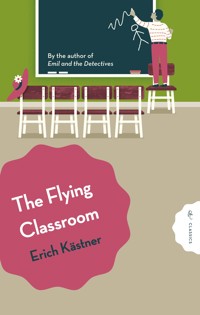
Martin's school is no ordinary school. There are snowball fights, kidnappings, cakes, a parachute jump, a mysterious man called 'No-Smoking' who lives in a railway carriage and a play about a flying classroom. As the Christmas holidays draw near, Martin and his friends - nervous Uli, cynical Sebastian, Johnny, who was rescued by a sea captain, and Matthias, who is always hungry (particularly after a meal) - are preparing for the end-of-term festivities. But there are surprises, sadness and trouble on the way - and a secret that changes everything. The Flying Classroom is a magical, thrilling and bittersweet story about friendship, fun and being brave when you are at your most scared. (It also features a calf called Eduard, but you will have to read it to find out why.)
Sie lesen das E-Book in den Legimi-Apps auf:
Seitenzahl: 191
Veröffentlichungsjahr: 2025
Das E-Book (TTS) können Sie hören im Abo „Legimi Premium” in Legimi-Apps auf:
Ähnliche




















‘Atmospheric… bittersweet… a memorable exploration of bravery, boyhood and friendships’ Wall Street Journal
‘A treasure-trove of childhood reading’ Huffington Post
‘The bold line drawings by Walter Trier are the work of genius… As for the stories, if you’re a fan of Emil and the Detectives, then you’ll find these just as spirited’ Spectator
‘Walter Trier’s deceptively innocent drawings are as classic as Kästner’s words; I never tire of them’ Quentin Blake
Contents
Foreword Part One
A discussion between Mrs Kästner and her son · The peak of the Zugspitze mountain · A butterfly called Gottfried · A black and white cat · A little of the eternal snows · A pleasant evening after work · And a farmer’s professional opinion that calves sometimes grow up to be big bullocks
This is going to be a real Christmas story. In fact I meant to write it a couple of years ago, and then of course I meant to write it last year. But you know how it is; something was always getting in the way. Until my mother said, only the other day, ‘If you don’t start writing this moment, you won’t get anything for Christmas!’
That made up my mind for me. I packed my case at top speed, putting in my tennis racket, my bathing trunks, my green pencil and enormous amounts of writing paper, and when we were standing on the railway station concourse, sweating and feeling harassed, I asked, ‘Where do I go now?’ Because, understandably enough, in the middle of a summer heatwave it is really difficult to sit down and write: ‘It was bitterly cold, snowflakes were falling from the sky, and when Dr Eisenmayer looked out of the window both his earlobes froze.’ I mean, with the best will in the world you can’t write that kind of thing in August, when you’re lying in the family bathtub feeling like a pot roast and expecting to get heatstroke any moment. Well, can you?
Women are practical. My mother had a good idea. She went up to the ticket office window, nodded to the ticket-seller in a friendly way, and asked, ‘Excuse me please, but do you know where snow still lies on the ground in August?’
The man was probably about to say, ‘At the North Pole,’ but then he recognized my mother, bit back any such sarcastic remark and said politely, ‘On the peak of the Zugspitze mountain, Mrs Kästner.’
So there and then I had to buy a ticket to Upper Bavaria where the Zugspitze, the highest mountain in Germany, is to be found. My mother added, ‘Don’t come home until you’ve written that Christmas story, understand?’ Then the train drew out of the station.
‘And don’t forget to send your washing home!’ my mother called after me.
Just to annoy her a bit, I shouted back, ‘Mind you remember to water the flowers!’ Then we waved our handkerchiefs until we were out of sight of each other.
So now I’ve been staying for the last two weeks beside a large, dark-green lake at the foot of the Zugspitze mountain, and if I’m not swimming or doing exercises or playing tennis, or getting Karlinchen to row me out on the lake, I sit on a little wooden bench in the middle of a wide meadow, with a table that keeps on wobbling in front of me, and I am writing my Christmas story on that wobbly table.
Flowers of all colours grow around me. Tall, quaking grass bows respectfully to the wind. Butterflies flutter through the air, and one of them, a large peacock butterfly, even visits me now and then. I’ve christened him Gottfried, and we get on well together. Hardly a day goes by without his settling confidently on my writing paper. ‘How’s things, Gottfried?’ I ask him. ‘Is life still fun?’ He opens and closes his wings gently by way of an answer, and flies happily on his way.
Someone has stacked up a big woodpile on the outskirts of the dark wood of fir trees. A black and white cat crouches on it, staring at me. I strongly suspect her of being a magic cat who could talk to me if she wanted. She just doesn’t want to. Every time I light a cigarette she arches her back.
In the afternoon she goes away, because then it’s too hot for her on top of the woodpile. It’s too hot for me as well, but I stay where I am. Sitting like that, boiling hot, and writing about a snowball fight, for instance, is no mean achievement.
Then I lean far back on my wooden bench, I look up at the peak where the cold, eternal snows shine in the mountain’s rocky ravines—and I find that I can go on writing! On many days, to be sure, clouds come up over the part of the lake where bad weather is brewing, and they drift across the sky towards the mountain peak, towering up until I can’t see it any more.
Of course that makes it impossible for me to go on describing snowball fights and other definitely wintry activities, but it doesn’t matter. On such days I simply write about indoor scenes. An author has to get bright ideas like that.
In the evening, Eduard regularly comes to fetch me. Eduard is a brown calf with tiny horns, and he’s as pretty as a picture. I can hear him coming, because he has a bell hanging round his neck. First it is heard from far away, for the calf grazes in a mountain meadow high above, and then the sound of the bell comes closer and closer. Finally Eduard comes into sight. He steps out from among the tall, dark-green fir trees, with a few yellow marguerite daisies in his mouth as if he had picked them specially for me, and he trots across the meadow until he comes to my table.
‘Hello, Eduard, time to stop work for the day?’ I ask him. He looks at me and nods, and his cowbell rings. But he goes on grazing a little longer, because beautiful buttercups and anemones grow here. And I write a few more lines, while high above an eagle circles in the air, rising up and up into the sky.
Finally I put away my green pencil and pat Eduard’s warm, smooth coat. And he nudges me with his little horns to remind me to stand up. Then we stroll home together over the beautiful, flowery meadow.
Outside my hotel we part company, because Eduard doesn’t live at the hotel, but with a farmer round the corner.
The other day I asked the farmer about him, and he said yes, Eduard would certainly grow up to be a great big bullock.
Foreword Part Two
The loss of a green pencil · The size of children’s tears · Little Jonathan Trotz and his ocean voyage · Why his grandparents didn’t meet him · In praise of a thick skin · And the urgent necessity of combining courage and intelligence
Yesterday evening, when I’d eaten my supper and was sitting idly in the hotel lounge, I really meant to go straight on writing. The glow of the Alpine sunset had faded away. The peaks of the Zugspitze and Riffelwände mountains were sinking into the shadows of nightfall, and on the other side of the lake the smiling face of the full moon gazed over the dark forest.
Then I discovered that I’d lost my green pencil. It must have fallen out of my pocket on the way back to the hotel. Or maybe Eduard, the pretty calf, had eaten it, thinking it was a blade of grass. Anyway, there I sat in the lounge, unable to write anything. Because although I was staying in a very posh hotel, there wasn’t a green pencil for me to borrow anywhere in the entire place. Oh, wonderful!
In the end I picked up a children’s book that its author had sent me, and began reading. But I soon put it down again. The book made me really cross, and I’ll tell you why. Its author tries to tell any children who read his book that they are having non-stop fun the whole time, and they’re so happy they hardly know what to do with themselves! That dishonest gentleman acts as if childhood were made of the very best cake mixture.
How can a grown-up forget his childhood so entirely that a day comes when he simply doesn’t know how sad and unhappy children can sometimes be? (I would like to take this opportunity of asking you, with all my heart, never to forget your own childhood! Will you promise me that? Word of honour?)
For it makes no difference whether you’re crying over a broken doll, or maybe, later, because you have lost a friend. It’s never a question of exactly what makes you sad but of how much you grieve for it. Heaven knows, children’s tears are no smaller than the tears shed by grown-ups, and often they weigh more heavily. Don’t get me wrong, ladies and gentlemen! We don’t want to be unnecessarily soppy. All I’m saying is that you have to be honest even if it hurts. Honest right to the bone.
In the Christmas story that I am going to tell you, beginning in the next chapter, there’s a boy whose name is Jonathan Trotz, although the others call him Johnny. That little fourth-year boy is not the central character of this book, but a short account of his life fits into my story here. He was born in New York, his father was German, his mother was American, and they fought like cat and dog. In the end Johnny’s mother ran away, and when he was four years old his father put him on board a steamer setting out from New York for Germany. He bought the boy a ticket for the crossing, he put a ten-dollar note in Johnny’s little brown wallet, and he hung a piece of cardboard round Johnny’s neck with his name on it. Then they went to see the ship’s captain. And Johnny’s father said, ‘Please will you take my son over the ocean to Germany? His grandparents will meet him when he gets off the ship in Hamburg.’
‘That’s all right, sir,’ replied the captain. And then Johnny’s father went away as well.
So the boy crossed the ocean all by himself. The passengers were very kind to him. They gave him chocolate, they read the notice round his neck and said, ‘Well, aren’t you in luck, going on such a long sea voyage at your age!’
When they had been at sea for a week they arrived in Hamburg, and the captain waited by the gangway for Johnny’s grandparents to turn up. All the passengers disembarked and patted the boy’s cheeks once again. ‘O Johnny,’ said a Latin teacher in the vocative, ‘may all go well for you!’ And the sailors going ashore called, ‘Keep a stiff upper lip, Johnny!’ Then some workmen came on board, to repaint the ship so that it would look sparkling clean before the voyage back to America.
The captain stood on the quayside holding the little boy’s hand, looking at his wristwatch from time to time, and waiting. But Johnny’s grandparents never turned up. They couldn’t, because they had been dead for many years. Johnny’s father, who simply wanted to get rid of the child, had shipped him off to Germany without a second thought.
At the time Jonathan Trotz didn’t understand what happened to him. But he grew larger, and there were many nights when he lay awake crying. And he will never in his life really recover from the grief he felt at that time, although you can believe me when I tell you he is a brave boy.
However, a reasonable solution was found. The captain had a married sister; he took the little boy to live with her, visited him when he was in Germany, and when he was ten years old sent him to boarding school at the Johann-Sigismund Grammar School in Kirchberg. (This boarding school, by the way, is the scene of our Christmas story.)
Sometimes Jonathan Trotz still goes to see the captain’s sister in the holidays. The family there are very nice to him. But usually he stays at the school. He reads a lot. And secretly he writes stories.
Perhaps he will be a writer one day, but no one can tell yet. He spends half-holidays in the big school grounds, talking to the great tits. They fly down to perch on his hand and look at him inquiringly with their little eyes when he speaks to them. Sometimes he shows them a small, brown wallet and the ten-dollar bill inside it…
I told you the story of Johnny’s life only because the dishonest writer whose book I was reading in the hotel lounge last night says children are always cheerful, in fact quite beside themselves with joy the whole time. If only he knew!
The serious business of life begins long before you start to earn a living. That’s not where it begins, or where it ends either. I emphasize these well-known facts not to make you feel you’re the cat’s whiskers, heaven forbid! And I don’t emphasize them to make you scared. No, no! Be as happy as you can! And be so cheerful that your little tummies hurt with laughing!
Only don’t pretend to yourselves, and don’t let other people pretend to you. Learn to look misfortune in the eye. Don’t be afraid when something goes wrong. Don’t just cave in when you have bad luck. Keep a stiff upper lip. You must learn to be tough and develop a thick skin!
You must be able to stand up to blows, as boxers know. You must learn to take them and put up with them. Otherwise you’ll feel groggy the first time life slaps you down. Because life wears a large size of boxing glove, ladies and gentlemen! If life has hit out at you, and you weren’t prepared for it, a little housefly has only to cough and it will knock you flat.
So keep a stiff upper lip and develop a thick skin, understand? If you stand up to the first blows of fate, you’re well on the way to winning. Because in spite of the blows that you have received, you’ll have the presence of mind to activate two very important qualities: courage and intelligence. Remember what I tell you: courage without intelligence doesn’t amount to anything, and intelligence without courage is no good either. At many times in the history of the world, stupid people have been brave and intelligent people have been cowardly. That wasn’t the way to go about it.
Only when the brave have become intelligent and the intelligent have become brave will we really be sure of something that we often, but mistakenly, feel is an established fact: the progress of mankind.
By the way, as I write these almost philosophical remarks I am sitting on my wooden bench again, at the wobbly table, in the middle of the large and colourful meadow. I bought myself a green pencil this morning in the general store here. And now it’s late afternoon again. Newly fallen snow is glittering on top of the Zugspitze mountain. The black and white cat is crouching on the woodpile, staring at me. She must be under a magic spell! And down from the mountain comes the sound of the cowbell round my friend Eduard’s neck. He will soon be here to nudge me with his little horns and fetch me home. Gottfried the peacock butterfly didn’t visit me today. I hope nothing has happened to him.
And tomorrow, at last, I shall begin writing my Christmas story. It will be about brave people and scaredy-cats, about clever people and stupid people. There are all kinds of children in a boarding school.
I’ve just thought of something: do you all know what a boarding school is? It’s a kind of school where you live as well as having lessons. The boys stay there. They eat at long tables in a big refectory, and they have to lay the tables themselves. They sleep in big dormitories, and in the morning the caretaker comes and pulls a bell rope, and a bell rings very loudly. And a few of the boys from the top class are dormitory prefects. They keep watch like hawks to make sure that the others jump out of bed on the dot. Many boys never learn to make their beds neatly, and so when the others go out on Saturdays and Sundays they stay in the boarding house writing lines. (Not that the lines teach them how to make their beds.)
The parents of the boarders live in cities far away, or in the country where there are no secondary schools. And the children only go home in the holidays. Many boys would like to stay at home when the holidays are over. Others would rather stay at school even in the holidays if their parents would let them.
And then there are other students who are day-boys. They live in the town where the school is, and they don’t sleep in its boarding house but at home with their parents.
However, here comes my pretty-as-a-picture friend Eduard the calf, stepping out of the dark-green wood of fir trees. And now he shakes himself and trots right across the meadow to me and my wooden bench. He has come to take me back to the hotel. It’s time I stopped writing for today.
He is standing beside me, looking at me affectionately. So forgive me if I stop now! I’ll get up early tomorrow morning, and then, at last, I will begin telling the Christmas story.
My mother wrote yesterday asking how far I had got with it.




