


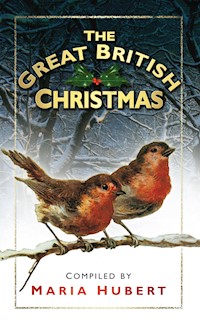
The Great British Christmas E-Book
8,49 €
Mehr erfahren.
- Herausgeber: The History Press
- Kategorie: Geisteswissenschaft
- Sprache: Englisch
A delightful history of how Christmas has been celebrated in Britain over the past 2,000 years. From the legend of Arthur pulling the sword from the stone one Christmas day, to when the Puritan Parliament tried to 'ban' Christmas, through to Charles Dickens's vivid recollections of his boyhood celebrations, and his delight in the present of a jumping frog. Amongst the wealth of stories and personal reminiscences this book also teaches us how the traditions we now hold so dear came into being, including Mrs Beeton's recipe for the original Christmas cake (made with a horn of mead), the birth of Christmas carolling, the first ever Christmas tree to be brought to England from Germany by Prince Albert and the origins of the Christmas cracker. This is simply the perfect book with which to celebrate Christmas and all the traditions that surround it.
Das E-Book können Sie in Legimi-Apps oder einer beliebigen App lesen, die das folgende Format unterstützen:
Veröffentlichungsjahr: 2011
Ähnliche




















Contents
Title Page
Acknowledgements
The Great British Christmas – An Introduction
Maria Hubert
Christmas Books
William Makepeace Thackeray
The Calennig
King Arthur’s Christmas
Sir Thomas Malory
‘Eddi’s Service’
Rudyard Kipling
‘The First Wassail’
R. Acton
A Horn of Mead
Anon – A recipe for honeyed wine
An Anglo-Norman Carol
The Second Shepherd’s Play
A Hue and Cry After Christmas
From a seventeenth-century broadsheet by Simon Minc’d Pye
‘Old Christmas Still Comes!’
Christmas with the Diarists
Samuel Pepys, John Evelyn and others
Deck the Church with Evergreens
From the Spectator, 1712
Love and Hot Cockles!
From the Spectator, 1711
‘Hallo Hogmanay!’
D.B. Wyndham Lewis
The Christmas Tree
Charles Dickens
Tales of the Christmas Cracker
Maria Hubert and Michael Harrison
The Twelfth Cake
From The Memoirs of a London Doll
Richard Henry Horne
The Royal Christmases of Queen Victoria
The Christmas Tree at Windsor Castle
From the Illustrated London News, 1848
Mrs Beeton’s Christmas Cake
From Mrs Beeton’s Book of Household Management, 1853
“‘Owed” to the Christmas Tree’
‘A Sharp Old File’, 1853
Christmas Eve at an Old Hertfordshire Farmhouse
Edmund Hollier
Windsor Castle Mincemeat
The Court Chef, Alexis Soyer, 1861
‘Winter Sports’
Anon
The Mummers
From Thomas Hardy’s The Return of the Native
Cornish Cakes and Other Customs
From Christmas in Cornwall Sixty Years Ago
Mrs John Bonham
‘The Ballade of Christmas Ghosts’
Andrew Lang
Reminiscences of Christmas
From Sketches by ‘Boz’, Charles Dickens
Candied Walnuts, English Caramels and Preserved Violets
Recipes for sweets from Home Notes, 1898
‘A Fenland Carol’
Rudyard Kipling
‘Christmas Eve’
Ruth and Celia Duffin
‘The Wondrous Tree of Christmas’
Glyn Griffiths
Village Christmas
Cyril Palmer
Nativity Play
Iris Cannon
All Aboard for Santa’s Grotto
Maria Hubert
A Christmas Epilogue
William Makepeace Thackeray
Sources and Bibliography
Copyright
Acknowledgements
I am grateful to the many publishers, editors and authors who have given permission for their work to be used, and to a few who are no longer around or cannot be traced. I hope that you will take the inclusion of your work as the compliment intended. I particularly thank the publishers of the works listed in the bibliography for permission to reproduce them or extracts from them.
Original research, translations and presentation of historical facts are by Maria Hubert. All unacknowledged material is taken from the Christmas Archives Research Library. All illustrations are reproduced courtesy of the Christmas Archives Picture Library.
The original artwork for ‘Christmas Eve’ and ‘Eddi’s Christmas’ are courtesy of Jung-Sook Nam Hubert.
I especially acknowledge the former Tom Smith Cracker Company, Norwich (particularly the late Mr Varney), for the story about the origins of the Christmas cracker. I also thank my husband Andrew for all his work with the scanner and computer. And to everyone who has helped me on this series of books – family, friends, strangers who became friends, editorial staff at Sutton Publishing, artists and authors who permitted use of their work, and the many librarians and archivists – my most grateful thanks.
The Great British Christmas – An Introduction
Maria Hubert
For many, the British Christmas is the epitome of Christmas. Visitors travel from all over the world just to be in Britain and to be able to appreciate the atmosphere of a British Christmas.
Many of the innovations of Christmas that are enjoyed around the world today originated in Britain. The Christmas card, invented by Henry Cole and his friend the engraver John Horsley in 1843, was to become the means in a great many countries of showing distant friends that they were remembered. The Christmas cracker, a toy created by the confectioner Tom Smith in 1840 and which later received the royal warrant, has become an essential part of Christmas celebrations. The Christmas tree was, of course, a German custom. However, in the 1840s the tree found favour with fashionable society after the Illustrated London News published the now famous engraving of Queen Victoria and her consort Prince Albert with their children around the Christmas tree at Windsor.
People in many countries recognise the name Charles Dickens and are familiar with his story A Christmas Carol. During the war years, the Dickensian Christmas was portrayed as an ideal, creating a nostalgic longing in everyone. Christmas cards showed ladies in crinolines and gentlemen in Dickensian frock-coats shopping at bulls-eye paned shops. The British Christmas is also associated with white Christmas – snow, snowball fights, tobogganing on the new red sledge brought by Father Christmas, skating on icy ponds, carolling. Strangely, although we can all remember a white Christmas, it very rarely snows on Christmas Eve or Day!
From the earliest times, Britain has celebrated Christmas. The early christianised Romans who settled in the Welsh Borders brought with them the custom of Strenia, the giving of gifts from the groves of the Roman goddess, Strenia, which bought good fortune to all who received them. This became the Welsh Calennig, which is still given in small areas along the borderlands today. The Norsemen brought their sun breads and corn meal to Scotland and the north of England. Today, these have become Scottish shortbread, the segments of which represent the traditional image of the sun’s rays, and the Yorkshire ‘moggy’, a wheaten porridge served to break the fast on Christmas Eve and which is still occasionally eaten in isolated areas.
Christmas Books
William Makepeace Thackeray
Christmas books were a feature of the nineteenth century. They were small books designed to be given as presents and released by publishers hoping to catch Christmas sales. However, Christmas books rarely contained anything of a seasonal nature, which prompted that observer of social custom William Makepeace Thackeray to write an essay on the subject.
Thackeray wrote extensively on the theme of Christmas, among other subjects, and not one part of this festival escaped his wry humour from the expense of children’s parties to the frivolity of the pantomime. He himself created a series of Christmas books which he had published during the 1840s and 1850s. It is not surprising perhaps that the following essay was encouraged by the rather scathing press he received for one of his Christmas books. The Times no less, which distressed Thackeray so, accused all writers and publishers of Christmas books of being scavengers, no better than the dustman knocking for his Christmas box! It is presented here, in an abridged form, as a tongue-in-cheek amusement by one such scavenger of Christmas boxes!
Being an Essay on Thunder and Small Beer
Any reader who may have a fancy to purchase a copy of this present second edition of the History of the Kickleburys Abroad, had best be warned in time that The Times newspaper does not approve of the work, and has but a bad opinion both of the author and his readers. Nothing can be fairer than this statement: if you happen to take up the poor little volume at a railroad station, and read this sentence, lay the book down, and buy something else. You are warned. What more can the author say? If after this you will buy, – amen! Pay your money, take your book, and fall to. Between ourselves, honest reader, it is no very strong potation which the present purveyor offers to you. It will not trouble your head much in the drinking.
It was intended for that sort of negus which is offered at Christmas parties; and of which ladies and children may partake with refreshment and cheerfulness. Last year I tried a brew which was old, bitter, and strong; and scarce any one would drink it. This year we send round milder tap, and it is liked by customers: though the critics (who like strong ale, the rogues!) turn up their noses. Heaven’s name, Mr. Smith, serve round the liquor to the gentlefolks. Pray, dear Madam, another glass; it is Christmas time: it will do you no harm. It is not intended to keep, this sort of drink. (Come, froth up, Mr. Publisher, and – quickly round!) And as for the professional gentlemen, we must get a stronger sort for them some day.
The Times gentleman (a very difficult gent to please) is the loudest and noisiest of all, and has made more hideous over the refreshment offered to him than any other critic. There is no use shirking this statement: when a man has been abused in The Times, he can’t hide it, any more than he could hide the knowledge of his having been committed to prison by Mr. Henry, or publicly caned in Pall Mall. You see it in your friends’ eyes when they meet you. They know it. They have chuckled over it to a man. They whisper about it at the club, and look over the paper at you. My next-door neighbour came to see me this morning, and I saw by his face that he had the whole story pat. ‘Hem!’ says he, ‘well, I have heard of it; and the fact is, they were talking about you at dinner last night, and entioning that The Times had – ahem! – “walked into you.”’
Here is The Times piece:
It has been customary of late years for the purveyors of amusing literature – the popular authors of the day – to put forth certain opuscules denominated ‘Christmas Books’ with the ostensible intention of swelling the tide of exhilaration, or other expansive emotions, incident upon the exodus of the old and the inauguration of the new year.
We have said that their intention was such because there is another motive for these productions … Oh that any muse should be cast upon a high stool to cast up accounts and balance a ledger! Yet it is so. And the popular author finds it convenient to fill up the declared deficit!, and place himself in the position the more effectually to encounter those liabilities which sternly assert themselves contemporaneously and in contrast with the careless and freehanded tendencies of the season by the emission of Christmas books – a kind of literary ‘assignats’ representing to the emitter expunged debts, to the receiver an investment of enigmatical value. For the most part wearing the stamp of their origin in the vacuity of the writer’s exchequer rather than in the fullness of his genius, they suggest by their feeble flavour the rinsings of a void brain after the more portant concoctions of the expired year. Indeed, we should as little think of taking these compositions as examples of the merits of their authors as we should think of measuring the valuable services of Mr. Walker, the postman, or Mr. Bell, the dust-collector, by the copy of verses they leave at our doors as a provocative of the expected annual gratuity-effusions with which they may fairly be classed for their intrinsic worth no less than their ultimate purport.
… I suppose you and I had to announce the important news that some writers published what are called Christmas books; that Christmas books are so called because they are published at Christmas; and that the purpose of the authors is to try and amuse people. Suppose, I say, we had, by the sheer force of intellect, or by other means of observation or information, discovered these great truths, we should have announced them in so many words. And there it is that the difference lies between a great writer and a poor one; and we may see how an inferior man may fling a chance away.
… The popular author finds it convenient to fill up the declared deficit by the emission of Christmas books – a kind of assignats that bear the stamp of their origin in the vacuity of the writer’s exchequer. There is a trope for you! You rascal, you wrote because you wanted money! His lordship has found out what you were at, and that there is a deficit in your till. But he goes on to say that we poor devils are to be pitied in our necessity; and that these compositions are no more to be taken as examples of our merits than the verses which the dustman leaves at his lordship’s door ‘as a provocative of the expected annual gratuity,’ are to be considered as measuring his, the scavenger’s, valuable services – nevertheless the author’s and the scavenger’s ‘effusions may fairly be classed, for their intrinsic worth, no less than their ultimate purport.’
Heaven bless his lordship on the bench – What a gentlemanlike badinage he has, and what a charming and playful wit always at hand! What a sense he has for a simile, O what Mrs. Malaprop calls an odorous comparison, and how gracefully he conducts it to ‘its ultimate purport’. Gentleman writing a poor little book is a scavenger asking for a Christmas box!
But when this profound scholar compares me to a scavenger who leaves a copy of verses at his door and begs Christmas-box, I must again cry out, and say, ‘My air, it is true your simile is offensive, but can you make it? Are you not hasty in your figures and allusions?’
…How can I be like a dustman that rings for a Christmas box at your hall-door? I never was there in my life. I never left at your door a copy of verses provocative of an annual gratuity, as your noble honour styles it. Who are you? If you are the man I take you to be, it must have been you who asked the publisher for my book, and not I who sent it in, and begged a gratuity of your worship. You abused me out of The Times’ window; but if ever your noble honour sent me a gratuity out of your own door, may I never drive another dust-cart. ‘Provocative of a gratuity!’ O splendid swell! How much was it your worship sent out to me by the footman? Every farthing you have paid I will restore to your lordship, and I swear I shall not be a halfpenny the poorer.
As before, and on similar seasons and occasions, I have compared myself to a person following a not dissimilar calling, let me suppose now, for a minute, that I am a writer of a Christmas farce, who sits in the pit, and sees the performance of his own piece. There comes applause, hissing, yawning, laughter, as may be; but the loudest critic of all is our friend the cheap buck, who sits yonder and makes his remarks, so that all the audience may hear. ‘This a farce!’ says Beau Tibbs; ‘demmy! it’s the work of a poor devil who writes for money, confound his vulgarity! This a farce! Why isn’t it a tragedy, or a comedy, or an epic poem, stap my vitals? This is a farce, indeed! It’s a feller as sends round his ‘at, and appeals to charity.
Let’s ’ave our money back again, I say.’ And he swaggers off; – and you find the fellow came with an author’s order.
But if, in spite of Tibbs, our ‘kyind friends,’ &c-&c-&c., – if the little farce, which was meant to amuse Christmas (or what my classical friend calls Exodus), is asked for, even up to Twelfth Night, – shall the publishers stop because Tibbs is dissatisfied? Whenever that capitalist calls to get his money back, he may see the letter from the respected publisher, informing the author that all the copies are sold, and that there are demands for a new edition. Up with the curtain, then! Vivat Regina! and no money returned except The Times’ ‘gratuity’.
M.A. TITMARSH.
January 5 1851
The Calennig
During the Roman occupation of Britain many customs from the old Roman Empire were adopted and changed to suit the lifestyles of the early Christians. One such custom evolved from the giving of Branches of Peace and Good Fortune in honour of the Roman deity, Strenia. The Calennig, which is a New Year gift, is an apple with nuts and raisins pressed into it, a sprig of greenery placed in the top and three twig legs which form a stand. The children would go around the houses giving these gifts to their family and friends and neigbours. The apples were usually kept on the windowsill for good luck throughout the year. The custom more or less died out in the 1950s and 1960s. A translation of a Welsh carol sung by the children who delivered this gift is reproduced here.
Calennig for me, Calennig for the stick
Calennig to eat this evening
Calennig for my dad for mending my shoe
Calennig for my mam for sewing my sock.
Well, this is the Calend, remember the day
And give free a Calennig from your heart,
If you give free on the first day of the year
Without fail every day will be blessed.
Calennig for the Master, Calennig for the boy
Calennig for the girl who lives in the big house
Calennig for the man and Calennig for his wife
Calennig of money to all scholars!




