


0,99 €
Mehr erfahren.
- Herausgeber: ePembaBooks
- Kategorie: Gesellschafts- und Liebesromane
- Sprache: Englisch
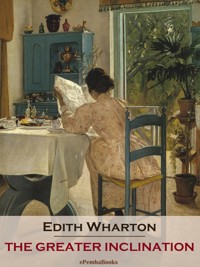
- This edition includes the following editor's introduction: Edith Wharton, the feminism of a Pulitzer Prize winner
First published in 1899, “The Greater Inclination” was the earliest collection of short fiction by American author Edith Wharton, her first work of literature.
“The Greater Inclination” consists of 8 works, 7 short fiction and a play in two acts. It is a somewhat diverse collection, with several stories touching on aspects of women, human relationships and interactions, a very dark story that delves into the psyche, and a light and humorous story is also included. Overall, it is a very solid first effort and well worth reading.
The stories included are: "The Muse's Tragedy," "A Journey," "The Pelican," "Souls Belated," "A Coward," "The Twilight of the God," "A Cup of Cold Water" and "The Portrait."
Das E-Book können Sie in Legimi-Apps oder einer beliebigen App lesen, die das folgende Format unterstützen:
Veröffentlichungsjahr: 2023
Ähnliche






Edith Wharton
The Greater Inclination
Table of contents
Edith Wharton, the feminism of a Pulitzer Prize winner
THE GREATER INCLINATION
Chapter 1 - The Muse's Tragedy
Chapter 2 - A Journey
Chapter 3 - The Pelican
Chapter 4 - Souls Belated
Chapter 5 - A Coward
Chapter 6 - The Twilight of the God
Chapter 7 - A Cup of Cold Water
Chapter 8 - The Portrait
Edith Wharton, the feminism of a Pulitzer Prize winner
Literature has been consolidated over time as a small oasis for many writers and readers. Many saw and see in the pages of a book an escape from the routine and boredom characteristic of the society that surrounds them. Edith Wharton was also aware of this. Edith Wharton, a well-known figure in American literature, received the call of writing from childhood. The writer's childhood and youth clearly marked her literary repertoire. These periods were characterized by the writer's loneliness, with an artificial mother, a distant father and a subsequent marriage of convenience that was defined by the author as one of her greatest mistakes and that would end in divorce years later. It was not until her encounter with the opera singer Camilla, when Wharton met true love. Her life, like that of many women of the time and later, was divided between her literary ambitions and the demands she encountered in the private sphere. Her fierce character made her a woman too different for her time, in the eyes not only of her husband, but also in the eyes of acquaintances and colleagues. The patrician New York in which she was born, raised and educated, was the main framework that inspired the criticism present in her novels, as well as her personal experiences and misfortunes were the basis of all her works. Undoubtedly, Edith Wharton's work marked a fundamental time in the transition to the European genre novel in American literature. In her novels we find a fierce criticism of the hostile economic and social laws that only generated benefits for a privileged few, as well as a clear social and sexual confinement characteristic of her protagonists. Thus, we observe in the same all kinds of issues related to the private sphere between men and women, whether adultery, restricted passion or marital conflicts. The work that brought Wharton the most fame and recognition in 1920 was "The Age of Innocence", which received a warm welcome. The Times Book Review itself dedicated an article to this work " a brilliant panorama of the New York of 45 years ago. The most requested novel in public libraries and a best seller in bookstores". In addition to this masterpiece, four earlier novels that tell the stories of women of her time are considered by many to be Wharton's true masterpieces, “ The Greater Inclination” (1899), "Sanctuary" (1903), "The House of Mirth" (1905) and “Bunner Sisters” (1916).
Another significant and indispensable work of Wharton's for its maturity and masterful depiction of human feelings, "The Glimpses of the Moon" (1922), would come within a year after receiving the Pulitzer Prize in May 1921 for "The Age of Innocence." Edith Wharton's style had little or nothing to do with that of Henry James, her great friend, since it was characterized above all by a more realistic attitude in relation to the meticulous description of the chores and social changes of American life and society. One of the main characteristics of her work is the frequent use of irony. Born into the upper class of pre-war society, Wharton became one of the most astute critics of this social group. As a result of her great work, Edith Wharton won the prestigious Pulitzer Prize in 1921, and in 1923 she was named Doctor honoris causa by Yale University.
Leaving the novel "The Buccaneers" unfinished, Wharton died in 1937. Her last work was finished by Marion Mainwaring who found the synopsis and notes that the author left written. Wharton became with the passage of time an essential in the world of literature and a passionate critic of injustice and social inequality.
The Editor, P.C. 2022
THE GREATER INCLINATION
Edith Wharton
Chapter 1 - The Muse's Tragedy
Danyers afterwards liked to fancy that he had recognized Mrs. Anerton at once; but that, of course, was absurd, since he had seen no portrait of her—she affected a strict anonymity, refusing even her photograph to the most privileged—and from Mrs. Memorall, whom he revered and cultivated as her friend, he had extracted but the one impressionist phrase: "Oh, well, she's like one of those old prints where the lines have the value of color."
He was almost certain, at all events, that he had been thinking of Mrs. Anerton as he sat over his breakfast in the empty hotel restaurant, and that, looking up on the approach of the lady who seated herself at the table near the window, he had said to himself, "That might be she."
Ever since his Harvard days—he was still young enough to think of them as immensely remote—Danyers had dreamed of Mrs. Anerton, the Silvia of Vincent Rendle's immortal sonnet-cycle, the Mrs. A. of the Life and Letters. Her name was enshrined in some of the noblest English verse of the nineteenth century—and of all past or future centuries, as Danyers, from the stand-point of a maturer judgment, still believed. The first reading of certain poems—of the Antinous, the Pia Tolomei, the Sonnets to Silvia,—had been epochs in Danyers's growth, and the verse seemed to gain in mellowness, in amplitude, in meaning as one brought to its interpretation more experience of life, a finer emotional sense. Where, in his boyhood, he had felt only the perfect, the almost austere beauty of form, the subtle interplay of vowel-sounds, the rush and fulness of lyric emotion, he now thrilled to the close-packed significance of each line, the allusiveness of each word—his imagination lured hither and thither on fresh trails of thought, and perpetually spurred by the sense that, beyond what he had already discovered, more marvellous regions lay waiting to be explored. Danyers had written, at college, the prize essay on Rendle's poetry (it chanced to be the moment of the great man's death); he had fashioned the fugitive verse of his own storm-and-stress period on the forms which Rendle had first given to English metre; and when two years later the Life and Letters appeared, and the Silvia of the sonnets took substance as Mrs. A., he had included in his worship of Rendle the woman who had inspired not only such divine verse but such playful, tender, incomparable prose.
Danyers never forgot the day when Mrs. Memorall happened to mention that she knew Mrs. Anerton. He had known Mrs. Memorall for a year or more, and had somewhat contemptuously classified her as the kind of woman who runs cheap excursions to celebrities; when one afternoon she remarked, as she put a second lump of sugar in his tea:
"Is it right this time? You're almost as particular as Mary Anerton."
"Mary Anerton?"
"Yes, I never can remember how she likes her tea. Either it's lemon with sugar, or lemon without sugar, or cream without either, and whichever it is must be put into the cup before the tea is poured in; and if one hasn't remembered, one must begin all over again. I suppose it was Vincent Rendle's way of taking his tea and has become a sacred rite."
"Do you know Mrs. Anerton?" cried Danyers, disturbed by this careless familiarity with the habits of his divinity.
"'And did I once see Shelley plain?' Mercy, yes! She and I were at school together—she's an American, you know. We were at a pension near Tours for nearly a year; then she went back to New York, and I didn't see her again till after her marriage. She and Anerton spent a winter in Rome while my husband was attached to our Legation there, and she used to be with us a great deal." Mrs. Memorall smiled reminiscently. "It was the winter."
"The winter they first met?"
"Precisely—but unluckily I left Rome just before the meeting took place. Wasn't it too bad? I might have been in the Life and Letters. You know he mentions that stupid Madame Vodki, at whose house he first saw her."
"And did you see much of her after that?"
"Not during Rendle's life. You know she has lived in Europe almost entirely, and though I used to see her off and on when I went abroad, she was always so engrossed, so preoccupied, that one felt one wasn't wanted. The fact is, she cared only about his friends—she separated herself gradually from all her own people. Now, of course, it's different; she's desperately lonely; she's taken to writing to me now and then; and last year, when she heard I was going abroad, she asked me to meet her in Venice, and I spent a week with her there."
"And Rendle?"
Mrs. Memorall smiled and shook her head. "Oh, I never was allowed a peep at _him_; none of her old friends met him, except by accident. Ill-natured people say that was the reason she kept him so long. If one happened in while he was there, he was hustled into Anerton's study, and the husband mounted guard till the inopportune visitor had departed. Anerton, you know, was really much more ridiculous about it than his wife. Mary was too clever to lose her head, or at least to show she'd lost it—but Anerton couldn't conceal his pride in the conquest. I've seen Mary shiver when he spoke of Rendle as our poet. Rendle always had to have a certain seat at the dinner-table, away from the draught and not too near the fire, and a box of cigars that no one else was allowed to touch, and a writing-table of his own in Mary's sitting-room—and Anerton was always telling one of the great man's idiosyncrasies: how he never would cut the ends of his cigars, though Anerton himself had given him a gold cutter set with a star-sapphire, and how untidy his writing-table was, and how the house- maid had orders always to bring the waste-paper basket to her mistress before emptying it, lest some immortal verse should be thrown into the dust-bin."
"The Anertons never separated, did they?"
"Separated? Bless you, no. He never would have left Rendle! And besides, he was very fond of his wife."
"And she?"
"Oh, she saw he was the kind of man who was fated to make himself ridiculous, and she never interfered with his natural tendencies."
From Mrs. Memorall, Danyers further learned that Mrs. Anerton, whose husband had died some years before her poet, now divided her life between Rome, where she had a small apartment, and England, where she occasionally went to stay with those of her friends who had been Rendle's. She had been engaged, for some time after his death, in editing some juvenilia which he had bequeathed to her care; but that task being accomplished, she had been left without definite occupation, and Mrs. Memorall, on the occasion of their last meeting, had found her listless and out of spirits.
"She misses him too much—her life is too empty. I told her so—I told her she ought to marry."
"Oh!"
"Why not, pray? She's a young woman still—what many people would call young," Mrs. Memorall interjected, with a parenthetic glance at the mirror. "Why not accept the inevitable and begin over again? All the King's horses and all the King's men won't bring Rendle to life-and besides, she didn't marry him when she had the chance."
Danyers winced slightly at this rude fingering of his idol. Was it possible that Mrs. Memorall did not see what an anti-climax such a marriage would have been? Fancy Rendle "making an honest woman" of Silvia; for so society would have viewed it! How such a reparation would have vulgarized their past—it would have been like "restoring" a masterpiece; and how exquisite must have been the perceptions of the woman who, in defiance of appearances, and perhaps of her own secret inclination, chose to go down to posterity as Silvia rather than as Mrs. Vincent Rendle!
Mrs. Memorall, from this day forth, acquired an interest in Danyers's eyes. She was like a volume of unindexed and discursive memoirs, through which he patiently plodded in the hope of finding embedded amid layers of dusty twaddle some precious allusion to the subject of his thought. When, some months later, he brought out his first slim volume, in which the remodelled college essay on Rendle figured among a dozen, somewhat overstudied "appreciations," he offered a copy to Mrs. Memorall; who surprised him, the next time they met, with the announcement that she had sent the book to Mrs. Anerton.
Mrs. Anerton in due time wrote to thank her friend. Danyers was privileged to read the few lines in which, in terms that suggested the habit of "acknowledging" similar tributes, she spoke of the author's "feeling and insight," and was "so glad of the opportunity," etc. He went away disappointed, without clearly knowing what else he had expected.
The following spring, when he went abroad, Mrs. Memorall offered him letters to everybody, from the Archbishop of Canterbury to Louise Michel. She did not include Mrs. Anerton, however, and Danyers knew, from a previous conversation, that Silvia objected to people who "brought letters." He knew also that she travelled during the summer, and was unlikely to return to Rome before the term of his holiday should be reached, and the hope of meeting her was not included among his anticipations.
The lady whose entrance broke upon his solitary repast in the restaurant of the Hotel Villa d'Este had seated herself in such a way that her profile was detached against the window; and thus viewed, her domed forehead, small arched nose, and fastidious lip suggested a silhouette of Marie Antoinette. In the lady's dress and movements—in the very turn of her wrist as she poured out her coffee—Danyers thought he detected the same fastidiousness, the same air of tacitly excluding the obvious and unexceptional. Here was a woman who had been much bored and keenly interested. The waiter brought her a _Secolo,_ and as she bent above it Danyers noticed that the hair rolled back from her forehead was turning gray; but her figure was straight and slender, and she had the invaluable gift of a girlish back.
The rush of Anglo-Saxon travel had not set toward the lakes, and with the exception of an Italian family or two, and a hump-backed youth with an _abbé_, Danyers and the lady had the marble halls of the Villa d'Este to themselves.
When he returned from his morning ramble among the hills he saw her sitting at one of the little tables at the edge of the lake. She was writing, and a heap of books and newspapers lay on the table at her side. That evening they met again in the garden. He had strolled out to smoke a last cigarette before dinner, and under the black vaulting of ilexes, near the steps leading down to the boat-landing, he found her leaning on the parapet above the lake. At the sound of his approach she turned and looked at him. She had thrown a black lace scarf over her head, and in this sombre setting her face seemed thin and unhappy. He remembered afterwards that her eyes, as they met his, expressed not so much sorrow as profound discontent.
To his surprise she stepped toward him with a detaining gesture.
"Mr. Lewis Danyers, I believe?"
He bowed.
"I am Mrs. Anerton. I saw your name on the visitors' list and wished to thank you for an essay on Mr. Rendle's poetry—or rather to tell you how much I appreciated it. The book was sent to me last winter by Mrs. Memorall."
She spoke in even melancholy tones, as though the habit of perfunctory utterance had robbed her voice of more spontaneous accents; but her smile was charming. They sat down on a stone bench under the ilexes, and she told him how much pleasure his essay had given her. She thought it the best in the book—she was sure he had put more of himself into it than into any other; was she not right in conjecturing that he had been very deeply influenced by Mr. Rendle's poetry? Pour comprendre il faut aimer, and it seemed to her that, in some ways, he had penetrated the poet's inner meaning more completely than any other critic. There were certain problems, of course, that he had left untouched; certain aspects of that many-sided mind that he had perhaps failed to seize—
"But then you are young," she concluded gently, "and one could not wish you, as yet, the experience that a fuller understanding would imply."
She stayed a month at Villa d'Este, and Danyers was with her daily. She showed an unaffected pleasure in his society; a pleasure so obviously founded on their common veneration of Rendle, that the young man could enjoy it without fear of fatuity. At first he was merely one more grain of frankincense on the altar of her insatiable divinity; but gradually a more personal note crept into their intercourse. If she still liked him only because he appreciated Rendle, she at least perceptibly distinguished him from the herd of Rendle's appreciators.
Her attitude toward the great man's memory struck Danyers as perfect. She neither proclaimed nor disavowed her identity. She was frankly Silvia to those who knew and cared; but there was no trace of the Egeria in her pose. She spoke often of Rendle's books, but seldom of himself; there was no posthumous conjugality, no use of the possessive tense, in her abounding reminiscences. Of the master's intellectual life, of his habits of thought and work, she never wearied of talking. She knew the history of each poem; by what scene or episode each image had been evoked; how many times the words in a certain line had been transposed; how long a certain adjective had been sought, and what had at last suggested it; she could even explain that one impenetrable line, the torment of critics, the joy of detractors, the last line of The Old Odysseus.
Danyers felt that in talking of these things she was no mere echo of Rendle's thought. If her identity had appeared to be merged in his it was because they thought alike, not because he had thought for her. Posterity is apt to regard the women whom poets have sung as chance pegs on which they hung their garlands; but Mrs. Anerton's mind was like some fertile garden wherein, inevitably, Rendle's imagination had rooted itself and flowered. Danyers began to see how many threads of his complex mental tissue the poet had owed to the blending of her temperament with his; in a certain sense Silvia had herself created the Sonnets to Silvia.
To be the custodian of Rendle's inner self, the door, as it were, to the sanctuary, had at first seemed to Danyers so comprehensive a privilege that he had the sense, as his friendship with Mrs. Anerton advanced, of forcing his way into a life already crowded. What room was there, among such towering memories, for so small an actuality as his? Quite suddenly, after this, he discovered that Mrs. Memorall knew better: his fortunate friend was bored as well as lonely.
"You have had more than any other woman!" he had exclaimed to her one day; and her smile flashed a derisive light on his blunder. Fool that he was, not to have seen that she had not had enough! That she was young still—do years count?—tender, human, a woman; that the living have need of the living.
After that, when they climbed the alleys of the hanging park, resting in one of the little ruined temples, or watching, through a ripple of foliage, the remote blue flash of the lake, they did not always talk of Rendle or of literature. She encouraged Danyers to speak of himself; to confide his ambitions to her; she asked him the questions which are the wise woman's substitute for advice.
"You must write," she said, administering the most exquisite flattery that human lips could give.
Of course he meant to write—why not to do something great in his turn? His best, at least; with the resolve, at the outset, that his best should be the best. Nothing less seemed possible with that mandate in his ears. How she had divined him; lifted and disentangled his groping ambitions; laid the awakening touch on his spirit with her creative _Let there be light!_
It was his last day with her, and he was feeling very hopeless and happy.
"You ought to write a book about _him,"_ she went on gently.
Danyers started; he was beginning to dislike Rendle's way of walking in unannounced.
"You ought to do it," she insisted. "A complete interpretation—a summing- up of his style, his purpose, his theory of life and art. No one else could do it as well."
He sat looking at her perplexedly. Suddenly—dared he guess?
"I couldn't do it without you," he faltered.
"I could help you—I would help you, of course."
They sat silent, both looking at the lake.
It was agreed, when they parted, that he should rejoin her six weeks later in Venice. There they were to talk about the book.
Lago d'Iseo, August 14th
When I said good-by to you yesterday I promised to come back to Venice in a week: I was to give you your answer then. I was not honest in saying that; I didn't mean to go back to Venice or to see you again. I was running away from you—and I mean to keep on running! If you won't, I must. Somebody must save you from marrying a disappointed woman of—well, you say years don't count, and why should they, after all, since you are not to marry me?
That is what I dare not go back to say. You are not to marry me. We have had our month together in Venice (such a good month, was it not?) and now you are to go home and write a book—any book but the one we—didn't talk of!—and I am to stay here, attitudinizing among my memories like a sort of female Tithonus. The dreariness of this enforced immortality!
But you shall know the truth. I care for you, or at least for your love, enough to owe you that.
You thought it was because Vincent Rendle had loved me that there was so little hope for you. I had had what I wanted to the full; wasn't that what you said? It is just when a man begins to think he understands a woman that he may be sure he doesn't! It is because Vincent Rendle _didn't love me_ that there is no hope for you. I never had what I wanted, and never, never, never will I stoop to wanting anything else.
Do you begin to understand? It was all a sham then, you say? No, it was all real as far as it went. You are young—you haven't learned, as you will later, the thousand imperceptible signs by which one gropes one's way through the labyrinth of human nature; but didn't it strike you, sometimes, that I never told you any foolish little anecdotes about him? His trick, for instance, of twirling a paper-knife round and round between his thumb and forefinger while he talked; his mania for saving the backs of notes; his greediness for wild strawberries, the little pungent Alpine ones; his childish delight in acrobats and jugglers; his way of always calling me _you—dear you_, every letter began—I never told you a word of all that, did I? Do you suppose I could have helped telling you, if he had loved me? These little things would have been mine, then, a part of my life—of our life—they would have slipped out in spite of me (it's only your unhappy woman who is always reticent and dignified). But there never was any "our life;" it was always "our lives" to the end… .
If you knew what a relief it is to tell some one at last, you would bear with me, you would let me hurt you! I shall never be quite so lonely again, now that some one knows.
Let me begin at the beginning. When I first met Vincent Rendle I was not twenty-five. That was twenty years ago. From that time until his death, five years ago, we were fast friends. He gave me fifteen years, perhaps the best fifteen years, of his life. The world, as you know, thinks that his greatest poems were written during those years; I am supposed to have "inspired" them, and in a sense I did. From the first, the intellectual sympathy between us was almost complete; my mind must have been to him (I fancy) like some perfectly tuned instrument on which he was never tired of playing. Some one told me of his once saying of me that I "always understood;" it is the only praise I ever heard of his giving me. I don't even know if he thought me pretty, though I hardly think my appearance could have been disagreeable to him, for he hated to be with ugly people. At all events he fell into the way of spending more and more of his time with me. He liked our house; our ways suited him. He was nervous, irritable; people bored him and yet he disliked solitude. He took sanctuary with us. When we travelled he went with us; in the winter he took rooms near us in Rome. In England or on the continent he was always with us for a good part of the year. In small ways I was able to help him in his work; he grew dependent on me. When we were apart he wrote to me continually—he liked to have me share in all he was doing or thinking; he was impatient for my criticism of every new book that interested him; I was a part of his intellectual life. The pity of it was that I wanted to be something more. I was a young woman and I was in love with him—not because he was Vincent Rendle, but just because he was himself!




