


The Handbook of Global Security Policy E-Book
146,99 €
Mehr erfahren.
- Herausgeber: John Wiley & Sons
- Kategorie: Geisteswissenschaft
- Serie: HGP - Handbooks of Global Policy
- Sprache: Englisch
This Handbook brings together 30 state-of-the-art essays covering the essential aspects of global security research and practice for the 21st century.
- Embraces a broad definition of security that extends beyond the threat of foreign military attack to cover new risks for violence
- Offers comprehensive coverage framed around key security concepts, risks, policy tools, and global security actors
- Discusses pressing contemporary issues including terrorism, disarmament, genocide, sustainability, international peacekeeping, state-building, natural disasters, energy and food security, climate change, and cyber warfare
- Includes insightful and accessible contributions from around the world aimed at a broad base of scholars, students, practitioners, and policymakers
Sie lesen das E-Book in den Legimi-Apps auf:
Seitenzahl: 1345
Veröffentlichungsjahr: 2014
Ähnliche




















Handbook of Global Policy Series
Series Editor
David Held
Master of University College and Professor of Politics and International Relations at Durham University
The Handbook of Global Policy series presents a comprehensive collection of the most recent scholarship and knowledge about global policy and governance. Each Handbook draws together newly commissioned essays by leading scholars and is presented in a style which is sophisticated but accessible to undergraduate and advanced students, as well as scholars, practitioners, and others interested in global policy. Available in print and online, these volumes expertly assess the issues, concepts, theories, methodologies, and emerging policy proposals in the field.
Published
The Handbook of Global Climate and Environment Policy
Robert Falkner
The Handbook of Global Energy Policy
Andreas Goldthau
The Handbook of Global Companies
John Mikler
The Handbook of Global Security Policy
Mary Kaldor and Iavor Rangelov
The Handbook of Global Health Policy
Garrett Brown, Gavin Yamey, and Sarah Wamala
The Handbook of Global Security Policy
Edited by
Mary Kaldor and Iavor Rangelov
This edition first published 2014 © 2014 John Wiley & Sons Ltd
Registered OfficeJohn Wiley & Sons Ltd, The Atrium, Southern Gate, Chichester, West Sussex, PO19 8SQ, UK
Editorial Offices350 Main Street, Malden, MA 02148-5020, USA 9600 Garsington Road, Oxford, OX4 2DQ, UK The Atrium, Southern Gate, Chichester, West Sussex, PO19 8SQ, UK
For details of our global editorial offices, for customer services, and for information about how to apply for permission to reuse the copyright material in this book please see our website at www.wiley.com/wiley-blackwell.
The right of Mary Kaldor and Iavor Rangelov to be identified as the authors of the editorial material in this work has been asserted in accordance with the UK Copyright, Designs and Patents Act 1988.
All rights reserved. No part of this publication may be reproduced, stored in a retrieval system, or transmitted, in any form or by any means, electronic, mechanical, photocopying, recording or otherwise, except as permitted by the UK Copyright, Designs and Patents Act 1988, without the prior permission of the publisher.
Wiley also publishes its books in a variety of electronic formats. Some content that appears in print may not be available in electronic books.
Designations used by companies to distinguish their products are often claimed as trademarks. All brand names and product names used in this book are trade names, service marks, trademarks or registered trademarks of their respective owners. The publisher is not associated with any product or vendor mentioned in this book.
Limit of Liability/Disclaimer of Warranty: While the publisher and authors have used their best efforts in preparing this book, they make no representations or warranties with respect to the accuracy or completeness of the contents of this book and specifically disclaim any implied warranties of merchantability or fitness for a particular purpose. It is sold on the understanding that the publisher is not engaged in rendering professional services and neither the publisher nor the author shall be liable for damages arising herefrom. If professional advice or other expert assistance is required, the services of a competent professional should be sought.
Library of Congress Cataloging-in-Publication Data
The handbook of global security policy / edited by Mary Kaldor and Iavor Rangelov. – Global security and international law. pages cm Includes bibliographical references and index. ISBN 978-0-470-67322-5 (cloth) 1. Security, International. 2. Security, International–Forecasting. I. Kaldor, Mary, author, editor of compilation. II. Rangelov, Iavor, 1977–, author, editor of compilation. JZ5588.H358 2014 355′.0335–dc23
2013049094
A catalogue record for this book is available from the British Library.
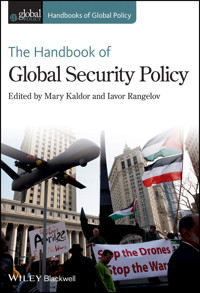
Cover image: A model of a drone is lofted over protesters during a rally held to end the wars at home and abroad in New York April 9, 2011. Photo © Jessica Rinaldi / Reuters. Cover design by Design Deluxe.
CONTENTS
Notes on Contributors
Introduction: Global Security Policy in the Twenty-First Century
Structure and Organization of the Book
Note
References
Part I Key Concepts
Chapter 1 Global Security
What is a Global Security Issue?
Existential
and
Emancipatory
Threats
Where Are We In History? The Paradoxes of Proximity
Where Are We Going? The Evolving Global Securityscape and the Inconvenient Truth of the International
The Challenge: Can we Escape the “Madness of Sanity”?
Notes
References
Chapter 2 Security and Social Critique
Security Studies Meets Social Critique
Feminism and the Critique of Violence
After Frankfurt: Security as Emancipation
The Radical Promise of Poststructuralism
Conclusion
Notes
References
Chapter 3 Gender and Security
State-Centric Security and Gendered Violences
The Securitization of Sexual and Gender-Based Violence
Humanizing Security, Gendering Security?
Gender Narratives and the “War on Terror”
Conclusion
Notes
References
Chapter 4 Security Policy and (Global) Risk(s)
Introduction
The Modern Invention Called “Risk”
Security Policies and the Logic of “Risk'
“Global Risks” and the Imperative to Rethink Modern (Security) Institutions
Conclusion
Note
References
Chapter 5 Human Security
The Evolution of the Concept of Human Security
The Critiques of Human Security
Reconstructing Human Security
Notes
References
Part II Policy Arenas
Chapter 6 Nuclear Disarmament and Nonproliferation
Deconstructing Nonproliferation and Disarmament
Nuclear Nonproliferation
Nuclear Disarmament
New Frontiers in Policy and Research
Comparative Conclusions: Beyond Nuclear Politics
Notes
References
Chapter 7 Terrorism and Antiterrorism
Progress in Defining Terrorism
The Rise of Terrorism in the Early Twenty-First Century
Transnationalization of Terrorism
“Global Terrorism” After 9/11: Transformation and/or Decline?
Causes and Explanations of Terrorism
Specifics of Antiterrorism
Conclusion
References
Chapter 8 Genocide and Large-Scale Human Rights Violations
Conceptual and Legal Parameters
The History of Genocide in Academic Perspectives
Historical Parameters of Global-Era Genocide
Reasons Not To Be Cheerful
Policies and Politics of Genocide Prevention
Limitations of Global Genocide Policy
References
Chapter 9 Transnational Crime
Transnational Groups and Enterprises
Networks of Gangs and Cartels
A Global TCO Sampler: AfPak, Mexico, Central America, and West Africa
Violent Non-State Actors, Statemaking, and State Reconfiguration
Conclusion: Illicit Networks of Crime and Disorder
References
Further Reading
Chapter 10 Natural Resources and Insecurity
Introduction
Cross-Country Empirical Studies: Are Resources and Civil War Related?
Theoretical Models and Mechanisms: the “How” of this Relationship
More Empirics: Which Mechanism(s) do the Data Support?
Conclusion and Policy Implications
Note
References
Chapter 11 The Web of Water Security
Not Water Secure
Why Narrow and Deterministic is not Good Enough
The “Web” of Water Security
Interdependency and Sustainable Water Security
Analytical and Policy Implications of the “Web” of Water Security
Conclusions
Acknowledgements
Notes
References
Further Reading
Part III Policy Tools
Chapter 12 Civilian Protection
Introduction
Civilian Protection as Acts of Omission: Avoiding Civilian Harm in Armed Conflict
Peacekeeping and the Protection of Civilians
Strategies of Civilian Protection and R2P
Conclusion
Acknowledgements
Notes
References
Further Reading
Chapter 13 Humanitarian Assistance
Introduction
Humanitarianism, Security, and Politics
Securing Humanitarian Space
Conclusion: Humanitarian (In)coherence, or Humanitarian Purity?
References
Chapter 14 The Evolution of International Peacekeeping
Introduction
The Evolution of International Peacekeeping
Current Implementation Challenges
Rethinking International Peacekeeping?
Notes
References
Chapter 15 State-Building, Nation-Building, and Reconstruction
Introduction
Definitions
(Post-)Liberal and Critical Framings
Dilemmas and Contradictions
New Emerging Alternatives: Hybrid and Post-Liberal Peace, the “Local”, the “Everyday”, and Beyond
Conclusion
References
Chapter 16 Strengthening Democratic Governance in the Security Sector: The Unfulfilled Promise of Security Sector Reform
What is Security Sector Reform?
The Evolution of the Security Sector Reform Concept
The Challenges of Implementing the SSR Agenda
Becoming More Effective: Giving More Attention to Process
References
Chapter 17 Diplomacy and Mediation
The Post-Cold War Issues
The Post-Cold War Actors
Post-Cold War Trends
Notes
References
Chapter 18 Global Security and International Law
A Conceptual Introduction
Global Security, Use of Force, and International Law
Climate Change and Other Global Challenges
Concluding Comment
Notes
References
Chapter 19 Transitional Justice
Introduction
The Evolution of Transitional Justice
The Justice Dilemma and its Critics
Beyond the State: Challenges for Scholars and Policymakers
Conclusion
References
Part IV Global Security Actors
Chapter 20 Reframing the Use of Force: The European Union as a Security Actor
Introduction
Integrated Security
Norms and Values
European Security Capabilities
Conclusion
Notes
References
Chapter 21 China
Introduction
Part I
Part II: China's Role in Global Security
Conclusion
References
Chapter 22 India as a Global Security Actor
Introduction
India's Worldview
India as a Global Security Actor
Challenges and Opportunities
Conclusion: India's Emerging Global Profile
Notes
References
Chapter 23 Security Agenda in Russia: Academic Concepts, Political Discourses, and Institutional Practices
Introduction
Methodological Remarks
Security for Domestic Audience: a Genealogy of Russian Fears
Russia's Visions of International Security: the Challenges of Legitimation
Russia's Security Roles
Conclusion
Notes
References
Chapter 24 Contextualizing Global Security: The Case of Turkey
Introduction
Becoming a Global Security Actor
Continuity and Change in Turkey's Security-Policies
Lingering Questions
Notes
References
Chapter 25 The United States
Introduction
The Context for Policy: Managing Decline or Reasserting Hegemony?
Policy Priorities for the United States
Reconfiguring Counterterrorism
Conclusion
References
Chapter 26 Civil Society in Fragile Contexts
1
Introduction
Strengthening Civil Society, What Is It All About?
Hybrid Providers of Development in “Fragile States”
5
Agents of Peace and Democratization?
Legitimacy and “Civilness”
Global Connections and Difficulties of Outside Support
Case Study – Strengthening “Agents of Change” in Ituri
7
Identifying Peace-Minded Partners
Conclusion
Notes
References
Chapter 27 Protest and Politics: How Peace Movements Shape History
A Global Context
Opposing War in Indochina
Blocking Escalation
Seeds of Watergate
Defunding the War
Campaigning for Disarmament
Resisting the Iraq War
Understanding Change
Notes
References
Chapter 28 Corporate Actors
Introduction
Outlining the Rise of the PSI
Security Privatization: Historical Roots
The Post-Cold War Spurt
Categorization of PMSCs
Major Activities and involvement
Protecting the Neoliberal Agenda
Problems Related to Monitoring and Regulation
Quest for Legitimacy
Conclusion
Notes
References
Index
End User License Agreement
List of Tables
Chapter 10
Table 10.1
Chapter 22
Table 22.1
Table 22.2
Table 22.3
Table 22.4
Table 22.5
List of Illustrations
Chapter 7
Figure 7.1 Terrorist incidents worldwide, 2000–2011.
Figure 7.2 Terrorist incidents in Iraq, Afghanistan, and Pakistan, 2001–2011.
Figure 7.3 Top 10 countries most affected by terrorism.
Chapter 11
Figure 11.1 The global “web” of national water security.
Chapter 22
Map 22.1 Indian Ocean Region.
Guide
Cover
Table of Contents
Introduction
Part
Chapter
Pages
ii
iii
iv
ix
x
xi
xii
xiii
xiv
xv
1
2
3
4
5
6
7
8
9
10
12
13
14
15
16
17
18
19
20
21
22
23
24
25
26
27
28
29
30
31
32
33
34
35
36
37
38
39
40
41
42
43
44
45
46
47
48
49
50
51
52
53
54
55
56
57
58
59
60
61
62
63
64
65
66
67
68
69
70
71
72
73
74
75
76
77
78
79
80
81
82
83
84
85
86
87
88
89
90
91
92
93
94
95
96
97
98
99
100
101
102
103
104
105
106
107
108
109
110
111
112
113
114
115
116
117
118
119
120
121
122
123
124
125
126
127
128
129
130
131
132
133
134
135
136
137
138
139
140
141
142
143
144
145
146
147
148
149
150
151
152
153
154
155
156
157
158
159
160
161
162
163
164
165
166
167
168
169
170
171
172
173
174
175
176
177
178
179
180
181
182
183
184
185
186
187
188
189
190
191
192
193
194
195
196
197
198
199
200
201
202
203
204
205
206
207
208
209
210
211
212
213
214
215
216
217
218
219
220
221
222
223
224
225
226
227
228
229
230
231
232
233
234
235
236
237
238
239
240
241
242
243
244
245
246
247
248
249
250
251
252
253
254
255
256
257
258
259
260
261
262
263
264
265
266
267
268
269
270
271
272
273
274
275
276
277
278
279
280
281
282
283
284
285
286
287
288
289
290
291
292
293
294
295
296
297
298
299
300
301
302
303
304
305
306
307
308
309
310
311
312
313
314
315
316
317
318
319
320
321
322
323
324
325
326
327
328
329
330
331
332
333
334
335
336
337
338
339
340
341
342
343
344
345
346
347
348
349
350
351
352
353
354
355
356
357
358
359
360
361
362
363
364
365
366
367
368
369
370
371
372
373
374
375
376
377
378
379
380
381
382
383
384
385
386
387
388
389
390
391
392
393
394
395
396
397
398
399
400
401
402
403
404
405
406
407
408
409
410
411
412
413
414
415
416
417
418
419
420
421
422
423
424
425
426
427
428
429
430
431
432
433
434
435
436
437
438
439
440
441
442
443
444
445
446
447
448
449
450
451
452
453
454
455
456
457
458
459
460
461
462
463
464
465
466
467
468
469
470
471
472
473
474
475
476
477
478
479
480
481
482
483
484
485
486
487
488
489
490
491
492
493
494
495
496
497
498
499
500
501
502
503
504
505
506
507
508
509
510
511
512
513
514
515
516
517
518
519
520
521
522
523
524
525
526
527
528
529
530
531
532
533
534
535
536
537
538
539
540
541
Notes on Contributors
Ken Booth is Senior Research Associate, Department of International Politics, Aberystwyth University, where he was formerly E.H. Carr Professor and Head of Department. He is a Fellow of the British Academy (FBA) and a former Chair of the British International Studies Association. In 2004, he was recipient of the ISA's Susan Strange Award in recognition of his contribution to International Studies.
David Mutimer is Director of the York Centre for International and Security Studies and Associate Professor of Political Science at York University. His research considers issues of contemporary international security through lenses provided by critical social theory, as well as inquiring into the reproduction of security in and through popular culture. Much of that work has focused on weapons proliferation as a reconfigured security concern in the post-Cold War era, and has tried to open possibilities for alternative means of thinking about the security problems related to arms more generally. In the past few years, this program of research has concentrated on small arms and light weapons. More recently, he has turned his attention to the politics of the global War on Terror, and of the regional wars around the world presently being fought by Canada and its allies.
Natasha Marhia has recently completed a PhD in Gender Studies at the London School of Economics and Political Science (LSE) Gender Institute. Her research, funded by the Economic and Social Research Council, explores gendered everyday (in)security through an analysis of police discourses and practices surrounding violence against women in Delhi. Her research interests include gender, violence, militarism, (human) security, masculinities, and the state. Her recent work also engages with broad theoretical questions of power, performativity and the imbrication of the material and the discursive, particularly in relation to gender, violence, and security. She has previously conducted research on sexual and gender-based violence for women's organizations in both London and Delhi, and taught on gender theory and on conflict and globalization at LSE.
Sabine Selchow is Fellow in the Civil Society and Human Security Research Unit, Department of International Development at the London School of Economics and Political Science (LSE). At LSE, she directs the “Culture/s'-research component in the 5-year-project “Security in Transition”, funded by the European Research Council. Sabine is involved in various initiatives and international working groups, such as the working group “Cosmopolitan Communities of Risk”, established by Professor Ulrich Beck at the Center of Advanced Studies in Munich, Germany. She holds a PhD in Government from LSE.
Mary Kaldor is Professor of Global Governance and Director of the Civil Society and Human Security Research Unit at the London School of Economics. She is the author of many books, including The Ultimate Weapon is No Weapon: Human Security and the Changing Rules of War and Peace; New and Old Wars: Organised Violence in a Global Era; and Global Civil Society: An Answer to War. Professor Kaldor was a founding member of European Nuclear Disarmament and of the Helsinki Citizen's Assembly. She was also convener of the Human Security Study Group, which reported to Javier Solana.
Maria Rost Rublee is a senior lecturer at the Australian National University in Canberra, Australia. Her book, Nonproliferation Norms: Why States Choose Nuclear Restraint, received the Alexander George Book Award for best book in political psychology, awarded by the International Society for Political Psychology. Nonproliferation Norms has also been positively reviewed in 14 journals, including Foreign Affairs and Political Psychology. Rublee has received major grants from the United States Institute of Peace, the Norwegian Ministry of Foreign Affairs, and the Japan Foundation. Her work uses social constructivism and social psychology to understand how material and normative factors interact to shape elite and civil society conceptions of “security”. She has published articles in numerous international journals, including International Studies Review, Comparative Political Studies, and the Nonproliferation Review. She serves as editor for the journal International Studies Perspectives and is a member of the international Fissile Materials Working Group. Rublee earned her PhD in political science from the George Washington University in 2004.
Ekaterina Stepanova is a lead researcher and Head of the Peace and Conflict Studies Unit at the Institute of the World Economy and International Relations (IMEMO), Moscow. In 2007–2009, she was on leave from IMEMO to direct the Armed Conflicts and Conflict Management Program at Stockholm International Peace Institute (SIPRI). She is the author of six books, including Terrorism in Asymmetrical Conflict: Ideological and Structural Aspects. She serves on editorial boards of the journals Global Governance, Terrorism and Political Violence, International Journal of Conflict and Violence; on the expert panel of Global Peace Index; and Advisory board of the “Security in Transition” program, London School of Economics. She is also a member of the US–Russia Expert group on Afghan narcotrafficking. She lectures in English at the European University in St Petersburg. For more details, see http://www.estepanova.net
Martin Shaw is a sociologist of global politics, war, and genocide and author of numerous books including What is Genocide? and Genocide and International Relations: Changing Patterns in the Upheavals of the Late Modern World. He is Research Professor at the Institut Barcelona d'Estudis Internacionals (IBEI), Professorial Fellow in International Relations and Human Rights at the University of Roehampton, London, and Emeritus Professor of International Relations at the University of Sussex. His website is http://www.martinshaw.org
John P. Sullivan is a Senior Fellow at the Stephenson Disaster Management Institute at Louisiana State University. He also serves as a lieutenant with the Los Angeles Sheriff's Department. Sullivan holds a Bachelor of Arts in Government from the College of William and Mary, a Master of Arts in Urban Affairs and Policy Analysis from the New School for Social Research, and a PhD in Information and Knowledge Society from the Open University of Catalonia. He is a Member of the Advisory Board for Southern Pulse/Networked Intelligence, and an adjunct researcher on society and global crime at the VORTEX Research Group, Bogotá, Colombia. His current research focus is terrorism, transnational gangs and organized crime, conflict disaster, intelligence studies, post-conflict policing, sovereignty, and urban operations.
Anouk S. Rigterink is a PhD Candidate at the London School of Economics and Political Science, Department of International Development. She is associated with the ERC-funded Security in Transition Programme headed by Professor Mary Kaldor and the Department for International Development-funded Justice and Security Research Programme, headed by Professors Tim Allen and Alex de Waal.
Mark Zeitoun is Director of the Water Security Research Centre, School of International Development, University of East Anglia, UK. He has worked as a water resources engineer in conflict and post-conflict zones throughout Africa and the Middle East, and regularly advises bilateral and multilateral donor and implementing organizations on water policy, emergency preparedness, and water conflict negotiations.
Sarah Sewall teaches international affairs at the Harvard Kennedy School. A pioneer in the field of civilian protection, she helped revise US counterinsurgency doctrine, created new joint US military doctrine to stop genocide, and led the first comprehensive US field study on reducing civilian casualties in war. Previously, Dr Sewall served as the inaugural Deputy Assistant Secretary of Defense for Peacekeeping, as Director of Harvard's Carr Center for Human Rights Policy, and as Foreign Policy adviser to Senate Majority Leader George Mitchell.
Henry Radice is Research Fellow and Research Manager of the Justice and Security Research Programme at the London School of Economics and Political Science. His work focuses on the politics of humanity, that is, on how our understandings of common humanity and concepts of solidarity are shaped by our responses to moments of crisis, practices of inhumanity, and other humanitarian challenges such as climate change.
Renata Dwan is an official of the United Nations who has served in the Democratic Republic of the Congo, Haiti, Afghanistan, and Syria. She received her doctorate from the University of Oxford where she was Hedley Bull Junior Research Fellow in International Relations. Previous positions include Head of Stockholm International Peace Research Institute (SIPRI)'s project on armed conflict and conflict management and Special Advisor to EU civilian crisis management operations. The views expressed in this chapter are personal and do not represent the official position of the United Nations.
Vesna Bojicic-Dzelilovic is Senior Research Fellow at the Department of International Development at the London School of Economics and Political Science. Her main area of research is political economy of transition, conflict and post-conflict reconstruction, political economy of policy making and decentralization, and regional development. She has published academic and policy papers on these topics with a focus on South East Europe. Her published work includes co-edited a volume on Persistent State Weakness in the Global Age.
Denisa Kostovicova is Associate Professor in Global Politics at the Government Department, London School of Economics and Political Science. She is the author of Kosovo: The Politics of Identity and Space, and co-editor of several volumes including Bottom–up Politics: An Agency-Centred Approach to Globalization and Civil Society and Transitions in the Western Balkans. Her research interests concern challenges of post-conflict recovery in the global context from a bottom–up perspective. She has studied state-building, human security, transitional justice, and Europeanization in the Western Balkan, which is her area of expertise.
David Rampton is a Fellow in Global Politics in the Government and International Relations Departments of the London School of Economics. He completed his PhD, which focused on hegemony, identity, and Sinhala nationalism, at the School of Oriental and African Studies. His current research focuses on the biopolitics of nationalism and the governmental interface between nationalist and international state-building projects. He has recently published articles in Commonwealth and Comparative Politics and in edited volumes.
Nicole Ball is Senior Fellow at the Center for International Policy, Washington, DC; Senior Visiting Fellow at the Conflict Research Unit, Clingendael Institute, The Hague; and Enough Fellow at the Center for American Progress, Washington, DC. For much of her career, she has worked on issues relating to security-sector governance in non-OECD countries. Since 1998, she has consulted for the governments of the United Kingdom, The Netherlands, Germany and the United States; United Nations Development Programme; the Organisation for Economic Co-operation and Development Development Assistance Committee; and the World Bank on issues relating to security sector governance, conflict-affected states and multilateral financing arrangements. Recent publications include three reports for the INCAF Peacebuilding, Statebuilding and Security Task Team: “The Challenges of Undertaking Effective Security and Justice Work” (with Luc van de Goor, 2011); “From Quick Wins to Long-Term Profits? Developing better approaches to support security and justice engagements in fragile states: Burundi case study” (with Jean-Marie Gasana and Willy Nindorera, 2012); and “From Quick Wins to Long-Term Profits? Developing better approaches to support security and justice engagements in fragile states: Report of the Netherlands MFA headquarters visit” (2012). In 2013, she was participating in an evaluation of the EU's African Peace Facility.
Àlvaro de Soto held senior positions at the United Nations for 25 years, and during this time led the 1990–1991 negotiations that ended the war in El Salvador and the 1999–2004 negotiations on Cyprus. He was Special Envoy for Myanmar (1995–1999) and Special Representative for Western Sahara (2003–2005). He was the chief envoy for the Arab–Israeli conflict (2005–2007). He now teaches conflict resolution at Sciences Po, in Paris. He is a member of the Global Leadership Foundation and a Fellow at the Ralph Bunche Institute in New York.
Richard Falk is Albert G. Milbank Professor of International Law Emeritus at Princeton University where he was a member of the faculty for forty years (1961–2001). Between 2002 and 2013, he has been associated with Global & International Studies at the Santa Barbara campus of the University of California. He currently conducts a research project on “Climate Change, Human Security, and Democracy” under the auspices of the Orfalea Center. Professor Falk is currently the Special Rapporteur on Occupied Palestine for the United Nations Human Rights Council. He served as Chair of the Board, Nuclear Age Peace Foundation, 2004–2012, and now is Senior Vice President. Over the years, Falk has published more than 50 books, including Legal Order in a Violent World (1968); This Endangered Planet: Prospects and Proposals for Human Survival (1971); A Study of Future Worlds (1975); Predatory Globalization: A Critique (1999); Religion and Humane Global Governance (2001). His most recent books Achieving Human Rights (2009); a co-edited volume entitled Legality and Legitimacy in Global Affairs (2012); Global Parliament (with Andrew Strauss) (2011); Path to Zero: Dialogues on Nuclear Dangers (with David Krieger) (2012). Forthcoming is (Re)Imagining Humane Global Governance (2013).
Iavor Rangelov is Global Security Research Fellow at the Civil Society and Human Security Research Unit, London School of Economics and Political Science, and Co-Chair of the London Transitional Justice Network. He is fellow of the research and training programme European Foreign & Security Policy Studies (EFSPS), which supported his post-doctoral research and visiting fellowships at the European Policy Centre, Brussels; EU Institute for Security Studies, Paris; Institut Barcelona d'Estudis Internacionals, Barcelona; and T.M.C. Asser Instituut, The Hague. He is the author of Nationalism and the Rule of Law: Lessons from the Balkans and Beyond (2014).
Ruti Teitel is a Fellow at New York University Law School's Straus Institute for the Advanced Study of Law and Justice (2012–2013); the Ernst C. Stiefel Professor of Comparative Law, New York Law School; Fellow, London School of Economics; and Affiliated Visiting Professor, Hebrew University of Jerusalem. She is the author of Transitional Justice (2000) and many articles and book chapters on international and comparative law, often focusing on political transitions. Her latest work is Humanity's Law (2011). She is founding Co-Chair of the American Society of International Law Interest Group on Transitional Justice and Rule of Law, a life member of the Council on Foreign Relations, and a member of the ILA International Human Rights Law Committee.
Mary Martin is Associate Research Fellow at the Civil Society and Human Security Research Unit, and a Visiting Fellow at the Government Department of the London School of Economics. She was previously coordinator of the Human Security Study Group, which reports to the High Representative of the European Union. She is the editor of several books on human security. Her research interests also include the privatization of security, the role of corporate actors in conflict and peacebuilding, and European Union security policies.
May-Britt U. Stumbaum heads the NFG Research Group “Asian Perceptions of the European Union” at the Freie Unviersität, Berlin. She has worked both in policy research and academia, and has held positions at Harvard, SIPRI, DGAP, as well as other institutions in Europe, China, and the United States. May-Britt U. Stumbaum has published widely on security policy and EU–Asia/EU–China relations.
Sun Xuefeng is Associate Professor at the Department of International Relations at Tsinghua University and Executive Editor of the Chinese Journal of International Politics. Dr Sun Xuefeng is also a resident scholar at the Carnegie–Tsinghua Center for Global Policy. His research focuses on the rise of great powers, China's foreign policy, and international relations in East Asia.
Jivanta Schöttli is Lecturer in Comparative and International Politics at the Department of Political Science, South Asia Institute, Heidelberg University. Along with a Masters in Economic History and Bachelors in International Relations from the London School of Economics and Political Science, she holds a PhD, summa cum laude in political science from Heidelberg University. Her thesis was on the subject of policy-making and institution-building during the crucial transition period following independence under Prime Minister Jawaharlal Nehru. It has been published with Routledge, London in 2012 as Vision and Strategy in Indian Politics. She is co-author of A Political and Economic Dictionary of South Asia, has written articles on Indian foreign policy, and edited various publications. Jivanta was a research fellow at the Institute for Defence Studies and Analyses, New Delhi and at the India Study Centre, Beijing University. She is a member of the Heidelberg University, Cluster of Excellence, Asia and Europe in a Global Context and Deputy Editor of Heidelberg Papers in South Asian and Comparative Politics (HPSACP). Her research interests include India's international politics and the interplay between domestic and systemic dynamics of change and continuity in policy-making.
Markus Pauli studied Political Science at the Freie Unviersität in Berlin (FU) and the London School of Economics and Political Science. His research interests include political economy and international relations. Previously, he worked as project coordinator for InWEnt – Capacity Building International, a nonprofit organization dedicated to human resource development commissioned by the German Federal Government. His doctoral thesis at Heidelberg University explores the impact of microfinance in South India through an operationalization of the capability approach.
Andrey Makarychev is Professor at Institute of Government and Politics, University of Tartu, Estonia. His previous international employers were the Danish Institute for International Studies and the Center for Security Studies and Peace Research (ETH, Zurich). Andrey Makarychev lectured in the University of Tartu (Estonia), Diplomatic Academy of Azerbaijan, and National Mechnikov University (Odessa, Ukraine), and published in “Cooperation and Conflict”, “International Spectator”, “Journal of International Relations and Development” and other journals.
Aslı Çalkıvik is a Faculty Member at the Department of Humanities and Social Sciences at Istanbul Technical University. She received her PhD at the University of Minnesota in 2010 with her dissertation thesis, Dismantling Security. Her major research interests include global politics of security, international political theory, and critical security studies.
Adam Quinn is Lecturer in International Studies at the University of Birmingham. He is presently leading an ESRC Seminar Series on The Future of American Power and was convener of the US Foreign Policy Group of the British International Studies Association (BISA) 2008–2012. He is the author of US Foreign Policy in Context: National Ideology from the Founders to the Bush Doctrine (2010) and “The Art of Declining Politely: Obama's Prudent Presidency and the Waning of American Power”, International Affairs (July, 2011).
Willemijn Verkoren is Associate Professor and Head of the Centre for International Conflict Analysis and Management (CICAM) at the Institute of Management Research (IMR) of Radboud University Nijmegen, the Netherlands.
Mathijs van Leeuwen is Assistant Professor with the CICAM/IMR, and researcher at the African Studies Centre at Leiden University, the Netherlands.
David Cortright is the Director of Policy Studies at the Kroc Institute for International Peace Studies at the University of Notre Dame. He is the author or editor of 17 books and has written widely on nonviolent social change, nuclear disarmament, and the use of multilateral sanctions and incentives as tools of international peacemaking. Cortright has a long history of public advocacy for disarmament and the prevention of war. He opposed the Vietnam War as an active duty soldier (1968–1971); was the Executive Director of SANE, the Committee for a Sane Nuclear Policy (1978–1988); and was co-founder and co-chairs Win Without War, a coalition of national organizations opposed to US policies of war and military occupation in Iraq and Afghanistan.
Shantanu Chakrabarti is currently an Associate Professor in the Department of History, University of Calcutta. He also holds the honorary position of the Convener, Academic Committee, Institute of Foreign Policy Studies, and University of Calcutta. He was formerly a Research Fellow at the Institute for Defence Studies and Analyses (IDSA), New Delhi. His current research interests include peace studies and conflict resolution; South Asian regional trends; Indian foreign policy making; privatization of security, and comprehensive security agenda in Asia.
Introduction: Global Security Policy in the Twenty-First Century
Mary Kaldor and Iavor Rangelov*
We live in insecure times. We trust our institutions because we believe they keep us safe; yet the present moment is characterized by a pervasive worldwide sense of insecurity. In places like Syria, Iraq, Afghanistan, Democratic Republic of the Congo, Somalia, and Mali, people live under the daily threat of being killed, expelled from their homes, or being robbed, raped, tortured or kidnapped. In places like Bangladesh, Oklahoma, Japan, and Australia, people are increasingly vulnerable to flooding, earthquakes, tsunamis, or fires. In much of the world, access to water, food, or shelter is scarce. And in the richer parts of the world, growing fears about welfare and pensions, or terrorism and criminality, are probably the basis of a growing mistrust of political institutions and the political class.
Security policy is supposed to address insecurity. During the Cold War, the institutions that were responsible for security policy were largely provided by nation-states and political blocs. Even though the United Nations (UN) had security functions, these were constrained by the continuing East–West conflict. Traditionally, security policies consist of military forces that are designed to repel an attack by a foreign state and police forces who are supposed to uphold the rule of law and deal with criminality. What Ulrich Beck (1992) calls the “master narrative” of the modern state was constructed around its role in protecting people against risk: the dangers posed by nature, personal risks of ill health and unemployment, as well as threats posed by foreign enemies. Indeed the idea of defense against a foreign enemy became a metaphoric umbrella term for security in general. Yet in a world where inter-state war is declining, the metaphor is much less reassuring than in the past. It is this mismatch between security policies as traditionally conceived and people's everyday experience in which the pervasive sense of insecurity resides.
This book is about global security policy. By global, we do not mean universal; rather we refer to the changes in security policy “in these global times”. In part, global security policy is about the interconnectedness of contemporary sources of insecurity. Conflict, terrorism, criminality, climate change, or economic crisis can no longer be addressed only or even primarily at the level of the nation-state; hence the term global implies beyond the nation-state and often refers to a multiscalar system that is local, regional, and national, as well as global. But we mean more than that. Global security policy is not just about a change of level; it is about a change in kind. It is about how we understand and conceptualize security and how our understandings are implemented. It is about concepts and tools and not just actors. It entails a contradictory process of overlapping arenas that are public and private, and local and transnational, as well as national.
Much of the contemporary literature on security deals with the new range of world risks in place of the threat of attack by foreign military forces. Some of these risks, like cyber warfare or climate change, are clearly new; some, like terrorism or the spread of weapons of mass destruction or sectarian conflict, appear in a new guise. Some have new features that are the consequence of, for example, growing interconnectedness; new forms of communication that speed up mobilization and facilitate long-distance violence; or weak states that are the legacy of the collapse of dictatorships, the drying up of superpower aid to clients, and the pursuit of neoliberal economic strategies. Our point, however, is that many of these risks are risks that we used to think about in domestic terms – they only became visible as global risks after the end of the Cold War. During the Cold War, bipolar security was a mechanism for world order. Because an East–West conflict seemed like the worst possible eventuality, other sources of insecurity were accorded a low priority. Growing risk and complexity reflects not so much a change in how the world works, although it changes all the time, but rather the absence of a simple narrative to understand the world.
This book uses the term security to address primarily issues relating to violence. Nowadays, security discussions, including climate change, energy security, food security, and so on, tend to take a wider approach. This has the advantage of stressing the urgency of these issues. But it also allows for “securitization” – that is to say, co-option by those institutions traditionally responsible for security, such as the military and intelligence agencies (Buzan et al., 1998). It also carries the implication that if we solve these other problems, peace will follow. Of course, the sources of insecurity are much wider than this and, moreover, different sources of insecurity are interrelated; indeed, we touch upon this relationship in several of the chapters in this volume. There are, for example, complex linkages between high levels of military spending and global imbalances, strategies of structural adjustment and weak rule of law, sporadic violence, and poor economic performance. But a book that covered all sources of insecurity would be a book about global problems in general; thus we have chosen a perhaps arbitrary limitation on our subject matter although we do acknowledge that issues of war and crime need to be addressed on their own terms as well as in relation to wider global problems.
In identifying the sources of insecurity covered in this book, we have decided against any attempt to categorize or code different gradations of what are considered global risks; rather, we have adopted an empirical approach of identifying those sources of insecurity with which existing policy is actually concerned. We describe them as policy arenas rather than risks or sources of insecurity and they are addressed in Part II of the book.
Much has been written about conceptual and theoretical issues raised by global security (Booth, 2007; Buzan and Hansen, 2009) but much less about global security as policy. While there is growing literature on aspects of global security – terrorism, state-building, peace-keeping, and so on – we are not aware of any work that pulls all this together. Our interest is less in abstract theorizing about the possible directions and meanings of global security, although that is important, but more in the way that global security policy is actually practiced: how is it conceptualized and implemented, who is responsible, and what tools do they use? The book does not assume that a global security policy is being developed that offers a more effective answer to contemporary sources of insecurity. On the contrary, the global security landscape is characterized by multiple and often contradictory tendencies. The legacies of the Cold War period still shape the geo-political preoccupations of what could be described as the national players on the global stage; in fact, a very large proportion of world security expenditure is devoted to these preoccupations. The War on Terror launched in response to the events of 9/11 seems to have mutated into a global binary dynamic involving, on the one hand, long-distance air power, especially drones, carried out by new combinations of private security contractors, local non-state actors, and intelligence agencies, as well as traditional security actors and, on the other hand, networks of extremists and criminal groups tied together through an increasingly operational narrative of resistance. In international institutions like the UN, the European Union (EU), or the African Union, security policies are evolving largely around what Duffield (2001) describes as the “liberal peace”: the combination of formulations, strategies, tools, and preoccupations conjured up in terms like stabilization, crisis management, human security, post-conflict reconstruction, etc. Many of the chapters in this book primarily address the concerns of the liberal peace, although they are less about setting up norms and more about understanding actual practice, achievements and inadequacies. However, the authors do take into account alternative tendencies and consider how they shape the evolution of different aspects of global security policy.
Structure and Organization of the Book
The Handbook has four parts: key concepts; security risks, which we describe as policy arenas; policy tools or instruments; and global security actors. Collectively, they provide an original account of global security policy in the twenty-first century and a comprehensive introduction to the main subjects and ideas that animate scholarly and policy discussions in this field.
Part I comprises five contributions, which elaborate some of the key concepts that constitute global security policy as a distinctive field of practice and scholarship. In Chapter 1, Ken Booth argues that arriving at a consensual understanding of “global security” is critical for promoting the well-being of humanity and nature in general. He elaborates the concept of global security in relation to existential and emancipatory global threats and places them in their contemporary historical context. The chapter examines the emergence of a new global “securityscape” at the current juncture, shaped by the tension between the urgency of developing what Booth calls “global domestic security politics” on one side and the continuing power of statist rationality on the other.
The next two chapters examine the contribution of Critical Security Studies, focusing on a series of unsettling questions that scholars in this field have raised about security policy. David Mutimer (Chapter 2) introduces three stands of critical security scholarship: Feminism; post-Marxist Critical Theory; and post-structuralism. He demonstrates how despite their differences, all these approaches share a commitment to interrogating troubling simplicities and certainties in the name of those who are marginalized, oppressed, or made insecure by security policy. The aspiration of the work surveyed in the chapter, Mutimer argues, is not to promote better security policy, even though it may help contribute to it; instead, critical security scholars seek freer people engaged in more productive politics. Natasha Marhia (Chapter 3) deepens the analysis of the relationship between gender and security. In particular, she examines with a critical eye the securitization of sexual and gender-based violence under the Women, Peace and Security Agenda of the UN and the mobilization of gender narratives in the War on Terror.
Next, Sabine Selchow (Chapter 4) highlights the growing significance of the logic of “risk” for security policy, especially in the West, and examines some if its far-reaching implications. She introduces two different approaches to risk in this context. The first approach reflects the increased reliance on the concept of risk in security practices, setting in motion important dynamics that have implications extending well beyond the security field itself. These developments require sustained public discussion because what is at stake here, Selchow argues, is nothing short of the future of affected societies. The second approach emerges from Ulrich Beck's work on “global risk” and “risk society”, and here the main implication is the need to rethink modern (security) institutions.
The final contribution to this part of the book is Mary Kaldor's discussion of human security (Chapter 5). The concept of human security came to the fore in the 1990s and since then it has attracted multiple critiques articulated from diverse positions and perspectives. Kaldor traces the evolution of the concept and takes issue with its radical critics, arguing that these critiques could be seen as representing the discursive achievement of the War on Terror. She suggests that the critical debates about what it is to be human, the meaning of security, and the use of the idea of biopower, add value and could help substantiate the concept of human security. The problem is their normative standpoint. By taking human security as their target, Kaldor argues, the radical critics have fallen into the trap set by the War on Terror and contributed to the narrowing of emancipatory space. The challenge is to reconstitute the idea of human security by harnessing some of the insights introduced by its critics.
Part II shifts the focus from concepts to risks that constitute key policy arenas in the evolving landscape of global security. Maria Rost Rublee (Chapter 6) discusses the related fields of nuclear disarmament and nonproliferation, starting with a critical examination of the meaning of these two terms. She considers traditional and more recent approaches in these arenas and addresses a series of questions about the frontiers of research on disarmament and nonproliferation, as well as their potential contribution to broader debates over global security. Next, Ekaterina Stepanova (Chapter 7) draws attention to important trends, dynamics, and explanatory frameworks of terrorism and their implications for the pursuit of antiterrorism policies in the early twenty-first century. Her account highlights key insights from recent statistical data, in particular the significance of terrorist activity by insurgencies against foreign forces and their local allies in Iraq and Afghanistan/Pakistan as a share of terrorism in the 2000s. In thinking about long-term strategies to prevent terrorism, these insights call for developing solutions at the level of global governance to the underlying problem of internationalization of conflict in weak or dysfunctional states. Martin Shaw's contribution to the volume (Chapter 8) evaluates the global policy challenges arising from genocidal violence. The chapter introduces the conceptual, theoretical and political background that shapes this policy arena and examines the character and extent of genocidal violence in a global era. Shaw takes a closer look at global policy-making aimed at preventing and punishing acts of genocide and offers reflections on the appropriate global institutions and policy frameworks for genocide prevention.
John Sullivan (Chapter 9) introduces an issue that is attracting growing attention from scholars and policymakers: transnational crime. He conveys the diversity of organized criminal groups that operate across borders in terms of their activities but also their relationship to global flows and state power. Sullivan considers how such groups increasingly operate as transnational networks and examines the role of actors such as transnational gangs, cartels, mafias, and pirates. The chapter reviews recent developments in key global regions and explores the potential of transnational networks to challenge states through criminal insurgencies. Next, Anouk Rigterink (Chapter 10) investigates the relationship between natural resources and insecurity. She argues that the evidence for the proposition that natural resources cause civil war is not as robust as popularly believed and points out that, from a policy perspective, it is equally important to understand the mechanisms that connect resources and violent conflict in order to develop effective policy interventions. In the final contribution to this part of the book, Mark Zeitoun (Chapter 11) explores the reasons why efforts to promote water security, whether by states or the international water policy community, often fall short of their goals. He proposes a new conceptual tool – the “web of water security” – as a partial remedy, combining consideration for the social and physical processes that either enable or prevent water security. Zeitoun argues that in the long term, sustainable water security depends on the balance between related security areas and equitable distribution of resources among the actors involved.
Part III comprises a set of chapters that focus on some of the “tools” available to policymakers: key instruments of global security policy. Sarah Sewall (Chapter 12) opens this part of the book with a discussion of civilian protection. She examines three approaches that have emerged in recent decades: international humanitarian law; the Protection of Civilians initiated by the United Nations in peacekeeping operations; and the Responsibility to Protect (R2P) norm, which at the sharp end may include humanitarian intervention. While each of these frameworks is a work in progress and may engender tensions, Sewall argues that they create new opportunities for protecting human rights. Henry Radice (Chapter 13) engages some of these issues from another perspective in his analysis of a related policy instrument: humanitarian assistance. He points out that the definition of humanitarianism in conflict-affected environments has been broadened to encompass not only alleviation of insecurity but also provision of security though concepts such as humanitarian intervention and R2P, prompting concerns that it risks becoming a driver of insecurity in its own right. Radice also introduces the debate over humanitarian space, suggesting that what is often left out of these discussions is the sense that such spaces are sites of governance, which bear out the consequences of humanitarianism for the in/security of the intended beneficiaries of assistance. Renata Dwan (Chapter 14) traces the evolution of international peacekeeping since 1948 – from limited monitoring of ceasefires between states to a comprehensive exercise in enforcing and building peace within states. The chapter shows how the scope and effectiveness of peacekeeping reflects the consensus of the authorizing states and explores the extent to which changes in global governance may be even more important than operational challenges in shaping the future direction of international peacekeeping.
In a co-authored contribution, Vesna Bojicic-Dzelilovic, Denisa Kostovicova and David Rampton (Chapter 15) consider the meanings and implications of a range of international instruments employed in state-building, nation-building, and reconstruction efforts in the aftermath of conflict. The chapter highlights the tensions and contradictions inherent in externally driven, liberal peace-based interventions by focusing on accountability, legitimacy, ownership, and sovereignty, but also considers the turn to hybridity as an alternative framework and draws out some of the implications for policy-making. Next, Nicole Ball (Chapter 16) turns to security sector reform (SSR), introducing the concept with a discussion of its definition, evolution, and application. She explores four main challenges for effective implementation of the SSR agenda: the international political and security landscape; the extent to which reforming countries own SSR efforts; the ability of international actors to navigate the local politics; and the effectiveness of donor approaches to SSR. Àlvaro de Soto (Chapter 17) discusses diplomacy and mediation, drawing attention to some of the new challenges and issues that have come to the fore since the end of the Cold War and highlighting the evolving roles of key players, old and new, active in this field. He argues that the War on Terror has narrowed mediation space while, paradoxically, the proliferation of conflict-resolution actors has ended up complicating the search for peace.
The last two chapters in this part of the book focus on the role of law and legal institutions in global security policy. Richard Falk (Chapter 18) interrogates the complicated relationship between international law and global security policy. He examines issues such as nuclear weapons, the threat and use of force, and climate change, arguing that in these domains international law has failed to protect the human interest in the face of structural constraints and pressures associated with world order, such as geopolitical control and the national interest of leading states. On this account, the link between global security policy and international law is complex and contradictory: part adherence, part interpretive manipulation, and part expedient violation. Iavor Rangelov and Ruti Teitel (Chapter 19) examine a range of novel legal instruments for addressing mass atrocity and human rights abuse, usually discussed under the rubric of transitional justice. The authors discuss the evolution of transitional justice in recent decades and introduce the “justice dilemma” – a set of perceived tensions and trade-offs between normative concerns and strategic considerations, which often underpins debates over justice and security – and the critiques it has elicited. The chapter identifies the state-centricity of transitional justice as the main challenge for scholars and policy makers and argues for engaging alternative normative frameworks, actors and geographies beyond the state in rethinking the relationship between justice and security.
Part IV of the book comprises nine chapters that explore the role of key actors in global security policy. Mary Martin (Chapter 20) traces the evolution of the EU as a security actor on the world stage, focusing on its contribution in terms of ideas, policies, and resources. The outcome of these efforts, Martin argues, is a distinctive but ambiguous concept of security, the effectiveness of which is yet to be proven in practice. Next, May-Britt Stumbaum and Sun Xuefeng (Chapter 21) examine China as a global security actor. The chapter discusses a range of traditional and non-traditional security challenges that China is facing and the capabilities that are used to meet them. It also introduces the debates over China's role in global security that are currently taking place internationally and within China itself, conveying the perspective of outsiders but also those internal dynamics that are rarely visible in Western-dominated discussions. The contribution by Jivanta Schöttli and Markus Pauli (Chapter 22) emphasizes the growing demands on India to play a greater role in global security affairs. The authors locate India's current aspirations in their historical context, which is inextricably tied to the idea and practice of non-alignment. They assess the relevance of India in the global security landscape by focusing on specific zones of (in)security and conclude by examining some of the constraints and challenges that are shaping India's contribution to global security.
Turning to Russia, Andrey Makarychev (Chapter 23) shows how the Russian security agenda is formulated and how security messages are communicated to the outside world. In doing so, he employs the lens of “securitization” and interrogates security discourses, the interplay of academic concepts and political narratives, as well as their institutional effects. Next, Aslı Çalkıvik (Chapter 24) discusses the transformation of Turkey's security policies in recent decades and their relationship to the broader agenda of global security. The chapter places these developments in the changing policy-making context of the post-Cold War era, emphasizing the ways in which Turkey sees itself as contributing to global security but also the emergence of security itself as a site of major contestation domestically. Adam Quinn (Chapter 25) examines the changing role of the United States in global security policy at a time when its power is seen as declining while, at the same time, many security threats arise from sources beyond the command and control of nation-states. Some of the key challenges facing the United States, such as rising powers, “rogue” states, jihadist terrorism, weapons proliferation, and economic instability, present serious questions about its ability to manage the new security landscape with existing capabilities and policy frameworks, without producing unintended consequences that may be aggravating these very problems or creating new ones.
The last three chapters of the volume shift the focus to non-state or private actors who have become more prominent in the formulation and implementation of global security policy in the early twenty-first century. Willemijn Verkoren and Mathijs van Leeuwen (Chapter 26) interrogate the role of civil society in fragile contexts. The chapter directs attention to the problem of distinguishing between state and society, and between “civil” and “uncivil” in such environments, and explores the tensions




