


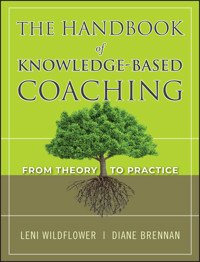
The Handbook of Knowledge-Based Coaching E-Book
90,99 €
Mehr erfahren.
- Herausgeber: John Wiley & Sons
- Kategorie: Fachliteratur
- Sprache: Englisch
PRAISE FOR THE HANDBOOK OF KNOWLEDGE-BASED COACHING
“Definitive, with extensive references and a commitment to connecting theory to practice in every chapter, this important contribution is a delicious and wide-ranging exploration of the lineages that have shaped the modern practice of coaching.”
—Doug Silsbee, author, Presence-Based Coaching and The Mindful Coach
“The translation of theories from multiple disciplines to the practice of coaching makes this book a must-read!”
—Terrence E. Maltbia, senior lecturer, Adult Learning and Leadership; and faculty director, Columbia Coaching Certification Program, Teachers College, Columbia University
“If you have an appetite for the scientific roots of what works best in coaching, and you are hungry for an easy-to-digest translation of the science to practice, this book is a feast and will be on your plate for many years to come.”
—Margaret Moore (Coach Meg), founder and CEO, Wellcoaches Corporation; and codirector, Institute of Coaching, McLean Hospital, Harvard Medical School
“Whether you’re a beginner or an experienced coach, this rollicking ride through dozens of the most important theories and perspectives in coaching will be a vital companion. With quick and helpful summaries of key ideas and their use—and selective bibliographies should you wish to go deeper into a particular area—this book will help you support your clients in a targeted and sophisticated way.”
—Jennifer Garvey Berger, author, Changing on the Job: Growing the Leaders Our Organizations Need; and coeditor, Executive Coaching: Practices and Perspectives
“This is a book I have been missing. What a pleasure to read and what a stretching of my mind.”
—Kim Gørtz, senior consultant, Copenhagen Coaching Center
“Anyone who is serious about improving the quality of coaching will find The Handbook an invaluable resource that reflects the breadth and richness of the growing evidence-based approach to coaching practice.”
—David Clutterbuck, visiting professor in the coaching and mentoring faculties, Oxford Brookes and Sheffield Hallam Universities
Sie lesen das E-Book in den Legimi-Apps auf:
Seitenzahl: 614
Veröffentlichungsjahr: 2011
Ähnliche




















Table of Contents
Cover
Title page
Copyright page
Series page
Dedication
PREFACE: FROM THEORY TO PRACTICE
ACKNOWLEDGMENTS
PART ONE: Human Behavior and Coaching
chapter ONE Humanistic and Transpersonal Psychology
CARL ROGERS AND THE CLIENT-CENTERED APPROACH
FRITZ PERLS AND GESTALT THERAPY
ABRAHAM MASLOW AND SELF-ACTUALIZATION
STANISLAV GROF, ROBERTO ASSAGIOLI, AND TRANSPERSONAL PSYCHOLOGY
chapter TWO Cognitive Behavioral Therapy and Related Theories
COGNITIVE BEHAVIORAL THERAPY AND AARON BECK
CBT APPLIED TO THE CONCEPT OF FEELING GOOD: DAVID BURNS
RATIONAL EMOTIVE BEHAVIORAL THERAPY AND ALBERT ELLIS
SOCIAL LEARNING THEORY: ALBERT BANDURA
COGNITIVE BEHAVIORAL COACHING
chapter THREE Positive Psychology
POSITIVE PSYCHOLOGY AND MARTIN SELIGMAN
THE BROADEN-AND-BUILD THEORY AND BARBARA FREDRICKSON
REIVICH, SHATTE, AND RESILIENCE
STRENGTHS THROUGH VIA (VALUES IN ACTION)
CSIKSZENTMIHALYI AND THE CONCEPT OF FLOW
chapter FOUR Transactional Analysis
EGO STATES
TRANSACTIONS
STROKES
LIFE SCRIPTS
LIFE POSITIONS
INJUNCTIONS
COUNTERINJUNCTIONS AND DRIVERS
FITTING THE WORLD TO OUR SCRIPT: DISCOUNTING
JUSTIFYING OUR SCRIPT: GAMES
chapter FIVE Adult Development
THE MIDLIFE EXPERIENCE AND CARL JUNG
ADULT DEVELOPMENT AS A SERIES OF STAGES CHARACTERIZED BY TASKS AND CONTRADICTIONS: ERIC ERIKSON AND GEORGE VAILLANT
STAGE DEVELOPMENT AND MIDLIFE ISSUES: DANIEL LEVINSON
INCREASED COMPLEXITY OF MEANING MAKING: ROBERT KEGAN
DEVELOPMENT AND AWARENESS: STEVEN AXELROD
DEVELOPMENT, CONSCIOUSNESS, AND INTEGRAL STUDIES: KEN WILBER
chapter SIX Theories of Intelligence
THEORY OF MULTIPLE INTELLIGENCES: HOWARD GARDNER
EMOTIONAL INTELLIGENCE: DANIEL GOLEMAN
SOCIAL INTELLIGENCE: KARL ALBRECHT
TRIARCHIC THEORY OF INTELLIGENCE: ROBERT STERNBERG
chapter SEVEN Neuroscience
PEOPLE HAVE CHOICES: HENRY STAPP
ATTENTION CHANGES THE BRAIN—AT ANY AGE
THE SOCIAL BRAIN: LESLIE BROTHERS
PART TWO: Human Interaction and Coaching
chapter EIGHT Theories of Adult Learning
ANDRAGOGY: MALCOLM KNOWLES
TRANSFORMATIONAL LEARNING: JACK MEZIROW
LEARNING STYLES: DAVID KOLB, PETER HONEY, AND ALAN MUMFORD
REFLECTIVE LEARNING: GILLIE BOLTON
chapter NINE Social Constructionism
SOCIAL CONSTRUCTIONISM AND COMMUNALLY CREATED KNOWLEDGE
IDENTITY, RELATIONSHIP, AND SOCIAL CONSTRUCTIONISM
LANGUAGE, NARRATIVE, AND SOCIAL CONSTRUCTIONISM
chapter TEN Theories of Change
THE TRANSTHEORETICAL MODEL OF CHANGE: PROCHASKA AND DICLEMENTE
MOTIVATIONAL INTERVIEWING: WILLIAM MILLER
WILLIAM BRIDGES: TRANSITIONS IN ADULTHOOD
IMMUNITY TO CHANGE: ROBERT KEGAN AND LISA LAHEY
chapter ELEVEN Communication Theory
DIALOGUE: MARTIN BUBER
COLLABORATIVE LANGUAGE SYSTEMS: HARLENE ANDERSON
DIALOGUE FROM A COMMUNICATION PERSPECTIVE: PEARCE AND CRONEN
CONVERSATIONAL STYLE THEORIES: DEBORAH TANNEN
chapter TWELVE Conflict Management
UNDERSTANDING CONFLICT
PRINCIPLED NEGOTIATION AND ALTERNATIVE DISPUTE RESOLUTION
CONFLICT COACHING
chapter THIRTEEN Systems Theory and Family Systems Therapy
ASSUMPTIONS OF FAMILY SYSTEMS THERAPY
MURRAY BOWEN AND BOWENIAN FAMILY THERAPY
STRUCTURAL FAMILY SYSTEMS MODEL: SALVADOR MINUCHIN
INTERNAL FAMILY SYSTEMS MODEL: RICHARD C. SCHWARTZ
chapter FOURTEEN Transition and Career Management
THE NEED FOR CHANGE
ELIZABETH KÜBLER-ROSS AND CHANGE
THEORY OF TRANSITION: WILLIAM BRIDGES
IDENTIFYING LIFE PURPOSE: VIKTOR FRANKL
THE USE OF “FLOW”: CSIKSZENTMIHALYI
CREATING YOUR PERSONAL BRAND
PART THREE: Organizations, Leadership, and Coaching
chapter FIFTEEN Leadership
CHARACTERISTICS AND ROLE MODELS FOR LEADERSHIP: DRUCKER, BENNIS, COLLINS, AND WHEATLEY
LEADERSHIP STYLES AND GETTING RESULTS: GOLEMAN
BEST PRACTICES OF EXEMPLARY LEADERSHIP: KOUZES AND POSNER
LEADERSHIP FROM THE BALCONY: HEIFETZ AND LINSKY
chapter SIXTEEN Organizations and Organizational Culture
ORGANIZATIONAL STRUCTURE
ORGANIZATIONAL CULTURE: SCHEIN
ORGANIZATIONAL SYSTEMS: HANDY, WHEATLEY, MORGAN, AND SENGE
ORGANIZATIONAL LEARNING AND SYSTEMS THINKING: ARGYRIS, SCHÖN, SENGE, NONAKA, AND TAKEUCHI
chapter SEVENTEEN Team and Group Behavior
A FRAMEWORK FOR UNDERSTANDING THEORIES OF SMALL GROUPS AND TEAMS: WHAT, HOW, AND WHEN
GROUP TASK PERSPECTIVE: WHAT THE GROUP DOES
GROUP PROCESS AND DYNAMICS PERSPECTIVE: HOW THE GROUP OPERATES AND INTERACTS
GROUP DEVELOPMENT: HOW THE GROUP DEVELOPS OVER TIME
chapter EIGHTEEN Situational and Contextual Issues in the Workplace
COACHING AND PERFORMANCE MANAGEMENT
COACHING AND ORGANIZATIONAL CHANGE
COACHING FOR LEADERSHIP ASSIMILATION
PART FOUR: Traditions from Self-Help, Personal Growth, and Spirituality
chapter NINETEEN Spiritual and Religious Traditions
DESIRE, FEAR, SELF-BELIEFS, AND THEIR RELATIONSHIP TO SPIRITUALITY
JAMES FOWLER: STAGES OF FAITH
CONTEMPLATIVE SPIRITUAL PRACTICES OF THE WORLD’S RELIGIONS
UNIVERSAL SPIRITUAL PRINCIPLES AND PRACTICES
chapter TWENTY The Self-Help and Human Potential Movements
LANDMARK EDUCATION
TIM GALLWEY: THE INNER GAME
JOHN GRINDER AND RICHARD BANDLER: NEURO-LINGUISTIC PROGRAMMING
BILL WILSON AND BOB SMITH: ALCOHOLICS ANONYMOUS
chapter TWENTY-ONE Mindfulness
ATTENTION, PURPOSE, AND NONJUDGMENT: JON KABAT-ZINN
MINDFULNESS AND ATTUNEMENT WITH OTHERS: DANIEL SIEGEL
REFLECTIVE PRACTICE: DONALD SCHÖN
MINDFUL REFLECTION AND CHANGING HABITS OF PRACTICE
PART FIVE: Coaching Specific Populations
chapter TWENTY-TWO Education
COMBINING COACHING AND STAFF TRAINING
COACHING APPROACHES IN EDUCATION
COGNITIVE AND INSTRUCTIONAL COACHING
STRATEGIES FOR SUSTAINABILITY
POTENTIAL IMPACT OF SCHOOL CULTURE ON COACHING
IMMUNITY TO CHANGE: ROBERT KEGAN AND LISA LAHEY
chapter TWENTY-THREE Issues of Aging
NEW MODELS OF AGING
AWARENESS OF THE AGING PROCESS
ACTIVITY
AFFILIATION
ATTITUDE: POSITIVE AGING
chapter TWENTY-FOUR Culture and Cultural Intelligence
DIMENSIONS OF CULTURAL DIFFERENCES: HOFSTEDE
CULTURAL INTELLIGENCE: GOLEMAN
CULTURAL DIFFERENCES: TROMPENAARS AND HAMPDEN-TURNER
CROSS-CULTURAL MANAGEMENT: SCHWABENLAND, SACKMANN, AND PHILLIPS
GLOBAL NOMADIC LEADERS: BURRUS
chapter TWENTY-FIVE Issues of Gender
GENDER AND DEVELOPMENT OF MORALITY: CAROL GILLIGAN
GENDER AND WORK-LIFE BALANCE: ARLIE RUSSELL HOCHSCHILD
GENDER AND CONVERSATIONAL STYLES: DEBORAH TANNEN
GENDER AND FEMALE LEADERSHIP: SALLY HELGESEN
GENDER AND HIGH-ACHIEVING WOMEN AT MIDLIFE: CONNIE GERSICK AND KATHY KRAM
chapter TWENTY-SIX Environmental Sustainability
THE ECOLOGICAL FOOTPRINT
THE NATURAL STEP
NATURAL CAPITALISM
INDUSTRIAL ECOLOGY
CRADLE-TO-CRADLE
BIOMIMICRY
PART SIX: Creative Applications
chapter TWENTY-SEVEN Coaching and the Body
LEGITIMACY OF THE FELT EXPERIENCE
SOMATIC COACHING AND THE PIONEERS
ONTOLOGICAL COACHING: JULIO OLALLA
chapter TWENTY-EIGHT A Narrative Approach to Coaching
FOUNDATIONS OF NARRATIVE COACHING
NARRATIVE IDENTITY IN COACHING
NARRATIVE SKILLS IN COACHING: LISTENING FOR THE WHOLE STORY
chapter TWENTY-NINE Solution-Focused Coaching and the GROW Model
SOLUTION-FOCUSED BRIEF COACHING
THE GROW MODEL
chapter THIRTY Appreciative Inquiry
UNDERLYING CONCEPTS
FIVE AI PRINCIPLES
SOCIAL CONSTRUCTIONISM: BERGER AND LUCKMANN
HOLISTIC VIEW OF TIME
FOUR AI STAGES
PART SEVEN: Components of Effective Coaching
chapter THIRTY-ONE Coach Maturity: An Emerging Concept
OBSERVATIONS ABOUT COACHES AND COACHING
MIND-SETS AND MODELS
CHARACTERISTICS OF A SYSTEMIC ECLECTIC COACH
BECOMING A SYSTEMIC ECLECTIC COACH
chapter THIRTY-TWO Use of Assessments in Coaching
WHY CONDUCT ASSESSMENTS?
WHICH ASSESSMENTS, AND WHEN?
WHO SHOULD BE ASSESSED, AND HOW?
REVIEW OF ASSESSMENTS
chapter THIRTY-THREE Current Research on Coaching
PRACTICE, PRACTITIONERS, AND THE INDUSTRY
COACHING IMPACTS AND OUTCOMES
SPECIAL POPULATION NEEDS AND IMPLICATIONS FOR COACHING
THEORETICAL COACHING MODELS
Afterword: Challenges Ahead
REFERENCES
THE EDITORS
THE CONTRIBUTORS
Name Index
Subject Index
Copyright © 2011 by John Wiley & Sons, Inc. All rights reserved.
Published by Jossey-Bass
A Wiley Imprint
989 Market Street, San Francisco, CA 94103-1741—www.josseybass.com
No part of this publication may be reproduced, stored in a retrieval system, or transmitted in any form or by any means, electronic, mechanical, photocopying, recording, scanning, or otherwise, except as permitted under Section 107 or 108 of the 1976 United States Copyright Act, without either the prior written permission of the publisher, or authorization through payment of the appropriate per-copy fee to the Copyright Clearance Center, Inc., 222 Rosewood Drive, Danvers, MA 01923, 978-750-8400, fax 978-646-8600, or on the Web at www.copyright.com. Requests to the publisher for permission should be addressed to the Permissions Department, John Wiley & Sons, Inc., 111 River Street, Hoboken, NJ 07030, 201-748-6011, fax 201-748-6008, or online at www.wiley.com/go/permissions.
Readers should be aware that Internet Web sites offered as citations and/or sources for further information may have changed or disappeared between the time this was written and when it is read.
Limit of Liability/Disclaimer of Warranty: While the publisher and author have used their best efforts in preparing this book, they make no representations or warranties with respect to the accuracy or completeness of the contents of this book and specifically disclaim any implied warranties of merchantability or fitness for a particular purpose. No warranty may be created or extended by sales representatives or written sales materials. The advice and strategies contained herein may not be suitable for your situation. You should consult with a professional where appropriate. Neither the publisher nor author shall be liable for any loss of profit or any other commercial damages, including but not limited to special, incidental, consequential, or other damages.
Jossey-Bass books and products are available through most bookstores. To contact Jossey-Bass directly call our Customer Care Department within the U.S. at 800-956-7739, outside the U.S. at 317-572-3986, or fax 317-572-4002.
Jossey-Bass also publishes its books in a variety of electronic formats. Some content that appears in print may not be available in electronic books.
Library of Congress Cataloging-in-Publication Data
The handbook of knowledge-based coaching: from theory to practice / [edited by] Leni Wildflower and Diane Brennan.
p. cm.
Includes bibliographical references and index.
ISBN 978-0-470-62444-9 (hardback); ISBN 978-1-118-03336-4 (ebk); 978-1-118-03337-1 (ebk); 978-1-118-03338-8 (ebk)
1. Executive coaching. I. Wildflower, Leni. II. Brennan, Diane.
HD30.4.H3497 2011
658.3'124—dc22
2011011134
The Jossey-Bass
Business & Management Series
To all those who take the risk of changing their careers to be of service to others through coaching
PREFACE
FROM THEORY TO PRACTICE
As coaches we have responsibilities: to master the skills of our trade, to work on the issues in ourselves that might obstruct or distort our dealings with clients, to be ethical, to acknowledge limitations and recognize boundaries, to justify the trust clients put in us. We also have a responsibility to understand the intellectual underpinnings of our fledgling profession.
Some of us have an instinctive ability to draw people toward greater insight; some of us have to work at it. But we all need to understand what we do when we coach, to recognize that coaching has not sprung fully formed from the protocols of our coaching schools or the minds of individuals, however dynamic and innovative, but has grown from a rich tilth of wisdom and study.
Some of this knowledge is the direct history of coaching. Much of it could be thought of as coaching’s prehistory—ideas developed in entirely independent fields before coaching in its modern sense was conceived of. But far from dry or dutiful, these explorations have the power to continually reignite our sense of coaching as a living practice.
In each of the chapters that follow there is a progression from theory to application, studying first a model or a set of findings in the context of a particular discipline and then identifying the implications for the practicing coach. There is a mind-opening diversity in this, but also a striking unanimity. Coaching may derive from the confluence of many rivers, but it flows with its own powerful current.
Leni Wildflower
Diane Brennan
ACKNOWLEDGMENTS
To the students and alumni of the Fielding Graduate University Evidence-Based Coaching Certificate Program: your enthusiasm for our program—the curiosity and idealism with which you responded to its mix of theory and practice—inspired us to take this book forward.
To the Fielding Graduate University Human and Organizational Development Program (HOD), particularly Judy Stevens-Long, who championed the Coaching Certificate Program in the crucial planning stage, and Dean Charles McClintock and Associate Dean Katrina Rogers, who oversaw its inception and continue to nurture it: you gave us the support and encouragement to make this book possible.
To our Wiley publishers and especially senior editor Kathe Sweeney: we owe much to you for believing in us.
To our many contributing authors: thank you for your time, your energy, and your patience, and for the wonderful range of knowledge and insight you have brought to this project.
To our husbands and kids—Joe, Jesse, Bill, and Ashley: thank you for putting up with our late nights, early mornings, and endless phone calls, and our long preoccupation with this enterprise.
To Joe Treasure, our writing coach: you challenged and inspired us to keep working toward greater clarity of thought and expression, and to discover a way to create a unique coaching book.
PART ONE: Human Behavior and Coaching
In its adolescent phase, coaching was sometimes reluctant to acknowledge its parents.
There was a concern to establish the independence of this new activity, to assert the particular limits and possibilities of what we were doing, which expressed itself in a tendency to define coaching by what it was not—obviously not consulting and not exactly mentoring either, but above all not therapy or counseling or any form of psychology-in-practice.
No doubt there was an element of insecurity in these negative definitions, a fear of being overshadowed or subsumed, a suspicion that the connection was, at times, too close for comfort. But there was also a legitimate concern. Coaching did have something new and distinct to offer, and it was important to establish its separateness.
Now, from a position of relative maturity, the profession can more freely recognize and embrace its origins. It is clear that coaching draws on and fulfills some of the essential premises of humanistic and positive psychology, beginning with an assumption not of sickness but of well-being and aspiring not merely to remedy but to transform. It leans on the concept of adult development. It builds on the idea that there is a cyclical relationship between cognition and behavior.
These connections are not merely historical. The relationship between coaching and psychology is dynamic. We continue to draw on research from psychology, neuroscience, and other related fields; such knowledge is not the exclusive territory of the specialist, any more than mathematical knowledge is to be used only by mathematicians.
As coaches, we take from psychology the essential understanding that we humans are more alike than not, with similar needs and fears and impulses, and we find this recognition liberating and life-enhancing. And we recognize that while our work with clients is pragmatic and forward looking, we should not be frightened of the kinds of personal issues that have traditionally been considered the domain of psychologists.
chapter ONE
Humanistic and Transpersonal Psychology
Alison Whybrow and Leni Wildflower
Psychology provides the primary theoretical underpinning to the theory and practice of coaching. The theories of humanistic psychology and Carl Rogers (1961) have formed the basis for many of the skills and assumptions used today in the coaching engagement. Coaching has also been significantly influenced by the psychological theories of Fritz Perls (Perls, Hefferline, & Goodman, 1994) and Gestalt therapy; Abraham Maslow’s work on self-actualization and peak experiences (1968); and Stanislav Grof (2000), Roberto Assagioli (2007), and transpersonal psychology.
CARL ROGERS AND THE CLIENT-CENTERED APPROACH
There is probably no single person more responsible for shifting psychology from a pathological, childhood-focused Freudian orientation to a present-day, positive orientation than Carl Rogers. A clinical psychologist with a PhD from Columbia University, Rogers began developing client-centered or nondirective therapy in the 1940s. He opposed the assumption that the therapist knows more than the client or has a more informed understanding of the client’s problem, and should therefore direct the progress of the therapeutic engagement. He objected not only to explicit forms of direction, such as offering a diagnosis or giving advice, but also to more subtle forms of control, such as asking direct questions.
Rogers took issue with the psychoanalytic and behaviorist approaches that were dominant at the time. Neither seemed to offer a particularly optimistic or noble vision of the human predicament. Both could be seen to fragment and diminish the wholeness of the individual. Freud, the founder of psychoanalysis, had emphasized unconscious motivation, often destructive or antisocial in nature; the inevitability of deep internal conflict; and the search for early trauma as an explanation of adult dysfunction. Behaviorism, which had grown out of Ivan Pavlov’s study of the conditioned reflex, also put the focus on impulses and patterns of behavior beyond conscious control. From these perspectives, the individual is a stranger to herself. Certainly Jung, Freud’s chosen successor, had allotted a more positive and creative role to the hidden regions of the mind, envisioning in the collective unconscious and the archetypes that inhabit it an ancient repository of shared wisdom. But the dominant view among Rogers’s contemporaries was of the unconscious as a dangerous and disturbing terrain to be explored only with the guidance of a professional.
In contrast, Rogers argued that given a healthy therapeutic environment, people can be trusted to understand and resolve their own problems, that they are naturally inclined toward what is good for them, and that they have a huge capacity for positive growth. Rogers’s work rested on several critical principles. To establish the right kind of environment, the therapist must first of all be genuine in his relationship with the client. In a word favored by the existentialists (a significant influence on Rogers’s thinking), the therapist must be authentic. Rogers saw no place for the kind of professional façade designed to preserve the therapist’s detachment, anonymity, or authority. It follows that the therapist might find it appropriate at times to disclose thoughts or feelings of his own. Just as important, there is no place for judgment. The therapist must communicate unconditional positive regard for the client, who should feel genuinely accepted and valued.
Within this relationship, the essential work of the therapist is to listen attentively to the client to understand the world as the client experiences it. This listening must be not only empathetic but accurate: the therapist should be willing to check that he has understood correctly. He must be sensitive to implied meanings as well as explicit ones, and to feelings and thoughts not fully grasped by the client. The purpose of client-centered therapy is to enable the client to become more open to experience, to develop greater trust in herself, and to continue to grow, pursuing goals of her own choosing. This development of a stronger and healthier sense of self is sometimes referred to as “self-actualization.” Rogerian therapy imposes no particular structure and is not based on a set of techniques, but is highly dependent on the nature of the relationship the therapist establishes with the client, a relationship in which the therapist must be present in the most profound sense.
In the late 1950s, Rogers began working with other theorists and practitioners interested in promoting a more holistic approach to psychology, including Abraham Maslow. This led to the formation in 1961 of the Association for Humanistic Psychology, and it became possible for humanistic psychology to be identified as a “third force” in psychology after psychoanalysis and behaviorism.
Coaching clearly owes a great deal to client-centered therapy in its emphasis on treating the client with respect, trusting her instinct for what she needs, and allowing her to take the lead in shaping the purpose and direction of the process. It was important in its time as a corrective to what some have experienced as the disempowering experience of more traditional forms of psychotherapy. Perhaps its major drawback is that it does not allow any mechanism for feedback to assist the essentially healthy client in correcting unhelpful or dysfunctional behaviors.
Coaching Applications
Establish collaboration as the basis for the coaching relationship. It is your responsibility to actively engage your client in dialogue with such questions as What would you like to work on today?Practice empathetic listening. Attend carefully to your client’s experience, imagine that you are in her shoes, ask for clarification, and communicate to her your understanding of her situation.Communicate to the client that he has the knowledge, emotional strength, and personal power to make the changes he desires. Use his experience and understanding as the basis for your work together.Work to create a relationship with your client that is caring and mutually respectful. This relationship is fundamental to the success of the coaching endeavor. Metastudies in psychotherapy have demonstrated that it is the relationship, not necessarily the type of therapeutic intervention used, that produces a positive experience and growth. The same is almost certainly true of coaching.Be authentic in the coaching relationship. Be yourself. Give open and honest feedback to the client to support her exploration and learning. At the same time, value her without judgment wherever she finds herself in life. This is what it means to hold her in “unconditional positive regard” and is fundamental to your role in empowering her to change.FRITZ PERLS AND GESTALT THERAPY
Approximately translated, gestalt is German for “form.” Gestalt therapy was founded in the 1940s by Fritz and Laura Perls. Rooted in the idea that the mind has a capacity to see things in their wholeness and to construct forms out of fragmentary information, it is concerned with helping the individual observe herself in the broader context of a web, or field, of relationships. It can be seen as a process of experimentation and observation. In contrast to a tradition of experimental psychology that has tended, on the model of the physical sciences, to break things down into their component parts, the Gestalt approach is essentially holistic.
The philosophy underlying Gestalt therapy is existentialist in its view that most people live in a state of self-deception, accepting conventional notions that obscure the reality of how the world is; that this leads to feelings of anxiety and guilt; and that to live authentically, people must continually rediscover and reinvent themselves. Therapists and clients engage in dialogue, with the aim of observing the process rather than its content. Dialogue is understood to include all forms of communication, such as body language and movement as well as speech. Perceptions, feelings, and actions are considered to be more reliable kinds of data than explanations or interpretations. Relationships experienced in the present moment, including that between therapist and client, are more immediately revealing as objects of study than what is merely reported, but external relationships can be effectively brought into the room and reexperienced.
During the session, the client will show behavior patterns that occur outside the session. Noticing these patterns will increase the client’s awareness of how she behaves in the world. This will enable her not only to accept and value herself as she is but also to change and grow and become more fully responsible. The role of the therapist is not to lead or direct the process and not to put theory or interpretation in the way, but to be present without judgment, modeling authentic dialogue.
Coaching Applications
Encourage self-observation so that your client is bothbeingin the moment andseeinghimself being in the moment. Create greater awareness by helping him notice any disconnect between what he is saying and the behavior he is exhibiting. Be conscious of subtleties of body language, tone of voice, and other nonverbal indicators.Be aware of the importance of cocreating a safe, open, and honest relationship with your client. A feeling of profound trust is essential if she is to feel safe exploring unacknowledged or unrecognized truths.In working with groups or teams, encourage awareness of what ishappeningin the group as opposed to what is spoken. In other words, shift the focus from the content of the conversation to the process.ABRAHAM MASLOW AND SELF-ACTUALIZATION
Abraham Maslow, along with Rogers and Perls, is considered one of the founders of the humanistic psychology movement. Among the contributions for which he is best known are his Hierarchy of Needs model and the concept of peak experiences. The needs Maslow identifies, starting with the most basic, are physiological needs (food, shelter, water, sleep, sex); need for safety and security; need for love and belonging; need for self-esteem and esteem by others; and self-actualization needs. Maslow defines self-actualization as a sense of knowing exactly who you are and where you are going, and the ability to enjoy a state of completeness and wholeness in life. According to Maslow, a self-actualized individual experiences play and work as similar, has an increased capacity for spontaneity, and an acceptance and expression of the inner core of self.
Self-actualization can be achieved intermittently in what Maslow calls peak experiences. These transient moments of self-actualization can occur at any time in life, though Maslow felt they were more likely to occur during adulthood. Peak experiences take us beyond our ordinary perceptions and provide a moment of transcendence. They are nonreligious, quasi-mystical experiences that might encompass a sudden feeling of intense happiness and well-being, a sense of wonder and awe, or fleeting moments of enlightenment.
At one point Maslow developed a set of qualities that characterized a self-actualized individual. Some of the qualities he posited included
An ability to see problems in terms of challenges and situations requiring solutions
A need for privacy; being comfortable with being alone
The reliance on one’s own judgment and experiences; not being influenced by social pressures
The ability to accept others as they are and not attempt to change people
Being comfortable with oneself, with a sense of humor about oneself and an ability to see others as completely separate from oneself
A sense of excitement and interest in everything
The capacity to be creative, inventive, and original
Coaching Applications
If appropriate, use Maslow’s Hierarchy of Needs model to help your client understand himself in terms of his needs, desires, and aspirations. Like the balance wheel (see Chapter Twenty-Five), Maslow’s hierarchical pyramid and definition of a self-actualized individual can be used as templates to give structure to an exploration of issues in your client’s life.Invite your client to consider the moments in her life when she has felt self-actualized. Think about appropriate ways of asking this question. When has she experienced a sense of acceptance, wholeness, or fulfillment; been at her most creative; realized her full potential? When has she been at one with herself, at peace with her work and her life? There are times when focusing on a peak experience from the past may help create a sense of possibility.STANISLAV GROF, ROBERTO ASSAGIOLI, AND TRANSPERSONAL PSYCHOLOGY
In the 1960s, Maslow’s study of peak experiences made a significant contribution to the emerging field of transpersonal psychology. Another leading figure was Stanislav Grof, who directed research at the Maryland Psychiatric Research Center and went on to become scholar-in-residence at the Esalen Institute in Big Sur, California (see Chapter Twenty). Grof became interested in what he identified as nonordinary states of consciousness, studying the impact of LSD on the mind, and later developing breathing techniques to achieve similar effects.
Transpersonal psychology explores states of consciousness that have been traditionally associated with mystical and spiritual experiences. Proponents of transpersonal psychology state that if these experiences can be accessed, they offer the potential for joy, insight, and healing. Whereas mainstream psychology has tended to marginalize these experiences or identify them as symptoms of mental illness, transpersonal psychology sees them as glimpses of a greater reality.
To this extent, the roots of transpersonal psychology can be traced to various religious traditions, particularly to eastern traditions that emphasize meditation and mindfulness. More immediate influences include Carl Jung, who envisaged a collective unconscious in which reside the archetypes of shared human experience. In addition, Roberto Assagioli, a friend and colleague of Carl Jung, worked on the concept, proposed by Jung, of psychosynthesis—a coming together of personal growth, personality integration, and self-actualization. His goal was a direct experience of the pure self at a spiritual level. Like Grof and Maslow, Assagioli researched the higher levels of human awareness.
The application of transpersonal psychology to coaching is less well established, although there are strong philosophical links between Gestalt and transpersonal approaches. In fact, Gestalt is often viewed as a transpersonal approach.
Coaching Applications
Listen to your client. What needs does he express? What needs is he not yet able to identify or ready to acknowledge?Be open to a view of life’s mystical dimension that you don’t happen to share. Your client may feel attuned to the transpersonal and the transcendent, or may think of herself as a rationalist and a skeptic. Whatever your own view, be responsive to hers.Additional Reading
Assagioli, R. (2007). Transpersonal development: The dimension beyond psychosynthesis. Findhorn, Scotland: Smiling Wisdom.
The most recently published book by Assagioli discussing his research into altered states.
Boeree, G. Personality theories: Abraham Maslow. Available on the Web at www.ship.edu/∼cgboeree/maslow.html.
Good and thorough introduction to Maslow’s theories and the concept of self-actualization and peak experiences.
Cox, E., Bachkirova, T., & Clutterbuck, D. (2010). The complete handbook of coaching. London: Sage.
An excellent overview of coaching theories in a more academic context, including a theoretical essay on transpersonal psychology.
Grof, S. (2000). Psychology of the future: Lessons from modern consciousness research. Albany: State University of New York Press.
Grof’s most recent book describing his research into consciousness. Helpful reading in this area.
Kirschenbaum, H., & Henderson, V. L. (Eds.). (1989). The Carl Rogers reader: Selections from the lifetime work of America’s preeminent psychologist, author of On Becoming a Person and A Way of Being. Boston: Houghton-Mifflin.
An excellent overview of Rogers’s life and work.
Leary-Joyce, J., & Allen, M. (2010). The Gestalt coaching handbook. Available on the Web at www.aoec.com.
An online publication that supports coaches in understanding the application of Gestalt to coaching.
Maslow, A. H. (1999). Toward a psychology of being (3rd. ed.). Hoboken, NJ: Wiley.
Maslow’s most well-known book on his theories and their application.
Perls, F. S. (1992). Gestalt therapy verbatim. Gouldsboro, ME: Gestalt Journal Press.
A collection of talks by Perls, originally published in 1969, with commentary. Gives a good sense of his dynamic personality.
Rogers, C. R. (1980). A way of being. Boston: Houghton-Mifflin.
Rogers’s classic text on self-actualization and how to facilitate this process.
chapter TWO
Cognitive Behavioral Therapy and Related Theories
Leni Wildflower
There is nothing either good or bad, but thinking makes it so.
—Hamlet, act 2 scene 2
Assume a virtue if you have it not. …
For use almost can change the stamp of nature.
—Hamlet, act 3 scene 4
In the midtwentieth century, mainstream therapeutic assumptions—that behavior is governed by feeling and that extensive reflection on the past is necessary for healing—were challenged by new cognitive and behavioral approaches. Cognitive behavioral therapy and the theories related to it can readily be adapted to certain coaching situations. They share with coaching an emphasis on attending cognitively to the issue at hand, a pragmatic interest in overcoming present and future limitations, and an immediate engagement with the world as a testing ground for better ways of functioning.
COGNITIVE BEHAVIORAL THERAPY AND AARON BECK
Aaron Beck trained as a psychoanalyst, but in the 1960s repudiated the Freudian emphasis on unconscious processes and developed cognitive therapy. He is considered the father of cognitive behavioral therapy (CBT). Instead of exploring the unconscious and delving into childhood experience to find the sources of unhappiness and dysfunction, CBT focuses on changing behavior. It is goal oriented and focused on the here and now. It emphasizes the role of thinking in the treatment of emotional and behavioral disorders, and operates on the premise that present-day changes in thoughts or behaviors can be highly effective in solving deep-seated emotional problems:
For a good part of their waking life, people monitor their thoughts, wishes, feelings and actions. Sometimes there is an internal debate as the individual weighs alternatives and courses of action and makes decisions. … Cognitive therapy consists of all the approaches that alleviate psychological distress through the medium of correcting faulty conceptions and self-signals. … By correcting erroneous beliefs, we can damp down or alter excessive, inappropriate emotional reactions.
(Beck, 1976)
CBT grew out of a merging of two rival approaches. Behavior therapy, popular in the 1950s, was rooted in research by John B. Watson and B. F. Skinner into behavior modification and in Ivan Pavlov’s work on conditioned stimulus response. It was challenged by cognitive psychologists, including Aaron Beck and Albert Ellis. For the behaviorists, the key factor in learning was the environment. Cognitive theory, in contrast, focused on the way the brain processes information—particularly in sorting it into long-term and short-term memory—and attributed more control to the individual learner. Behaviorism asserts that a change in behavior will alter one’s thinking, whereas in cognitive therapy the emphasis is on changing one’s thought patterns to bring about a change in behavior. In reality, thought and behavior influence each other, so that it is difficult to distinguish which comes first. Recent research indicates that maximum effectiveness in this approach is achieved when there are both cognitive and behavioral shifts.
Lesen Sie weiter in der vollständigen Ausgabe!
Lesen Sie weiter in der vollständigen Ausgabe!
Lesen Sie weiter in der vollständigen Ausgabe!
Lesen Sie weiter in der vollständigen Ausgabe!
Lesen Sie weiter in der vollständigen Ausgabe!
Lesen Sie weiter in der vollständigen Ausgabe!
Lesen Sie weiter in der vollständigen Ausgabe!
Lesen Sie weiter in der vollständigen Ausgabe!
Lesen Sie weiter in der vollständigen Ausgabe!
Lesen Sie weiter in der vollständigen Ausgabe!
Lesen Sie weiter in der vollständigen Ausgabe!
Lesen Sie weiter in der vollständigen Ausgabe!
Lesen Sie weiter in der vollständigen Ausgabe!
Lesen Sie weiter in der vollständigen Ausgabe!
Lesen Sie weiter in der vollständigen Ausgabe!
Lesen Sie weiter in der vollständigen Ausgabe!
Lesen Sie weiter in der vollständigen Ausgabe!
Lesen Sie weiter in der vollständigen Ausgabe!
Lesen Sie weiter in der vollständigen Ausgabe!
Lesen Sie weiter in der vollständigen Ausgabe!
Lesen Sie weiter in der vollständigen Ausgabe!
Lesen Sie weiter in der vollständigen Ausgabe!
Lesen Sie weiter in der vollständigen Ausgabe!
Lesen Sie weiter in der vollständigen Ausgabe!
Lesen Sie weiter in der vollständigen Ausgabe!
Lesen Sie weiter in der vollständigen Ausgabe!
Lesen Sie weiter in der vollständigen Ausgabe!
Lesen Sie weiter in der vollständigen Ausgabe!
Lesen Sie weiter in der vollständigen Ausgabe!
Lesen Sie weiter in der vollständigen Ausgabe!
Lesen Sie weiter in der vollständigen Ausgabe!
Lesen Sie weiter in der vollständigen Ausgabe!
Lesen Sie weiter in der vollständigen Ausgabe!
Lesen Sie weiter in der vollständigen Ausgabe!
Lesen Sie weiter in der vollständigen Ausgabe!
Lesen Sie weiter in der vollständigen Ausgabe!
Lesen Sie weiter in der vollständigen Ausgabe!
Lesen Sie weiter in der vollständigen Ausgabe!
Lesen Sie weiter in der vollständigen Ausgabe!
Lesen Sie weiter in der vollständigen Ausgabe!
Lesen Sie weiter in der vollständigen Ausgabe!
Lesen Sie weiter in der vollständigen Ausgabe!
Lesen Sie weiter in der vollständigen Ausgabe!




