


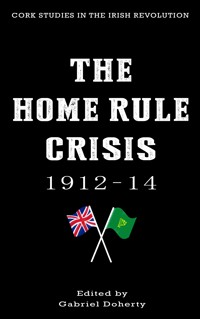
The Home Rule Crisis 1912–14 E-Book
Erhalten Sie Zugang zu diesem und mehr als 300000 Büchern ab EUR 5,99 monatlich.
- Herausgeber: Mercier Press
- Kategorie: Geisteswissenschaft
- Serie: Cork Studies in the Irish Revolution
- Sprache: Englisch
The Home Rule Bill, passed by the British parliament in 1912, was due, when it came into effect in 1914, to give Ireland some control over her own affairs for the first time since the Act of Union in 1800. However, this was postponed when the First World War broke out and by the time the war had ended the political landscape in Ireland had changed irrevocably. The nationalist movement split into the followers of John Redmond who chose to fight for the British in the war in the hope that their loyalty would be rewarded and those on the other side who felt that this was just a delaying tactic and that 'England's difficulty [was] Ireland's opportunity'. Meanwhile the Unionists were violently opposed to any form of Irish self government, believing that 'Home rule is Rome rule' and this led to the signing of the Ulster Covenant and the establishment of the Ulster Volunteers. The respected historians who have contributed to this book examine the reaction to the Home Rule Bill across many shades of political opinion across these islands and give a fascinating analysis of what might have been if external events had not overtaken local ones.
Sie lesen das E-Book in den Legimi-Apps auf:
Seitenzahl: 727
Veröffentlichungsjahr: 2014
Das E-Book (TTS) können Sie hören im Abo „Legimi Premium” in Legimi-Apps auf:
Ähnliche




















In memory of my parents Seán Doherty 1931–85 and Lena Doherty (née Kenny) 1929–2014
MERCIER PRESS
3B Oak House, Bessboro Rd
Blackrock, Cork, Ireland.
www.mercierpress.ie
http://twitter.com/IrishPublisher
http://www.facebook.com/mercier.press
© The individual contributors, 2014
ISBN: 978 1 78117 245 2
Epub ISBN: 978 1 78117 304 6
Mobi ISBN: 978 1 78117 305 3
This eBook is copyright material and must not be copied, reproduced, transferred, distributed, leased, licensed or publicly performed or used in any way except as specifically permitted in writing by the publishers, as allowed under the terms and conditions under which it was purchased or as strictly permitted by applicable copyright law. Any unauthorised distribution or use of this text may be a direct infringement of the author’s and publisher’s rights and those responsible may be liable in law accordingly.
Contents
Cork studies in the Irish revolution
Acknowledgements
List of Contributors
Introduction
The 1912 Home Rule bill: then and now
1 When histories collide: the third Home Rule bill for Ireland
2 The politics of comparison: the racialisation of Home Rule in British science, politics and print, 1886–1923
3 Literary provocateur: revival, revolt and the demise of the Irish Review, 1911–14
4 Liberal public discourse and the third Home Rule bill
5 Ulster ‘will not fight’: T. P. O’Connor and the third Home Rule bill crisis, 1912–14
6 Myopia or utopia? The discourse of Irish nationalist MPs and the Ulster question during the parliamentary debates of 1912–14
7 The All-for-Ireland League and the Home Rule debate, 1910–14
8 The Murnaghan memos: Catholic concerns with the third Home Rule bill, 1912
9 ‘Resigned to take the bill with its defects’: the Catholic Church and the third Home Rule bill
10 ‘Neither Whigs, Tories, nor party politicians’? The Church of Ireland and the Ulster crisis, 1910–14
11 Irish Presbyterians and the Ulster Covenant
12 ‘Grotesque proceedings’? Localised responses to the Home Rule question in Ulster
13 The Ulster Volunteer Force, 1913–14
14 The persistence of Liberal Unionism in Irish politics, 1886–1912
15 The role of the leaders: Asquith, Churchill, Balfour, Bonar Law, Carson and Redmond
16 The centenary commemoration of the third Home Rule crisis
17 The third Home Rule bill in British history
About the Author
About the Publisher
Cork studies in the Irish revolution
This is the first of a series of books that will appear over the coming decade. It contains, as will future volumes, the selected proceedings of conferences organised within University College Cork on the subject of the major events and developments that marked the ‘revolutionary decade’ in modern Irish history, 1912–23. Each volume will bring together young, up-and-coming scholars, senior figures within the Irish historical profession, and individuals outside that profession with valued perspectives on the period, with a view to conveying to the broader public the most up-to-date research on the event, events or theme covered by the volume.
The second volume in the series, on the 1913 Dublin Lockout and the more general cause of labour during the revolutionary decade, is scheduled to appear next, with the third, on Ireland and the First World War, to follow shortly thereafter. Further volumes – including (amongst others topics) examinations of the 1916 Rising, the international dimensions to the revolutionary decade, the War of Independence, partition and the Irish Civil War – will follow at approximately yearly intervals.
Acknowledgements
The editor wishes to thank the following individuals for their assistance either in the preparations for the original conference in University College Cork, or in the production of this volume:
University College Cork: President Michael Murphy, Vice-President & Registrar Paul Giller, Maria Carroll, Dara O’Shea, Louise Tobin, Ruth McDonnell, Sonya Kiely, the General Service operatives, Professor Caroline Fennell, Anne Marie Cooney, Charlotte Holland, Deirdre O’Sullivan, Geraldine McAllister, Maeve Barry, Sheila Cunneen, Dr Donal Ó Drisceoil, Dr John Borgonovo and Dr Andy Bielenberg.
Mercier Press: Mary Feehan, Sharon O’Donovan, Niamh Hatton, Patrick Dunphy, Sarah O’Flaherty and Wendy Logue.
Department of the Taoiseach: Jerry Kelleher.
Department of Foreign Affairs and Trade: Jennifer Whelan.
Department of Arts, Heritage and the Gaeltacht: John Kennedy, Sabina O’Donnell and Stephen Brophy.
The original conference was organised with the support of a grant from the Reconciliation/Anti-sectarianism fund of the Department of Foreign Affairs and Trade, and this volume has been produced with the support of a grant from the Department of Arts, Heritage and the Gaeltacht. The editor wishes to express his thanks to the ministers in question.
List of Contributors
Jonathan Bardon was born and educated in Dublin but has spent almost all of his adult life in Belfast, retiring from Queen’s University in 2008. His most recent book is The Plantation of Ulster (2011). His other publications include: Belfast: an illustrated history (1982); Dublin: a thousand years of Wood Quay (1984); A History of Ulster (1992, updated 2001); and A History of Ireland in 250 Episodes (2008). He has written historical documentaries for Channel 4 and the BBC, including 48 twenty-minute and 360 five-minute dramatised programmes on the history of Ireland for BBC Radio Ulster.
Tom Bartlett is professor of Irish history at the University of Aberdeen. He formerly worked at University College Dublin where he was professor of modern Irish history, and in the National University of Ireland, Galway. His most recent publication is Ireland: a history (Cambridge, 2010).
Eugenio Biagini is an alumnus of the Scuola Normale Superiore di Pisa and is currently professor of modern and contemporary history at the University of Cambridge and a college fellow of Sidney Sussex College. He first came to Sidney in 1985–6 as a visiting scholar, before becoming a junior research fellow at Churchill College, Cambridge, in 1987. Having spent two years in the Department of History of Newcastle University, he became an assistant professor of modern British history at Princeton. He came back to Cambridge, to Robinson College, in 1996, becoming a university lecturer in 1998, a reader in 2000 and a professor in 2011. He returned to Sidney in 2008. He has written on Gladstonian liberalism, the Italian Risorgimento and anti-fascism in the 1940s. His current research interests include various aspects of Irish and British history since the 1910s, with particular reference to democracy, civil rights and religious minorities.
Tim Bowman was born and raised in Bangor, County Down. He took his first degree from Queen’s University, Belfast in 1995 and completed his PhD in 1999, in the now sadly defunct Department of History at the University of Luton (now Bedfordshire) under the supervision of Professor Ian F. W. Beckett. He held lecturing posts at Queen’s University, Belfast, the University of Durham and King’s College London (based at the Joint Services Command and Staff College) before going to Kent in 2005. To date his research has considered aspects of the British Army in the Great War and the Ulster Volunteer Force of 1910–22. He is currently completing a co-authored book (with Professor Mark Connelly) concerning the Edwardian British Army and will then turn his attention to a co-authored work (with Professors Ian Beckett and Mark Connelly) concerning the British Army in the Great War. His next major research project will concern the Irish soldier in the British Army c. 1793–1968.
Kurt Bullock is an associate professor of English at Grand Valley State University, an institution of 25,000 students located in south-west Michigan. He teaches contemporary literature and theory, including undergraduate and graduate courses on Irish literature. His articles have appeared in New Hibernia Review and American Drama, among other journals.
Ian Cawood is head of history at Newman University College in Birmingham. He leads Newman’s undergraduate modules on modern British history as well as a fieldwork module focusing on the English cathedral. His research interests include the identity, culture and political structure of Liberal Unionism, 1886–1912, and regional history, including (but not exclusively) that of the English West Midlands. He is the author of The Liberal Unionist Party: a history (Ibtauris, 2012).
Dominick Chilcott went to school at St Joseph’s College, Ipswich (De La Salle brothers), spent a year in the Royal Navy as a midshipman, and read philosophy and theology in Oxford University. He is a career diplomat who joined the Foreign and Commonwealth Office thirty years ago. He has served as high commissioner to Sri Lanka and Maldives (2006–7), deputy ambassador to the United States (2008–11), ambassador to Iran (for six weeks only in late 2011 – the posting was ended by the attack on the embassy), and is now ambassador to Ireland. In addition to those postings, Dominick has served in Ankara (1985–8), Lisbon (1993–5) and at the UK’s mission to the European Union in Brussels (1998–2002). Between overseas assignments, he has worked in the Foreign and Commonwealth Office in London on European, African and Middle Eastern affairs. He has been a private secretary to two foreign secretaries, Sir Malcolm Rifkind and the late Robin Cook. He was director of the Iran Policy Unit in 2003 and director for bilateral relations with European countries from 2003 to 2006.
Pauline Collombier-Lakeman was awarded her PhD on the topic of Le discours des leaders du nationalisme constitutionnel irlandais sur l’autonomie de l’Irlande: utopies politiques et mythes identitaires from the Université Paris 3 – Sorbonne Nouvelle in 2007. Her current research work is focused on the relationship between Ireland and the British Empire. She has taught nineteenth- and twentieth-century history of the British Isles as well as English language at the following universities: Paris 3, Le Mans, Nantes and lately Strasbourg, where she was appointed maître de conférences (lecturer) in 2009. Recent publications include ‘Ireland and the empire: the ambivalence of Irish constitutional nationalism’, Radical History Review, no. 104 (2009), pp. 57–76.
Erica S. Doherty is a third-year PhD student in history at Queen’s University, Belfast.
Gabriel Doherty is a college lecturer in modern Irish history in the School of History, University College Cork.
James Doherty is a second-year PhD student at the University of Southampton. The title of his thesis is ‘The Liberals and the Irish Parliamentary Party, 1910–14’.
Laurence Kirkpatrick is Professor of Church History in the Institute of Theology at Queen’s University, Belfast. His specialist research covers several areas of church history, ranging from the Patristic era to the present century. He has conducted field research in China and India relating to Irish Presbyterian missions, in Manchuria and Gujarat respectively. He has also researched nineteenth-century Presbyterian activity in Connacht and First World War battlefields. His publications include Presbyterians in Ireland (Booklink, 2006) and Made in China – but not as you know it (Manleys, 2008), and he was a co-editor of John Calvin: reflections of a reformer (Union, 2009). He has contributed to numerous television documentaries and was historical consultant to the acclaimed ‘An independent people’, the BBC Northern Ireland series on Irish Presbyterianism first broadcast in 2013.
Martin Mansergh spent seven years in the Departments of Foreign Affairs and the Taoiseach before resigning in 1981 to take up the position of political and Northern Ireland advisor to the then leader of Fianna Fáil, Charles Haughey (a position he subsequently held under Albert Reynolds and Bertie Ahern). The son of prominent historian Nicholas Mansergh, he is a distinguished historian in his own right, having published on a wide variety of topics relating, in particular, to modern Irish history. He is currently a member of the Government’s Advisory Group on Commemorations.
Conor Mulvagh has recently completed a PhD entitled ‘Sit, act, and vote: the political evolution of the Irish Parliamentary Party at Westminster, 1900–1918’ under the supervision of Professors Diarmaid Ferriter and Michael Laffan. He completed an MPhil in modern Irish history (Trinity College Dublin) in 2008, where his thesis considered the interactions between John Redmond and the Roman Catholic hierarchy. He currently lectures on Northern Nationalism (1920–1998) and the 1916 Rising at University College Dublin. His research interests include constitutional nationalism, the Irish Volunteers, the Ulster crisis and partition, and the organisation of political parties.
Daithí Ó Corráin is a lecturer in history at St Patrick’s College, Drumcondra (a college of Dublin City University). He has undertaken extensive research in the following areas: Irish political violence; the Irish revolution, 1912–23; north–south relations; the Northern Ireland troubles; church–state relations; Ireland in the 1950s and 1960s; and ecumenism. He is the author of Rendering to God and Caesar: the Irish churches and the two states in Ireland, 1949–73 (Manchester, 2006) and co-author (with Eunan O’Halpin) of The Dead of the Irish Revolution, 1916–21, which will be published by Yale University Press. He is editor, with Professor Marian Lyons (National University of Ireland, Maynooth), of the ‘Irish Revolution, 1912–23’ series, published by Four Courts Press. The first volume, on Sligo, was published in November 2012. He is currently working on a history of the Irish Volunteers from 1913 to 1918.
John O’Donovan completed his master’s thesis at University College Cork on ‘William O’Brien and the United Irish League in Cork’ in 2012. His major research interests include Cork 1890–1912, the life and career of D. D. Sheehan, the United Irish League, the All-for-Ireland League and Irish nationalism 1890–1922. His publications include ‘Political violence in Cork 1910: case studies of riots in Newmarket and Bantry’, History Studies, vol. 12 (2011); ‘Nationalist political conflict in Cork, 1910’, Journal of the Cork Historical and Archaeological Society, vol. 117 (2012); and ‘D. D. Sheehan and the rural labour movement in Cork, 1894–1910’ in the forthcoming edited collection Irish Agrarian Radicals, c. 1850–1930.
Andrew Scholes studied at Queen’s University, Belfast, completing a BA in history and theology in 2003 and an MA in Irish history in 2004. His research interests are focused on late nineteenth- and twentieth-century British and Irish political and religious history. He is the author of The Church of Ireland and the Third Home Rule Bill (Dublin, 2009).
Matthew Schownir is a graduate student of Purdue University, Lafayette, Indiana, USA.
Introduction
The crisis that followed the introduction of the third Home Rule bill at Westminster on 11 April 1912 was a defining one in both British and Irish history. For decades, however, it has been, at best, on the periphery of the collective memory of the events of the early twentieth century of both peoples. The reasons for this are not hard to find. In Britain the cataclysm of the First World War tended to eclipse the other seminal events that were occurring at that time – including the demand for the extension of suffrage to women, the industrial unrest of the pre-war period and the post-war rise of the Labour Party at the expense of the Liberals – before, in turn, being virtually erased from popular remembrance and being replaced by the apparently ‘good war’ of 1939–45. In Ireland most historically minded citizens found the 1916 Rising, the subsequent rise of republicanism and the collapse of the Home Rule cause in the 1918 general election, the War of Independence, partition, Treaty split and Civil War more than enough to digest, and by degrees the events of 1912–14 ebbed to a point where, for most people, they reposed in obscurity, if not entirely in peace.
If there is a theme running throughout the diverse collection of essays in this volume, it is that this collective amnesia was unfortunate (for many reasons), is to be regretted and, where possible, should be corrected – for what happened in these islands between 1912 and 1914 was a series of political seismic shocks that will forever register high on the Irish and British historical Richter scales. The almost daily confluence of dramatic developments experienced during these years simply has not happened very often over the centuries, and if, in this case, what was seldom may not have been entirely wonderful, it was certainly important – very important.
It was in recognition of this significance that the School of History, University College Cork, as part of its broader programme of events designed to mark the revolutionary decade in modern Irish history, convened a major public conference in the university in October 2012. Over the two days of the event approximately 200 academics and members of the public heard and discussed, in formal session and in informal discussions, manifold aspects of the crisis over the Home Rule bill. At the end of the programme the overwhelming consensus among all participants – speakers and audience members alike – was that the proceedings should be published. To that end selected participants in the symposium were given an opportunity, on the basis of the discussions at the conference, to refine their ideas before submission of their final texts. The resulting volume is one that contains a multiplicity of views on the third Home Rule crisis, some of them, as one would expect, at odds with each other. There is no single ‘line’ or interpretation evident here, no over-arching ‘meta-narrative’, save, perhaps, a refusal to be unduly influenced by the subsequent development of the ‘Irish’ and ‘Ulster’ questions – matters to which the attention of future conferences and volumes in the series will be directed. In the meantime, I trust that the reader shall have as much pleasure in reading the various papers as I have had in collating and editing them.
Gabriel Doherty
School of History
University College Cork
Opening Address to the Conference, 19 October 2012
The 1912 Home Rule bill: then and now
Dominick Chilcott
I applaud the vision of the School of History, University College Cork, in organising this conference. It seems exactly right, for reasons on which I intend to elaborate further, that the events that form its theme should be held up to the light of objective, modern scholarship and re-evaluated. The Minister of Justice, Equality and Defence, Alan Shatter, put it very well in his statement to the Dáil, earlier this year, announcing the pardon for Irish soldiers who had deserted their posts in order to join the Allies to fight against Nazi Germany in the Second World War. Mr Shatter said that in the time since the outbreak of the Second World War ‘our understanding of history has matured. We can re-evaluate actions taken long ago, free from the constraints that bound those directly involved and without questioning or revisiting their motivations. It is time for understanding and forgiveness.’
Before going any further, I should offer a health warning and make a plea. At the de la Salle boarding school in Ipswich, where I was educated, I had to choose, at age fourteen, which subjects to study for ‘O’ level, the equivalent of the Irish junior certificate. For some Byzantine timetabling reason, we faced a straight choice between music and history. I chose music. I am confident, therefore, that, by a long distance, I must be the least qualified of all the speakers at this conference. So it is with an entirely appropriate sense of humility that I deliver this address to the cream of Irish, British and international scholars of this tumultuous period in British and Irish history.
I make one plea to this audience. Contested history is a subject best left to historians; governments enter the territory at their peril. There are many examples where modern interpretations of historic events by governments have caused tension in international affairs. Perhaps one of the best-known recent cases was the law passed by the French parliament in January 2012 making it a crime publicly to deny that the killings of Armenians in the Ottoman Empire in 1915 constituted genocide, an action that provoked an angry response from Ankara. I obviously want to avoid prompting that sort of controversy. So to be clear, where I touch on the events of 100 years ago, these are my personal reflections. I am entirely responsible for their accuracy or otherwise. They are not the policy positions of the British government. And someone who stopped studying history when he was fourteen is delivering them. So be gentle with me.
The title of this speech is ‘The 1912 Home Rule bill: then and now’. The ‘now’ is significant. The ambassador’s job is to promote his country’s interests in his host country. Happily, relations between Ireland and Britain have never been stronger or more settled than now. We both have governments committed to accentuating the positive in our relations. The ‘joint statement’ agreed by the Taoiseach and the Prime Minister in March sets out a new narrative for our relations, one that is no longer dominated by Northern Ireland but focuses more on promoting jobs and economic growth and working together in the European Union and in the wider world. We both recognise the very high value our economies have for each other. The United Kingdom is Ireland’s biggest trading partner. Ireland is the UK’s fifth biggest export market. When one of us is in difficulty, it affects the other. When one of us is growing fast, it helps to promote growth in the other. We are increasingly interdependent. It has never been less true that England’s or, more correctly, Britain’s difficulty is Ireland’s opportunity. As two very open economies, we sink or swim together.
The greatly improved state of affairs between our two countries is due to a number of factors. Firstly, ever since our entry into the European Economic Community in 1973, British and Irish ministers and officials have been cooperating and building alliances on European issues. We often have a very similar approach to European Union business. Secondly, the successful design and implementation of the peace process in Northern Ireland saw our two governments sustaining an unprecedented level of cooperation at the highest level over a number of years as we worked towards a common goal. And thirdly, Queen Elizabeth’s visit to Ireland last year removed any lingering inhibitions that the British or Irish people might have felt about expressing our regard and indeed affection for each other. A very important stage in that historic visit, of course, took place here in Cork. None of us will quickly forget the sight of the Queen joshing with the stallholders in the English Market or enjoying a walkabout with the people of the city.
Why is this relevant? Both governments and the vast majority of our two peoples want to strengthen our bilateral cooperation since it is so clearly to our mutual benefit. But there remains a very small minority who feel differently. They may wish to exploit the decade of centenaries for their own nefarious purposes. We mustn’t allow them to wind the clock back. One of the best ways of preventing this is for both governments and for scholars and historians from our two countries and from other parts of the world to come together in a spirit of transparency and truth seeking to commemorate the past. We should make this as inclusive an endeavour as we can. We are not trying to hide from the past or cover it up – on the contrary. We know that some of it will be uncomfortable. And we recognise how important an understanding and knowledge of the past is to our separate senses of national identity.
In her speech at Dublin Castle, the Queen said we should ‘bow to the past but not be bound by it’. Those words carried extra force as, earlier in the day, she had indeed bowed her head at the Garden of Remembrance as she laid a wreath in memory of those who gave their lives in the cause of Irish freedom. And as President McAleese said during the Queen’s visit: ‘We cannot change the past. But we have chosen to change the future.’ The British government is working closely with the Northern Ireland Executive, the Irish government and others to commemorate the different anniversaries in a way that promotes reconciliation and healing. Events like this conference are an opportunity to come together in a spirit of mutual respect and in a manner that emphasises the importance of forbearance and conciliation.
The decade of centenary commemorations has had an encouraging start. The First Minister of Northern Ireland, Peter Robinson, gave a ground-breaking lecture on Carson and unionism in Dublin earlier in the year. The then-British Minister of State in the Northern Ireland Office, Hugo Swire, delivered the John Redmond lecture at Waterford in April. A small exhibition, commemorating the third Home Rule bill, opened in Westminster in March and has travelled to Dublin and Belfast since. The big parade on the anniversary of the Ulster Covenant passed off peacefully and in something of a carnival atmosphere.
Despite my disclaimer earlier on, I would like to offer some thoughts on the third Home Rule bill and its aftermath. It’s hard to read about those times without coming away with a strong admiration for John Redmond. There is no doubting his parliamentary talents. The deal he struck with Asquith, whereby the Irish Party supported the Liberal government’s Parliament Act, which restricted the power of the House of Lords, in exchange for commitments on Home Rule, was the game-changer. The methods he used to pursue his ambition of Home Rule for a united Ireland commend him highly. He eschewed violence and revolution. He was a moderating influence as the leader of the Irish Volunteers. His constitutionalist and parliamentary approach achieved a lot. He not only exploited an opportunity in British politics to get the third Home Rule bill introduced to parliament, but he navigated it onto the statute book a month after the start of the First World War.
Another reason for warming to Redmond was the position he took at the outset of the First World War. He realised that this was not a war of two morally equivalent parties, as some have presented it. There was an aggressor and at least one neutral victim – a small Catholic country, Belgium. It was the violation of Belgium’s neutrality, of course, that triggered Britain’s entry into the war. The expectation was that, like previous European wars, this war would be relatively short. The fighting in the Franco-Prussian war of 1870–1 had lasted only six months. The industrial-scale slaughter of the First World War that would last more than four years and take the lives of a million men in the British armed forces, including over 40,000 Irishmen, could not have been foreseen in August 1914. So I’m with the former Taoiseach, John Bruton, in believing that Redmond’s call for Irishmen to join the army in September 1914 should be judged by what he was trying to achieve at the time. His aim was to persuade Ulster unionists voluntarily to come in under a Home Rule government in Dublin. His goal was ‘unity by consent’. He hoped that the experience of fighting shoulder to shoulder would bind together Ulster unionists and Irish nationalists.
It didn’t work, as we know. The war was far longer and bloodier than anyone had expected. The Liberal government, crucial for Home Rule, collapsed during the war. And it is probably fair to say that, like many nationalist leaders of the time, Redmond did not understand Ulster well and underestimated the intensity of unionist opposition to Home Rule. His reputation survives in Westminster to this day. His bust stands just outside the members’ dining room in the House of Commons – a tribute to an outstanding parliamentarian and political leader who believed passionately in Irish unity and self-government and sought to achieve those aims through constitutional and peaceful means.
The assessment of Edward Carson, the statesman who began his career as a barrister in Dublin, and the Ulster Covenant are, in terms of the methods they advocated, less straightforward. Of course, the Covenant expressed the reasons why unionists were so opposed to Home Rule. They feared Home Rule or ‘Rome Rule’ would undermine their civil and religious freedom. They worried about its effect on the more advanced, industrial economy of Ulster. And they thought their interests were being cynically sacrificed to the demands of the Irish Party by a Liberal government desperate to keep itself in power. As the Emeritus Professor of Irish studies at Queen’s University, Belfast, Brian Walker, has said, these arguments from a unionist point of view were not unreasonable. The Ulster Volunteer Force was established in 1913 and equipped with rifles in a clandestine operation in April 1914. The creation of the Irish Volunteers was, of course, the nationalists’ response. To quote Professor Walker again:
It is possible to claim that the Ulster Covenant served to protect the interests of Ulster unionists in the six counties of what became Northern Ireland. At the same time it helped to justify the threat or use of force which led to the rise of armed resistance and Irish separatism in the rest of Ireland.1
For much of the twentieth century, the people of these islands lived with the legacy from that time, of the gun being at the centre of Irish politics. We must hope that, with the success of the peace process in Northern Ireland, the use or threat of violence has finally been replaced by democratic principles and consent. I believe that this conference and similarly inclusive events, which re-examine and commemorate, as dispassionately as we can, the years leading up to Ireland’s independence, will help cement a culture of greater tolerance, understanding and reconciliation in our politics.
This conference took place in the week that the United Kingdom and Scottish governments reached an agreement to provide for a referendum on Scottish independence. The story of constitutional developments on these islands clearly has some distance to run. This week’s agreement will ensure the referendum in Scotland is legal, fair and decisive and commands the confidence of all sides. The people of Scotland will have a single-question referendum on independence, based on the principles set out for referenda held across the United Kingdom. There will be a clear choice: partnership within the UK or separation without it. Of course, the British government adheres to the view that any decisions on Scotland’s future are for people in Scotland to decide. We believe that the principles of free debate and governance by consent which underlie the process in Scotland are universal values.
It would be foolish to draw very close parallels to developments in Scotland today and Ireland 100 years ago. The context and circumstances are very different. And thankfully one way in which they are different is the absence of the threat or use of violence in the process in Scotland.
I think John Redmond would approve.
1The Irish Times, 27 September 2012.
1 When histories collide: the third Home Rule bill for Ireland
Thomas Bartlett
The narrative is well known.1 On 11 April 1912 the British Prime Minister, Herbert Henry Asquith, introduced in the British House of Commons the third Home Rule bill for Ireland. Two previous Home Rule bills, both introduced by William Ewart Gladstone, in 1886 and 1893 respectively, had failed, the first in the House of Commons, the second in the House of Lords. The third Home Rule bill, however, had every chance of passing into law, for the Parliament Act of 1911, carried with Irish Party support, meant that the House of Lords could delay designated legislation for only three years – which meant that, all things being equal, Irish Home Rule would become law in 1914. But if this was the major difference between this Home Rule bill and the earlier ones, there was still a remarkable similarity, principally in what was on offer, between all three. As with the 1893 Bill, though not with that of 1886, which had provided for no Irish representation, forty-two Irish MPs would continue to attend at Westminster – which would of course be supreme – and Ireland would remain an integral part of the Empire and United Kingdom. The proposed new legislature to be set up in Dublin would have two chambers: a senate with forty members, and a lower house with 164 members. However, the term ‘legislature’ is undoubtedly rather extravagant, for the powers to be delegated to the new assembly were extremely limited. Matters relating to the monarchy, marriage (a hot topic at the time because of the Ne Temere decree),2 the military, peace or war, foreign affairs, coinage, the law of treason, and trade and navigation – even lighthouses and, curiously, trademarks – were to be outside its remit, while others – such as policing, tax collection, old age pensions, land purchase, national insurance and even the post office – could possibly be delegated to Dublin, but only after a period of years. We may note that in a marked departure from proposals in the earlier Home Rule bills, that proposed by Asquith stipulated that there could be no Irish interference with the existing Irish civil service.3 In addition, a lord lieutenant would reside, as before, in Dublin, but now he would have real power, with the authority to approve or veto legislation, or to delay action of any kind. Admittedly, a sum of around six million pounds would be transferred annually from the British Exchequer, but even here there was a humiliating condition: the money would be paid only in proportion to the receipt of annuities due under the various land acts of the previous twenty years. If Irish farmers failed to pay up, funds from the British Exchequer to Ireland would dry up. Uncharacteristically – for he had accepted the rest without demur – John Redmond, leader of the Irish Party, was moved to complain that this safeguard for the British Treasury meant that ‘the whole revenue of Ireland is thus held in pawn’.4 By any standards, the third Home Rule bill offered a derisory amount of devolved government to Ireland: a legislature shorn of legislative powers, whose prime function, as envisioned in the days of Gladstone, was to act as a collector of British taxpayers’ money previously advanced to Irish tenants to enable them to buy their holdings. Thirty years and more of constitutional and political struggle had, it seemed, produced a legislative mouse.
And yet, as is also well known, this excessively modest measure instantly provoked a series of extravagant, not to say hysterical, reactions that within a short time brought Ireland to the verge of a civil war. Even before Asquith had introduced his bill at Westminster, a nationalist crowd estimated at a half million strong had gathered in anticipation in Dublin city centre to acclaim the coming triumph. When Asquith did introduce the bill, Redmond declared flatly that ‘I personally thank God that I have lived to see this day’ and he hailed the third Home Rule bill as no less than a ‘great treaty of peace between Ireland, England and the Empire’.5 When Asquith visited Dublin in July 1912 he received a rapturous reception at the Theatre Royal: ‘the entire audience rose to their feet,’ reported TheIrish Times, ‘and waving hats, handkerchiefs and papers, cheered enthusiastically with a growing rather than a diminishing volume of sound … for close on five minutes.’6 Given the extremely limited amount of devolved government on offer, such euphoria, such triumphalism, is hard to explain.
And, of course, on the opposite side of the case, Conservative and unionist fury at Asquith’s action appeared equally unwarranted. Two days before the bill had been introduced, Andrew Bonar Law, leader of the Conservative Party, with Sir Edward Carson, leader of the Irish unionists at his side, had reviewed a march past at Balmoral, near Belfast, of over 100,000 opponents of the proposed Home Rule bill and Bonar Law had pledged his party’s support in their resistance to that measure. On 12 July he went further: he warned that there were ‘things that were stronger than parliamentary majorities’, and some weeks later, he notoriously averred that ‘I can imagine no lengths of resistance to which Ulster can go in which I should not be prepared to support them.’7 Mobilisation against Home Rule proceeded apace. On ‘Ulster Day’, 28 September 1912, against a background of sectarian rioting in Belfast and elsewhere, and expulsions of Catholics and other deviants from the shipyards, Sir Edward Carson became the first to sign the Ulster Covenant at Belfast City Hall, in which document he and his fellow signatories pledged to use ‘all means which may be necessary to defeat the present conspiracy to set up a Home Rule Parliament in Ireland’. Within weeks, some 500,000 others, men and women, had followed his example and signed. Quite what ‘all means that may be necessary’ signified became clear over the subsequent months, with the purchase of arms, the drilling of armed men, the formation of the Ulster Volunteer Force (UVF) and gun-running at Larne and elsewhere in 1913. And these developments were mirrored on the nationalist side by the later formation of a corresponding force, the Irish Volunteers, and by the attempt to secure arms from abroad. As tempers flared, military preparations increased and the political temperature rose, it seemed that a civil war between opponents and supporters of the third Home Rule bill was inevitable, probably some time in 1914.
So far so conventional. Yet the puzzle remains: how could such a truncated piece of proposed legislation, one devoid of any Irish nationalist input, and one deliberately designed to set up such a toothless institution, arouse such elation on the one part and such horror on the other, so much so that civil war would quickly appear unavoidable?
In his review of Anglo-Irish constitutional relations between 1912 and 1972 Nicholas Mansergh addressed this question of the glaring disparity between what was offered and the extreme reactions that the bill produced. So far as Redmond was concerned, Mansergh noted, the limited nature of the bill was very much a secondary consideration. For him, and by extension nationalist Ireland, ‘[the bill] proposed to reconstitute a parliament for Ireland, all Ireland’, and ‘it was the “example” of [the parliament at] College Green that counted, not the powers or the lack of them to be vested in it’. Once a parliament was restored, Mansergh continued, Redmond believed that ‘much else would be added and the psychological gain would more than compensate for restrictions that were little short of humiliating’.8 There is undoubtedly much in this insight; and unionists at the time would have concurred that the third Home Rule bill represented precisely that ‘thin end of the wedge’ (or staging post to complete separation of Ireland from Britain) that they feared would mean ruination and destruction for them. Whatever else, the Home Rule parliament envisaged in 1912, precisely because it was so evidently flawed in its structure and restricted in its powers, could never prove a final settlement, and therein lay the danger for unionists.
Further unionist objections, though the word seems inadequate, to Home Rule for all Ireland have been well rehearsed in the literature. Unionists claimed – possibly with an eye to winning British support – that Home Rule would strike a blow at the integrity of the British Empire, even presage its break-up. Then there was the self-pitying charge that Home Rule was ‘the most nefarious conspiracy that has ever been hatched against a free people’ and that unionists had done nothing to deserve being prised from the embrace of mother England and handed over to their enemies. As Carson put it (quoting a report produced by the Belfast Chamber of Commerce protesting against the 1893 Act): ‘We can imagine no conceivable reason – no fault that we have committed – which will justify the treatment which this Bill prepares for us.’9 It was confidently asserted that Home Rule must mean both financial ruin, with Ulster money being drained to bail out feckless southern peasants, and industrial decay, since a Dublin parliament dominated by agriculturalists would legislate against the industrialised north-east. Home Rule, as well, would produce social chaos, with those, as Carson put it, ‘whose capacity has never been applied towards the practical advancement of the material interests of the country’, men who were demonstrably unfitted to rule, being placed over the natural governors.10 Home Rule in short was ‘ridiculous’, for it was a farcical proposition that the Irish could govern themselves, and the thing must end in complete ruination.11 Lastly, Home Rule was Rome Rule: as the Rev. Dr William McKean, a former Presbyterian moderator, put it in his sermon on ‘Ulster Day’ 1912: ‘The Irish Question is at bottom a war against Protestantism; it is an attempt to establish a Roman Catholic Ascendancy in Ireland to begin the disintegration of the empire by securing a second parliament in Dublin.’12
And yet, while conceding that unionist fears and anxieties – and determination to resist Home Rule – were undoubtedly real, it is still difficult to reconcile the modest measure of devolution on offer with the apocalyptic consequences that unionists argued would inevitably flow from it, or indeed with the triumphalism with which nationalist Ireland viewed the proposed measure. Perhaps one way of doing so is to concede from the beginning that Home Rule itself was not at stake here, that is to say, that the crisis sparked off by the third Home Rule bill was not really about Home Rule at all: that in essence Home Rule was always more about image than substance.13 And that image, for both unionists and nationalists, was refracted through Irish history.
When Asquith rose in the Commons to propose his Home Rule bill ‘for the better government of Ireland’, he declared that it signalled ‘the most urgent and most momentous step towards the settlement of the controversy which, as between ourselves and Ireland, has lasted for more than a century’.14 Asquith’s time frame – more than a hundred years – for the Irish demand for Home Rule may have struck some of his listeners as rather odd. After all, Gladstone’s conversion to Home Rule had been in 1886, just under thirty years earlier, and while Irish demands for home government under Isaac Butt and Charles Stewart Parnell had been heard ten years earlier, the first use of the term ‘Home Rule’ appears to have been in 1873: a long way short of that century of struggle to which Asquith alluded. It is possible that he was including Daniel O’Connell’s campaign in the 1840s for Repeal of the Union or ‘Simple Repeal’ in his passing reference to the chronology of the Home Rule agitation. After all, in a real sense, O’Connell not only pioneered the notion of the repeal of the Act of Union – and thus devolved government, however ill-defined, for Ireland – but he also created strategies, particularly electoral strategies, and institutions – the Loyal National Repeal Association and mass meetings – which later Home Rulers would make use of (and which their unionist opponents would copy).15 We are, however, even with O’Connell’s campaigns, some way short of the hundred years that Asquith mentioned, but we are approaching that period to which nationalists of all hues, and many Liberal politicians, looked back to with unashamed nostalgia and admiration: ‘Grattan’s Parliament’.
It is difficult nowadays to appreciate how much the perceived historical record of the last two decades of the eighteenth century weighed and played upon the imagination of those seeking Home Rule a hundred years on and was a constant source of inspiration. The years 1782–1801 appeared to be characterised by amazing triumphs: it was self-evidently a period of Home Rule under the guidance of Protestant patriots such as Henry Flood and Henry Grattan, and devolved government in the 1780s had also apparently sparked a surge in economic prosperity. In addition, the role played by the citizen-soldiers, the Volunteers of 1782, was particularly relished and even the United Irishmen, with their non-sectarian message and their union of Catholic, Protestant and Dissenter, offered proof that Irish people could cooperate together and need not always be at each other’s throats. True, it had all ended in the carnage of 1798 and the resulting Act of Union, but many believed that the rebellion had been deliberately exploded by the British government in order to furnish the pretext and provide the opportunity to end the independent Irish parliament.
It mattered little that the historical record was far removed from the perception of a golden age. In reality, neither Grattan nor Flood had much influence with the new constitutional dispensation after 1782; what prosperity there was appears unrelated to the ‘revolution of 1782’, as some dubbed it; and, as the rebellion of 1798 made clear, it was not too difficult to stir up sectarian passions. Such criticisms – whether made at the time (‘a most bungling imperfect business’, claimed Theobald Wolfe Tone) or later (an ‘Ascendancy charade’ or ‘noisy sideshow’, as D. P. Moran and Daniel Corkery respectively dismissed the so-called ‘Grattan’s Parliament’) – mattered little and were easily brushed aside.16
Allusions to the halcyon days of Grattan’s parliament abound in the debates and arguments that surrounded the entire Home Rule agitation from the 1870s down to 1912 and beyond. W. E. Gladstone, for example, was enormously influenced by W. E. H. Lecky’s multi-volume depiction of Grattan’s parliament as a sort of golden age in which rank, loyalty and nationality were to be found fused together in the interests of the whole Irish people. It was in vain for Lecky, a Unionist MP for Trinity College Dublin, to protest that the preconditions for something like ‘Grattan’s parliament’ simply did not exist in late nineteenth-century Ireland and that his historical writings did not support the nationalist cause. Gladstone disagreed: unionist opposition to Home Rule was brushed aside by reference to the strong role played by Protestants in Grattan’s parliament. And he frequently alluded to the gallant Presbyterian farmers turning out against the king’s soldiers during the 1798 rebellion, making the point that their inner nationalism would re-emerge under devolved government and that their opposition to Home Rule was essentially bogus. As for Redmond, he yielded to none in his admiration for Grattan’s parliament, an institution that, he declared, ‘possesses today the enthusiastic and affectionate remembrance of the Irish people’. Redmond was even on record as claiming that with all its ‘disqualifications’ (‘a parliament in which no Catholic could sit; for election to it no Catholic was allowed to vote’) he would prefer taking back Grattan’s parliament ‘tomorrow’ to continued rule under the union.17 And he revered Grattan and Flood, indeed he saw himself acting as a latter-day Grattan or Flood when Home Rule was secured. Neither rebel nor fanatic, ‘Redmond’s natural pose’, intoned TheTimes of London in his obituary, ‘was that of the eighteenth-century patriot, a Grattan or a Flood.’18
Viewed in this light, it is clear that just as Grattan’s parliament was forever associated with the Volunteers of 1782, so too a reborn Volunteer formation would have been needed to safeguard whatever Home Rule was achieved. Now, it is frequently asserted that the Irish Volunteers of 1913 drew their inspiration from the recently formed Ulster Volunteers, and certainly Eoin MacNeill in his famous article ‘The North Began’ pointed to their example. The emergence of the Irish Volunteers at that time may, however, be regarded as much a coincidence as a direct emulation of the Ulster Volunteers. It was accepted on all sides of nationalist opinion that the major flaw in Grattan’s parliament had been the decision to disband the Volunteers. MacNeill in his article had explicitly evoked the example of the earlier Volunteers of 1782: ‘their disbanding led to the destruction alike of self-government and of prosperity’.19 And that well-known Home Ruler Patrick Pearse, when he appealed for Volunteers to be set up in 1913, stated that this time there would be no standing down: if the Volunteers of 1782 had not handed in their arms, Pearse said, there would have been no Union, no Famine and no emigration.20 Fifty years later, Éamon de Valera, in his foreword to F. X. Martin’s collection of documents on the Irish Volunteers, explained that the new Volunteer army was ‘a heaven-sent opportunity to repair the mistake made when the Volunteer organisation of 1782 was allowed to lapse’.21 UVF or no UVF, the lesson of history was that a Volunteer force was needed to safeguard Home Rule.
In short, nationalist Ireland, led by John Redmond, was prepared to settle for a cash-strapped assembly with little power because it appeared to offer the recreation of the glories of Grattan’s parliament. When defended by an army of Volunteers on the model of 1782, its existence would be safeguarded and its quest for more power presumably enhanced. It was, it may be argued, this fixation with a largely fictitious image of the last period of self-government, or Home Rule, at the end of the eighteenth century that explains Redmond’s, and nationalist Ireland’s, embrace of a devolved scheme of government in 1912 that was almost certainly unworkable.
Unionists, by contrast, had little time for Grattan’s parliament or the Volunteers of 1782. True, some of them took pride in their Presbyterian forebears who had turned out in 1798 against crown forces at Antrim, Saintfield and Ballynahinch, but their ancestors’ resistance to oppression in 1798, the ‘year of liberty’, offered a useful precedent for armed resistance to oppression in 1912; it most certainly did not reveal Ulster Presbyterians to be closet Home Rulers. This is not to say that Irish history, or examples drawn from Irish history, played little part in unionist opposition to Home Rule. On the contrary, such opposition to Home Rule was firmly rooted in Irish history. The unionist battle anthem was, after all, ‘O God our help in ages past’, and while Carson would often allude to differences between unionist and nationalist based on ‘traditions, ideas and race’, he also pointed to ‘deep-rooted historical questions’ that divided one community from the other.22
The difference between unionist and nationalist lay in the periods of Irish history from which they strove to draw lessons, examples, inspiration or warnings. Just as nationalists sought to emulate Grattan’s parliament, unionists preferred to contemplate the seventeenth century in Irish history, and within the seventeenth century, it was chiefly the Ulster plantation, the Irish rebellion of 1641 and the Williamite wars of 1688–91 from which they drew appropriate lessons. These years, beginning with the plantation, continuing with the rebellion of 1641 and concluding, after a series of heart-stopping reverses and glorious triumphs, with Protestant victory at the Boyne (1690) and Aughrim (1691) were of abiding interest to Irish Protestants. The plantation had proved a success, and this could be seen in the clear way that ‘Ulster’, and particularly Belfast and its environs, had through its industry and commerce decisively detached itself from Ireland by the end of the nineteenth century. Home Rule was seen as an attempt to undo the plantation and had to be resisted on that count. As well, and probably more important, Catholic treachery and cruelties in the Rebellion had been well documented at the time and they had been retold over and over in subsequent centuries. Sir John Temple’s Irish Rebellion (1646), with its lurid stories of Catholic excesses against defenceless Irish Protestants – such as drowning, boiling, hanging, stabbing, burning and robbing them – had frequently been reprinted and may be deemed pre-eminent among the literature of Irish atrocity. By the end of the nineteenth century the ghastly crimes attendant on the 1641 rebellion were being recalled in the public prints, on Orange Lodge banners and in quasi-scholarly productions. In particular, further selections from the 1641 depositions, or eyewitness accounts of atrocities that Irish Protestants suffered at the hands of Irish Catholics in the 1640s, were being published to acclaim (and to denunciation, from those who argued that such testimony was entirely suspect).23
Later additions to the Irish Protestant canon of atrocity tales had come from Archbishop King’s State of the Protestants of Ireland (1691) in which Irish Protestant resistance to tyranny and oppression – as threatened by James II and his ‘Catholicke designe’ – was not only fully justified but was shown to be a Godly duty. James had ‘designed’, wrote King, ‘to destroy and utterly ruin the Protestant religion, the liberty and property of the subjects in general and the English interest in Ireland in particular and alter the very frame and constitution of the government’ and on these grounds he had to be resisted. To Irish Protestants it looked as if Asquith and Redmond were embarked on a similar undertaking. But King spelled out especially the dreadful social revolution attempted by the Stuart king and his agents, in which those of mean condition and poor understanding – ‘the scum and rascality of the world’ fit only to be ‘hewers of wood and drawers of water’ – were catapulted to positions of authority simply because they were Catholics, and he instanced as example ‘one that was no other than a cowherd to his Protestant landlord was set before him on the bench as a justice of the peace’.24 For Irish Protestants, King’s book detailed the social chaos attendant on Catholics gaining power over them.
The trilogy of works in Irish atrocity literature was completed by Sir Richard Musgrave’s Memoirs of the Different Rebellions in Ireland (1801). He reaffirmed from his compilation of atrocities committed by Catholics during the 1798 rebellion that Catholicism was, and remained, a cruel and oppressive religion, and he confirmed that Catholics must never be permitted to assume a position of authority over Protestants.
There were other motifs drawn from the seventeenth century: a compact with God to resist oppression, a tradition of self-reliance in the face of danger and a conviction that a besieged Protestantism would ultimately triumph – hence the Covenant of 1912, which was inspired by the Solemn League and Covenant of 1643 against Popery and Prelacy. Hence, too, the Ulster Volunteer Force of 1913, which was most likely modelled not on the Volunteers of 1782, but on the Yeomanry of the 1790s and, even further back, the Laggan army, an armed body swiftly mobilised by Protestant settlers in the west of Ulster in the face of Catholic onslaught in 1642. And hence, lastly, the overwhelming presence of siege imagery in Protestant rhetoric at the time of the Home Rule crisis. Speaking at the massive Balmoral rally of Easter 1912, Bonar Law had recourse to the by now familiar language of an Ulster under siege:
Once again you hold the pass – the pass for the Empire. You are a besieged city. The timid have left you; your Lundys have betrayed you but you have closed the gates … a boom [has been set up] against you to shut you off from the help of the British people. You will burst that boom.25
To conclude: the limited, indeed drastically truncated terms of the third Home Rule bill are almost entirely irrelevant; few of the half million or so who pledged undying opposition ‘by all means necessary’ to the bill going through the House of Commons had any idea of its terms and conditions. They viewed the whole project through the lens of history, especially the history of the seventeenth century; and in this stark glare any measure of devolved government that put Catholics in charge must prove not just threatening or dangerous, but potentially catastrophic. Home Rule, ‘a term redolent of family values and fireside comfort’, or so nationalists thought, when viewed through the prism of seventeenth-century Irish history became a fearsome thing for unionists.26 As in the seventeenth so too in the twentieth century: the issue had never been about politics; it was what it had always been – ‘a struggle between the loyal for existence and the disloyal for supremacy’.27 By contrast, Irish nationalists were not just content, but were euphoric at the prospect of what many saw as the recovery of Grattan’s parliament, an institution forever associated with patriotism, economic prosperity and communal goodwill. Its profound flaws were ignored, just as the faults of the third Home Rule bill were dismissed as inconsequential. What mattered was the image; the substance could wait. It was the collision of those rival or mutually exclusive views of the Irish past that was to lead to the very real prospect of civil war after the third Home Rule bill was introduced.
1 Unless otherwise stated I have drawn on TheIrish Times supplement to commemorate Home Rule, published on 25 April 2012, to supply the background information for this article, especially the essays contributed by Mark Hennessy, Jonathan Bardon and Michael Laffan.
2 The Ne Temere decree was issued in 1907 under Pope Pius X; it refined canon law in respect of marriage for practising Roman Catholics.
3 M. Maguire, The Civil Service and the Revolution in Ireland, 1912–38 (Manchester, 2008), pp. 12–15.
4 J. Redmond, The Home Rule Bill (London, 1912), p. 23.
5House of Commons Debates, Fifth series, vol. 36, 11 April 1912, col. 1452.
6TheIrish Times, 20 July 1912.
7 N. Mansergh, The Unresolved Question: the Anglo-Irish settlement and its undoing 1912–72 (New Haven, 1991), pp. 53–4.
8Ibid., p. 53.
9House of Commons Debates, Fifth series, vol. 39, 13 June 1912, col. 1070.
10Ibid., col. 1071.
11Ibid.
12 Quoted in J. Bardon, ‘The day Ulster first said No’, The Irish Times Supplement on Home Rule, 25 April 2012, p. 12.
13 A. Jackson, Home Rule: an Irish history, 1800–2000 (London, 2003), p. 2.
14House of Commons Debates, Fifth series, vol. 36, 11 April 1912, col. 1424.
15 Jackson, Home Rule, p. 13.
16 Mansergh, Unresolved Question, p. 12.
17House of Commons Debates, Fifth series, vol. 39, 13 June 1912, col. 1087.
18TheTimes, 7 March 1918.
19 MacNeill’s article is reprinted in F. X. Martin (ed.), The Irish Volunteers (Dublin, 1963), pp. ix–x.
20 J. Augusteijn, Patrick Pearse: the making of a revolutionary (London, 2010), p. 233.
21 Martin (ed.), Irish Volunteers, p. v.
22House of Commons Debates, Fifth series, vol. 39, 13 June 1912, col. 1074.
23 Mary Hickson presented a number of the depositions in her Ireland in the Seventeenth Century (2 vols, London, 1884). Her ‘Protestant’ reading of the rebellion drew the ire of Thomas Fitzpatrick, in his The Bloody Bridge and Other Papers Relating to the Insurrection of 1641 (Dublin, 1903).
24 W. King, The State of the Protestants of Ireland under the late King James’s Government (London, 1691), pp. 6–7, 22, 27, 29.
25 I. McBride, The Siege of Derry in Ulster Protestant Mythology (Dublin, 1997), pp. 67–70, passim.
26 Jackson, Home Rule, p. 2.
27 A. Jackson, ‘Unionist politics and Protestant society in Edwardian Ireland’, Historical Journal, vol. 33, no. 4 (1990), p. 864.
2 The politics of comparison: the racialisation of Home Rule in British science, politics and print, 1886–1923
Matthew Schownir
In the months leading up to the reading of the second Irish Home Rule bill in 1893, two leading Members of Parliament traded rhetorical blows in the pages of the North American Review over the issue of Irish self-government. The Duke of Argyll, a leading unionist, reminded his American audience of the support he had given to the federalist cause during their ‘great Civil War’ three decades past. In that war, the Duke ‘felt that the “North” was in the right, and that the cause of civilisation was at stake’ in the union’s fight with the secessionists. For Argyll, the debate over Irish Home Rule was no different. Catering at once to New England sympathy and nomenclature, the Duke claimed that Irish self-government could be summarised ‘in one well-known word – “Secesh”’. After all, English rule and law had only benefited the Irish, ‘due to the utter absence of civilising institutions’ before English conquest. Regrettably, even under such benevolent rule there was ‘the survival in Ireland of semi-barbarous habits that were peculiarly Irish’, including a ‘contentment with a very low standard of life’.1




