


8,99 €
Mehr erfahren.
Your Body Isn't Broken. Nobody Told You the Truth About What's Happening to It.
You're doing everything right. Eating well. Exercising. Getting to bed at a reasonable hour. And yet you're gaining weight you cannot shift, sleeping badly, forgetting words mid-sentence, and feeling a rage so disproportionate it frightens you. Your doctor ran the tests. Everything came back normal.
Normal doesn't explain why you feel like a stranger in your own body.
Here is what nobody told you. Perimenopause doesn't begin when your periods stop. It begins up to a decade earlier — with the anxiety that arrived without a reason, the belly fat that appeared overnight, the sleep that stopped being restorative, the brain fog that makes you question your own competence.
These symptoms are not weakness. They are not aging gracefully. They are the documented, biological, completely explainable consequences of hormonal changes that your healthcare system was never properly trained to address.
You deserve better than vague reassurances. You deserve the science.
The Hormone Fix is the complete, protocol-driven guide to understanding and reclaiming your hormonal health — built on the four pillars that research consistently shows make the biggest difference: sleep and circadian alignment, gut health and nutrition, targeted movement, and nervous system regulation. Inside, you will discover why your gut directly controls your estrogen levels, why your old workout is actively making your symptoms worse, which supplements are worth your money and which are expensive noise, and how to speak to your doctor with the clinical confidence to finally get the answers and the care you deserve.
You will also find what most menopause books are afraid to say out loud — the honest truth about the rage, the identity shift, the libido, the grief, and the quiet liberation waiting on the other side of this transition.
This is not a book about managing decline. It is a book about understanding transformation.
The 30-Day Protocol is inside. The meal plans are inside. The lab test guide is inside. The science is inside.
Everything you needed someone to tell you years ago — it's all here now.
Your body has been waiting for this information. It's time to give it what it needs.
Das E-Book können Sie in Legimi-Apps oder einer beliebigen App lesen, die das folgende Format unterstützen:
Veröffentlichungsjahr: 2026
Ähnliche

















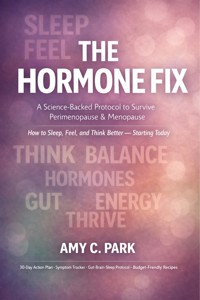
the hormone fix
Table of contents
The Hormone Fix
How to Sleep, Feel, and Think Better — Starting Today
INCLUDES:
Copyright©Amy C. Park, 2026.
T A B L E O F C O N T E N T S
A Letter to Every Woman Who Was Told "It's All in Your Head" Why I Wrote This Book — And Why It's Different
Introduction: Your Body Isn't Broken — It's Shifting What the Hormone Fix Protocol Is, How It Works, and What to Expect in 30 Days
Chapter 1 — You're Not Crazy — You're in Perimenopause
Chapter 2 — The Gut-Brain-Sleep Triangle: The Root Cause Nobody Is Talking About
The GBS Triangle Diagnostic Quiz
Chapter 3 — Why Your Doctor Dismissed You (And How to Get the Help You Deserve)
How to Find the Right Doctor — Because Not All of Them Are Starting From the Same Place
The Lab Test Cheat Sheet — What to Ask For and Why
Test
Timing Instructions
The primary form of estrogen in premenopausal women. A single measurement is insufficient—you want to see the pattern.
Progesterone
FSH (Follicle-Stimulating Hormone)
Test on day 2 or 3 of your cycle.
Often tested alongside FSH. The LH:FSH ratio provides information about ovarian function and ovulation regularity.
Total Testosterone
Free Testosterone
SHBG (Sex Hormone-Binding Globulin)
DHEA-S
Can be tested at any time, ideally alongside morning cortisol.
Why It Matters
Morning Cortisol
Test within 30–60 minutes of waking. Ideally done alongside DHEA-S.
Maps the full cortisol rhythm (morning, noon, afternoon, evening). Identifies dysregulation not visible in a single blood draw.
Test
Timing Instructions
The standard screening marker. Can appear normal even when thyroid function is impaired. Insufficient alone.
Free T4
Anytime, alongside Free T3.
The active form of thyroid hormone. Many women convert T4 to T3 inefficiently, resulting in low T3 despite normal TSH.
Reverse T3
TPO Antibodies
Anytime. Essential if Hashimoto's is suspected.
Another marker for Hashimoto's. Should be tested alongside TPO antibodies.
Test
Timing Instructions
The most sensitive early marker of insulin resistance. Can be elevated even when glucose and HbA1c are normal.
HbA1c
Anytime. No fasting required.
Basic baseline blood sugar marker.
High-Sensitivity CRP (hs-CRP)
Anytime. Avoid testing during acute illness.
An amino acid that rises when B vitamin metabolism is impaired. Associated with cardiovascular risk and cognitive decline.
Test
Optimal Range / Notes
Functions like a hormone, influencing immune function, mood, bone density, and sleep. Deficiency worsens every symptom.
Ferritin
Optimal for symptomatic women is often 50–100 ng/mL, not just "within range."
Red blood cell magnesium is more accurate than serum magnesium. Deficiency linked to insomnia, anxiety, cramps, and insulin resistance.
B12
Optimal is often considered 500–800 pg/mL or higher.
Works with B12 to support methylation and neurotransmitter production.
Omega-3 Index
Summary Checklist for Your Doctor
Test
☐
Day 2-3 AND Day 19-22
Progesterone
☐
Day 2-3
LH
☐
Morning
Free Testosterone
☐
Morning
DHEA-S
☐
Within 1 hour of waking
4-Point Salivary Cortisol
☐
Morning
Free T4
☐
Morning
Reverse T3
☐
Anytime
Anti-Thyroglobulin Antibodies
☐
Fasting
HbA1c
☐
Fasting
hs-CRP
☐
Anytime
Vitamin D
☐
Anytime
RBC Magnesium
☐
Anytime
Omega-3 Index
Chapter 4 — Sleep Is Not a Luxury — It's Your #1 Hormone Repair Tool
The Four Biological Mechanisms That Perimenopause Uses to Destroy Your Sleep
The 7-Night Sleep Reset Plan
Your Complete Implementation Guide
Non-Negotiable
Question
☐
Check if done
Nutrition Strategy
☐
Check if done
Mind Strategy
Possible Improvements You May Notice
Positive Changes
Night 1 (Baseline)
Question
Chapter 5 — Your Circadian Clock Is Broken — Here's How to Fix It
Circadian Fasting, Light Therapy, and the Morning Routine That Resets Your Hormone Rhythm in 14 Days Includes: The Hormone Rhythm Daily Schedule
Circadian Fasting — What It Is, How It Works, and Why It Is Different From Every Other Fasting Approach You Have Heard Of
My Fixed Wake Time:
Example Time
Activity
Example Time
Activity
Example Time
Activity
Event
Your Time
Did I maintain consistent wake time?
Did I have caffeine after noon?
Sleep Quality (1–5)
1
☐ Yes / ☐ No
☐ Yes / ☐ No
☐ Yes / ☐ No
☐ Yes / ☐ No
3
☐ Yes / ☐ No
☐ Yes / ☐ No
☐ Yes / ☐ No
☐ Yes / ☐ No
5
☐ Yes / ☐ No
☐ Yes / ☐ No
☐ Yes / ☐ No
☐ Yes / ☐ No
7
☐ Yes / ☐ No
☐ Yes / ☐ No
Chapter 6 — Eat to Fix Your Hormones: The Science-Backed Nutrition Framework
☐
Approx. Price
☐
Approx. Price
☐
Approx. Price
☐
Approx. Price
☐
Approx. Price
Category
Pillar
Key Foods
The Gut Microbiome, the Estrobolome, and the Exact Foods That Rebuild Your Internal Hormone Factory Includes: 3-Day Gut Reset Meal Plan
Time
Components
Time
Components
Time
Components
Category
Pillar
Chapter 8 — Supplements, Adaptogens & What's Actually Worth Your Money
Supplement
Best For
Approx. Monthly Cost
300–400mg elemental magnesium Nightly
Glycinate: Sleep & anxietyThreonate: Brain fog & cognition
Vitamin D3 with K2-MK7
Bone density, mood, immune function, gut lining, serotonin synthesis
$15–$30
2,000–3,000mg combined Daily (2:1 EPA:DHA ratio)
Triglyceride form fish oil or algae-based for plant-based women
Methylated B Complex
Methylation, hormone clearance, neurotransmitter production, energy
$15–$25
Dose & Timing
Cautions
Ashwagandha KSM-66
Anxiety, elevated cortisol, wired-but-tired, insomnia, adrenal burden
$15–$25
200–400mg Morning on empty stomach
Do not combine with Ashwagandha without medical guidance
Phosphatidylserine
Brain fog, memory, high cortisol reactivity, evening cortisol reduction
$20–$35
100–200mg daytime, 200–400mg evening
Combines well with magnesium (sleep) or caffeine (calm focus)
Supplement
Best For
Approx. Monthly Cost
1,500–3,000mg daily With food
6–8 weeks minimum before assessing effect
Black Cohosh
Hot flashes, night sweats, vasomotor symptoms
$10–$20
10–15g daily With vitamin C
Marine for best bioavailability. Types I and III.
❌
Why to Skip
Most proprietary menopause blends
❌
Unreliable absorption, not medically supervised
Detox teas
❌
Worsens cortisol, anxiety, and sleep
High-dose isolated calcium above 500mg
❌
No evidence, potential toxicity, skip entirely
Supplement
Timing
1
1
2
3
Quality Indicator
☐
Ensures purity and accurate dosing
No proprietary blends hiding individual doses
☐
Cheaper forms are poorly absorbed
Clear expiration date
☐
Ensures you can take them consistently
The Hormone Fix Weekly Exercise Framework
Day
Duration
Day
Minimum Duration
Day
Completed?
How I Felt After
Type
Key Benefits for Perimenopause
Use this structure
Structure Used (Ideal / Modified / Minimum)
Zone 2 Sessions Completed
Yoga Sessions Completed
Mood Trend (1–5)
2
4
Chapter 11 — Every Woman's Menopause Is Different: A Special Note on Race, Culture & Body Type
Meal
Preparation
Meal
Preparation
Meal
Preparation
Chapter 12 — The Hormone Fix in Action: Your Complete 30-Day Protocol
The 20 Hormone Fix Recipes
BREAKFASTS — 6 RECIPES
DINNERS — 5 RECIPES
Task
Purpose
Recipe 8
☐ Cook a double batch of brown rice or quinoa
☐ Hard boil six eggs
☐ Make one batch of energy balls
Yields sixteen balls for snacks throughout the week
Sweet potato, broccoli, Brussels sprouts, carrots
☐ Prepare overnight oats
Ready and waiting for Monday morning
Eliminates 6pm decision fatigue that often leads to takeout
Approach
Time
Rotate through quick options
Each takes under 5 minutes
Alternate between batch-cooked soup and simple assembly meals
Minimal preparation required
Centered on sheet pan meals, slow cooker dishes, and pre-cooked components
Maximizes Sunday preparation
Choose based on whether gut support or blood sugar balance is the focus
Quick and purpose-driven
Breakfast
Dinner
Monday
Lentil soup (Sunday batch)
Recipe 13 (Sheet Pan Salmon)
Recipe 7, 10, or 12
Recipe 14 (Slow Cooker Chicken)
Lentil soup (Sunday batch)
Saturday
Conclusion: You're Not at the End — You're at the Beginning
Postmenopause, the Upgrade Phase, and How the Best Years of Your Health Are Still Ahead
30g PROTEIN
3 PROBIOTIC FOODS
Across all meals daily.
Eggs, Greek yogurt, chicken, fish, cottage cheese, lentils, tempeh, protein smoothie
Greek yogurt, kefir, sauerkraut, kimchi, miso, tempeh, natto
Timing
On waking — before anything else
Within 10 minutes — minimum 10 minutes outdoors
Zero screens for the first 30 minutes of every morning
Within 60–90 minutes of waking — minimum 30g complete protein
Coffee or tea only after 60–90 minutes — not immediately on waking
Nothing caffeinated after noon — extends to 2 pm in maintenance phase
Walk, workout, or yoga — ideally outdoors during your light window
Timing
Dinner at least 3 hours before your target sleep time
On 2 hours before bed — without exception
Switch to warm amber lighting throughout your home
60 minutes: no screens, no email, no news — books / stretching / bath
Magnesium glycinate 300–400 mg + L-theanine 200–400 mg
60–90 minutes before bed — triggers temperature drop that starts sleep
5 minutes writing every concern out of your head onto paper
Write 3 specific things that happened today — not generic
Inhale 4 counts — hold 7 — exhale 8. Repeat 5 cycles in bed
Charge outside the bedroom — every single night
Recommendation
Timing Rules
Best window: morning or 3–6 pm
No vigorous exercise after 7 pm
48–72 hrs recovery between resistance sessions
☐ Daily walking — 7,000 steps minimum
Supplement
Benefits
300–400 mg nightly
☐ Vitamin D3 + K2-MK7
bone, mood, immune, gut
2,000–3,000 mg combined (2:1 EPA:DHA)
☐ Methylated B Complex
hormones, energy, detox pathways
Dose
☐ Ashwagandha KSM-66
anxiety, cortisol, wired-but-tired, adrenal burden
200–400 mg morning (empty stomach)
☐ Phosphatidylserine
brain fog, memory, cortisol reactivity
100–200 mg day / 200–400 mg evening
Supplement
Best For
1,500–3,000 mg daily
☐ Black Cohosh
hot flashes, night sweats, vasomotor
10–15 g daily with vitamin C
❌
Why
☐
☐
☐
☐
☐
☐
☐
☐
☐
☐
☐
☐
☐
☐
☐
☐
☐
☐
☐
☐
☐
☐
☐
☐
W1
W3
Daily Nutrition Targets
Appendix A: Recommended Lab Tests & What They Mean
A complete reference guide to bring to every medical appointment
Test
Optimal for Perimenopause
A Personal Note from the Author
landmarks
Title page
Table of contents
Book start
The Hormone Fix
A Science-Backed Protocol to Survive Perimenopause & Menopause
How to Sleep, Feel, and Think Better — Starting Today
Amy C. Park
INCLUDES:
30-Day Action Plan · Symptom Tracker · Gut-Brain-Sleep Protocol · Budget-Friendly Recipes
Copyright©Amy C. Park, 2026.
All rights reserved. No part of this publication may be reproduced, distributed, or transmitted in any form or by any means, including photocopying, recording, or other electronic or mechanical methods without the publisher's prior written permission, except in the case of brief quotation embodied in critical reviews permitted by copyright law.
T A B L E O F C O N T E N T S
"You don't have to settle for feeling awful. The fix starts today."
— Amy C. Park
A Letter to Every Woman Who Was Told "It's All in Your Head" Why I Wrote This Book — And Why It's Different
I want to start with something no medical textbook ever taught me.
I want to start with an apology.
Not from me personally — though I'll get to my part in a moment — but from a medical system that has spent decades telling women that what they were feeling wasn't real. That their exhaustion was laziness. That their anxiety was personality. That their weight gain was a lack of willpower. That their brain fog, their rage, their insomnia, their racing heart at 2am — all of it — was either stress, depression, or simply the unavoidable price of getting older.
You were told to push through it.
You were handed antidepressants when you asked about hormones.
You were told your labs were "normal" while you sat in that office feeling anything but normal.
You were sent home.
And the worst part? You believed them. You went home, looked in the mirror, and told yourself maybe it really was all in your head. Maybe you were falling apart. Maybe this was just who you were now.
I need you to hear this clearly: It was never in your head. Not one single symptom.
I have sat across from hundreds of women in my career. Women in their late thirties who couldn't figure out why they suddenly couldn't sleep through the night. Women in their forties who had been to four different doctors, ran every test, and been told everything was fine — while they quietly fell apart at home. Women in their fifties who had accepted suffering as their new normal because nobody gave them any other option.
What broke my heart every single time was not the symptoms. Symptoms can be addressed. What broke my heart was the look on their faces when I finally told them the truth — that what they were experiencing was real, it had a name, it had a cause, and most importantly, it had a solution. The look was always the same. Relief. Followed immediately by anger. Because they had been carrying this alone for years, sometimes decades, and nobody had bothered to connect the dots for them.
That look is why I wrote this book.
Let me be honest with you about something else.
The medical community is not entirely to blame. Most doctors genuinely want to help their patients. The problem is that perimenopause and menopause have been catastrophically under-researched and under-taught. I went through years of medical training and I can tell you with complete honesty that what I learned about menopause in school could fit on half a page. Hot flashes. Hormone replacement. The end.
Nobody taught us that perimenopause can begin in your late thirties. Nobody explained that estrogen receptors exist all over the body — in your gut, your brain, your bones, your heart, your skin — which is why when estrogen starts shifting, everything shifts with it. Nobody connected the dots between declining hormones and disrupted sleep, between disrupted sleep and gut imbalance, between gut imbalance and the brain fog and anxiety and depression that follow.
Women were experiencing a full-body hormonal transition and being treated symptom by symptom, in isolation, by specialists who never talked to each other. A cardiologist for the palpitations. A psychiatrist for anxiety. A gastroenterologist for the bloating. A sleep specialist for insomnia. Nobody standing back and saying — wait. This is all one thing. This is hormones.
I became that person. And this book is the result.
Now let me tell you why this book is different from every other menopause book on the shelf.
First — this book does not assume you are fifty years old. If you are thirty-seven and something feels off, this book is for you. If your periods are still regular but your sleep has gone sideways, your moods are unpredictable, and you've gained weight around your middle despite not changing anything about your diet or exercise, this book is for you. Perimenopause does not wait for a convenient age. For many women it begins quietly, almost invisibly, up to ten years before their last period. The earlier you understand what is happening, the more power you have to change its course.
Second — this book does not just give you information. It gives you a system. I have read the other books. They are full of excellent science. I respect the authors deeply. But readers consistently say the same thing: they finished the book feeling informed but not knowing what to actually do on Monday morning. What to eat for breakfast. What to do when they wake up at 3am. How to talk to their doctor. How to move their body in a way that helps rather than hurts. This book answers all of that. Every chapter ends with action. There are checklists, trackers, scripts, and meal plans. You will never finish a chapter and wonder what to do next.
Third — this book talks about sleep as the central issue, not a side topic. Every competing book mentions sleep. Most give it a chapter buried somewhere in the middle. But in my clinical experience, sleep is not just one symptom of hormonal imbalance — it is the engine of it. When you do not sleep, your cortisol rises. When your cortisol rises, your blood sugar spikes. When your blood sugar spikes, your other hormones are thrown further into chaos. Everything gets worse. Fixing sleep is not optional. It is the foundation of everything else, and it gets an entire section of this book because it deserves one.
Fourth — this book does not pretend that every woman's experience is the same. Research consistently shows that Black women enter perimenopause earlier, experience more severe symptoms, and are more likely to be dismissed by their doctors than white women. Latina women face their own hormonal patterns and cultural pressures around aging that are rarely addressed. Asian women have unique dietary considerations and different baseline risks. These differences are real, they are documented in the science, and they deserve more than a single footnote. You will find dedicated space in this book for the reality that menopause is not a one-size-fits-all experience.
Fifth — this book is honest about money. Not every woman can afford a functional medicine doctor, expensive specialty supplements, and weekly lab work. The protocol in this book was built to work on a real budget. The grocery list can be completed at a regular supermarket for under seventy-five dollars a week. The supplements I recommend are the ones with the strongest evidence, not the highest price tags. Healing your hormones should not require a second mortgage.
One more thing, and this is the most important thing I will say in this entire book.
You are not falling apart. You are not weak. You are not dramatic. You are not too sensitive or too emotional or too much. You are a woman whose body is going through one of the most significant hormonal transitions of her entire life, with almost no roadmap, and you have been doing it largely alone.
That ends today.
What you are holding in your hands is not just information. It is a protocol — a clear, step-by-step system built on real science and real clinical experience — designed to help you sleep again, think clearly again, and feel like yourself again. Not a diminished version of yourself. Not the best you can hope for given your age. Actually yourself. Maybe even better.
I have seen women come out the other side of perimenopause and menopause with more energy, more clarity, more confidence, and more joy than they had in their thirties. It is not only possible — it is what your body is capable of when it has the right support.
The protocol works. The science is solid. And you deserve both.
So let's get into it.
How to Use This Book
Read it from the beginning if you can. Each part builds on the one before it. But if you are in crisis right now — if sleep deprivation is destroying your life or your symptoms feel unmanageable — go straight to Part Two first. Get your sleep stabilized. Then come back and start from Chapter One.
There is a 30-Day Action Plan in Chapter 12 that pulls everything together into a daily schedule. Some readers like to flip there first to see the big picture. That is completely fine. Do what works for you.
Most importantly — take notes. Mark pages. Fill in the trackers. This book was designed to be written in.
Because this is not a book you read and put on a shelf.
This is a book you live in.
Welcome. I am so glad you are here.
— Amy C. Park
Introduction: Your Body Isn't Broken — It's Shifting What the Hormone Fix Protocol Is, How It Works, and What to Expect in 30 Days
Can I ask you something personal?
When was the last time you felt like yourself? Not just okay. Not just functional. But genuinely, fully, recognizably yourself — with energy that lasted past noon, sleep that actually restored you, a mind that was sharp and present, and a body you understood?
Take a moment with that question. Really sit with it.
If you had to think hard to remember, you are exactly where this book was written for. And if that question made something tighten in your chest — a quiet grief for the version of you that used to exist — I want you to know that feeling is one of the most common things women describe when they finally sit down and get honest about what perimenopause and menopause have taken from them.
Not just the sleep. Not just the energy. But the sense of knowing themselves.
That is what we are getting back. That is what this book is really about.
Let me paint you a picture.
It is 3am. You are wide awake for the third night in a row, covers kicked off because your body is radiating heat like a furnace. Your mind is running a highlight reel of every unfinished task, every uncomfortable conversation, every worry you managed to keep at bay during the day. You are exhausted but you cannot sleep. You are calm but you feel anxious. Nothing makes sense and everything hurts a little — not dramatically, not in a way you could easily explain to someone else — just a low, persistent, full-body wrongness that has become so familiar you have almost stopped noticing it.
Almost.
You notice it every morning when you wake up more tired than when you went to bed. You notice it when you walk into a room and forget why you're there. You notice it when your jeans fit differently despite the fact that you have not changed a single thing about how you eat or move. You notice it when your patience — which used to be one of your best qualities — is suddenly so thin that a slow driver or an unanswered text can send you into a rage that frightens even you.
And then — and this is the part that really stings — you notice it when you smile and tell everyone you are fine.
You are not fine. But you have gotten so good at pretending that sometimes you are not sure where the performance ends and the truth begins.
Here is what I need you to understand right now, in this introduction, before we go a single page further.
What you just read above? That is not a mental health crisis. That is not burnout. That is not you falling apart or losing your mind or failing at life. That is perimenopause. That is your hormones shifting, and your body doing exactly what it is biologically programmed to do — just without any warning, any guidance, or any real support from a medical system that was never properly designed to help you through it.
Your body is not broken. It is shifting.
And shifting can be survived. More than survived — it can be navigated with grace, with knowledge, and with a clear protocol that actually works.
So what exactly is the Hormone Fix Protocol?
I want to be straightforward with you because I think you have had enough vague wellness advice to last a lifetime. You do not need another list of superfoods. You do not need another breathing exercise. You do not need to be told to manage your stress as if stress is something you just forgot to schedule around.
What you need is a system. A real, clear, science-backed system that addresses what is actually happening inside your body — not just the symptoms on the surface, but the root causes underneath them.
The Hormone Fix Protocol is built on one central discovery that changes everything once you understand it. Your hormones do not operate in isolation. They are part of a deeply connected triangle — your gut, your brain, and your sleep — and when one point of that triangle breaks down, the other two follow. This is why treating symptoms one at a time has never worked for you. You cannot fix anxiety without fixing sleep. You cannot fix the sleep without fixing the gut. You cannot fix the gut without addressing the hormones that govern it. Everything is connected. Every single thing.
The protocol works by targeting all three points of that triangle simultaneously, using nutrition, circadian rhythm science, targeted movement, and specific lifestyle shifts that work with your changing hormones rather than against them. It is not about restriction. It is not about pushing harder. It is about giving your body the precise inputs it needs at this precise stage of life — inputs that are completely different from what worked for you in your twenties and thirties, because your biology is completely different now.
Here is the short version of what the protocol centers on. Three things. Just three.
Protein is your first priority at your first meal, because it stabilizes blood sugar, reduces cravings, and gives your adrenal glands the raw material they need to compensate for declining estrogen. Fiber as your daily non-negotiable, because a diverse, fiber-rich gut microbiome directly regulates how your body processes and eliminates excess estrogen — meaning your gut is literally a hormone organ and most women have no idea. And probiotic foods every single day, because the specific community of bacteria in your gut — called the estrobolome — determines whether your estrogen is recycled properly or thrown out of balance entirely.
Three things. And built around those three things is a complete daily structure — a sleep protocol, a movement approach, a circadian fasting window, a supplement guide, and emotional tools — that together create a compounding effect in your body. Each piece makes the other pieces work better. Within days, most women notice something shifting. Within thirty days, most women feel genuinely, measurably different.
Not different as in someone else. Different as in themselves again.
Now I want to talk to you about the thirty days ahead, because I think it is important you know exactly what to expect.
The first week is going to feel like information. You are going to be learning how to eat differently, sleep differently, and think about your body differently. Some of it will feel unfamiliar. Some of it will feel surprisingly simple. There will probably be a moment — maybe around Day 3 or Day 4 — where you think, is this actually going to work? That moment is completely normal. Push through it.
By the second week, your body starts responding. For most women, sleep is the first thing that begins to improve, and when sleep improves, everything else starts to feel more manageable. The brain fog lifts slightly. The morning anxiety is a little quieter. You start to feel — not great yet, but better. Noticeably better. And that noticeably better is important because it tells you something crucial: your body is listening. It responds quickly when you give it what it needs.
The third week is where momentum builds. Your gut is adjusting, your blood sugar is more stable, and your cortisol — the stress hormone that has been working overtime since your hormones started shifting — begins to come down from its permanent state of emergency. You sleep deeper. You wake up more rested. The number on the scale may or may not move, but your clothes start fitting differently because inflammation is reducing and your body is beginning to let go of the water weight it has been holding as a stress response.
By the fourth week, something happens that I want you to be ready for because it tends to catch women off guard. It is not a dramatic transformation. It is quieter than that. It is a Tuesday afternoon when you realize you have not snapped at anyone in three days. It is waking up at 7am before your alarm, feeling actually rested, and lying there for a moment thinking — oh. There she is. It is putting on a pair of jeans that have not fit in a year and finding that they button without a fight. It is a conversation with your partner or your friend where you feel present and warm instead of thinly stretched and emotionally unavailable.
It is you. Coming back to yourself.
That is what thirty days looks like. Not perfection. Not a complete overhaul. But real, tangible, meaningful change — the kind that compounds over time and builds into something extraordinary.
Before you dive into Chapter One, I want you to do something for me right now.
Grab a pen — yes, right now, literally get a pen — and answer these three questions honestly. Write the answers in the margin of this page or in a notebook. It does not matter where. What matters is that you write them down.
One: What is the symptom that is affecting your quality of life the most right now?
Two: What have you already tried that has not worked?
Three: How do you want to feel in thirty days?
That third question is the most important one. Not how you want to look. Not what number you want to see on a scale. How do you want to FEEL? Write it down in as much detail as you can. Because that description — that feeling — is your why. And on the hard days, on the days when you are tired or tempted to skip the protocol or go back to old habits, your why is the thing that pulls you forward.
Know your why before you turn this page.
One last thing before we begin.
I need you to release something. I need you to put down, right here in this introduction, the story you have been telling yourself about your body. The one where you are too far gone. The one where it is too late, you have left it too long, the damage is done. The one where other women can feel better but maybe you are just different, maybe you are the exception, maybe your case is too complicated.
That story is not true. I have worked with women who felt exactly that way — worn out, dismissed, convinced they were beyond help — and I have watched them transform. Not because of magic. Not because they were special. Because they had the right information, a clear protocol, and the decision to trust their body one more time.
Your body has not given up on you. It has been sending you signals — loud, disruptive, impossible-to-ignore signals — because it needs something different. It is not punishing you. It is talking to you.
This book is how you talk back.
You are not at the end of feeling good. You are at the beginning of feeling better than you have in years — possibly better than you have ever felt — because you now have something you did not have before.
You have the fix.
Let's go get it.
How to Use This Introduction
Before you move to Chapter One, flip to the back of the book and look at the 30-Day Habit Tracker in Chapter 12. Fill in today's date on Day One. Just that. You do not need to read Chapter 12 yet — just mark the start date. There is something powerful about committing to a beginning. It makes the whole thing real.
Then come back here, take a breath, and turn the page.
Your thirty days start now.
Chapter 1 — You're Not Crazy — You're in Perimenopause
The Surprising Truth About Why Symptoms Start in Your Late 30s — Before Your Period Even Changes Includes: The 34 Symptoms Checklist & Your Hormone Timeline
She was thirty-nine years old.
Healthy. Active. Ate well. Had a good life by every measurable standard. But for the past eighteen months, she had not been sleeping through the night. Her anxiety — which she had never struggled with before — had become a background hum she could not turn off. She had gained eleven pounds without changing anything about her diet. Her hair was thinning. Her periods were still regular, arriving every twenty-eight days like clockwork, so her gynecologist kept telling her there was nothing hormonally wrong.
"You're too young," she was told. "Your bloodwork is normal. Have you considered therapy?"
She had considered therapy. She had also considered that she was losing her mind, that she was fundamentally broken, and that this exhausted, anxious, unrecognizable version of herself was simply who she was now.
Then she found out what was actually happening.
She was in perimenopause.
And the moment she heard those words — not as a distant future event but as her current reality — everything she had been experiencing for nearly two years finally made sense. Insomnia. The anxiety. The weight gain. The brain fog. The irritability. The joint pain she had been blaming on aging. All of it had the same root cause. All of it had a name. And more importantly — all of it had a solution.
That woman is not unusual. She is, in fact, the most common patient I see. And if you are reading this chapter, there is a very good chance her story sounds uncomfortably familiar.
So let's start from the very beginning, because I think you deserve to understand exactly what is happening inside your body — not in vague terms, not with complicated medical jargon, but in plain language that actually makes sense.
What Perimenopause Actually Is — And What It Is Not
Most women grow up thinking menopause is a single event. One day your period stops, you have some hot flashes, and then it is over. What nobody tells you — and what medical education has been embarrassingly slow to correct — is that menopause is not an event. It is the finish line of a long race called perimenopause, and that race starts years, sometimes more than a decade, before your period ever becomes irregular.
The word perimenopause literally means "around menopause." It is the transitional phase during which your ovaries gradually begin producing less estrogen and progesterone. Gradually is the key word there. This does not happen overnight. It does not happen in a month. It is a slow, uneven, sometimes chaotic hormonal shift that can begin as early as your mid-thirties and typically lasts anywhere from four to twelve years.
Read that again. Four to twelve years.
That means a woman who enters perimenopause at thirty-seven may not reach actual menopause — defined as twelve consecutive months without a period — until she is in her late forties. She could spend an entire decade experiencing symptoms that her doctors keep dismissing because her periods are still showing up on schedule.
This is not a rare edge case. Research published in the journal Menopause found that the average age of perimenopause onset is forty-seven, but a significant percentage of women begin experiencing hormonal changes in their late thirties. And because nobody talks about this openly, most of those women spend years being misdiagnosed with depression, anxiety disorders, thyroid problems, or chronic fatigue — when the real answer was sitting in their ovaries the whole time.
Your Hormones Have a Hierarchy — And It Matters
To understand why perimenopause affects so much of your body, you need to understand one thing about hormones that most people never learn: they do not work independently. They work as a system. When one changes, everything downstream changes with it.
Think of your endocrine system like a chain of dominoes. Estrogen is the first domino. When it starts to fall — even slightly, even unevenly — everything else in the chain moves.
Here is how that chain actually works.
Your brain contains a small region called the hypothalamus. Its job is to monitor your hormone levels constantly, like a thermostat monitoring room temperature. When it detects that estrogen levels are dropping, it sends a signal to the pituitary gland, which then releases a hormone called FSH — follicle-stimulating hormone — to tell your ovaries to produce more estrogen. In your twenties and thirties, your ovaries respond to this signal reliably. But as you move through your late thirties, your ovaries become less responsive. They carry fewer viable eggs, and the follicles that remain are less efficient at producing estrogen.
So what happens? Your hypothalamus panics. It sends more FSH. Your pituitary pumps it out harder. Your ovaries struggle to respond. The result is erratic, unpredictable estrogen production — sometimes too high, sometimes too low, swinging between the two in ways that your brain and body struggle to manage.
This hormonal volatility — not a steady decline, but a chaotic fluctuation — is what causes most of the symptoms women experience in early perimenopause. And because estrogen receptors exist in almost every tissue in your body — your brain, your gut, your bones, your heart, your skin, your bladder, your joints — when estrogen becomes unstable, the effects are felt everywhere simultaneously.
This is why perimenopause does not feel like one thing. It feels like everything, all at once, for no obvious reason.
The Progesterone Problem Nobody Talks About
Here is something that surprises most women: the very first hormone to decline in perimenopause is not estrogen. It is progesterone.
Progesterone is produced primarily after ovulation, during the second half of your menstrual cycle. As you move into your late thirties, your ovulations become less consistent. Some months you ovulate normally. Some months you do not ovulate at all, even though you still bleed. And when you do not ovulate, you produce very little progesterone that month.
Why does this matter so much? Because progesterone is your calming hormone. It has a direct sedative effect on the brain. It binds to GABA receptors — the same receptors that anti-anxiety medications target — and creates a natural sense of calm and ease. It promotes deep sleep. It reduces anxiety. It counterbalances the stimulating effects of estrogen.
When progesterone starts dropping first, while estrogen is still relatively high, you end up in a state called estrogen dominance. Your estrogen is not necessarily high in absolute terms, but it is high relative to your progesterone. And estrogen dominance is characterized by a very specific cluster of symptoms: anxiety, insomnia, irritability, heavy periods, breast tenderness, water retention, and weight gain — especially around the hips and abdomen.
Sound familiar?
This is why so many women in their late thirties — with regular periods and "normal" bloodwork — are suffering from textbook perimenopause symptoms. Their estrogen looks fine on paper. Their FSH looks fine. But their progesterone is quietly declining, and the balance between the two hormones has shifted in ways that standard lab panels frequently miss.
Your doctor was not lying to you when they said your labs were normal. They were just looking at the wrong thing.
Why Your Adrenal Glands Are Both Your Backup System and Your Breaking Point
Here is another piece of the picture that rarely gets explained. Your ovaries are not your only source of sex hormones. Your adrenal glands — two small glands that sit on top of your kidneys — also produce estrogen and testosterone, particularly a precursor hormone called DHEA that your body converts into both.
In a healthy hormonal state, your adrenals play a supporting role. Your ovaries do the heavy lifting and your adrenals fill in the gaps. But as your ovaries begin to wind down in perimenopause, your adrenals are asked to pick up more and more of the slack. They become the backup generator when the main power source starts to falter.
The problem is that your adrenal glands have another full-time job: managing your stress response. They produce cortisol and adrenaline, the hormones that activate your fight-or-flight response every time you face a threat — whether that threat is a car swerving into your lane or a difficult email from your boss. They are not designed to simultaneously manage stress and compensate for declining ovarian function without support.
When you add chronic stress, poor sleep, blood sugar instability, and a nutrient-depleted diet to the equation — all of which are common in the lives of women in their late thirties and forties — your adrenal glands become overwhelmed. They prioritize cortisol production over sex hormone production, because your brain considers immediate survival more urgent than hormonal balance. The result is that your backup system fails at the exact moment you need it most.
This is why managing stress and stabilizing blood sugar are not optional lifestyle bonuses in the Hormone Fix Protocol. They are foundational requirements. You cannot fix your sex hormones while your adrenal glands are in permanent crisis mode. It simply does not work.
The Gut Connection — Your Second Hormone Organ
Your gut does something that will genuinely change how you think about your entire body once you understand it.
Inside your digestive tract lives a specific community of bacteria called the estrobolome. This community of microbes produces an enzyme called beta-glucuronidase, which controls how much estrogen your body recycles versus how much it eliminates. When your gut microbiome is diverse and healthy, this process works efficiently — used estrogen gets packaged up and removed from your body through your bowel movements. When your gut microbiome is imbalanced — a condition called dysbiosis, which is extremely common in perimenopausal women — that enzyme goes into overdrive, breaking the packaging on used estrogen and sending it back into circulation.
What this means practically is that a woman with poor gut health can end up with significantly more circulating estrogen than she should have — even as her ovaries are producing less. This contributes directly to estrogen dominance, worsens mood instability, increases breast tenderness, and makes weight loss extraordinarily difficult.
It also means that healing your gut is not a wellness trend. It is a hormonal intervention. Every probiotic food you eat, every gram of fiber you consume, every inflammatory food you reduce — these are direct inputs into your hormone balance, not peripherally but mechanically.
This is the gut-hormone connection that almost no mainstream menopause book explains in plain language, and it is one of the three pillars that the Hormone Fix Protocol is built on.
Why Your Brain Feels Like It Belongs to Someone Else
Estrogen does not just influence your reproductive system. It is one of the most neuroprotective compounds in the human body. It supports the production of serotonin, dopamine, and acetylcholine — the neurotransmitters responsible for mood, motivation, pleasure, and memory respectively. It promotes the growth of new neural connections. It regulates inflammation in the brain. It helps maintain the myelin sheath — the protective coating around nerve fibers that makes your thinking fast and clear.
When estrogen fluctuates unpredictably, all of these functions fluctuate with it. This is why brain fog in perimenopause is not psychological. It is neurological. The neurons in your brain are literally receiving less estrogen-dependent support than they used to, and they are struggling to compensate.
The memory lapses, the difficulty concentrating, the sense that your thoughts are moving through wet cement — these are physiological symptoms of a brain adapting to a new hormonal environment. They do not mean you have early dementia. They do not mean you are losing your intelligence. They mean your brain is in transition, and it needs specific nutritional and lifestyle support to navigate that transition without long-term consequences.
The good news — and this is significant — is that the brain is extraordinarily adaptable. Research from neuroscientist Dr. Lisa Mosconi at Weill Cornell Medicine has shown that women who support their brains during the perimenopausal transition with the right inputs — adequate protein, omega-3 fatty acids, quality sleep, and stress management — can emerge on the other side with brain function that is not only preserved but in some ways enhanced. The brain does not decline through menopause. It reorganizes. And how well it reorganizes depends largely on what you feed it.
The 34 Symptoms of Perimenopause
One of the most validating things I can do in this chapter is give you the complete list. Not the sanitized, four-bullet-point version that gets handed out in doctors' offices. The real list. Because one of the most disorienting things about perimenopause is how many seemingly unrelated symptoms it produces, and how easy it is to attribute each one to a completely different cause.
Read through this list and check everything that applies to you — right now, in the margin, or in your notebook. Be honest.
Sleep and Energy
Waking between 2am and 4am for no obvious reason
Difficulty falling asleep despite feeling exhausted
Waking unrefreshed even after a full night of sleep
Persistent fatigue that does not improve with rest
Afternoon energy crashes that feel sudden and severe
Mood and Mental Health
6. Anxiety that feels new or significantly worse than before
7. Irritability or rage that feels disproportionate to trigger
8. Low mood or mild depression, particularly in the week before your period
9. Feelings of overwhelm that arrive without warning
10. Emotional sensitivity — crying more easily than you used to
11. Loss of motivation or joy in things you previously enjoyed
Cognitive Function
12. Brain fog — difficulty concentrating or thinking clearly
13. Memory lapses, particularly with words or names
14. Difficulty multitasking or managing complex information
15. Slower mental processing — feeling like your brain has a lag
Physical and Body Changes
16. Weight gain, particularly around the abdomen, without dietary changes
17. Bloating and water retention, especially before your period
18. Joint pain or stiffness, particularly in the morning
19. Muscle soreness that takes longer to recover than it used to
20. Changes in body odor
21. Skin changes — dryness, increased sensitivity, or new breakouts
22. Hair thinning or increased shedding
23. Dry eyes or increased eye sensitivity
24. Tingling or numbness in hands and feet
25. Heart palpitations — a racing, fluttering, or pounding heartbeat
Reproductive and Hormonal
26. Breast tenderness, particularly in the second half of your cycle
27. Changes in period flow — heavier, lighter, longer, or shorter
28. Shorter cycles — your period arriving earlier than usual
29. Changes in PMS symptoms — either new symptoms or worsening of existing ones
30. Decreased libido or changes in sexual response
31. Vaginal dryness or discomfort during sex
32. Urinary urgency or increased frequency
33. Hot flashes — even occasional or mild ones
34. Night sweats
Now count your checks.
If you check five or more, your body is giving you a clear signal. If you checked ten or more, perimenopause is not a distant possibility — it is your current reality. And if you checked fifteen or more and you are still being told everything is normal, take this book to your next doctor's appointment and open it to this page.
Your Hormone Timeline — When Does What Actually Happen
Understanding the sequence of hormonal changes helps you know where you are in the process — and what to expect next.
Your Late Thirties (approximately 35 to 40): Progesterone begins its gradual decline as ovulations become less consistent. Estrogen may actually spike erratically during this phase. Common experiences: worsening PMS, new anxiety, disrupted sleep, breast tenderness, heavier periods. Most women do not connect these to hormones at this stage.
Early Perimenopause (approximately 40 to 45): Estrogen fluctuations become more pronounced and unpredictable. FSH begins to rise as your brain tries to stimulate your less-responsive ovaries. Symptoms intensify: more significant sleep disruption, mood changes, brain fog, and the beginnings of metabolic changes including weight redistribution. Periods are still mostly regular but may shift in length or flow.
Mid Perimenopause (approximately 45 to 50): Estrogen levels begin a more consistent downward trend, though fluctuations continue. Hot flashes and night sweats become more common. Periods begin to change — skipping months, arriving unexpectedly, or changing dramatically in character. Gut symptoms often become more pronounced as the estrobolome adjusts. Cognitive symptoms peak for many women during this phase.
Late Perimenopause (approximately 48 to 52): Periods become increasingly irregular — multiple months may pass between them. Estrogen and progesterone are consistently low. Many women report that certain symptoms actually begin to stabilize during this phase, as the dramatic fluctuations of earlier perimenopause give way to a new, lower hormonal baseline. Hot flashes may intensify briefly before settling.
Menopause (average age 51 in the US): Defined as twelve consecutive months without a period. This is not a new phase — it is simply the official end point of perimenopause.
Postmenopause: The years following menopause. Estrogen and progesterone remain consistently low. Many symptoms from perimenopause resolve as the body adapts to its new hormonal environment. Long-term health focus shifts to bone density, cardiovascular health, and cognitive protection — all of which are addressed in Chapter 12.
What This Means for You Right Now
Here is the thing I want you to take from this chapter, above everything else.
Perimenopause is not something that is happening to you. It is something that is happening to you — and there is a difference. Something happening to you is outside your control. Something happening in you is a process you can influence, support, navigate, and in many ways direct.
You now understand why your sleep is broken. You understand why your anxiety appeared out of nowhere. You understand why the weight settled around your middle despite nothing changing. You understand the progesterone drop, the estrogen fluctuation, the adrenal burden, the gut connection, and the brain changes. You are not guessing anymore. You are not blaming yourself anymore.
Now you have something far more powerful than confusion. You have a map.
And in every chapter that follows, we are going to use that map to guide you — step by step, clearly and practically — back to yourself.
But first, do this right now before you turn the page.
Go back to the 34 symptoms list. Circle the three that are affecting your daily life the most. Just three. Write them at the top of a fresh page in your notebook and underneath them write: these are not permanent. They are symptoms of a shift. And shifts can be supported.
Then write today's date.
Because today is the day you stopped guessing and started fixing.
Chapter 2 — The Gut-Brain-Sleep Triangle: The Root Cause Nobody Is Talking About
How Your Gut, Your Brain, and Your Sleep Are One Interconnected System — and How Fixing One Fixes All Three Includes: The GBS Triangle Diagnostic Quiz
There is a question I ask every woman who comes to see me frustrated, exhausted, and convinced that her body has turned against her.
I ask: "Which came first — the bad sleep, the gut problems, or the anxiety?"
Almost every single time, the woman goes quiet. She tilts her head. She thinks about it carefully. And then she says some version of the same thing: "I honestly don't know. They all seemed to show up around the same time."
That answer tells me everything I need to know. Because when three different problems arrive together, at the same time, without a single obvious trigger — they are not three different problems. There is one problem showing up in three different places.
That one problem is what I call the Gut-Brain-Sleep Triangle. And understanding it is not just the most important chapter in this book. It might be the most important thing you ever learn about your own body.
Here is why.
Most doctors treat the gut, the brain, and sleep as three separate systems. If your gut is struggling, you see a gastroenterologist. If your brain is struggling — anxiety, depression, brain fog — you see a psychiatrist or a neurologist. If your sleep is broken, you see a sleep specialist. Three different doctors, three different treatment plans, three separate diagnoses, zero connection between them.
But your body did not get that memo. Your body does not operate in neat departmental silos. Your gut, your brain, and your sleep are not three separate systems that occasionally influence each other. They are one deeply integrated network, constantly communicating, constantly regulating each other, built on shared chemistry that runs through all three simultaneously.
When that network is healthy and balanced, you sleep deeply, think clearly, digest easily, and feel emotionally stable. When it breaks down — as it almost inevitably does during perimenopause and menopause, when the hormones that hold the whole network together begin to shift — everything breaks down at once.
This is the root cause that almost nobody in mainstream medicine is talking about. And once you understand it — truly understand it, not just intellectually but in a way that makes your own experience make complete sense — you will never think about your symptoms the same way again.
Let's Start With the Gut — Because Most People Underestimate It Completely
When most people think about their gut, they think about digestion. Food goes in, gets broken down, nutrients get absorbed, waste gets removed. Simple, mechanical, unglamorous. Not exactly the stuff of revolutionary health science.
But your gut is so much more than a digestive tube. It is, without exaggeration, one of the most complex and intelligent organs in your entire body. And three specific things about it are going to completely change how you understand your hormones, your mood, and your sleep.
The first thing is this: your gut contains its own independent nervous system.
It is called the enteric nervous system, and it consists of approximately 500 million neurons — nerve cells — embedded in the lining of your gastrointestinal tract from your esophagus all the way to your rectum. Five hundred million. To put that in perspective, your spinal cord contains roughly 100 million neurons. Your gut has five times more. Scientists have taken to calling it "the second brain" not as a metaphor but as a literal anatomical description, because it can sense, process, and respond to information entirely independently of your brain upstairs.
Your gut and your brain are connected by a direct communication highway called the vagus nerve — the longest nerve in your body, running from your brainstem all the way down through your chest and into your abdomen. What most people do not know — and this is the part that changes everything — is that approximately 90 percent of the signals traveling along the vagus nerve go from the gut UP to the brain, not the other way around. Your gut is not passively receiving instructions from your brain. Your gut is actively sending information to your brain, constantly, all day and night, shaping your mood, your cognition, your stress response, and your sleep.
This means that what is happening in your gut right now is directly influencing what is happening in your head right now. Not metaphorically. Neurologically.
The second thing about your gut that matters enormously is what lives inside it.
Your gut houses approximately 38 trillion microorganisms — bacteria, fungi, viruses, and other microbes — collectively called the gut microbiome. This is not contamination. This is not something to be sterilized away. These microorganisms are essential partners in almost every biological process that keeps you healthy, including — and this is critical — hormone regulation.
Inside your microbiome lives a specific subset of bacteria called the estrobolome. We touched on this in Chapter 1, but now let's go deeper because this mechanism is central to everything in the Triangle.
Your liver processes used estrogen and packages it for removal from the body. It gets sent to the gut, bound to a carrier molecule, ready to be excreted in your stool. A healthy estrobolome allows this process to complete smoothly. But certain bacteria in an imbalanced microbiome produce excessive amounts of an enzyme called beta-glucuronidase. This enzyme cuts the packaging open and releases the used estrogen back into circulation before it can be eliminated.
The result is that estrogen keeps getting recycled back into your bloodstream — over and over — creating a state of estrogen excess even when your ovaries are producing less. This contributes to bloating, breast tenderness, mood instability, and significant difficulty losing weight. It also disrupts the estrogen-progesterone balance at the exact time in perimenopause when that balance is already fragile.
Here is what this means practically: your gut microbiome is not just a digestive tool. It is a hormone-regulating organ. A damaged microbiome does not just cause stomach problems. It directly destabilizes your entire hormonal system.
The third thing about your gut that connects directly to the Triangle is neurotransmitter production.
You have almost certainly heard that serotonin is a brain chemical responsible for mood and happiness. What you probably were not told — because most people are not told — is that approximately 90 to 95 percent of your body's serotonin is produced in your gut, not your brain. Your gut lining cells and enteric neurons manufacture serotonin in response to specific strains of gut bacteria, and this serotonin has local effects on gut motility and also signals the brain through the vagus nerve.
Your gut also produces a significant portion of your body's GABA — gamma-aminobutyric acid — the primary calming neurotransmitter. GABA is what tells your nervous system to stand down, to relax, to stop being on alert. It is what allows you to fall asleep. It is what dampens anxiety. And specific strains of bacteria — particularly Lactobacillus and Bifidobacterium species — are directly responsible for producing it.
So when your gut microbiome is imbalanced — too many harmful bacteria, not enough beneficial ones, insufficient diversity — your serotonin production drops and your GABA production drops. You feel anxious. You feel low. You cannot sleep. And you go to a doctor who prescribes an SSRI for your serotonin or a benzodiazepine for your GABA, never once looking at the actual source of the deficiency.
This is not a small oversight. This is a fundamental misunderstanding of where these chemicals come from and what is disrupting them.
Now Let's Talk About the Brain — And What Estrogen Has Been Quietly Doing There All Along
Your brain and your hormones have a relationship that goes far deeper than mood. Estrogen is, at its core, a neuroprotective compound. That means one of its primary jobs — a job it has been doing quietly in the background your entire adult life without you ever knowing — is to protect the health and function of your brain.
It does this in several specific ways that are worth understanding.
Estrogen stimulates the production of brain-derived neurotrophic factor — BDNF for short. Think of BDNF as fertilizer for your neurons. It promotes the growth of new brain cells, strengthens connections between existing ones, and supports the survival of neurons under stress. When estrogen levels are stable and adequate, BDNF levels are relatively high and your brain is adaptable, resilient, and sharp. When estrogen fluctuates or declines, BDNF drops with it, and your brain's ability to form new connections and recover from cognitive stress is compromised.
This is the biological mechanism behind the brain fog of perimenopause. It is not tiring. It is not stressful. It is a measurable reduction in the neurotrophic support your neurons have been relying on for decades.
Estrogen also regulates the glucose metabolism of your brain. Your brain is an energy-hungry organ — it consumes approximately 20 percent of your body's total energy despite being only about 2 percent of your body weight. It runs almost exclusively on glucose, and estrogen helps neurons access and use that glucose efficiently. When estrogen becomes unstable during perimenopause, some neurons begin to struggle to get enough fuel. They start burning ketone bodies instead — an alternative fuel source — which is functional but less efficient. The result is a brain that is working harder to achieve less. Processing becomes slower. Recall becomes effortful. Concentration becomes something you have to actively fight for instead of something that just happens.
Now here is where the gut comes back into the picture in a way that is both brilliant and deeply practical.
The gut produces serotonin and GABA, as we just established. But those same gut bacteria also influence the production of dopamine, the neurotransmitter responsible for motivation, reward, focus, and drive. Dopamine production in the brain requires a precursor called L-DOPA, and the conversion of certain dietary compounds into L-DOPA is facilitated by gut bacteria. A depleted microbiome means a depleted dopamine pathway, which manifests as that flat, unmotivated, what-is-the-point feeling that many perimenopausal women describe but struggle to put words to.
It is not laziness. It is chemistry. Specifically, it is the chemistry of a gut microbiome that has been disrupted by hormonal changes, dietary patterns, chronic stress, and a lifetime of factors that nobody ever connected to your mood.
The Inflammation Bridge — How Your Gut Sets Your Brain on Fire
There is a direct biological pathway connecting gut health to brain function, and it runs through inflammation. Understanding this pathway is one of the most important things in this entire book.
Your gut lining is a remarkable structure. It is designed to be selectively permeable — meaning it allows nutrients to pass through into your bloodstream while keeping harmful substances, bacteria, and undigested food particles out. This barrier is maintained by tight junction proteins that hold your gut lining cells together like the grout between tiles.
When your gut microbiome is healthy and your hormone levels are stable, these tight junctions hold firm. But when your microbiome is disrupted — by stress, by a poor diet, by antibiotics, by the hormonal changes of perimenopause, which directly affect gut motility and microbial diversity — those tight junctions can loosen. Gaps form. Bacteria, bacterial fragments, and partially digested proteins begin leaking through the gut wall into the bloodstream.
This condition is called intestinal hyperpermeability — commonly referred to as leaky gut. When these foreign particles enter the bloodstream, your immune system responds the only way it knows how: with inflammation. It launches an immune attack, releasing inflammatory chemicals called cytokines. This inflammatory response does not stay neatly contained in your abdomen. It travels through the bloodstream, crosses the blood-brain barrier, and triggers neuroinflammation — inflammation inside the brain itself.
Neuroinflammation is directly linked to depression, anxiety, cognitive decline, and sleep disruption. Research from the University of California found that elevated levels of inflammatory cytokines in the brain interfere with the same serotonin and dopamine pathways we just discussed. It also activates your brain's stress response — specifically the HPA axis, the hypothalamic-pituitary-adrenal axis — keeping your cortisol elevated and your nervous system locked in a low-grade state of alarm.
And elevated cortisol at night is one of the primary reasons perimenopausal women cannot sleep.




