


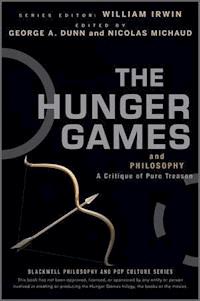
The Hunger Games and Philosophy E-Book
17,99 €
Mehr erfahren.
- Herausgeber: John Wiley & Sons
- Kategorie: Geisteswissenschaft
- Serie: The Blackwell Philosophy and Pop Culture Series
- Sprache: Englisch
A philosophical exploration of Suzanne Collins's New York Times bestselling series, just in time for the release of The Hunger Games movie Katniss Everdeen is "the girl who was on fire," but she is also the girl who made us think, dream, question authority, and rebel. The post-apocalyptic world of Panem's twelve districts is a divided society on the brink of war and struggling to survive, while the Capitol lives in the lap of luxury and pure contentment. At every turn in the Hunger Games trilogy, Katniss, Peeta, Gale, and their many allies wrestle with harrowing choices and ethical dilemmas that push them to the brink. Is it okay for Katniss to break the law to ensure her family's survival? Do ordinary moral rules apply in the Arena? Can the world of The Hunger Games shine a light into the dark corners of our world? Why do we often enjoy watching others suffer? How can we distinguish between what's Real and Not Real? This book draws on some of history's most engaging philosophical thinkers to take you deeper into the story and its themes, such as sacrifice, altruism, moral choice, and gender. * Gives you new insights into the Hunger Games series and its key characters, plot lines, and ideas * Examines important themes such as the state of nature, war, celebrity, authenticity, and social class * Applies the perspective of some of world's greatest minds, such as Charles Darwin, Thomas Hobbes, Friedrich Nietzsche, Plato, and Immanuel Kant to the Hunger Games trilogy * Covers all three books in the Hunger Games trilogy An essential companion for Hunger Games fans, this book will take you deeper into the dystopic world of Panem and into the minds and motivations of those who occupy it.
Sie lesen das E-Book in den Legimi-Apps auf:
Seitenzahl: 469
Veröffentlichungsjahr: 2012
Ähnliche




















CONTENTS
Acknowledgments
Introduction
Part One: “Having an Eye for Beauty isn’t Necessarily a Weakness”: The Art of Resisting the Capitol
Chapter 1: “The Final Word on Entertainment”
“The Right Shade for Sunlight on Fur”
“We Could Really Make you Something Special”
“You Almost Look Like a Real Person”
“Oh, That is a Piece of Bad Luck”
“It Would Be Best for Everyone If I Were Dead”—Not!
Chapter 2: “Somewhere between Hair Ribbons and Rainbows”
Can Music Be Dangerous?
The Character of Music and the Music of Character
The Renewal of Hope: “The Meadow Song”
A Fate Worse Than Death: “The Hanging Tree”
Dangerous Music: Rue’s Four Notes and the Mockingjay’s Song
The Power of Music: From Plato to Panem
Chapter 3: “I Will Be your Mockingjay”
Words and Images Catching Fire
The Reaping: Symbols that Create an Oppressive World
Preparation for the Arena: Theatrical Performance as a Weapon
The Arena and the Careers: Metaphors in a Manufactured World
Katniss in the Arena: Paradox and Change
The Metaphor of the Mockingjay
Part Two: “We’re Fickle, Stupid Beings”: Hungering for Morality in an Immoral World
Chapter 4: “The Odds Have Not Been Very Dependable of Late”
“Best of Luck”
“It’s Worked So Far”
“There’s Still You, There’s Still Me”
“Feeling Somehow Worried”
“The Answer to Who I Am”
Chapter 5: The Joy of Watching Others Suffer
The Diabolical Vice
“The Dying Boys and Girls in the Arena”
“Savages”
“They Say the Food is Excellent”
“These Monsters Called Human Beings”
All Too Human and All too Familiar
Chapter 6: “So Here I Am in His Debt Again”
Bread, Bonds, and Burdens
Debts inside the Arena that Can Never Be Repaid
Not All Bonds are Burdensome
The Gift of Loyalty
The Gift of Memory
Part Three: “I am as Radiant as the Sun”: The Natural, the Unnatural, and Not-So-Weird Science
Chapter 7: Competition and Kindness
“One Slip in Thousands”
The Competitive Edge of Kindness
Not Saving the Avox: Conscience and Regret
Deep Down, Aren’t We All Selfish?
Altruism: Real or Not Real?
Chapter 8: “No Mutt is Good”—Really? Creating Interspecies Chimeras
“A Mix of Human and Lizard and Who Knows What Else”
“An Eerily Human Quality”
“Animals in Nature Don’t Act Like this”
Part Four: “Peeta Bakes. I Hunt.”: What Katniss can Teach us About Love, Caring, and Gender
Chapter 9: Why Katniss Chooses Peeta
What Could Katniss Learn, Sitting on Her Porch?
Marcus Aurelius Should Be President of Panem
Katniss the Stoic?
Why Katniss Chooses Peeta
Chapter 10: “She Has No Idea. The Effect She Can Have.”
“She’s a Survivor, that One”
Theseus, Spartacus, and Katniss
“Fresh as a Raindrop”: Prim and Femininity
Gender in Panem
The Star-Crossed Lovers from District 12
“I Really Can’t Think about Kissing”
Chapter 11: Sometimes the World is Hungry for People Who Care
Sometimes Katniss Cares First and Thinks Later
Sometimes you Need to Care about More than Justice
Sometimes We All Need to Be Cared For
Sometimes Love for a Sister Leads to Care for a Stranger
Sometimes you Care So Much that you Shoot an Arrow at the President
Part Five: “As long as you can find yourself, you’ll Never Starve”: How to be yourself when it’s all a Big Show
Chapter 12: Why Does Katniss Fail at Everything She Fakes?
“It’s All a Big Show”
“Are you Sick?”
“As Long as you Can Find yourself”
“I’m Not Going Anywhere”
Chapter 13: Who is Peeta Mellark?
“It’s No Use. His Heart Has Failed.”
“I Don’t Think He’ll Ever Be the Same”
“The Problem Is, I Can’t Tell What’s Real Anymore, and What’s Made Up”
“They’ve Replaced you with the Evil-Mutt Version of yourself”
Part Six: “Here’s some Advice. Stay Alive.”: A Tribute’s guide to the Morality and Logic of Warfare
Chapter 14: “Safe to Do What?”
“The Dark Days Must Never Be Repeated”
Bellum Universale at the Cornucopia
“An Enormous Kindness”
“I’m Done Killing Slaves”
“It Benefits No One”
Chapter 15: Starting Fires Can Get you Burned
Stepping into the Arena
Designing the Arena
Justice Doesn’t Require a “Justice Building”
Cracking the Nut
Putting Out the Fire
Chapter 16: The Tribute’s Dilemma
The Game with the Bread
The First Game: Reaping by the Numbers
The Second Game: Training Days
The Prisoner’s Dilemma: Cooperate or Betray?
The Arena: The Tribute’s Dilemma
Part Seven: “It must be very Fragile if a Handful of Berries can Bring it down”: The Political Philosophy of Coriolanus Snow
Chapter 17: Discipline and the Docile Body
Fantastic Fashion and Shifting Focus
The Hunger of Docile Bodies
Discovering Discipline in the Capitol
Going Underground: Discipline in District 13
Mastering Modification with Cinna
Chapter 18: “All of This is Wrong”
The Cornucopia of Happiness
Capitol Corruption
There’s More than One Way to Be a Slave
Chapter 19: Class is in Session
A Different Kind of Capital
Capital in the Capitol
Learning to Labor
It’s a Hard Habitus to Break
You Say you Want a Revolution?
Let’s Play “Find the Wavy Squares”
Contributors
Index
The Blackwell Philosophy and Pop Culture Series
Series Editor: William Irwin
24 and Philosophy
Edited by Jennifer Hart Weed, Richard Davis, and Ronald Weed
30 Rock and Philosophy
Edited by J. Jeremy Wisnewski
Alice in Wonderland and Philosophy
Edited by Richard Brian Davis
Arrested Development and Philosophy
Edited by Kristopher Phillips and J. Jeremy Wisnewski
The Avengers and Philosophy
Edited by Mark D. White
Batman and Philosophy
Edited by Mark D. White and Robert Arp
Battlestar Galactica and Philosophy
Edited by Jason T. Eberl
The Big Bang Theory and Philosophy
Edited by Dean Kowalski
The Big Lebowski and Philosophy
Edited by Peter S. Fosl
The Daily Show and Philosophy
Edited by Jason Holt
Family Guy and Philosophy
Edited by J. Jeremy Wisnewski
Final Fantasy and Philosophy
Edited by Jason P. Blahuta and Michel S. Beaulieu
Game of Thrones and Philosophy
Edited by Henry Jacoby
The Girl with the Dragon Tattoo and Philosophy
Edited by Eric Bronson
Green Lantern and Philosophy
Edited by Jane Dryden and Mark D. White
Heroes and Philosophy
Edited by David Kyle Johnson
House and Philosophy
Edited by Henry Jacoby
Iron Man and Philosophy
Edited by Mark D. White
Inception and Philosophy
Edited by David Johnson
Mad Men and Philosophy
Edited by James South and Rod Carveth
Metallica and Philosophy
Edited by William Irwin
The Office and Philosophy
Edited by J. Jeremy Wisnewski
South Park and Philosophy
Edited by Robert Arp
Spider-Man and Philosophy
Edited by Jonathan Sanford
Terminator and Philosophy
Edited by Richard Brown and Kevin Decker
True Blood and Philosophy
Edited by George Dunn and Rebecca Housel
Twilight and Philosophy
Edited by Rebecca Housel and J. Jeremy Wisnewski
The Ultimate Harry Potter and Philosophy
Edited by Gregory Bassham
The Ultimate Lost and Philosophy
Edited by Sharon Kaye
Watchmen and Philosophy
Edited by Mark D. White
X-Men and Philosophy
Edited by Rebecca Housel and J. Jeremy Wisnewski
Copyright © 2012 by John Wiley & Sons. All rights reserved
Chapter opener design by Forty-five Degree Design LLC
Published by John Wiley & Sons, Inc., Hoboken, New Jersey
Published simultaneously in Canada
No part of this publication may be reproduced, stored in a retrieval system, or transmitted in any form or by any means, electronic, mechanical, photocopying, recording, scanning, or otherwise, except as permitted under Section 107 or 108 of the 1976 United States Copyright Act, without either the prior written permission of the Publisher, or authorization through payment of the appropriate per-copy fee to the Copyright Clearance Center, 222 Rosewood Drive, Danvers, MA 01923, (978) 750-8400, fax (978) 646-8600, or on the web at www.copyright.com. Requests to the Publisher for permission should be addressed to the Permissions Department, John Wiley & Sons, Inc., 111 River Street, Hoboken, NJ 07030, (201) 748-6011, fax (201) 748-6008, or online at http://www.wiley.com/go/permissions.
Limit of Liability/Disclaimer of Warranty: While the publisher and the author have used their best efforts in preparing this book, they make no representations or warranties with respect to the accuracy or completeness of the contents of this book and specifically disclaim any implied warranties of merchantability or fitness for a particular purpose. No warranty may be created or extended by sales representatives or written sales materials. The advice and strategies contained herein may not be suitable for your situation. You should consult with a professional where appropriate. Neither the publisher nor the author shall be liable for any loss of profit or any other commercial damages, including but not limited to special, incidental, consequential, or other damages.
For general information about our other products and services, please contact our Customer Care Department within the United States at (800) 762-2974, outside the United States at (317) 572-3993 or fax (317) 572-4002.
Wiley also publishes its books in a variety of electronic formats and by print-on-demand. Some content that appears in standard print versions of this book may not be available in other formats. For more information about Wiley products, visit us at www.wiley.com.
ISBN 978-1-118-06507-5 (paper : alk. paper); ISBN 978-1-118-20602-7 (ebk); ISBN 978-1-118-20603-4 (ebk); ISBN 978-1-118-20604-1 (ebk)
ACKNOWLEDGMENTS
“It’s Like the Bread. How I Never Get Over Owing You for That.”
Just as Katniss Everdeen believed that she could never adequately repay her debt to Peeta for the gift of bread that gave her hope, we too feel an immense debt to the many people who helped us to create this book, starting with our contributing authors. It has been a joy to work with them all. Their philosophical insights into the Hunger Games trilogy have enriched our own appreciation of the harrowing but somehow still hopeful world that Suzanne Collins has crafted—and we believe that the light they bring to their respective topics will do the same for you. Moreover, just as Katniss and Peeta Mellark benefited from the guidance of a skilled, dedicated, and experienced mentor, Haymitch Abernathy, we too have benefited immeasurably from the support that our more sober but no less able editors, Bill Irwin and Connie Santisteban, have provided us at every step along the way.
To delve so deeply into the emotionally wrenching world of the Hunger Games trilogy has been a rewarding but challenging adventure. The love and patience of family and friends have been as vital to helping us navigate our way through our many trials as Katniss’s alliances were to her in the arena. George would like to extend a special thanks to Dereck Coatney, Brian McDonald, and Ariadne Blayde for their help and support along the many stations of this process. Nick owes a deep debt of gratitude to Jessica Watkins and Powell Kreis, who both suffered with him through the many trials of the Hunger Games.
And many thanks to you, our readers, for volunteering to join us in this exciting journey through the arena of the mind. Hope to see you in the Victory Tour on the other side!
INTRODUCTION
Let The Hunger Games and Philosophy Begin!
We love the Hunger Games trilogy for many reasons. It offers us a strong and resourceful heroine, Katniss Everdeen, whom we all can admire and aspire to be like; it constantly leaves us on tenterhooks with its blend of thrilling action and captivating romance; it gives us the opportunity to grow alongside the main characters as they come to understand themselves and their world more deeply; and it’s packed with memorable scenes that touch our emotions and stay with us long after we’ve put the books down. Who will ever forget Peeta Mellarks’s declaration of love during his interview with Caesar Flickerman, Katniss’s strewing of Rue’s body with flowers in the arena, or the explosion outside President Snow’s palace that upends our heroine’s world—and ours as well? These scenes and many others are revisited and reflected on at length in the pages of this book.
Yes, there’s much to love about the Hunger Games trilogy, but one of the biggest reasons we’re so excited about this amazing series is that it’s about something especially dear to those of us who produced this book: the quest for truth. The Hunger Games trilogy tells the story of how an intrepid girl named Katniss peels away the layers of lies that swaddle her world and discovers the truth beneath its many deceptive facades. Falseness abounds in Panem—and not just in the Capitol, where a prettifying cosmetic veneer can’t really disguise the hideousness dwelling inside its residents. In a world of false appearances, Katniss is on fire with a philosopher’s love of truth that impels her to question everyone and everything, reducing all of the subterfuges to cinders so that only the naked—and often painful—truth remains. If you love the Hunger Games trilogy as much as we do, perhaps that same fire burns in you.
Our goal in this book is to explore as deeply as we can this fantastic, grotesque, and yet disturbingly familiar world that has gripped our imaginations as we’ve journeyed with Katniss, standing by her side as she has fought, loved, and reflected on the meaning of the tumultuous events in her life. In the course of this journey, there’s a good chance that you laughed when Peeta made gentle but insightful jokes, were outraged and repulsed by the cruel actions of President Snow, and cried—or at least fought back tears, as Katniss often must do—more than a few times. Although the story takes place in a postapocalyptic world that in many ways seems impossibly distant from our own, the hopes, fears, and desires that drive these characters are really no different from the passions that sway us all. And so these books speak deeply to us—not just about the life of an imaginary and amazing girl, but also about ourselves and our own hardships and aspirations.
That’s where philosophy comes in. Reflecting on the Hunger Games trilogy can be a doorway that leads to thinking about our own lives. There’s another famous doorway associated with thinking, near the birthplace of Western philosophy in ancient Greece. At the entrance to a temple dedicated to the god Apollo in the city of Delphi, someone had inscribed two sayings—“Know Thyself” and “Nothing in Excess”—that many ancient philosophers took to be pithy summaries of the wisdom we need to live well. Clearly, the residents of the Capitol have missed the boat when it comes to avoiding excess and they don’t seem very self-aware, unlike Katniss, whose life has taught her the importance of self-control and who continually examines her motivations. It’s her relentlessly skeptical spirit that propels her growth in wisdom. Katniss’s hunger for answers is contagious. As we ponder the parallels between her world and ours, we too are beset by a swarm of questions that descend on us like a horde of tracker jackers bursting from their nest.
How far, we wonder, is our own world from that of Katniss, Prim, Peeta, and Gale Hawthorne? Could our nation succumb to the same evils that ravage Panem? Perhaps we’re already on our way there. Suzanne Collins tells us that contemporary reality TV supplied much of the inspiration for her saga, and as some of the chapters in this book point out, the similarities between our world and Collins’s futuristic dystopia don’t end there. Reading about the horrors that Katniss and her fellow tributes endure in the arena, we wonder how human beings can justify atrocities like the Hunger Games. And then we remember that not so long ago, powerful elites in the Western world sponsored their own Hunger Games in the Roman Colosseum, which was another inspiration for Collins’s saga. The more we reflect on the world of the Hunger Games, the more questions rain down on us like the little silver parachutes that carry food and medicine to Katniss and Peeta in the arena—for, like those lifesaving gifts that the tributes receive from their sponsors, good questions nourish and sustain us when we venture into the arena of thought.
And so, fortified with questions, we persist in wonder: Why do we enjoy watching others suffer? Do ordinary rules of morality apply when we’re fighting just to survive? Could we be controlled and manipulated as easily as the citizens of Panem? Are we already being controlled in insidious ways that escape our notice? Then, when questions like these get too weighty and we want to retreat from the field of battle into the gentler precincts of romance, we find ourselves wondering which of her two suitors Katniss should choose, Peeta or Gale, and we ask ourselves: How do we make similar decisions in our lives?
The more we read, the more we question, as the events unfolding in Panem invite us to ponder the meaning of art, music, science, and culture—in short, the whole messy business of being human. These questions are hard to ignore. Pretending they aren’t real won’t make them go away any more than Katniss can make the mutts hunting her disappear by closing her eyes.
Questions like these are the focus of philosophy. As the most powerful tool we human beings have forged for exploring the meaning of our lives, philosophy is an invention worthy of Beetee. It’s as indispensable to anyone who wants to think as Katniss’s skill with a bow and arrow is to her survival in the arena. Using this tool, we’ve set off in search of answers to some of the questions raised by the Hunger Games trilogy. We’ve enlisted a team of allies whose minds are as sharp as Clove’s knives, who weave arguments as strong as Finnick Odair’s nets, and who are as farsighted as Jackson, the soldier who devised the game of Real or Not Real to help Peeta recover from the tracker-jacker-induced confusion that addled his brain and poisoned his heart with irrational rage. Come to think of it, the philosophers in this book are a lot like Jackson, since they also play a high-stakes game of Real or Not Real as a kind of therapy designed to help us navigate through a world where things aren’t always as they seem.
The Hunger Games trilogy is a cautionary tale about what human society could easily become. It depicts a world where children are slaughtered for entertainment, power is in the hands of nearly untouchable tyrants, and workers starve as the affluent look on and laugh. At the same time, it offers us an opportunity to think about how those evils might be foreshadowed in our world and to reflect on the extraordinary capacity for goodness and heroism that dwells inside the most seemingly ordinary people, such as a brave teenage girl determined to protect her family. After all, extraordinary acts of goodness by ordinary people might be our best hope of salvation. But the time for thinking, reflecting, and questioning is now, lest we find ourselves buying tesserae for our own children someday.
So—let The Hunger Games and Philosophy begin!
PART ONE
“HAVING AN EYE FOR BEAUTY ISN’T NECESSARILY A WEAKNESS”: THE ART OF RESISTING THE CAPITOL
“THE FINAL WORD ON ENTERTAINMENT”
Mimetic and Monstrous Art in the Hunger Games
Brian McDonald
During what Katniss Everdeen calls “the worst [hours] of my life,” she is overwhelmed by the dying screams and whimpering moans of Cato as he’s torn apart in an exquisitely slow-motion death by the muttations, grotesque mixtures of different animals who, in a final hellacious touch, wear the facial features of the tributes who were killed earlier in the contest. “Why don’t they just kill him?” she cries out to Peeta Mellark, who simply replies, “You know why.” And she does. “From the Gamemakers’ point of view this is the final word in entertainment.”1
This flippantly despairing sentence announces one of the key themes of Suzanne Collins’s trilogy, the Hunger Games. The trilogy is, among other things, a cautionary tale about the dark side of entertainment. In a popular culture that glibly celebrates “pushing the envelope,” Collins imagines what might happen to our “envelopes” if we kept pushing them without ceasing. What if the ethos of Survivor and American Idol were taken to its logical extreme? What if our obsession with tattoos and “extreme sports” kept burgeoning? What if entertainment became the whole point of life, and the appetite for excitement swept away all of the limits formerly enforced by our battered moral sensibilities?
It’s unlikely that the lust for entertainment Collins satirizes will ever arrive at the “final word” of terror and torture she so effectively dramatizes. Rather, she’s engaging in the kind of exaggeration typical of dystopias: fictional works that take a negative cultural trend and imagine a future or an alternative world in which that trend dominates every aspect of life. But this very quality of exaggeration can be an aid to philosophical reflection. Just as an adept impersonator can throw a politician’s or celebrity’s features and mannerisms into sharp relief through artfully exaggerated caricature, dystopic fiction can give us a clearer view of certain aspects of the human condition by exaggerating them and dramatizing their possible distortions. In particular, the exaggerations of the Hunger Games highlight the place of the imaginative faculty that enables human beings to produce various forms of art, if we may use that word somewhat broadly (as befits a chapter in a book on philosophy and popular culture) to cover popular entertainment as well as so-called high art.
Lesen Sie weiter in der vollständigen Ausgabe!
Lesen Sie weiter in der vollständigen Ausgabe!
Lesen Sie weiter in der vollständigen Ausgabe!
Lesen Sie weiter in der vollständigen Ausgabe!
Lesen Sie weiter in der vollständigen Ausgabe!
Lesen Sie weiter in der vollständigen Ausgabe!
Lesen Sie weiter in der vollständigen Ausgabe!
Lesen Sie weiter in der vollständigen Ausgabe!
Lesen Sie weiter in der vollständigen Ausgabe!
Lesen Sie weiter in der vollständigen Ausgabe!
Lesen Sie weiter in der vollständigen Ausgabe!
Lesen Sie weiter in der vollständigen Ausgabe!
Lesen Sie weiter in der vollständigen Ausgabe!
Lesen Sie weiter in der vollständigen Ausgabe!
Lesen Sie weiter in der vollständigen Ausgabe!
Lesen Sie weiter in der vollständigen Ausgabe!
Lesen Sie weiter in der vollständigen Ausgabe!
Lesen Sie weiter in der vollständigen Ausgabe!
Lesen Sie weiter in der vollständigen Ausgabe!
Lesen Sie weiter in der vollständigen Ausgabe!
Lesen Sie weiter in der vollständigen Ausgabe!
Lesen Sie weiter in der vollständigen Ausgabe!
Lesen Sie weiter in der vollständigen Ausgabe!
Lesen Sie weiter in der vollständigen Ausgabe!
Lesen Sie weiter in der vollständigen Ausgabe!
Lesen Sie weiter in der vollständigen Ausgabe!




