


4,49 €
4,49 €
oder
-100%
Sammeln Sie Punkte in unserem Gutscheinprogramm und kaufen Sie E-Books und Hörbücher mit bis zu 100% Rabatt.
Mehr erfahren.
Mehr erfahren.
- Herausgeber: Taji Media LLC
- Kategorie: Gesellschafts- und Liebesromane
- Sprache: Englisch
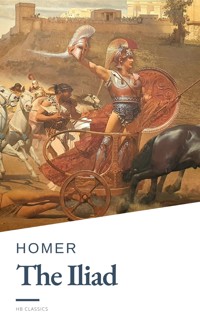
- Illustrated Edition with 20 stunning illustrations that bring the epic to life
- Includes a clear and engaging summary of The Iliad
- Contains a comprehensive character list for easy reference
- Features a concise biography of Homer, the legendary poet
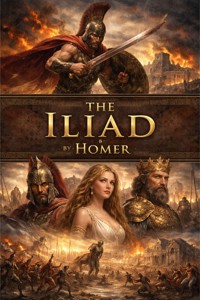
The Iliad is a timeless epic of war, honor, rage, and humanity, centered on the legendary Trojan War and the fiery wrath of Achilles—the greatest warrior of the Greeks. When pride and power collide, heroes rise, kingdoms tremble, and fate unfolds under the watchful eyes of the gods.
More than a tale of battle, The Iliad explores the deepest emotions of the human soul: grief, loyalty, love, and the devastating cost of anger. Through unforgettable characters such as Hector, Achilles, Helen, and Agamemnon, Homer reveals that even the mightiest heroes are bound by mortality and moral struggle.
This beautifully crafted illustrated edition enhances the reading experience with 20 evocative illustrations, making the ancient world vivid and accessible for modern readers. Whether you are discovering this masterpiece for the first time or revisiting it as a classic, the added summary, character guide, and author biography ensure clarity, context, and deeper appreciation.
Perfect for students, literature lovers, and classic collectors, this public domain edition honors the power of one of the foundations of Western literature—an epic that has endured for nearly three thousand years and still speaks to the heart today.
Experience the epic that defined heroism, shaped storytelling, and changed literature forever.
Das E-Book können Sie in Legimi-Apps oder einer beliebigen App lesen, die das folgende Format unterstützen:
Veröffentlichungsjahr: 2026
0,0
Bewertungen werden von Nutzern von Legimi sowie anderen Partner-Webseiten vergeben.
Legimi prüft nicht, ob Rezensionen von Nutzern stammen, die den betreffenden Titel tatsächlich gekauft oder gelesen/gehört haben. Wir entfernen aber gefälschte Rezensionen.
Ähnliche






The Iliad By Homer
ABOUT HOMER
Homer stands at the threshold of Western literature like a half-lit doorway—inviting, immense, and ultimately unknowable. Traditionally placed in ancient Greece around the 8th century BCE, Homer is credited with two monumental epics, The Iliad and The Odyssey, works that shaped not only Greek culture but the literary imagination of the world for millennia.
What makes Homer unique is not just the grandeur of his stories, but the mystery of his existence. Ancient sources described him as a blind bard, wandering from city to city, singing of gods and heroes. Modern scholars debate whether “Homer” was a single poet, a master editor, or a name given to a long oral tradition refined over generations. Yet this uncertainty has only deepened his legacy: Homer is less a man than a voice—one that carries the memory of an entire civilization.
His poetry emerged from an oral tradition, composed to be heard rather than read. Formulaic phrases, repeated epithets like “swift-footed Achilles” or “rosy-fingered Dawn,” and rhythmic structure allowed the epics to live in performance, reshaped slightly each time they were sung. Through this method, Homer captured not only epic battles and perilous journeys, but also deeply human emotions: rage, grief, loyalty, cunning, longing for home.
In The Iliad, Homer explores the devastating cost of pride and anger against the backdrop of the Trojan War, focusing on a brief but explosive moment of conflict. In The Odyssey, he turns inward, telling a story of endurance, intelligence, and identity, as Odysseus struggles for ten years to return home. Together, the poems balance brutality with tenderness, heroism with vulnerability.
Whether Homer was one man or many, his influence is singular. From ancient Greek education to Roman poets, from Dante to modern novels and films, his stories continue to echo. Homer’s true biography, then, is written not in dates or places, but in the countless retellings of his tales—proof that a voice born in antiquity can remain alive as long as humans tell stories.
SUMMARY
The Iliad is a thunderous tale of war, honor, and the fragile line between glory and ruin, set during the final days of the Trojan War. Rather than telling the entire conflict, Homer plunges us into its most explosive moment—the wrath of Achilles, the greatest warrior of the Greeks.
When Achilles is dishonored by his commander Agamemnon, his pride ignites a chain of devastation. As he withdraws from battle, the tides of war turn brutally against the Greeks, allowing Hector, noble defender of Troy, to rise as a tragic hero. Gods descend from Olympus to meddle in mortal affairs, amplifying passions, rivalries, and fate itself, while the battlefield becomes a stage for courage, cruelty, and heartbreaking loss.
At its core, The Iliad is not just about war—it is about the cost of anger, the meaning of honor, and the shared humanity of enemies. In moments of startling tenderness, Homer reminds us that behind every shield is a beating heart, and behind every victory, a wound that may never heal.
Epic in scale yet intimate in emotion, The Iliad endures because it speaks timeless truths: that pride can destroy the mighty, compassion can rise amid carnage, and even in war’s darkest hours, humanity still flickers.
CHARACTERS LIST
Greek (Achaean) Heroes
Achilles
The greatest Greek warrior. Fierce, nearly invincible, and driven by pride and rage. His anger shapes the entire epic.
Agamemnon
King of Mycenae and leader of the Greek army. Powerful but arrogant, his conflict with Achilles triggers disaster.
Patroclus
Achilles’ closest companion. Kind-hearted and brave, his death becomes the emotional turning point of the story.
Odysseus
Clever, eloquent, and strategic. Known for intelligence rather than brute strength.
Ajax the Great
A towering warrior second only to Achilles in strength. Symbol of courage and steadfast honor.
Menelaus
King of Sparta and husband of Helen. The Trojan War is fought to reclaim her.
Nestor
An aged king and wise counselor, respected for his experience and judgment.
Trojan Heroes
Hector
Prince of Troy and its greatest defender. Noble, loyal, and compassionate—a tragic hero.
Priam
King of Troy. A dignified and sorrowful father who embodies human suffering in war.
Paris
Prince of Troy whose abduction of Helen sparks the war. Handsome but often seen as cowardly.
Aeneas
A brave Trojan warrior favored by the gods, destined for greatness beyond Troy.
Andromache
Hector’s devoted wife, representing the pain of war on families and civilians.
Helen
The most beautiful woman in the world. Torn between guilt, longing, and fate.
Gods and Goddesses
Zeus
King of the gods. Tries to maintain balance while allowing fate to unfold.
Athena
Goddess of wisdom and war strategy. Strong supporter of the Greeks.
Hera
Queen of the gods. Bitter enemy of Troy.
Apollo
God of prophecy and archery. Protector of Troy, brings plague upon the Greeks.
Aphrodite
Goddess of love. Protector of Paris and Helen.
Ares
God of war. Embodies chaos and bloodshed on the battlefield.
Why These Characters Matter
Each character in The Iliad represents more than a role—they embody honor, rage, love, fate, pride, and loss, making the epic timeless and deeply human.
Table of Contents
Titlepage
Imprint
Preface
The Iliad
Book I: The Contention of Achilles and Agamemnon
Book II: The Trial of the Army, and Catalogue of the Forces
Book III: Single Combat of Menelaus and Paris
Book IV: The Breaking of the Truce, and the First Battle
Book V: The Exploits of Diomed
Book VI: Interviews Between Glaucus and Diomed, and Hector and Andromache
Book VII: The Combat of Hector and Ajax
Book VIII: The Second Battle
Book IX: The Embassy to Achilles
Book X: The Night-Adventure of Diomed and Ulysses
Book XI: The Third Battle, and Exploits of Agamemnon
Book XII: The Battle at the Grecian Wall
Book XIII: The Continuation of the Fourth Battle
Book XIV: The Fraud Practised on Jupiter by Juno
Book XV: The Fifth Battle at the Ships
Book XVI: The Sixth Battle—Death of Patroclus
Book XVII: The Seventh Battle
Book XVIII: The Grief of Achilles for the Death of Patroclus
Book XIX: The Reconciliation of Achilles and Agamemnon
Book XX: The Battle of the Gods
Book XXI: The Battle in the River Scamander
Book XXII: The Death of Hector
Book XXIII: The Funeral of Patroclus
Book XXIV: The Body of Hector Recovered
Colophon
Uncopyright
Preface
Having now nearly completed my translation of the Iliad of Homer, I sit down to write the Preface, that it may be prefixed to the first volume. To this task of translation, which I began in 1865, I afterwards gave myself the more willingly because it helped in some measure to divert my mind from a great domestic sorrow. I am not sure that, when it shall be concluded, it may not cost me some regret to part with so interesting a companion as the old Greek poet, whose thoughts I have, for four years past, been occupied, though with interruptions, in the endeavor to transfer from his own grand and musical Greek to our less sonorous but still manly and flexible tongue.
In what I shall say of my own translation I do not mean to speak in disparagement of any of the previous English versions of the Iliad, nor to extenuate my obligations to some of them. I acknowledge that although Homer is, as Cowper has well observed, the most perspicuous of poets, I have been sometimes, perhaps often, guided by the labors of my predecessors to a better mode of dealing with certain refractory passages of my author than I should otherwise have found. Let me, without detracting from their merits, state what I have endeavored to do. I have endeavored to be strictly faithful in my rendering; to add nothing of my own, and to give the reader, so far as our language would allow, all that I found in the original. There are, however, in Homer, frequently recurring, certain expressions which are merely a kind of poetical finery, introduced when they are convenient to fill out a line or to give it a sonorous termination, and omitted when they are not needed for this purpose. The Greeks, for example, almost whenever they are spoken of, are magnanimous, or valiant, or warlike, or skilled in taming steeds: the Trojans are magnanimous also, and valiant, and warlike, and equally eminent in horsemanship. The warriors of the Iliad are all sons of some magnanimous or warlike parent. Achilles is the son of Peleus, and Peleus is magnanimous; and these epithets are repeated upon page after page throughout the poem. Achilles is spoken of as swift-footed or godlike almost whenever he appears, and sometimes is honored by both epithets. Hector is illustrious, and knightly, and distinguished by his beamy crest. Even the coxcomb Paris, for whom Homer seems to entertain a proper contempt, is godlike. These complimentary additions to the name of the warrior are, however, dispensed with whenever the hexameter is rounded to a well-sounding conclusion without them. Where they appear in the Greek, I have in nearly all instances retained them, making Achilles swift-footed and Ulysses fertile in resources, to the end of the poem; but in a very few cases, where they embarrassed the versification, I have used the liberty taken by Homer himself, and left them out. Everywhere else it has been my rule not to exclude from the translation anything which I found in the text of my author.
There is another point in regard to which I have taken equal pains, and which seems to me equally important. I have endeavored to preserve the simplicity of style which distinguishes the old Greek poet, who wrote for the popular ear and according to the genius of his language, and I have chosen such English as offers no violence to the ordinary usages and structure of our own. I have sought to attain what belongs to the original—a fluent narrative style, which shall carry the reader forward without the impediment of unexpected inversions and capricious phrases, and in which, if he find nothing to stop at and admire, there will at least be nothing to divert his attention from the story and the characters of the poem, from the events related and the objects described. I think that not many readers of the present day would agree with Pope, who, as Spence relates, after remarking that he had nothing to say for rhyme, went on to observe that he doubted whether a poem could be supported without it in our language, unless it were stiffened with such strange words as would destroy our language itself. It is remarkable that this should have been said by one who had given the reading world an edition of Shakespeare, in whose dramas are to be found passages of blank verse which might be instanced as the perfection of that form of versification—not to be excelled in sweetness of modulation, and grace and freedom of language—without a single harsh inversion, or any of that clumsy stiffening which Pope so disapproved, yet seemed to think so necessary. The other dramatists of the Elizabethan period also supply examples of the same noble simplicity of language and construction, suited to the highest poetry. In this translation the natural order of the words has been carefully preserved, as far as the exigencies of versification would allow, and I have ventured only upon those easy deviations from it which form no interruptions to the sense, and at most only remind the reader that he is reading verse.
I have chosen blank verse for this reason among others, that it enabled me to keep more closely to the original in my rendering, without any sacrifice either of ease or of spirit in the expression. The use of rhyme in a translation is a constant temptation to petty infidelities, and to the employment of expressions which have an air of constraint, and do not the most adequately convey the thought. I had my reasons also for not adopting the ballad measure, which some have thought to allow the nearest approach to the manner of Homer. There are, it is true, certain affinities between the style of Homer and that of the old ballad poems of Great Britain. Both were the productions of a rude age; both were composed to be sung to public audiences; and this gave occasion to certain characteristics in which they resemble each other. But the Homeric poems, as it seems to me, are beyond the popular ballads of any modern nation in reach of thought and in richness of phraseology; and if I had adopted that form of poetry there would have been, besides the disadvantage of rhyme, a temptation to make the version conform in style and spirit to the old ballads of our own literature, in a degree which the original does not warrant, and which, as I think, would lead to some sacrifice of its dignity. I did not adopt the hexameter verse, principally for the reason that in our language it is confessedly an imperfect form of versification, the true rhythm of which it is difficult for those whose ear is accustomed only to our ordinary metres to perceive. I found that I could not possibly render the Greek hexameters line for line, like Voss in his marvellous German version, in which he has not only done this, but generally preserved the pauses in the very part of the line in which Homer placed them. We have so many short words in English, and so few of the connective particles which are lavishly used by Homer, that often when I reached the end of the Greek line I found myself only in the middle of my line in English. This difficulty of subduing the thought—by compression or expansion of phrase—to the limits it must fill would alone have been sufficient to deter me from attempting a translation in hexameters. I therefore fell back upon blank verse, which has been the vehicle of some of the noblest poetry in our language; both because it seemed to me by the flexibility of its construction best suited to a narrative poem, and because, while it enabled me to give the sense of my author more perfectly than any other form of verse, it allowed me also to avoid in a greater degree the appearance of constraint which is too apt to belong to a translation.
I make no apology for employing in my version the names Jupiter, Juno, Venus, and others of Latin origin, for Zeus, Hera, Aphrodite, and other Greek names of the deities of whom Homer speaks. The names which I have adopted have been naturalized in our language for centuries, and some of them, as Mercury, Vulcan, and Dian, have even been provided with English terminations. I was translating from Greek into English, and I therefore translated the names of the gods, as well as the other parts of the poem.
In explanation of what may appear to some readers an unauthorized abridgment of the famous simile of the moon and stars at the end of the Eighth Book, I will mention here, by way of note—the only one which I shall have occasion to make—that in translating I have omitted two lines of the text, which the best critics regard as not properly belonging to it, but as transferred by some interpolator from another simile in the Sixteenth Book, where they are found in their proper place.
In the intimate acquaintance with the Iliad which the work of translation has given me, an impression has been revived which was made upon my mind when in my boyhood I first read that poem in an English version. I recollect very well the eager curiosity with which I seized upon the translation of Pope when it came within my reach, and with what avidity I ran through the pages which rendered into our language what was acknowledged to be the greatest production of poetic genius that the world had seen. I read with a deep interest for the fate of Troy, and with a kindly feeling toward Hector, whose part I took warmly against the bloodthirsty Achilles; and great as might have been the guilt of Paris, I read with an earnest wish that Troy might be delivered from its besiegers. When I came to the end of the poem, I laid it down with a feeling of disappointment. I was not told, save in certain dim predictions, what became of Troy, which the Greeks had mustered from so many regions to besiege, nor what was the fate of the mild and venerable Priam, and the aged Hecuba, and Andromache, the gentle and affectionate wife, and her infant son—personages for whose fortunes the poet had so powerfully awakened my concern and my curiosity. Helen, to recover whom the war was waged, was still in Troy, and Paris, her effeminate husband, was still alive and unharmed. Why the Trojans, who hated Paris—why Hector and the other sons of Priam, who disapproved of their brother’s conduct—why Priam himself, who is never said to have approved of it, did not insist that the seducer should restore Helen to her first and proper husband, for whom she seems to have still entertained a lingering regard, I could never imagine. Particularly strange it seemed that Paris was not forced by his countrymen to give up Helen after the combat between him and Menelaus, in which he was clearly overcome, and by the terms of the solemn treaty which preceded the duel was bound to restore his stolen bride and her wealth to the Greeks. The poet has chosen to leave that circumstance without adequate explanation. The breaking of the truce by Pandarus, and the sudden renewal of the war in consequence, does not explain it, for afterwards, in the Seventh Book, we have Antenor proposing, in council, to restore Helen and her wealth, as a certain way of ending the war—a proposal which is not adopted simply because Paris objects to it. Paris would not consent to restore Helen, and the Trojan princes and leaders, as if Paris were their absolute monarch, allowed him to have his way, and to prolong a war which Hector foresaw—as he says in the famous interview with Andromache—was to end in the destruction of Troy. The impression to which I refer has been confirmed by the minute study which I have recently made of the poem. I can make nothing of it but a detached chapter of the poetic history of the Trojan war—an episode in the narrative of that long siege which was to be concluded by a greater event than any recorded in the Iliad, the taking of the city of Troy;—a work of an inexhaustible imagination, with characters vigorously drawn and finely discriminated, and incidents rapidly succeeding each other and infinitely diversified—everywhere a noble simplicity, mellifluous numbers, and images of beauty and grandeur; yet everywhere indications that the poem had a continuation. It is full of references to events which are yet to be related, and provokes a desire for further disclosures, which it fails to gratify. There are frequent allusions to the brief term of life allotted to Achilles, and several, one of which I have already mentioned, to the final capture of Troy. Thetis predicts that her son, perishing almost immediately after taking the life of Hector, will not live to see the fall of the besieged city. The audiences before whom the books of the Iliad were recited by the minstrels would naturally say: “You speak of the capture of Troy; tell us how it was taken at last. Achilles, the mightiest of warriors, you say, was to be slain soon after the death of Hector. Relate the manner of his death, and how it was received by the Greeks and the Trojans. Describe his funeral, as you described those of his friend Patroclus and his adversary Hector. Tell us what became of Andromache, and Astyanax, her son, and all the royal family of Priam.” Thus may we suppose that, until Aristotle arose to demonstrate the contrary, the fable of the Iliad must have appeared to the general mind to be incomplete.
Let me say a word or two of the personage whom the critics call the hero of the Iliad. Achilles is ill-used by Agamemnon, the general-in-chief of the Greeks—and so far he has the sympathy of the reader; but he is a ferocious barbarian at best, and as the narrative proceeds, he loses all title to our interest. His horrid prayer that the Greeks may be slaughtered by thousands until they learn to despise a monarch who has done him a personal injury, and his inhuman delight in the havoc made of them by the Trojans under Hector, cause us to turn from him with the horror and aversion due to a selfish and cruel nature which imposes no reserve or restraint upon its own impulses. His warm affection for his gentle friend and companion, Patroclus, partly restores him to our favor; but his pitiless treatment of the Trojans who supplicate him for quarter, and his capture of twelve Trojan youths in order to cut their throats at the funeral pile of Patroclus, as he afterwards does in cold blood, bring back our disgust; and when Hector with his dying voice warns him of his approaching death, the reader has no objection to offer. If Achilles be the hero of the poem, the poet has not succeeded in obtaining for him either our good opinion or our good wishes. In the fortunes of Hector, however, whose temper is noble and generous, who while grieving at the crime of Paris defends his country with all his valor, whose character is as gentle and affectionate as it is spirited and manly, it is impossible for the reader not to feel a strong interest. The last book of the Iliad relates the recovery of his dead body from the Greeks, and the celebration of his funeral in Troy. In this book, also, the character of Achilles appears less unamiable, since he grants the rites of hospitality to Priam, and is persuaded by his entreaties to restore, for a princely ransom, the dead body of Hector, contrary to his first resolution. It is to be observed, however, that he is moved to this, not by his own native magnanimity, but by considerations which indirectly relate to himself—that is to say, by being artfully led to think of his own father, Peleus, an aged man like Priam, anxiously waiting in his distant palace for the return of his son from the war, and fearing that he may never behold him again. Once in the interview with Priam the fierce and brutal nature of Achilles breaks out in threats, which terrify the old king into silence. Priam is himself warned by the gods that he is not safe in remaining overnight in the tent of Achilles, and, lest he should not be protected from the ferocity of Agamemnon, withdraws by stealth in the darkness and returns to Troy.
I have no answer to make to those who regard it as a blemish in the great work of Homer that he represents the gods in their dealings with men as governed, for the most part, by motives either mean and base, or frivolous and childish. In the Trojan war everything happens by their direction or their prompting. In the system of Homer it is they who stir up men to strife, who bring on the battles, promote the slaughter, and bring it to an end, urge the personages of the fable to ruinous follies and imprudences, and give or withhold victory at their pleasure; and in all this their rule is not one of justice and beneficence, but of caprice. Their favor is purchased by hecatombs, and their hatred incurred by acts which have no moral quality that should give offence to an upright judge. They are debauched, mercenary, rapacious, and cruel; they dwell in a world in which the rules of right and the maxims necessary to the well-being of human society find no recognition. It was for this reason that Plato, the earliest author of an Index expurgatorius, forbade the circulation of the writings of the Greek poets in his imaginary commonwealth.
Yet let me say this in favor of my author, that in one part of the poem the absolute rectitude of the Divine government is solemnly recognized. In the Third Book of the Iliad, a truce is agreed upon between the Trojans and the Greeks, while Menelaus and Paris are to decide by single combat the quarrel which has occasioned the siege of Troy. A compact is made, according to which the victor is to possess Helen and her wealth, and the Trojans and Greeks are ever afterward to remain friends and allies. The gods are invoked to be witnesses of the treaty, and to pursue with their vengeance those by whom it shall be violated, whether they be Greeks or Trojans. Few passages in the Iliad are more striking or of graver import than this appeal to the justice of the gods—this testimony, given by two warring nations, of their confidence in the equity with which the immortals govern the world. Paris is overcome by Menelaus in the combat; the truce is broken by a Trojan, who wounds Menelaus severely; the treaty is not fulfilled by delivering up Helen; and, as the action of the poem proceeds in the next book, Agamemnon exhorts the Greeks to fight valiantly, in the full assurance that Jupiter and the other gods will never permit treachery to remain unpunished; and accordingly he predicts a terrible retribution already hanging over Troy. And whatever may be our admiration for the amiable and noble qualities of Hector, and our sympathy for the thousands of innocent persons dwelling in his populous city, it cannot be denied that the interference of the gods in the affairs of Troy leads in the end to a great result consistent with substantial justice. Paris, the violator of the laws of hospitality, the adulterer and robber, is sheltered, protected, and countenanced in Troy—the Trojan people make themselves partakers in his guilt; and in the end they share in its punishment. Hector, the prop of their state, the champion in whom they put their trust, is slain; and we are allowed, by means of predictions, a glimpse of the coming destruction of Troy, and learn that the sceptre of the kingdom will pass from the house of Priam, whose son committed the crime which led to the war, and will be swayed by the posterity of the blameless Aeneas.
Here I leave my translation in the hands of the reading public, who, if they do not wholly neglect it, will judge whether I have made any approach toward the fulfilment of the design set forth in the beginning of this Preface.
W. C. Bryant
December, 1869.
The Iliad
Book I
The Contention of Achilles and Agamemnon
The visit of Chryses, Priest of Apollo, to Agamemnon, asking the ransom of his daughter—Refusal of Agamemnon—A pestilence sent by Apollo upon the Greek army—A Council called by Achilles—The cause of the pestilence declared by the Seer Calchas—Dispute between Agamemnon and Achilles, which ends with the taking away of Briseis from Achilles—The daughter of Chryses restored to him—Visit of Thetis to Jupiter, who promises to avenge Achilles—Mutual chiding of Jupiter and Juno.
O Goddess! Sing the wrath of Peleus’ son,
Achilles; sing the deadly wrath that brought
Woes numberless upon the Greeks, and swept
To Hades many a valiant soul, and gave
Their limbs a prey to dogs and birds of air—
For so had Jove appointed—from the time
When the two chiefs, Atrides, king of men,
And great Achilles, parted first as foes.
Which of the gods put strife between the chiefs,
That they should thus contend? Latona’s son
And Jove’s. Incensed against the king, he bade
A deadly pestilence appear among
The army, and the men were perishing.
For Atreus’ son with insult had received
Chryses the priest, who to the Grecian fleet
Came to redeem his daughter, offering
Uncounted ransom. In his hand he bore
The fillets of Apollo, archer-god,
Upon the golden sceptre, and he sued
To all the Greeks, but chiefly to the sons
Of Atreus, the two leaders of the host:—
“Ye sons of Atreus, and ye other chiefs,
Well-greaved Achaians, may the gods who dwell
Upon Olympus give you to o’erthrow
The city of Priam, and in safety reach
Your homes; but give me my beloved child,
And take her ransom, honoring him who sends
His arrows far, Apollo, son of Jove.”
Then all the other Greeks, applauding, bade
Revere the priest and take the liberal gifts
He offered, but the counsel did not please
Atrides Agamemnon; he dismissed
The priest with scorn, and added threatening words:—
“Old man, let me not find thee loitering here,
Beside the roomy ships, or coming back
Hereafter, lest the fillet thou dost bear
And sceptre of thy god protect thee not.
This maiden I release not till old age
Shall overtake her in my Argive home,
Far from her native country, where her hand
Shall throw the shuttle and shall dress my couch.
Go, chafe me not, if thou wouldst safely go.”
He spake; the aged man in fear obeyed
The mandate, and in silence walked apart,
Along the many-sounding ocean-side,
And fervently he prayed the monarch-god,
Apollo, golden-haired Latona’s son:—
“Hear me, thou bearer of the silver bow,
Who guardest Chrysa, and the holy isle
Of Cilia, and art lord in Tenedos,
O Smintheus! If I ever helped to deck
Thy glorious temple, if I ever burned
Upon thy altar the fat thighs of goats
And bullocks, grant my prayer, and let thy shafts
Avenge upon the Greeks the tears I shed.”
So spake he supplicating, and to him
Phoebus Apollo hearkened. Down he came,
Down from the summit of the Olympian mount,
Wrathful in heart; his shoulders bore the bow
And hollow quiver; there the arrows rang
Upon the shoulders of the angry god,
As on he moved. He came as comes the night,
And, seated from the ships aloof, sent forth
An arrow; terrible was heard the clang
Of that resplendent bow. At first he smote
The mules and the swift dogs, and then on man
He turned the deadly arrow. All around
Glared evermore the frequent funeral piles.
Nine days already had his shafts been showered
Among the host, and now, upon the tenth,
Achilles called the people of the camp
To council. Juno, of the snow-white arms,
Had moved his mind to this, for she beheld
With sorrow that the men were perishing.
And when the assembly met and now was full,
Stood swift Achilles in the midst and said:—
“To me it seems, Atrides, that ’twere well,
Since now our aim is baffled, to return
Homeward, if death o’ertake us not; for war
And pestilence at once destroy the Greeks.
But let us first consult some seer or priest,
Or dream-interpreter—for even dreams
Are sent by Jove—and ask him by what cause
Phoebus Apollo has been angered thus;
If by neglected vows or hecatombs,
And whether savor of fat bulls and goats
May move the god to stay the pestilence.”
He spake, and took again his seat; and next
Rose Calchas, son of Thestor, and the chief
Of augurs, one to whom were known things past
And present and to come. He, through the art
Of divination, which Apollo gave,
Had guided Iliumward the ships of Greece.
With words well ordered courteously he spake:—
“Achilles, loved of Jove, thou biddest me
Explain the wrath of Phoebus, monarch-god,
Who sends afar his arrows. Willingly
Will I make known the cause; but covenant thou,
And swear to stand prepared, by word and hand,
To bring me succor. For my mind misgives
That he who rules the Argives, and to whom
The Achaian race are subject, will be wroth.
A sovereign is too strong for humbler men,
And though he keep his choler down awhile,
It rankles, till he sate it, in his heart.
And now consider: wilt thou hold me safe?”
Achilles, the swift-footed, answered thus:—
“Fear nothing, but speak boldly out whate’er
Thou knowest, and declare the will of Heaven.
For by Apollo, dear to Jove, whom thou,
Calchas, dost pray to, when thou givest forth
The sacred oracles to men of Greece,
No man, while yet I live, and see the light
Of day, shall lay a violent hand on thee
Among our roomy ships; no man of all
The Grecian armies, though thou name the name
Of Agamemnon, whose high boast it is
To stand in power and rank above them all.”
Encouraged thus, the blameless seer went on:—
“ ’Tis not neglected vows or hecatombs
That move him, but the insult shown his priest,
Whom Agamemnon spurned, when he refused
To set his daughter free, and to receive
Her ransom. Therefore sends the archer-god
These woes, and still will send them on the Greeks,
Nor ever will withdraw his heavy hand
From our destruction, till the dark-eyed maid
Freely, and without ransom, be restored
To her beloved father, and with her
A sacred hecatomb to Chrysa sent.
So may we haply pacify the god.”
Thus having said, the augur took his seat.
And then the hero-son of Atreus rose,
Wide-ruling Agamemnon, greatly chafed.
His gloomy heart was full of wrath, his eyes
Sparkled like fire; he fixed a menacing look
Full on the augur Calchas, and began:—
“Prophet of evil! Never hadst thou yet
A cheerful word for me. To mark the signs
Of coming mischief is thy great delight.
Good dost thou ne’er foretell nor bring to pass.
And now thou pratest, in thine auguries,
Before the Greeks, how that the archer-god
Afflicts us thus, because I would not take
The costly ransom offered to redeem
The virgin child of Chryses. ’Twas my choice
To keep her with me, for I prize her more
Than Clytemnestra, bride of my young years,
And deem her not less nobly graced than she,
In form and feature, mind and pleasing arts.
Yet will I give her back, if that be best;
For gladly would I see my people saved
From this destruction. Let meet recompense,
Meantime, be ready, that I be not left,
Alone of all the Greeks, without my prize.
That were not seemly. All of you perceive
That now my share of spoil has passed from me.”
To him the great Achilles, swift of foot,
Replied: “Renowned Atrides, greediest
Of men, where wilt thou that our noble Greeks
Find other spoil for thee, since none is set
Apart, a common store? The trophies brought
From towns which we have sacked have all been shared
Among us, and we could not without shame
Bid every warrior bring his portion back.
Yield, then, the maiden to the god, and we,
The Achaians, freely will appoint for thee
Threefold and fourfold recompense, should Jove
Give up to sack this well-defended Troy.”
Then the king Agamemnon answered thus:—
“Nay, use no craft, all valiant as thou art,
Godlike Achilles; thou hast not the power
To circumvent nor to persuade me thus.
Think’st thou that, while thou keepest safe thy prize,
I shall sit idly down, deprived of mine?
Thou bid’st me give the maiden back. ’Tis well,
If to my hands the noble Greeks shall bring
The worth of what I lose, and in a shape
That pleases me. Else will I come myself,
And seize and bear away thy prize, or that
Of Ajax or Ulysses, leaving him
From whom I take his share with cause for rage.
Another time we will confer of this.
Now come, and forth into the great salt sea
Launch a black ship, and muster on the deck
Men skilled to row, and put a hecatomb
On board, and let the fair-cheeked maid embark,
Chryseis. Send a prince to bear command—
Ajax, Idomeneus, or the divine
Ulysses;—or thyself, Pelides, thou
Most terrible of men, that with due rites
Thou soothe the anger of the archer-god.”
Achilles the swift-footed, with stern look,
Thus answered: “Ha, thou mailed in impudence
And bent on lucre! Who of all the Greeks
Can willingly obey thee, on the march,
Or bravely battling with the enemy?
I came not to this war because of wrong
Done to me by the valiant sons of Troy.
No feud had I with them; they never took
My beeves or horses, nor, in Phthia’s realm,
Deep-soiled and populous, spoiled my harvest fields.
For many a shadowy mount between us lies,
And waters of the wide-resounding sea.
Man unabashed! We follow thee that thou
Mayst glory in avenging upon Troy
The grudge of Menelaus and thy own,
Thou shameless one! And yet thou hast for this
Nor thanks nor care. Thou threatenest now to take
From me the prize for which I bore long toils
In battle; and the Greeks decreed it mine.
I never take an equal share with thee
Of booty when the Grecian host has sacked
Some populous Trojan town. My hands perform
The harder labors of the field in all
The tumult of the fight; but when the spoil
Is shared, the largest share of all is thine,
While I, content with little, seek my ships,
Weary with combat. I shall now go home
To Phthia; better were it to return
With my beaked ships; but here, where I am held
In little honor, thou wilt fail, I think,
To gather, in large measure, spoil and wealth.”
Him answered Agamemnon, king of men:—
“Desert, then, if thou wilt; I ask thee not
To stay for me; there will be others left
To do me honor yet, and, best of all,
The all-providing Jove is with me still.
Thee I detest the most of all the men
Ordained by him to govern; thy delight
Is in contention, war, and bloody frays.
If thou art brave, some deity, no doubt,
Hath thus endowed thee. Hence, then, to thy home,
With all thy ships and men! There domineer
Over thy Myrmidons; I heed thee not,
Nor care I for thy fury. Thus, in turn,
I threaten thee; since Phoebus takes away
Chryseis, I will send her in my ship
And with my friends, and, coming to thy tent,
Will bear away the fair-cheeked maid, thy prize,
Briseis, that thou learn how far I stand
Above thee, and that other chiefs may fear
To measure strength with me, and brave my power.”
The rage of Peleus’ son, as thus he spake,
Grew fiercer; in that shaggy breast his heart
Took counsel, whether from his thigh to draw
The trenchant sword, and, thrusting back the rest,
Smite down Atrides, or subdue his wrath
And master his own spirit. While he thus
Debated with himself, and half unsheathed
The ponderous blade, Pallas Athene came,
Sent from on high by Juno, the white-armèd,
Who loved both warriors and made both her care.
She came behind him, seen by him alone,
And plucked his yellow hair. The hero turned
In wonder, and at once he knew the look
Of Pallas and the awful-gleaming eye,
And thus accosted her with wingèd words:—
“Why com’st thou hither, daughter of the god
Who bears the aegis? Art thou here to see
The insolence of Agamemnon, son
Of Atreus? Let me tell thee what I deem
Will be the event. That man may lose his life,
And quickly too, for arrogance like this.”
Then thus the goddess, blue-eyed Pallas, spake:—
“I came from heaven to pacify thy wrath,
If thou wilt heed my counsel. I am sent
By Juno the white-armed, to whom ye both
Are dear, who ever watches o’er you both.
Refrain from violence; let not thy hand
Unsheathe the sword, but utter with thy tongue
Reproaches, as occasion may arise,
For I declare what time shall bring to pass;
Threefold amends shall yet be offered thee,
In gifts of princely cost, for this day’s wrong.
Now calm thy angry spirit, and obey.”
Achilles, the swift-footed, answered thus:—
“O goddess, be the word thou bring’st obeyed,
However fierce my anger; for to him
Who hearkens to the gods, the gods give ear.”
So speaking, on the silver hilt he stayed
His strong right hand, and back into its sheath
Thrust his good sword, obeying. She, meantime,
Returned to heaven, where aegis-bearing Jove
Dwells with the other gods. And now again
Pelides, with opprobrious words, bespake
The son of Atreus, venting thus his wrath:—
“Wine-bibber, with the forehead of a dog
And a deer’s heart! Thou never yet hast dared
To arm thyself for battle with the rest,
Nor join the other chiefs prepared to lie
In ambush—such thy craven fear of death.
Better it suits thee, midst the mighty host
Of Greeks, to rob some warrior of his prize
Who dares withstand thee. King thou art, and yet
Devourer of thy people. Thou dost rule
A spiritless race, else this day’s insolence,
Atrides, were thy last. And now I say,
And bind my saying with a mighty oath:
By this my sceptre, which can never bear
A leaf or twig, since first it left its stem
Among the mountains—for the steel has pared
Its boughs and bark away, to sprout no more—
And now the Achaian judges bear it—they
Who guard the laws received from Jupiter,
Such is my oath—the time shall come when all
The Greeks shall long to see Achilles back,
While multitudes are perishing by the hand
Of Hector, the man-queller; thou, meanwhile,
Though thou lament, shalt have no power to help,
And thou shalt rage against thyself to think
That thou hast scorned the bravest of the Greeks.
As thus he spake, Pelides to the ground
Flung the gold-studded wand, and took his seat.
Fiercely Atrides raged; but now uprose
Nestor, the master of persuasive speech,
The clear-toned Pylian orator, whose tongue
Dropped words more sweet than honey. He had seen
Two generations that grew up and lived
With him on sacred Pylos pass away,
And now he ruled the third. With prudent words
He thus addressed the assembly of the chiefs:—
“Ye gods! What new misfortunes threaten Greece!
How Priam would exult and Priam’s sons,
And how would all the Trojan race rejoice,
Were they to know how furiously ye strive—
Ye who in council and in fight surpass
The other Greeks. Now hearken to my words—
Ye who are younger than myself—for I
Have lived with braver men than you, and yet
They held me not in light esteem. Such men
I never saw, nor shall I see again—
Men like Pirithoüs and like Druas, lord
Of nations, Caeneus and Exadius,
And the great Polypheme, and Theseus, son
Of Aegeus, likest to the immortal gods.
Strongest of all the earth-born race they fought—
The strongest with the strongest of their time—
With Centaurs, the wild dwellers of the hills,
And fearfully destroyed them. With these men
Did I hold converse, coming to their camp
From Pylos in a distant land. They sent
To bid me join the war, and by their side
I fought my best, but no man living now
On the wide earth would dare to fight with them.
Great as they were, they listened to my words
And took my counsel. Hearken also ye,
And let my words persuade you for the best.
Thou, powerful as thou art, take not from him
The maiden; suffer him to keep the prize
Decreed him by the sons of Greece; and thou,
Pelides, strive no longer with the king,
Since never Jove on sceptred prince bestowed
Like eminence to his. Though braver thou,
And goddess-born, yet hath he greater power
And wider sway. Atrides, calm thy wrath—
’Tis I who ask—against the chief who stands
The bulwark of the Greeks in this fierce war.”
To him the sovereign Agamemnon said:—
“The things which thou hast uttered, aged chief,
Are fitly spoken; but this man would stand
Above all others; he aspires to be
The master, over all to domineer,
And to direct in all things; yet, I think,
There may be one who will not suffer this.
For if by favor of the immortal gods
He was made brave, have they for such a cause
Given him the liberty of insolent speech?”
Hereat the great Achilles, breaking in,
Answered: “Yea, well might I deserve the name
Of coward and of wretch, should I submit
In all things to thy bidding. Such commands
Lay thou on others, not on me; nor think
I shall obey thee longer. This I say—
And bear it well in mind—I shall not lift
My hand to keep the maiden whom ye gave
And now take from me; but whatever else
May be on board that swift black ship of mine,
Beware thou carry not away the least
Without my leave. Come, make the trial now,
That these may see thy black blood bathe my spear.
Then, rising from that strife of words, the twain
Dissolved the assembly at the Grecian fleet.
Pelides to his tents and well manned ships
Went with Patroclus and his warrior friends,
While Agamemnon bade upon the sea
Launch a swift barque with twenty chosen men
To ply the oar, and put a hecatomb
Upon it for the god. He thither led
The fair-cheeked maid Chryseis; the command
He gave to wise Ulysses; forth they went,
Leader and crew, upon their watery path.
Meanwhile, he bade the camp be purified;
And straight the warriors purified the camp,
And, casting the pollutions to the waves,
They burned to Phoebus chosen hecatombs
Of bulls and goats beside the barren main,
From which the savor rose in smoke to heaven.
So was the host employed. But not the less
Did Agamemnon persevere to urge
His quarrel with Pelides; and he thus
Addressed Talthybius and Eurybates.
His heralds and his faithful ministers:—
“Go ye to where Achilles holds his tent,
And take the fair Briseis by the hand,
And bring her hither. If he yield her not,
I shall come forth to claim her with a band
Of warriors, and it shall be worse for him.”
He spake, and sent them forth with added words
Of menace. With unwilling steps they went
Beside the barren deep, until they reached
The tents and vessels of the Myrmidons,
And found Achilles seated by his tent
And his black ship; their coming pleased him not.
They, moved by fear and reverence of the king,
Stopped, and bespake him not, nor signified
Their errand; he perceived their thought and said:—
“Hail, heralds, messengers of Jove and men!
Draw near; I blame you not. I only blame
Atrides, who hath sent you for the maid.
Noble Patroclus! Bring the damsel forth,
And let them lead her hence. My witnesses
Are ye, before the blessed deities,
And mortal men, and this remorseless king,
If ever he shall need me to avert
The doom of utter ruin from his host.
Most sure it is, he madly yields himself
To fatal counsels, thoughtless of the past
And of the future, nor forecasting how
The Greeks may fight, unvanquished, by their fleet.”
He spake. Meantime Patroclus had obeyed
The word of his beloved friend. He brought
The fair-cheeked maid Briseis from the tent,
And she was led away. The messengers
Returned to where their barques were moored, and she
Unwillingly went with them. Then in tears
Achilles, from his friends withdrawing, sat
Beside the hoary ocean-marge, and gazed
On the black deep beyond, and stretched his hands,
And prayed to his dear mother, earnestly:—
“Mother! Since thou didst bring me forth to dwell
Brief space on earth, Olympian Jupiter,
Who thunders in the highest, should have filled
That space with honors, but he grants them not.
Wide-ruling Agamemnon takes and holds
The prize I won, and thus dishonors me.”
Thus, shedding tears, he spake. His mother heard,
Sitting within the ocean deeps, beside
Her aged father. Swiftly from the waves
Of the gray deep emerging like a cloud,
She sat before him as he wept, and smoothed
His brow with her soft hand, and kindly said:—
“My child, why weepest thou? What grief is this?
Speak, and hide nothing, so that both may know.”
Achilles, swift of foot, sighed heavily,
And said: “Thou know’st already. Why relate
These things to thee, who art apprised of all?
“To Thebé, to Eëtion’s sacred town,
We marched, and plundered it, and hither brought
The booty, which was fairly shared among
The sons of Greece, and Agamemnon took
The fair-cheeked maid Chryseis as his prize.
But Chryses, priest of Phoebus, to the fleet
Of the Achaian warriors, brazen-mailed,
Came, to redeem his daughter, offering
Ransom uncounted. In his hand he bore
The fillets of Apollo, archer-god,
Upon the golden sceptre, and he sued
To all the Greeks, but chiefly to the sons
Of Atreus, the two leaders of the host.
Then all the other chiefs, applauding, bade
Revere the priest and take the liberal gifts
He offered; but the counsel did not please
Atrides Agamemnon: he dismissed
The priest with scorn, and added threatening words.
The aged man indignantly withdrew;
And Phoebus—for the priest was dear to him—
Granted his prayer and sent among the Greeks
A deadly shaft. The people of the camp
Were perishing in heaps. His arrows flew
Among the Grecian army, far and wide.
A seer expert in oracles revealed
The will of Phoebus, and I was the first
To counsel that the god should be appeased.
But Agamemnon rose in sudden wrath,
Uttering a threat, which he has since fulfilled.
And now the dark-eyed Greeks are taking back
His child to Chryses, and with her they bear
Gifts to the monarch-god; while to my tent
Heralds have come, and borne away the maid
Briseis, given me by the sons of Greece.
But succor thou thy son, if thou hast power;
Ascend to heaven and bring thy prayer to Jove,
If e’er by word or act thou gav’st him aid.
For I remember, in my father’s halls
I often heard thee, glorying, tell how thou,
Alone of all the gods, didst interpose
To save the cloud-compeller, Saturn’s son,
From shameful overthrow, when all the rest
Who dwell upon Olympus had conspired
To bind him—Juno, Neptune, and with them
Pallas Athene. Thou didst come and loose
His bonds, and call up to the Olympian heights
The hundred-handed, whom the immortal gods
Have named Briareus, but the sons of men
Aegeon, mightier than his sire in strength;
And he, rejoicing in the honor, took
His seat by Jove, and all the immortals shrank
Aghast before him, and let fall the chains.
Remind him of all this, and, sitting down,
Embrace his knees, and pray him to befriend
The Trojans, that the Greeks, hemmed in and slain
Beside their ships and by the shore, may learn
To glory in their king, and even he,
Wide-ruling Agamemnon, may perceive
How grievous was his folly when he dared
To treat with scorn the bravest of the Greeks.”
And Thetis answered, weeping as she spake:—
“Alas, my son, why did I rear thee, born
To sorrow as thou wert? O would that thou
Unwronged, and with no cause for tears, couldst dwell
Beside thy ships, since thou must die so soon.
I brought thee forth in an unhappy hour,
Short-lived and wronged beyond all other men.
Yet will I climb the Olympian height among
Its snows and make my suit to Jupiter
The Thunderer, if haply he may yield
To my entreaties. Thou, meanwhile, abide
By thy swift ships, incensed against the Greeks,
And take no part in all their battles more.
But yesterday did Jove depart to hold
A banquet far in Ocean’s realm, among
The blameless Ethiopians, and with him
Went all the train of gods. Twelve days must pass
Ere he return to heaven, and I will then
Enter his brazen palace, clasp his knees,
And hope to move his purpose by my prayers.”
So saying, she departed, leaving him
In anger for the shapely damsel’s sake,
Whom forcibly they took away. Meantime
Ulysses, with the sacred hecatomb,
Arrived at Chrysa. Entering the deep port,
They folded up the sails and laid them down
In the black ship, and lowering the mast,
With all its shrouds, they brought it to its place,
Then to the shore they urged the barque with oars,
And cast the anchors and secured the prow
With fastenings. Next, they disembarked and stood
Upon the beach and placed the hecatomb
In sight of Phoebus, the great archer. Last,
Chryseis left the deck, and, leading her
Up to the altar, wise Ulysses gave
The maid to her dear father, speaking thus:—
“O Chryses! Agamemnon, king of men,
Sends me in haste to bring this maid to thee
And offer up this hallowed hecatomb
To Phoebus, for the Greeks: that so the god,
Whose wrath afflicts us sore, may be appeased.
So speaking, to her father’s hands he gave
The maiden; joyfully the priest received
The child he loved. Then did the Greeks array
The noble hecatomb in order round
The sculptured altar, and with washen hands
They took the salted meal, while Chryses stood
And spread abroad his hands and prayed aloud:—
“Hear me, thou bearer of the glittering bow,
Who guardest Chrysa and the pleasant isle
Of Cilia and art lord in Tenedos!
Already hast thou listened to my prayer
And honored me, and terribly hast scourged
The Achaian people. Hear me yet again,
And cause the plague that wastes the Greeks to cease.”
So spake he, supplicating, and to him
Phoebus Apollo hearkened. When the prayers
Were ended, and the salted meal was flung,
Backward they turned the necks of the fat beeves,
And cut their throats, and flayed the carcasses,
And hewed away the thighs, and covered them
With caul in double folds; and over this
They laid raw fragments of the other parts.
O’er all the aged priest poured dark red wine,
And burned them on dry wood. A band of youths
With five-pronged spits, beside him, thrust these through
The entrails, which they laid among the flames.
And when the thighs were all consumed, and next
The entrails tasted, all the rest was carved
Into small portions and transfixed with spits
And roasted with nice care and then withdrawn
From the hot coals. This task performed, they made
The banquet ready. All became its guests
And all were welcome to the equal feast.
And when their thirst and hunger were allayed,
Boys crowned the ample urns with wreaths, and served
The wine to all, and poured libations forth. Meantime the
Argive youths, that whole day long,
Sang to appease the god; they chanted forth
High anthems to the archer of the skies.
He listened to the strain, and his stern mood
Was softened. When, at length, the sun went down
And darkness fell, they gave themselves to sleep
Beside the fastenings of their ships, and when
Appeared the rosy-fingered Dawn, the child
Of Morning, they returned to the great host
Of the Achaians. Phoebus deigned to send
A favoring breeze; at once they reared the mast
And opened the white sails; the canvas swelled
Before the wind, and hoarsely round the keel
The dark waves murmured as the ship flew on.
So ran she, cutting through the sea her way.
But when they reached the great Achaian host,
They drew their vessel high upon the shore
Among the sands, and underneath its sides
They laid long beams to prop the keel, and straight
Dispersed themselves among the tents and ships.
The goddess-born Achilles, swift of foot,
Beside his ships still brooded o’er his wrath,
Nor came to council with the illustrious chiefs,
Nor to the war, but suffered idleness
To eat his heart away; for well he loved
Clamor and combat. But when now, at length,
The twelfth day came, the ever-living gods
Returned together to the Olympian mount
With Jove, their leader. Thetis kept in mind
Her son’s desire, and, with the early morn,
Emerging from the depths of ocean, climbed
To the great heaven and the high mount, and found
All-seeing Jove, who, from the rest apart,
Was seated on the loftiest pinnacle
Of many-peaked Olympus. She sat down
Before the son of Saturn, clasped his knees
With her left arm, and lifted up her right
In supplication to the Sovereign One:—
“O Jupiter, my father, if among
The immortals I have ever given thee aid
By word or act, deny not my request.
Honor my son, whose life is doomed to end
So soon; for Agamemnon, king of men,
Hath done him shameful wrong: he takes from him
And keeps the prize he won in war. But thou,
Olympian Jupiter, supremely wise,
Honor him thou, and give the Trojan host
The victory, until the humbled Greeks
Heap large increase of honors on my son.”
She spake, but cloud-compelling Jupiter
Answered her not; in silence long he sat.
But Thetis, who had clasped his knees at first,
Clung to them still, and prayed him yet again:—
“O promise me, and grant my suit; or else
Deny it—for thou need’st not fear—and I
Shall know how far below the other gods
Thou holdest me in honor.” As she spake,
The Cloud-compeller, sighing heavily,
Answered her thus: “Hard things dost thou require,
And thou wilt force me into new disputes
With Juno, who will anger me again
With contumelious words; forever thus,
In presence of the immortals, doth she seek
Cause of contention, charging that I aid
The Trojans in their battles. Now depart,
And let her not perceive thee. Leave the rest
To be by me accomplished; and that thou
Mayst be assured, behold, I give the nod;
For this, with me, the immortals know, portends
The highest certainty: no word of mine
Which once my nod confirms can be revoked,
Or prove untrue, or fail to be fulfilled.”
As thus he spake, the son of Saturn gave
The nod with his dark brows. The ambrosial curls
Upon the Sovereign One’s immortal head
Were shaken, and with them the mighty mount
Olympus trembled. Then they parted, she
Plunging from bright Olympus to the deep,
And Jove returning to his palace home;
Where all the gods, uprising from their thrones,
At sight of the Great Father, waited not
For his approach, but met him as he came.
And now upon his throne the Godhead took
His seat, but Juno knew—for she had seen—
That Thetis of the silver feet, and child
Of the gray Ancient of the Deep, had held
Close council with her consort. Therefore she
Bespake the son of Saturn harshly, thus:—
“O crafty one, with whom, among the gods,
Plottest thou now? Thus hath it ever been
Thy pleasure to devise, apart from me,
Thy plans in secret; never willingly
Dost thou reveal to me thy purposes.”
Then thus replied the Father of the gods
And mortals: “Juno, do not think to know
All my designs, for thou wilt find the task
Too hard for thee, although thou be my spouse.
What fitting is to be revealed, no one
Of all the immortals or of men shall know
Sooner than thou; but when I form designs
Apart from all the gods, presume thou not
To question me or pry into my plans.”
Juno, the large-eyed and august, rejoined:—
“What words, stern son of Saturn, hast thou said!
It never was my wont to question thee
Or pry into thy plans, and thou art left
To form them as thou wilt; yet now I fear
The silver-footed Thetis has contrived—
That daughter of the Ancient of the Deep—
To o’erpersuade thee, for, at early prime,
She sat before thee and embraced thy knees;
And thou hast promised her, I cannot doubt,
To give Achilles honor and to cause
Myriads of Greeks to perish by their fleet.”
Then Jove, the cloud-compeller, spake again:—
“Harsh-tongued! thou ever dost suspect me thus,
Nor can I act unwatched; and yet all this
Profits thee nothing, for it only serves
To breed dislike, and is the worse for thee.
But were it as thou deemest, ’tis enough
That such has been my pleasure. Sit thou down
In silence, and obey, lest all the gods
Upon Olympus, when I come and lay
These potent hands on thee, protect thee not.”




