


1,99 €
Mehr erfahren.
- Herausgeber: Quickie Classics
- Kategorie: Poesie und Drama
- Sprache: Englisch
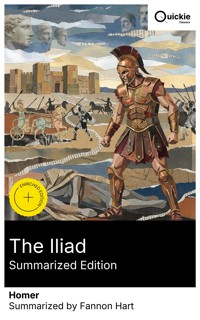
The Iliad condenses the Trojan War into a searing chronicle of a few weeks, governed by the catastrophic rage of Achilles and the fragile negotiations of honor. Composed in rolling dactylic hexameter, it fuses aristeiai, duels, councils, and funeral rites with a vivid divine machinery and far-ranging similes that place bronze-age combat within a cosmic ecology. Its formulaic diction, epithets, and ring composition reveal origins in an oral performance tradition, while its focus on the cost of kleos and the limits of heroic power sets it within the emergent literature of Archaic Greece. Ascribed to Homer, the semi-legendary poet of archaic Ionia, the poem crystallizes centuries of song shaped by rhapsodic performance and communal memory. Whether a single author or a tradition—the Homeric Question remains vital—its unity reflects a Panhellenic synthesis of local myths, an aristocratic warrior ethos, and a meticulous command of oral-formulaic technique. Both an unsparing anatomy of violence and a humane meditation on mortality, The Iliad rewards readers interested in epic poetics, political counsel, and the ethics of anger and pity. It is essential for students of classical literature and for any reader seeking narrative grandeur fused with psychological insight and cultural memory. Quickie Classics summarizes timeless works with precision, preserving the author's voice and keeping the prose clear, fast, and readable—distilled, never diluted. Enriched Edition extras: Introduction · Synopsis · Historical Context · Author Biography · Brief Analysis · 4 Reflection Q&As · Editorial Footnotes.
Das E-Book können Sie in Legimi-Apps oder einer beliebigen App lesen, die das folgende Format unterstützen:
Veröffentlichungsjahr: 2026
Ähnliche





The Iliad (Summarized Edition)
Table of Contents
Introduction
In The Iliad, the fury of a preeminent warrior collides with the fragile bonds of a besieging army, drawing mortals and gods into a struggle where personal honor, collective survival, and the limits of fate clash on a battlefield that tests what it means to be human, as pride hardens into principle, principle breeds defiance, and defiance ripples outward through councils, tents, and city walls until every decision—whether made in anger, duty, or love—demands a reckoning with the costs of glory and the inescapable certainty of mortality within a war already grown old and unyielding.
The Iliad is an ancient Greek epic poem, traditionally attributed to Homer and commonly dated to the late eighth or early seventh century BCE. Composed in the cadence of dactylic hexameter and shaped by oral performance, it gathers the myths of the Trojan War into a concentrated vision rather than a full chronology. Its setting is the plain and city of Troy, where a coalition of Greek-speaking forces has laid siege for years. The poem’s action spans only a few weeks in the war’s final phase, yet its scope embraces camp, council, ritual, and battlefield, as well as the caprice of intervening gods.
At the poem’s outset, a crisis erupts when a dispute over honor fractures the command structure of the besieging army, provokes a divine punishment, and spurs the foremost warrior to withdraw from battle. This act of refusal becomes the engine of the narrative, altering the balance of power and inviting bold countermoves among allies and adversaries. The poem follows the repercussions across embassies, duels, negotiations, and sudden reversals, shifting from intimate scenes in tents and homes to sweeping clashes at the city walls. It is less a ledger of victories than a study of choices pressed by time, pride, and loss.
Readers encounter an elevated, ceremonial voice that remains startlingly attentive to material detail—metal gleams, wounds open, weather changes, and gestures of hospitality, prayer, and mourning unfold with ritual precision. Formulaic epithets and recurring scenes create momentum and pattern, while extended similes reframe violence through the natural and domestic worlds. The tone ranges from austere to tender, capable of pity even for enemies. Narration is omniscient yet tactful, often pausing to name a fighter’s lineage or trace a fleeting biography before the next event. Depending on translation, the verse can feel sonorous or taut, but the underlying architecture is lucid and propulsive.
The poem’s central preoccupation is the ethics of honor: who deserves esteem, how it is measured, and what it costs a community when a leader’s status is threatened. Around this core orbit themes of rage and reconciliation, fate and agency, mortality and memory. The epic asks how individuals seek lasting renown while living under the certainty of death, and what responsibilities they bear toward comrades, supplicants, and foes. It probes leadership—what steadies a coalition, what corrodes it—and examines the social fabric of war through rituals of supplication, oath, and burial. Above all, it insists on the human price of heroic ideals.
For contemporary readers, The Iliad matters because it refuses to let conflict become abstract. It depicts the mechanics of escalation, the risks of wounded pride in positions of authority, and the fragile negotiations that stand between grievance and catastrophe. Its empathy crosses battle lines, offering a model for imagining the suffering of others without abandoning moral judgment. The poem illuminates how communities narrate loss, how grief reshapes identity, and how public honor rubs against private affection. In a world still haunted by war and displacement, its clear-eyed attention to dignity, mourning, and restraint speaks with bracing, unsettling immediacy.
Approached patiently, the epic rewards readers with a layered experience: martial spectacle, political debate, domestic intimacy, and theology braided into a coherent whole. Knowing that the poem narrows its focus to a brief slice of the war can anchor expectations; it closes before the conflict’s famous end, emphasizing character over conquest. Notes, maps, and a consistent translation of names can smooth the way, but no apparatus replaces the poem’s own momentum, which gathers through repetition and return. Read now, The Iliad is less a relic than a living conversation about power, grief, and meaning under pressure—an art of remembering in extremis.
Synopsis
The Iliad is an ancient Greek epic, traditionally attributed to Homer, set during the Trojan War but focused on a few weeks in its final year. Its central conflict is the anger of Achilles and the costs of wounded honor. The poem opens with a plague sent by Apollo after Agamemnon refuses to return a captive. Achilles calls an assembly; a quarrel follows when Agamemnon seizes Briseis from him. Feeling dishonored, Achilles withdraws with the Myrmidons and asks his mother, Thetis, to intercede. She petitions Zeus to let the Achaeans suffer reverses so they will recognize Achilles’ worth, aligning divine and human pressures.
With Achilles absent, Agamemnon receives a misleading dream from Zeus and hastily prepares for victory. A confused assembly nearly dissolves the campaign before order returns. The epic then surveys the forces in a broad catalog that situates the conflict within a wider Greek world. On the field, a proposed duel between Menelaus and Paris promises to end the war, but divine intervention disrupts the agreement. A broken truce returns both hosts to battle. The gods take sides, though Zeus initially restrains them, maintaining his plan to honor Thetis’s request by giving the Trojans an advantage.
Combat intensifies in vivid episodes of individual excellence. Encouraged by Athena, Diomedes ranges across the field, wounding Aphrodite and even Ares, moments that display the poem’s porous boundary between mortal and divine. A chance meeting with the Lycian Glaucus recalls an inherited bond of hospitality, pausing violence to affirm shared customs. The Achaeans fortify their camp, anticipating assaults on the ships, while Trojan momentum grows under Hector’s leadership. Above, the Olympians maneuver for advantage, their preferences mirroring human loyalties. The ebb and flow of battle emphasize the heroic code: renown is won in public view, yet every triumph courts sudden loss.
A rare domestic interlude draws Hector back inside the city. He counsels with elders, declines refreshment from Hecuba to avoid dulling his vigor, and reproaches Paris for lingering away from the fight. In a tender encounter on the walls, Hector speaks with Andromache and watches their child, a scene that balances tactical necessity with the private costs of war. His resolve hardens as he returns to the field, urging Paris to follow. The episode anchors Trojan valor in familial duty, framing the stakes not merely as strategic positions, but as the survival of a city and its households.
As losses mount, leading Achaeans—Agamemnon among them—suffer wounds, and morale falters. Nestor advises a diplomatic appeal to Achilles. Odysseus, Phoenix, and Ajax visit his hut with gifts and promises intended to restore honor. Achilles remains unmoved, insisting that compensation cannot erase the slight to his status and even contemplating departure. The embassy’s failure underscores the tension between communal need and personal esteem. That night, Odysseus and Diomedes conduct a perilous raid, seizing intelligence and striking the enemy, a daring success that briefly steadies the Greeks yet leaves the larger imbalance—willed by Zeus and Achilles’ absence—unchanged.
At dawn the Trojans press hard, threaten the wall, and surge toward the beached ships that symbolize both lifeline and defeat. Poseidon, acting surreptitiously, heartens Greek leaders, but the line wavers until a desperate proposal emerges from Achilles’ camp. Patroclus, his closest companion, pleads to enter the fight wearing Achilles’ armor to stiffen resistance. Granted conditional leave and warned not to overreach, he leads the Myrmidons into battle. The maneuver repels the Trojans from the ships and reenergizes the Greeks, yet it also triggers a chain of events that magnifies the costs of honor and the perils of glory.
What follows turns Achilles from watcher to actor once more. Thetis secures from Hephaestus a resplendent set of arms, with a shield whose scenes of city, field, music, and conflict widen the poem’s frame beyond the battlefield. Publicly reconciled with Agamemnon, Achilles reenters combat empowered by new armor and a clarified, if grim, purpose. His charge is relentless; the river god rises against him in outrage at the carnage, and the Olympians erupt into open quarrel. The narrative fuses cosmic spectacle with human fury, asking what limits exist when a hero pursues renown at any cost.
Driving the enemy back to their walls, Achilles confronts the defender whose courage has sustained the city. Their encounter encapsulates the poem’s preoccupations: the pull of honor, the fear of shame, and the fragile line between courage and ruin. Its outcome alters morale on both sides and inaugurates urgent mourning within the city. Achilles’ rage, once absolute, begins to encounter the counterweight of grief and counsel from the gods, who nudge him toward recognition of common human bounds. Negotiations and laments reshape the battlefield’s tempo, substituting ritual and prudence for momentum without resolving the broader war.
The Iliad’s closing movement shifts from conquest to compassion. In a quiet nocturnal embassy, opponents meet face to face and find, briefly, a language of shared suffering that tempers vengeance without erasing enmity. The epic ends not with the fall of Troy but with solemn rites and a fragile truce, suspending the clash long enough to honor the dead. Through its intense focus on a few weeks and one hero’s wrath, the poem articulates enduring questions about honor, mortality, and the intersection of human will with divine design. Its broader message is a grave, humane meditation on war’s costs.
Historical Context
The Iliad is an ancient Greek epic traditionally attributed to Homer, composed in archaic Greece, most likely in the late eighth or early seventh century BCE. It is set during the Trojan War, a legendary conflict located in western Anatolia near the site known today as Hisarlik. The narrative focuses on a brief period in the war’s final year and centers on elite warriors within a hierarchical society. Institutions depicted include rule by kings (basileis), councils and assemblies, guest-friendship (xenia), oath-taking, and formal gift exchange. Its verses employ dactylic hexameter and preserve features of oral performance shaped over generations.
Mycenaean Greece provides the poem’s deep backdrop. From about 1600 to 1200 BCE, palatial centers such as Mycenae, Pylos, and Tiryns administered wide territories recorded in Linear B tablets. These documents attest officials like the wanax (overlord), mobilization of resources, and warrior elites. Archaeology reveals fortified citadels, chariot equipment, boar’s-tusk helmets, and large figure-eight and tower shields—items mirrored in Homeric descriptions. Around 1200 BCE, many palaces were destroyed and the palatial system collapsed. The memory of this Late Bronze Age world, refracted through centuries of oral song, informs the social and material environment that the poem evokes for its heroic protagonists.
Western Anatolia anchors the other side of the setting. Hittite records from the thirteenth century BCE mention Wilusa (widely identified with Ilion/Troy) and Ahhiyawa (interpreted by many scholars as Achaeans/Greeks), noting diplomatic tensions and warfare in the region. At Hisarlik, archaeological strata known as Troy VI and VII show impressive walls and evidence of destruction in the Late Bronze Age. The city’s location near the Dardanelles controlled maritime routes between the Aegean and Black Sea. These sources do not verify Homer’s story but establish a historical landscape of contested power that plausibly frames conflicts remembered in Greek epic.
The poem took shape amid the transformations of archaic Greece (circa eighth–sixth centuries BCE). This era saw the consolidation of city-states (poleis), waves of Greek colonization around the Mediterranean and Black Sea, and the rise of Panhellenic sanctuaries at Olympia and Delphi. The Olympic Games, traditionally dated from 776 BCE, and other festivals fostered competition, athletic and poetic, alongside a shared Hellenic identity. Epic song circulated across regions, speaking to audiences beyond any single city. In this milieu, narratives of a common heroic past offered both entertainment and a symbolic charter for inter-polis values and rivalries.
Technological and performance developments aided the poem’s preservation. Greeks adapted the Phoenician script in the eighth century BCE, creating an alphabet suited to recording spoken Greek. Although epic composition remained primarily oral-formulaic—using repeated phrases and type-scenes in dactylic hexameter—writing enabled versions of the Iliad to be recorded. Professional performers (rhapsodes) recited Homeric poetry at public festivals; by the classical period, such recitations are attested and the poems had become central to education. The resulting textual and performative traditions stabilized a long, complex song into a broadly shared cultural touchstone across the Greek-speaking world.
The social and martial practices depicted correspond to documented Greek customs and Bronze Age evidence. Leaders award honor (time) through gifts and war-prizes; wealth circulates via reciprocal exchange, oath-bound treaties, and sacrificial feasting. Warfare features seaborne expeditions, primarily bronze weaponry, chariots used mainly for elite transport, massed infantry, and siege operations—patterns supported by archaeology. Assemblies debate policy, and heralds, oath rituals, and formal single combats structure conflict. Such details anchor the narrative in recognizable institutions, illuminating how authority, reputation, and material resources governed relations among communities engaged in prolonged warfare.
Religious life shapes the story’s framework. The Olympian gods, familiar from Greek cult, intervene as patrons of cities and individuals. Rituals such as libations, animal sacrifice, vows, and funeral pyres are depicted in forms consistent with practices attested in archaic and classical Greece and with some earlier archaeological evidence. Sanctuaries, omens, and priestly roles underscore a worldview in which divine favor and ritual correctness influence success. By embedding decision-making within sacrifice and prayer, the poem mirrors the integration of religion with politics and warfare in Greek communities, where appeals to gods legitimated counsel, alliances, and campaigns.
Within this historical horizon, the Iliad articulates aristocratic values while scrutinizing their costs. It examines leadership through quarrels among commanders, the authority of councils and assemblies, and the management of honor, gifts, and obligations. It portrays the human price of siege warfare for fighters and households, acknowledging both courage and suffering. The poem’s attention to eloquence, persuasion, and public debate aligns with the era’s competitive civic arenas, while its memorialization of mortal fame responds to societies emerging from the Bronze Age collapse. By dramatizing conflict between personal renown and communal necessity, it reflects and critiques its age’s ideals.




