


4,49 €
4,49 €
oder
-100%
Sammeln Sie Punkte in unserem Gutscheinprogramm und kaufen Sie E-Books und Hörbücher mit bis zu 100% Rabatt.
Mehr erfahren.
Mehr erfahren.
- Herausgeber: Taji Media LLC
- Kategorie: Gesellschafts- und Liebesromane
- Sprache: Englisch
- Illustrated Edition – Perfect for Classic Literature Lovers
- Fully Illustrated Edition with 20 Stunning Illustrations
- Includes a Clear and Engaging Summary
- Complete Characters List for Easy Reference
- Author Biography of Homer
Embark on one of the greatest adventures ever told.
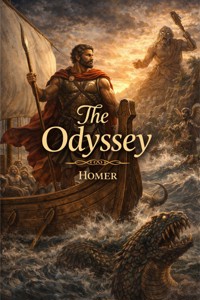
The Odyssey is a timeless epic that follows the legendary hero Odysseus, King of Ithaca, as he struggles to return home after the Trojan War. What should have been a short voyage becomes a perilous journey across unknown seas, filled with monstrous foes, divine intervention, temptation, and tests of endurance that challenge both body and soul.
From the haunting song of the Sirens to the brute force of the Cyclops Polyphemus, from the magic of Circe to the wrath of Poseidon, Odysseus must rely on his intelligence, courage, and resilience to survive. Meanwhile, back in Ithaca, his faithful wife Penelope and son Telemachus fight their own battles—against time, doubt, and ruthless suitors who threaten their home.
This beautifully illustrated edition brings Homer’s masterpiece to life with 20 carefully crafted illustrations, enhancing the drama, emotion, and mythic scale of the story. Designed for both new readers and longtime admirers, this volume also includes a concise summary, a helpful characters list, and an author biography that adds historical and literary context to the epic.
Rich in adventure, emotion, and timeless wisdom, The Odyssey is more than a story—it is a celebration of perseverance, loyalty, cleverness, and the enduring meaning of home.
A must-have classic for your personal library, students, and lovers of epic storytelling.
Das E-Book können Sie in Legimi-Apps oder einer beliebigen App lesen, die das folgende Format unterstützen:
Veröffentlichungsjahr: 2026
0,0
Bewertungen werden von Nutzern von Legimi sowie anderen Partner-Webseiten vergeben.
Legimi prüft nicht, ob Rezensionen von Nutzern stammen, die den betreffenden Titel tatsächlich gekauft oder gelesen/gehört haben. Wir entfernen aber gefälschte Rezensionen.
Ähnliche






The Odyssey By Homer
ABOUT HOMER
Homer is the name traditionally given to the ancient Greek poet credited with composing the Iliad and the Odyssey, two of the most influential works in Western literature. Although his life remains shrouded in mystery, Homer’s voice—whether singular or the product of a long oral tradition—has echoed across nearly three millennia.
Scholars generally place Homer’s activity around the late 8th or early 7th century BCE, during a period when Greek culture was transitioning from oral storytelling to written literature. He is often described in later tradition as a blind bard who traveled from place to place, reciting epic poetry accompanied by a lyre. While this image is likely symbolic rather than factual, it reflects the deep roots of his work in oral performance, memory, and communal storytelling.
Homer’s epics draw on a rich tapestry of myth, history, and human psychology. The Iliad explores the rage of Achilles against the backdrop of the Trojan War, examining themes of honor, fate, mortality, and the cost of glory. The Odyssey, by contrast, follows the long and perilous journey of Odysseus returning home after the war, focusing on intelligence, perseverance, identity, and the pull of home and family. Together, these works present a wide emotional and moral range, from battlefield brutality to domestic tenderness.
One of Homer’s enduring achievements lies in his portrayal of humanity. Gods and heroes alike are flawed, emotional, and driven by conflicting desires. Even minor characters are given moments of dignity and depth, lending the epics a realism that transcends their mythic scale. His use of repeated phrases, vivid similes drawn from everyday life, and carefully structured narratives reflects techniques developed to aid oral recitation, yet they also contribute to the poetry’s distinctive power and rhythm.
The question of whether Homer was a single individual or a symbolic name for multiple poets—often called the “Homeric Question”—remains unresolved. Regardless of the answer, the works attributed to him shaped ancient Greek education, values, and identity, and later became foundational texts for Roman, medieval, and modern literature.
Homer’s legacy is not merely literary but cultural. His epics have inspired countless writers, philosophers, artists, and thinkers, from Plato and Virgil to Dante, Joyce, and beyond. Through stories of war and wandering, pride and loss, cunning and compassion, Homer continues to speak to the enduring complexities of the human condition.
SUMMARY
The Odyssey – A Captivating Summary
After the fall of Troy, the clever hero Odysseus begins what should be a simple voyage home—but the journey turns into a legendary struggle that lasts ten long years. The Odyssey is an epic tale of adventure, endurance, and the irresistible pull of home.
Cursed by the sea god Poseidon for his pride and cunning, Odysseus is driven across unknown waters, facing monstrous dangers and tempting illusions. He outwits the terrifying Cyclops Polyphemus, resists the deadly song of the Sirens, survives the wrath of Scylla and Charybdis, and is held captive by the enchanting nymph Calypso, who offers him immortality if he abandons his past. Yet through every trial, Odysseus clings to his identity as a husband, a father, and a king.
Meanwhile, in Ithaca, his loyal wife Penelope fends off a crowd of greedy suitors who believe Odysseus is dead and seek to claim his throne. Using her own intelligence and patience, she delays remarriage while their son Telemachus grows into manhood, searching for news of his father and his own sense of purpose.
When Odysseus finally returns home in disguise, the story builds to a powerful climax. With sharp wit and quiet resolve, he reveals himself, restores justice, and reunites with his family—proving that true heroism lies not only in strength, but in cleverness, resilience, and loyalty.
Rich with danger, emotion, and unforgettable characters, The Odyssey is a timeless journey that celebrates the human desire to belong, the strength of perseverance, and the enduring meaning of home.
CHARACTERS LIST
Main Characters in The Odyssey by Homer
Heroes & Mortals
Odysseus – King of Ithaca and the epic’s hero; famed for his intelligence, cunning, and resilience as he struggles to return home after the Trojan War.
Penelope – Odysseus’s loyal wife; clever and patient, she fends off suitors while waiting for her husband’s return.
Telemachus – Son of Odysseus and Penelope; matures from a hesitant youth into a confident young man during his search for his father.
Laertes – Odysseus’s aging father, living in seclusion and grief during his son’s absence.
Eurycleia – Faithful nurse of Odysseus; one of the first to recognize him upon his return.
The Gods
Athena – Goddess of wisdom and strategy; Odysseus’s divine protector and guide.
Poseidon – God of the sea; Odysseus’s enemy, who punishes him for blinding his son, the Cyclops.
Zeus – King of the gods; ultimate authority who allows Odysseus’s return to Ithaca.
Hermes – Messenger god; helps Odysseus with divine advice and magical aid.
Mythical Beings & Enemies
Polyphemus – A one-eyed Cyclops, son of Poseidon, outwitted and blinded by Odysseus.
Circe – Enchantress who turns men into animals; later aids Odysseus on his journey.
Calypso – Nymph who detains Odysseus for years, offering immortality if he stays with her.
The Sirens – Creatures whose irresistible song lures sailors to destruction.
Scylla and Charybdis – Twin sea threats: a multi-headed monster and a deadly whirlpool.
Suitors of Penelope
Antinous – Arrogant and cruel leader of the suitors.
Eurymachus – Smooth-talking and deceitful suitor.
Amphinomus – More honorable than the others, yet still complicit.
Allies & Hosts
Nestor – Wise king of Pylos; offers guidance to Telemachus.
Menelaus – King of Sparta and husband of Helen; shares stories of Odysseus’s fate.
Phaeacians (King Alcinous & Queen Arete) – Hospitable rulers who finally help Odysseus reach home.
Together, these characters—human, divine, and monstrous—create the rich world of The Odyssey, a story driven by loyalty, intelligence, temptation, and the enduring quest for home.
Table of Contents
Titlepage
Imprint
Preface
The Odyssey
Book I: Visit of Pallas to Telemachus
Book II: Departure of Telemachus from Ithaca
Book III: Interview of Telemachus with Nestor
Book IV: Conference of Telemachus and Menelaus
Book V: Departure of Ulysses from Calypso
Book VI: Ulysses Discovered by Nausicaä
Book VII: Reception of Ulysses by Alcinoüs
Book VIII: Festivals in Honor of Ulysses
Book IX: The Ciconians, Lotus-Eaters, and Cyclops
Book X: Aeolus, the Lestrigonians, and Circè
Book XI: Visit of Ulysses to the Land of the Dead
Book XII: The Sirens, Scylla, and Charybdis
Book XIII: Arrival of Ulysses at Ithaca
Book XIV: Meeting of Ulysses and Eumaeus
Book XV: Return of Telemachus
Book XVI: Ulysses Discovering Himself to Telemachus
Book XVII: Return of Ulysses to His Palace
Book XVIII: Combat of Ulysses and Irus
Book XIX: Ulysses Recognized by Eurycleia
Book XX: The Last Banquet of the Suitors
Book XXI: The Bending of the Bow of Ulysses
Book XXII: Death of the Suitors
Book XXIII: Ulysses and Penelope After the Slaughter
Book XXIV: Conclusion
Colophon
Uncopyright
Preface
The kind reception which my translation of the Iliad has met with from my countrymen has encouraged me to attempt a translation of the Odyssey in the same form of verse. I have found this a not unpleasing employment for a period of life which admonishes me that I cannot many times more appear before the public in this or any other manner. The task of translating verse is not, it is true, merely mechanical, since it requires that the translator should catch from his author somewhat of the glow with which he wrote, just as a good reader is himself moved by the words which he delivers, and communicates the emotion to his hearers; yet is the translator spared the labor of invention—the task of producing the ideas which it is his business to express, as well as that of bringing them into their proper relations with each other. A great part of the fatigue which attends original composition, long pursued, is therefore avoided, and this gentler exercise of the intellectual faculties agrees better with that stage of life when the brain begins to be haunted by a presentiment that the time of its final repose is not far off.
Some of the observations which I have made, in my Preface to the Iliad, on that work and the translation which I have made of it, apply also to the Odyssey and to the version which I now lay before the reader. The differences between the two poems have been so well pointed out by critics, that I shall have occasion to speak of but two or three of them. In executing my task, I have certainly missed in the Odyssey the fire and vehemence of which I was so often sensible in the Iliad, and the effect of which naturally was to kindle the mind of the translator. I hope that the version which I have made will not on that account be found lacking in a sufficient degree of spirit and appearance of freedom to make it readable. Another peculiarity of the Iliad, of a less agreeable nature, consists in the frequent recurrence of hand-to-hand combats, in which the more eminent warriors despatch, by the most summary butchery, and with a fierce delight in their own prowess, their weaker adversaries. These incidents so often occur in the narrative, being thrown together in clusters, and described with an unsparing minuteness, that I have known persons, soon sated with these horrors, to pass over the pages in which they are described, and take up the narrative further on. There is nothing of this kind in the Odyssey, at least until near the close, where Ulysses takes a bloody vengeance on the suitors who have plundered his estate, and conspired to take the life of his son, and in that part of the poem the horror which so enormous a slaughter would naturally awaken is mitigated by the recollection of their guilt. The gods of the Odyssey are not so often moved by brutal impulses as those of the Iliad, nor do they seem to dwell in a sphere so far removed from the recognition of those rules of right and wrong which are respected in human society. In the composition of the two poems, one of the most remarkable differences is the abundance of similes in the Iliad, and their comparatively rare appearance in the Odyssey. In the Iliad the desire of illustrating his subject by a similitude sometimes seizes the poet in the midst of one of the most interesting parts of his narrative, and immediately there follows a striking picture of some incident bearing a certain resemblance to the one which he is relating. Sometimes, after one simile is minutely given, a second suggests itself, and is given with equal minuteness, and there is one instance at least of a third. It is curious to mark what a fascination the picturesque resemblance of objects and incidents has for the poet, and how one set of these images draws after it another, passing in magnificent procession across the mirror of his imagination. In the Odyssey are comparatively few examples of this mode of illustration; the poet is too much occupied with his narrative to think of them. How far this point of difference between the two poems tends to support the view of those who maintain that they could not have proceeded from the same author, is a question on which it is not my purpose to enter.
In the Preface to my version of the Iliad, I gave very briefly my reason for preserving the names derived from the Latin, by which the deities of the Grecian mythology have hitherto been known to English readers—that is to say, Jupiter, Juno, Neptune, Pluto, Mars, Venus, and the rest, instead of Zeus, Herè, and the other names which are properly Greek. As the propriety of doing this is questioned by some persons of exact scholarship, I will state the argument a little more at large. The names I have employed have been given to the gods and goddesses of ancient Greece from the very beginnings of our language. Chaucer, Spenser, Shakespeare, Milton, and the rest, down to Proctor and Keats—a list whose chronology extends through six hundred years—have followed this usage, and we may even trace it back for centuries before either of them wrote. Our prose writers have done the same thing; the names of Latin derivation have been adopted by the earliest and latest translators of the New Testament. To each of the deities known by these names there is annexed in the mind of the English reader—and it is for the English reader that I have made this translation—a peculiar set of attributes. Speak of Juno and Diana, and the mere English reader understands you at once; but when he reads the names of Herè and Artemis, he looks into his classical dictionary. The names of Latin origin are naturalized; the others are aliens and strangers. The conjunction and itself, which has been handed down to us unchanged from our Saxon ancestors, holds not its place in our language by a firmer and more incontestable title than the names which we have hitherto given to the deities of ancient Greece. We derive this usage from the Latin authors—from Virgil, and Horace, and Ovid, and the prose writers of ancient Rome. Art as well as poetry knows these deities by the same names. We talk of the Venus de Medicis, the Venus of Milo, the Jupiter of Phidias, and never think of calling a statue of Mars a statue of Ares.
For my part, I am satisfied with the English language as it has been handed down to us. If the lines of my translation had bristled with the names of Zeus and Herè, and Poseidon and Ares, and Artemis and Demeter, I should feel that I had departed from the immemorial usage of the English tongue, that I had introduced obscurity where the meaning should have been plain, and that I had given just cause of complaint to the readers for whom I wrote.
W. C. Bryant
August, 1871.
The Odyssey
Book I
Visit of Pallas to Telemachus
A council of the gods—Deliberations concerning Ulysses—Mercury despatched to Calypso, to bid her send Ulysses to Ithaca—Visit of Pallas, in the shape of Mentor, to Telemachus, advising him to repair to Pylos and Sparta in quest of his father, Ulysses—Revels of the suitors of Penelope—Phemius, the minstrel, and his song of the return of the Grecians—The suitors rebuked by Telemachus.
Tell me, O Muse, of that sagacious man
Who, having overthrown the sacred town
Of Ilium, wandered far and visited
The capitals of many nations, learned
The customs of their dwellers, and endured
Great suffering on the deep: his life was oft
In peril, as he labored to bring back
His comrades to their homes. He saved them not,
Though earnestly he strove; they perished all,
Through their own folly; for they banqueted,
Madmen! upon the oxen of the Sun—
The all-o’erlooking Sun, who cut them off
From their return. O goddess, virgin-child
Of Jove, relate some part of this to me.
Now all the rest, as many as escaped
The cruel doom of death, were at their homes
Safe from the perils of the war and sea,
While him alone, who pined to see his home
And wife again, Calypso, queenly nymph,
Great among goddesses, detained within
Her spacious grot, in hope that he might yet
Become her husband. Even when the years
Brought round the time in which the gods decreed
That he should reach again his dwelling-place
In Ithaca, though he was with his friends,
His toils were not yet ended. Of the gods
All pitied him save Neptune, who pursued
With wrath implacable the godlike chief,
Ulysses, even to his native land.
Among the Ethiopians was the god
Far off—the Ethiopians most remote
Of men. Two tribes there are; one dwells beneath
The rising, one beneath the setting sun.
He went to grace a hecatomb of beeves
And lambs, and sat delighted at the feast;
While in the palace of Olympian Jove
The other gods assembled, and to them
The father of immortals and of men
Was speaking. To his mind arose the thought
Of that Aegisthus whom the famous son
Of Agamemnon, Prince Orestes, slew.
Of him he thought and thus bespake the gods:—
“How strange it is that mortals blame the gods
And say that we inflict the ills they bear,
When they, by their own folly and against
The will of fate, bring sorrow on themselves!
As late Aegisthus, unconstrained by fate,
Married the queen of Atreus’ son and slew
The husband just returned from war. Yet well
He knew the bitter penalty, for we
Warned him. We sent the herald Argicide,
Bidding him neither slay the chief nor woo
His queen, for that Orestes, when he came
To manhood and might claim his heritage,
Would take due vengeance for Atrides slain.
So Hermes said; his prudent words moved not
The purpose of Aegisthus who now pays
The forfeit of his many crimes at once.”
Pallas, the blue-eyed goddess, thus replied:—
“O father, son of Saturn, king of kings!
Well he deserved his death. So perish all
Guilty of deeds like his! But I am grieved
For sage Ulysses, that most wretched man,
So long detained, repining, and afar
From those he loves, upon a distant isle
Girt by the waters of the central deep—
A forest isle, where dwells a deity
The daughter of wise Atlas, him who knows
The ocean to its utmost depths, and holds
Upright the lofty columns which divide
The earth from heaven. The daughter there detains
The unhappy chieftain, and with flattering words
Would win him to forget his Ithaca.
Meanwhile, impatient to behold the smokes
That rise from hearths in his own land, he pines
And willingly would die. Is not thy heart,
Olympics, touched by this? And did he not
Pay grateful sacrifice to thee beside
The Argive fleet in the broad realm of Troy?
Why then, O Jove, art thou so wroth with him?”
Then answered cloud-compelling Jove: “My child,
What words have passed thy lips? Can I forget
Godlike Ulysses, who in gifts of mind
Excels all other men, and who has brought
Large offerings to the gods that dwell in heaven?
Yet he who holds the earth in his embrace,
Neptune, pursues him with perpetual hate
Because of Polypheme, the Cyclops, strong
Beyond all others of his giant race,
Whose eye Ulysses had put out. The nymph
Thoosa brought him forth—a daughter she
Of Phorcys, ruling in the barren deep—
And in the covert of o’erhanging rocks
She met with Neptune. For this cause the god
Who shakes the shores, although he slay him not,
Sends forth Ulysses wandering far away
From his own country. Let us now consult
Together and provide for his return,
And Neptune will lay by his wrath, for vain
It were for one like him to strive alone
Against the might of all the immortal gods.”
And then the blue-eyed Pallas spake again:—
“O father! son of Saturn, king of kings!
If such the pleasure of the blessed gods
That now the wise Ulysses shall return
To his own land, let us at once despatch
Hermes, the Argicide, our messenger,
Down to Ogygia, to the bright-haired nymph,
And make our steadfast purpose known to bring
The sufferer Ulysses to his home,
And I will haste to Ithaca, and move
His son, that with a resolute heart he call
The long-haired Greeks together and forbid
The excesses of the suitor train, who slay
His flocks and slow-paced beeves with crooked horns.
To Sparta I will send him and the sands
Of Pylos, to inquire for the return
Of his dear father. So a glorious fame
Shall gather round him in the eyes of men.”
She spake, and fastened underneath her feet
The fair, ambrosial golden sandals worn
To bear her over ocean like the wind,
And o’er the boundless land. In hand she took,
Well tipped with trenchant brass, the mighty spear,
Heavy and huge and strong, with which she bears
Whole phalanxes of heroes to the earth,
When she, the daughter of a mighty sire,
Is angered. From the Olympian heights she plunged,
And stood among the men of Ithaca,
Just at the porch and threshold of their chief,
Ulysses. In her hand she bore the spear,
And seemed the stranger Mentes, he who led
The Taphians. There before the gate she found
The haughty suitors. Some beguiled the time
With draughts, while sitting on the hides of beeves
Which they had slaughtered. Heralds were with them,
And busy menials: some who in the bowls
Tempered the wine with water, some who cleansed
The tables with light sponges, and who set
The banquet forth and carved the meats for all.
Telemachus the godlike was the first
To see the goddess as he sat among
The crowd of suitors, sad at heart, and thought
Of his illustrious father, who might come
And scatter those who filled his palace halls,
And win new honor, and regain the rule
Over his own. As thus he sat and mused
Among the suitors, he beheld where stood
Pallas, and forth he sprang; he could not bear
To keep a stranger waiting at his door.
He came, and taking her right hand received
The brazen spear, and spake these winged words:—
“Hail, stranger! thou art truly welcome here,
First come and share our feast and be refreshed,
Then say what thou requirest at our hands.”
He spake and led the way, and in his steps
Pallas Athenè followed. Entering then
The lofty halls, he set the spear upright
By a tall column, in the armory
With polished walls, where rested many a lance
Of the large-souled Ulysses. Then he placed
His guest upon a throne, o’er which he spread
A covering many-hued and beautiful,
And gave her feet a footstool. Near to her
He drew his parti-colored seat, aloof
From where the suitors sat; that so his guest
Might not amid those haughty revellers
Be wearied with the tumult and enjoy
His meal the less, and that himself might ask
News of his absent father. In a bowl
Of silver, from a shapely ewer of gold,
A maid poured water for the hands, and set
A polished table near them. Then approached
A venerable matron bringing bread
And delicacies gathered from the board;
And he who served the feast before them placed
Chargers with various meats, and cups of gold;
While round the board a herald moved, and poured
Wine for the guests. The haughty suitors now
Came in, and took their places on the thrones
And couches; heralds poured upon their hands
The water; maidens heaped the canisters
With bread, and all put forth their hands to share
The banquet on the board, while to the brim
Boys filled the beakers. When the calls of thirst
And hunger were appeased, the suitors thought
Of other things that well become a feast—
Song and the dance. And then a herald brought
A shapely harp, and gave it to the hands
Of Phemius, who had only by constraint
Sung to the suitors. On the chords he struck
A prelude to his lay, while, as he played,
Telemachus, that others might not hear,
Leaned forward, and to blue-eyed Pallas spake:—
“My friend and guest, wilt thou take no offence
At what I say? These revellers enjoy
The harp and song, for at no cost of theirs
They waste the substance of another man,
Whose white bones now are mouldering in the rain
Upon some mainland, or are tossed about
By ocean billows. Should they see him once
In Ithaca, their prayers would rather rise
For swifter feet than richer stores of gold
And raiment. But an evil fate is his,
And he has perished. Even should we hear
From any of the dwellers upon earth
That he is near at hand, we could not hope.
For him is no return. But now, I pray,
Tell me, and frankly tell me, who thou art,
And of what race of men, and where thy home,
And who thy parents; how the mariners
Brought thee to Ithaca, and who they claim
To be, for well I deem thou couldst not come
Hither on foot. All this, I pray, relate
Truly, that I may know the whole. Art thou
For the first time arrived, or hast thou been
My father’s guest? for many a stranger once
Resorted to our palace, and he knew
The way to win the kind regard of men.”
Pallas, the blue-eyed goddess, answered thus:—
“I will tell all and truly. I am named
Mentes; my father was the great in war
Anchialus. I rule a people skilled
To wield the oar, the Taphians, and I come
With ship and crew across the dark blue deep
To Temesè, and to a race whose speech
Is different from my own, in quest of brass,
And bringing bright steel with me. I have left
Moored at the field behind the town my barque,
Within the bay of Reithrus, and beneath
The woods of Neius. We claim to be
Guests by descent, and from our fathers’ time,
As thou wilt learn if thou shouldst meet and ask
Laertes, the old hero. It is said
He comes no more within the city walls,
But in the fields dwells sadly by himself,
Where an old handmaid sets upon his board
His food and drink when weariness unnerves
His limbs in creeping o’er the fertile soil
Of his rich vineyard. I am come because
I heard thy father had at last returned,
And now am certain that the gods delay
His journey hither; for the illustrious man
Cannot have died, but is detained alone
Somewhere upon the ocean, in some spot
Girt by the waters. There do cruel men
And savage keep him, pining to depart.
Now let me speak of what the gods reveal,
And what I deem will surely come to pass,
Although I am no seer and have no skill
In omens drawn from birds. Not long the chief
Will be an exile from his own dear land,
Though fettered to his place by links of steel;
For he has large invention, and will plan
A way for his escape. Now tell me this,
And truly; tall in stature as thou art,
Art thou in fact Ulysses’ son? In face
And glorious eyes thou dost resemble him
Exceedingly; for he and I of yore
Were oftentimes companions, ere he sailed
For Ilium, whither also went the best
Among the Argives in their roomy ships,
Nor have we seen each other since that day.”
Telemachus, the prudent, spake: “O guest,
True answer shalt thou have. My mother says
I am his son; I know not; never man
Knew his own father. Would I were the son
Of one whose happier lot it was to meet
Amidst his own estates the approach of age.
Now the most wretched of the sons of men
Is he to whom they say I owe my birth.
Thus is thy question answered.” Then again
Spake blue-eyed Pallas: “Of a truth, the gods
Ordain not that thy race, in years to come,
Should be inglorious, since Penelope
Hath borne thee such as I behold thee now.
But frankly answer me—what feast is here,
And what is this assembly? What may be
The occasion? is a banquet given? is this
A wedding? A collation, where the guests
Furnish the meats, I think it cannot be,
So riotously goes the revel on
Throughout the palace. A well-judging man,
If he should come among them, would be moved
With anger at the shameful things they do.”
Again Telemachus, the prudent, spake:—
“Since thou dost ask me, stranger, know that once
Rich and illustrious might this house be called
While yet the chief was here. But now the gods
Have grown unkind and willed it otherwise,
They make his fate a mystery beyond
The fate of other men. I should not grieve
So deeply for his loss if he had fallen
With his companions on the field of Troy,
Or midst his kindred when the war was o’er.
Then all the Greeks had built his monument,
And he had left his son a heritage
Of glory. Now has he become the prey
Of Harpies, perishing ingloriously,
Unseen, his fate unheard of, and has left
Mourning and grief, my portion. Not for him
Alone I grieve; the gods have cast on me
Yet other hardships. All the chiefs who rule
The isles, Dulichium, Samos, and the groves
That shade Zacynthus, and who bear the sway
In rugged Ithaca, have come to woo
My mother, and from day to day consume
My substance. She rejects not utterly
Their hateful suit, and yet she cannot bear
To end it by a marriage. Thus they waste
My heritage, and soon will seek my life.”
Again in grief and anger Pallas spake:—
“Yea, greatly dost thou need the absent chief
Ulysses here, that he might lay his hands
Upon these shameless suitors. Were he now
To come and stand before the palace gate
With helm and buckler and two spears, as first
I saw him in our house, when drinking wine
And feasting, just returned from Ephyrè
Where Ilus dwelt, the son of Mermerus—
For thither went Ulysses in a barque,
To seek a deadly drug with which to taint
His brazen arrows; Ilus gave it not;
He feared the immortal gods; my father gave
The poison, for exceedingly he loved
His guest—could now Ulysses, in such guise,
Once meet the suitors, short would be their lives
And bitter would the marriage banquet be.
Yet whether he return or not to take
Vengeance, in his own palace, on this crew
Of wassailers, rests only with the gods.
Now let me counsel thee to think betimes
How thou shalt thrust them from thy palace gates.
Observe me, and attend to what I say:
Tomorrow thou shalt call the Achaian chiefs
To an assembly; speak before them all,
And be the gods thy witnesses. Command
The suitors all to separate for their homes;
And if thy mother’s mind be bent to wed,
Let her return to where her father dwells,
A mighty prince, and there they will appoint
Magnificent nuptials, and an ample dower
Such as should honor a beloved child.
And now, if thou wilt heed me, I will give
A counsel for thy good. Man thy best ship
With twenty rowers, and go forth to seek
News of thy absent father. Thou shalt hear
Haply of him from someone of the sons
Of men, or else some word of rumor sent
By Jove, revealing what mankind should know.
First shape thy course for Pylos, and inquire
Of noble Nestor; then, at Sparta, ask
Of fair-haired Menelaus, for he came
Last of the mailed Achaians to his home.
And shouldst thou learn that yet thy father lives,
And will return, have patience yet a year,
However hard it seem. But shouldst thou find
That he is now no more, return forthwith
To thy own native land, and pile on high
His monument, and let the funeral rites
Be sumptuously performed as may become
The dead, and let thy mother wed again.
And when all this is fully brought to pass,
Take counsel with thy spirit and thy heart
How to destroy the suitor crew that haunt
Thy palace, whether by a secret snare
Or open force. No longer shouldst thou act
As if thou wert a boy; thou hast outgrown
The age of childish sports. Hast thou not heard
What honor the divine Orestes gained
With all men, when he slew the murderer,
The crafty wretch Aegisthus, by whose hand
The illustrious father of Orestes died?
And then, my friend—for I perceive that thou
Art of a manly and a stately growth—
Be also bold, that men hereafter born
May give thee praise. And now must I depart
To my good ship, and to my friends who wait,
Too anxiously perhaps, for my return.
Act wisely now, and bear my words in mind.”
The prudent youth Telemachus rejoined:—
“Well hast thou spoken, and with kind intent,
O stranger! like a father to a son;
And ne’er shall I forget what thou hast said.
Yet stay, I pray thee, though in haste, and bathe
And be refreshed, and take to thy good ship
Some gift with thee, such as may please thee well,
Precious and rare, which thou mayst ever keep
In memory of me—a gift like those
Which friendly hosts bestow upon their guests.”
Then spake the blue-eyed Pallas: “Stay me not,
For now would I depart. Whatever gift
Thy heart may prompt thee to bestow, reserve
Till I come back, that I may bear it home,
And thou shalt take some precious thing in turn.”
So spake the blue-eyed Pallas, and withdrew,
Ascending like a bird. She filled his heart
With strength and courage, waking vividly
His father’s memory. Then the noble youth
Went forth among the suitors. Silent all
They sat and listened to the illustrious bard,
Who sang of the calamitous return
Of the Greek host from Troy, at the command
Of Pallas. From her chamber o’er the hall
The daughter of Icarius, the sage queen
Penelope, had heard the heavenly strain,
And knew its theme. Down by the lofty stairs
She came, but not alone; there followed her
Two maidens. When the glorious lady reached
The threshold of the strong-built hall, where sat
The suitors, holding up a delicate veil
Before her face, and with a gush of tears,
The queen bespake the sacred minstrel thus:—
“Phemius! thou knowest many a pleasing theme—
The deeds of gods and heroes, such as bards
Are wont to celebrate. Take then thy place
And sing of one of these, and let the guests
In silence drink the wine; but cease this strain;
It is too sad; it cuts me to the heart,
And wakes a sorrow without bounds—such grief
I bear for him, my lord, of whom I think
Continually; whose glory is abroad
Through Hellas and through Argos, everywhere.”
And then Telemachus, the prudent, spake:—
“Why, O my mother! canst thou not endure
That thus the well-graced poet should delight
His hearers with a theme to which his mind
Is inly moved? The bards deserve no blame;
Jove is the cause, for he at will inspires
The lay that each must sing. Reprove not, then,
The minstrel who relates the unhappy fate
Of the Greek warriors. All men most applaud
The song that has the newest theme; and thou—
Strengthen thy heart to hear it. Keep in mind
That not alone Ulysses is cut off
From his return, but that with him at Troy
Have many others perished. Now withdraw
Into thy chamber; ply thy household tasks,
The loom, the spindle; bid thy maidens speed
Their work. To say what words beseem a feast
Belongs to man, and most to me; for here
Within these walls the authority is mine.”
The matron, wondering at his words, withdrew
To her own place, but in her heart laid up
Her son’s wise sayings. When she now had reached,
With her attendant maids, the upper rooms,
She mourned Ulysses, her beloved spouse,
And wept, till blue-eyed Pallas closed her lids
In gentle slumbers. Noisily, meanwhile,
The suitors revelled in the shadowy halls;
And thus Telemachus, the prudent, spake:—
“Ye suitors of my mother, insolent
And overbearing; cheerful be our feast,
Not riotous. It would become us well
To listen to the lay of such a bard,
So like the gods in voice. I bid you all
Meet in full council with the morrow morn,
That I may give you warning to depart
From out my palace, and to seek your feasts
Elsewhere at your own charge—haply to hold
Your daily banquets at each other’s homes.
But if it seem to you the better way
To plunder one man’s goods, go on to waste
My substance; I will call the immortal gods
To aid me, and if Jupiter allow
Fit retribution for your deeds, ye die,
Within this very palace, unavenged.”
He spake; the suitors bit their close-pressed lips,
Astonished at the youth’s courageous words.
And thus Antinoüs, Eupeithes’ son,
Made answer: “Most assuredly the gods,
Telemachus, have taught thee how to frame
Grand sentences and gallantly harangue.
Ne’er may the son of Saturn make thee king
Over the seagirt Ithaca, whose isle
Is thy inheritance by claim of birth.”
Telemachus, the prudent, thus rejoined:—
“Wilt thou be angry at the word I speak,
Antinoüs? I would willingly accept
The kingly station if conferred by Jove.
Dost thou indeed regard it as the worst
Of all conditions of mankind? Not so
For him who reigns; his house grows opulent,
And he the more is honored. Many kings
Within the bounds of seagirt Ithaca
There are, both young and old, let anyone
Bear rule, since great Ulysses is no more;
But I will be the lord of mine own house,
And o’er my servants whom the godlike chief,
Ulysses, brought from war, his share of spoil.”
Eurymachus, the son of Polybus,
Addressed the youth in turn: “Assuredly,
What man hereafter, of the Achaian race,
Shall bear the rule o’er seagirt Ithaca
Rests with the gods. But thou shalt keep thy wealth,
And may no son of violence come to make
A spoil of thy possessions while men dwell
In Ithaca. And now, my friend, I ask
Who was thy guest; whence came he, of what land
Claims he to be, where do his kindred dwell,
And where his patrimonial acres lie?
With tidings of thy father’s near return
Came he, or to receive a debt? How swift
Was his departure, waiting not for us
To know him! yet in aspect and in air
He seemed to be no man of vulgar note.”
Telemachus, the prudent, answered thus:—
“My father’s coming, O Eurymachus,
Is to be hoped no more; nor can I trust
Tidings from whatsoever part they come,
Nor pay regard to oracles, although
My mother send to bring a soothsayer
Within the palace, and inquire of him.
But this man was my father’s guest; he comes
From Taphos; Mentes is his name, a son
Of the brave chief Anchialus; he reigns
Over the Taphians, men who love the sea.”
He spake, but in his secret heart he knew
The immortal goddess. Then the suitors turned.
Delighted, to the dance and cheerful song,
And waited for the evening. On their sports
The evening with its shadowy blackness came;
Then each to his own home withdrew to sleep,
While to his lofty chamber, in full view,
Built high in that magnificent palace home,
Telemachus went up, and sought his couch,
Intent on many thoughts. The chaste and sage
Dame Eurycleia by his side went up
With lighted torches—she a child of Ops,
Pisenor’s son. Her, in her early bloom,
Laertes purchased for a hundred beeves,
And in his palace honored equally
With his chaste wife; yet never sought her bed.
He would not wrong his queen. ’Twas she who bore
The torches with Telemachus. She loved
Her young lord more than all the other maids,
And she had nursed him in his tender years.
He opened now the chamber door and sat
Upon the couch, put his soft tunic off
And placed it in the prudent matron’s hands.
She folded it and smoothed it, hung it near
To that fair bed, and, going quickly forth,
Pulled at the silver ring to close the door,
And drew the thong that moved the fastening bolt.
He, lapped in the soft fleeces, all night long.
Thought of the voyage Pallas had ordained.
Book II
Departure of Telemachus from Ithaca
The chief men of Ithaca assembled by Telemachus—His complaint of the suitors—Their attempt to justify themselves—Prophecy of the return of Ulysses by the seer, Halitherses—Request of Telemachus for a vessel to visit Pylos and Sparta, in quest of his father, granted by the assembly—Preparations for his departure.
Now when the Morning, child of Dawn, appeared,
The dear son of Ulysses left his bed
And put his garments on. His trenchant sword
He hung upon his shoulders, and made fast
His shapely sandals to his shining feet,
And issued from his chamber like a god.
At once he bade the clear-voiced heralds call
The long-haired Greeks to council. They obeyed,
Quickly the chiefs assembled, and when all
Were at the appointed place, Telemachus
Went to the council, bearing in his hand
A brazen spear, yet went he not alone.
Two swift dogs followed him, while Pallas shed
A heavenly beauty over him, and all
Admired him as he came. He took the seat
Of his great father, and the aged men
Made way for him. And then Aegyptius spake—
A hero bowed with age, who much had seen
And known. His son, the warlike Antiphus,
Went with the great Ulysses in his fleet
To courser-breeding Troy, and afterward
The cruel Cyclops, in the vaulted cave,
Slew him for his last meal. Three other sons
There were, and one of these, Eurynomus,
Was of the suitor train; the others took
Charge of their father’s acres. Never yet
Had he forgotten his lost son or ceased
To grieve for him, and as he spoke he wept
“Hear, men of Ithaca, what I shall say.
No council, no assembly, have we held
Since great Ulysses in his roomy ships
Departed from our isle. Who now is he
That summons us? On which of our young men
Or elders presses this necessity?
Is it belike that one of you has heard
Of an approaching foe, and can declare
The tidings clearly? Or would he propose
And urge some other matter which concerns
The public weal? A just and generous mind
I deem is his, and ’tis my hope that Jove
Will bring to pass the good at which he aims.”
As thus he spake Ulysses’ son rejoiced
In his auspicious words, nor longer kept
His seat, but, yielding to an inward force,
Rose midst them all to speak, while in his hand
Pisenor, the sagacious counsellor
And herald, placed the sceptre. Then he turned
To the old man, Aegyptius, speaking thus:—
“O aged man, not far from thee is he
Who called this council, as thou soon shalt know
Mine chiefly is the trouble; I have brought
No news of an approaching foe, which I
Was first to hear, and would declare to all,
Nor urge I other matters which concern
The public weal; my own necessity—
The evil that has fallen on my house—
Constrains me; it is twofold. First, that I
Have lost an excellent father, who was king
Among you, and ruled o’er you with a sway
As gentle as a father’s. Greater yet
Is the next evil, and will soon o’erthrow
My house and waste my substance utterly.
Suitors, the sons of those who, in our isle,
Hold the chief rank, importunately press
Round my unwilling mother. They disdain
To ask her of Icarius, that the king
Her father may endow her, and bestow
His daughter on the man who best may gain
His favor, but with every day they come
Into our palace, sacrificing here
Oxen and sheep and fatling goats, and hold
High festival, and drink the purple wine
Unstinted, with unbounded waste; for here
Is no man like Ulysses to repel
The mischief from my house. Not such are we
As he was, to resist the wrong. We pass
For weaklings, immature in valor, yet
If I had but the power, assuredly
I would resist, for by these men are done
Insufferable things, nor does my house
Perish with honor. Ye yourselves should feel
Shame at these doings; ye should dread reproach
From those who dwell around us, and should fear
The offended gods, lest they repay these crimes
With vengeance. I beseech you, O my friends,
Both by Olympian Jove, and her by whom
Councils of men are summoned and dissolved—
The goddess Themis—that ye all refrain,
And leave me to my grief alone, unless
Ulysses, my great father, may have done
Wrong in his anger to the gallant Greeks,
Which ye, by prompting men to acts like these,
Seek to avenge on me. Far better ’twere,
Should ye yourselves destroy our goods and slay
Our herds, since, were it so, there might in time
Be some requital. We, from street to street,
Would plead continually for recompense,
Till all should be restored. But now ye heap
Upon me wrongs for which is no redress.”
Thus angrily he spake, and clashed to earth
The sceptre, shedding tears. The people felt
Compassion; all were silent for a space,
And there was none who dared with railing words
Answer Telemachus, save one alone,
Antinoüs, who arose and thus replied:—
“Telemachus, thou youth of braggart speech
And boundless in abuse, what hast thou said
To our dishonor? Thou wouldst fix on us
A brand of shame. The blame is not with us,
The Achaian suitors; ’tis thy mother’s fault,
Skilled as she is in crafty shifts. ’Tis now
Already the third year, and soon will be
The fourth, since she began to cozen us.
She gives us all to hope, and sends fair words
To each by message, yet in her own mind
Has other purposes. This shrewd device
She planned; she laid upon the loom a web,
Delicate, wide, and vast in length, and said
Thus to us all: ‘Young princes, who are come
To woo me, since Ulysses is no more—
My noble husband—urge me not, I pray,
To marriage, till I finish in the loom—
That so my threads may not be spun in vain—
A funeral vesture for the hero-chief
Laertes, when his fatal hour shall come
With death’s long sleep. Else some Achaian dame
Might blame me, should I leave without a shroud
Him who in life possessed such ample wealth!’
Such were her words, and easily they wrought
Upon our generous minds. So went she on,
Weaving that ample web, and every night
Unravelled it by torchlight. Three full years
She practised thus, and by the fraud deceived
The Grecian youths; but when the hours had brought
The fourth year round, a woman who knew all
Revealed the mystery, and we ourselves
Saw her unravelling the ample web.
Thenceforth, constrained, and with unwilling hands,
She finished it. Now let the suitors make
Their answer to thy words, that thou mayst know
Our purpose fully, and the Achaians all
May know it likewise. Send thy mother hence,
Requiring that she wed the suitor whom
Her father chooses and herself prefers.
But if she still go on to treat the sons
Of Greece with such despite, too confident
In gifts which Pallas has bestowed on her
So richly, noble arts, and faculties
Of mind, and crafty shifts, beyond all those
Of whom we ever heard that lived of yore,
The bright-haired ladies of the Achaian race,
Tyro, Alcmena, and Mycenè, famed
For glossy tresses, none of them endowed
As is Penelope, though this last shift
Be ill devised—so long will we consume
Thy substance and estate as she shall hold
Her present mood, the purpose which the gods
Have planted in her breast. She to herself
Gains great renown, but surely brings on thee
Loss of much goods. And now we go not hence
To our affairs nor elsewhere, till she wed
Whichever of the Greeks may please her most.”
And then rejoined discreet Telemachus:—
“Antinoüs, grievous wrong it were to send
Unwilling from this palace her who bore
And nursed me. Whether he be living yet
Or dead, my father is in distant lands;
And should I, of my own accord and will,
Dismiss my mother, I must make perforce
Icarius large amends, and that were hard.
And he would do me mischief, and the gods
Would send yet other evils on my head.
For then my mother, going forth, would call
On the grim Furies, and the general curse
Of all men would be on me. Think not I
Will ever speak that word. But if ye bear
A sense of injury for what is past,
Go from these halls; provide for other feasts,
Consuming what is yours, and visiting
Each other’s homes in turn. But if it seem
To you the wiser and the better way
To plunder one man’s goods, go on to waste
My substance. I shall call the eternal gods
To aid me, and, if Jupiter allow
Fit retribution for your crimes, ye die
Within this very palace unavenged.”
So spake Telemachus. The Thunderer, Jove,
Sent flying from a lofty mountaintop
Two eagles. First they floated on the wind
Close to each other, and with wings outspread;
But as they came to where the murmuring crowd
Was gathered just beneath their flight, they turned
And clapped their heavy pinions, looking down
With deadly omen on the heads below,
And with their talons tore each other’s cheeks
And necks, and then they darted to the right
Away through Ithaca among its roofs.
All who beheld the eagles were amazed,
And wondered what event was near at hand.
Among the rest an aged hero spake,
Named Halitherses, Mastor’s son. He knew
More truly than the others of his age,
To augur from the flight of birds, and read
The will of fate—and wisely thus he spake:—
“Hear, men of Ithaca, what I shall say.
I speak of what most narrowly concerns
The suitors, over whom already hangs
Great peril, for Ulysses will not be
Long at a distance from his home and friends.
Even now he is not far, and meditates
Slaughter and death to all the suitor train;
And evil will ensue to many more
Of us, who dwell in sunny Ithaca.
Now let us think what measures may restrain
These men—or let them of their own accord
Desist—the soonest were for them the best.
For not as one untaught do I foretell
Events to come, but speak of what I know.
All things that I predicted to our chief,
What time the Argive troops embarked for Troy,
And sage Ulysses with them, are fulfilled;
I said that after many hardships borne,
And all his comrades lost, the twentieth year
Would bring him back, a stranger to us all—
And all that then I spake of comes to pass.”
Eurymachus, the son of Polybus,
Answered the seer: “Go to thy house, old man,
And to thy boys, and prophesy to them,
Lest evil come upon them. I can act,
In matters such as these, a prophet’s part
Better than thou. True, there are many birds
That fly about in sunshine, but not all
Are ominous. Ulysses far away
Has perished; well it would have been if thou
Hadst perished with him; then thou wouldst not prate
Idly of things to come, nor wouldst thou stir
Telemachus to anger, in the hope
Of bearing to thy house some gift from him.
Now let me say, and be assured my words
Will be fulfilled: experienced as thou art,
If thou by treacherous speeches shalt inflame
A younger man than thou to violent deeds,
The sharper punishment shall first be his,
But we will lay on thee a penalty,
Old man, which thou shalt find it hard to bear,
And bitterly wilt thou repent. And now
Let me persuade Telemachus to send
His mother to her father. They will make
A marriage for her there, and give with her
A liberal dowry, such as may become
A favorite daughter on her wedding-day,
Else never will the sons of Greece renounce,
I think, the difficult suit. We do not fear
Telemachus himself, though glib of speech,
Nor care we for the empty oracle
Which thou, old man, dost utter, making thee
Only more hated. Still will his estate
Be wasted, nor will order e’er return
While she defers her marriage with some prince
Of the Achaians. We shall urge our suit
For that most excellent of womankind
As rivals, nor withdraw to seek the hand
Of others, whom we fitly might espouse.”
To this discreet Telemachus replied:—
“Eurymachus, and ye, the illustrious train
Of suitors, I have nothing more to ask—
No more to say—for now the gods and all
The Achaians know the truth. But let me have
A gallant barque, and twenty men to make
From coast to coast a voyage, visiting
Sparta and sandy Pylos, to inquire
For my long-absent father, and the chance
Of his return, if any of mankind
Can tell me aught, or if some rumor come
From Jove, since thus are tidings often brought
To human knowledge. Should I learn that yet
He lives and may return, I then would wait
A twelvemonth, though impatient. Should I hear
That he no longer lives, I shall return
Homeward, and pile his monument on high
With funeral honors that become the dead,
And give my mother to a second spouse.”
He spake and took his seat, and then arose
Mentor, once comrade of the excellent chief
Ulysses, who, departing with his fleet,
Consigned his household to the aged man,
That they should all obey him, and that he
Should safely keep his charge. He rose amid
The assembly, and addressed them wisely thus:—
“Hear and attend, ye men of Ithaca,
To what I say. Let never sceptred king
Henceforth be gracious, mild, and merciful,
And righteous; rather be he deaf to prayer
And prone to deeds of wrong, since no one now
Remembers the divine Ulysses more,
Among the people over whom he ruled
Benignly like a father. Yet I bear
No envy to the haughty suitors here,
Moved as they are to deeds of violence
By evil counsels, since, in pillaging
The substance of Ulysses, who they say
Will nevermore return, they risk their lives.
But I am angry with the rest, with all
Of you who sit here mute, nor even with words
Of stern reproof restrain their violence,
Though ye so many are and they so few.”
Leiocritus, Evenor’s son, rejoined:—
“Malicious Mentor, foolish man! what talk
Is this of holding us in check? ’Twere hard
For numbers even greater than our own
To drive us from a feast. And should the prince
Of Ithaca, Ulysses, come himself,
Thinking to thrust the illustrious suitors forth
That banquet in these palace halls, his queen
Would have no cause for joy at his return,
Greatly as she desired it. He would draw
Sure death upon himself in strife with us
Who are so many. Thou hast spoken ill.
Now let the people who are gathered here
Disperse to their employments. We will leave
Mentor and Halitherses, who were both
His father’s early comrades, to provide
For the youth’s voyage. He will yet remain
A long time here, I think, to ask for news
In Ithaca, and never will set sail.”
Thus having said, he instantly dismissed
The people; they departed to their homes;
The suitors sought the palace of the prince.
Then to the ocean-side, apart from all,
Went forth Telemachus, and washed his hands
In the gray surf, and prayed to Pallas thus:—
“Hear me, thou deity who yesterday,
In visiting our palace, didst command
That I should traverse the black deep to learn
News of my absent father, and the chance
Of his return! The Greeks themselves withstand,
My purpose; the proud suitors most of all.”
Such was his prayer, and straightway Pallas stood,
In form and voice like Mentor, by his side,
And thus accosted him with winged words:—
“Telemachus, thou henceforth shalt not lack
Valor or wisdom. If with thee abides
Thy father’s gallant spirit, as he was
In deed and word, thou wilt not vainly make
This voyage. But if thou be not in truth
The son of him and of Penelope,
Then I rely not on thee to perform
What thou dost meditate. Few sons are like
Their fathers: most are worse, a very few
Excel their parents. Since thou wilt not lack
Valor and wisdom in the coming time,
Nor is thy father’s shrewdness wanting quite
In thee, great hope there is that happily
This plan will be fulfilled. Regard not then
The suitor train, their purposes and plots.
Senseless are they, as little wise as just,
And have no thought of the black doom of death
Now drawing near to sweep them in a day
To their destruction. But thy enterprise
Must suffer no delay. So much am I
Thy father’s friend and thine, that I will cause
A swift barque to be fitted out for sea,
And will myself attend thee. Go now hence
Among the suitors, and make ready there
The needful stores, and let them all be put
In vessels—wine in jars, and meal, the strength
Of man, in close thick skins—while I engage,
Among the people here, a willing crew.
Ships are there in our seagirt Ithaca
Full many, new and old, and I will choose
The best of these, and see it well equipped.
Then will we drag it down to the broad sea.”
Thus Pallas spake, the child of Jupiter.
Telemachus obeyed the heavenly voice,
And stayed not; home he hastened, where he saw
Sadly the arrogant suitors in the hall,
Busily flaying goats and roasting swine.
Antinoüs, laughing, came to meet the youth.
And fastened on his hand, and thus he spake:—
“Telemachus, thou youth of lofty speech
And boundless in abuse, let neither word
Nor deed that may displease thee vex thy heart,
But gayly eat and drink as thou wert wont.
The Achaians generously will provide
Whatever thou requirest, ship and men—
All chosen rowers—that thou mayst arrive
Sooner at sacred Pylos, there to learn
Tidings of thy illustrious father’s fate.”
Then spake discreet Telemachus in turn:—
“Antinoüs, never could I sit with you,
Arrogant ones! in silence nor enjoy
The feast in quiet. Is it not enough,
O suitors, that while I was yet a child
Ye wasted on your revelries my large
And rich possessions? Now that I am grown,
And, when I hear the words of other men,
Discern their meaning, now that every day
Strengthens my spirit, I will make the attempt
To bring the evil fates upon your heads,
Whether I go to Pylos or remain
Among this people. I shall surely make
This voyage, and it will not be in vain.
Although I go a passenger on board
Another’s ship—since neither ship have I
Nor rowers—ye have judged that so were best.”
He spake, and quickly from the suitor’s hand
Withdrew his own. The others who prepared
Their banquet in the palace scoffed at him,
And flung at him their bitter taunts, and one
Among the insolent youths reviled him thus:—
“Telemachus is certainly resolved
To butcher us. He goes to bring allies
From sandy Pylos or the Spartan coast,
He is so bent on slaughter. Or perhaps
He visits the rich land of Ephyrè
In search of deadly poisons to be thrown
Into a cup and end us all at once.”
Then said another of the haughty youths:—
“Who knows but, wandering in his hollow barque,
He too may perish, far from all his friends,
Just as Ulysses perished? This would bring
Increase of labor; it would cast on us
The trouble to divide his goods, and give
His palace to his mother, and to him
Who takes the woman as his wedded wife.”
So spake they, but Telemachus went down
To that high-vaulted room, his father’s, where
Lay heaps of gold and brass, and garments store
In chests, and fragrant oils. And there stood casks
Of delicate old wine and pure, a drink
For gods, in rows against the wall, to wait
If ever, after many hardships borne,
Ulysses should return. Upon that room
Close-fitting double doors were shut, and there
Was one who night and day kept diligent watch,
A woman, Eurycleia, child of Ops,
Peisenor’s son. Telemachus went in
And called her to him, and bespake her thus:—
“Nurse, let sweet wine be drawn into my jars,
The finest next to that which thou dost keep
Expecting our unhappy lord, if yet
The nobly born Ulysses shall escape
The doom of death and come to us again.




