


9,99 €
Mehr erfahren.
- Herausgeber: Fermento
- Kategorie: Gesellschafts- und Liebesromane
- Sprache: Englisch
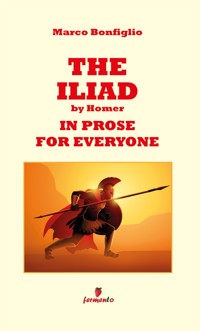
Discover the epic tale of Troy, where the destinies of heroes, mortals, and gods collide in a breathtaking narrative. Dive into a world where each character relentlessly pursues their goals, even when their ambitions clash with those of their allies or bitter enemies. The seething anger of Achilles towards Agamemnon looms large, casting a dramatic shadow over the entire conflict.
But amidst the chaos and divine whims, a powerful sense of belonging to a people emerges, transcending mere allegiance to an army. It’s a determination that refuses to waver, even when the gods seem to have turned their backs. Experience Hector’s courageous acceptance of his fated final duel, as he embraces his destiny with unwavering resolve.
In the Iliad, honor takes center stage, standing tall before the clash of swords. This isn’t just a war story; it’s a captivating exploration of the motivations that drive Greeks and Trojans to collide, motivations that go beyond mere possession of Helen.
Never has this theme been more relevant than in today’s world. Marco Bonfiglio, as he did with the Odyssey (Fermento, 2023) masterfully blends Homer’s timeless epic with modern prose, transforming the Iliad into an accessible and gripping narrative. Experience wild battles, internal conflicts, and cunning stratagems like never before. But beneath the surface, discover a world of emotions, reflections, and a profound respect for humanity that transcends loyalties. It’s an eternal quest for the delicate balance between war and peace that resonates with our times.
Das E-Book können Sie in Legimi-Apps oder einer beliebigen App lesen, die das folgende Format unterstützen:
Veröffentlichungsjahr: 2023
Ähnliche



















Marco Bonfiglio
The Iliad in prose for everyone
Indice dei contenuti
Copertina
The reasons behind a work
BOOK I
BOOK II
BOOK III
BOOK IV
BOOK V
BOOK VI
Book VII
Book VIII
BOOK IX
Book X
Book XI
Book XII
BOOK XIII
BOOK XIV
Book XV
BOOK XVI
BOOK XVII
Book XVIII
Book XIX
Book XX
Book XXI
Book XXII
BOOK XXIII
BOOK XXIV
Main Characters
Copertina
The reasons behind a work
In the Iliad, battles rage and lives are extinguished. Yet, this alone is not the heart of the matter. Throughout the annals of time, men have clashed swords and met their fates on the battlefield. So, perhaps, the paramount inquiry is not the act itself, but rather the profound query: what compels two peoples, two warriors, or any two souls to entwine in combat?
The spark that ignites this war is the abduction of Helen, the enchanting consort of the Greek Menelaus, by Paris, the beguiling scion of Priam, the sovereign of Troy. Here, in this theft, honor takes root, and an unwavering resolve to rectify a wrong at any cost, even if it requires the shedding of blood. Yet, can it be believed that an entire host of Greeks would embark on a campaign to assail Troy solely for the sake of one woman?
Would it not have been simpler, for the Trojans, to return Helen and spare their city the ravages of siege? These queries may seem rational, if the Iliad were but a chronicle of war. However, the splendor of Homer's opus lies in its exploration of why wars are waged.
Within these pages, the individual's motives take precedence over the army's cause and the formation's design. There exists an abiding, fervent incentive that propels each warrior to stand his ground or continue to sail. Remember this: no soul is coerced into battle. The Greek army that descends upon Troy is an amalgamation of numerous factions, of diverse peoples who willingly rally beneath Agamemnon's standard. Yet, at any juncture, they retain the autonomy to depart, and their sovereign would be powerless to restrain them. Thus, the Iliad reveals its first great revelation: an unyielding sense of belonging, a shared purpose, an unwavering cognizance of a goal worth fighting for.
However, this is not confined to the literal battlefield. When, after a decade of warfare, many Greeks falter, contemplating a return to their homelands, Odysseus responds candidly, almost disarmingly."You could depart, but would it not be a travesty to relinquish the purpose for which we've toiled, year upon year?" Here stand men possessed of purpose, resolute in its pursuit. The battles themselves, though pivotal, serve as but a means to an end, and not necessarily the most paramount one. It is also the allure of discovery, the intrigue of encountering new cultures, that propels many warriors.
They harbor a genuine desire to ascertain whether there exist individuals superior to themselves, both as warriors and as men. In matters of combat, yes, but also in the realms of character and virtue. The Iliad is replete with accounts of the battlefield, yet none of its participants ever harbors doubt about the ultimate outcome of their engagements. They accept their fate, which may entail defeat or a duel with a superior foe.
It is intriguing to juxtapose this mindset with the present day when few can gracefully accept defeat, should another prove superior in the duels of daily life. Yet, in the Iliad, it is this very ethos that may lead two adversaries to drive their spears into the earth and clasp hands. Every man believes strongly in himself, and yet this does not preclude the acknowledgment of his adversary's worth, virtue, and substance.
In such a milieu, human and psychological dimensions assume the power to shape the course of war. Achilles, for instance, refuses to fight, not because he fears any adversary, but because he endures an affront at the hands of Agamemnon, who strips him of his beloved Briseis. All are aware that he is the mightiest warrior in the Greek host, and Achilles himself knows that the fortunes of his comrades hinge upon his involvement. He unhesitatingly transforms a personal slight into a matter of principle, even though his very essence is entwined with warfare. A relentless warrior, he nevertheless bears an elevated sense of loyalty and honor. For, in the end, even war is meaningless when it severs the bonds of fairness and mutual respect, whether the adversaries be foes or allies.
This principle similarly governs Hector, the most valorous commander of the Trojans. He does not shy away from his confrontation with Achilles, despite knowing his own impending doom. Hector willingly sacrifices his life so that future generations will remember his valor. It is not a futile gesture, for Hector's heart is dedicated to his people before his own destiny. Concurrently, a parallel struggle unfolds among the gods themselves—those who defend the Greeks and those who stand by the Trojans. The destinies of mortals and immortals interweave and converge time and again, returning to the core premise. Ultimately, the manner in which the Trojan War concludes is of little consequence. The question of which side triumphs holds no primary significance; it remains unaddressed.
This is a saga that delves into the reasons behind war. Within the Iliad, one may uncover an infinite array of motives. Yet, the reader may ultimately arrive at the conclusion that there exist no truly valid reasons for warfare. And herein lies the Iliad's profound secret: it compels you to delve into the deepest recesses of what constitutes right or wrong. In the end, you may realize that you inhabit a world where millions perish without explanation.
To glean even a modicum of understanding of how such events unfold is a rarity in our times. And, in truth, it is comforting to know that a morsel of insight, however small, emanates from a masterpiece crafted thousands of years ago.
Marco Bonfiglio
BOOK I
The Fury of Achilles and the Clash with Agamemnon
Sing to me, O Muse, the wrath of Achilles, son of Peleus, which brought countless sorrows upon the Greeks. The wrath that cost the lives of many valiant heroes, their lifeless bodies devoured by dogs and birds of prey. It was the will of Zeus that was fulfilled, as he had initially sown the seeds of discord and conflict between the Greek king Agamemnon and Achilles. Which of the gods set them at odds? It was Apollo, the son of Zeus and Leto. He, angered by Agamemnon's ill-treatment of the priest Chryses, unleashed a devastating plague upon the Greek camp. Warriors perished, and Chryses had come to the Greek camp to free his daughter. He bore an extravagant ransom and in his hands carried the laurel-wreathed staff of Apollo. Beside the golden scepter, he implored the Greeks, especially Agamemnon and Menelaus:
'Sons of Atreus, and all you valiant Greek warriors, may the gods who dwell on Olympus grant you victory in the siege of Priam's city, and a safe return to your homeland. But first, release my daughter, my dear one! Accept the ransom I offer and honor the son of Zeus, Apollo, the god of the distant shores and the far-reaching arrows.'
The entire army urged that the priest's request be granted, that they accept such a generous ransom. But Agamemnon, the king, did not agree, and he scornfully sent Chryses away, adding:
'Old man, let me never find you near our ships again! Do not delay now, and do not return in the future! Your golden staff and the laurel-wreathed staff of Apollo may no longer be of use to you. I will not release your daughter. She shall remain with me until old age claims her in my house, far from her native land, as she tends to my loom and shares my bed. Go now, do not provoke my anger if you value your safety.'
The trembling old priest obeyed the king's stern command and silently withdrew towards the roaring sea's edge. There, alone, he prayed to Apollo:
'O silver bow, protector of Chryse and Cilla, mighty lord of Tenedos! Hear me, Apollo! If ever in the past, I have built a temple in your honor, or burned the fat thighs of goats and cattle for you, grant my request now. May the Greeks, through your arrows, pay for the tears they have caused me.'
Apollo heard the prayer and descended from the heights of Olympus with anger in his heart. He carried his bow on his shoulder and a quiver hung from both sides, with arrows that resonated ominously with each movement of the god's shoulders.
He descended upon the earth like the nightfall, taking his stand at a distance from the ships, and he let loose an arrow. The twang of his silver bowstring sounded terrifyingly in the silence. Initially, he struck mules and swift-footed dogs, but soon his aim turned towards men. Funeral pyres of the fallen began to burn in great numbers in the Greek camp.
Apollo's arrows brought plague for nine days. On the tenth day, Achilles, advised by the goddess Hera and distressed by the sight of so many deaths, gathered the army for a council. When all were assembled and gathered in a group, the son of Peleus rose to speak:
'Agamemnon, I believe it is time to return to our homeland. We are besieged by both war and plague, and too many of our comrades are perishing. Let us go back to avoid further death. Now, let us consult a prophet, or a priest, or one skilled in the interpretation of dreams, for even dreams come from Zeus. We need to understand the cause of Apollo's anger if he accuses us of not honoring him enough. Perhaps, if we can appease him with a hecatomb of goats and smoking lambs, he will remove the afflictions from our camp.'
Achilles then sat down. Calchas, son of Thestor, renowned as the best of seers, stepped forward. He knew the present, the future, and the past, possessing the gift of prophecy bestowed upon him by Apollo himself. He had been a helpful guide for the Greeks in their journey to Troy. Speaking wisely, he addressed the army:
'You command me to reveal the source of Apollo's anger, Achilles, and I shall do so truthfully. But try to understand what I am about to say, and swear that you will defend me, with words and deeds, should it become necessary. I ask this because I fear that a powerful man here will become enraged, a man who rules over the Greeks and whom the Greeks obey. The wrath of a king is unbearable when unleashed upon an ordinary representative of the people! Even if the ruler somehow manages to contain his anger, he will harbor resentment until he can take revenge. Therefore, I need to know if you will protect me, you who are beloved by Zeus.'
'Take courage and reveal the divine response you know,' Achilles reassured him. 'As long as I am alive and have my eyes upon this earth, no harm shall come to you from any man near our ships! No one shall dare to touch you, not even if you speak of Agamemnon, who boasts of being the mightiest in this camp.'
The seer, with renewed confidence, spoke plainly:
'Apollo is not angered by unfulfilled vows or offerings. He is enraged because of Agamemnon's treatment of the priest, his refusal to release the priest's daughter, and his rejection of the ransom. For this reason, Apollo has sent these grievous afflictions upon us and will continue to do so until the maiden is returned to her father with an appropriate ransom. Afterward, a great sacrifice must be performed at Chryse, and only then can we hope to appease and soothe the god's anger.'
Powerful Agamemnon rose to his feet, infuriated. His heart pounded with anger, and his eyes blazed with fire. He glared at Calchas and exclaimed:
'Prophet of doom, you never bring good tidings! Instead, your heart seems to relish in foretelling calamities and misfortunes! From your lips, we never hear joyful words. Now, before the entire army, you announce like a prophet that I am the cause of Apollo's wrath, all because I did not accept the ransom for the young maiden Chryseis. I desire her in my own home and indeed prefer her to my lawful wife, Clytemnestra, who is in no way inferior to her in beauty, grace, thoughts, or deeds. However, if it is deemed best for the sake of the army, I will release the girl. I want the well-being of my forces, not their destruction. But you must prepare a new gift for me, as I will have to part with her. Do so immediately. It is not fitting that I alone among the Greeks go without offerings. Therefore, hasten to determine what other prize is rightfully mine.'
Achilles retorted, annoyed, and gave him a sidelong glance:
'You are insatiable, Agamemnon! How can the Greeks offer you a gift? In this land, we cannot find rich treasures to share. Those we acquired in the cities we plundered have already been divided. It would not be appropriate for the warriors to pool them again. Now, give up the maiden to appease the god. If Zeus allows us to topple the walls of Troy, we can ransom her back fourfold or more.'
'However skilled you may be, Achilles,' the king replied, 'do not hide your true thoughts. You cannot deceive or persuade me. Would you demand, you who have already received your gift, that I relinquish the girl and insist that she be returned? Very well, as long as the Greeks provide me with an offering that suits my desires. If they fail to do so, I will personally come and take your share of the spoils, or that of Ajax or Odysseus. I will carry it off, and let anyone who loses his prize try to provoke me! But we can discuss these matters later. For now, let us launch a ship, gather a crew of rowers, and load it with the necessary items for the hecatomb. Let Chryseis be embarked upon it. One of our leaders shall escort her: Ajax, or Idomeneus, or perhaps Odysseus. Or you yourself, son of Peleus, known for your implacable nature. Through this ritual, may you appease Apollo's favor towards us.'
Achilles, vexed, glared at him:
'You are clothed in shamelessness! Your only concern is your own gain! How can the Greeks willingly obey you or march and fight valiantly against other warriors? I did not come all the way here to fight the Trojans. They have not wronged me in any way; they have never stolen my cattle or horses, nor have they destroyed the crops of Phthia, my homeland, which lies far from Troy, separated by rugged mountains and endless sea. We followed you, shameless Agamemnon, seeking revenge for your brother Menelaus and for yourself, accursed dog, to the detriment of the Trojans. But you care not for that, nor do you worry... You even threaten to take away the gifts that I have labored hard for and were given to me by the very sons of the Greeks! You know well, though, that when our army conquers a Trojan city, I do not receive a share of the spoils equal to yours. Yet, my hands handle and resolve the most difficult tasks of war! But when it comes to dividing the spoils, the lion's share goes to you... And after all the toil of battle, what I bring back to my ships is only a small reward. Now, I will return to Phthia. It is undoubtedly best for me to go back to my homeland on my own ships. I have no intention of continuing to amass riches to inflate your glory, only to remain here humiliated!'
'If your heart compels you, then leave,' Agamemnon replied. 'I will not beg you to stay with me. I have other warriors by my side who will do me honor, and above all, Zeus is on my side.'
You are the most hateful of all the Greek leaders present here! Your spirit is always inclined towards conflict, wars, and battles. But remember, if you are so strong, it is thanks to a god and no one else! Return home with your ships and your comrades, resume your rule over the Myrmidons. I don't care about you, nor do I fear your wrath. On the contrary, this is my will: if Apollo deprives me of Chryseis, I will send her back with my own ship and my companions. But in return, I will take the lovely Briseis and go to the tent to claim her myself. I will take your gift so that it is known how much stronger I am than you! And let this be a warning to anyone in the future who dares to speak to me as an equal or challenge me."
Achilles felt a sharp pang of pain. Two thoughts battled within his hairy chest: whether to draw his dagger from its sheath, send the others away, and kill Agamemnon, or to contain his anger in his heart. While tumultuous considerations churned within him, and he was ready to gleam the blade, the goddess Athena descended from the sky. She was sent by Hera, who cared for both Achilles and Agamemnon equally. Athena appeared behind the mighty warrior, visible only to him, and seized him by his golden hair. No one else noticed her presence.
Achilles was left breathless. He turned, immediately recognizing the goddess. His eyes gleamed with a terrible light as he spoke to her."Oh daughter of Zeus, what brings you here? Have you come to witness Agamemnon's violence? I declare that soon he, due to his arrogant actions, will lose his life. And you can be sure that such a prediction will come true!"
"I have come from the heavens to appease your anger, if you will obey me. It is Hera who sent me, as she cares for both of you. Cease your quarrel, put away your sword. If you intend to continue your insults, do so with words. What I'm about to tell you will come to pass: one day, for this violence, threefold gifts will be offered to you. Hold back, then."
"Oh goddess, your words should be respected even by one who harbors much anger in his heart. Those who obey the gods are heard by them."
Achilles released his grip on the silver hilt of his sword. He held Athena's counsel in his heart as she departed for the Olympus, Zeus's abode. Achilles then resumed his invective against Agamemnon, unable to control himself.
"Drunkard, with the eyes of a dog and the heart of a deer, your spirit never drives you to wear armor and join the battle with the army or assault alongside the mightiest Greeks! Such prospects terrify you! It is certainly much easier to stay in camp and seize the spoils from those who speak to you face to face... You are a king who devours his people and rules over the incompetent! Otherwise, Agamemnon, this would have been your last offense! Listen to my great oath. By this wooden scepter, which will never sprout leaves or branches since it was torn from its trunk on the mountains, and it will never flower because bronze blades have stripped it of leaves and bark all around. Yes, by this scepter, now held by those Greeks who uphold justice and maintain laws in the name of Zeus! Here is my oath. One day, the sons of the Greeks, all of them, will mourn Achilles. And then, tormented, you will not be able to help them when many of them fall dying under Hector's blows. Your heart will be torn by regret for not having rightly rewarded the mightiest warrior in this army!"
Having said this, he threw the scepter covered in golden nails to the ground and sat down. Agamemnon, on the other side, was furious. It was Nestor, the eloquent speaker, who rose to his feet; his words flowed as sweet as honey. Under his reign, two generations had passed, born and raised with him in Pylos, and he continued to rule the third. He addressed the two disputants:
"Ah, a great misfortune befalls the Greeks! If Priam and his sons knew of your sad quarrel, they would rejoice in their hearts, along with all the Trojans. You, the foremost in this army in the assembly and in valor, listen to me. Both of you are younger than me. I once lived among warriors even mightier than you, and they certainly did not disregard my words. Nowhere have I seen, nor will I in the future, men equal to Pirithous and Dryas, Ceneus and Exadius, Polyphemus and Theseus, son of Aegeus, resembling gods. They grew mightiest among all men on earth, and mightiest they proved themselves. They fought against equally valiant opponents, such as the mountain Centaurs, and massacred them horrendously. I left Pylos and lived with them in distant lands. They called me, and I fought for my own sake. But against them, none among mortals who can open their eyes to the sun today could hold their own. Yet they followed my advice and respected my thoughts. It would be fitting for both of you to do the same. Agamemnon, despite your power, do not take the girl from Achilles. Allow him to keep her; it was the Greeks who gave her to him. And you, son of Peleus, do not openly oppose the king. He who holds a scepter receives glory from Zeus and does not share a common honor with others. Your strength is boundless and comes from your mother, a goddess. But he commands many men and is much more powerful. Although you, Agamemnon, should also remove the anger from your heart. I implore you to dispel the wrath you feel towards Achilles, an irreplaceable bulwark for the entire army in this sorrowful war!"
The king responded."I completely agree with your words. But this man claims to be above everyone else! He wants to command, to tyrannize, to give orders that I believe not everyone will obey. If the immortals made him a wondrous warrior, did they also grant him the right to boast and spew insults?"
The reply from Achilles, son of Peleus, came quickly."If I yielded to all your arguments, I would truly be called a worthless and cowardly man! You can command a multitude of men, but you will not give me orders. I will not obey you anymore. I will say one more thing, and I want you to remember it: I will not use force to keep the girl, neither from you nor from anyone else. In that case, you gave her, and you would take her back. But the rest of my wealth is stored on the ships and you could never take it away against my will! If you dare to try, all those present will see your dark blood flow around my spear!"
The two stopped quarreling and disbanded the assembly of the army near the ships. Achilles returned to his tent with his companions and the son of Menoetius; the king pushed a ship into the sea, chose twenty rowers, and had the offerings for the sacred hecatomb to Apollo loaded on board. Young Chryseis was also brought on board, escorted by the crafty Odysseus.
The ship began to trace paths on the water. Meanwhile, Agamemnon ordered the army to purify themselves. They did so, throwing their impurities from their bodies into the sea. They then offered hecatombs of bulls and goats to Apollo. The fat, as it burned, rose to the sky, mingling with the smoke. But the king had not forgotten the threat he had made to Achilles earlier. He turned to his two heralds and loyal attendants, Talthybius and Eurybates:
"Both of you, go to Achilles' tent, take Briseis by the hand, and bring her here. If he refuses to follow you, it will be worse for her: I will go to get her myself, accompanied by many warriors!"
The king's order was brutal and unyielding. The heralds reluctantly walked along the beach and arrived at the Myrmidons' ships. They found Achilles sitting beside his tent. The hero certainly did not rejoice at the sight of the heralds, who, out of fear and respect for him, stopped and remained silent. However, he had already understood:
"Greetings, heralds sent by Zeus and by men. Come closer, do not be afraid. The fault is not yours but Agamemnon's, who sends you two in search of Briseis. Patroclus, go and bring the girl and give her to them. But both of you shall be witnesses before mortals and immortals, and before that wicked king! If ever in the future there is still a need for me to resolve troubles and battles... Agamemnon is mad, he cannot connect present prospects with future ones! He has no idea how the Greeks will be saved by fighting beside their ships!"
Patroclus followed his friend's instructions and led Briseis out of the tent. The two heralds took the young woman and returned from where they had come. The maiden did not follow them willingly. Achilles, having distanced himself from his comrades, stood aside and burst into tears on the seashore with its white crests. As he gazed at the vast expanse of water, stretching out his arms, he implored his mother:
"Mother, I was born to live a short life... Zeus, who thunders from the heights of Olympus, should at least grant me glory? Yet I am deprived even of honor! See how the arrogant Agamemnon offends me. He has taken my gift, ripped it from my hands!"
He alternated between words and equally bitter tears. Tethys, from the depths of the sea where she sat beside her aged father, heard her son call out. She immediately emerged from the waters in the form of mist and positioned herself beside Achilles, caressing him with her hand and trying to comfort him:
"My child, why do you weep? What sorrow pierces your heart? Do not hide it from me; we both know it!"
"Why should I repeat it, if you already know everything? We went to Thebes, the city of Eezius, the father of Andromache, and we burned it."
"We took away all the riches. The Greeks divided the spoils evenly, and they chose Chryseis for Agamemnon. But Chryses, her father and a priest of Apollo, came to our ships and implored us to release her. He held in his hands the sacred fillets of the god and offered an endless ransom. He prayed around the golden scepter to the entire army, and especially to the two sons of Atreus. The Greeks thought it was right to honor the priest's request and urged that it be accepted. However, Agamemnon did not agree and rudely dismissed Chryses, making it clear that he never wanted to see him near the ships again. The old man left, angered. Apollo, who protected him, heard his prayer and began to strike our camp with his arrows. Men were dying piled on top of each other, under Apollo's arrows that were striking everywhere. Our seer, aware of the situation, revealed the reasons for the god's wrath. I was the first to work towards appeasing his fury. But at that point, even Agamemnon was blinded by anger. He confronted me and made a threat... A threat that has now been fulfilled. At this moment, the Greeks are bringing Chryseis back to her father. But other heralds are also leaving, taking with them the young daughter of Briseis, whom the Greeks themselves had given me. Ah, if you can, help your son! Ascend to Olympus, beseech Zeus, if you have ever pleased his heart with words or deeds! Often, in the palace, I heard you boast of the time when you alone among the gods kept shame away from Zeus's head. The other immortals, including Hera, Poseidon, and Athena, wanted to bind him, but you released him from his chains by calling for help from one of the hundred-handed monsters: the gods call him Briareus, but among men, his name is Aegaeon, even stronger than his father. He sat down next to Zeus, and the other gods were terrified, immediately abandoning their intent! Now, you could remind Zeus of that episode, embracing his knees. Ask him to stand by the Trojans, to help them. Implore him to bring slaughter among the Greeks, to drive their ships into the sea... Then, yes, they will enjoy their mad king! And Agamemnon himself will understand his stubborn madness in not wanting to reward the mightiest warrior in the army!"
"I am a miserable mother... For what reason did I raise you? If only you could avoid crying and suffering after learning that your fate will be short... Now you are destined for a swift death and endless pains! Misfortune hung over your head when you were born in that palace... I will go to the snowy Olympus to speak with Zeus if he will listen. But I know that he left for the Ocean yesterday to attend a banquet among the Ethiopians; all the other gods followed him. He will return in twelve days, and then I will go to his bronze threshold to supplicate him. I think I know how to persuade him. Meanwhile, you keep the anger you feel towards the Greeks inside you and refrain from fighting."
Thetis left, leaving her son angry at having lost Briseis, forcibly taken away from him. At that moment, Odysseus arrived in Chrysa, leading the sacred hecatomb. The crew, upon reaching the port, gathered the sails and stowed them in the ship's hold. By quickly slackening the ropes, they raised the mast onto the crutch and advanced toward the mooring, propelled by the oars. They cast out the drilled stones and tied the stern cable, landing on the pebbly beach. On the shore, they set up the necessary for the sacred hecatomb to the god Apollo. Chryseis disembarked. Odysseus led her to the altar, handing her over to her father.
"O Chryses, Agamemnon sends me to return your daughter to you and to offer a solemn sacrifice to Phoebus Apollo on behalf of the Greeks. May his wrath, which is now bringing moans and troubles upon our army, be appeased."
The priest welcomed his daughter with joy. They immediately prepared and arranged the hecatomb around the altar. After washing their hands, they took the barley grains, for which Chryses, with his arms raised to the sky, began to pray.
"Hear me, Apollo with the silver bow, who protects Chrysa and Cilla, who reign as lord over Tenedos. In the past, you accepted my plea, granting me great honor and striking the Greek warriors. Now, once again, fulfill my vow: drive your humiliating scourge far from their camp!"
Apollo listened. After the prayer, they threw the barley grains. They slaughtered and skinned the animals, cutting their thighs and wrapping them in fat, placing the first fruits on top. The elderly priest burned the meat on the altars and sprinkled it with red wine. The younger men wielded their forks. After the thighs were cooked, they ate the entrails and cut the rest into pieces, which were carefully skewered and roasted. Once hunger and thirst were satisfied, the wine bowls were filled. Cups brimming with sweet nectar were raised for many toasts throughout the day. The Greek warriors pleased Apollo with beautiful hymns as they sang his praises.
As the sun set and shadows lengthened, the Greeks slept near their ships. At the first light of dawn, they returned to the great army camp. Apollo sent a favorable wind for them, and immediately the crew raised the mast, on which white sails were spread. The powerful gusts of the wind filled the center of the canvas, and foamy waves crashed, roaring, against the moving ship's hull.
Upon returning to the camp, they placed long beams under the vessel and pushed it onto the sand. Finally, they moved away among the tents and other ships. Achilles, however, brooded over his anger. He avoided attending the assembly out of respect for the men and was no longer seen in battle. His heart consumed him in an immobile body that longed for the shouts and clashes of battle.
As the twelfth dawn after that day approached, the gods, led by Zeus, returned to their dwelling. Thetis had not forgotten her son's cause. She emerged from the sea currents and ascended to the mountain that was the abode of the immortals. She found Zeus sitting apart, on the highest peak of Olympus. She embraced his knees with her left hand and caressed his chin with her right, speaking in a supplicating tone:
"Oh, Father Zeus, do you remember the help I provided with my words and deeds? Grant my wish now: honor my son, who among all faces a premature death. Agamemnon has deeply offended him, taking away the gift he received from his own companions. So, wise Zeus, grant glory to Achilles and victory to the Trojans, so that the Greeks understand the respect he deserves!"
Zeus did not respond. He remained silent. Thetis clung tighter to his knees and implored him once more:
"Give me a sign, make me a promise... Or refuse my request, do not hesitate to show how I am the most despised among the goddesses!"
"Ah, wretched woman, wherever I go, I am always plagued by your suspicions! Nothing escapes you... Yet you can do nothing against my will."
"Indeed, I will distance you even further from my heart, which will become increasingly bitter for you. If things continue in this direction, it means that this is what pleases my heart. Therefore, remain seated and silent, obey my command! If I were to approach you, moving my invincible hands toward your throat, the gods on Olympus would be powerless to save you!"
She trembled at Zeus's threat. She remained still, silent, suppressing the tumultuous thoughts racing through her mind.
The blessed ones were on the verge of anger in that immense hall. Hephaestus, the glorious blacksmith, began to confer with them and bring some sweetness to his mother Hera's wounded pride:
"This cursed affair will become unbearable if you two continue to quarrel vehemently over mortals, causing turmoil among the gods! When hostility prevails, not even a splendid banquet can restore peace. My mother is wise, but I want to give her advice: be kinder to our father Zeus... We do not want him to get even more irritated and disrupt our banquets. Let it never be that he decides to cast you down from your throne! Zeus is truly the eternal strongest. Mother, address him with calm words; immediately, he will show himself kinder and more conciliatory toward all of us."
Limping, Hephaestus placed a cup in the hands of the one who had given him birth. He continued:
"Have patience, my mother, control your emotions. I know how angry you are, but I don't want to see you struck in this hall with my own eyes... As much as it pains me, I couldn't defend you. You can't fight Zeus! I tried to defend you once, and he grabbed me by the foot and threw me out of Olympus. I fell for an entire day, and only at sunset did my descent end on Lemnos. I had only moments left to breathe, but fortunately, the Sintians came to my aid immediately."
Hera laughed, and still smiling, she took the cup from her son's hands. Hephaestus, moving from right to left and pouring wine from the crater, made sure to fill the cups of all the other gods. A hearty laugh spread among the gods at the sight of the blacksmith bustling from one side of the hall to the other. They feasted until the setting of the sun, accompanied by the sublime melody of Apollo's lyre and the harmonious alternating voices of the Muses.
When the sun's rays disappeared behind the divine mountain, the desire for rest led everyone to their homes, built by the skilled hands of Hephaestus.
Zeus returned to his bed, and his wife was beside him.
BOOK II
The Preparation for War
Heroes and gods rested throughout the night. Zeus, on the other hand, couldn't sleep. He contemplated how to honor Achilles and bring about the deaths of many Greek warriors near the ships. The best course of action seemed to be sending Agamemnon a wicked dream. To this end, he spoke to the dream:
"Go, wicked dream, and reach the Greek ships. Once inside Agamemnon's tent, deliver my exact command: advise him to swiftly arm the army, for now is the opportune moment to seize the city of the Trojans. Tell him that the city of Troy, among the abode of the immortals, is no longer discussed; Hera, through her prayers, has convinced all of us, and soon the people of Priam will face dire misfortunes."
Upon hearing the order, the dream swiftly made its way to the ships. It sought out Agamemnon, who was sleeping soundly in his tent, surrounded by silence. Next to the king's head, taking on the appearance of Nestor, the dream addressed him:
"You sleep, son of Atreus... But it is not wise for a hero upon whose grave decisions the army relies to spend the entire night in slumber. Pay heed to my words, for I am here as a messenger of Zeus. Although distant, he has thoughts and compassion for you. He orders you to swiftly arm the army. Now is the time to conquer Troy. The city is no longer in the thoughts of the gods, for Hera has persuaded them through repeated prayers, and Zeus will bring calamity upon them. Remember what I have said; do not forget it when sleep abandons your eyelids."
The dream disappeared from the king's sight, leaving him in a blissful sleep. Agamemnon awoke suddenly, and the divine voice echoed in his ears. He raised himself up, sat for a moment, and then dawned on him. He put on a splendid, new tunic over which he draped a large mantle. He fastened sturdy sandals to his feet and hung a silver-studded sword from his shoulder. Finally, he picked up the scepter handed down through the generations, passed on to him by his ancestors, and with it, he made his way to the ships.
As the dawn arrived, shedding new light for both mortals and immortals, Agamemnon ordered his heralds to summon the war council. The army was assembled. Prior to this, the king had gathered the council of elders near Nestor's ship and outlined his plan:
"Listen to me! Last night, a divine dream came to me, remarkably resembling the figure of the illustrious Nestor. It stood by my head, advising against further sleep. It foretold that now is the opportune moment to arm the army: we shall conquer Troy! The city is no longer in the thoughts of the gods, for Hera has convinced them through her prayers, and Zeus will bring misfortune to them. It ordered me to keep these words in my heart and then vanished, leaving me in a sweet slumber. So, let us decide how to arm our soldiers. However, before we do that, it is necessary to test them, as is fitting. I will encourage the warriors to flee with their ships. Then, some on this side, some on the other, you shall try to restrain them with your arguments."
As Agamemnon sat back down, Nestor rose to his feet. With his customary wisdom, he addressed the council:
"O leaders and commanders of the army, if anyone else came to us with a dream, we would distance ourselves from it as mere deception. But the one who brought it is none other than the man who rightfully claims to be the best among the Greeks. Let us, therefore, consider how to arm our soldiers."
Having said this, Nestor was the first to leave the council, followed immediately by the other elders. In the meantime, the warriors were converging on the meeting place. Like swarms of bees that continually pour out of a hole in a rock and fly compactly over spring flowers, in the same way, a multitude of Greeks streamed onto the beach. They descended from the ships, emerged from their tents, and formed rows along the shore. It was fame, the messenger of Zeus, that drove them to hurry. The ranks were closed together, and as the soldiers sat, the ground groaned under their weight. Noise and commotion seized the assembly. Nine heralds tried to calm the army, urging them to lower their voices and listen to their leaders. With effort, the murmuring was subdued.
Agamemnon held the scepter crafted by Hephaestus firmly in his hands. The lame blacksmith had fashioned it for Zeus, who then gave it to Hermes, who, in turn, entrusted it to Pelops. Pelops passed it to Atreus, who left it to Thyestes. Finally, Thyestes gifted it to Agamemnon, who carried it among the islands of Argolis, where he ruled. Holding it firmly, the king put the army to the test:
"Dear Greek heroes, faithful servants of Ares, the lord of war: Zeus lays a heavy burden on my heart! He, the deceiver, initially promised that I would return home after destroying Troy. However, he has mocked me and deceived me... Now I am forced to return to Argos without glory, without all the companions I have lost. This was Zeus's true desire, and with his power, he has obliterated the reputation of many cities and will ruin many more in the future. No one can contend with his strength. But this shame will also be remembered by those who live after us: such a vast and valiant Greek army engages in vain warfare against a few enemies and still cannot prevail! I am certain that there are Greeks in greater numbers than the inhabitants of Troy, at least among those who live within the city. If the two peoples were ever to unite under a solemn oath, those who have a home here and our armies could be counted. And if we were to decide that each of us should have a Trojan as a cupbearer, surely many Greeks would remain without anyone to pour wine into their cups."
However, we must consider that our enemies can rely on allies from other regions. It is they, skilled spear-wielding warriors, who resist me and prevent me from taking the fortress of Troy, no matter how much I desire it. Nine years have passed since we arrived... The wood of the ships has rotted, and the ropes have loosened. Our wives await us at home, trembling in anticipation of our return, our children not yet able to speak on our knees. And the goal for which we came here is still far from being achieved... But now, you will all obey my command! Let us board the ships and return home. We will not be able to conquer Troy!"
Those who listened to the king's words among the crowd had a jolt in their hearts. The assembly was in turmoil, like the enormous waves at sea when Zeus drives the east and south winds to swell them toward the shore. Or like when the west wind comes violently to bend the shoots of plants, and the stalks bend under its breath. In the same manner, the assembly dispersed: the soldiers, with shouts of encouragement, hurried to the ships. The dust raised by too many sandals rose to the sky. Everyone urged each other to push the ships into the sea, to clear the trenches. The most impatient ones shouted for joy as they released the keels from the beams. The return of the Greeks was about to happen against the fate predicted.
But Hera was immediately in conversation with Athena:
"Ah, daughter of Zeus, is this the intention of the Greeks, then? Will they flee across the sea, leaving Helen in the hands of Priam and the Trojans, the very woman for whom they reached Troy and died to bring her home? Go immediately to their camp and persuade every man to stay put. Prevent them from putting the ships into the water!"
The blue-eyed goddess followed the order, leaping down from the heights of Olympus and soon among the Greek ships. She found wise Odysseus motionless, as he didn't dare to approach the boats. His heart was filled with bitterness. Athena asked:
"Son of Laertes, is this truly the state of affairs? Will you leave Helen in the hands of the Trojans? Hold your army back; don't let your comrades forget why they've endured so much suffering."
Odysseus recognized the voice of the goddess. He began to run, forgetting his own cloak, which was later picked up by the herald Eurybates, who tried not to lose sight of it. He arrived before Agamemnon and snatched the scepter from the king's hands. With it, he went to the ships. When he encountered heroes and chosen leaders, he held each of them back with measured words:
"Foolish one, it doesn't suit your character for me to strike fear into you as I would a coward. Sit down instead, and let other soldiers follow your example. Have you not understood Agamemnon's true intent? He is testing the Greeks now, but soon he will strike them from behind, revealing his true intentions. Haven't we all heard what he declared in the council? Ah, may he not mistreat the sons of the Greeks in one of his fits of anger! As you know, the anger of kings raised by Zeus is great. Their honor comes from the father of the gods, and the father of the gods loves them."
As he moved through the camp, he also encountered common soldiers. Whoever he saw ranting was struck with the scepter and verbally reprimanded:
"Irresponsible one, remain still and listen to the counsel of those stronger than you! You are a coward, useless, possessing no power in war or council. Besides, not all Greeks can be rulers. Allotting power to many would not be wise. It's much better to have a single king, a single leader with complex thoughts, to wield the scepter and laws, to provide for his subjects."
With his authority, he rallied the army. The soldiers were now returning to crowd the assembly, coming out of the ships and tents with a noise resembling that of a wave crashing on the shore of the sea. As everyone was back in their places, only Thersites persisted in shouting wildly. His heart spewed out disordered phrases with the intention of bringing disgrace upon the kings. He was the ugliest man who had gone to Troy: lame in one foot, flattened nose, hunched shoulders that curved towards his chest. Sharp skull and sparse beard. Hated by all, especially by Achilles and Odysseus, of whom he constantly spoke ill. But in those moments, his target of insults was Agamemnon. Unconcerned about the hatred all the Greeks felt towards him, he addressed the king with a shrill voice:
"Son of Atreus, what reason do you have to complain? What are you plotting now? Your tents are full of bronze and populated with all those women we offer to you every time we capture a citadel. Do you still crave gold, desire the ransom of some Trojan whose child has been taken by me or another soldier? Or do you long for a young woman to possess away from our gaze? Yet it's unjust for a ruler to let his subjects drown in misfortunes! Ah, cowards, you deserve to be called women rather than men! But let us sail; let us return home and leave Agamemnon to digest his own honor. He will come to realize the help we all provided him. He has even offended Achilles, a man far more valuable than himself. He has even taken possession of his spoils without respect! Achilles's heart is truly immune to anger... Otherwise, Agamemnon, this would have been your last offense!"
Thersites was quickly approached by Odysseus, who glared at him and addressed him with harsh words:
"However sharp an orator you may be, your tongue is very confused. Stop it and never dare to insult any king again! I maintain that a coward like you doesn't exist among all those who arrived beneath the walls of Troy. Therefore, you cannot afford to choose kings as the subject for your words! Do not spew insults and do not think about returning home. No one knows if we will have luck or misfortune, if the sons of the Greeks will return home or die at sea and in battle. But you insist on striking Agamemnon with trivial arguments because you envy the many gifts that the army has reserved for him... However, I promise you this: if you behave like an idiot again, I will seize you, strip you of the clothes covering your shame, and send you crying out of the assembly after beating you with harsh blows. May I not be called Odysseus and the father of Telemachus if it does not happen as I say!"
With the scepter, he struck Tersites heavily in the chest. Thersites writhed, a warm tear rolled down from his eye, and a lump of blood appeared beneath the golden staff. He sat down in amazement, and with a foolish expression, he tried to wipe his eyes. The other soldiers burst into laughter, and someone said to his nearby companion:
"Odysseus has done marvelous deeds, distinguishing himself with good advice and valor in battle, but this is certainly the most beautiful thing he has ever done for the Greeks, silencing the babbling of that arrogant fool! Surely, he will think twice before offending the kings with futile words again."
Odysseus stood up still holding the scepter in his hands. Next to him, Athena, in the guise of a herald, silenced the army so that both the first and the last of the warriors could hear and understand his thoughts.
The King of Ithaca continued:
"Now, sire, the Greeks would make your figure odious to mortals and forget the promise they made when they left Argos: to return home only after the fall of the walls of Troy. Just like newborns or widowed women, they groan among themselves just to get away from here. Undoubtedly, this is an adventure we would like to avoid as much as it has wearied our hearts. If a man stays away from his wife for even a month, he has every reason to curse the winter storms that churn the sea and prevent his return. And we have been in this land for nine years now... There is, therefore, no reason to blame all those soldiers who are now agitating near the ships. Yet it is a shame to stay in one place for so long and return without achieving our goal. But, friends, try to resist and stay a bit longer: we will know if Calchas is telling the truth or not.
In our hearts, we are aware, and you who have escaped the demons of death are witnesses, that the ships of the Greeks gathered at Aulis with the intention of defeating Priam and the Trojans. Do you remember? Next to the sacred altars, we offered great hecatombs to the eternal gods, under a beautiful plane tree and near a spring from which clear water flowed. Then a clear sign appeared to us: a dreadful scarlet serpent with its back arched onto the plane tree. It was Olympus that wanted us to witness that scene. On the tree, on the highest branch hidden by the leaves, there was a nest of eight tender sparrows, nine counting the mother. The reptile devoured those little, chirping birds pitifully, and the mother flew around lamenting the sad fate of her offspring. We saw the predator coil, leap, and seize her by the wing. After it had eaten those feathered creatures, you haven't forgotten, Zeus turned it into stone. We remained still to watch until the tremendous prodigies of the gods interrupted the hecatomb. Calchas explained its meaning. He said:
"Why are you all silent, long-haired Greeks? This is a sign that the wise son of Cronos wanted to show us. A slow sign, one that will take time to come to pass, but it will become a reality. Just as the serpent devoured nine birds, for nine years we will have to fight hard. But on the tenth, we will conquer Troy."
That was the seer's explanation, which is now coming to fruition. Stay, brave Greeks, stay until the capture of Priam's citadel!"
The soldiers cheered. The ships echoed with their shouts. Everyone applauded Odysseus's speech. Nestor then intervened:
"Ah, you express yourselves like stuttering children who don't give a thought to the war. But what will become of promises and alliances? Will plans and counsel go up in smoke, handshakes, libations we've trusted in? The truth is that we know how to fight with words, but we cannot find a way to stay here for long. Agamemnon, you, as in the past, will have to lead the Greeks with firm will through grueling battles. Let the few soldiers who plot solitary plans consume their minds; let them return to Argos before finding out whether Zeus's promise is concrete or false. I still remember that the father of the gods gave us an irrefutable sign when we gathered the ships to bring devastation to the land of the Trojans. Let no one be in a hurry to return home before lying with a Trojan bride and avenging the sufferings of Helen. But if some madman truly intends to embark on returning to his palace, let him even attempt to reach the ship and he will meet death before anyone else! You, sire, take care of yourself but do not ignore the opinions of others. Do not reject my words. Divide the men into tribes and quarters: tribe will support tribe and quarter will support quarter. In this way, the Greeks will follow your orders, and you will know who, among leaders and common soldiers, proves cowardly or valorous because they will fight separately. Finally, you will understand whether the failure to capture Troy can be attributed to the cowardice of the warriors or to mistaken war strategies."
"Once again, you are right," Agamemnon acknowledged."Ah, by Zeus and Apollo, if I could count on ten advisers like you among the entire army, we would soon conquer Priam's citadel, destroying it with our own hands. However, Zeus has granted me only pains and forces me into pointless quarrels and disputes. I created a quarrel with Achilles over a maiden, exchanging violent words. And I was the first to fall into the trap of anger... But if one day we manage to all agree, then the Trojans will be left without even a breath! Now, go and eat. Let each man sharpen his spear, his sword, let each feed the horses with barley and check the proper functioning of the chariots awaiting the next, hateful battle. When we resume fighting, there will be no rest, and only the night, perhaps, descending, may cool the ardor of men. Under the shield, the strap that binds the chest will be wet with sweat. Hands will tire on the spear, and the beasts that pull the chariots will be fatigued. And if I discover that someone prefers to stay on the ships rather than in the midst of the conflict, they can prepare from now on to feed dogs and birds with their own corpses!"
The Greeks roared like the wave raised by the south wind crashing against the rocky cliff. They rose, dividing themselves among the ships, lighting fires near the tents, and eating. The soldiers sacrificed animals to this or that deity, praying to escape death in the heat of battle. Agamemnon sacrificed a fat five-year-old bull to Zeus and invited elders and princes to the ceremony: Nestor first, Idomeneus, the two Ajaxes, and the son of Tydeus, and finally Odysseus. Menelaus, who understood how many and what torments alternated in his brother's heart, presented himself of his own accord.
They surrounded the bull and offered barley grains. Among them, Agamemnon began to pray:
"Mighty Zeus, shrouded in dark clouds, may the sun not set and darkness not descend until I have destroyed Priam's abode, bringing blazing fire to its gates. Not until I have torn to shreds Hector's tunic, torn by iron around his chest. Alongside him, many will bite the earth, his comrades."
Cronus' son accepted the offering but did not grant the prayer. On the contrary, he increased the magnitude of their misfortunes.
After throwing the barley grains, they slaughtered and skinned the animal, then wrapped the thigh bones in fat, arranging the rest of the meat on spits. They burned the thigh bones on dry branches and roasted the entrails. They ate the innards and impaled the remaining meat on spits.
A lavish feast ensued.
Nestor then urged his comrades:
"Agamemnon, we can no longer delay the venture that a deity compels us to undertake. Let us waste no more time in words. The heralds should gather the scattered army. Once assembled, all together, we will awaken the warrior spirit of Ares."
Agamemnon was convinced not to waste further time in delay. The heralds were given the order to call the scattered soldiers to war. At their head were the commanders along with Athena, armed with the aegis shield adorned with a hundred golden fringes, which fluttered through the air, each worth a hundred oxen. She showed herself everywhere among the army, encouraging it for battle. She instilled strength in every heart so they could fight without respite: the Greeks found war sweeter than the prospect of returning home. Like a destructive fire that burns an immense forest from the mountaintop, with flames visible from afar, the bronze of their weapons gleamed as it sliced through the air and rose to the heavens. Like countless flocks of swans, cranes, and geese that soar through the currents of the Caïster and in the meadows of Asia, whirling and flapping their broad wings, while the valley resounds with their calls, so did the ranks of warriors abandon their ships and tents to pour onto the Scamandrian plain. Thousands of them, as numerous as the flowers and leaves that sprout in spring, covered the meadow. Like dense swarms of flies buzzing around a sheepfold full of sheep in the fair season when the milk fills the pails, the Greeks positioned themselves in view of the eager Trojans, ready to annihilate them.
And just as shepherds skillfully separate herds of goats if they become mixed while grazing, the commanders divided their troops in anticipation of battle. Among them stood out Agamemnon, resembling Zeus in countenance, Ares in his belt, and Poseidon in his build. Like a bull among cows in the herd, so on that day did the son of Atreus stand out among many heroes.
Now, O Muses who dwell on Olympus, you who know everything, who are ever-present, narrate to us who listen but could not see, who were the commanders at the head of the Greek army. I cannot list the names of all the soldiers in the army; I would not be able to do so even if I knew ten languages, even if I had ten mouths and an exhaustible voice. Not even the Muses, daughters of Zeus, could report the exact number of those who came to Troy. But I will recount the ships and their leaders. The commanders of the Boeotians were Leitos and Penelios, Arkesilaos, Clonios, and Prothoenor. Some dwelled in Hyle and in barren Aulis, in Schene, in Scolus, in Eteon rich in hills, in Thisbe and Graea, and in the wide Mycalessus; others resided in Arne, Eritra, Ilisus, Thebes, Thisbe, Graea, and Thespiae. All of them arrived at Priam's city with fifty ships, each carrying a hundred and twenty young Boeotian warriors.
Among the people of Aspledon and the Minyans of Orchomenus, the leaders were Ascalaphus and Ialmenus, the sons of Ares and Astyoche, born in the upper chambers of Attic Atreus. They came with thirty ships.
Schedius and Epistrophus, sons of Iphitus, led the Phocians, who inhabited Parnassus, Cyparissus, Crisa, Daulis, Panopeus, and Anemoria. They lived in Hyampolis, and by the banks of the river Cephisus, in Lilaea. They participated in the expedition with forty ships and their leaders efficiently ordered their troops. Well-armed, they stood on the right of the Boeotians.
The leader of the Locrians was the swift Ajax, son of Oileus: smaller in stature than Ajax, son of Telamon, he was a warrior of humble size who wore a linen cuirass and excelled in the use of the spear, surpassing all Greeks and Achaeans. The Locrians came from Cynus, Opous, Calliarus, Bessa, and Scarphe, Augeae, and Tarphe, Trachis on the Boagrius River. Ajax was followed by forty ships.
The Abantes occupied Euboea, with Calcis, Eretria, Histiaea, and Cerinthus by the sea, Dium, Carystus, and Styra. They were under the command of Elephenor, son of Chalcodon, their prince. They were a people of swift warriors, long-haired, armed with spears of ash, with which they sought to shatter the breastplates on the chests of their enemies. They also joined with forty ships.
Athens was the city of the noble Erechtheus, raised by Athena within her own temple. Celebrated by the youths with the sacrifice of bulls and lambs at the beginning of each year, the Athenians in Troy were led by Menestheus' son, Peteos. No one later born was as skilled at taming horses and leading soldiers armed with shields; only Nestor, older than him, could rival him. They came with fifty ships.
From Salamis, Ajax had arrived with twelve ships. He positioned his men beside the Athenian phalanxes.
The people of Argos and Tiryns, Hermione and Asine, Troezen, and Epidaurus with its vineyards, Aegina and Masete, were under the command of Diomedes, whose voice was the most listened to, and Stenelus, son of Capaneus, and Eurypylus, a hero like the gods, son of Euaemon. They came with eighty ships.
The inhabitants of Mycenae and the vast Corinth, Cleonae, Orneae, and Aricrathere, Sicyon on which Adrastus first reigned, Hyperesia, Gonoiessa, Pellene, and Aegium, arrived with one hundred ships under the leadership of Agamemnon, son of Atreus. They were followed by nobles and countless troops. He shone in shining bronze, proud like the one who rises strongest among all heroes.
His brother Menelaus led the inhabitants of the hollow Lacedaemon, of Pharis, Sparta, Messe, Augeia, and Briseia, of Amicla and Helos by the sea's shore, of Laas and Oetylus. They arrived with sixty ships and were now armed, eager for war, spurred on by the courage of Menelaus, whose heart burned with the desire to redeem his wife Helen.
The population of Pylus and Arene, born on the banks of the Alpheus River, included Epeians and Cyparisseans, Amphigenia and Pteleon, Helos and Dorium, where the Muses took away the song from the Thracian Thamyris. He came from Echalia, from the house of Eurytus, and believed he had a better voice even compared to the songs of the daughters of Zeus. The Muses were angered and made him blind and unable to sing or play the lyre. Nestor, the commander of these people, led them with ninety ships.
The people of Arcadia, at the foot of Mount Cyllene, near the tomb of Epitus, where men engage in single combat, and who inhabited Pheneus, Orchomenus, Rhipae, Stratia, Enispe with its many winds, and Tegea, Mantinea, Stymphalus, and Parrhasia, were led by Agapenor, the powerful son of Ancaeus. He commanded sixty ships, filled with skilled Arcadian warriors. The ships were provided by Agamemnon since these people had no experience with the sea.
The inhabitants of Buprasium and the closed Elis by the river Alpheus, along with Irmene, Mysia, Alesium, and Olenus, had four leaders, each commanding ten ships. These leaders were Amphimachus, the son of Cteatus, Thalpius, the son of Eurytus, Diomedes, the son of Amarynceus, and Polypoetes, the son of Agasthenes.
People from Dulichium and the Echinades Islands, located off Elis, were commanded by Meges, born to Phyleus, who emigrated to Dulichium after a falling out with his father. He led them with forty ships.
Odysseus, wise as Zeus, led the Cephallonian people, inhabitants of Ithaca, with Mount Neritus, and of Crocylea, Aegilips, Zacynthus, and Same. He commanded twelve ships.
Tlepolemus, the son of Hercules, led nine ships from Rhodes, the island of Camirus, Ialysus, and Lindus. He was born to Astyochea and Hercules and arrived in Rhodes after many trials and tribulations.




