


7,99 €
Mehr erfahren.
- Herausgeber: Fermento
- Kategorie: Gesellschafts- und Liebesromane
- Sprache: Englisch
The Odyssey has earned its place as the trailblazing novel of the Western world. What makes this epic tale timeless? It's a mix of factors that have cemented its enduring appeal: the modernity of its central figure, Odysseus, a hero navigating a treacherous path to return home, coupled with his unmistakable humanity, mirroring our own penchant for finding ourselves in tight spots.
In this epic odyssey, we encounter a cast of characters that could easily fit into today's world – the audacious, the naive, the romantics, and the wise.
In this edition, just as with the Iliad (Fermento 2004) and the Aeneid (Fermento 2004), Marco Bonfiglio weaves a masterpiece that marries timeless storytelling with contemporary language. The Odyssey morphs into a captivating narrative, an action-packed saga of emotions and adventure. Dialogues, descriptions, and emotions take on a fresh, accessible light that speaks to everyone.
Odysseus' return to Ithaca isn't just a quest to reunite with loved ones and homeland; it's the ultimate aspiration of our hero, a reason to fight, an opportunity to acknowledge his flaws, and a step toward becoming a better man. It's an endeavor to reclaim a dreamt life, one thwarted by the Trojan War. In the pursuit of this dream, Odysseus fearlessly confronts hostile tribes, Cyclopes, enchanting sirens, cunning sorceresses, formidable goddesses, and arrogant suitors vying for Penelope's hand. He's irresistibly drawn to the unknown, recognizing that oftentimes, great sacrifices are the price of wisdom – not unlike our daily struggles to attain a life of contentment.
Das E-Book können Sie in Legimi-Apps oder einer beliebigen App lesen, die das folgende Format unterstützen:
Veröffentlichungsjahr: 2023
Ähnliche



















Marco Bonfiglio
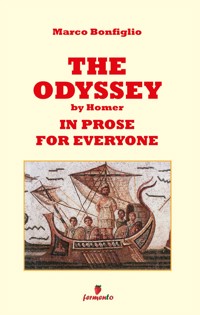
The Odyssey in prose for everyone
All rights reserved
© 2023 Fermento
www.fermento.net
Lucca (Italy)
ISBN 978-88-6997-722-3
First edition: september 2023
Table of contents
Cover
Synopsis
Biographical information
Road Signs for Easy Navigation Through the Book ©
The reasons behind a work
BOOK I
BOOK II
BOOK III
BOOK IV
BOOK V
BOOK VI
BOOK VII
BOOK VIII
BOOK IX
BOOK X
BOOK XI
BOOK XII
BOOK XIII
BOOK XIV
BOOK XV
BOOK XVI
BOOK XVII
BOOK XVIII
BOOK XIX
BOOK XX
BOOK XXI
BOOK XXII
BOOK XXIII
BOOK XXIV
Main Characters
Cover
Synopsis
The Odyssey has earned its place as the trailblazing novel of the Western world. What makes this epic tale timeless? It's a mix of factors that have cemented its enduring appeal: the modernity of its central figure, Odysseus, a hero navigating a treacherous path to return home, coupled with his unmistakable humanity, mirroring our own penchant for finding ourselves in tight spots.
In this epic odyssey, we encounter a cast of characters that could easily fit into today's world – the audacious, the naive, the romantics, and the wise.
In this edition, just as with the Iliad (Fermento 2004) and the Aeneid (Fermento 2004), Marco Bonfiglio weaves a masterpiece that marries timeless storytelling with contemporary language. The Odyssey morphs into a captivating narrative, an action-packed saga of emotions and adventure. Dialogues, descriptions, and emotions take on a fresh, accessible light that speaks to everyone.
Odysseus' return to Ithaca isn't just a quest to reunite with loved ones and homeland; it's the ultimate aspiration of our hero, a reason to fight, an opportunity to acknowledge his flaws, and a step toward becoming a better man. It's an endeavor to reclaim a dreamt life, one thwarted by the Trojan War. In the pursuit of this dream, Odysseus fearlessly confronts hostile tribes, Cyclopes, enchanting sirens, cunning sorceresses, formidable goddesses, and arrogant suitors vying for Penelope's hand. He's irresistibly drawn to the unknown, recognizing that oftentimes, great sacrifices are the price of wisdom – not unlike our daily struggles to attain a life of contentment.
Biographical information
Marco Bonfiglio lives in Rome, where he was born in 1980. He holds a degree in Communication Sciences. He loves Homer and dreams of a world where the great classics are accessible to every type of reader. Captivated by the Beatles in his adolescence, he plays the guitar and sings in the band The Beaters, which has performed in the most important venues and theaters in Italy and abroad. He is a sports journalist, specializing in basketball, and has hosted television programs and written for industry publications. For this publishing house, he has released “Odyssey in prose for everyone” (Fermento 2003), “Iliad in prose for everyone” (Fermento 2004), “Aeneid in prose for everyone” (Fermento 2004), Beatles for sale - The Novel” (Fermento 2005) and “The Italy ‘90 Syndrome” (Fermento 2014).
Marco Bonfiglio
Road Signs for Easy Navigation Through the Book ©
comma [ , ]
brief pause
semicolon [ ; ]
medium-long pause
period [ . ]
long pause
colon [ : ]
pause to catch your breath before the sprint
exclamation mark [ ! ]
long open-mouthed pause: astonishment, anger, pain, surprise, satisfaction
question mark [ ? ]
curious pause
question mark with exclamation mark [ ?! ]
pause of curious astonishment
ellipsis [ ... ]
pause with bated breath, prolonged pause because the list could go on, curiosity, waiting
quotation marks / dashes [ « » “ ” - ]
faithfully report a dialogue, a quote, a thought
The reasons behind a work
Back in high school, when I was studying the great classics, I often dreamed of seeing them rewritten in a way that would make them directly accessible to anyone. I'm not talking about content, mind you, but form. We all know the values, the meanings, the invaluable legacy that such works have left in human history. Personally, however, I have always felt that approaching the classics was not immediate. When you think of the classics, you almost spontaneously imagine an absolutely precious literary production, refined in style as well as in meaning. Undoubtedly it is so.
However, this does not prevent my mind from continuing to ask a question: how many have really read, from start to finish, the Odyssey? Or the Iliad? Or any other great classic of humanity? I wouldn't know how to answer, but I imagine they are a significantly lower percentage compared to those, practically everyone, who know the plot, broadly or in detail. Probably, people approach such works with a mix of fear and devotion. You don't pick up the Odyssey like it's a normal fiction novel. An incongruity, if you will, since the Odyssey has been defined as the first novel in Western history.
So, in short, we are faced with a great novel that no one experiences as such. There is no doubt that if there is a universal work, whose contents are constantly renewed over time, it is the Odyssey. The adventures of Odysseus (Ulysses for the Latins) and his companions, but more generally the world narrated by Homer, are as current as you can imagine. Another question follows: what would happen if, to such modern concepts, a language equally close to our days were to be combined? The answer is in this book. I want to emphasize that there is no intention to give a particular interpretation to the Odyssey.
It has been studied, dissected, and from its analysis continue to arise endless themes and keys to reading. My intention is not to provide another one. I have always thought that the true, great magic of this masterpiece is the ability to arouse in each as many emotions and sensations as there are its readers. It's like looking at a wonderful painting in which everyone can see different horizons, depending on the personality of the viewer. Everyone can find something in it, which can consist of a common theme for reflection or a small personal consideration to be jealously guarded within one's own heart.
The goal I dream of achieving, ambitious I must admit, is to provide the reader with a tool that allows them to make the Odyssey their own in the most direct way possible. Simply, I would like the user to have the opportunity to construct their own through a version accessible to everyone. It was also a challenge for me: I wanted to see to what extent Homer's work could become a modern action and sentiment novel. As far as I'm concerned, the results have been surprising. And I would like it to be placed in bookstores among fiction books rather than in the section dedicated to classics.
The Odyssey has a unique charm when read in verse, just as it has a unique charm when read in current prose. If with this work I could help someone, offer an alternative in choosing how to approach the first novel in history, I would be really happy. And if someone, reading it, would get even just a part of the emotions it aroused in me in writing it, I would be even more so.
Marco Bonfiglio
BOOK I
The Council of the Gods and the Meeting Between Athena and Telemachus
O Muse, tell me the story of the craftiest among men, who wandered long after destroying the sacred stronghold of Troy. He saw numerous cities, knew countless men, and during his sea journey, he endured a thousand pains trying to save the lives of his comrades and himself. Yet he failed, despite all attempts; they lost their way in the madness and ate the cattle sacred to the Sun God, who never allowed them to return home. O Muse, tell us something of these incredible adventures as well.
At that time, all the survivors had managed to return home, saved from war and the dangers of the sea. He, however, yearning to return home and embrace his wife, was held on the island of Ogygia by the beautiful nymph Calypso, who was in love with him. And when he finally returned to Ithaca after so long, even among his own people, great challenges awaited him. All the gods pitied him except Poseidon: the sea god harbored a fierce grudge against him. Nevertheless, Poseidon went to visit the Ethiopians, people situated at the ends of the world, where the sun rises and sets, to attend a sacrifice of bulls and lambs.
While the sea god feasted, the other gods gathered in the hall of Olympian Zeus.
Zeus, father of gods and men, spoke first; he was thinking of noble Aegisthus, killed by the son of Agamemnon, Orestes: "Ah, how many wrongs the gods suffer at the hands of men! They think we are the cause of their sorrows, but they do not realize that they instead pay for the crimes they commit. Aegisthus stole Agamemnon's wife and moreover killed him upon his return home. Yet he knew the sad fate that would befall him; we warned him... We sent Hermes, the messenger of the gods, to advise him not to kill Agamemnon, not to desire his wife: relentless vengeance would come from the son, Orestes, once he returned home from exile as an adult. Hermes warned him of all this, but Aegisthus did not listen: now he has paid for his sins!"
Athena, with her blue eyes, replied to Zeus: "O father, Aegisthus truly deserved to die, as would anyone else who behaved like him. But I am concerned for Odysseus, who endures indescribable pains far from his loved ones. Right now he is on the island of Ogygia, right in the middle of the sea. It is a place rich in woods, where a goddess, daughter of terrible Atlas who holds up the pillars of the sky, lives. His daughter keeps the afflicted Odysseus on the island and tries to make him forget Ithaca by covering him with sweet and honeyed words. Yet he, who desires nothing more than to see even just the smoke rising from his land, wants to die. And your heart is still not moved, father... Was Odysseus not pleasing to you when he made sacrificial offerings on the Greek ships during the Trojan War? Why are you so angry with him?"
"Daughter, what big words you are using! How can I forget Odysseus, who stands out among all men for his cunning and offered excellent sacrifices to the immortal gods, masters of the sky? But Poseidon, the earth-shaker, is incredibly angry with him because Odysseus blinded the eye of his son Polyphemus, the strongest among all the Cyclopes, born from his union with the nymph Thoosa, daughter of Phorcys. For this reason, he prevents his return to Ithaca and keeps him away from that island, though he does not kill him. But now is the right time to study how to allow Odysseus to return to his homeland. Poseidon will have to quell his anger; he can't possibly fight against the will of all the other gods."
Athena sighed: "O father, if this is the will of the gods, then let Odysseus return to Ithaca. Let us send Hermes to the island of Ogygia to convince the nymph Calypso that she can no longer hold Odysseus, to make her understand that he must return to his land. In the meantime, I will go to Ithaca to spur and encourage Odysseus's son, Telemachus. I will tell him to convene the wise and the elders in council so that they can force the invaders of Ithaca to leave. Then I will send him to Sparta and Pylos to inquire about his father and his return."
So saying, she tied elegant sandals to her feet and grabbed an enormous spear with a bronze tip. With a leap, she descended from Olympus and immediately found herself in Ithaca, in front of the porch of Odysseus's palace, on the threshold of the atrium. In her hand, she held a bronze staff and had assumed the appearance of Mentes, lord of the Taphians. She immediately noticed the suitors for Penelope's hand, Odysseus's wife: she found them enjoying themselves with dice, seated on the skins of oxen they had slaughtered. Around them, a whole host of heralds and squires: some were mixing water and wine, some were washing and arranging trays with sponges, some were cutting the meat.
Telemachus was the first to see her; he was sitting among the suitors, visibly distressed, pondering his absent father. He dreamed of his father's sudden return, which would mean liberation from all his mother's suitors; he would reclaim the honor that was his due and begin to rule over his own lands again. Lost in these thoughts, he saw Athena and went to meet her on the porch. He was dismayed to see that a guest had to wait at the entrance to be received.
Once in front of the goddess, he shook her hand and took the bronze staff from her; then, with hurried words, said: "Welcome, stranger! You will be well received among us. But please, before you speak, accept the food from my table. Once you've refreshed yourself, you can tell us the reason for your visit."
He walked toward the great hall, Athena following, to place the spear in the same spear rack that held many of Odysseus's spears. Then he led her to a stool covered with finely-woven linen and placed a footstool beneath it. Telemachus took for himself a brightly colored chair. He took care to sit apart from his mother's suitors, fearing the guest would not appreciate dining among such boorish and noisy company; he also intended to ask about his father's fate.
From a gold-chiseled pitcher, a servant poured water into a silver basin, allowing the guest to wash her hands. Many dishes were served, along with bread, and plates of meats of every kind, while a herald mixed wines in elegant gold cups.
During the meal, Penelope's suitors entered the hall and immediately took their seats on thrones and stools. For them, too, heralds and maids brought water for their hands, bread, and abundant wine. And when thirst and hunger were satisfied, the young men turned to music and dance, pleasures that should never be lacking at a banquet. The bard Phemius was forced to entertain them, and, taking up a beautiful lyre, began to sing.
At that moment, Telemachus spoke to Athena, leaning close to her ears so that no one could hear:
"Will you be angry if I say something? Look how these young men enjoy the music and the sound of the lyre. They enjoy it because they are devouring someone else's property without any consequences—the wealth of a man whose bones may be rotting underground or lying at the bottom of the sea. But if they were to see him return to Ithaca, they would all gladly trade their fine clothes and gold for a pair of good legs to run away with. Unfortunately, he is dead, and we have no more comfort, even if someone keeps saying he will come back one day. That day never comes! However, please be honest with me about who you are and where you come from. What city are you from? And by what ship have you arrived? Why have sailors brought you to Ithaca? Who are they? I don't think you could have gotten here on foot. And tell me this: have you come by chance, or are you a guest of my father? It is important for me to know; he knew many people and our house has always been frequented by foreign guests."
Athena replied: "Indeed, I will be honest. I am Mentes, son of wise Anchialus, and I rule over the Taphians, a people of skilled sailors. I come from the city of Temesa, where I went to trade in bronze. Now my ship is anchored in the port of Ithaca, on the opposite side of the city, in the fields beneath Mount Neio. Our men have been guests in Ithaca for many years; you can ask old Laertes, Odysseus's father; I heard he no longer comes to the city but lives secluded on a vineyard-covered hill with an old servant who takes care of him when fatigue prevents him from walking through the fields. I know he also suffers a lot. I arrived here just now, and they told me that perhaps Odysseus has already returned home: but it is likely that the gods are making his journey difficult. Because your father is not dead, but still alive. He is struggling to return here... Perhaps he is stuck on an island inhabited by savage people, an island in the middle of the sea, whose wild inhabitants are holding him against his will. But, even though I am neither a seer nor an expert in bird omens, I will make a prediction because I feel inspired by the immortal gods, and I believe it will come true: Odysseus will not stay away from his land much longer, even if he were chained at this moment. He will find a way to return because he is a man rich in ingenuity and resourcefulness. Tell me something, be honest: are you really his son? You incredibly resemble him in your eyes and facial features. I used to meet him quite often before he sailed for Troy with many other valiant Greeks. Since then, I have not seen him, nor has he seen me." "To hear about my father is a tale my mother tells, but honestly, I wouldn't know. No one can recognize their lineage on their own. If I had been the fortunate son of a man who grew old among his loved ones... But know this, since you ask, that I am the son of the most unfortunate of all mortals."
Athena observed: "Ah, the lineage of Odysseus will surely not be weakened in the future if Penelope has given birth to a son like you! But explain to me: what is this feast? And who is participating? What reason is it being organized for? Is it a simple banquet, or are weddings being celebrated? It doesn't seem like a dinner where all the guests share the expenses. They are so rude and insolent that any wise man would be disgusted to witness such a shame!"
"If you really want to know, this house was once wealthy and honored when my father was still here. But now the gods seem to have decided a different fate for him, reserving misfortunes, and they have set him against him like they have never done to any other man. If he had fallen on Trojan soil or in the arms of his comrades, after winning the war, his death would not have caused me such anguish: all the Greeks would have given him the honors he deserved, and I would have enjoyed excellent fame in the future. Instead, the evil spirits that snatch men alive have dragged him to the afterlife, devoid of any glory; he disappeared without anyone seeing him, and under unknown circumstances... Leaving only pain and lamentation for me. And the gods cause me further torments, in addition to the enormous one of his disappearance. The nobles from the islands of Dulichium, Same, and Zacynthos, as well as those from Ithaca itself, all aspire to my mother's hand and are destroying our house. She, as much as she considers new weddings hateful, does not refuse them. But she also does not have the courage to complete them, so the suitors ruin our home with their feasts and will soon ruin me too."
"You really have a great need for your father to return," replied the goddess with disdain, "to teach these brazen suitors a lesson! Ah, if he suddenly stood in the hall of this palace, holding an axe, shield, and two spears, as confident as I saw him in my palace, drinking and enjoying himself after returning from a journey to Ephyra, to visit Ilus, the lord of Ephyra! He went there to seek a certain deadly poison to anoint his bronze arrows; but Ilus did not give it to him, fearing the wrath of the gods. It was my father who gave it to him, for he highly esteemed Odysseus. Look, if your father were to appear now in that manner before those suitors, none of them would live long enough to celebrate another wedding. But his fate, his return to Ithaca, his revenge—all are subject to the will of the gods. Meanwhile, I want you to think about how to rid your house of these annoying suitors: listen to my words and do as I say.
Tomorrow, gather the Greek leaders in assembly, speak to all, and declare that the gods are your witnesses. Urge the suitors to go away and return to their homes. If your mother truly wishes to remarry, she should go back to her father's palace. A wedding will be held, and she will receive a very generous dowry, as befits a daughter. And if you want to listen to me, I'll give you another piece of advice: embark on the best ship you have available and go to look for news of your father who has been gone for so long; perhaps someone will tell you about him, or you may learn the will of Zeus, which often manifests quickly among men. First go to Pylos and inquire from wise Nestor. Then go to Sparta to speak with Menelaus, the last of the Greeks who managed to return from Troy. If you learn that your father is alive and on his way back, even if he is far away, wait another year. If you find out he is no longer alive, that he has died, then return to Ithaca and give him a proper burial, along with many funeral gifts, as befits a man like him. Then entrust your mother to a new husband. Once you have done all these things, you may consider in your heart how best to slaughter the nobles who have invaded your house: openly, secretly, or by some trick."
"But don't act like a child; you're not of that age anymore! Haven't you heard how much glory Orestes gained after killing the dishonest Aegisthus, the murderer of his father Agamemnon? Be strong, you too! I see you are handsome and robust, so make sure that even in the future, among your grandchildren, there will always be someone to praise your deeds. But now I must return to my ship and my companions, who are surely worried seeing me not return. Do what I have told you, listen to my advice."
"You have spoken these words with a friendly spirit, as a father speaks to a son. I will not forget them. But stay now, even if you have a journey ahead; after taking a bath and having something to eat, you can return to your ship more happily, taking with you a gift that will remind you of me, a significant present as is only given to friendly guests."
But Athena refused: "Do not detain me any longer, I must leave immediately. The gift your heart prompts you to offer, give it to me when I return here, and then I can take it to my land. Choose a beautiful one, like the one I will give you."
Having said this, the goddess disappeared like a bird taking flight. Telemachus felt filled with new strength and an even stronger memory of his father; reflecting within himself, he was astonished and thought he had just spoken to a god. Then he returned among the suitors, who continued to listen to music: the bard was singing of the return of the Greek heroes from Troy, made difficult by Pallas Athena.
From the upper rooms, Penelope heard the melodious song and decided to descend the high staircase of the palace to go to the main hall, followed by two maids. As soon as the beautiful woman found herself among her suitors, she stood in front of a column and covered her face with a veil, while her maids stood beside her.
Weeping, she addressed the bard: "Phemius, you know many other songs to entertain men... Songs of heroes and gods, glorified by the melodies of bards. Choose one for these men, while they sip their wine. But please, stop this heart-wrenching melody, which breaks my heart every time and fills me with pain and sorrow... It reminds me of the man whose glory spreads throughout all of Greece."
Telemachus responded to his mother: "Why do you stop Phemius from entertaining the guests as he sees fit? The blame is certainly not on the singers, but on Zeus: he who controls the destiny of all men. Phemius is not at fault for singing the unfortunate fate of the Greeks; it's a song that praises heroes and lets those who listen know their glory. Your heart and mind should bear this music, and remember that not only Odysseus, but many other valiant heroes failed to return from Troy. Go, return to your rooms and tend to your loom and spindle; tell the maids to attend to their work. The men and I will think about the music: in this house, I am the one in command."
Penelope returned to her rooms in astonishment, holding in her heart her son's words. Along with her maids, she went back upstairs, where she cried long for the fate of Odysseus, her beloved husband, until Athena made her fall into a gentle sleep.
But the suitors murmured as the woman went up, and each one longed to share a bed with her. Telemachus addressed them:
"Listen, suitors of my mother, full of arrogance and lacking respect: now let's enjoy the feast without making noise. It is wonderful to listen to a bard like Phemius, whose voice is akin to that of the gods. As soon as dawn breaks, we will all convene in an assembly that will indisputably order you to leave my palace. Go look for other feasts and dishes, get invited to other houses. But if it seems easier and more pleasant to destroy another man's belongings without penalty, go ahead... But I will invoke the eternal gods, and who knows, Zeus might listen to me: you will die without revenge in this very hall!"
All bit their lips in anger, surprised at the audacity with which Telemachus had just spoken; Antinous, son of Eupithes, replied: "Dear Telemachus, it seems as if the gods themselves are teaching you the art of speaking audaciously... Let's hope Zeus doesn't make you king of Ithaca, as would be your birthright!"
"Actually, I wish Zeus would grant me precisely that, Antinous, even if you get angry with me for saying so. Do you perhaps think that being king is a disgrace for men? It is not bad at all: a king's house is abundant in wealth, and he is always respected and honored. But besides me, there are many other princes in Ithaca, young and old. And if Odysseus is really dead, let one of them possess the kingdom. In that case, I will at least be the master of my own house and servants."
Eurymachus, son of Polybus, replied: "Only the gods can determine who will be king of Ithaca. But you keep your palace and your wealth. No one can come here and steal them by force, not as long as Ithaca is a populated island. I wanted to ask you instead about the stranger who just visited you: who is he? Where is he from? Has he perhaps brought news of your father's return, or did he come here for business? He disappeared so quickly, all of a sudden, and didn't even exchange a word with anyone! He certainly did not look like just any man."
"No one," Telemachus replied, "knows if my father will ever return. I don't believe any news about him, no matter who brings it, nor do I believe the prophecies of the seers my mother sometimes invites to the palace. That stranger was once a guest of my father and comes from Taphos; his name is Mentes, son of wise Anchialus, and he is the lord of that city."
Telemachus answered prudently, but in his heart, he understood it was a deity. Everyone then returned to focusing on dance and song, enjoying themselves awaiting the evening. While they were still feasting, darkness fell. Each went to his own home. Telemachus went to bed, in a room built for him on the upper floor in a secluded wing, with a thousand thoughts in his heart. Leading him through the corridors to his apartment was the faithful maid Euryclea, daughter of Ops Pisenorides, who had been bought by Laertes in her youth and paid for with twenty oxen. Laertes never treated her as a slave, but honored her as a wife, though he never shared a bed with her to avoid his wife's wrath. Euryclea followed Telemachus holding torches; among all the maids, she loved him most, having raised him since he was little. She opened the door to the room, and after sitting on the bed, he took off his tunic and handed it to the old woman, who folded it and smoothed it with loving care. Then she hung it on a peg near the bed and left the room, pulling the silver ring to close the doors. Telemachus, wrapped in a sheep's fleece, thought all night about the journey suggested by Athena.
BOOK II
The Assembly of the Ithacans and Telemachus's Departure
When the first light of dawn appeared, the son of Odysseus leaped out of bed, dressed himself, slung a sword over his shoulder, and fastened sandals to his ankles. Then he left his room. Immediately, he commanded the heralds with a firm voice to summon the assembly of the elder Greeks.
They gathered swiftly, and as soon as all were assembled, Telemachus arrived, holding a bronze spear. Two dogs followed him. He was enveloped in a remarkable beauty that Athena had bestowed upon him, and the entire population, amazed, watched him pass. The leaders of the assembly made way for him to sit in the seat that had belonged to his father. The first to speak was the aged hero Egisthus, bent with old age and very wise. One of his sons, a valiant spirit, had embarked for Troy alongside Odysseus. He was killed by the savage Cyclops Polyphemus in his cave, devoured last during that terrible feast of men. Egisthus had three other sons: two managed their father's wealth, and a third, Eurynome, lived among Penelope's suitors. But the old hero still mourned for the first son, grieving for his unfortunate fate. With tears in his eyes for him, he rose from his seat and began to speak:
"Ithacans: since the valiant Odysseus set sail for Troy, our assembly and council have never convened again. Who has called us together today? Is it the youth or those advanced in years who need the assembly? Perhaps someone has heard that our army is returning and wishes to declare it publicly? Or perhaps they wish to discuss other public matters? Whoever it may be, I deem them a good person: may Zeus fulfill their intention."
These words filled Odysseus's son with joy, and he could no longer restrain himself; the herald Pisenor placed the scepter in his hand, and Telemachus rose in the assembly, addressing Egisthus:
"Old man, as you can see, the one who has gathered the crowd is not far: it was I. But I have no news of the army's return; the only matter I wish to discuss in public is my distress. A double calamity has befallen my house... Not only have I lost my noble father, who once ruled so harmoniously that he seemed a father even to you; now something even worse has happened, something that will soon destroy my home and annihilate my possessions. Among my mother's suitors are also sons of the nobles of this island, yet each one forces her hand. Yet they fear to go to her father, Icarus, for it would be his role to choose a new husband who pleases him and repeat the wedding ceremony. Instead, every day they come to my palace and slaughter oxen, sheep, goats; they drink wine without end, revel merrily. This behavior causes us the loss of many goods. Unfortunately, there is no man like my father who can root out the evil from the house. At this moment, we have no way to drive them away, and even in the future, perhaps, we may not have the strength; but if I had the opportunity, I would send them away immediately. Their actions are no longer tolerable, for my home is heading towards ruin. And you should also be indignant, because we are covering ourselves with shame in the eyes of the peoples who live near Ithaca."
You should also fear the wrath of the gods and hope that they do not abandon you, in case they are opposed to these criminal actions. I beseech you, friends, by Zeus and Themis, the goddess of justice, compel them to stop and let me bear this great sorrow on my own. Or perhaps my father Odysseus wronged valiant Greek men, and now you seek revenge by inciting those suitors to harm me? But maybe it would be better if you continued to consume my belongings and provisions... If you truly did that, I would soon be rewarded: I would make such a commotion in the city that in the end, I would regain everything that has been stolen from me. However, right now you are causing infinite pain in my heart!"
Having said this, visibly agitated, he threw the scepter to the ground and burst into tears, moving those present. All those gathered remained silent, and none had the courage to answer him harshly except Antinous:
"Telemachus, you who suddenly become an orator, do you realize the words you've used to slander us in your outburst of anger? You want to brand us with infamy! The blame certainly does not lie with the Greek suitors, but with your mother who knows a thousand tricks. It's been three years, or rather four by now, that Penelope has been deceiving the hearts of us nobles, leading us to hope, sending messages, and making promises to all... But her mind is clearly plotting something else. And now I will recount the deception she has subjected us to. Locked in her chambers, she continually wove an enormous, delicate, and boundless fabric. She came to us and said, 'My young suitors, I know you are eager to marry me. If Odysseus is truly dead, then at least wait until I finish weaving this shroud: it will serve as a death shroud for Laertes on the unfortunate day when Moira, the sovereign of the fate of each of us, takes him away with her. No Greek woman can reproach me for not giving a worthy shroud to the man who chose me as his wife for his son.' With these words, she managed to calm us. Instead... During the day, she did indeed weave that large fabric; but at night, by torchlight, she would unravel it. And so for three years, she deceived us, concealing this trick. But at the beginning of the fourth year, a woman who discovered the ruse warned us, and we caught Penelope undoing the splendid fabric. And, albeit unwillingly, she was forced to complete it. Therefore, we suitors respond to you: send Penelope back to her father's house and compel her to celebrate her wedding with whoever he prefers. But perhaps she prefers to continue deceiving the hearts of the Greek sons, as she knows and practices the art of cunning bestowed upon her by Athena. She fills our heads with beautiful thoughts and speeches... So beautiful we had never heard, even from ancient goddesses like Tyro, Alcmena, and Mycenae. However, this deception was not well devised, because your wealth and belongings will be devoured as long as she clings to her plan in her heart. Maybe with such an attitude, she will increase her fame, but you will have to lament the loss of many possessions. We will not return to work, and we will not leave here until your mother chooses which one of us she prefers to marry."
Telemachus made an effort to respond calmly:
"Antinous, I certainly cannot send my mother away against her will. Could I ever do such a thing to the woman who bore and raised me? And who knows if my father, somewhere in the world, is alive or dead. I would be blamed by Penelope's father, Icarus, if I were to choose to send her back to her home. This would undoubtedly cause problems with him; my mother would cause more problems for me, being angry at being expelled: she would certainly invoke the hateful Furies, spirits of vengeance. And finally, I would be blamed by all other men. No, I will never tell her to leave!"
If your hearts have even a trace of shame, leave my palace and go feast elsewhere, spend your own money and not mine, find invitations elsewhere but not in my home. And if it seems easier and more pleasing to you to destroy the belongings of one man, go ahead! But I will invoke Zeus, and if he sides with me, all of you will die in my hall without vengeance!"
As Telemachus spoke in this manner, mighty Zeus sent two eagles swooping down from the peak of Mount Ithaca: aided by the wind, the two birds descended with wings outstretched, riding the air currents, and flying together, they plunged over the heads of those present. Their eyes had the color of death. Then the two eagles began a furious battle between themselves, tearing at each other's necks with sharp talons; then they disappeared towards the city, flying over the houses. All those assembled in the assembly were astonished by what they had just witnessed, and each one had a foreboding of what might happen. Indeed, the aged hero Halitherses, son of Mastor, the most knowledgeable interpreter of bird flight and its significance for the destiny of men, spoke up:
"Listen carefully to what I say, Ithacans! I address especially the suitors: a great misfortune is about to descend upon you, for Odysseus will not be far from his homeland for much longer. In fact, at this very moment, he might be very close and ready to exterminate all of you. And the misfortune will also touch many other inhabitants of Ithaca! Therefore, we must try to limit the damage of the suitors, and let them try to appease themselves voluntarily. It's much better for them! I am not a fool but an experienced seer: that's why I am telling you that the fate of Odysseus is about to be fulfilled. And it will happen in the exact way I predicted when Odysseus set out with the Greek heroes for Troy. I told him that he would lose all his companions, that he would suffer a thousand pains, but that in the twentieth year after the war began, he would return to Ithaca in disguise. Now all of this is coming to pass."
"Listen, old man," retorted Eurymachus, "go home and make predictions for your own children, lest they meet some misfortune in the future! I can explain this event much better than you: during the day, in the sunlight, the sky is full of birds flying, and certainly not all of them are dangerous. As for Odysseus, he's been dead for a long time. Too bad you didn't die with him, so you wouldn't be here spewing nonsense and hoping to receive from Telemachus, who already has his reasons to be upset, a gift for your prophecies! Let me tell you something, and rest assured it will come true: if you - and you should know this given your age and experience - incite Telemachus to anger with your chatter, he will be the first to suffer. Because even listening to your words, he won't be able to do anything against us. As for you, old man, we'll give you a lesson. And even if your heart is full of rage, you will pay dearly for it! I want to give Telemachus some advice, here in front of everyone: compel Penelope to return to her father's house. There she will receive a generous dowry, as befits a daughter; then the wedding will be celebrated. Before all that happens, I believe, the noble sons of the Greeks will not cease their annoying courtship of Penelope. We fear no one, least of all Telemachus, though he's a great talker. And we care nothing for your prophecy, old man. All you achieve with your speeches is to become even more odious in our eyes. As long as Penelope keeps the princes waiting, no one will benefit, and the wealth of Odysseus's house will be devoured."
"We will continue to court her every day and compete for her. We know how much her hand is worth. And we will have no eyes for any other woman."
Telemachus grew impatient: "Eurymachus, and all you suitors, it's pointless for me to keep begging and speaking to you about the same topic. The gods and all the Greeks already know how this will end. Instead, I need a ship and twenty men to accompany me on a journey to Sparta and Pylos. I will go seek news of my father's return; perhaps someone might tell me something, or maybe I'll somehow receive a sign from the gods. And if I find out that Odysseus is on his way home, albeit distant, I will wait for another year. But if I am told he is dead, then I will return here and offer him a tomb and many funeral gifts, as many as a hero like him deserves. Then, I will entrust my mother to a new husband."
As Telemachus sat down again, Mentor, an old companion of Odysseus, stood up. When the king had departed, he had entrusted the management of his household to Mentor, to oversee it as if Odysseus were still present.
Mentor emphasized that even the islanders held heavy responsibilities in the matter: "Now listen to me, Ithacans. From now on, no one should be mild, respectful, and a lover of justice. Instead, we need to be tough and take ruthless actions... No one remembers Odysseus anymore and how good he was. I am not blaming the suitors if they ruin his house, commit violence, or hatch evil plots: they simply hope that Odysseus never returns. I accuse the rest of the people and all of you who remain silent! Instead of forcing them to stop, all you can do, with your many words, is attack the few suitors."
But Leocritus, one of the suitors, harshly retorted: "Mentor, you foolish simpleton, how dare you say they should force us to stop? If Odysseus were to return and have the foolish idea of expelling the princes who are feasting from his house, he could meet a inglorious death fighting alone against many! And in that case, Penelope, who still dreams of him, would certainly not feel great joy for his return... You spoke out of turn! But now, people, let's disband this assembly and each go to our own fields. Mentor and Halitherses can help Telemachus prepare for the journey, as they have always been friends of his father. But if we continue to stay here and talk about the news of Ithaca, this journey will never happen!"
The council was quickly dissolved.
Telemachus went to the seashore and, washing his hands in the foamy water, invoked the deity he believed had visited his palace the previous day: "Hear me, O god who visited my palace yesterday, who ordered me to go by sea to seek news of my father's fate: all the Greeks are against me, especially those arrogant suitors!"
He uttered these words in prayer. Athena then took on the appearance of Mentor and attempted to reassure him: "Telemachus, if you have inherited from your father the strength to accomplish deeds and keep promises, you will never be a foolish or cowardly man. Therefore, under no circumstances will your journey remain incomplete or futile. If you were not the son of Odysseus and Penelope, then I might have doubts about your ability to carry out what you are planning."
It must be acknowledged that rarely are sons similar to their fathers: few are better, most do not measure up to them. But since you certainly lack not the wit of the one who fathered you, nor will you ever be a witless coward, I have high hopes of seeing you accomplish this task. Leave aside the plans and speeches of your mother's suitors... They are foolish and know neither justice nor wisdom. They do not even recognize death, the dark Fate, that unfortunate spirit of destiny, which will soon descend upon them and kill them all in a single day. The date of departure is not far off. I am as much your friend as I am loyal to your father, so I will prepare the ship and follow you on the journey. In the meantime, go home, return to the suitors. Prepare the provisions and store them in containers: wine in jars and the essential flour in skins. Meanwhile, I will search among the people for volunteers for the journey. Itaca certainly has no shortage of ships, new and less new. I will choose the best one, and after equipping it, we will finally be ready to sail the sea."




