


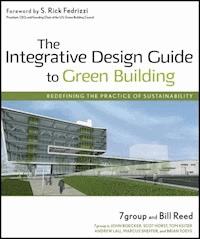
The Integrative Design Guide to Green Building E-Book
82,99 €
Mehr erfahren.
- Herausgeber: John Wiley & Sons
- Kategorie: Geisteswissenschaft
- Serie: Wiley Series in Sustainable Design
- Sprache: Englisch
"The members of 7group and Bill Reed are examples writ large of the kind of leadership that is taking this idea of green building and forming it into reality, by helping change minds, building practice, and design process." --from the Foreword by S. Rick Fedrizzi President, CEO, and Founding Chair, U.S. Green Building Council A whole-building approach to sustainability The integrative design process offers a new path to making better green building decisions and addressing complex issues that threaten living systems. In The Integrative Design Guide to Green Building: Redefining the Practice of Sustainability, 7group's principals and integrative design pioneer Bill Reed introduce design and construction professionals to the concepts of whole building design and whole systems. With integrative thinking that reframes what sustainability means, they provide a how-to guide for architects, designers, engineers, developers, builders, and other professionals on incorporating integrative design into every phase of a project. This practical manual: * Explains the philosophy and underpinnings of effective integrative design, addressing systems thinking and building and community design from a whole-living system perspective * Details how to implement integrative design from the discovery phase to occupancy, supported by process outlines, itemized tasks, practice examples, case studies, and real-world stories illustrating the nature of this work * Explores the deeper understanding of integration that is required to transform architectural practice and our role on the planet This book, both practical and thoughtful, will help you deliver your vision of a sustainable environment.
Sie lesen das E-Book in den Legimi-Apps auf:
Seitenzahl: 803
Veröffentlichungsjahr: 2011
Ähnliche




















Cover image:
A rendering of the Syracuse Center of Excellence designed by Toshiko Mori Architect working with Ashley McGraw Architects as the administrative architect and with 7group as an integrative design consultant. Located on a severely contaminated brownfi eld that had previously rendered this district largely uninhabitable, the project represents a major urban revitalization in a devastated quarter of Syracuse, New York, including the creation of a public transportation hub where no such prior infrastructure existed. Opening in 2009, this building, which includes spaces that function as “laboratory” offi ces for testing human performance relative to various IEQ variables, serves as an example of using an integrative approach to create healthy interrelationships that sustain life.” Courtesy of Toshiko Mori Architects.
Table of Contents
About the Cover Page
Title Page
Copyright
Acknowledgments
Foreword
Introduction: The Integrative Design Guide to Green Building—Redefining the Practice of Sustainability
Dedication
Chapter 1: Many Minds
From Master Builder to the Twenty-First Century: Where We are and How We Got Here
The Age of Specialization
Stop and Reflect: Our current process
The Call Before Us
Chapter 2: Building as an Organism
Shift in Thinking: No Part or System in Isolation
Buildings as Organisms
Project Teams as Organisms
Chapter 3: Reframing Sustainability
What is Sustainability?
The Trajectory of Sustainability Practice
The Role of The Mental Model: From Products to A New Mind-Set
Nested Subsystems
Solving for Pattern
Chapter 4: Aligning Values, Purpose, and Process
Introduction to the Discovery Phase
The Four Es
Questioning Assumptions
Creating Alignment
Fostering an Iterative Process
Integrating Intentions with Purpose
Chapter 5: The Discovery Phase
This is Not a Cookbook
Here's Where We are
Stop and Reflect
Integrative Process Overview
Three-Part Structure
Part A: Discovery
Chapter 6: Schematic Design
Entering Part B—Design and Construction
Here's Where We are
Stop and Reflect
How Can We Do (and Think about) This Differently?
Chapter 7: Design Development and Documentation
Here's Where We are
Chapter 8: Construction, Operations, and Feedback
The Evolving Commissioning Process
Learning from Feedback
Here's where We are
Stop and Reflect
How Can We Do (and Think About) This Differently?
Epilogue-Evolving the Field
A Transformational Process
Shifting the Paradigm
The Fifth System
Index
Wiley Books on Substainable Design
Color Plates
This book is printed on acid-free paper.
Copyright © 2009 by 7group and Bill Reed. All rights reserved
Published by John Wiley & Sons, Inc., Hoboken, New Jersey
Published simultaneously in Canada
No part of this publication may be reproduced, stored in a retrieval system, or transmitted in a form or by any means, electronic, mechanical, photocopying, recording, scanning, or otherwise, except as permitted under Section 107 or 108 of the 1976 United States Copyright Act, without either the prior written permission of the Publisher, or authorization through payment of the appropriate per-copy fee to the Copyright Clearance Center, 222 Rosewood Drive, Danvers, MA 01923, (978) 750-8400, fax (978) 646-8600, or on the web at www.copyright.com. Requests to the Publisher for permission should be addressed to the Permissions Department, John Wiley & Sons, Inc., 111 River Street, Hoboken, NJ 07030, (201) 748-6011, fax (201) 748-6008, or online at www.wiley.com/go/permissions.
Limit of Liability/Disclaimer of Warranty: While the publisher and the author have used their best efforts in preparing this book, they make no representations or warranties with respect to the accuracy or completeness of the contents of this book and specifically disclaim any implied warranties of merchantability or fitness for a particular purpose. No warranty may be created or extended by sales representatives or written sales materials. The advice and strategies contained herein may not be suitable for your situation. You should consult with a professional where appropriate. Neither the publisher nor the author shall be liable for any loss of profit or any other commercial damages, including but not limited to special, incidental, consequential, or other damages.
For general information about our other products and services, please contact our Customer Care Department within the United States at (800) 762-2974, outside the United States at (317) 572-3993 or fax (317) 572-4002.
Wiley also publishes its books in a variety of electronic formats. Some content that appears in print may not be available in electronic books. For more information about Wiley products, visit our Web site at www.wiley.com.
Library of Congress Cataloging-Publication Data:
The integrative design guide to green building : redefining the practice of sustainability / by
7group (John Boecker, Scot Horst, Tom Keiter, Andrew Lau, Marcus Sheffer, and Brian Toevs)
and William Reed. p. cm.
ISBN 978-0-470-18110-2 (cloth)
1. Sustainable buildings—Design and construction. 2.Leadership in Energy and Environmental Design Green Building Rating System. I. Reed, William, 1953- II. 7group (Organization) TH880.I58 2009
720'.47—dc22
2008038602
Acknowledgments
Writing this book was an act of integrative design. For all who contributed their talents, knowledge, insights, and time to this process, we are grateful.
First and foremost, we needed someone to “integrate the integrators,” someone to develop a narrative line and voice for all the ideas and aspects of a green design process. Shannon Murphy gave us this gift; she became a vital partner in our writing effort. As both author and translator of complex natural systems and site assessment work, she helped reframe the structure of the book and became our writing partner, not simply an editor. Shannon made our lives easier by challenging us to think as writers, not simply people conveying technical information and case studies. She deserves more thanks than we can give.
We especially thank Rick Fedrizzi of the U.S. Green Building Council for his foreword, but we also thank others who contributed their own insights directly to this book in the form of sidebars: Barbra Batshalom, Guy Sapirstein, Alex Zimmerman, James Patchett, Gerould Wilhelm, David Leventhal, Pamela Mang, Michael Ogden, Marc Rosenbaum, Max Zahniser, Elisabet Sahtouris, Christopher Brooks, Victor Canseco, Vivian Loftness, Keith Bowers, and Doug Gatlin.
We also are deeply grateful to everyone who shared their images for inclusion and for the efforts they expended in sharing them. Special thanks go to Corey Johnston for his insightful and thorough translation of the integrative design process into graphic images.
Thanks as well to our dedicated 7group staff for all of their help and long hours: Cris Argeles, Jennifer Biggs, David Blontz, Alvin Changco, Shannon Crooker, Nicole Elliott, Cam Fitzgerald, Rei Horst, Sol Lothe, Todd Reed, Sheila Sagerer, Gerren Wagner...and especially Lura Schmoyer, for her amazing skills at keeping everything organized and her constant reminders about details and deadlines.
We would also like to thank Jennifer Zurick and Christopher Magent for their engaging participation in developing some of the early materials that helped form the initial framework and outline of this book.
We offer extra thanks to our wives and children— for whom we live—with special thanks to Lisa Boecker and Ellen Reed for obliging the many weekends spent away, as well as for suffering through all of the long three-day weekends when we invaded their domestic bliss, during which their culinary delights kept us nourished throughout those twenty-hour-writing days.
We also acknowledge the work of the Whole System Integrative Process Committee whose work is also reflected in these pages: Bill Reed, John Boecker, Marcus Sheffer, Brian Toevs, Tom Keiter, Steve Bushnell, Mike Italiano, Jeff Levine, Markku Allison, Helen Kessler, Sean Culman, Kevin Settlemyre, Mitchell Swan, Gail Borthwick, Barbra Batshalom, Doug Pierce, Mike Pulaski, Muscoe Martin, Gunnar Hubbard, Alex Zimmerman,Ann Kosmal,Pam Touschner,Guy Sapirstein, Keith Winn, Kimberly Yoho, Rex Loker, Thomas Taylor, Garrick Maine, John Albrecht, Sherrie Gruder, John Montgomery, Thomas Mozina, Rick Prohov, Mandy Wong, Joel Freehling, Julie Gabrielli, John Jennings and Vuk Vujovic.
To our many clients who do not accept the status quo and are seeking a better way, we gratefully acknowledge your patience and perseverance. This book would have been a very dry and academic exercise without the stories from your projects that have enabled us to bring this subject to life. We appreciate your willingness to share your stories so that we can discover collectively a new path toward producing continually better and greener buildings.
And finally, we must thank everyone who is out in the field working every day to keep us all progressing toward a more sustainable world. We have been privileged to work with hundreds of such dedicated colleagues— far too many to name here—who share our commitment to contributing to the health of our planet. In short, this book is a reflection of all we have learned thus far on this journey with all of you, and we merely stand on the shoulders of those from whom we are learning.
Foreword
The act of building is by its very nature complex. Hundreds of linear processes must be completed in concert so that foundations can be poured, walls can rise, interiors can be fitted out, and occupancy can occur. Though practice, materials, and technology improved over time, our approach did not change much from when humans first began constructing habitats. We built where we lived, with this simple concept implied, and our structures were durable and beautiful and in harmony with their surroundings.
The Industrial Age changed all that. In the name of growth and alleged productivity, we picked places to build with little thought to that harmony; sited structures for aesthetics or economics; chose materials for their cheapness or trendiness and used them carelessly in the construction process; tacked on systems that used too much energy or too much water; threw all our leftovers into the nearest landfill; and moved people into spaces that were uncomfortable at best, unhealthy all too often; and then moved on to the next project.
But fifteen years ago, a group of leaders from every sector of the building industry came together and said: ENOUGH. We are using too many of our finite resources too fast. We are building structures as if they are as disposable as yesterday's newsprint. We are valuing cents saved over our children's health, not to mention their future. ENOUGH.
Thus was born the green building movement, and the transformation of the built environment—to one that is healthier, more sustainable, and more respectful of those who use the buildings—began. It is clear why: Buildings have a lifespan of fifty to one hundred years, throughout which they continually consume energy, water, and natural resources, thereby generating significant CO2 emissions, the biggest contributor to climate change. In fact, buildings are responsible for 39 percent of the United States’ CO2 emissions per year. Annually, buildings account for 40 percent of primary energy use in the United States; 72 percent of U.S. electricity consumption; 13.6 percent use of our potable water per year; and 40 percent use of raw materials globally.
It is also clear what we need to do to build sustainably: Build so that we use less energy and less water and use fewer finite resources or figure out how to use more recycled resources. Build so that our choices deliver healthier solutions that respect the building's occupants, not compromise them. Build with an eye to future savings not first cost. Build smarter. Build so our children have a future.
What is still being formulated is how to do this: And this book, The Integrative Design Guide to Green Building: Redefining the Practice of Sustainability, is all about the how, specifically the how of integrative design. This fundamental change in the process of how we build buildings is the result of systems thinking, which—as the authors point out—has the potential to create buildings and places that (and people who) make the world a better, healthier place.
The U.S. Green Building Council's LEED® Green Building Rating System™ serves as an essential, proven tool for enabling this market transformation, and it works because it is founded on this principle of integrative design. It promotes a whole-building approach to sustainability by recognizing performance in five key areas: sustainable site development, water savings, energy efficiency, materials and resources, and indoor environmental quality, with an additional category to recognize innovation. It has become the nationally accepted benchmark, because it provides a concise framework for best practices in high-performance green building design and operations.
Equally important is the independent, thirdparty verification that a building meets these highperformance standards. This ensures that buildings are constructed as designed and that they perform as expected.
By every measure, green building is clearly an idea whose time is now. The USGBC tracks a host of metrics that give evidence of the rightness of the idea of sustainable design and construction, operations, and maintenance: they are, for example, visible in the number of LEED registrations and LEED Accredited Professionals; the attendance at educational courses, in person or online; the visits to our websites; and the growth in organizational membership, chapters, and volunteers.
But it is the committed, talented people behind those numbers that are making market transformation possible. The members of 7group and Bill Reed are examples writ large of the kind of leadership that is taking this idea of green building and forming it into reality by helping change minds, building practice, and design process. With this book, their individual and collective skills and experience in enhancing the design and building process are served up with thoughtful, practical guidance told through stories and examples that are at once illuminating and inspiring. It has been my great privilege to know the principals of 7group and Bill Reed individually through their many and important contributions to USGBC and to the advancement of green building practice and integrative thinking. I am grateful to have been part of this movement that continues to benefit from their work.
We understand why green buildings matter: They save energy, reduce CO2 emissions, conserve water, improve health, increase productivity, cost less to operate and maintain, and increasingly cost no more to build than conventional structures. It is in understanding how to work together by utilizing the principles of integrative design to build these structures well that we will be able to deliver on our vision of green buildings for everyone within a generation.
S. Rick Fedrizzi
President, CEO, and Founding Chair
U.S. Green Building Council
Introduction: The Integrative Design Guide to Green Building—Redefining the Practice of Sustainability
This is a pragmatic book. There are many books on green design that describe the what of sustainability—what to do, what to use, what to design, what to buy, what not to buy. In this book, we talk about how. How to make the best decisions, how to work with others to creatively address the issues of sustainability, how to address complex issues that threaten living systems, and how to be more and more deeply purposeful in pursuing what is required of us to achieve these objectives.
How you do something is a process. This book is about redesigning the design process.
It is called the Integrative Design Process (IDP). It is not our idea. This practice has emerged from the field of green and sustainable design as a natural response to the wall that we all hit when we look only at green technologies, green products, and the “objects of design.” This book is based on our collective experience gained from how we've seen this process work, and its potential to create buildings, places, and people that contribute to making the world a better, healthier place.
The Integrative Design Process is how the most environmentally effective and cost-effective green buildings are achieved. Various rating systems such as LEED, BREEAM, and others are helpful tools, but they simply act as measures of how well we've incorporated deeper and deeper systems thinking processes through the course of design. Integrative systems design is what we do to get there—how we get there. Green buildings are the outcome.
In this book we define Integrative Design as a discovery process that optimizes—(i.e., makes the best use of, or creates synergy between)—the interrelationships between all the elements and entities that are directly and indirectly associated with building projects in the service of efficient and effective use of resources.
In addition to the conventional issues of building projects, this book takes the term integration literally and extends the identification of the systems we are integrating to a conceptually “whole” system. A whole system includes everything—human, biotic, and earth systems and the consciousness that connects them: the Whole. To achieve the health of the Whole, we must ask ourselves how the process of building can be a catalyst for a discovery process that addresses the interrelationships of all living and technical systems in the service of sustaining the health of all life. Hence, the idea of addressing interrelationships that extend well beyond our buildings and the boundaries of our construction sites is a thread that runs throughout the entire book in order to expand our scope into wholesystem integrative design.
We are intentionally very explicit about the use of the term “Integrative” Design instead of “Integrated” Design. The latter term implies something that is past and completed; it implies that we're done. The word integrative suggests an evolving process rather than a fixed process. It implies that we're never really done. As suggested in the larger context of achieving wholesystem integration, we have a long way to go before we are fully integrated.
We intend for this book to be used as a practice manual, or guide book, one with three basic divisions: The first provides the philosophy behind integrative design; the second is intended to serve as a manual for practicing professionals; and the third introduces deeper levels of integration.
Chapters One through Four focus on the philosophy and underpinnings of an effective IDP. These chapters address systems thinking and building and community design from a whole and living system perspective. These chapters are the foundation of this book, and as such, serve as a conceptual structure to guide the thinking that leads to a more and more deeply sustainable design process.
Chapter Five begins the manual section of the book—the “how to do it” structure that can be used to guide the process. This begins with the Discovery Phase—the foundation of an integrative design process. It is the most important phase of a green project, and as a result, is the longest chapter. Chapters Six through Eight complete the manual and serve as a “field guide” that identifies the level of investigation required during the various stages of implementing an effective integrative design process. For the purposes of this book, we have identified thirteen explicit stages, but these are intended only as a guide that can be compressed or expanded, as necessary, to better respond to the constraints and opportunities of each project. Process outlines, practical examples, case studies, and stories are used throughout to illustrate the nature of this work.
Chapter Nine offers a view into the deeper realm of integration that we believe is required of each of us in order to truly transform our practice and our role on this planet.
You may notice that the manual section of this book provides greater detail at the beginning and then distills issues as it moves into the later stages of the integrative design process. The same is true of many of the subsections within each identified stage—more detail at the beginning than at the end. This is because the vital work of integrative design must occur at the beginning. This early work builds a proper foundation upon which all decisions are built. In addition, the further along we are in a project the more variables crop up. It is impossible to list all the possible flows in a single design process, but we have attempted to present a clear framework that can be applied to any situation or building type. We leave it to you, the practitioner, to use this framework to respond to the unique situation in each project.
We have delineated a process that has grown out of our experience. After several attempts to translate this experience into a list of tasks, we found describing this work through stories and examples to be more effective and meaningful. We are confident and optimistic that once you begin to implement this process, it will never play out in exactly the way that we have written it. If you keep checking back as you go, your own process will continue to evolve. And to evolve is itself a process—a valuable one, because we still have a lot to learn.
Dedicated to Gail Lindsey
SMILES . . . . . . . . wink!!!!!
Chapter 1
Many Minds
People don't like change. But make the change happen fast enough and you go from one type of normal to another…
—said by novelist Terry Pratchett's character Moist von Lipwig in Making Money
From Master Builder to the Twenty-First Century: Where We are and How We Got Here
The Master Builder
The Industrial Revolution had profound effects on human society, especially on how we build in our places. Only a little more than 150 years ago, local natural and human resources were the basis and the limit for what was designed and built. The resulting process was far different from contemporary practice. The architects of that time were called Master Builders.
Master builders were schooled through local apprenticeships, and the techniques and technologies they learned were developed from an understanding of local issues and passed down through generations. Mechanized transportation was limited, so people possessed an intimate knowledge of local materials, as well as workforce skills, economies, cultural imagery and traditions, microclimates, and soil conditions. They understood the flow of local resources and what local conditions could be limiting. The built environment was designed and constructed from a deep connection to each individual place, with the master builder conceptualizing the overall pattern and each artisan, craftsman, and journeyman then contributing layers of richness and diversity at smaller scales. What resulted were buildings and communities that truly were integrated with their environment and that lived, breathed, and grew to become timeless elements of their place.
Figure 1-1 The peaks of the Dolomiti Lucane mountains in southern Italy (in the Basilicata region) surround and protect one of the most beautiful villages of Italy, Castelmezzano. Dating from the tenth century, the town's organic development pattern works with, rather than against, the natural formation of the mountains, and the town's buildings are oriented in alignment with the mountains to shield inhabitants from cold northeast winds and to capture solar heat from the south. Image courtesy of John Boecker.
Figure 1-2 This view from one of the fourteen surviving thirteenth-century towers of San Gimignano, the famous Italian hill town in Tuscany, reveals the town's connection with its surrounding landscape and topography—its source for materials, food, and protection for more than 1,000 years. Image courtesy of John Boecker.
Understanding this process, modern architect Ma rio Botta recently offered this advice after designing buildings outside his native Ticino, Italy: “Build where you live.” Those that have visited Ticino may recall the magical quality of the centuries-old hill towns nestled in the Swiss-Italian Alps. Built of native stone and local alpine wood, using indigenous practices and traditions handed down through generations, these towns feel organic—as if they grew out of the landscape, blurring the line between the built and natural environment, presenting a unified place. To this day, these towns remain largely self-sufficient, sustainable communities.
Many of the buildings and communities that we respect and envy today were created in this way and still thrive after centuries of vitality—so much so that many have become popular tourist destinations. Sometimes, theme parks are built to replicate these buildings and communities with the aim of capturing some hint of the life and the quality they possess. But that quality cannot be reproduced in this way, because it was generated specifically by individual master builders’ intimate process of building with and within their own communities.
Figure 1-3 This picturesque Ticino hill town, located in southern Switzerland, integrates seamlessly with its Alpine terrain, the stone of its structures seemingly growing from the mountain upon which it nests. It is a distinctly Italian-style town that relies on the local hills for its farming and the adjacent river for hydroelectricity. Image courtesy of John Boecker.
Figure 1-4 The town of Alberobello, a UNESCO World Heritage site, contains an urban concentration of more than 1,500 Trulli dwellings, dating from the midfourteenth century that are still in use and were made from limestone blocks collected from surrounding &fields. These indigenous structures could be quickly erected and dismantled, utilizing ancient mortarless drystone construction for their distinctive conical roofs that draw off the heat of their southern Italian climate. Image courtesy of John Boecker.
Figure 1-5 Matera, the “City of the Sassi” in southern Italy's Basilicata region, has been inhabited since the Stone Age and is a protected UNESCO World Heritage site consisting of nearly 3,000 cave dwellings and 150 churches carved into the rock ravine of the Torrente Gravina on which it is built, an ideal and well-protected canyon for prehistoric human habitation. Image courtesy of John Boecker.
Figure 1-6 The cream-colored façades of Matera, built of local tufa stone bricks, are placed in front of the many natural grottoes and carved caves to serve as entrance structures. Rainwater collection in small pools and wastewater flows were managed for 9,000 years via an ingenious system of tiny canals until overcrowding between the two world wars rendered Matera uninhabitable. Legislation in 1952 mandated restoration of the Sassi, and many of the cave dwellings and churches have been restored, transforming Matera into a breathtaking “living museum.” Image courtesy of John Boecker.
Figure 1-7 Since structures are constructed into the rock of the ravine's steep slopes, houses were layered atop houses, so it is not unusual to encounter chimneys when walking through this ancient town, before realizing that winding roads, gardens, and other structures rest on the roofs of dwellings below. Image courtesy of John Boecker.
When we experience the buildings and communities that were created within the master builder process, we can see how truly integrated that process was at every level. Each person that contributed to these structures was thinking and working from a unified schema derived from a shared understanding of local patterns. This cohesive intelligence ensured that each craftsman's individual contribution would be perfectly integrated within the whole of the built environment. Not only were they working from the same place physically and culturally, but these craftsmen were also in a sense working from the same mind.
The Siena Duomo
Medieval cathedrals are familiar examples of the type of powerful coherence that characterized the built environment of the master builder. Recently we had the opportunity to visit in Italy the Duomo di Siena (cathedral of Siena), originally designed by master builders Nicola Pisano and his son Giovanni, along with pupil Arnolfo di Cambio. The Siena cathedral was largely completed between 1215 and 1263, under Pisano's guidance, with layers of work integrated into his original conception by Donatello, Michelangelo, Gian Lorenzo Bernini, and others.
The Siena Duomo occupies the highest point in Siena and seems to grow right out of the landscape, adding a physical and spiritual pinnacle to the rocky plateau. The cathedral is built primarily of local marble that the town's inhabitants gathered from nearby quarries and carted back to town. These indigenous marbles create a consistent color palette of black and white stripes with green and yellow accents. The entire complex is beautifully integrated into its place—born of the place and the people that lived there.
Figure 1-8 The aweinspiring Siena Duomo (cathedral) appears to have grown out of the plateau upon which it sits, integrating seamlessly with its surroundings as a pinnacle that towers above the medieval town built into the hills below. Image courtesy of John Boecker.
Figure 1-9 The striking Romanesque marble banding of the Siena Duomo's campanile (bell tower), which was added in 1313, extends the pattern of the cathedral's exterior materials. Almost all of the marble used for the cathedral was harvested by inhabitants of the town from local quarries. Image courtesy of John Boecker.
Figure 1-10 Daylight streaming in from the gallery windows of the cathedral's nave highlight the signature marble stripes of the Duomo's columns. Image courtesy of John Boecker.
Inside the Siena Duomo, a magical vaulted space is supported by ordered rows of stone columns and piers comprised of the same horizontal black and white stripes that dominate the exterior. On a recent trip, we noticed that only a few, seemingly randomly placed columns were not striped. After looking closely for a while, we realized that these anomalous columns were far from randomly placed but were located to establish spatial hierarchies within the overall space. This architectural cipher communicated a semiotics, a natural language within the whole that revealed additional layers of meaning.
The marble floor mosaics throughout the cavernous space within the duomo remain among the world's most exquisite, each conceived and executed by a master artisan within a consistent overall pattern, each telling its own tale within the biblical stories depicted. From 1372 to 1547, these fifty-nine floor panels were executed by Siena's top artists. On our trip, we chatted with an old man we met repairing a small area of this marble floor. He told us that he was a descendant of the original fourteenth-century master masons, who were trained locally in a craft lovingly sustained and nurtured through generations for over seven centuries. We watched as he honed the three-inch-thick marble pieces to fit together seamlessly, with hairline joints crisper than a jigsaw puzzle.
Figure 1-11 The Duomo's mosaic floor panels depict Old Testament stories, framed by intricate patterns of local marble, composed by Siena's top artisans. Image courtesy of John Boecker.
Figure 1-12 Meticulously executed geometric mosaic flooring patterns throughout the Duomo evoke the colors of indigenous materials used throughout Siena. Image courtesy of John Boecker.
In the 1300s, the townspeople began the construction of a transept that would make Siena's duomo the largest cathedral in Christendom. This monumental addition was intended to continue the same pattern of the structure's spatial choreography, which begins at the end of a journey through the narrow, climbing streets of the medieval town. This effort was abruptly abandoned in 1348, when over 50 percent of the town's population fell victim to the plague. What remains is a ghostlike figural void that was conceived as a roofed interior space but left virtually untouched as an exterior, “urban” room for 650 years. The space is striking in its authenticity, and acts as a permanent commemoration of the place's history.
In its totality, this spectacular cathedral complex embodies more than 350 years of continuous work, all generated from an original thirteenth-century conception that was rooted in a deep understanding of the unique interrelationships of its place, integrating landscape, materials, workforce, cultural semiotics, traditions, art forms, local climate, habitat, and urban development patterns. Nearly eight centuries later, it still leaves us marveling at the awe-inspiring result, an accomplishment almost beyond imagining today—and on the hottest summer day, it remains the coolest space in Siena for taking a quiet respite from the sun's heat.
The Age of Specialization
With the Industrial Age came advancements that removed many of the limitations that had kept the master builder management structure in place. The evolution toward global transportation and communication meant that building materials and other resources need not be locally available and could come from anywhere. As new materials and technologies were rapidly and increasingly introduced, specialists were needed to resolve and implement the complex aspects of electricity, lighting, ergonomics, heating, cooling, ventilation, municipal waste systems, water supply, automatic climate control, smart buildings, and more; and each of these systems is now designed by different and separate professionals, and optimized in isolation.
Figure 1-13 A journey though Siena's organic labyrinth of narrow medieval streets offers countless hidden and sudden views, a spatial choreography culminating at this final portal, which frames the Duomo's campanile, before arriving in the exterior space of the would-be transept nave. Image courtesy of John Boecker.
Figure 1-14 Looking back on the arrival portal to this exterior space reveals an “urban room” as it was in 1348, when the plan to create an interior space expanding the Duomo was thwarted by the arrival of the Black Death. Image courtesy of John Boecker.
Where we once had one mind—a unified intelligence—conceptualizing and integrating patterns born of the place and its people, we now involve anywhere from dozens to hundreds of disparate companies, organizations, and individuals in designing our buildings and their components. In other words, we entered what might be termed the Age of Specialization. We have fragmented the whole into myriad separate pieces.
In short order, we moved from a time of commonsense integration into a period—now more than a century and a half long—of “it's-not-my-job” specialization and “this-is-not-my-area-of-purview” disintegration. On a recent project, for example, we worked hard to convince the civil engineer that we needed him at our first predesign, goal-setting integration meeting with the owner and all members of the design team. He said, “Well, why do I need to come? You guys haven't started designing; there's nothing for me to do yet.” But with some support from the owner, we were able to convince him to attend this all-day, team goal-setting session. Early on that day, after spending a couple of hours walking through site issues and discussing pre-existing site forces, conditions, flows, constraints, and opportunities, the civil engineer got up to leave, saying “OK, the rest is not my job—I'm only responsible for everything five feet from the building and beyond. You guys do whatever you want inside that … just tell me where I need to hook up your systems.”
This is not to say that good work is not being done. Each specialist possesses tremendous skill for design-ing and optimizing the systems and components for which they alone are responsible. However, our design process is such that only pieces are optimized and not the whole. Each of these professionals is designing fully within the silo of their discipline, and the interaction between each discipline is usually kept to a minimum—limited to ensuring, for example, that the electrical engineer's supply system provides adequate power to the mechanical engineer's specified heating, ventilating, and air-conditioning (HVAC) equipment. The optimization of the building's individual systems is primarily done in isolation, based on rule-of-thumb conventions that target abstract, generalized standards. These systems are then assembled into a building.
Stop and Reflect: Our current process
Siloed Optimization
We often ask our clients at the very inception of a project to reflect on today's design and construction-delivery methodology. Let's see if this sounds familiar: The project starts when the architect meets with the owner to discuss the program for the building to determine the required spaces, as well as their sizes and functions, and the relationships and proximities between them. Once this program has been documented, the architect produces a series of iterative sketches over weeks or months and presents them to the owner until they agree that everything is the right size, in the right place, and “looks good,” essentially completing schematic design. These drawings are then sent to each member of the team of professionals assembled: the HVAC engineer, the electrical engineer, the plumbing engineer, the structural engineer, the civil engineer, the fire-protection consultant, the landscape architect, and others—all of whom are specialists within their disciplines, possessing tremendous acumen and skill in optimizing their systems.
The optimization of each individual system is done primarily in isolation, based on rule-of-thumb conventions and standards. Then, after each system has been designed, the drawings are sent back to the architect, who ostensibly coordinates everything—making sure that ducts do not run into sprinkler piping, structure, and so on. The architect then issues a final set of design documents, which results in an estimate for a building that more often than not is over budget, so we resort to “value engineering.” You likely have heard the joke that value engineering is neither—since it is certainly not about value nor does it require engineering. In other words, the building is made cheaper by cutting out pieces, reducing scope, or both, often by plucking away any “green” components that appear to represent low-hanging fruit, because they were conceived as an additional layer of desired elements—in essence, eliminating things that the owner originally wanted. Once the project is back on budget, a final set of construction documents is created in the form of a large stack of drawings and a much larger stack of bound-paper specifications, which we then issue for bidding.
The Abyss Between Design and Construction Professionals
For the sake of argument, let us say that the scenario above describes a twenty-million-dollar building. How many people were involved in the building design process from the beginning of the programming effort to the day the bidding documents are put out on the street? Definitely dozens, even hundreds, if we include all of the equipment manufacturers and product representatives involved. How long did the process take? A year? Eighteen months? Two years? By doing the math, it is easy to see that what is embedded in that set of bidding documents equates to hundreds of thousands of person-hours of research, analysis, decision making, and documentation. And then what do we do? We give construction professionals (who typically are not involved in the design process) four weeks to bid on these documents, which really means two weeks or even one week, based on our conversations with contractors.
Not only are we giving contractors only a week or two to understand hundreds of thousands of hours’ worth of information, but we are also asking them to put a price on that understanding and, further, to commit contractually to meeting that price. Then, we select the lowest bidder, which essentially means that we end up awarding the construction contract to the team that understands the project the least!
It gets worse. If you look around the room you are in right now, it is likely that you will see dozens of products. The chair you are sitting in, the pants you are wearing, the cup you are drinking from. Every one of these products is produced dozens if not hundreds or tens of thousands of times, built over and over again with plenty of opportunity to work out the bugs and quirks, usually accompanied by some level of quality control. However, in the case of a building—likely the most expensive product a person will buy in his or her lifetime—every single new building is entirely unique. It has never been built before. It will never be built again—even if it is a prototype that is being site adapted, the team of professionals is different, making it an absolutely unique product. Furthermore, every one of the products in the room around you was designed and constructed by the same entity. Our buildings, though, are designed by one set of design professionals and constructed by an entirely different set of construction professionals, with no interaction between the two of them whatsoever until construction begins. Not only does an abyss exist between these two sets of professionals, the contractual arrangement between the two actually renders them adversaries! It seems that we have created a perverse construction-delivery methodology from beginning to end.
This conventional process creates buildings that are no more than the sum of their parts—and some- times less. The most striking innovations remain un- leveraged, as any improvement that occurs is confined to its silo and secluded from the whole. The process more closely resembles assembly than integration. And because the assembly is, in a way, blind, we often face redundancies, unnecessary costs, and a great deal of wasted time and effort.
It is not surprising, then, that data from the Law- rence Berkley National Lab from a 1998 study indicates that 90 percent of U.S. buildings have either systems controls problems or nonfunctioning HVAC components upon occupancy and during the first year of operations. Further, 15 percent of our buildings are actually missing components that were in the construction documents and purchased by the owner in the construction contract. This is no secret to design and construction professionals. In fact, of the hundred thousand or so design and construction professionals to whom we have presented in the last ten years, when asked “When was the last time you were involved in a project that, after it was constructed and occupied, had no HVAC problems?” only one person has ever raised his hand. This person got us very excited, so we said, “Tell us about your HVAC system.” He replied, “There wasn't an HVAC system. It was a cabin in the woods.”
Doing Less Damage by Adding Technologies
The very system by which we certify our green buildings is illustrative of the assembly-like nature of our process. When utilizing LEED® (the U.S. Green Building Council's Leadership in Energy and Environmental Design Green Building Rating System), we whip out the LEED scorecard and begin assessing which credits are applicable and achievable. We walk the team through a credit-by-credit analysis, asking the architect, the engineers, and design team members to think about how they can make their systems and components greener by meeting the requirements of the applicable LEED credits. We ask them to consider how they can reduce the environmental impacts associated with their work in order to reduce automobile use, site disturbance, stormwater runoff, heat-island effects, and water and energy consumption. Each team member identifies and commits to the points that are achievable from within their discipline, and at the end of the day we add our points up to see whether we can target a silver, gold, or platinum rating.
Each project team member is then assigned LEED credit responsibilities, and each begins designing his or her system with the mission to achieve the identified LEED points assigned to them. For example, these responsibilities on a typical LEED project might generate the following activities:
The Civil Engineer adds the design of a retention basin to hold a greater percentage of stormwater on site and reserves several parking spaces for carpooling.
The Landscape Architect adds trees to the south side of the parking lot for shading, a bike rack, and more areas for vegetation, as well as native planting materials that do not require permanent irrigation; the landscape architect also changes site pavement materials to lighter colors.
The Plumbing Engineer specifies low-flow lavatory faucets, waterless urinals, and a high-efficiency domestic hot-water heater.
The Mechanical Engineer adds energy-recovery units, variable-speed fans, carbon dioxide sensors, and air-conditioning components that contain non-hydrochlorofluorocarbon (HCFC) refrigerants, and designs a ground-source heat pump system for heating and cooling.
Figure 1-15 A cabin with a fireplace in the Adirondacks is free from any HVAC problems. Image courtesy of Todd McFeely.
The Electrical Engineer adds a few more (but lower wattage) exterior cutoff luminaires in the parking lot, some photovoltaic panels, a few more energy-monitoring sensors, and also specifies individual lighting controls and high-efficiency compact fluorescent lighting fixtures throughout, tied to photocell sensors and dimming ballasts for daylight harvesting.
The Architect adds insulation to the walls and roof, several skylights for daylighting, a vegetated green roof, a few more windows comprised of tripleglazed systems for high performance, and specifies “greener” materials, such as drywall made from 100 percent recycled content.
The Interior Designer selects paints with low or no emission volatile organic compound (VOC) content, high recycled-content carpet, certified wood finishes, and rapidly renewable cork flooring.
The Owner commits to hiring a commissioning authority, a construction waste manager, and an indoor air quality testing agency.
Once all these technologies are added and the building is constructed, we have a successful green building that does less damage to the environment. Hundreds of these buildings are being constructed as you read this— they are doing their part by hurting the planet less. But where does that leave us? If you have a planet filled with millions and millions of buildings that do less damage, you still have not solved the problem. With thousands and thousands of talented design and construction professionals working with brilliant minds and genuine caring, we need to accomplish more than simply doing less damage—we need to do better than just slowing our way down our collision course.
There are many problems that arise with this unholistic, unintegrated approach, the most significant of which is the lack of a clear leverage point or an accepted and established methodology for changing the way that we build. Given the magnitude of the challenges that we face, it will take nothing less than a massive transformation to get us out of this mess. How might that transformation occur? Where in our current design process exists the point at which we might intervene to create large-scale change? The answer, simply, is that it does not exist within the current process.
Figure 1-16 The largest ozone hole over Antarctica, recorded as of September 2006. Image courtesy of National Aeronautics and Space Administration (NASA).
Figure 1-17 This image of the ozone hole in December 2007 offers hope that the Montreal Protocol on Substances that Deplete the Ozone Layer, which entered into effect in 1989, is having a positive effect. Image courtesy of NASA.
The Call Before Us
As our collective values have shifted toward the pursuit of sustainability, great innovations have been made. Thousands of the best and brightest professionals are devising ways to improve the efficiency and reduce the impact of what they design. But we are still designing within a process that belongs to the Age of Specialization, and thus our solutions and approaches to sustainability are as fragmented as ever. When a technology is proposed as a solution to a green building issue, we are in effect saying that we have the answer for you. But do we? Have we even asked the right question?
These are urgent times. Depending on which reports one reads, we have only a little or almost no time left to change. There is a call to action before us—change the way that we build, or the Earth will change it for us. If one part of the building improves, it remains just that—an improved part. We are working brilliantly toward creating highly efficient pieces of buildings, but the world's most efficient HVAC system, unintegrated with the whole, is but a drop in the bucket compared to the magnitude of change that we need to create. The process by which the master build er produced such enduring and vital places has been lost, for the practice of development has become far too dynamic and complex for such a process to function. Even understanding the systems within a single building has become too complex for one mind, one person, to grasp completely. What is being called for is a new process of integration for the many minds devoted to each project and a new process for building the more complex systems that we inhabit.
Figure 1-18 Computer simulations of rising sea levels resulting from global climate change, such as this image of Florida, indicate that millions of people residing in coastal areas around the world may be displaced. Image courtesy of Weiss and Overpeck, University of Arizona.
Figure 1-19 On the East Coast of the United States, rising sea levels could wipe out many major urban and residential areas. Image courtesy of Weiss and Overpeck, University of Arizona.
Chapter 2
Building as an Organism
English does not contain a suitable word for system of problems. Therefore I have had to coin one. I choose to call such a system a mess. The solution to a mess can seldom be obtained by independently solving each of the problems of which it is composed.
Russell L. Ackoff, Systems, Messes and Interactive Planning from Redesigning the Future. New York/London: Wiley, 1974
Shift in Thinking: No Part or System in Isolation
In the first chapter we described the shift from the one mindof the master builder to the many minds of the professionals and specialists that contribute their expertise to today's development projects. Yet it is not the collaboration of many minds that is the problemit is the process by which they collaborate.
With these many minds, each representing an advanced discipline, we have a tremendous potential: rather than assembling our buildings from fragments that interact with one another in unplanned ways, we could be creating them as harmonious wholes whose parts support one another in mutually beneficial interrelationships. The result would be historic, tapping into the cocreative potential of our many advanced disciplines and transforming not only how we work and build but also how we live.
To do this, we need to create a shift both in process and in thinking. In fact, the two go hand in hand. Our conventional thinking treats buildings as objects, as things. Yet each building is in fact a system, with each individual part affecting the other parts and, in turn, the building as a whole. Our conventional process, however, prevents the systemic relationships between building components from being understood or even seen. On our first few projects, even when we thought we were implementing what we called integrated design, we really were not there yet.
Everyone is practicing Integrative Design...at least that's what they say
Lesen Sie weiter in der vollständigen Ausgabe!
Lesen Sie weiter in der vollständigen Ausgabe!
Lesen Sie weiter in der vollständigen Ausgabe!
Lesen Sie weiter in der vollständigen Ausgabe!
Lesen Sie weiter in der vollständigen Ausgabe!
Lesen Sie weiter in der vollständigen Ausgabe!
Lesen Sie weiter in der vollständigen Ausgabe!
Lesen Sie weiter in der vollständigen Ausgabe!
Lesen Sie weiter in der vollständigen Ausgabe!
Lesen Sie weiter in der vollständigen Ausgabe!




