


Erhalten Sie Zugang zu diesem und mehr als 300000 Büchern ab EUR 5,99 monatlich.
- Herausgeber: Parthian Books
- Kategorie: Poesie und Drama
- Sprache: Englisch
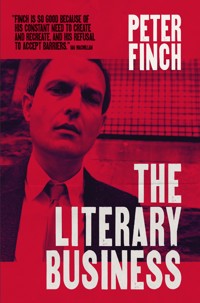
A personal ramble around the book world from the man who has experienced all sides of it. A handbook, a demystification and an intimate history of the wide literary world. Written with Peter Finch's characteristic good humour, The Literary Business relates through bitingly well-observed vignettes how it is and how it was over the past six decades. This book has something for everyone: writers, academics, critics and other enthusiasts in search of a no-holds-barred personal history; administrators wishing to navigate the obstacle course that is funding writers and writing; fans hunting data on the Poetry wars of the 70s, and fellow litterateurs who will want to check whether they have received a mention in these pages. If you're new to the game and seeking publication, or just someone who enjoys the cut and thrust of the literary world, then this book is for you. Few others in Wales know the business and how we got here like Finch does. And few others will have been capable of reporting back in such an entertaining fashion.
Sie lesen das E-Book in den Legimi-Apps auf:
Seitenzahl: 566
Veröffentlichungsjahr: 2025
Das E-Book (TTS) können Sie hören im Abo „Legimi Premium” in Legimi-Apps auf:
Ähnliche














Parthian, Cardigan SA43 1EDwww.parthianbooks.com
© Peter Finch 2025
ISBN 978 1 917140 53 9
Edited by Harper Dafforn
Typeset by Elaine Sharples
Index by Non Evans
Printed by 4edge Limited
Published with the financial support of the Books Council of Wales
British Library Cataloguing in Publication Data
A cataloguing record for this book is available from the British Library.
Every attempt has been made to secure the permission of copyright holders to reproduce archival and printed material.
Printed on FSC accredited paper
For Dan and Will and always for Belinda
CONTENTS
Introduction
Writing The Blues
Second Aeon
Wanted
Taking Up Publishing
Cyril Hodges
The Book Bang
George Dowden and Brighton
John Tripp
Poets Conference
Walking to Maplewood Court
The Soviet Approach
Self-Publishing with the Davies Brothers
From Triskel to Seren in Twenty-Five Years
Getting Your Poetry Published
The Poetry Wars
The Final Link
Charles Street
Oriel’s First Customer
The Shop Begins to Roll
Shrinkage
Taking Stock
The Renaissance of the Celtic Harp
The Oriel Playlist
The Other Market
Oriel and the Stationery Office
The Welsh Academy
Academi Redivivus Hits Home
Bob Cobbing
The Book Launch
How The Poems Arrive (1)
How The Poems Arrive (2)
How The Poems Arrive (3)
How The Poems Arrive (4)
How The Poems Arrive (5)
Chris Torrance
Reading
On Stage
The Student House
Photographing Poets
Performance Poetry – Cabaret and the Women
lloyd robson
Teaching at Tŷ Newydd
Nigel Jenkins
Hay Festival on Fire
The Singing Horizons of Gwyneth Lewis
The National Poet
Top Books Borrowed
Casablanca & Open Mics
Organising a Reading
Some Great Poetry Readings
How Not to Do It
The Trust
Cultural Prizes
Psychogeography
Onwards
Acknowledgements
Works Consulted
Peter Finch: A Biographical Note
Index
Credits for cover photographs of the author:
Rear flap – Allan Burgis, 1976
Back cover – John Briggs, 2018
Front cover – Stuart Smith, 1987
Front flap – Colin Molyneux, 1977
INTRODUCTION
Writing, to some degree, has always been judged by the noise it makes and, as the futurist Luigi Russolo pointed out more than a hundred years ago, the variety of noise is infinite. When I first experienced the thrill that good writing could engender—in my case, discovering R. S. Thomas in 1962 and then Allen Ginsberg in 1963—I realised that writing was not just the kind of thing that arrived on the pages of popular romances rented out by corner stores or in the speech bubbles emerging from the mouths of Dan Dare, Marvel Man and Desperate Dan. There was considerably more to it. To paraphrase the poet Barry MacSweeney, the great joy was realising that you could do anything with words.
In Wales, my Wales—the drizzle-filled, heavy industry scarred, battered and ever damp southern valleys and ill-lit coastal plain—two ways of writing that excluded each other and ran hot contesting the world for an audience were emerging. The first was the one I’d uncovered, unwittingly, on the shelves in the basement of SPCK bookshop on Cardiff’s Friary. Books by the Angry Young Men, the Beats, the revolutionaries: Jacques Prevert, John Wain, Kingsley Amis, W.H. Auden, Solzhenitsyn, Yevgeny Yevtushenko, Allen Ginsberg, Jack Kerouac, Arthur Rimbaud, T. S. Eliot, Carlos Williams, Gertrude Stein and Ezra Pound. Someone on the bookshop staff knew what they were doing. Roath Park Public Library did not have any of these.
Reading them, and then getting excited by what I’d uncovered, led directly to my founding of the libertine, counter-culture champion Second Aeon in the February of 1967. This modernist and exhilarating flood was something we needed here in the land of the dragon. I was going to help it arrive.
Not long before, in 1963 Merthyr Tydfil radical nationalist Meic Stephens had founded his Triskel Press, followed in 1965 by the ultra-Welsh literary journal Poetry Wales. Here was another approach, a world vastly different from—and in many ways, just as exciting as— the one I had hitherto involved myself with: that of John Tripp, Raymond Garlick, R.S., David Jones, Lynette Roberts, Harri Webb, Glyn Jones, Roland Mathias, Menna Gallie, John Idris Jones, Peter Gruffydd.
Meic’s approach to literature-building was almost the complete opposite of my own. Of first significance was place; second, language; and third, tradition. His aim was to make Welsh writing in English as valid as Welsh writing in Welsh clearly already was. The innovative, post-modern, world-embracing work that interested me was almost entirely excluded. Stephens’ Anglo-Welsh, as Welsh writing in English was then known, seemed slow and, from some angles, almost ancient compared with the pop-art sixties rush and roar of Bob Cobbing, Adrian Henri, William Wantling, Gavin Bantock, George Dowden, Peter Redgrove, Harry Guest, Tom Raworth, Edwin Morgan, Penelope Shuttle, William Burroughs, Charles Bukowski, Paul Auster and the many others whom I promoted.
But there were thrills, ultimately, in both approaches, as I came to learn. Second Aeon and the many other literary ventures I have become involved with over the ensuing fifty or more years have ended up embracing both sides of this spinning literary coin, presenting a real and complex world.
To be fair to Poetry Wales, it did eventually publish avant-garde work from a small number of Welsh-based practitioners. By the time we get to the twenty-first century, with Meic having taken his hand from the rudder a long time before, the magazine published editions consisting almost entirely of British poetry revival-styled innovative work.
The Literary Business, then, is my tour, through all of this and a lot more besides. It shows an evolving literary and publishing world that does nothing but change and grow. Beginning in the sixties with an explosion of new names, new faces, new ways of writing and new methods of production, pamphleteering, small-press innovating and little-magazine proliferation were everywhere. Print began to cost less; it was also easier for the newcomer to engage with and readily saleable to an expectant youthful audience.
By the nineteen-nineties, innovation had become a standard approach: computers, with their ease of word-processing and desktop-publishing programming, turned small press production into an almost unmanageable flood. The emerged creative writing industry had forged more poets than we’d ever seen. By the advent of the new millennium, they were everywhere.
The literary world has shifted: change and experimentation are commonly accepted these days. Books are easy to publish and can be readily managed by total novices. Periodicals often appear only in digital online form and have huge capacity. Too huge, perhaps. The ten-page periodical has been replaced by the two-hundred-poem online magazine. Getting into print can be a too-ready achievement.
The Welshness of Wales, the version I uncovered early on in the steady hands of the Arts Council’s Meic Stephens—subsequently championed by gatekeepers such as publisher and critic Cary Archard, Professor of Poetry Tony Curtis, critic and educationalist John Pikoulis, historian Dai Smith, R.S. Thomas-expert Tony Brown, Planet editor and poet John Barnie, independence activist Mike Jenkins, Wynn Thomas, Nigel Jenkins, eco promoter Robert Minhinnick, Jane Aaron, Sally Roberts Jones, Katie Gramich and others—appears to be in significant retreat. That other world centred around the British Poetry Revival—represented in Wales by poets and teachers such as John Freeman, Norman Schwenk, Ian Davidson, Zoe Brigley, Chris Torrance and Zoe Skoulding—has at last established some credibility for itself. Geography is today dissolving. The future is diverse, awake, aware and on screen.
Not that in this book I ramble only across the disparate literary realms of Wales. There is good coverage of the wider small-press worlds and the business of books themselves: How you put them together, and how you get them published? How do they work in the marketplace? The avant-garde gets a talking-through, as do the many ways in which poems actually arrive: If you want to write, how do you begin? How are readings managed? How do you teach this stuff? How do you perform it? How do you give it prizes, promote it, make it spin?
And where do I fit into all this? This is, after all, a highly personal account.
Read on.
Peter Finch
Penylan, Cardiff, 2025.
WRITING THE BLUES
Head down, I’m walking Arabella Street to get to Geoff’s House. I’d like to see it again after all these years. In this part of Roath, the terraced houses sit in each other’s laps, their tiny front gardens full of wheelie bins and discarded bulbous sofas waiting for a man with a van to move them on. There are some yards with plants in pots, and a couple where the owners have filled the space with decorative slate chippings. But generally, it’s bleak, inner city, dust and grime.
Geoff’s house—with a pub, The Albany, just round the corner— hasn’t changed much. Living accommodation is at the front, with the rear taken up by Sherlock’s Garage, which has a long frontage extending onto Dalcross Street. Dalcross, whence the Mackintoshes came. The 28th Clan Chief, Alfred Donald Mackintosh, the Mackintosh of Mackintosh, inherited the land around here when he married Diana Arabella Richards, heiress of the Richards Estate, in 1880. Money blossomed in a great upended shower. Nothing Scottish about these streets now.
When I first came here, back in the early sixties, Geoff had a loft we could escape into. The ceiling and the sloping walls under the slates were all covered with egg boxes as a sop to sound insulation. His brother’s band used the space to rehearse in. The Sect Maniacs: a rhythm and blues band playing blues with a rhythm they barely understood.
Not that I understood the music any better: ‘The only way to tell blues from pop is that blues has jazz,’ I’d said in a letter to the Melody Maker. They’d published it under the banner ‘I’m Fed Up with All This Arguing’, which provoked Long John Baldry to write in, sarcastically suggesting that I was clearly someone who had studied the music for years and listened to thousands of records, and he was eagerly awaiting my next gem of wisdom.
I’d long harboured the notion that things could be understood by simply standing next to them—through a process of osmosis. Flann O’Brien suggested something similar in his novel The Third Policeman, where Michael Gilhaney, the constable in question, had become half bicycle simply by spending so much time sitting on its saddle. Could this happen with poetry? There was plenty of it about. Let enough run through your hands and your ears, and, eventually, it would become your own.
My approach to understanding the blues was setting me up for a whole life. Poetry and this North American black music seemed to be indelibly the same thing. The Finnish poet Anselm Hollo’s anthology Negro Verse, published by Vista Books in 1964, included a whole run of blues lyrics next to more conventional verse by poets such as Ted Joans, LeRoi Jones and Wole Soyinka. ‘It’s a hard, hard road when your baby done throwed you down, / Goin’ keep on walkin’ from town to town,’ ran one. I hadn’t exactly been ‘throwed down’ yet, but I was sure it was only a matter of time. Yep, this was for me.
Comprehension arrived slowly; it was achieved by listening, playing the records again and again. Examples by John Lee Hooker, Big Bill Broonzy, Muddy Waters, Big Joe Williams, Sonny Boy Williamson and many others began to turn up on my Dansette and on the stereograms and players of friends. There was a distinct vocabulary in use in the lyrics and one which, despite its irrelevance to my South-Wales location, I naturally sought to emulate. Big fat mommas. Southbound trains. Hellhounds. Mojos. Hearing that train a-coming. Somehow getting on it, this morning train, and then being gone.
My blues were full of these things. I typed them up, two-finger key-pressing on my sit-up Olympus typewriter. No music, just words. I sent a few off to famous blues singers—c/o their record labels— suggesting that they might be interested, that we could perhaps collaborate. Blind Boy Fuller, Sister Rosetta Thorpe, Sleepy John Estes, Willie Dixon and Lightning Hopkins all heard from me but, naturally, I never heard from them.
The loft was large, big enough for a flat, and certainly enough as a practice space for a five-piece. The Sect Maniacs morphed into Amen Corner, acquired new members, a recording contract and world-wide fame. Just before they left for the clubs of London and R&B success, I passed the lead singer one or two of my best blues. What can you do with these, I asked?
Got the blues in Roath Park this mornin’
The sky was full of ducks
O I got them blues in Roath Park this mornin’
The sky is full of ducks
My mama got them great big chicken legs
I’m completely out of luck.
I wince recalling it. Not much, he replied. Never saw him again.
Dalcross Street runs on passing The Albany, today styled high up as the ANY HO EL, its Victorian nameboard losing letters over the course of the century, but its bar still selling decent ale. Ahead is the green expanse of the Recreation Ground, football being played again as it has been, wartime aside, virtually every snow-free day since the park first opened in 1890. Any blues singers in action on street corners around here? Not one.
SECOND AEON
Eros Island
It’s August ‘65. The sun is up, hot enough to have dried the worn-step slabs we’re sitting on. We are at the heart of the British Empire. Behind us is the Shaftsbury Memorial Fountain, an aluminium god with wings modelled from classical antiquity, set here atop a bronze fountain in Central London. It acts as a magnet for out-of-towners, tired hipsters, beatnik wannabes, low-hopers and other hangers-on who are still impressed enough with the city’s multicultural greatness to want to sit at its centre.
I’m here with Geoff and Alan, hitched in from the west like replica-Kerouacs, now taking the Big Smoke air. My plan is to write things, to turn everything around me into poetry and to send it out to the waiting world. I’ve a hard-backed notebook in my bag, which I’m steadily filling. My route will be via the little mags. These journals run on excitement, stamped self-addressed envelopes and duplicating paper. They are cultural engines that emit hipster sparks. Ken Geering’s Breakthru. Lyndon Puw’s Mainly, Dave Cunliffe’s Poetmeat, Lynn Carlton and Fred Cosgrove’s Manchester-based Viewpoints. Wes Magee’s Prism. Dave Stringer’s Firebird. They are the spirit of a poetry age.
We’ve been sleeping in Hyde Park for days and are full of freedom’s spirit. I’ve bought a copy of Walt Whitman’s Leaves of Grass in Hatchards and am already chanting parts for the edification of my companions:
Unscrew the locks from the doors!
Unscrew the doors themselves from their jambs!
I settle on that famous phrase from the Michigan counterculture rock masters, MC5, same as many others will in this era of the rising rock underground: ‘Kick out the jams, brothers and sisters!’ Out on Elektra. John Peel playing them almost every night.
A couple of lines from my notebook describing the sounds of London encircling night-time Hyde Park then, amazingly, appear in the following night’s Evening Standard:
A red sky in the night
Crashing
Booming
Competing
With London’s neon brilliance
This is because investigative journalist Anne Sharpley has written a feature on the lost souls who find themselves in the Piccadilly Circus centre of the universe that is Eros Island. Under the banner ‘The Eros islanders’ there’s a photograph of the three of us sprawling there. Me, the hipster; Alan, the adventurer in his hunter’s hat; and Geoff, a centre of normality in his tidiness, reminding us of who we really are. We are on an ‘exodus to sanity’, which is apparently what I said to Anne Sharpley when she asked us why we were here. I’m described as wearing a Jew’s harp on a leather thong around my neck and carrying two whistles, three harmonicas and an ocarina. Poet or musician? I don’t really know yet.
In a blaze of enthusiasm, I record myself in the phone-box-sized Voice-O-Graph machine on Paddington Station. I manage a breath-filled imitation of Cyril Davies’ ‘Country Line Special’ in a single two-and-ahalf-minute take. The echoing, wail-filled roar I make encased in the booth is utterly thrilling. The 5” disc slides out from the slot and sort of glows. A record. But that was pretty much the last manifestation of any musical pretentions I might have had. The word took over after that.
Placing your poems in the little mags provokes a slow, foggy kind of recognition. A dim and compulsive glimmering. Once you’ve put a few poems out there, it’s hard to not carry on and place more. Looked at now through the lens of sixty years, those early poems of mine were hardly it. They were poor. No, they were dreadful. They didn’t say much, but they thought they did. Their young vocabulary barely got to the end of the corridor. Little sparkled. Much sounded like things you’d read elsewhere. And there were lots of them. I was a compulsive creator, and I wanted them all published. If there were not enough magazines out there to help, then I’d need to start my own.
This was not a new thing. George Pitten and I had run two magazines when we were in school. Joke-filled, spirited compilations: The Whizz Bang, and then the slightly better-organised Dynamite. They were published in an edition of one on paper purchased from Woolworths. They had a charge of 3d a borrow. After Dynamite appeared with a steam train on its cover, looney stories by George, and Mad Magazine-imitation humour, the head teacher, duly impressed at kids showing enterprise, said he’d help us. But he never did. In the end, someone on a borrow who’d never actually paid failed to return our sole copy and that was that.
Eros Islanders photo from the Evening Standard, August 1965. Original caption read ‘Four of the patient, uncritical islanders: Luis Carlos, Moloch, Peter and Geoff’.
The Magazine Sets Out
My first piece of regular employment was with Glamorgan County Council, that giant local authority that extended all the way from Swansea to the Cardiff border. I ran the Council post system, sending out reminders, pushing envelopes through the franking machine and distributing the office mail. Access to the office duplicating machine was easy. ‘Don’t overdo it,’ Vernon from Ynysybwl advised me, ‘and no one will notice you’ve been there.’ I jumbled together a run of nine of my latest poems, added two from my mate Michael Newman and got a friend I’d made in the typing pool to key the stuff up on a set of six-foolscap stencils. Second Aeon, I titled it, Number One. February 1967. ‘Pictures of the gone world. Poems that are just sculptures from the mind.’
I ran off a hundred and then stood at the side of the corridor at lunchtime and sold copies hand to hand to passing clerks, administrators and delivery persons. At three pence a time, the mags were so cheap that no one said no. I was in business, a publisher with my own magazine. City Lights. New Directions. Poetry for a new era. A literal second aeon.
The next three issues, printed on folded quarto and centre-fixed using a long-arm stapler, were more like proper small magazines. They included considerably less Finch material and were printed in larger quantity: 300 copies for number two, and then 500 each for three and four. I’d acquired a series of agents across the UK who were allowed to keep a margin of whatever they sold. I also supplied a few bookshops: there are eight listed in issue four. They include Houseman’s in N1, The Head Shop in Kensington Park, Bux in Nottingham and the distant Manichee Books in Somerville, Massachusetts. H. J. Lears in the Cardiff Royal Arcade refused to help. ‘You’ve got an amateur magazine here,’ the manager told me. ‘We don’t carry that kind of thing.’
I began to think about just what a magazine was. Who was it for? I imagined a poetry audience out there keen to read anything Second Aeon had to offer. That’s what readers did, wasn’t it? They read. So convinced was I about the value of new verse that I wrote to the editor of the South Wales Echo, never a newspaper of intellectual heft, and suggested that they consider running a weekly poetry column. I’d compile it, they’d get the glory. The editor Geoff Rich wrote back telling me that this was a great idea, but they felt that new poetry should continue to see the light of day first in magazines like mine. Good luck for the future. Out there in poetry land, where verse was consumed like beer. But, as I soon discovered, it wasn’t.
Poetry’s audience was actually vanishingly small. Subscribers in their thousands, anxious for new verse, simply did not exist. This hasn’t stopped state funders in Wales from the sixties to the present day from clinging to the notion that a great undiscovered mass market exists, just waiting for some poetry entrepreneur to exploit it. The problem is that it doesn’t exist.
Poetry’s mainline consumer base consisted of the poets themselves. Plus, I suppose, the poet’s followers, their friends and their loved ones, perhaps along with a minute number of outward-looking consumers of new lit bent on riding the wave.
There were, however, tricks to this game. Institutions often felt a moral obligation to support the culture around them, and if you caught the librarian in a good moment, they could be persuaded to subscribe. A few large bookshops would buy half-dozens, pay in advance and then often lose the copies in their stockrooms. The inebriated in pubs sometimes, when they weren’t accusing you of being an intellectual snob for flogging verse in the first place, could be persuaded to buy a mag just to make you go away.
I learned to stand with the sellers of Anarchy and CND’s Sanity on Queen Street and flog my magazines on the back of theirs. But it was hard going. On the steps of the Old Library for a two-hour stint on Saturday afternoon, I sold precisely one copy. And that was to a contributor who wanted an extra to celebrate his place in poetry’s expanding continuum.
The magazine’s content began to develop. Poets who got to hear of Second Aeon’s existence started to send stuff in. Keith Armstrong, Wes Magee, Steve Sneyd, Martin Petavel, Cavan McCarthy, Anna Scher, Brian Wake, Dave Stringer, Chrissie Smith. A lot of these people were poetry magazine editors themselves. We had originally exchanged copies of our publications and were now sending each other poems.
I set up a review section listing every magazine or poetry booklet that reached me. POETRY IN PRINT AND OTHER THINGS, it was called. It ran to two pages. Later, as The Small Press Scene, it would hit sixty pages or more. But that was the future. For now, it itemised other magazines with names like Script, Platform, Tlaloc, The Buddhist Third Class Junkmail Oracle, Accent and Poetmeat. At the bottom of issue four’s listings came this advice: ‘Mail a dirty word, on a postcard, to your nearest censor or watch committee member—their stupidity over things like Ulysses and Last Exit to Brooklyn is fast becoming intolerable.’ Second Aeon beginning, slowly, to spark.
Gears changed when Meic Stephens suggested that I might apply to the Welsh Arts Council, where he was the Literature Director, for some production money. I ended up with a cheque for fifty quid. That would be worth a thousand today. Issue five, which I spent it on, got itself a boost in circulation, a card cover, an increase in the number of pages, a letters-to-the-editor section, and a significant step-up in its contributions with solicited new work from Adrian Henri, Geraint Jarman (then writing in English), David Callard, Mike Horovitz, Bill Wyatt, Chris Torrance and others. Second Aeon was starting to feel like a real magazine.
After a reading to help launch it—held at Boucher Hall at the back of the Blind Institute on Newport Road—I was approached by a well-dressed, round-faced audience member who told me that what I was doing was important for Wales. ‘You are making space for new Welsh writers,’ he told me, ‘getting them out there on the international stage.’ I was. This was the industrialist, arts sponsor and complete Welshman Cyril Hodges.
He claimed at the time to know Wales backwards and to have cycled along its every road. This was an assertion I accepted at face value then, although thinking about it now puts me in mind of Will Self’s much-advertised declaration that he had walked from his home in south London to the heart of Manhattan. A psychogeographic act more than a hard reality.
Cyril was a poet himself, although not an outgoing one. He wrote under the pseudonym of Cyril Hughes. He’d brought out a booklet of translations from the Chinese in 1941 (China Speaks) and then in 1965 a deluxe fine print slip-cased set of verse using Welsh mythological tales as their starting points. The book, easily the size of a BBC B computer and needing two hands to lift, was sumptuously illustrated with lithographs by the Welsh-American artist Paul Jenkins. But Cyril wasn’t here to push his own creativity. He wanted me to take Second Aeon further. He handed me a brown envelope containing a hundred pounds in fivers. ‘This should help keep you going,’ he said.
It certainly did. From that event in 1968 onwards, Cyril became a long-term benefactor of Second Aeon and a personal friend. Each edition of my now ever-growing magazine had some of Cyril’s brown envelops somewhere in its spread sheet. In 1971 I repaid part of his faith in me by bringing out a booklet of his work: Remittances. This was a set of Welsh religious and historical versifying recollection, and political hypothesis rendered in a swirl of Anglo-Celtic resolution that in other circumstances would have ended up being published by the Triskel Press or Gwasg Gomer. Radical Second Aeon was hitting the mainstream. (You can read more about Cyril on page 32.)
Starting to fly
1968 was pivotal. This was the Summer of Love at full strength. The Beatles released the White Album. There was worldwide protest against the Vietnam War. Martin Luther King was assassinated. Manchester United won the European cup. Second Aeon adopted ‘Poems of the Exploding Universe’ as its subtitle. Its editor moved to Maplewood Court, the place that would see the magazine and its small publishing operation fly on into the stratosphere.
Maplewood was a ground-floor flat in Cardiff’s Llandaff North. Decent size, fashionable orange curtains, lounge, bathroom, bedroom, kitchen, separate office for the magazine. Equidistant between four pubs, two bus stops, two red pillar boxes, a chip shop, a sub-post office and a railway station. What more could anyone ever want?
Issues six and seven, at around 32 pages each, continued looking outward to those parts of Wales conventional lit mags never reached, and to the wider world beyond. Issue six, with Spiderman on the cover, ran with Ginsberg bibliographer George Dowden, American concretist Amelia Etlinger, ace short-fictioneer Jim Burns, typewriter master Cavan McCarthy and Allen Ginsberg himself. For Wales, there was Geraint Jarman’s translation from the Welsh of John Gwyn Griffiths, the Anglo-Welsh historian and poet Raymond Garlick, David Callard, Barry Pilcher and others.
Issue seven—this time, there was a mushroom cloud on the front— topped the previous number with Brian Patten, Henry Graham, Geraint Jarman, Brian Wake, Peter Gruffydd, Chris Torrance, Pete Morgan, Tony Curtis and a long run of highly fashionable Beat Americans including D A Levy, Leroi Jones and Doug Blazek. We had a Barry Edgar Pilcher visual poem on the back jacket. A pattern was emerging.
From its office in the north of the city—squashed in between stacks of small press items sent in for review, mountains of yet to be sold back issues and a desk kitted with an Olivetti daisy-wheel electric typer and a sprawl of lever-arch files—the magazine took shape. The typer, as the magazine’s American contributors insisted it was called, had interchangeable fonts, used a film ribbon and could be operated at speed. A concrete poet’s dream. John Tripp, who—having strolled the short distance from his father’s neat bungalow, crossing Whitchurch common, to reach the much more working-class Llandaff North—would turn up unannounced for coffee, was hugely envious. We were both two-finger typists, me the swifter. I’d worked hard trying to teach myself to touch-type, to get qwerty into my bloodstream, to render unnecessary that constant peering at the keyboard, but I’d never got there. I could, however, still bang text out using the keys faster than I could handwrite, which was something, I guess.
Issues eight to eleven appeared between 1969 and the end of 1970. The Summer of Love remained in flower, just about. Prices were shown in shillings and pence. Production was now done by F. H. Brown of Burnley. The demands I was making had moved well beyond my employer’s copying department. Browns were an East Lancashire office supplies and small printing company that Second Aeon had alighted on through an advert in the trade press. They had lithography and typewriting divisions, supplied stationery and were vigorously efficient. They could manage everything Second Aeon needed: typesetting, Gestetner duplication, perfect binding, image scanning. The terminology used and the techniques employed shifted from being arcane to daily normality. Circulation was up to 1000 copies across 100 pages. A triumph. When the issue was delivered, it took a pantechnicon.
This was the period during which the magazine with those ‘poems of the exploding universe’ almost did explode. Managing the behemoth this little mag was fast becoming began to take everything I had. In the time left to me after working a full week as a trainee accountant for the local authority, what did I do? I did Second Aeon.
Contributions had never been an issue. I was drowning in the things. To fill the magazine with the kind of work I wanted, though— to make it reflect what I saw as the whole breadth of modern poetry, from the pastoral to the wildly modernist—I needed to seek contributions from poets with reputations. I wrote many letters. As I worked my way through the list of contributors to everything from Oxford’s anthologies to Penguin’s Modern Poets, I had quite a bit of luck. I read as widely as I could, immersing myself in the contemporary poetry scene, and ended up with a magazine ‘that rocked’. John Peel said that about it. On air. The following week, the mail reached flood point.
These issues majored on the visual. Double issue eight & nine came with an A3-size print of my ‘Boom Poem’ folded into a flap at the back. Issue ten had a plastic bag filled with visual poem postcards. Elsewhere there were concrete works from Peter Mayer, Alison Bielski, Nickolas Zurbrugg, Dom Sylvester Houedard (dsh) and many more.
slogans for second aeon
still forthcoming
poems of the exploding universe
fully printed at last
second aeon is a big mag
the larger the picture the better
all those pages of goodies
as I read it the book grows too hot to hold
the future has lights in it
The Small Press Scene
Items sent in for review, or at least mention, were starting to mount. They arrived by carrier, parcel post, morning post, second post. They came from Swansea, Bangor, Bristol, London, Newcastle, San Francisco, Los Angeles, New York, Australia, New Zealand, South Africa, Hong Kong and points east and west, across the entire map. There was a thrill to all this. Not only was I seeing firsthand just what the rest of the world was publishing in its literary magazines, small and large, but I was also being exposed to the global preoccupation with new ways of doing things.
Books in wildly differing formats turned up in packets, padded bags and boxes. Mail-art constructions, mags that expanded into three-footby-two-foot posters, newsprint give-aways, match boxes with poems inside them, books created on transparent pages and bound together with nails. Magazines with slices of carpet as covers. Flexi discs or C90 cassettes offering recordings of everything from French sound poets to Oxbridge-accented recitations of the poetry of the thirties. Compilations of postcards, bound into shoe boxes and fine-printproduced on handmade paper, run off machines at Gregynog, in the heart of Wales, and private presses across the whole of Europe.
The mechanics of sales and distribution were also at the fore. That hippie dream of a world that would be entirely listed inside The Whole Earth Catalogue—a world where art was completely free—often held sway. Bill Wantling told me nothing cost anything at the head shop. You turned up with something and left it. You took what you wanted and carried it away. Dope floated through the air. Money, that dark angel, never appeared.
My job, entirely self-appointed, was to list everything to do with poetry that I could get my hands on. A world’s worth. As Cavan McCarthy had discovered, there was an information gap in the poetry world. Everything was so small circulation, elusive, and fragmented. It’s hard to imagine now just how difficult it was in those pre-internet days to find out what was new and exciting in the world of verse. The big guys, the Fabers and Capes and Chattos and Penguins, could not be trusted. The real stuff was always elsewhere. I was determined to track it down. In issue eleven, with its Haight Street Tower of Babel cover, I listed 225 publications, giving a brief description, the price, and the editor’s address for each. I tried to make my comments personal and relevant:
Black Country Meat Chronicle – One of the new crop of dadaist/surrealist mags appearing now and one of the best I’ve seen. A wild trip through the insanity of our dreams… part mimeo, litho, silk screen and almost every other printing process available… excellent illustrations and much Burroughs-like prose. Try it. Buy it.
Gong – Lush glossy format mag with an average sort of content. It always strikes me that the best mags content-wise are those that are printed the worst. Nonetheless, this is a first issue and shows signs of getting better.
The books, booklets and magazines continued to arrive. I tried to impose order geographically—and alphabetically—but the multiplying mounds of publications always seemed on the edge of defeating me. This poetry beast I’d unleashed was uncontainable.
In later years, managing the skyscraper stacks that accompanied the giant, perfect bound book-sized issues of the magazine’s heyday would go beyond me. I roped in John Tripp to help. He’d do it, he said, if he could take his pick and keep the book after. He came round and scavenged an armful to then type up his thoughts on a wonky-ribboned typer. But that still left me familiarising myself with seventy-odd pages worth of world poetry production. The process remained a thrill. It showed me what was going on, who was rising and where there might be gaps. Poetry gestalt. A totality of verse and excitement in your hands.
Triple issue 19-21 of Second Aeon had a Small Press section, which ran to 70 pages. This gave coverage to around 950 separate items, with maybe 80 of those reviewed by John Tripp:
Deaf Eyes by Andrew Darlington – Fiasco Publications. This press has the right name – simply too many unnecessary words. Monumental fudge. Learn to cut the editor should say to the author.
JT took no prisoners. In my recollection Andrew Darlington was generally much better than that.
In Nothing is Being Suppressed: British Poetry of the 1970s (Shearsman, 2022) the critic Andrew Duncan has this to say about Second Aeon’s mammoth efforts to fill the information gap:
‘Peter Finch’s Second Aeon was the best magazine of the Underground…Finch won because his sense of where he was, was mammoth years ahead of anyone else: most British editors are in love with the past… In the ‘English Small Press’ section of Second Aeon 16/7, I counted 203 items. The count could be higher if you count seven (oversize) single-sheet issues from Trans Gravity Advertiser (Paul Brown) …. But, in sum you have Finch reading 200 new publications and forming crisp opinions on them…. What does he say? Finch is very tough on high prices, so a book from Sinclair’s Albion Village Press is sanctioned as ‘it’s an expensive book’. Costing 75p. Second Aeon was for young people who had no money, not for the luxury market….’
He continues: ‘These goods are not going to be on the shelf of a local bookshop.’
Science Fiction
Science fiction had followed me around from a young age. By the age of ten I had read the entire run of E.C. Eliott’s Kemlo books that my local Roath Park branch of the library held in stock. I’d moved on to the classic greats from Jules Verne and H. G. Wells before becoming consumed by Issac Asimov, Fred Hoyle, Ray Bradbury, Alfred Bester and the rest.
In 1967 I’d heard Adrian Henri recycling Bester’s Gully Foyle in performance with his band, the Liverpool Scene, at the Estonian Club in Cardiff’s Charles Street. The following year John Fairfax’s Frontiers of Going: An Anthology of Space Poetry appeared from Panther. SF was where the edge clearly was.
I hunted some of the greats down as potential verse contributors. Issac Asimov, Brian Aldiss, Frank Herbert, Philip K. Dick and Robert Heinlein all lost my requests down the back of their sofas. Star Trek’s James Blish and Nebula Award-winning fantasist Poul Anderson both wrote back and sent poems. Ray Bradbury said he’d like to contribute, but for reasons he didn’t explain, he did not. John Fairfax did. But none of this work was actually very exciting. Somehow that stretching of ideas that SF novels were filled with rarely carried over when the writers in question turned to verse.
Cruising Altitude
In the seventies the magazine became a very different beast. Gone was the exploding universe, and in its place was an ordered content that included news from poetry’s many forefronts, prose experiments, correspondence, poetics, translations, features on new poetry movements and the largest set of small press listings available anywhere before the advent of Peter Hodgkiss’ Poetry Information magazine.
At Maplewood Court the flat buzzed. The editing took place against a background of Jefferson Airplane, Santana, Al Stewart, Bob Dylan, Tom Rush, Phil Ochs, Miles Davies, Charles Mingus, Thelonius Monk, and the Byrds. Terry Riley would repeat himself, but never exactly, night after night.
Poetry was a broad church. The factions within might all hate each other out among the reviews and on the platform, but somehow, they all came together at Second Aeon. In a typical issue I would mix the unmixable. I would place Edward Lucie-Smith, Octavio Paz, Peter Redgrove, William Wantling and Tom Phillips next to each other in one issue. In another it would be Carol Berge, Robert Bly, Cid Corman, Penelope Shuttle, John Wain and Maurizio Nannucci.
I ran translations of the work of the Dadaists, features on the visual artist John Furnival’s letter columns in America, Adrian Henri reporting on Meredith Monk in Liverpool, Tom Phillips explaining A Humument, the rise of Signalism in Yugoslavia, Iain Sinclair interviewing Allen Ginsberg, work from Japan’s visual Asa group, new translations of Brecht, Ian Breakwell on the theatre and performing his diary, twenty-two straight pages of Theodore Enslin’s Synthesis, our part-time small press reviewer John Tripp on composer Charles Ives, thirty pages of Eric Mottram on the work of Bob Cobbing, and much more. I wanted to see just how far you could stretch poetry in English and still remain in the land of verse.
The magazines were now indistinguishable in look from trade paperbacks. They had full-colour covers designed by Tom Phillips, John Furnival, Tony Rickaby, Alan Perry and others. They were hefty reads, perfectly spine-bound and held together with glue that worked well fifty years ago but comes apart in your hands today. I’ve repaired most of my back copies with carpet adhesive, which sets clear and grips like hell.
Issues were sometimes nearly an inch thick. Managing the outgoing mail took much time and arm-aching effort. Circulation had done nothing but rise and readership was now in the thousands. Bulk delivery to shops and agents was managed using a carrier that called at Maplewood. Individual copies went laboriously into kraft-brown envelopes and were delivered to the post office down the road.
On one occasion, with the bulk delivery of copies in printers packets lining the hallway and spilling into the lounge, I finished a long packing session at midnight. I posted them by filling to the top the post box at the end of the road and then filling the next two down the road. Job done. A day or so later I had a visit from a Post Office inspector. He wore an inspector’s hat and a long black mack. He told me politely that while I hadn’t broken any actual regulation, the post man who emptied the normally scantily full boxes on his way into the sorting office each early morning did so on a push bike. He could carry half a box full that way. Just. My postings were presenting him with three. Could we do a deal? By arrangement, I’d take the envelopes into the sorting office, where they’d stick on the stamps and I’d pay.
Second Aeon #14 from October, 1971, with its startling cover by Jochen Gerz
The Magazine’s End
The final issue, a triple—nineteen, twenty, twenty-one—was 268 pages thick and appeared in late 1974. In the editorial, I explained that the confluence of two events meant that the magazine had to cease. The first was the untimely death of the magazine’s sponsor, Cyril Hodges. The second was my employment shift from Glamorgan County Council to the Welsh Arts Council, where I had been recruited to set up and run the Oriel Bookshop. I could not both work for the Arts Council and accept its sponsorship. Between them, Cyril Hodges and the Arts Council had covered the shortfall in the magazine’s print bill. Without either one of these, the magazine would have been considerably slimmer.
A world where I was no longer obliged to constantly read other people’s (usually unedited and certainly unexpurgated) poetry was going to be a different one. It was amazing how I’d managed to get through seven years without ever paying a magazine contributor anything more than a contributor’s copy or, at a push, two. The majority of poets I’d written to seeking poems had been only too pleased to help. Kingsley Amis hadn’t been. He sent a printed postcard which read ‘Mr Amis regrets that he is not able to do as you ask.’ Ron Berry withdrew his clutch of three short stories when he learned that he wouldn’t get anything for them. ‘If you can’t pay, Finch, then you are not having my stuff,’ he told me. ‘You get subsidy from the Arts Council, don’t you?’
He had a point, of sorts. If Second Aeon had been funded to the level other Welsh-based periodicals were, my magazine world would have been a different place. The main anglophone magazines of Wales—Poetry Wales, Planet and The Anglo-Welsh Review—all received formal grant aid that enabled them to not only cover their print bill shortfall, but also to pay contributors as well as offering their editors a fee. Second Aeon was funded ad hoc from the Council’s tiny Little Magazine Fund.
There were also constant complaints from members of the Council’s Literature Committee. Second Aeon was too wild for them, never Welsh enough, although each issue always went out of its way to include a good range of bards. Issue 15, as an example, included Raymond Garlick, Peter Gruffydd, Philip Jenkins, John James, Cyril Hodges, Chris Morgan, Malcolm Parr, R. S. Thomas and J.P. Ward. Not bad coverage, I’d say, of what was going on in Wales at the start of the seventies.
I was criticised for publishing poor quality work from better-known poets, for not proof-checking well enough (‘The editor has spelled the name of Dom Sylvester Houedard three different ways in the same issue’) and for casting my net far too wide. At bottom, the magazine just took too many risks for sedate Wales. My supporters would have none of this. Peter Redgrove wrote in to point out that the magazine was ‘leading taste rather than slavishly following it’. A group of fans (including London Poetry Society Chair John Cotton, John Tripp, Peter Porter, Martin Booth, Phil Holmes and Tony Rudolf) wrote stern letters to the Welsh Arts Council’s Literature Director. Someone must have read them. The Council’s Little Magazine Fund continued to send me small cheques.
At the end of 1974 I put the lid on it. After the final bumper issue of the magazine, there were a few more booklets—including the marvellous If You Are Going to Be Famous by Doug Blazek, which appeared on old-fashioned bright yellow mimeo paper in the summer of ’75—but the magazine days were over. The flood of hopeful poetry contributions and publications for review turning up in my letter box daily had slowed to a trickle. I’d sold all the copies of that giant final issue I was going to. I kept it on the shelves of Oriel, but I didn’t push it. The magazine papers went to the State University of New York at Buffalo.1 An era had ended.
Currently a number of issues are available online at the Poetry Library, and there are plans at the National Library of Wales to digitise the whole of twentieth century Welsh periodical culture including Second Aeon, although living writers complaining about copyright and asking for fees might have slowed the proposals. Is Second Aeon still for sale anywhere? It might be. Let me know if you have an interest.
But if Second Aeon were publishing today, how might it be different? Five decades on the name still works and the market for adventurous, all-embracing poetry is a strong as ever. There would be fewer entries in the Small Press Scene, more online addresses, and as geography dissolved greater internationalism (if that were possible). The ready sexism of the day would vanish and the number of women contributing would significantly rise. Malcolm, Roger, Trevor, Howard, Brian, Douglas and Peter would sink. Names from across the multilingual globe would replace them. In the wings Jayden, Jaydan, Jordan and Kyle would be waiting.
There would be an online edition but the print version would be larger. Poets would continue not to be paid either enough or at all although the magazine editor would keen on trying.
A run of Second Aeon and attendant publications. Photo: Peter Finch, 2024
_____________
1 These now form the Second Aeon Archive MSS.023, all ‘6.75 Linear feet in 14 boxes’ at the State University of New York Fales Library and Special Collections. ‘The Second Aeon Archive is comprised of all the correspondence and manuscript material that created Second Aeon’s issues, such as: magazine layouts, page proofs, letters to the editor, illustration layouts, and original manuscripts.’ Much of this material can be accessed online at https://findingaids.library.nyu.edu/fales/mss_023/.
WANTED
What was a book? Text printed, poems collected. Bound. UNESCO had a definition: ‘a non-periodical printed publication of at least 49 pages exclusive of the cover.’ Less than 49 but more than 5 turned the vehicle into a pamphlet. These had to be bound somehow, saddle-stapled at very least. The organisation had come up with these definitions in order to accurately interrogate its world-wide book production statistics. More used to simplicity, brevity and tightness, poets called anything that gathered words together and enabled them to be make their way in the world books. We were going to publish one.
The idea had come from Steve Morris. Half each. You print the pages, and I’ll do the covers, he’d suggested. We’ll bind up our own copies and then hit the local market: a self-publishing co-operation. Steve was a poet and lecturer at the Faculty of Art at Wolverhampton University. He was big on trade unions and what they could do for the world. He was a good poet and had new ideas spinning around him all the time.
The title was his suggestion: Wanted for Writing Poetry. We would create a cover that showed a head and shoulders shot of each of us in the style of a Wild West ‘Wanted’ poster. In the finished article Steve is gazing out from behind his bohemian beard. He wears a knotted silk scarf in the prevailing fashion of the time. Seeing his, I subsequently bought one of my own and can be seen wearing it in any extant shots of me in literary circumstances taken over the next few years.
For my part I appear panic stricken staring out to the left from below a Beatle cut that makes me look like I’m wearing a crash helmet. My Zapata moustache looks hand drawn. We selected our own poems. One of mine ran, ‘I have spent this past year / drawing up eternal plans’—and, in a way, I had. This was early 1968. My literary little magazine Second Aeon had attracted Welsh Arts Council support and was selling on a broad front. A booklet of poems with my name on the cover was the obvious next thing to do. I would present my best. Although, viewed today from the distance of more than half a century on, they appear pretty weak. In terms of ideas, they were anorexic. In terms of content, plagiaristic. In terms of form, irredeemably derivative and unconscionably feeble. But full of enthusiasm, nonetheless.
What I didn’t know at this time was that a whole artform had found itself created out of those qualities: derivative, plagiaristic, cut-up, fluxed, chance-identified, borrowed, stolen, restructured, filigreed, fleeced, formulated, manipulated, manufactured, mixed, middled, moulded, remaindered and rock and rolled. Eventually I’d find this future way across the void and fly with it. Big. Persuasive. But not yet.
Wanted trembled when I thought about it. All me. Half me, actually. But in my pages, all my own. Steve invited me up to a launch reading to celebrate our achievement and to further our collective art. There was a meeting of the Wolverhampton Trades Council at which culture, a high-flyer in the new bomb-protesting socialist future, held a significant position. We’ll get a decent audience, he told me. I’d never read anything out in public before. The idea of doing so frightened me to death.
Publicity was flowing. Copies of the booklet had been sent all over the place. On its culture pages The Journal, the Wolverhampton Trades Council’s newspaper covered the booklet in depth. Written by Steve under a nom-de-plume, as it turned out. The South Wales Echo’s Stroller (aka Herbert Williams) said some nice things. The underground represented by Gandalf’s Garden, Hapt and International Times had promised coverage, although in the event it somehow failed to get round to this.
I rang Steve up. ‘How am I going to cope?’ I asked.
‘Stare at a spot at the back of the hall, just above the heads of the audience and keep looking there. Deliver slowly and firmly. If you feel you are likely to be shaking with nerves, try to stand behind something—a chair or a table—and if it gets really bad then lean yourself slightly against it. Then blow. Just like Dylan. Go’.
Yes, that was it. But which one did he mean? I put my Caedmon album of the Laugharne master’s works onto the player and listened for a bit. That anglicised artificial county voice formed and reformed the words of his verse around me. Did people ever really speak like this? Was this how you were supposed to sound up there on the poetry reading platform? Hell. I put on Like a Rolling Stone. I’d try to sound like that instead.
In this era, the late sixties, poetry had yet to take off as an acceptable mass medium. Among the working classes, readings had hitherto been about as popular as string quartets. On one occasion, I’d sneaked into the back of an Anglo-Welsh celebration centred around Keidrych Rhys in the Park Hotel, Cardiff, and been depressed to count the number of double-breasted suits on the men and Celtictartan knitted capes draping the women. No zing. Nobody young. Nobody looking like me. The words emanating from the lectern were like great monolithic stones: dense to the point of inaudibility and incomprehensibly old.
But Steve and I had heard Adrian Henri and the Liverpool Scene, and we’d caught the zeitgeist. Our heads were full of poetry and rock music: Langston Hughes, Allen Ginsberg, Jack Kerouac, Roger McGough, the electrifying Adrian Mitchell, the cantankerous Kenneth Rexroth and the coolest poet on the planet: Brian Patten. Our launch reading rocked. Afterwards, we sold a great stack of copies. A shilling a go.
TAKING UP PUBLISHING
Fired by the success of my first book, Wanted, and the whole otherness of this booklet publishing operation, Second Aeon expanded its outlook. Books were not magazines: they lived in a different, far less readily disposable world. The No Walls weekly poetry—attracted a stream of aficionados. Readings from the floor would regularly be enhanced by a performance from a guest poet. Adrian Mitchell came. So did Adrian Henri, Jim Burns, Scot Alan Jackson, master of the spoken poem Mike Horovitz, and Peter Nijmeijer, promoting the Dutch. We used a room that might, at one time, have been the pub’s restaurant if the sign outside in the street advertising it as such was anything to be believed, although there was no trace of food anywhere now. Norman Draper, an old-world trade unionist and part-time poet had suggested we find a way of collectively acquiring printing equipment. This would give us ownership of the means of production, as Norman put it. Except that no one had the initial capital, or the expertise required to work a printer.
Poetry, as I saw it then, was something you had to sell. Not so much the verse itself as the concepts that ran beneath. ‘Contrary to popular opinion, all people are not poets—but some are—and those are the ones to listen to,’ ran the blurb on one No Walls poster. ‘You Need The Poets,’ it said across the top.
Technology in the late sixties was changing fast. Traditional letterpress publishing, where the words were set in type and the resulting printed pages gathered and sewn together, had become a craft. It was gloried in for the sake of its sheer beauty far more than for the words that rolled across its pages. In its streetwise replacement, small-run booklets could be made overnight using a Gestetner duplicating machine, common in offices and church halls, and regularly used by those manning the barricades since the Russian Revolution. I’d used the process. That’s how Wanted had been produced: a letter press illustrated cover wrapping duplicated or, as they were sometimes known, cyclostyled pages. I’d published a few more: Zutique which gathered poems from two former pupils of Cathays High School, David Callard and Geraint Jarman; Diamonds in the Dust, a collection of the work of Phil Cope, Roger Stennett, Meg Wright and Andrew Teague and other Cardiff poets; and Pieces of the Universe, another showing-off of my own stuff.
Small publishers—tiny publishers in fact, one person back-room operations run in the owner’s spare time—had a huge advantage over their professional fellows, or so they imagined. Speed. You could take an idea, turn it directly into poetry and have it available in booklet form by the evening. The resultant publications might have looked a little ragged, but they got the work out.
Down at the local poetry coalface, I’d met poet Will Parfitt, who seemed just as keen as I was on the art of publishing. Will, who would go on to become a significant presence in the world of personal development, psychosynthesis and the Jewish mysticism of the Qabalah, had founded Vertigo Publications. He was intent on exploring the same visual poetry that I was. Haroldo de Campos, Eugen Gomringer, Hansjörg Mayer, dsh, Ian Hamilton Finlay. We published each other’s collections of work in this revelatory, fast-expanding field. My beyond the silence came from Vertigo. His midnight on the diamond air appeared from Second Aeon. In them, letters danced.
For a short time, we had the world running before us. So we thought. Will had discovered an inexpensive litho printer who was interested enough in the kind of work we were producing to run it off at cost. His workshop was in a converted coach house right up against the railway on Fitzroy Street, Roath. The premises are now a slightly cramped residential house with a back door onto the rattling railway tracks, but, for a brief period in the early 1970s, they were the heart of the south Wales edge-pushing universe. Using the new IBM Selectric typers running film-ribbons, we were able to key out pages directly onto the litho plates, which Mike then offset. Cost was low, incredibly so. I bought a professional centre-stapler and a guillotine to trim the titles’ ragged paper edges. We banged out booklets in a great flow. Between 1970 and 1973, Second Aeon’s glory days, I published more than fifty titles.
Will, who moved to Nottingham in 1971, produced a smaller number, but this still represented a significant boom period for experimentation. From Australia Road in the Heath, Parfitt published, among others, Ulli McCarthy’s Mindfilms, Andrew Lloyd’s The Quietest Ice and Thomas A. Clark’s Some Life until I Took Wing. Will also brought out the ground-breaking Test Tube, a loose-leaved folder of concrete poetry which mixed in visual poetry try-outs from British small-pressers including Huw Morgan, Bob Thomas, Bruton Connors and others alongside work by the greats including Amelia Etlinger, and Paula Claire. From over at Maplewood Court in Llandaf North, I managed Philip Jenkins’ The Fantasy Childhood Reset, Charles Verey and Thomas A Clark’s News from the South, Doug Blazek’s Climbing Blind, William Wantling’s Sick Fly, Jim Burns’ Types and many more.
‘It is easy to become a publisher, but difficult to remain one,’ said Stanley Unwin back in 1926.2 He was completely correct. With a magazine, you run the issue out, distribute and hand-sell it, and then retire back into editorial and production until the next issue is ready. With books they stay and stay. And then they stay again. Stock needs to be controlled. Distribution invoiced. Bad bill-payers—and there are hundreds of these—chased. I once showed up at Bernard Stone’s great Turret Bookshop on Kensington Church Walk in London with my invoice pad in hand. Bernard, despite his genuine enthusiasm for young start-ups and ragged self-publishing poets, was a notoriously slow payer. He owed me quite a sum. ‘Can you pay me now?’ I asked.
‘Once I locate my chequebook,’ he replied.
‘I’m not sure where it is.’
‘Okay,’ I said, grabbing a run of steady-selling Oxford dictionaries from his prime display table. ‘I’ll take these in lieu.’ The chequebook was swiftly found.
Second Aeon Publications outlived the magazine, lasting most of the seventies before slowing down and being put into storage in my garage. I still retail copies intermittently via Amazon, although by now most of that has dried.
There were a number of highlights. John Tripp’s The Inheritance File




