


Erhalten Sie Zugang zu diesem und mehr als 300000 Büchern ab EUR 5,99 monatlich.
- Herausgeber: Musaicum Books
- Kategorie: Geisteswissenschaft
- Sprache: Englisch
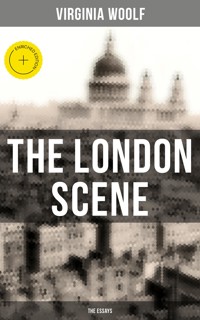
In 'THE LONDON SCENE: The Essays' by Virginia Woolf, the reader is taken on an insightful journey through the bustling city of London. Woolf's elegant and descriptive prose captures the essence of London in the early 20th century, providing vivid accounts of the city's various neighborhoods, landmarks, and social dynamics. As a key figure in the Bloomsbury Group, Woolf's writing style is characterized by its modernist experimentation and acute observations of human experiences, making 'THE LONDON SCENE' a noteworthy contribution to literary studies. Woolf's essays reflect her keen eye for detail and her profound understanding of the complexities of urban life, offering readers a unique perspective on London's vibrant culture and history. Virginia Woolf's personal connection to London, as a resident and writer, undoubtedly influenced the creation of 'THE LONDON SCENE'. Having spent much of her life in the city, Woolf was able to draw upon her own experiences and observations to craft these insightful essays. Her intimate knowledge of London shines through in the vivid imagery and introspective reflections found throughout the book. For readers interested in exploring the intersection of literature and urban studies, 'THE LONDON SCENE: The Essays' by Virginia Woolf is a must-read. With its evocative prose and keen insights, this collection offers a captivating glimpse into the heart of one of the world's most iconic cities, making it an essential addition to any literary enthusiast's bookshelf. In this enriched edition, we have carefully created added value for your reading experience: - A comprehensive Introduction outlines these selected works' unifying features, themes, or stylistic evolutions. - The Author Biography highlights personal milestones and literary influences that shape the entire body of writing. - A Historical Context section situates the works in their broader era—social currents, cultural trends, and key events that underpin their creation. - A concise Synopsis (Selection) offers an accessible overview of the included texts, helping readers navigate plotlines and main ideas without revealing critical twists. - A unified Analysis examines recurring motifs and stylistic hallmarks across the collection, tying the stories together while spotlighting the different work's strengths. - Reflection questions inspire deeper contemplation of the author's overarching message, inviting readers to draw connections among different texts and relate them to modern contexts. - Lastly, our hand‐picked Memorable Quotes distill pivotal lines and turning points, serving as touchstones for the collection's central themes.
Sie lesen das E-Book in den Legimi-Apps auf:
Seitenzahl: 101
Veröffentlichungsjahr: 2017
Das E-Book (TTS) können Sie hören im Abo „Legimi Premium” in Legimi-Apps auf:
Ähnliche



THE LONDON SCENE: The Essays
Published by
Books
Table of Contents
Introduction
THE LONDON SCENE: The Essays gathers Virginia Woolf’s complete sequence of six urban sketches—The Docks of London, Oxford Street Tide, Great Mens Houses, Abbeys and Cathedrals, “This is the House of Commons”, and Portrait of a Londoner—originally published as a series in Good Housekeeping magazine. Presented together, they form an intricate panorama of a city examined through movement, institution, and character. This volume restores their designed cohesion: a composed circuit from river to shop-front, from monumental stone to parliamentary debate, ending with a human study. It offers readers a compact but capacious map of Woolf’s London, made through the supple instrument of the essay.
The scope of this collection is precise and complete: it presents the entire London sequence as Woolf wrote it for periodical publication. Within her wider oeuvre—novels, short stories, essays, criticism, diaries, and letters—these pieces exemplify her non-fiction art. They are essays that draw upon adjacent modes without leaving their genre: city sketch, topographical vignette, cultural reportage, and miniature portrait. The purpose of gathering them here is to preserve their serial logic, to emphasize their unity of method and motif, and to foreground Woolf’s distinctive practice of looking—historically informed, sensuously alert, and committed to the life of the mind in public space.
Composed for Good Housekeeping, a widely read magazine, these essays show Woolf addressing a broad audience while retaining the finesse of her modernist prose. The commission encouraged clarity, brevity, and an eye for the telling scene. Yet the constraints of the page never confine her imagination; they refine it. Each piece is a self-sufficient excursion, hospitable to readers who might happen upon one installment in isolation. Read consecutively, however, they accumulate resonance, inviting us to experience London as serial perception: linked stations on a walk, variations in tone, and recurring images that bind the city’s disparate quarters into a legible whole.
Across the six essays, unifying themes emerge. Woolf treats the metropolis as an organism whose arteries throb with work, worship, commerce, debate, and sociability. She is drawn to thresholds—quaysides, shopfronts, doorways, porches, galleries—places where the private meets the public and where the past presses upon the present. She listens for tempo as much as for speech: the surge and ebb of a crowd, the measured cadence of institutional routine, the hush that gathers within stone enclosures. History is never inert backdrop; it is lived atmosphere. Attention itself is her ethic, and London provides inexhaustible occasions for its exercise.
Stylistically, the essays exhibit Woolf’s hallmarks: supple sentences that pivot from detail to reflection; metaphor that clarifies rather than ornaments; a mobile point of view that considers the seen and the unseen, the material and the remembered. She favors patterns of recurrence—images of tide, drift, current, and web—to register the city’s motions. Her prose balances exact observation with speculative reach, maintaining fidelity to what is before the eye while opening onto association and idea. The result is neither guidebook nor tract, but a form of thinking-in-place that models how literature can inhabit and interpret urban life.
The Docks of London sets the scale by beginning at the river, where goods, vessels, and labor marshal the city’s outward and inward energies. Woolf attends to the choreography of work and the distances condensed at the water’s edge, tracing how objects and stories arrive from elsewhere to become part of London’s daily fabric. The premise is simple—a visit to the docks—yet it yields a global horizon. The river becomes a medium of relation, binding far-off origins to local purposes, and encouraging the reader to sense the city as both particular ground and intersection of wider currents.
Oxford Street Tide turns inland to the theatre of consumption. Here Woolf surveys the surge of pedestrians, the choreography of windows and signs, and the seasonal pulse that alters the look of the same thoroughfare. The essay studies how faces and objects glance off one another in passing, how attention is solicited and diverted, and how the street stages a continual play of novelty. Without endorsing or condemning, she anatomizes the surface—its glitter and fatigue—and shows how modern life can be read there, moment by moment, as a moving pattern rather than a fixed design.
Great Mens Houses explores domestic interiors preserved as public memorials, spaces where private life has been refitted into national narrative. Woolf examines how rooms, furniture, and relics are arranged to tell exemplary stories about achievement and character. She is attentive to the tension between intimacy and display: what is revealed, what is curated, and what remains unknowable. The essay invites readers to consider how houses become texts, legible through the arrangement of things, and how admiration can coexist with quiet skepticism about the adequacy of objects to carry the weight of a life.
Abbeys and Cathedrals moves through ecclesiastical London, where stone, light, and ritual gather collective memory into architecture. Woolf attends to how people inhabit these spaces—tourists, clergy, citizens seeking respite—and to how buildings shape response through scale and acoustics. The essay treats churches as civic as well as sacred institutions, repositories not only of worship but of remembrance. Rather than argue doctrine, she reads the city’s holy places as instruments that regulate feeling and time, locations where the individual slips briefly into a larger cadence and then returns to the street altered by the encounter.
“This is the House of Commons” takes up the life of debate and procedure, presenting Parliament as a working organism rather than a symbol at a distance. Woolf describes movement through corridors and lobbies, the architecture that frames speech, and the ordinary labors required to keep an extraordinary institution in motion. The emphasis falls on process: how talk becomes action, how rooms arrange the relation between the seen and the heard. Without dramatizing personalities, the essay communicates the gravity and the oddity of public business, and the ways in which a city thinks aloud through its representatives.
Portrait of a Londoner concludes the sequence with a character study, distilling the metropolis into a single life whose habits, hospitality, and connections knit together a neighborhood. Instead of monumental stone or official ceremony, Woolf turns to the social fabric—visits, conversations, the tact that sustains community. The sketch suggests how a city’s largeness is legible in small exchanges, how reputation and welcome travel faster than vehicles. By closing on a person rather than a place, she reminds us that the human scale underlies every grand scene, and that London’s most durable architecture may be the web of relations.
Taken together, these essays demonstrate why Woolf’s non-fiction matters: they are models of seeing, patient and exact, capable of carrying history, mood, and idea within an apparently modest frame. They speak across decades because their questions remain urgent: how to dwell among institutions without being dwarfed by them; how to honor the past without turning it into a museum; how to notice the everyday without flattening it into mere routine. In assembling the complete London sequence, this volume offers a lucid entry to Woolf’s art and a lasting guide to reading a city with intelligence and care.
Author Biography
Virginia Woolf (1882–1941) was a British novelist, essayist, and critic whose experiments with narrative perspective and time helped define literary modernism. Writing largely in London, she forged a style that joined acute psychological insight to a keen sense of urban life. Her achievement spans fiction, criticism, and journalism, and it extends to vividly observed city portraits. The present collection highlights that facet through six interwar essays about the capital: The Docks of London, Oxford Street Tide, Great Mens Houses, Abbeys and Cathedrals, This is the House of Commons, and Portrait of a Londoner. Together they illuminate Woolf’s enduring preoccupation with public spaces, movement, and the texture of everyday experience.
Raised amid extensive reading and conversation, Woolf received part of her education in the Ladies’ Department at King’s College London, where she studied literature and history. She began her career as a reviewer and essayist for periodicals, including the Times Literary Supplement, cultivating a critical voice attentive to form and language. Engagement with painters, critics, and economists in the Bloomsbury circle encouraged experimentation and a secular, liberal cast of mind. With Leonard Woolf she later established the Hogarth Press, which fostered independent publishing and gave her unusual freedom to shape her books. These contexts—formal study, journalism, and a supportive artistic milieu—underwrote her stylistic daring.
Her early novels evolved rapidly from Edwardian convention to modernist experiment. The Voyage Out introduced recurrent concerns with perception and social ritual; Night and Day refined social analysis; Jacob’s Room, with its gaps and shifting viewpoints, announced a new approach to character and memory. Across this period she published essays and reviews that tested ideas she would carry into fiction. The reception was attentive, if sometimes divided, recognizing both her technical ambition and her critique of inherited forms. By the early 1920s, Woolf had established herself as a writer determined to expand what the English novel and essay could include.
In her middle years Woolf produced major works often taught as landmarks of high modernism. Mrs Dalloway and To the Lighthouse deepened interior monologue and examined time’s layered rhythms. Orlando blended biography and fantasy to explore identity and history. A Room of One’s Own offered a sustained argument about women’s material conditions and artistic possibility, uniting polemic with metaphor. Alongside such books she issued collections of literary essays that clarified her aesthetics and methods. The combined effect was to shape both narrative technique and the essay as a flexible, investigative form, open to the textures of thought, place, and memory.
The essays gathered here showcase Woolf’s urban attention at close range. The Docks of London surveys maritime labor and imperial circulation, reading warehouses and water as a living archive. Oxford Street Tide registers the ceaseless flow of shoppers and commodities, a choreography of modern consumption. Great Mens Houses explores domestic relics as instruments of remembrance and mythmaking. Abbeys and Cathedrals considers how worship, architecture, and nationhood interlock. This is the House of Commons observes the procedures and atmospheres of parliamentary life. Portrait of a Londoner distills social character through hospitality and talk. Each piece turns reportage into reflective, mobile prose.
Consistent across Woolf’s oeuvre is an interest in freedom of mind, the ethics of attention, and the pressures institutions exert on individuals. Her feminist arguments—most memorably in A Room of One’s Own and later in Three Guineas—insist on education, income, and privacy as preconditions for creative work, and question militarism and patriarchal authority. The London essays translate these concerns into scenes of civic life, showing how public spaces set terms for seeing and being seen. She treats streets, chambers, and monuments as social scripts, while her style—shifting vantage points, associative detail—suggests how private consciousness both absorbs and resists those scripts.
In the 1930s Woolf extended her experiments in works such as The Waves and The Years, and completed Between the Acts shortly before her death in 1941. The strain of war and periods of illness intersected with, but did not diminish, her commitment to formal inquiry and cultural critique. Posthumously, her diaries, essays, and fiction have sustained wide readership and scholarship, influencing narrative theory, feminist criticism, and urban writing. The London pieces in this collection endure as fresh records of an interwar metropolis and as demonstrations of how an essay can catch the pulse of a city while probing the life of the mind.




