


4,49 €
4,49 €
oder
-100%
Sammeln Sie Punkte in unserem Gutscheinprogramm und kaufen Sie E-Books und Hörbücher mit bis zu 100% Rabatt.
Mehr erfahren.
Mehr erfahren.
- Herausgeber: Kim Paradowski
- Kategorie: Gesellschafts- und Liebesromane
- Sprache: Englisch
- Illustrated Edition with 20 original illustrations
- Includes a complete story summary
- Contains a detailed characters list
- Features an insightful author biography of Graham Greene
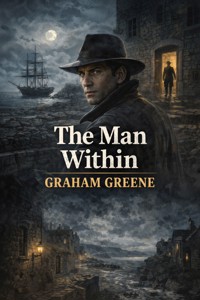
The Man Within is the powerful debut novel of Graham Greene, a master storyteller whose works probe the darkest corners of conscience and morality. Set against the bleak English coast and the dangerous underworld of smugglers, this gripping novel follows a man on the run—not only from ruthless pursuers, but from his own crushing sense of betrayal.
Francis Andrews is weak, frightened, and desperate to escape the consequences of his actions. Having betrayed a violent smuggling gang, he flees into the countryside where every step forward deepens his inner conflict. As danger closes in, Greene draws readers into a tense psychological struggle where fear, guilt, and the longing for redemption collide.
Rich in atmosphere and emotional intensity, The Man Within explores timeless themes of cowardice versus courage, loyalty versus survival, and the heavy cost of moral failure. Greene’s sharp prose and penetrating insight make this novel as compelling today as when it was first published.
This beautifully produced illustrated edition brings the story vividly to life with 20 evocative illustrations, enhancing the mood and drama of the narrative. Bonus features—including a clear summary, a helpful characters list, and a concise author biography—make this edition perfect for both new readers and classic literature enthusiasts.
A classic of psychological fiction and a must-have for any serious reader’s collection.
Das E-Book können Sie in Legimi-Apps oder einer beliebigen App lesen, die das folgende Format unterstützen:
Veröffentlichungsjahr: 2026
0,0
Bewertungen werden von Nutzern von Legimi sowie anderen Partner-Webseiten vergeben.
Legimi prüft nicht, ob Rezensionen von Nutzern stammen, die den betreffenden Titel tatsächlich gekauft oder gelesen/gehört haben. Wir entfernen aber gefälschte Rezensionen.
Ähnliche



















The Man Within by Graham Greene
ABOUT GREENE
Graham Greene (1904–1991) was one of the most influential English novelists of the twentieth century, a writer whose work consistently probed the uneasy border between morality and betrayal, faith and doubt, politics and personal conscience. His fiction is marked by a restless intelligence and a deep fascination with the flawed inner lives of individuals caught in extreme circumstances.
Born in Berkhamsted, England, Greene grew up in an atmosphere of emotional strain: his father was headmaster of the school he attended, leaving him socially isolated and introspective. These early experiences shaped his lifelong sensitivity to loneliness, fear, and divided loyalties. He studied history at Balliol College, Oxford, where he began writing seriously and published his first poetry collection before turning to novels.
Greene’s early career included journalism and film criticism, disciplines that sharpened his economical style and cinematic sense of tension. His breakthrough came with Stamboul Train (1932), a fast-paced novel that revealed his talent for blending popular storytelling with psychological depth. From this point on, Greene developed a distinctive body of work he himself divided into “entertainments” and “novels,” though even his thrillers carried moral weight and philosophical seriousness.
A convert to Roman Catholicism in the 1920s, Greene’s faith—often conflicted and unorthodox—became a central force in his writing. Novels such as Brighton Rock, The Power and the Glory, and The Heart of the Matter explore sin, grace, and redemption in bleak settings, portraying characters who struggle to act ethically in a world that offers few clear answers. Greene was less interested in piety than in the tension between belief and human weakness.
His love of travel and political curiosity took him to some of the world’s most volatile regions, including West Africa, Mexico, Vietnam, Cuba, and Central America. These experiences informed politically charged works like The Quiet American and Our Man in Havana, where personal motives collide with global power struggles. Greene was deeply skeptical of ideology and often sympathetic to the victims of imperialism and Cold War politics.
In later life, Greene became an international literary figure, admired for his clarity of prose, moral seriousness, and quiet compassion. Though never awarded the Nobel Prize—despite frequent speculation—his influence on modern fiction, film, and political writing is immense. He died in 1991, leaving behind a body of work that continues to resonate for its honesty about human frailty and its refusal to offer easy moral conclusions.
SUMMARY
The Man Within – Captivating Summary
The Man Within is a gripping psychological and moral drama that announces Graham Greene’s lifelong fascination with guilt, fear, and divided loyalties. Set against the stark landscapes of the English countryside and the shadowy world of smugglers, the novel draws readers into the troubled mind of a man who cannot escape his own conscience.
At its center is Francis Andrews, a weak and anxious young man fleeing both the law and his past. Once entangled with a ruthless smuggling gang, Francis betrays the men he fears most—and the betrayal poisons everything that follows. Hunted by former comrades and tormented by guilt, he seeks refuge with Elizabeth, a woman whose quiet strength and compassion offer him a fragile hope of redemption.
As the story unfolds, the real conflict shifts inward. Greene masterfully explores the “man within” Francis: the clash between cowardice and courage, selfishness and moral responsibility. Every choice tightens the tension, pushing Francis toward a reckoning where escape is no longer possible.
Dark, atmospheric, and deeply human, The Man Within is more than a tale of crime and pursuit. It is a haunting exploration of conscience and fear, showing how the greatest danger often lies not in those who chase us, but in the weaknesses we carry inside ourselves.
CHARACTERS LIST
Characters in The Man Within
Francis Andrews
The protagonist of the novel. Francis is a fearful, insecure young man plagued by guilt and self-doubt. Formerly associated with a smuggling gang, he betrays his companions and spends the novel fleeing both physical danger and his own conscience. His inner conflict—between cowardice and moral responsibility—drives the story.
Elizabeth
A strong, compassionate woman who offers Francis refuge and emotional support. Elizabeth represents moral stability and quiet courage, serving as a contrast to Francis’s weakness. Through her, Greene explores the possibility of redemption and the influence of integrity on a fractured soul.
Carlyon
The brutal and vengeful leader of the smuggling gang. Carlyon embodies raw power, cruelty, and relentless pursuit. His presence casts a constant shadow over Francis, symbolizing the inescapable consequences of betrayal.
Andrew
Elizabeth’s husband, a calm and principled man whose sense of justice and moral clarity highlights Francis’s inner turmoil. Andrew represents order and rational morality in a world dominated by fear and violence.
The Smugglers
The members of Carlyon’s gang function collectively as an ever-present threat. They reinforce the atmosphere of menace and underscore the dangers of loyalty built on fear rather than trust.
Table of Contents
Titlepage
Imprint
Dedication
Epigraph
The Man Within
Part I
I
II
III
IV
V
Part II
VI
VII
VIII
IX
Part III
X
XI
Colophon
Uncopyright
The Man Within
Part I
I
He came over the top of the down as the last light failed and could almost have cried with relief at sight of the wood below. He longed to fling himself down on the short stubbly grass and stare at it, the dark comforting shadow which he had hardly hoped to see. Thus only could he cure the stitch in his side, which grew and grew with the jolt, jolt of his stumble down hill. The absence of the cold wind from the sea that had buffeted him for the last half hour seemed like a puff of warm air on his face, as he dropped below the level of the sky. As though the wood were a door swinging on a great hinge, a shadow moved up towards him and the grass under his feet changed from gold to green, to purple and last to a dull grey. Then night came.
A hedge sprang up before his eyes at the distance of a dozen yards. His confused tired senses became aware of the smell of last year’s blackberry leaves wet with past rain. For a moment the scent swathed him in a beautiful content and left him with an ache for time in which to rest here. The grass grew long before he reached the hedge, and a little later his feet were heavy with wet earth and he knew that he was on a path. It was his feet rather than his mind that knew it. They made a rambling progress, now in the muddy centre of the way, now in the grass at the right hand edge, now scraping the outer fringe of the hedge on the other side. His mind was a confusion of scents and sounds, the far hush of the sea, a memory of rattling pebbles, the smell of the wet leaves and the trampled marl, the salt sweep of the wind that he had left behind on the top of the hill, voices, imaginary footsteps. They were jumbled together like the pieces of a puzzle, and they were half forgotten because of his fatigue and fear.
The fear in his mind told him that paths were dangerous. He whispered it out loud to himself, “Dangerous, dangerous,” and then because he thought that the low voice must belong to another on the path beside him, he scrambled panic stricken through the hedge. The blackberry twigs plucked at him and tried to hold him with small endearments, twisted small thorns into his clothes with a restraint like a caress, as though they were the fingers of a harlot in a crowded bar. He took no notice and plunged on. The fingers grew angry, slashed at his face with sharp, pointed nails. “Who are you anyhow? Who are you anyhow? Think yourself mighty fine.” He heard the voice, shrill and scolding. She had a pretty face and a white skin. “Another day,” he said, because he could not wait. He had to leave the town. The last twigs broke and the night became darker under trees. Through the latticing of the leaves half a dozen stars came suddenly to view.
He stumbled against a tree and leant for a moment against it, allowing his legs to relax. Freed from some of the weight of his body, they seemed to ache more than ever. He tried to pull himself together and remember exactly where he was—no longer in Shoreham but in a wood. Had he been followed? He listened, hungry for silence, and was rewarded. Had he ever been followed? He had seen Carlyon in the bar of the Sussex Pad, but only in the mirror behind the harlot’s head. Carlyon had been standing sideways to him and was ordering a drink. Unless Carlyon saw him leave, he was safe. What a fool he had been to leave so suddenly. He should have gone quietly out and taken the girl with him. Fool, fool, fool, fool, the word droned on in his mind, a sleepy and mechanical reiteration. His eyes closed, then opened with a start, as a twig broke under his own foot. He might have been asleep now in a comfortable bed, all the more comfortable for being shared. She was pretty and had a good skin. He didn’t suppose he would have been asleep … He woke again two minutes later feeling cold. He had dreamed that he was again in the bar, looking in the mirror at Carlyon’s face, and in the dream the face had begun to turn. But was it only in the dream? He could not stay here and again he began to run, very stumblingly because of the roots of the trees.
Oh, but he was tired, tired, tired. His wrist was hurting and felt damp and weak, slashed by the thorns in the hedge. If Carlyon had suddenly appeared now in front of him, he would have thrown himself down on his knees and cried. Carlyon wouldn’t do anything. Carlyon was a gentleman like himself. And one could always appeal to Carlyon’s sense of humour. “Hello, Carlyon, old man, it’s ages since I’ve seen you. Have you heard this one, Carlyon, old chap? Carlyon, Carlyon, Carlyon.” “And there shall be weeping and gnashing of teeth.” “How dare you teach my boy that stuff?” and then he’d beaten her. His father had always talked of him as “my boy,” as though his mother had not borne the pain. The damned old hypocritical bully. “Please God, give me a bear.” He hadn’t wanted a live puppy, which needed looking after. Am I going to faint, he asked himself? What’s this wood doing? Why a wood? Hansel and Gretel. There should be a cottage soon with a witch in it, and the cottage should be made of sugar. “I am so hungry,” he said aloud. “I can’t wait for Gretel.” But inside himself he knew only too certainly that there was no Gretel. He and Gretel had kissed under the holly tree on the common one spring day. Across a faintly coloured sky a few plump clouds had tumbled recklessly. And then time and again he was walking up narrow stairs to small rooms and untidy beds, and walking down again feeling dissatisfied, because he had never found Gretel there. How curious everything was. And now this wood … He saw a light glimmering in front at what seemed an infinite distance, and he began to run, remembering that Carlyon might be somewhere behind him in the dark. He had to get on, get on, get on. His feet stumbled, stumbled, and every stumble sent a shoot of pain up his arm to the shoulder, starting from his torn wrist, but not a stumble brought the light nearer. It shone mockingly ahead, very small and sharp and immeasurably knowing. It was as though the world had heaved upward, like a ship in a rough sea, and brought a star to its own lamp’s level. But as distant and as inaccessible as the star was the light.
He was almost on top of the light before he realised that its smallness was due to size and not to distance. The grey stones of a cottage suddenly hunched themselves up between the trees. To the man raising his head to see the ramshackle bulk, it was as though the uneven, knobbled shoulders of the place had shrugged themselves from the earth. The cottage had but one floor above the ground, and the window with which it faced the wood was of thick glass, slightly tinted, like the glass of liquor bottles. The stones of the place gave the impression of having been too hastily and formlessly piled upon one another, so that now with old age they had slipped, some this way, some that way, a little out of the perpendicular. An excrescence built clumsily upon one end might have been anything from some primitive sanitary arrangement to a pigsty or even a small stable.
He stood and watched it and swayed a little upon his feet. Soon he would go up and knock, but for the moment in spite of weariness and the pain from his wounded wrist, he was engaged in the favourite process of dramatising his actions. “Out of the night,” he said to himself, and liking the phrase repeated it, “out of the night.” “A hunted man,” he added, “pursued by murderers,” but altered that to “by worse than death.” He imagined himself knocking on that door. He saw it opening, and there would appear an old white-haired woman with the face of a saint. She would take him in, and shelter him. She would be like a mother to him and bind his wrist and give him food and drink, and when he had slept he would tell her everything—“I am a hunted man,” he would say, “pursued by worse than death.”
He became afraid again of his own reiteration of the phrase “worse than death.”
There was little satisfaction in an image which stood upon a fact. He looked behind him once into the dark from which he had come, half expecting to see Carlyon’s face luminous there, like a lighted turnip. Then he stepped nearer to the cottage.
When he felt the rough stones warm under his palm, he was comforted. At least it was something solid to have at one’s back. He turned and faced the wood, stared and stared, trying to pick out details and to see where each trunk stood. But either his eyes were tired, or else the darkness was too deep. The wood remained a black, forbidding immensity. He felt his way cautiously along the wall to the window and then, standing on tiptoe, tried to peer within. He could perceive only shadows, and the flame of a candle which stood on the ledge inside. He thought that one shadow in the room moved, but it might merely have been the effect of the flickering light. His mind cleared a little and gave room for cunning, and with cunning there crawled in uneasiness. He felt his way very cautiously along the wall towards the door, listening for any sound from the cottage on one side of him and from the wood on the other. It would be like his luck, he thought, his heart giving a sick jolt, if he had stumbled on a smuggler’s hole. It was just such a night, he knew, as he would have chosen himself to run a cargo, dark and moonless. Perhaps he had better move on and avoid the place, and even as the thought crossed his mind his fingers touched the wood of the door. His legs were weak as butter, his wrist was sending stab after stab of pain up his arm, and the edge of an approaching mist touched his consciousness. He could go no further. Better face what lay within the cottage than lie defenceless outside with Carlyon perhaps approaching through the wood. The vision of the white-haired old mother had been effaced very completely. He fumbled at the door, but he was unprepared for it to swing readily open, and he fell on his knees across the threshold in a silly sprawl.
He looked up. Clogged and dulled by that ever-approaching mist a voice had spoken to him. “Stay where you are,” it had said with a kind of quiet and unsurprised command. Now he saw at the other side of the room, wavering a little like a slim upstrained candle-flame, a woman. She was young, he recognised with an automatic leer, and white in the face but not frightened. What kept him still upon his knees, besides the complete physical weariness that made him unwilling to rise, was the gun which was aimed steadily at his chest. He could see the hammer raised.
“I say,” he said. “I say.” He was displeased at the dead sound of his own voice. He felt that it should be full of the mingled pathos of weariness and appeal. “You needn’t be afraid,” he tried again. “I’m done in.”
“You can stand up,” she said, “and let me look at you.” He rose shakily to his feet, with a feeling of immense grievance. This wasn’t the way for a woman to behave. She should be frightened, but she very damnably wasn’t. It was he who felt the fear, with his eye warily watching the gun.
“Now what do you want?” she asked. To his surprise there was no anger in her voice, but a quite genuine curiosity. It annoyed him to know that she was patently the mistress of the situation. It made him even in his weakness want to bully her, to teach her. If only he could get that gun …
“I want a hiding place,” he said. “I’m being followed.”
“Runners?” she asked. “Gaugers? You can’t stop here. You’d better go the way you came.”
“But I can’t,” he said, “they’d get me. Look here, I’m on the side of the law. It’s not the officers who are after me.” His eyes fixed on the gun, he made a step forward, spreading out his hands in appeal, in a gesture which he had often seen made on the stage.
“Keep back,” she said, “you can’t stay here. Turn round and go out.”
“For the love of God,” he said. He had picked that expression also from the stage, but the girl could not be expected to know it. It sounded genuine, for his voice was full of real tears. He was tired out and wanted to sleep.
“If you are being followed,” she said, as though speaking to a very stupid child, “you are wasting time here.”
“When I get you,” he said with sudden fury, “I’ll teach you charity. Call yourself a Christian”—his eyes filled with warm sentimental tears at a sudden vision of little grey churches, corn fields, stiles, honeyed distant bells in the dusk, robins in snow. “I’ll teach you,” he said again. The white serenity of her face infuriated him. “I’ll tell you what I’ll do to you.” With childish petulance he flung his mud at something beautiful and very distant, hated himself and enjoyed his hatred. He described what he would do to her in a brief, physiological sentence, and rejoiced at the flush which it fetched to her face. His outburst brought the mist down closer upon him. “You can join your fellows on the streets then,” he cried at her, determined to hurt before fainting should make him a powerless, shameful weakling at her mercy. For a moment he thought that she was going to shoot. He was too exhausted for fear now and felt only a vague satisfaction that he had made himself sufficiently hateful to drive her to action. Then the danger passed. “I told you to go,” was all she said, “I don’t know what you want here.”
He swayed a little on his feet. He could hardly see her now. She was a lighter wisp in a world of grey. “Look, he’s at the window,” he cried with sudden vehemence, and as the wisp moved he lunged forward.
He felt the gun within his hand and forced it upwards, struggling at the same time for the trigger. The girl had been taken by surprise and for the moment gave way.
With the muzzle pointing somewhere at the ceiling, he pulled the trigger. The hammer fell, but there was no explosion. The girl had fooled him with an unloaded weapon. “Now, I’ll teach you,” he said. He tried to wrench the gun away, the better to get at her, but his right wrist seemed to double up and collapse with the effort. He felt a hand press against his face, and his whole body grew weak, and he stumbled backwards. He hit against a table which he had not seen was in the room, so focused had his eyes been on the danger in front of him. He put out a hand to save himself, for his legs seemed made in numerous joints, which were now all folding in upon each other. Something fell to the floor with a brief dart of gold, like a disdainful guinea, and his fingers were scorched for a moment by flame.
The pain cleared his brain with the suddenness of an unseen hand wrenching a curtain aside. He looked behind him and found himself staring into a heavy bearded face, over which three other candles sent a straying luminance.
“But …” he cried, and never knew what he meant to add. He backed away in disgust from the body where it lay in its unlidded and unvarnished coffin. He had never met death before so startlingly face to face. His mother he had never seen in death, for his father had huddled her quickly away in earth with a cross and a bunch of flowers, and his father had been killed in a running fight at sea and dropped unobtrusively over the side, while he was learning to decline oikia at his school in Devon. He was frightened and disgusted and sick and somehow ashamed. It was, he felt remotely, indecorous to broil thus over a coffin, even though the coffin were of unvarnished deal. His eyes searched a deepening darkness, flickering with gold points where the candles shone, until they found a face which seemed now white rather with weariness than serenity. “I’m sorry,” he said, and then the lights were all extinguished.
II
Over a toppling pile of green vegetables two old women were twittering. They pecked at their words like sparrows for crumbs. “There was a fight, and one of the officers was killed.” “They’ll hang for that. But three of them escaped.” The vegetables began to grow and grow in size, cauliflowers, cabbages, carrots, potatoes. “Three of them escaped, three of them escaped,” one of the cauliflowers repeated. Then the whole pile fell to the ground, and Carlyon was walking towards him. “Have you heard this one?” he said. “Three of them escaped, three of them escaped.” He came nearer and nearer and his body grew in size, until it seemed as though it must burst like a swollen bladder. “Have you heard this one, Andrews?” he said. Andrews became aware that somewhere behind him a gun was being levelled, and he turned, but there were only two men, whose faces he could not see, laughing together. “Old Andrews, we won’t see his like again. Do you remember the time …” “Oh, shut up, shut up,” he called, “he was only a brute, I tell you. My father was a brute.” “Ring-a-ring-a-roses,” his father and Carlyon were dancing round him, holding hands. The ring got smaller and smaller and he could feel their breath, Carlyon’s cool and scentless, his father’s stale, tobacco-laden. He was gripped round the waist, and someone called out, “Three of them escaped.” The arms began to drag him away. “I didn’t do it,” he cried. “I didn’t do it.” Tears ran down his cheeks. He struggled and struggled against the pulling arms.
He emerged slowly into a grey dispersing mist, cut by jagged edges. They grew towards his sight and became boxes, old trunks, dusty lumber. He found that he was lying upon a pile of sacking and there was a stale smell in the room of earthen mould. A pile of gardening implements leant up against one wall, and one upturned lidless trunk was full of little shrivelled bulbs. At first he thought that he was in the potting shed of his home. Outside should be a lawn and a tall pine, and presently he would hear the shuffling footsteps of the gardener. The old man always dragged his left foot behind him, so that there was no regular cadence to his steps. They had to be counted like an owl’s cry—one twoooo—one twoooo. How it was that he came to be lying in the potting shed in the grey light of early morning Andrews did not question. He knew very well the unwisdom of questioning it—half indeed he was aware in what place he lay. I will play a little longer, he thought, and turned over and lay with his face to the wall, so that he might not notice the unfamiliar details of the room, shed, whatever it might be. Then he shut his eyes, because the wall he faced was stone and it should have been wood.
With his eyes shut all was well. He sniffed the warm scent of the mould comfortingly.
The old man would grumble at his presence, complain that he had shifted a hoe, a spade, a fork. Then as certainly as night closed day he would take up a box lid full of seeds, rattle the seeds back and forth with a noise like small, quick hailstones and murmur, “Winkle dust.” Andrews screwed his eyes tighter, sniffed deeper. He remembered how the old man had been standing once beneath the pine at the end of the lawn. He was feeling his chin thoughtfully and staring up at the tapering dark slimness above him. “Three hundred years,” he was saying slowly to himself, “three hundred years.” Andrews had commented on the sweet elusive smell that came sifting through the air. “That’s age,” said the old man, “that’s age.” He spoke with such conviction that Andrews half expected to see him vanish himself into a faint perfume formed out of bulbs and damp turned earth. “They make coffins out of pines,” the old man continued, “coffins, that’s why you get the smell sometimes where there ain’t no pines. Up through the ground you see.”
The thought of coffins jerked Andrews’s eyes open. He saw again the candle fall and the bearded face looking up at him. It was sheer chance that he had not placed his hand full on that dead stubble. Three years swept past; the present scratched at his nerves. He jumped up and looked round. How long had he slept? What had that girl been doing in the meanwhile? He had been a weak fool to collapse and a sentimental fool to dream into the past. The present called for brisk action if he was to bring himself to safe haven, but remembering all the circumstances of the last few weeks, he wondered with a sick lurch at the heart whether there was any haven to which Carlyon would not penetrate.
In the wall opposite was a window cobwebbed and dusty. By piling two of the boxes together he was able to reach it, and he calculated that he could just squeeze his body through the opening. He was afraid to break the glass, because of the noise the act would cause, and his fingers felt cautiously and timidly at the catch, which was almost welded to its position with the rust of many years. He began to pick at the rust with his nails and by small fractions of an inch he was able to move the catch. The tiny noises he made fretted at his nerves and the very need of caution made him careless. He stood on tiptoe, partly with the excitement and a restlessness to be gone, partly that he might get a better purchase on the terribly reluctant catch. With a long drawn out squeak it twisted and left the window free; at the same moment the noise of a door-handle turning swung him round. He had hardly noticed the door of the room, so certain had he been that it was locked, until now when it opened and the girl stood there. Andrews felt acutely ridiculous balanced upon his boxes. Carefully and slowly, with his eyes fixed on her, he stepped down.




