


Erhalten Sie Zugang zu diesem und mehr als 300000 Büchern ab EUR 5,99 monatlich.
- Herausgeber: Polygon
- Kategorie: Poesie und Drama
- Sprache: Englisch
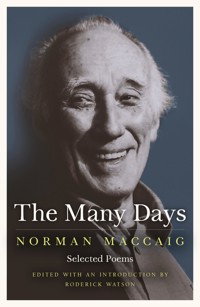
First published in 2010 to mark the centenary of Norman MacCaig's birth, The Many Days aims to strike a balance between representing the much-loved poems that any reader would expect to find in a selected MacCaig, and other less familiar verses. The collection is arranged to show the range of the poet's work in all its variety, from his love of nature and the landscape of the North West Highlands to his life in Edinburgh; from his care for animals and human friendship, to his moments of joy and grief, creative delight and occasional creative dread. Time and again MacCaig returns us to that good place we know as the world, but hardly ever seen so clearly as we do in these marvellous poems.
Sie lesen das E-Book in den Legimi-Apps auf:
Seitenzahl: 98
Veröffentlichungsjahr: 2013
Das E-Book (TTS) können Sie hören im Abo „Legimi Premium” in Legimi-Apps auf:
Ähnliche









The Many Days
This ebook edition published in 2013 by Birlinn Limited West Newington House Newington Road Edinburgh EH9 1QS
www.birlinn.co.uk
First published in Great Britain in 2010 by Polygon, an imprint of Birlinn Ltd Revised edition published 2013
Poems copyright © the estate of Norman MacCaig Introduction copyright © Roderick Watson, 2010
All rights reserved. No part of this publication may be reproduced, stored or transmitted in any form without the express written permission of the publisher.
eBook ISBN: 978-0-85790-780-6 Print ISBN: 978-1-84697-171-6
Version 1.0
British Library Cataloguing-in-Publication Data
Contents
Introduction
Ineducable Me
Ineducable me
Climbing Suilven
Sleeping compartment
Lord of Creation
Private
Go away, Ariel
Patriot
Small lochs
London to Edinburgh
Portobello waterfront
Journeys
On a beach
Bright day, dark centre
On the pier at Kinlochbervie
Emblems: after her illness
Sargasso Sea
By the Three Lochans
Hugh MacDiarmid
After his death
Grand-daughter visiting
To be a leaf
Between mountain and sea
One of the Many Days
One of the many days
Feeding ducks
Goat
Byre
Fetching cows
Blind horse
Frogs
Basking shark
Wild oats
Sparrow
Blackbird in a sunset bush
Ringed plover by a water’s edge
Dipper
Toad
Blue tit on a string of peanuts
My last word on frogs
Our neighbour’s cat
Gin trap
Likenesses
Likenesses
Instrument and agent
Summer farm
Linguist
Leaving the Museum of Modern Art
Painting – ‘The Blue Jar’
Helpless collector
No choice
Recipe
Also
No end to them
Landscape and I
Among Scholars
Among scholars
Midnight, Lochinver
Crofter’s kitchen, evening
By Achmelvich bridge
Neglected graveyard, Luskentyre
Moment musical in Assynt
Two shepherds
Aunt Julia
Uncle Roderick
The Red Well, Harris
Country dance
Return to Scalpay
Praise of a road
Praise of a collie
Praise of a boat
Praise of a thorn bush
Fishermen’s pub
Off Coigeach Point
Old Highland woman
Two men at once
Old Maps and New
Old maps and new
High Street, Edinburgh
Celtic cross
Crossing the Border
Two thieves
A man in Assynt
Old Edinburgh
Battlefield near Inverness
Rewards and furies
Queen of Scots
At the Loch of the Pass of the Swans
Characteristics
From My Window
From my window
November night, Edinburgh
Edinburgh courtyard in July
Hotel room, 12th floor
Last night in New York
Antique shop window
Milne’s Bar
Gone are the days
Neighbour
University staff club
Edinburgh stroll
Five minutes at the window
Foggy night
Balances
Balances
Equilibrist
Spate in winter midnight
July evening
Visiting hour
Assisi
Smuggler
Interruption to a journey
Vestey’s well
Notations of ten summer minutes
Intruder in a set scene
Adrift
Sea change
Two skulls
So many summers
Sounds of the Day
Small boy
Old poet
In That Other World
In that other world
Loch Sionascaig
Descent from the Green Corrie
Memorial
Old man thinking
From Poems for Angus
Notes on a winter journey, and a footnote
A.K. MacLeod
Praise of a man
Angus’s dog
In memoriam
Her illness
Myself after her death 1, 2, 3
Found guilty
A Man in My Position
A man in my position
Party
Estuary
Song without music
Names
Incident
Perfect evening, Loch Roe
Water tap
Index of Poem Titles
Biographical Notes
Introduction
‘His poems are discovered in flight, migratory, wheeling and calling. Everything is in a state of restless becoming: once his attention lights on a subject, it immediately grows lambent.’ In this description, Seamus Heaney gets to the heart of Norman MacCaig’s verse. Time and again MacCaig brings us to a moment of evanescent delight, to a humane epiphany of love and mortality in that good place we know as the world around us, but hardly ever see so clearly. MacCaig’s clear-sightedness is almost a matter of creative moral duty (one thinks of him as a conscientious objector during the Second World War). His imagination, in turn, allows us to see the world afresh, newly minted with surprise and delight: a goat ‘with amber dumb-bells in his eyes’, or that cow ‘bringing its belly home, slung from a pole’, or the thorn bush that traps stars in ‘an encyclopaedia of angles’.
MacCaig’s metaphors are well known and loved by the thousands of readers and listeners who enjoy his work. In poem after poem he leads us to make the leap that will reveal the connection, but also the disconnection, between the metaphor and the thing itself. The poet is always aware of the gap, sometimes ironically, often humorously, and sometimes – as an artist – in despair of ever really bridging it. Thus there are darker and more personal poems in this selection that speak of moments like the ‘ragged man’ waiting for him in the poem ‘Bright day, dark centre’, or the need ‘to feel the world like a straitjacket’ in ‘On the pier at Kinlochbervie’, where the strain of the poem’s opening metaphor about ‘a bluetit the size of the world’ pecking the stars out ‘one by one’ speaks for a moment of personal terror by turning one of his fond and familiar creative leaps into something simultaneously ‘ludicrous’ and menacing.
Such dichotomies are never far from the surface in MacCaig, and yet the landscape he shows us in his work, like the peaceable kingdom of animals and people and mountains that he found in Assynt, is everywhere, finally, infused with a caring attention. Seamus Heaney sees a link with early Irish verse and the Scottish Gaelic tradition in ‘the clarity of image, the sensation of blinking awake in a pristine world, the unpathetic nature of nature in his work’, and MacCaig specifically invoked that tradition with the praise poems he wrote for a road, a collie, a boat, a thorn bush – humble subjects, so radiantly realised.
The collective achievement of MacCaig’s lyrics is unprecedented in modern poetry. I cannot think of any other poet anywhere who has so faithfully and so persistently explored the act of noticing, and the nature of being in the world, through the thousands of epiphanic moments that are his poems, in a creative career of sixteen collections and more than fifty years. Such stern commitment to a single craft, and such generous devotion to the illumination of the world, has an almost monk-like quality to it, although MacCaig – no lover of organised religion – would have hated the comparison. But if you think of it as a secular devotion, and remember the strange little monsters to be found in the margins of the pages of the Book of Kells, then perhaps the analogy will hold.
It has not been easy to make a selection from the treasure house of the complete poems. I was helped in this task and owe a debt of thanks to Tom Pow, Alan Taylor and Ewen McCaig. Our meetings were lively as we tried to strike a balance between representing the much-loved poems that any reader would expect to find in a selected MacCaig, and choosing less familiar verses. The titled sections in this book are my way of perhaps providing new contexts for even the most well-known verses, and for allowing MacCaig’s own lines to reveal common themes and preoccupations in his work. Thus each section starts with a title poem that sets the scene for the selection to follow: Among Scholars, for example, introduces a series of poems that revolve around MacCaig’s regular sojourns in Achmelvich and the west of Scotland, while the poems in From My Window speak of his time in cities and most especially in Edinburgh. The section entitled Old Maps and New reminds us that MacCaig has often reflected – directly and indirectly – on Scottish history, not least in his long poem ‘A Man In Assynt’, whose personal-political focus must be included in any proper account of his work. The verses in Likenesses reflect – sometimes self-critically – on the poet’s own penchant for metaphor and have insights to offer on the nature of the creative process itself. Under Ineducable Me we find poems of a more personal aspect, humorous and sometimes disturbingly painful, from a writer who had nothing but contempt and distrust for ‘gush’ and the so-called confessional poetry of the 1960s. The poems of One of the Many Days bring us to the Edenic world of creatures and landscapes that is the setting for some of Norman’s most popular lyrics, just as those in Balances remind us that the human world has a darker side to it that no poet can escape or ignore. And if the prevailing spirit of MacCaig’s achievement is still one of surprise and delight, then the reflections on death and personal loss from In That Other World remind us that intimations of mortality underlie the beauty of all existence, and have powered the heart of every fine lyric that has ever been written. But in the end for MacCaig, and not just for the poems that make up the final section, A Man in My Position, the first and the last word, clear-eyed, sardonic or tender, has always been love.
But no editorial categorisation can ever do justice to the way MacCaig’s themes interpenetrate each other with surprise, humour, terror and delight at every turn of every line. Nor are these sections meant to suggest otherwise; rather they are a way of encouraging MacCaig’s own poems to speak for themselves and (in this arrangement) among themselves, to set up the best kind of creative dialogue, section to section, poem to poem.
Everything speaks to everything else in MacCaig’s work and, despite those wonderful frogs, he never wrote simply ‘an animal poem’ in his life.
Roderick Watson
Ineducable Me
Ineducable me
I don’t learn much, I’m a man
of no improvements. My nose still snuffs the air
in an amateurish way. My profoundest ideas
were once toys on the floor, I love them, I’ve licked
most of the paint off. A whisky glass
is a rattle I don’t shake. When I love
a person, a place, an object, I don’t see
what there is to argue about.
I learned words, I learned words: but half of them
died for lack of exercise. And the ones I use
often look at me
with a look that whispers, Liar.
How I admire the eider duck that dives
with a neat loop and no splash and the gannet that suddenly
harpoons the sea. – I’m a guillemot
that still dives
in the first way it thought of: poke your head under
and fly down.
Climbing Suilven
I nod and nod to my own shadow and thrust
A mountain down and down.
Between my feet a loch shines in the brown,
Its silver paper crinkled and edged with rust.
My lungs say No;
But down and down this treadmill hill must go.
Parishes dwindle. But my parish is
This stone, that tuft, this stone
And the cramped quarters of my flesh and bone.
I claw that tall horizon down to this;
And suddenly
My shadow jumps huge miles away from me.
Sleeping compartment
I don’t like this, being carried sideways
through the night. I feel wrong and helpless – like
a timber broadside in a fast stream.
Such a way of moving may suit
that odd snake the sidewinder
in Arizona: but not me in Perthshire.
I feel at rightangles to everything,
a crossgrain in existence. – It scrapes
the top of my head and my footsoles.
To forget outside is no help either –
then I become a blockage
in the long gut of the train.
I try to think I’m an Alice in Wonderland
mountaineer bivouacked
on a ledge five feet high.
It’s no good. I go sidelong.
I rock sideways ... I draw in my feet
to let Aviemore pass.
Lord of Creation
At my age, I find myself
making a mountainous landscape
of the bedclothes. A movement
of knee and foot
and there’s Cul Mor and a hollow
filled with Loch Sionascaig.
I watch tiny sheep stringing along
a lower slope.
Playing at God.




