


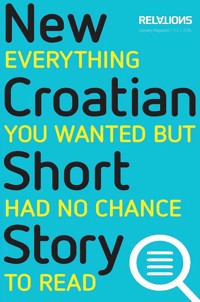
The New Croatian Short Story E-Book
Erhalten Sie Zugang zu diesem und mehr als 300000 Büchern ab EUR 5,99 monatlich.
- Herausgeber: Istros Books
- Kategorie: Gesellschafts- und Liebesromane
- Sprache: Englisch
Istros Books proudy presents a wonderful collection of the very best stories from the very best writers working in Croatia today. Not to be missed.
Das E-Book The New Croatian Short Story wird angeboten von Istros Books und wurde mit folgenden Begriffen kategorisiert:
Sie lesen das E-Book in den Legimi-Apps auf:
Seitenzahl: 362
Veröffentlichungsjahr: 2012
Das E-Book (TTS) können Sie hören im Abo „Legimi Premium” in Legimi-Apps auf:
Ähnliche




















The Journal of Croatian Literature
1-2/2014
Publisher Croatian Writers Society
Editor-in-chief Roman Simić Bodrožić
Assistant editor Jadranka Pintarić
Croatian Writers SocietyBasaričekova 24, Zagreb, CroatiaTel.: (+385 1) 48 76 463, fax: (+385 1) 48 70 186
www.hrvatskodrustvopisaca.hr
Stories Copyright © Edo Popović, Maja Hrgović, Zoran Pilić, Neven Ušumović, Senko Karuza, Olja Savičević Ivančević, Roman Simić Bodrožić, Zoran Ferić, Damir Karakaš, Zoran Malkoč, Jurica Pavičić, Tanja Mravak, Robert Perišić, Igor Rajki, and Josip Novakovich.
Translations Copyright © Marija Dukić, Šime Dušević, Celia Hawkesworth, Maja Hrgović, Tatjana Jambrišak, and Tomislav Kuzmanović.
Design and Layout Crtaona, ZagrebPrepress by Krešo TurčinovićPrinted by Grafocentar, Zagreb
1334-6768 (printed as magazine in Croatia)ISBN: 978-1-908236-89-0 (eBook)
The journal is financially supported by the Ministry of Culture of the Republic of Croatia and by the Municipal Funds of the City of Zagreb.
New CroatianShort Story
Everything You Wanted,But Had No Chance to Read
Contents
A Few Notes on the Panorama of the Croatian Short Story of the New Millennium
EDO POPOVIĆ
Welcome Mister Popović
MAJA HRGOVIĆ
Zlatka
ZORAN PILIĆ
Two Grand on Man U
The Marathon Runner
NEVEN UŠUMOVIĆ
Vereš
SENKO KARUZA
Crocodile
Why Do I Hate Myself
The Little House Ghost
It’s So Hard for Me to Say
OLJA SAVIČEVIĆ IVANČEVIĆ
Make the Dog Laugh
ROMAN SIMIĆ BODROŽiĆ
Thus Spoke Mayakovsky
ZORAN FERIĆ
Symmetries of a Miracle
DAMIR KARAKAŠ
The House
ZORAN MALKOČ
When I Was Nana Pila, Dead, but in My Prime
How Little Sleepy Death Dumped Me
JURICA PAVIČIĆ
The Snake Collector
TANJA MRAVAK
While Roland Gaross Was On
ROBERT PERIŠiĆ
The Convalescent
IGOR RAJKI
The Unfailing Atheist
Memoirs on the Germ of Insecurity or the Complex of a Small Nation
JOSIP NOVAKOVICH
Sheepskin
Author Biographies
A Few Notes on the Panorama of the Croatian Short Story of the New Millennium
The 1990s changed the world in which we lived.
In the shortest and most general of lines: almost overnight from one country (Yugoslavia) we moved to another (Croatia), from one political system (so-called self-managing socialism) to another (so-called capitalism), without actually moving an inch. After peace we lived (through) war, and then again had to learn how to live in peace, in a new world and language, in a new geography and a new history.
Croatian literature written in the 1990s was also new, as much as literature can be such at the end of the 20th century. War destruction, the establishment of a new country that was dreamed of for centuries and the life in the here & now, that resembled nothing from that dream, became topics writers obsessed about – they approached them either to legitimize and textually defend this new world or to criticize and question it.
But, besides the topics and the prevailing method of tackling them (the reality around us almost without exception opted for neorealism), something else was different too: the popularity of the short story.
Perhaps because they had neither the time nor the experience needed for the novel, or because in the wartime the life itself was a short form – in the mid-1990s, the new generation of Croatian writers gained their popularity with their collections of stories. True, some of the most important works of previous decades were books of stories (Edo Popović’s Ponoćni Boogie left a strong mark on the 1980s), but in the days of war and immediately after it, this almost became a rule. Miljenko Jergović (Sarajevski Marlboro, 1994) and Zoran Ferić (Mišolovka Walta Disneya, 1996), the first writers of the generation that crossed the national boundaries and echoed in foreign languages, did so with their short-story collections; Robert Perišić’s Možeš pljunuti onoga tko bude pitao za nas (1999) started a sort of a literary fashion and influenced many younger writers, while the books by Senko Karuza (Busbuskalai, 1997) and Neven Ušumović (7 mladih, 1997) – let’s mention just a few – ensured their authors perhaps less numerous but by no means less faithful fans and followers.
Generally speaking, short stories in the oeuvres of Croatian writers were never just a one-time affair. The short story was written, published, bought, and read, prestigious award were given for it and literary festivals tailored after it, pages in newspapers opened for it and films made after it – despite all global market trends, it was a literary form that most successfully encompassed all of what surrounded us.
At the peak of that wave, back in the legendary year 2000, Zoran Ferić and his short-story collection Andeo u ofsajdu won almost every more important literary award in Croatia and thanks to that book (among all other things), in that year Zoran Ferić was the most interviewed public person in Croatia, in a strong competition of politicians, actors, criminals, starlets, and TV-chefs.
And then... then everything went back to normal.
* * *
The panorama we bring in this issue of Relations Magazine is a selection of stories and authors published in the period from 2000 to 2013. Taking into consideration what has already been said, it could seem that we began this selection at the moment when the party was at its peak and are now slowly sliding towards what usually comes after the peak. The question that needs to be answered right here at the beginning is: is the party really over, have all the people already gone home, and have the lights (for the short story) been turned off?
These fifteen authors and the past thirteen years are the best proof of the opposite.
Even though short-story collections no longer fill windows of Croatian bookstores, nor do they occupy the first few places on most read lists, this is by no means a sign that the stories of the new millennium no longer hold the key to the world in which we live. On the contrary: stories we bring in this selection, we are sure, will show the readers all of the diversity of what contemporary Croatian literature (reality perhaps too) is today.
As far as topics are concerned, from a distance of a decade or two, the traumas of the birth of the world in which we live are now old news, which does not mean writers are any less interested in them. In most of the stories brought here, war, even if in traces, is an integral part of peace, but unlike the position that dominated the 1990s, the writers are now free to turn their backs on it, the great common denominator no longer exists.
This selection brings those who forged the Croatian short-story scene in the 1990s and who continue to do so today (Popović, Ferić, Karuza, Perišić, Pavičić, Ušumović), those whose short stories won awards and prizes (Savičević Ivančević, Simić Bodrožić, Malkoč, Mravak, Hrgović), those whose short stories attract new faithful fans and followers (Karakaš, Pilić, Rajki), those who won all of this – both the awards and the fans and the followers – outside of Croatia, in the English language (Novakovich).
And, finally, the title, the subtitle.
A good number of writers from this selection made it with their works (novel or collections of stories) into other languages, but only a few of them into English (that’s why: even if “Everything You Wanted” from the subtitle sounds a little far-fetched, this “But Had No Chance To Read” most certainly does not). We wanted to use this selection and bring the literary audience of the English speaking world closer to Croatia of the new millennium – through its stories: beautiful and terrifying, sweet-sounding and deafening, gentle and cruel. Even if in them there is no everything you wanted to know, what they bring, we are convinced, will serve as an inspiration for new wants, for new explorations.
The Editors
EDO POPOVIĆ
Welcome Mister Popović
Do you have any special requests or particulars regarding your accommodation, something we should take into account? a woman from the literary festival’s organization board asked in a letter.
Yes, I replied. I wrote back saying that I want a female volunteer waiting for me in the room, by no means younger than thirty or older than forty.
There was a TV set waiting for me in the room. On its screen it said: WELCOME MR. EDVARD POPOVIC. There was an A/C unit as well. Buzzing like a distant dentist’s drill.
The whole thing, the festival, I mean, took place in a theatre. On the second evening it was my turn. I sat at a table on the stage and read. I saw the audience. Younger people, mostly. Some heckled at me. I didn’t understand what they were saying so I mumbled too, cursing at them. Anyhow – we communicated, and that was all right.
After the reading, in the lobby, a woman approached me. She was smoking. Sucking on the cigarette quickly and blowing out the smoke. Her hands were shaking. From her restless eyes, madness peeked. Madness and misery.
Hello, she said.
Hello, said I.
Wanna get a drink with us? she asked shooting a glance somewhere behind my back.
With us? I looked around.
My friend is outside, waiting, she said.
No problem, I said.
She put the cigarette in her mouth and offered me her hand.
Klara, she said.
Her hand was cold and moist.
That fellow was waiting outside. A guy you would otherwise not notice in the street. One of those chameleon types eternally merging with the background. This one was just merging with the tattered façade of the theatre. Klara made no effort to introduce us. A local custom, it seemed, like burping in Japan. I went with them. You’re the festival’s guest and little courtesy will not kill you. Be polite with the natives, talk to them, show them you’re not an arrogant prick, you know what I mean.
And so, we walked. A strong wind blew through the streets. Coming down from Siberia, the Baltic or some place like that. Still, the streets were full of people. Scurrying here and there. Some strong fuel moved them, and it seemed as if all of them had a goal. I had no idea where we were going. Nor did I care. Also, there was nothing moving me, no energy the night injects into your muscles. As far as that was concerned, my tanks were dry. But, there was Klara. She took me by the hand and towed me behind. That guy pattered behind us.
Klara wore a short jacket and a pair of jeans that reached to her hips. Between the waistline and the jacket there was a belt of taut, smooth skin, with protruding little belly and dancing hips. When a woman dressed like that passes by, and you turn around and think, Jesus, what an idiot, she’ll freeze to death, that means you’re done, you’re ready for the scrapyard. And that’s exactly what I thought, that she would most certainly catch a cold, Klara would, that is, ruin her kidneys, lungs and god knows what else. It didn’t, however, seem she was in the least worried about it.
How do you like it here? she asked.
It’s cold, I said.
Wroclaw is nice, she said.
Aren’t you cold? I asked.
Why would I be cold?
We walked through a park and then across some bridge. Beneath us, in the water, the darkness mirrored. Then we passed more streets and we were finally there. We got in some bar. The furniture in it was brought from a junkyard, walls covered with old prints and posters, candles on rickety tables, that bar pulled you by the sleeve screaming: Relax! Feel good! I hate such places.
How do you like the bar? Klara asked.
It’s ok, I said.
The best place in town, we’re here all the time, she said.
I dig that, I said.
Dig that? she frowned. I don’t understand what that means.
It means – to understand, to get it.
Aaaah, she said.
They ordered beers. The guy took vodka with his beer. I ordered a glass of still mineral water.
You don’t want a beer? She looked at me suspiciously.
No, I said.
If you don’t like beer, than have some vodka, she said. Zubrowka is excellent.
I don’t drink alcohol, I said.
You don’t drink alcohol?!
No.
No way, she said, all writers drink.
I don’t.
She giggled. That bothered me. The whole thing started to get on my nerves. What am I doing here, with them? Why didn’t I go back to the hotel? Did I think she invited me out to sleep with me?
No, fuck, why would I think that? A woman approaches you, all scared, nervous… That doesn’t exactly seem like someone’s paving the ground for some serious seduction, no. Actually, at first instance, watching her being all hysterical, I thought she was a member of some catholic youth organization or something and that she would now say a word or two about the language in my stories. Although, statistically speaking, in every city there is at least one dreaming of fucking a guy like you. But this wasn’t the case. It certainly wasn’t. Besides, on my forehead, there’s a sign that has for a long time been saying: FUCKED UP! WRECKED! OUT OF SERVICE!
That guy said something. Klara replied. He stared at me. His look was calm, cloudy, distant. Then he went back to his vodka and his beer. He drank, gazing in front of him. I no longer interested him. I started to like him.
Tell me something, Klara said.
What?
Something interesting. You must have an interesting life.
Fuck, this is getting intense. It turns out I’m a talking machine. A jukebox full of interesting stories, and that’s why she called me out. To entertain her. I’m a fucking clown in some shithole in Popeland.
My life is shit, I said.
She laughed. Shit, it seemed, was a magical word around here. A mantra to lift one’s mood. The audience had laughed too every time they heard shit, or dick, or pussy, or fucking. It’s about time I take these words out of my stories. What do I need them for? Even this guy jumped when he heard the word. He glanced at Klara. She told him something. He turned to me and said something.
He says he studies forestry, Klara said.
Cool, I nodded.
He nodded back.
You don’t talk much, do you? I told him.
He looked at Klara. She translated.
He thought for a second.
My thoughts, he began in English, and my words, are far from one another.
I know the feeling, I said.
Sometimes I think about something for a long while, he said, and when I finally find the right words to say it, it seems it’s not important at all.
It made sense what he said.
Besides, I haven’t drunk enough yet, he said. Vodka loosens my tongue.
He took a sip of vodka and washed it down with his beer.
Isn’t that a dangerous combination, I said, vodka and beer?
Vodka without beer, money down the wind, he said.
I liked that.
You’re wise, I said.
It’s a Russian proverb, he replied.
Yes, Russians get these things, I said.
And you really don’t drink? he said and looked into my eyes.
No.
You don’t look like someone who doesn’t drink, he said.
No? How come?
Your eyes and your face, they say you drink.
They lie, I said. I no longer drink.
Problems?
I got tired, I said.
I understand, he said.
We sank each into our own silence. But, Klara wouldn’t give up.
If your life, as you say, is not interesting, then you probably know a lot of interesting people, she said.
Not at all, I said. Interesting types bore me.
Interesting types bore you?
Yes.
That doesn’t make sense.
It doesn’t, I said nervously.
She took a step back and cocked her head.
Why are you nervous?
I’m not nervous.
I know, she said, it bothers you because I speak Serbian.
I don’t give a fuck about that, I said.
I studied Serbian, she said.
Great, I replied.
I heard Croats and Serbs don’t like each other.
Croats don’t like anyone.
She laughed.
Anyhow, she said, I understand much more that I can speak.
You’re good, I said. Usually it’s the other way around.
I don’t understand, she said.
It doesn’t matter, I said.
Two people climbed the stage at the far end of the bar. A chubby woman in a red dress and a guy with a guitar. The woman said something and then started singing. She sang a ballad. Most likely something about the death of the loved one, about a fatal disease, or something like that. Anyhow, some standard Slavic shit along which the alcohol flows just as smoothly as the tears, and finally it all ends up in a brawl.
Here it didn’t seem it would end like that. The people booed, heckled, laughed at them, but there was no serious aggression in the air. The fat woman seemed to be used to such reception, so she just kept smiling and singing. Klara grew silent. She was on her third or fourth pint, I didn’t exactly keep track, and she was immersed deep in her thoughts. The forester was nodding groggily. When they finished, she sighed.
I believe in love, she said.
Of course you do, I said.
Everyone has to believe in something.
It depends, not everyone, I said.
Love is like the wind, she said. You can’t see it, but when it catches you, it carries you like a dry leaf.
Is that a Russian proverb?
No, she said dreamily, it’s just what I think. But, what do you believe in?
Everything and nothing all at once.
You wanna fuck my girl? the forester asked out of the blue.
Your girl?
Yes, my girl.
I thought about the offer.
I don’t know, I said finally.
She’s good, he said.
I believe you.
Here, look at her, he said and pointed at Klara.
A jerk, she said. Don’t listen to him.
She turned to the guy and shot a salvo of squeaky, furious words at him.
He paid no attention to her.
So? he looked into my eyes.
No, thanks, I said.
You don’t like her?
She talks too much, I said.
He laughed contentedly. Klara turned red in the face.
True, she talks too much, he said. That’s her biggest problem. She doesn’t know when to stop. Always has something to say. She doesn’t watch, doesn’t listen, doesn’t feel, doesn’t think, she just talks. Her words make me dizzy.
He waved at the waiter. They ordered more beer, plus a shot of vodka for the forester. I didn’t get anything. You can’t have five bottles of mineral water, right? You can’t have two, either. It’s just stupid. One more shot of mineral water and that’s it! We go home.
You know why she invited you to come out with us? the forester asked.
No.
You don’t.
No, I don’t.
To make me jealous.
Shut up, she said.
Yes, that’s it, he said. She invited you out to make me jealous.
Klara gabbled something in Polish. The forester was unmoved.
Last night a girl hit on me, he said.
Klara scoffed.
She went nuts, he pointed at Karla with his head.
He went to a hotel with her, she said. And you saw her, she doesn’t look like a woman at all.
Who? I asked.
That poet from England, she said bitterly.
I could understand Klara. There was that woman at the festival… Okay, ugly and pretty, those are tricky things, it’s hard to draw a line between them, but that woman… You really needed guts to go with someone like her. I admired the guy more and more.
And what’s best, Klara said, he went with her just because she’s a foreigner, and because she’s a poet. He thinks it’s something… special.
I drank everything from her minibar, the forester said, and after that I don’t remember anything.
But I still love him, said Klara. I can’t help myself. That’s the way it is.
Take her, the forester said tiredly. You have my permission. We deserve that, both I, and her, and you. Go with him, he looked at Klara.
She didn’t say anything. She was just staring at her pint. The forester turned his head away from Klara and gazed somewhere at the bar. It was time to leave. I got lost from there. They didn’t even look at me when I left.
The hotel bar was still open. I sat at the bar and ordered a cup of mint tea. At the far end of the bar there was a fat guy. Rocking back and forward, he was mumbling something into his pint of beer, some secret, boozer formulas.
Closer to me there was a woman. She was pretty. I observed her. I could not take my eyes off of her. Something was happening on her face. Something welled up from her skin, some joyful gleam, youthful flicker similar to the hot air above asphalt, which at the same time was thirstily swallowed by the wrinkles. She had quite a few, on her forehead, around her eyes and mouth, sharp, deep wrinkles. I smoked and watched the struggle on her face. Youth did not stand a chance, not anymore. At one moment she turned and looked at me.
Do you believe in love? I asked.
Excuse me?!
Do you believe in love?
Her eyes widened, and then she burst into laughter. It was a throaty, clear laughter adorned with spurting tears. It’s been a while since I heard someone laugh like that.
For a hundred euros, baby, she said wiping her tears, just for you, for a whole hour, I’ll believe whatever you want me to.
Some other time, I said.
You don’t know what you’re missing, she said.
Of course I do, I said. Try him, I pointed at the fat guy.
He’s done for, she said.
I paid for my tea and went to my room. I turned on the TV. WELCOME MR. EDVARD POPOVIC. I smoked and flipped through the channels, then stopped at some German program. A blonde was doing a striptease in a rubber boat under a waterfall. Shaking her ass and licking her lips. Gumotex, it said on the boat. A little later, some other broad did the same on a running track. She was lying between starting blocks, clutching her boobs and it seemed she was enjoying it. Then commercials. Live SEX. Women seeking men. Total Verboten. I want you. Ah, ah, ah, I’m cumming. Call now: 3.63 euro/minute.
Four euros for a minute’s worth of groaning on the phone?!
The one in the bar would be much cheaper. I turned off the TV and phoned the bar.
I’m sorry, said the barmen, the lady has just left with some gentleman, but he could offer me another one.
No, thanks, I said.
I undressed and went to bed. I gazed at the TV set’s silhouette in the darkness and listened to the buzz of the A/C unit. The dream stole around the hallways like a thief and I waited for it to crash into my room.
If a woman with a bottle of vodka in her hand ever shows up at your door, all chances are, on that night you’ll be peeing in your toilet tank.
Translated by Tomislav Kuzmanović
MAJA HRGOVIĆ
Zlatka
My head was hanging over the hair-washing basin like a weighty pistil. With her soft, sensually slow circular movements Zlatka made her way through the wet mass all the way to the roots. Pleasure spread down my neck; I closed my eyes. Naturally, the tips of her fingers were seductively certain of their experience.
Later, she sat me in front of a large mirror. In it I caught sight of well-thought-through clips of scissors snipping at the split ends of my hair, and two crinkles incised into the corners of Zlatka’s mouth as she said: “I’ll get that mane of yours in order.”
* * *
I lived near the train station in a neighbourhood built many decades ago for the families of railroad workers and machinists. Like tombstones over grave mounds, hardened chimneys rose from parallel rows of elongated one-storey buildings. Decaying, hideous buildings made of concrete, separated by narrow tracks of municipal ground and an occasional wild chestnut, shivered before sudden passes of express trains from Budapest and Venice.
My apartment perfectly blended in the sorrow of the neighbourhood; it grew out of it like a twig from a knarled old mulberry tree. I had two rooms at my disposal, but one smelled of damp so badly that I gave up on it. I slept, read and ate in the other, larger room, in which I was – perhaps because of a red futon, the only new piece of furniture in the apartment – less often taken by the feeling that someone had recently died here. The wardrobe seemed like a vertically placed coffin into which someone very clever had installed shelves. A large square window opened up to yet another horrible one-storey building and let in just enough light to give me a sense of missing something. The cold crept in through the worm-eaten window frame and it made, as I breathed, the air evaporate from my nose in light little clouds. The space seemed impossible to warm up. I sat next to the radiator, wrapped up in a blanket.
Although I lived alone, I could feel the presence of others: every word of the neighbours fighting reached me through the porous walls, and in the evening when they made up and fucked, I could tell who came first by their muffled or piercing screams.
* * *
Through the poorly ventilated underpass, gleaming with neon signs and small shop windows, in gushes, unstoppable like viruses, working people and students hurried downtown. At the station at the entrance into the underpass, the rattling buses that had brought them here from the suburbs gathered their strength for a new ride. Homeless people with their red noses dragged around with their plastic bottles and hauled their heavy stench behind them. Loudspeakers whined advertisements for prize contests, perfumes and meat product sales in the supermarket on the basement level.
That winter life spun around in circles of drunkenness, hangover and sleep. Despite the no-crossing sign, I crossed the railroad next to the switchman’s box. I pulled the legs of my pants so as not to get them dirty with the black grease that covered the rails – and jumped across looking left and right. I stayed at the Railroader’s until closing. When I dragged home drunk, I paid less attention to the grime on the rails: after a few weeks in the new neighbourhood, the legs on all of my trousers were soiled with the black substance that wouldn’t come off in washing.
* * *
I met Zlatka on that day when DJ Scrap played at the Railroader’s. I wanted to see the concert; not so much because I craved the Balkan Drum & Bass, but because I feared the loneliness that would have most certainly skinned me to the shuddering, sad core had I stayed home that evening, alone with myself, with all those sober thoughts and the moans from the apartment next door.
Again there was no warm water. My hair had been greasy for days. I walked into the first hairdresser’s salon I came across: it was actually a larger glass kiosk. The salon was called Rin Tin Tin and it serviced both men and women at discount prices.
Zlatka was alone in the salon. When I entered, she crushed her cigarette against the side of the ashtray and put down the magazine she’d been leafing through. “How can I help you?” she said. The beauty of her face – prominent cheekbones and large, dark eyes, her nose and lips, eyebrows, fringe, chin – did not fit the salon’s interior. In the cabinet, which looked like someone had stolen it from a landfill, there were plastic boxes with curlers, scissors and shampoos, two little dried-up rose bouquets, a frame with the price list and a photo of a laughing dog. Faded posters of women with their puffed-up hairdos decorated the glass walls.
I was embarrassed because my hair was dirty and I felt sorry for Zlatka’s fingers slowly making their way through my greasy curls under the stream of warm water. She told me I had split ends and they needed to be trimmed. I told her to go ahead and do it; their prices were sensationally low anyhow.
* * *
An early, gentle winter evening at the Railroader’s doesn’t mean much: the light of day doesn’t make its way through the windows darkened by painted canvases; sitting in booths always feels like being deep inside the catacombs. I twirled a lock of my hair, shiny and squeaky from washing, around my finger and let the waitress pour mulled wine from a large pot into my cup; she did it using a ladle as if it were a soup. Behind my back, DJ Scrap was pushing a metal box from one end of a small stage to another, dragging the cables that came along with the box, and every now and then stopping by the microphone, tapping it lightly and saying: “Check, check, one-two, one-two.”
Someone was throwing a birthday party; drinks started flowing faster, the atmosphere loosened slowly, sentences became funny and amusing. Someone complimented me on my hairdo; it was strange to take a compliment; perhaps I might have even blushed a little. Time rushed forward and when I glanced behind my back again, the club was already to the brim, strobe lights pierced the darkness and the voice of DJ Scrap, who had finally arranged all the props around the stage, confidently took a hold of the microphone and released a salvo of loud kisses at the crowd. He promised them, in a thick Serbian accent: “Tonight, we party!” and that made the first lines scream as if at a group bikini waxing session. And when the too loud music started, the groaning of admirers intensified together with uncontrollable scattering of limbs all over the dance floor. Soon the ventilation problem again made itself obvious: the passion of DJ Scrap’s admirers, condensed into drops of sweat, gathered on the ceiling and slimed down the windows.
I downed yet another shot that someone, when I wasn’t looking, had placed in front of me.
She sprung out of the crowd and elbowed her way next to me at the bar. She waved at the waitress with a crumbled bill and yelled in a raspy voice: “A beer! Large!” I recognized her immediately although now her hair was rowdy, her mascara beautifully smeared under her eyes. I couldn’t take my eyes off her.
“Hey, ciao!” I howled in greeting, trying to out shout the noise. She gazed at me as if she was nearsighted, but that lasted only a second; the next moment she offered me a wide smile, leaned toward me and in a cracked voice asked what I was drinking. I pointed at the steaming caldron and she got me a cup of mulled wine and sat next to me. “You’re alone?” she’d asked and that was enough to start with, to fill the silence with trivialities. She was alone; she came to the concert straight from work. She didn’t care much about DJ Scrap, had never heard any of his songs, she only felt like going out. She told me that there had been a competition on the radio and that she had made the call, gave the wrong answer to the prize question but had won two tickets anyhow. She couldn’t get anyone to come out with her, because it was the middle of the week, her friends had children, worked, didn’t feel like it... she had almost given up. Still, she was glad she was here. By the way, her name was Zlatka. “That’s such a nice name,” I said, and it sounded sweeter than I wanted.
That dreadful guy in a leather jacket approached us when the fuse blew. There must have been a short out or something, the lights went out, the music stopped, the crowd grew restless. The problem was solved in a couple of minutes, Scrap screamed into the microphone a little, fiddled with his cables, and as soon as he found his bearing, he again cranked up the volume to the max. Whipped by strobe lights, the dancers screamed gratefully.
The guy in the leather jacket, as soon as the power came back again, leaned over us; he wanted badly to stand at the bar right between Zlatka and me. He came to us from the back and put his arms around us as if wanting to share his deepest thoughts and fears with us. I took my drink and stepped away. I expected Zlatka to do the same.
But she didn’t move. She let him sit next to her, on my stool, and she even moved closer to him. The greasy leather jacket was screening her from me. Still, I could see her smiling flirtatiously, enjoying his attention.
Standing alone behind her back, I felt rejected and insecure. I approached the edge of the dance floor and danced a bit holding my cup, then I downed it to get it out of my way and let the dancing crowd suck me in. In a moment I was jumping all over the place and screaming into my clenched fist meaningless chunks of verses that kept repeating over and over again as if the CD was skipping.
The hair on my forehead soon went limp from moisture. At the right moment, pushing her way through shirtless young dancers, Zlatka appeared in front of me with a smile on her face and two pints of beer in her hands.
“The DJ rocks!” she yelled into my ear and started coiling around me like a snake in some sort of a parody of a dance. It made me laugh. She swung her hair, flexed her neck to the rhythm of the music and at the end of every song screamed so much that the veins on her neck popped up and her cheeks reddened. Everything was good again, as if that guy had never happened.
The people around us were just a moving background, extras in a movie starring Zlatka and me. I got carried away. At moments I felt rapture, thick and saturated, clotting in me, somewhere in my lungs, in my oesophagus – I had to open my mouth wide and yell into the noise, anything, just to let it, this something, come out of me.
When some bouncy song started playing, the half-naked boys started jumping all over the place and pushed us onto each other. I grabbed her forearm, slippery from sweat. Then she kissed me on the cheek, just for the sake of it. She was smiling.
After the concert the crowd dispersed towards the toilet and the bar. The dive’s regular musical repertoire was now in place, we stayed at the dance floor and danced a bit more and shuffled plastic cups with our feet.
“I hate it when the party finishes,” Zlatka said. She slurred words. “I sober up immediately when they turn off the music and switch on the lights. And when I see these bottles and cups all over the place... it’s like an apocalypse.”
I couldn’t agree more. Everything is somehow more bearable in the dark.
When we got out, our bodies steamed. The cold forced us to hunch our necks into our shoulders like turkeys. We stood at the door and watched the darkness around us. In the distance, down the railroad, the train station glowed.
“What do you wanna do now?” she asked. I didn’t feel like going home. The very thought that this night, so opulent and alive, could wither in the loneliness of my cold hole, on the stretched out red futon to the background of muffled squealing of water heater, made me draw my neck into my shoulders even more. And I couldn’t even imagine taking Zlatka there. “OK, let’s go to my place,” she said as if she could read my mind. She jangled her keys and pointed at the old, white Yugo parked at the entrance in the dive.
* * *
We took our time, played the game of delayed pleasure, which – it was clear the moment we had gotten in the car, the moment we had stepped into the elevator – was as imminent as sobering up.
The apartment was on the eighth floor of a highrise in Sopot, a shady part of Novi Zagreb.
“It may be small, but the welcome is big,” Zlatka spouted the slogan for Daewoo Tico, the smallest of small cars, and let me in.
The hallway was also a kitchen; further ahead there was a larger room whose glass wall separated it from a narrow balcony with a concrete fence. We had to be quiet so as not to wake up Mila, her daughter; the little girl slept in the other room. Framed photos of Zlatka and her daughter smiled down from bookshelves. Not taking off my coat, I stepped out on the balcony to get some fresh air. I felt a little dizzy; the vista of concrete lumps wobbled in front of me. Deep down below my feet Dubrovnik Avenue was. The cars rushed maniacally through the traffic lights trying to catch the green. Behind me, back in the apartment, Zlatka put on a CD with covers of Sixties hits.
“Why can’t I stop and tell myself I’m wrong, I’m wrong, so wrong,” softly sang some woman, perhaps a black woman. Zlatka came up beside me.
“See this skyscraper,” she pointed her chin toward the building separated from ours by a yard the size of a basketball court. “Some woman fell from her balcony yesterday, from the eighth floor, just like this one, across the way. She leaned over and fell,” she said and gazed down into the darkness. “I keep thinking about it. I wonder if she’d done it on purpose. I mean, these railings are quite high, you can’t just fall over.”
I lowered my eyes into the abyss below. I imagined the police and the forensic team gathering around a fat housewife’s corpse and a huge bloody stain that had remained on the yard after the investigation.
“This morning I met a neighbour in the elevator and she told me a lot of the tenants didn’t go to work yesterday so that they could see what was going on. They stood on their balconies as if they were on the stands somewhere; they spent the whole afternoon like that. Primitive bastards.”
“It’s the same everywhere,” I said.
Down on the avenue a car ran the red light.
* * *
She offered me her toothbrush to brush my teeth. I showered with her shower gel, I put her lotion on my body, and used her makeup remover and cotton pads to take off my makeup. When I was done, she tossed me a pink T-shirt with Mickey Mouse’s picture on it. We opened the couch, put on the sheets and turned off the light.
I started it. It was so natural to reach for Zlatka’s breasts: it seemed they were shaped to fit the mould of my palms. My breasts are round in a perfectly expected kind of way; they’re actually uninteresting. Hers are small, pyramid-shaped, and soft. I cupped them, my eyes closed, not breathing, until her hardened nipples pressed against my palm. I kissed them gently. She held me tighter: I was hers. I kissed her neck and slipped under the sheet. I took off her panties. I paid attention to every movement of my head, to every twitch of her hips; I listened carefully to her breathing. She moaned. Just a short run of my tongue over her clitoris. She moaned again. Spread her legs wider, twisted and threw her head back.
* * *
It’s morning, the blinds are up, the room is filled with light, and by my side Zlatka is still snoring like a man.
The first thing I see when I free myself from her embrace is the smiling face of a little girl, maybe ten years of age. Her brown hair reaches her shoulders, she kneels in front of me and her sleepy eyes are so close to mine that I imagine that only a moment ago she must have kissed me or smelled me, like a dog. When I realize that it’s Mila, she’s already up; clanging cups in the kitchen, letting the water run in the sink, opening the cupboards.
“What tea do you like?” she asks me as she materializes before me again. Embarrassed, I sit up in the bed and immediately pain seizes at my temples. I feel stupid in a wrinkled T-shirt with Mickey Mouse printed on it.
“Mint,” I say in a voice that this morning sounds squeaky and hoarse. I’m confused and slow. Anxiously I smile at Mila who, completely relaxed, begins to chatter about having an early music class, about her listening quiz. Her cheerfulness has a soothing effect; it makes me feel soft.
Mila puts the tea on the nightstand by my side of the bed and then shakes Zlatka’s forearm. “C’mon, Mom! I have an early class!” And then she goes to the bathroom. Zlatka slowly opens her eyes and when she sees me, her face transforms into a lazy smile and then she buries her head in the pillow again.
“An early class,” she says and sighs, trying to get out of the bed. When she realizes she’s completely naked under the comforter, she wraps herself in it like a caterpillar. Without a word I reach for the stretched-out T-shirt she so resolutely took off last night and threw it into the darkness of the room.
* * *
The school is nearby. During the short drive over wet streets of Novi Zagreb I see a lot of right corners, heavy traffic, a few traffic lights, a tramline behind a neglected hedge. In a few minutes we are in front of a playground in which a couple of boys hang around the basketball court with the ball in their hands. Despite the cold, they have taken off their jackets and jump at each other, yelling. Mila adjusts her scarf and kisses Zlatka on the cheek; Zlatka kisses her on the forehead. “Smart little forehead,” she says. I say, “Good luck with your listening quiz!” Mila says, “Thanks!” and leaves. We watch her as she runs toward a group of smiling girls with a huge chequered bag on her back; one of the girls waves at her widely, like the guy at the airport signalling to a plane. They fall into each other’s arms.
“They sit together in class,” Zlatka says, then puts the car in gear and we slowly move on.
The rest of our drive is more or less horrible. We feel Mila’s absence and we have nothing to replace it with. As if all that had happened last night happened to someone else. On the bridge, the line of cars moves more and more slowly. “It’s always like this in the morning, every morning,” says Zlatka. “You simply can’t avoid it.” Still, her fingers are restless on the wheel, and when she puts them on the gearshift, her fingertips leave the moist trace.
We move on in the pressing silence. Zlatka adjusts the heating, plays with the gearshift, looks down the river the colour of chocolate pudding. I watch the cars stranded on the bridge. Today, they are mostly red.




