


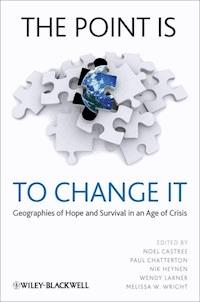
The Point Is To Change It E-Book
20,99 €
Mehr erfahren.
- Herausgeber: John Wiley & Sons
- Kategorie: Wissenschaft und neue Technologien
- Serie: Antipode Book Series
- Sprache: Englisch
Commissioned to celebrate the 40th year of Antipode: A Radical Journal of Geography, this book evaluates the role of the critical social scientist and how the point of their work is not simply to interpret the world but to change it
- Brings together leading critical social scientists to consider the major challenges of our time and what is to be done about them
- Applies diagnostic and normative reasoning to momentous issues including the global economic crisis, transnational environmental problems, record levels of malnourishment, never ending wars, and proliferating natural disasters
- Theoretically diverse - a range of perspectives are put to work ranging from Marxism and feminism to anarchism
- The chapters comprise advanced but accessible analyses of the present and future world order
Sie lesen das E-Book in den Legimi-Apps auf:
Seitenzahl: 779
Veröffentlichungsjahr: 2013
Ähnliche




















Contents
Cover
Half Title page
Title page
Copyright page
Introduction: The Point Is To Change It
Chapter 1: Now and Then
The 1970s Again
The Magna Carta Manifesto
Commodity Dialectics
Endnotes
References
Chapter 2: The Idea of Socialism: From 1968 to the Present-day Crisis
Introduction
The Left in 1968 and Today
The failures of twentieth-century socialism
What is to be undone?
Back to Basics
Responding to the present crisis
Acknowledgements
Endnotes
References
Chapter 3: The Revolutionary Imperative
A Bad Time for Revolution?
A Good Time for Revolution
Of New Deals and Stealth Neoliberalism
Acknowledgements
Endnote
References
Chapter 4: To Make Live or Let Die? Rural Dispossession and the Protection of Surplus Populations
Surplus Population
Rural Dispossession in Asia circa 2000
Biopolitical Assemblages and the Protection of Surplus Populations
The Politics of Entitlement
Conclusion
Acknowledgements
Endnotes
References
Chapter 5: Postneoliberalism and its Malcontents
Neoliberalism, R.I.P?
Looking over the Wall
Crisis, Theory
Beyond Neoliberalism
Acknowledgements
Endnotes
References
Chapter 6: D/developments after the Meltdown
Introduction
Periodizing Post-war D/developments
From Bretton Woods to the Dollar-Wall Street Regime
The Laboratory of Neoliberalism
Renovating Neoliberalism?
Some Challenges of the Conjuncture
Acknowledgements
Endnotes
References
Chapter 7: Is the Globalization Consensus Dead?
The Globalization Consensus
Questioning the Globalization Consensus
The Second Leg of Polanyi’s Double Movement?
Globalization and Upwards Income Redistribution
Conclusion
Endnotes
References
Chapter 8: The Uses of Neoliberalism
Basic Income
Food Aid and Cash Transfers
The Point is to Change It!
Endnotes
References
Chapter 9: Crisis, Continuity and Change: Neoliberalism, the Left and the Future of Capitalism
Introduction
The Making of a Double Whammy: Crises Perceived and Real
Theorising Crisis, Continuity and Systemic Change
From Theory to Reality: Neoliberalization, Social Formation and the Barriers to Change
The Future of Global Climate Change Governance: Why “Weak Markets” Will Persist
Conclusion
Acknowledgements
Endnotes
References
Chapter 10: Money Games: Currencies and Power in the Contemporary World Economy
Geographies of Power in the World Economy
Money and Power
Ways Forward?
Conclusion
Endnotes
References
Chapter 11: Pre-Black Futures
Future Risk and Surplus Life
What If? and When/Then Visions of the Future
Risky Schools: From a Nation at Risk, to No Child Left Behind
Risky Streets: From the Urban Underclass to Trespass Zoning
Conclusion
Endnotes
References
Chapter 12: The Shape of Capitalism to Come
Introduction
First Cut 1: Looking Back
First Cut 2: Looking Forward
Second Cut 1: The Politics of Global Competitiveness
Second Cut 2: Global Competitiveness and the Current Crisis
Second Cut 3: Embedding Competitiveness in Southeast Asia
Conclusion
Endnote
References
Chapter 13: Who Counts? Dilemmas of Justice in a Postwestphalian World
On Reflexivity as Meta-Political Critique: A Plea for the Concept of “Misframing”
On Discriminacy as Substantive Normative Critique: A Plea for the “All-Subjected Principle”
Conclusion
Endnotes
References
Chapter 14: The Communist Hypothesis and Revolutionary Capitalisms: Exploring the Idea of Communist Geographies for the Twenty-first Century
The Idea of Communism
The New Spirit of Capitalism: Capitalism’s Revolutions
What is Left to Think? Excavating the Future of the Communist Hypothesis, Mobilizing the Courage of the Intellect, and Trusting the Voluntarism of the Will
Acknowledgements
Endnotes
References
Chapter 15: An Economic Ethics for the Anthropocene
Learning to be Affected: An Ethical Practice of Co-transformation
Ethical Coordinates of Interdependence: Building Community Economies for the Anthropocene?
Emergent Hybrid Research Collectives in Rural and Outback Australia
Conclusion
Acknowledgments
Endnotes
References
Index
The Point Is To Change It
Antipode Book Series
General Editor: Noel Castree, Professor of Geography, University of Manchester, UK
Like its parent journal, the Antipode Book Series reflects distinctive new developments in radical geography. It publishes books in a variety of formats – from reference books to works of broad explication to titles that develop and extend the scholarly research base – but the commitment is always the same: to contribute to the praxis of a new and more just society.
Published
The Point Is To Change ItEdited by Noel Castree, Paul Chatterton, Nik Heynen, Wendy Larner, and Melissa W. Wright
Practising Public Scholarship: Experiences and Possibilities Beyond the AcademyEdited by Katharyne Mitchell
Grounding Globalization: Labour in the Age of InsecurityEdward Webster, Rob Lambert and Andries Bezuidenhout
Privatization: Property and the Remaking of Nature-Society RelationsEdited by Becky Mansfield
Decolonizing Development: Colonial Power and the MayaJoel Wainwright
Cities of WhitenessWendy S. Shaw
Neoliberalization: States, Networks, PeoplesEdited by Kim England and Kevin Ward
The Dirty Work of Neoliberalism: Cleaners in the Global EconomyEdited by Luis L. M. Aguiar and Andrew Herod
David Harvey: A Critical ReaderEdited by Noel Castree and Derek Gregory
Working the Spaces of Neoliberalism: Activism, Professionalisation and IncorporationEdited by Nina Laurie and Liz Bondi
Threads of Labour: Garment Industry Supply Chains from the Workers’ PerspectiveEdited by Angela Hale and Jane Wills
Life’s Work: Geographies of Social ReproductionEdited by Katharyne Mitchell, Sallie A. Marston and Cindi Katz
Redundant Masculinities? Employment Change and White Working Class YouthLinda McDowell
Spaces of NeoliberalismEdited by Neil Brenner and Nik Theodore
Space, Place and the New Labour InternationalismEdited by Peter Waterman and Jane Wills
Forthcoming
Space of Environmental JusticeEdited by Ryan Holifield, Michael Porter and Gordon Walker
Working Places: Property, Nature and the Political Possibilities of Community Land OwnershipFiona D. Mackenzie
This edition first published 2010 Chapters © 2010 the Authors Book Compilation © 2010 Editorial Board of Antipode and Blackwell Publishing Ltd First published as volume 41, supplement 1 of Antipode
Blackwell Publishing was acquired by John Wiley & Sons in February 2007. Blackwell’s publishing program has been merged with Wiley’s global Scientific. Technical, and Medical business to form Wiley-Blackwell.
Registered Office
John Wiley & Sons Ltd, The Atrium, Southern Gate, Chichester, West Sussex, PO19 8SQ, United Kingdom
Editorial Offices
350 Main Street, Maiden, MA 02148-5020, USA 9600 Garsington Road, Oxford, OX4 2DQ, UK The Atrium, Southern Gate, Chichester. West Sussex. PO19 8SQ, UK
For details of our global editorial offices, for customer services, and for information about how to apply for permission to reuse the copyright material in this book please see our website at www.wiley.com/wiley-blackwell.
The right of Noel Castree, Paul Chatterton, Nik Heynen, Wendy Larner and Melissa W. Wright to be identified as the authors of the editorial material in this work has been asserted in accordance with the Copyright, Designs and Patents Act 1988.
All rights reserved. No part of this publication may be reproduced, stored in a retrieval system, or transmitted, in any form or by any means, electronic, mechanical, photocopying, recording or otherwise, except as permitted by the UK Copyright, Designs and Patents Act 1988, without the prior permission of the publisher.
Wiley also publishes its books in a variety of electronic formats. Some content that appears in print may not be available in electronic books.
Designations used by companies to distinguish their products are often claimed as trademarks. All brand names and product names used in this book are trade names, service marks, trademarks or registered trademarks of their respective owners. The publisher is not associated with any product or vendor mentioned in this book. This publication is designed to provide accurate and authoritative information in regard to the subject matter covered. It is sold on the understanding that the publisher is not engaged in rendering professional services. If professional advice or other expert assistance is required, the services of a competent professional should be sought.
Library of Congress Cataloging-in-Publication Data
The point is to change it : geographies of hope and survival in an age of crisis/edited by Noel Castree … [et al.]. p. cm. – (Antipode book series) Includes index. “First published as volume 41, supplement 1 of Antipode.” ISBN 978-1-4051-9834-9 (pbk. : alk. paper) 1. Geography. I. Castree, Noel, 1968-G62.P65 2009 320.01’1-dc22
2010002766
Library of Congress Cataloging-in-Publication data is available for this book
A catalogue record for this book is available from the British Library.
Introduction: The Point Is To Change It
Noel Castree
School of Environment and Development, University of Manchester, UK
Paul Chatterton
School of Geography, University of Leeds, UK
Nik Heynen
Department of Geography, University of Georgia, USA
Wendy Larner
School of Geographical Sciences, University of Bristol. UK
Melissa W. Wright
Department of Geography, Pennsylvania State University. USA; [email protected]
The title we have chosen for this book, borrowed from one of Marx’s most famous injunctions, is an invitation to think and a provocation to act. We’re in the midst of some exceptionally challenging, complex and momentous changes to the global economy, polity, society and ecology. Disease, starvation, malnutrition, hunger, poverty, torture, unlawful imprisonment, poverty, marginalization, racial discrimination, cultural chauvinism, ethnic prejudice, gender inequality, religious intolerance, sexual discrimination, and environmental destruction are all signature features of the early twenty-first century. Democracy, in its various imperfect actually existing forms, is something that only a small minority of the world’s people enjoy. Material wealth exists in abundance, but is commanded disproportionately by an elite of financiers, land developers, property tycoons, commodity traders, corrupt politicians and owners of various transnational corporations. “Uneven development” is, today, extreme in both social and geographical terms. Equality of opportunity (never mind outcome) is still an idealist’s dream in most of the twenty-first century world. Militarism is also writ-large: the legal and illegal trade in weaponry helps to sustain the economies of supply countries and underpins seemingly endless conflagrations in the global South. Geopolitical tensions bubble under the surface where they are not already made manifest. Virtually all of the world’s problems have an international dimension to them, yet cross-governmental efforts to enact joined-up policy—such as the Kyoto protocol—are routinely foiled or attenuated. On top of this, the new powerhouses of capitalism—such as China and India—seem to be following a Western road to development, with all this implies for the world’s ecology. And we haven’t even mentioned the effects of the recent world financial crisis. But like any crisis moment, the late noughties are also a crossroads, a crucial interregnum of immense opportunity and new possibilities.
The essays in this volume have been commissioned to mark the 40th birthday of Antipode: A Radical Journal of Geography. The journal was founded during an extraordinary period in modern history, one in which hopes for progressive change were exceedingly high. Four decades on, and Leftists have an awful lot to contemplate. We think this is especially true for those of us who work with ideas and books, abstractions and words, among the sundry tools of the academic trade as we are faced with the task of using them to engage with the world in progressive ways. Plying the tools of our trade to reveal more effectively the multiple relations of power along with bolstering efforts for thwarting these relations continues to be an urgent challenge confronting academic leftists. It is the challenge that Antipode has embraced since its founding in 1969 as its many contributors endeavor to generate knowledge and pedagogy that sustain resistance to all manner of injustice and exploitation in a world in which the best ways to do so are not patently clear.
Engaging with this challenge is the de facto obligation of any journal that proudly claims the word “radical” in its masthead. Linguistically, the term originates from the Latin word, radix, meaning “root” that links the term to the idea of foundational truth, as is commonly used in mathematics, chemistry and also in politics, as radicals seek to expose political truths and not shy away from the consequences of doing so. Political truths in this meaning of the term “radical” are twinned always with subversion. As Rosa Luxemburg notably opined: “The most revolutionary thing one can do always is to proclaim loudly what is happening.” Or as Gloria Steinem quipped: “The truth will set you free, but first it will piss you off.” Whether advocating for political rights under fascism or for a woman’s right to control her own body within limited democracies, the point is not only to expose the many truths concerning how power corrupts all manner of social relationships. The point of radical leftist academic work, as Karl Marx famously announced, is also to conjoin revelation with revolution, not necessarily of the violent variant, but in its most basic sense of turning power around, however and whenever it corrodes the bonds of justice and humanity. As Antonio Conti, the Italian autonomous Marxist, said: “The goal of research is not the interpretation of the world, but the organization of transformation.” We are in this game to change things, directly or otherwise.
As a journal of radical geography, Antipode was founded with this point in mind. When it was the birth-child of a handful of Left-wing academics and graduate students at Clark University in 1969, the journal was the only one of its kind within the field of human geography, and not only because it was produced on a shoestring and eschewed the conventions of normal “academic” writing. It was the only geography journal that called itself “radical” at a time when universities were expunging faculty and expelling students so-labelled. By calling some four dozen pages “a journal”, the founders of Antipode created an outlet for the publishing of work that was unapologetically critical of the status quo and dedicated to ideals of social justice. And with this opening, the journal joined an incipient list of others across a variety of fields to turn the topics and approaches within its pages into legitimate academic concerns. Over the last four decades, Antipode has played an important role within and beyond geography in making capitalist exploitation, social justice, radical movements, gender inequality and other such topics into staple intellectual themes. But as Antipode’s contributors to this volume agree, now is not the time to settle into some middle-aged complacency. Around the world there is clearly a desperate need for progressive scholars and activists to challenge the notion that “business as usual” is not acceptable—and that we are willing to work as hard as we can, and in concert with others, to change things for the better.
Addressing this challenge is what we had in mind when we invited some 14 contributors (as we said in our letter to them) “to offer informative, illuminating and sophisticated analyses of ‘the state of the world’ in the early twenty-first century and how it might be changed for the better”. In response, we have received a collection of essays that seek to align commitments to social and environmental justice to political strategies for addressing complex political realities and our roles as radicals within the academy. This volume is topically and intellectually diverse, reflecting the microcosm of the broad Left comprised by our authors. The contributors speak to multiple concerns and use diverse examples to illustrate their assessments. And yet, they all converge around a common desire to unravel the meanings of power, inequality, injustice and progressive politics in the current period. While we do not want to impose an artificial interpretation that finds common ground across a wide-ranging set of essays, there is a coherent call within this volume for refining of conceptual tools that can be better used as instruments of political change in specific places and in response to specific issues in the world today. The essays are not oriented toward polemics or for theorizing for its own sake. They, rather, seek to hone and craft ideas into implements of progressive change.
Toward this end, the authors address the following sets of questions: How do our conceptions of justice contribute to social justice activism in diverse parts of the world? How do our analyses of social and economic crises assist those who are struggling against mean-spirited processes of neoliberalization, the ravages of privatization and the biopolitics of international development? How can we apply our analytical insights in ways that are accessible beyond our narrow disciplines and specialties and that address the devastation of racism and xenophobia? How can we on the left continue to be effective as we do our jobs in institutions that are conservative and corporate? How can we make the principal medium of our craft—the written and spoken word—more accessible to international publics that do not have access to our publications or to the languages of our medium and to less educated populations who are eager to engage our radical theory? How can we reach the youth of today who read less and communicate through Twitter and Facebook? How can we be relevant from our places of privilege to the people whose outrage, suffering and political commitments provide the material of our conjoined political and academic interests?
In raising such questions, the authors brought together in this collection are agreed on the continued need for radical scholarship. Less clear, however, is the form radical scholarship should take in the current period. Whereas 40 years ago when Antipode was founded there may have been a broad consensus that variants of Marxism offered the best intellectual platform on which challenges to injustice and exploitation should be based, this is no longer the case. While Marx, Polanyi and Gramsci remain key theorists for many of our authors, we also see clearly in these contributions how the challenges of, and ongoing encounters with, feminist, postcolonial, “green” and poststructural theorizing have indelibly reshaped the contours of radical scholarship. Even those who remain committed to a Left theoretical orthodoxy no longer take for granted the centrality of the industrial worker as the potential revolutionary subject, the economism of some Marxian frameworks, or the nation-state as the container within which capitalism operates. In addition to a more internationalist stance, there is also a new emphasis on plurality, contingency and a richer sense of the validity of multiple political sensibilities. Indeed, overall there is a notable reluctance to be overly prescriptive about the forms that left alternatives should or could take in the current period.
Then there are those who aspire to even broader conceptualizations of radical politics. Foucault, Negri, Latour, Plumwood, Said, Nancy, Ranciere, Agamben and Haraway, among others, are also part of the conceptual repertoire on which our contributors draw to the effort to understand and address the challenges of the present. Such accounts are attempting to develop new ways of thinking about politics that are genuinely progressive, but move away from the revolutionary ideals and Utopian desires that have tended to characterize leftist accounts. This often takes the form of more specific and situated approaches, in which already existing politics and practices are reframed and interrogated for their transformative potential. Whereas economies, states and markets tend to feature as the dominant categories in more conventional leftist political-economic analyses, spatialized, gendered and racialized bodies become more visible in these alternative accounts, as do geographically specific processes and practices of imagination and assembly, and the micro-politics of emotion, affect and ethics. There is also a politics of prefiguration flagged-up here (“be the change you want to see” as Ghandi said), which aims to build achievable future aspirations in the present through an accumulation of small changes. It is about embracing “power together” rather than power over.
There is, of course, a variety of views herein about the analytical and political utility of these diverse theoretical positions, and also of the actual and potential relationships between them. We would not wish it to be otherwise. However, what we do want to do is foster the linking of these critical analyses to contemporary political struggles, understanding that these struggles encompass, among others, issues such as finance, poverty, environment, indigeneity, enclosure, work, education and citizenship. None of these struggles are new foci in broader political ambitions to further economic and social justice. However, in the present political-economic conjuncture they may appear to be taking on new characteristics both because the world itself has changed—in both epochal and quotidian ways—but also because we are coming to understand this changing world in new ways.
Radical scholars have taken many cues from the emergence of anti-globalization activism often inflected with a strong anti-capitalist sentiment. The term “movement of movements” is often used to describe this latter turn, a vibrant hydra-like disorganization with no clear centre, defined through the idea of “one no, many yeses”, and which has networked groups across the world and mobilized large international days of action. The spaces opened up by this new anti-capitalist internationalism are fraught with tensions, disagreements and conflict, often reflecting the well worn divisions on the Left between majoritarian and minoritarian politics—or the horizontals and the verticals. Part of this is because it represents a clear tension and desire for a break with traditional models of Left political organizing, a rejection of ideological dogma in favour of fluid, creative and more shifting political affiliations. Well-worn routes to political change—central committees, organized marches and the ballot box—are rejected or questioned, and a much more complex definition of the enemy, political programmes and relations to state power are embraced. In the writings and actions of leftist scholars, there is a recognition that taking on capitalism is far from a simple process. Social change is usually not well organized, coherent and easily defined—and nor should it be. We are simultaneously in, against and beyond capitalism.
The contribution of this collection is not simply “academic”. Indeed, our initial intention was that these essays not be overly introspective, and certainly not simply exercises in rehearsing philosophical, theoretical, methodological or evidential debates. We asked the authors for pieces that offer informative, illuminating and sophisticated analyses of “The state of the world” in the early twenty-first century and how it might be changed for the better. We encouraged them to use concepts and evidence unselfconsciously and imagine a readership keen to know about the why and wherefore of twenty-first century power, inequality, injustice and progressive politics in all their complexity. In all cases, we sought essays which can both offer diagnosis and say something about political strategy and tactics looking into the future. We were not seeking polemics but, rather, well argued and evidenced assessments of our current conjuncture and the short-to-medium-term future.
Each of the authors asks us to think about changing the world in provocative and instructive ways. We open with Michael Watts, who recalls the context in which this journal was born and the aspirations of its founders. At the moment of Antipode’s inception, he reminds us that there was never a single understanding of the term “radical”, and that the tensions between liberalism, social democracy and socialism were always apparent within even its early pages. What can we take from this account as we consider the political possibilities of the current conjuncture? For Watts there is no going back to the political certitudes and orthodoxies of the 1970s; however, he concludes that a key reference point for the contemporary Left continues to be a critical stance towards capital. This is a reference point shared by all our contributors, even as they differ as to how this critical stance might be made manifest.
Hugo Radice is concerned to recuperate the tenets of socialism for the present, arguing for an “authentic and popular socialism” that reckons with the failures of the actually existing socialisms of the last century. He stresses the need for an internationalist vision of social justice based on radical egalitarianism, which begins in day-to-day workplace interactions. Concerns about the quality of work, the need for a new internationalism of labour, and calls for workplace democracy might allow the building of a new socialist commonsense that might realize the radical potential he saw in the events of 1968. Neil Smith has an even grander vision. He argues that we have lost the political imagination (and perhaps the intellectual ambition?) to think outside of capitalism. One consequence of this is that, until recently, revolutionary change was no longer seen as viable. Today, however, in the context of an apparent global economic crisis, social change and political transformation have once again become possible. This crisis, he emphasizes, is fundamentally a crisis of capitalism. Returning to Marx, he argues that just as feudalism was eventually replaced by capitalism so too might we be finally witnessing the difficult birth pangs of a new way of organizing social life.
Tania Murray Li is agreed that we should re-read Marx, but for her it is his analysis of spatial and temporal unevenness that gives us insight into the current conjuncture. In her analysis of rural dispossession, she’s concerned to show how both capitalist development strategies and biopolitical programmes need to be examined in their historical and spatial specificity. Unlike Smith, however, she’s not convinced there is a capitalist master-plan but rather regards political economy as “assemblages pulled together by one set of social forces, only to fragment and reassemble”. Consequently, she seeks the advancement of social justice in specific sites and conjunctures that are only very occasionally revolutionary.
Jamie Peck, Nik Theodore and Neil Brenner are also concerned with uneven spatial development, but in the context of a discussion about the analytical and political status of neoliberalism and postneoliberalism. While using the financial crash of 2008 to ponder what a postneoliberal order might entail, Peck, Theodore and Brenner are quick to urge us that progressive postneoliberal projects need to think deeply about the entrenched forms and processes that led to neoliberalism in the first place. Their astute political economic analysis offers much by way of insights regarding the next steps toward toppling these hegemonic forms. Just as Gillian Hart emphasizes the difference between “Development” as a postwar international project, and development as a creative project of creation and destruction, so too do Peck and his co-authors highlight the distinction between Neoliberalism as a fully formed political agenda, and neoliberalization as a polymorphous, relational, process that involves ongoing reconstructions and reorientations.
Robert Wade underlines this point in his discussion of the resilience of the globalization consensus, showing that even though much of the evidence mobilized to justify the deregulated market model is surprisingly weak, this may not lead to a decline in the dominance of finance capital. He emphasizes the importance of the politics of the policy-making process in determining the future of dominant economic narratives. Similarly James Ferguson makes an analytical distinction between the ideological project of neoliberalism and the politics of social policy and anti-poverty initiatives. Provocatively, he suggests that while certain political initiatives and programmes may appear to be aligned with the ideological project, they can also be used for quite different purposes than the term usually implies. Using the examples of Basic Income Grants and Food Aid and Cash Transfers, he shows how these might create situations in which markets play a redistributive role. Importantly, he stresses that this focus on the mundane real world debates around policy and politics is not simply to engage in reformist strategies, but rather illustrates that the need to develop new progressive arts of governing.
The next four essays focus on the so-called “neoliberal heartlands”. Noel Castree focuses on the coincidence of economic and environmental crises, and is interested in the possibility of post-neoliberal futures. Taking the case of the UK’s domestic politics and European Union emissions trading scheme, he’s concerned to identify the barriers to creating a new political-economic and social order. He argues that the legacies of neoliberalism are such that while progressive ideas abound the conditions to make them flesh are currently absent—even in a moment of apparent “crisis”. John Agnew and Katharyne Mitchell highlight distinctive features of the US financial and racial economy respectively. Agnew is also focused on the so-called global financial implosion of 2008, arguing it signals the decline of US-led Anglo-American model of global capitalism. He speculates about the emergence of new currency regimes, arguing that the world economy created and enforced by the USA is no longer sustainable. Mitchell is concerned with processes of racialization and new modalities of surveillance that—not for the first time—belie the classic American ideals of personal liberty and freedom.
Juxtaposed, Agnew and Mitchell’s essays depict an America whose slow decline on the global stage is accompanied by intensified domestic control and repression. Paul Cammack echoes Agnew, but with a twist. His account of institutions of global economic governance post-Bretton Woods suggests that mainstream and radical commentators alike have over-emphasized US dominance. Cammack shows that new hegemons and blocs have been in-the-making for some time, emerging under the aegis of globalizing capital and a transnational capitalist class.
Our last group of contributors emphasize the new cartographies of justice, conceptions of political agency, processes of subjectification, and solidarity demanded by contemporary political economies and ecologies. Nancy Fraser focuses on what a post-Westphalian notion of community and justice should look like. As she says:
a viable approach must valorize expanded contestation concerning the ‘who’, which makes thinkable, and criticizable, transborder injustices obscured by the Westphalian picture of political space. One the other hand, one must grapple as well with the exacerbated difficulty of resolving disputes in which contestants hold conflicting views of who counts. What sort of justice theorizing can simultaneously meet both of those desiderata?
Her essay provides an extended answer to this critical question.
Erik Swyngedouw emphasizes how the financialization of both nature and affect are giving rise to new forms of capitalism that in turn demand that we rethink the meaning of communism. Rather than being a claim taking the form of demands for self-management and self-government that would eliminate the need for the state, he calls for a reinvention of the communist hypothesis based on “equal, free and self-organizing being-in-common”. In this context we have deliberately given J.-K. Gibson-Graham and Gerda Roelvink the last word. Theirs is the most profound political challenge offered by the assembled authors in that they move even further away from the human-centred conceptions of human agency found in the other essays in the book and explicitly argue for a new economic ethics appropriate to a world in which the being-in-common of both humans and more-than-humans is recognized. While the language of their contribution draws from Marxism, the hybrid research collectives they call for demand radically new conceptions of political agency that proliferate actions and identities that may give rise to as yet barely visible progressive futures.
We believe that this volume is a fitting way to mark Antipode’s 40th year in existence. Perhaps in another four decades there will be no need for a “radical” journal in geography or any other field—but we doubt it.
Chapter 1
Now and Then1
Michael J. Watts
Class of 63 Professor of Geography and Development Studies, University of California, Berkeley. CA, USA; [email protected]
Abstract:Antipode was launched into the firmament of the 1970s. We might reflect upon how well the journal and its contributors fully appreciated the historical gravity and weight of what was surrounding the project to create “a radical journal of geography”. What sort of radicalism was on offer? The language was “social relevance” from “a radical (Left) political viewpoint”. In writing to celebrate Antipode’s birthday, this time in another, and similar, firmament there is still the need to confront the challenge of radicalism and its meanings. Whether we agree with Perry Anderson that the last vestiges of the 1960s have been finally swept away, that the “fluent vision” of the Right has no equivalent on the Left and that embedded liberalism is now as remote as “Arian bishops”, where do radical alternatives stand in relation to the fractured hegemony of neoliberalism? At the very least the need for alternatives is more pressing than ever. David Harvey has proposed rethinking the idea of “the right to the city”. But what other rights might we rethink? I reflect upon this question by returning to the 1960s and 1970s and Marxist debates over the law, and by thinking about the possibilities offered by this Polanyian moment.
Kew Words: radicalism, commons, law, Magna Carta, markets
One does not easily isolate ideas for study out of that mass of facts, lore, musings, speculations which we call the thought of an age or of a cultural tradition; one literal tears and wrenches them out. There is nothing disembodied about them, and the cut is not clean … Large bodies of thought thus appear, at first, like distant riders stirring up modest dust clouds, who, when they arrive, reproach one for his slowness in recognizing their numbers, strength and vitality (Clarence Glacken 1967:12).
Antipode was launched into the firmament of the 1970s: an imperialist war in southeast Asia, a troubled American Fordism feeling the pressures of global competition, class struggles over the future of embedded liberalism, the Nixon dollar devaluation and the turn to global financialization, massive volatility in commodity markets especially food and oil, a robust Third World nationalism ultimately hobbled by balance of payments deficits, massive public sector debt and Cold War “low-intensity conflict” and proxy wars, the popular energies unleashed by the environmental movement, and not least, the first stirrings of what was to become, to quote Perry Anderson (2000), the global neoliberal “grand slam”. Antipode came on the heels of the 1960s, and of the genuinely revolutionary moment of 1968, and was tempered by a decade in which some theoretical and political flesh was placed onto the bones of the social and cultural libertarianism that passed as the radicalism of the soixtante-huitards. The 1970s, in this sense, launched a ferocious debate within the Left and among Marxisms of various stripes, it gave birth to a number of vital political experiments, not the least of which were various Third World socialisms, and commenced, partly as a result of the failures of ‘68, what Antonio Gramsci called the “long march through the institutions”. From the perch of the present, there have been some remarkable personal trajectories through this period and beyond—one thinks of Joschka Fischer, Bernard Kouchner, Daniel Ortega—and they are not always salutary. A country which loses its hippies is, says Israeli playwright Salman Tamer (cited in Mamet 2009:12), in deep trouble. But I digress.
Lesen Sie weiter in der vollständigen Ausgabe!
Lesen Sie weiter in der vollständigen Ausgabe!
Lesen Sie weiter in der vollständigen Ausgabe!
Lesen Sie weiter in der vollständigen Ausgabe!
Lesen Sie weiter in der vollständigen Ausgabe!
Lesen Sie weiter in der vollständigen Ausgabe!
Lesen Sie weiter in der vollständigen Ausgabe!
Lesen Sie weiter in der vollständigen Ausgabe!
Lesen Sie weiter in der vollständigen Ausgabe!
Lesen Sie weiter in der vollständigen Ausgabe!
Lesen Sie weiter in der vollständigen Ausgabe!
Lesen Sie weiter in der vollständigen Ausgabe!
Lesen Sie weiter in der vollständigen Ausgabe!
Lesen Sie weiter in der vollständigen Ausgabe!
Lesen Sie weiter in der vollständigen Ausgabe!




