


The Pursuit of Philosophy E-Book
21,99 €
Mehr erfahren.
- Herausgeber: John Wiley & Sons
- Kategorie: Geisteswissenschaft
- Serie: Metaphilosophy
- Sprache: Englisch
Eleven Cambridge academics approach philosophy from various fields, to broaden its practical and theoretical applications.
- Guides a tour through various academic departments—including history, political science, classics, law, and English—to ferret out the philosophy in their syllabi, and to show philosophy's symbiotic relationship with other fields
- Provides a map of what philosophy is considered to be at Cambridge in the early twenty-first century, about a hundred years after the "founding fathers" of analytic philosophy reigned at Cambridge
- Offers useful new directions for the study and application of philosophy, and how other fields can influence them
Sie lesen das E-Book in den Legimi-Apps auf:
Seitenzahl: 379
Veröffentlichungsjahr: 2012
Ähnliche




















Table of Contents
COVER
METAPHILOSOPHY
TITLE PAGE
COPYRIGHT PAGE
NOTES ON CONTRIBUTORS
INTRODUCTION: PHILOSOPHY, ITS PITFALLS, SOME RESCUE PLANS, AND THEIR COMPLICATIONS
Philosophy in Non-Philosophy Departments
Definitions and Wittgensteinean Themes
Tradition and Philosophy’s Pitfalls
Science, Poetry, Real Politics, and History: Antidotes to Scholasticism, and Their Side Effects
Institutional Structures and the Road Not Taken
Acknowledgments
1 PHILOSOPHY, LOGIC, SCIENCE, HISTORY
Philosophy
Logic
Science
History
Acknowledgments
2 PHILOSOPHY AND ITS PITFALLS
Introduction
Philosophy
Pitfalls, and What Is Needed to Avoid Them
Institutional History at Cambridge
Cambridge Philosophy
3 A SURFEIT OF NATURALISM
Contemporary Naturalism
The Virtues of Naturalism
Naturalistic Excess: The Pessimistic Induction
Naturalistic Excess: Causation
Naturalistic Excess: “Preaching to Scientists”
Naturalistic Excess: Experimental Philosophy
Eclectic Naturalism
4 WHAT IS REALISTIC POLITICAL PHILOSOPHY?
5 BEDLAM OR PARNASSUS: THE VERSE IDEA
6 PHILOSOPHY, EARLY MODERN INTELLECTUAL HISTORY, AND THE HISTORY OF PHILOSOPHY
7 GOALS, ORIGINS, DISCIPLINES
Acknowledgments
8 FALLING IN AND OUT OF LOVE WITH PHILOSOPHY
9 FORMS OF REFLECTION, IMAGINATION, AND THE LOVE OF WISDOM
Against the Thracian Maid
Know Thyself!
Philosophy and History
The Glass of Reflection
Symbolism and Transcendence
10 WHAT IS LEGAL PHILOSOPHY?
Theoretical-Explanatory Enquiries
Moral Enquiries
Brief Concluding Remarks
Acknowledgments
11 THE CAMBRIDGE REVOLT AGAINST IDEALISM: WAS THERE EVER AN EDEN?
Genesis
Logical Constants
Converse Relations
Acknowledgments
INDEX
METAPHILOSOPHYSERIES IN PHILOSOPHY
Series Editors: Armen T. Marsoobian and Eric Cavallero
This edition first published 2012
Chapters © 2012 The Authors except for “Goals, Origins, Disciplines” © 2009 Raymond Geuss
Book compilation © 2012 Blackwell Publishing Ltd and Metaphilosophy LLC
First published as Metaphilosophy volume 43, nos. 1–2 (January 2012), except for “Goals, Origins, Disciplines,” by Raymond Geuss, first published in Arion: A Journal of Humanities and the Classics, third series, volume 17, no. 2 (Fall 2009): 1–24
Blackwell Publishing was acquired by John Wiley & Sons in February 2007. Blackwell’s publishing program has been merged with Wiley’s global Scientific, Technical, and Medical business to form Wiley-Blackwell.
Registered Office
John Wiley & Sons Ltd, The Atrium, Southern Gate, Chichester, West Sussex, PO19 8SQ, United Kingdom
Editorial Offices
350 Main Street, Malden, MA 02148-5020, USA
9600 Garsington Road, Oxford, OX4 2DQ, UK
The Atrium, Southern Gate, Chichester, West Sussex, PO19 8SQ, UK
For details of our global editorial offices, for customer services, and for information about how to apply for permission to reuse the copyright material in this book please see our website at www.wiley.com/wiley-blackwell.
The right of Alexis Papazoglou to be identified as the author of the editorial material in this work has been asserted in accordance with the UK Copyright, Designs and Patents Act 1988.
All rights reserved. No part of this publication may be reproduced, stored in a retrieval system, or transmitted, in any form or by any means, electronic, mechanical, photocopying, recording or otherwise, except as permitted by the UK Copyright, Designs and Patents Act 1988, without the prior permission of the publisher.
Wiley also publishes its books in a variety of electronic formats. Some content that appears in print may not be available in electronic books.
Designations used by companies to distinguish their products are often claimed as trademarks. All brand names and product names used in this book are trade names, service marks, trademarks or registered trademarks of their respective owners. The publisher is not associated with any product or vendor mentioned in this book. This publication is designed to provide accurate and authoritative information in regard to the subject matter covered. It is sold on the understanding that the publisher is not engaged in rendering professional services. If professional advice or other expert assistance is required, the services of a competent professional should be sought.
Library of Congress Cataloging-in-Publication Data
The pursuit of philosophy: some Cambridge perspectives / edited by Alexis Papazoglou.
p. cm.
Includes bibliographical references and index.
ISBN 978-1-118-29518-2 (pbk.)
1. Philosophy, British–20th century. 2. Philosophy, English–20th century. 3. University of Cambridge. Faculty of Philosophy. 4. Philosophy–Study and teaching (Higher)–England–Cambridge. I. Papazoglou, Alexis.
B1561.P87 2012
192–dc232012017697
A catalogue record for this book is available from the British Library.
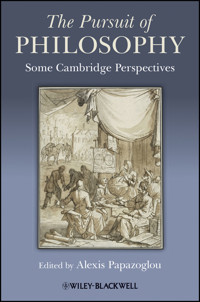
Cover image: A Group of Philosophers, drawing by Jan van Luyken (1649–1712). © The Fitzwilliam Museum, Cambridge.
Cover design by Design Deluxe
NOTES ON CONTRIBUTORS
Tim Crane is Knightbridge Professor of Philosophy at the University of Cambridge. He works on the philosophy of mind and psychology, and on metaphysics. He is the author of The Mechanical Mind (1995) and Elements of Mind (2001), and the editor of The Contents of Experience (1992) and History of the Mind-Body Problem (2000). He is currently working on a book about the representation of the non-existent.
Michael Edwards is Gurnee Hart Fellow and College Lecturer in History at Jesus College, Cambridge. He received a Ph.D. in intellectual history from Cambridge in 2006, and his research interests are in early modern intellectual history and the history of science—specifically, the relationship between the late scholastic and Aristotelian traditions and the “new philosophy” of the seventeenth century. He has published several articles on early modern natural philosophy, metaphysics, and psychology.
John Forrester is Professor of History and Philosophy of the Sciences at the University of Cambridge, author of Language and the Origins of Psychoanalysis (1980), The Seductions of Psychoanalysis (1990) (with Lisa Appignanesi), Freud’s Women (1992), Dispatches from the Freud Wars (1997), and Truth Games (1997). He is completing (with Laura Cameron) Freud in Cambridge, a study of the reception of psychoanalysis in the 1920s. He is interested in reasoning in cases in science, medicine, and law.
Raymond Geuss was born in Evansville, Indiana (USA), in 1946 and studied in the United States and West Germany. He took a Ph.D. in philosophy in 1971, and since his immigration to the United Kingdom in 1993 has taught at the University of Cambridge. His monographs include The Idea of a Critical Theory (1981), History and Illusion in Politics (2001), Public Goods, Private Goods (2001), and Philosophy and Real Politics (2008).
Jane Heal is Professor of Philosophy at the University of Cambridge and Fellow at St. John’s College, Cambridge; she previously taught at Newcastle upon Tyne. She took her Ph.D. at Cambridge and did postdoctoral study at Princeton and Berkeley. Her main areas of interest are philosophy of language and philosophy of mind, and her publications include Fact and Meaning: Quine and Wittgenstein on Philosophy of Language (Blackwell, 1989) and Mind, Reason and Imagination: Selected Essays in Philosophy of Mind and Language (Cambridge, 2003).
Douglas Hedley is Fellow at Clare College and Reader in hermeneutics and metaphysics in the Faculty of Divinity at the University of Cambridge. He has been a visiting professor at the Sorbonne in Paris and has lectured in India and China. He is the author of a trilogy on the religious imagination: Living Forms of the Imagination (Continuum, 2008), Sacrifice Imagined: Violence, Atonement and the Sacred (Continuum, 2011), and The Iconic Imagination (forthcoming).
Simon Jarvis is Gorley Putt Professor of Poetry and Poetics in the Faculty of English at the University of Cambridge. He is the author of Wordsworth’s Philosophic Song (2007) and of Dionysus Crucified: Choral Lyric for Two Soloists and Messenger (2011).
Matthew H. Kramer is Professor of Legal and Political Philosophy at the University of Cambridge, Fellow at Churchill College, Cambridge, and Director of the Cambridge Forum for Legal and Political Philosophy. His thirteen books and four co-edited books range over many areas of political, moral, and legal philosophy. The most recent of his books is The Ethics of Capital Punishment (Oxford, 2011).
Tim Lewens is Reader in Philosophy of the Sciences at the University of Cambridge, where he is also Fellow at Clare College. His research is in the philosophy of biology, the philosophy of science, and philosophical bioethics. He is the author of Organisms and Artifacts: Design in Nature and Elsewhere (MIT Press, 2004) and Darwin (Routledge, 2007).
Fraser MacBride is Lecturer in Philosophy at the University of Cambridge and Fellow at Trinity Hall, Cambridge. He was previously Reader in the Department of Logic and Metaphysics at the University of St. Andrews and in the School of Philosophy at Birkbeck College London. He has published on the history of analytic philosophy, metaphysics, and the philosophy of mathematics. He is currently completing a book on the origins of analytic metaphysics, On the Genealogy of Universals: 1899–1925.
Alexis Papazoglou is a Ph.D. candidate in philosophy at the University of Cambridge and has been a visiting graduate student in the Department of Philosophy at the University of Chicago. His doctoral thesis explores the relationship between reason and nature in Hegel’s philosophy, against the background of John McDowell’s Mind and World and contemporary naturalism.
David Runciman is Reader in Political Thought at the University of Cambridge and Staff Fellow in Politics at Trinity Hall, Cambridge. He is currently a Leverhulme Major Research Fellow (2009–2012) working on the history of democracy and crisis. He is the author of a number of books, including The Politics of Good Intentions and Political Hypocrisy (both Princeton University Press). He writes regularly about politics for the London Review of Books.
INTRODUCTION: PHILOSOPHY, ITS PITFALLS, SOME RESCUE PLANS, AND THEIR COMPLICATIONS
ALEXIS PAPAZOGLOU
Philosophy in Non-Philosophy Departments
The summer before I was about to begin my Ph.D. in the Faculty of Philosophy at Cambridge, I became interested in the presence of philosophy in faculties other than the homonymous one at the University of Cambridge. Did philosophy matter outside the Faculty of Philosophy? If so, what form did it take? Having been an undergraduate there I already knew that at Cambridge ancient Greek philosophy was studied primarily in the Faculty of Classics and that philosophy of science took place under the umbrella of the Department of History and Philosophy of Science (HPS). I was surprised, however, to find at least eight departments and faculties besides the Faculty of Philosophy that included philosophers or people whose work involved the close study of philosophy: HPS, Classics, History, Divinity, Political Science, Modern and Medieval Languages, Law, and English.1 In fact it became apparent that there were at least as many, if not more, academics involved in the study of philosophy outside the Faculty of Philosophy as there were in it. I was so intrigued by this discovery that I wanted to organise an event where all these philosophers would be brought together. But what would they discuss, given their quite different backgrounds and interests? What could function as the common ground they all shared? Well, philosophy! So the theme of the meeting came to life: How did these people, from nine different faculties and departments in the same university, think of philosophy? The primary aims of the conference were:
The main question that speakers were asked to respond to was “What is your conception of philosophy?” The speakers were also given a list of “guiding” questions that they could address while answering that question. They included:
Definitions and Wittgensteinean Themes
The idea was to ask questions that were relevant to all of the participants, but also questions that could have radically different answers, perhaps depending on which department one came from. The aim was also to see whether there was anything identifiable as “Cambridge philosophy” at the beginning of the twenty-first century. Around a hundred years ago the movement that was to become analytic philosophy was beginning to emerge, and there was a distinguishable tendency regarding which philosophical questions should be asked and how one should go about answering them.2 It would be interesting to see whether there was any such identifiable trend in Cambridge today, say at least one sentence that all could agree on regarding what philosophy is (or what it should be).
It quickly became clear, however, that agreeing on definitions was not going to be the order of the day. Even Wilfrid Sellars’s broadest possible definition, “The aim of philosophy, abstractly formulated, is to understand how things in the broadest possible sense of the term hang together in the broadest possible sense of the term” (Sellars 2007, 37), was not something all cared for. Tim Crane, for example, pointed out that Sellars’s definition, even though the most plausible, is at the same time too broad. Jane Heal, on the other hand, offered a different possible definition, closer to the etymology of the word “philosophy” and its origins in ancient Greek thought. As she puts it in Chapter 2, “Philosophy and Its Pitfalls,” “There is (or may be) such a thing as being wise. Being wise is a matter of having a good (or the right, or some admirable) stance to the world, such that one apprehends, feels, acts in ways that are good (or right, or somehow admirable)”; what is more, Heal adds, philosophy is the activity of the discursive pursuit of this right stance towards the world. This disagreement was not necessarily a surprise; when philosophers give definitions of philosophy they are not usually offering descriptive definitions, definitions of a cultural practice that a sociologist or anthropologist might have given. When philosophers give definitions of what philosophy is, they usually give normative definitions, that is, they put forward statements about what philosophy should be, what it should be aiming at, how it should be aiming at it, and so on, and as we know, answers to normative questions are the most controversial kind. It is not clear, however, that philosophy is something that can be given a definition, that there can be a statement of necessary and sufficient conditions for something to count as philosophy, because of the very nature of this practice. Echoing Nietzsche, who claimed that only things without a history could be given a definition (Nietzsche 1998, 53), Tim Crane in Chapter 1 asserts that “in understanding any complex phenomena, very little is achieved by giving definitions.” Indeed, it was an earlier Cambridge philosopher, Wittgenstein, who also tried to undermine the whole Socratic project of philosophy as the aim of defining elusive concepts. Raymond Geuss in Chapter 7, “Goals, Origins, Disciplines,” follows the Nietzchean version of this project against definitions and expands it. Instead of looking for definitions, Geuss investigates in his chapter what philosophy is by using a method that according to him philosophy itself sidelined: the genealogical method. He searches for the numerous origins of the practice that we call philosophy. He does that primarily by looking at the genealogies of philosophy that philosophers themselves have offered, in particular Aristotle’s (and Hegel’s) and Plato’s. Summing up the findings of the genealogical research, Geuss finds at least three, relatively disjointed, sources for philosophy: a concern with nature, questions about what the good is, and an interest in logical structures.
My aim for the conference, however, wasn’t to see how many different definitions of philosophy people could come up with. My suspicion before even the participants’ papers were presented was that this event was not going to be about arriving at definitions. What I thought was that the Wittgensteinean observation concerning aspect seeing would more accurately capture the landscape painted by the Cambridge philosophers, and that’s where the name of the conference came from: “Aspects of Philosophy at Cambridge.” The title served both as an indication that the conference wasn’t aiming at representing philosophy at Cambridge in its totality but only certain parts of it, and as an allusion to the famous duck-rabbit drawing in Wittgenstein’s Philosophical Investigations (Wittgenstein 1953). The premature diagnosis was that depending on which aspects of philosophy at Cambridge one focused one’s gaze on, the image one would be presented with could be very different. But I think the conference itself showed that perhaps this way of thinking about philosophy at Cambridge was unnecessarily divisive (separating Cambridge philosophy into this kind and that kind, a duck on the one hand and a rabbit on the other) and that the Wittgensteinean metaphor of family resemblance is more apt as a representation of the relationship of the work of contemporary philosophers in Cambridge.
The chapters in this book vary dramatically in terms both of form and of content. Some contributors, like Tim Crane and Jane Heal, address most of the guiding questions head on. Others focus on just one sub-question; Tim Lewens, for example, considers the question of the relationship of the natural sciences to philosophy, whereas Michael Edwards considers the question of the role the history of philosophy can and cannot play in the practice of philosophy. Others, like Fraser MacBride, approach the issues obliquely by demonstrating in action how the history of philosophy can illuminate our understanding of our philosophical culture. John Forrester opts for a more personal response, showing how philosophy is still for some of us a personal (love) affair, whereas Douglas Hedley demonstrates how a particular tradition in philosophy going back to Plato and continuing with the neo-Platonists and the Cambridge Platonists can still exert a powerful influence in the way some of us understand the discipline of philosophy, thus showing that the relationship philosophy has to its past is very different from the one science has to its past. Raymond Geuss’s contribution to this collection, though not one of the papers presented at the conference, moves in the area of questions that the conference dealt with, and I feel that it naturally belongs in this book.3 Part of the purpose of this collection is of course to make explicit the plurality of perspectives on philosophy living in the University of Cambridge today. As I have already mentioned, however, it is also an attempt to see if one can identify certain common themes and trends among Cambridge philosophers from around the university. Rather than offer a summary or analysis of each of the essays in this collection, I will discuss the themes in them that I find to be the most recurrent and the most important to how the contributors understand philosophy in itself but also in relation to other disciplines.
Tradition and Philosophy’s Pitfalls
Jane Heal, Tim Crane, and Douglas Hedley make the point that philosophy in the way it’s practised in the English-speaking world today is part of a tradition, broadly speaking a tradition that has its origins in ancient Greek philosophy and Judaeo-Christian religion. A philosophical tradition, as Tim Crane points out, is more correctly understood as a collection of inter-related texts than a body of doctrines or a distinctive technique. In Chapter 1, “Philosophy, Logic, Science, History,” he offers an impressive and often amusing deconstruction of certain stereotypes and myths about the philosophical tradition of analytic philosophy. Somewhat shockingly, he points out that what can be seen as the prototype of analytic philosophy, Russell’s project of “philosophical logic,” tackling philosophy’s problems by formulating them in the language of the Principia Mathematica, never really took off. Furthermore, Crane undermines analytic philosophy’s alleged special relationship to logic, or the philosophy of language, or Quinean naturalism; analytic philosophy is not defined by any of these things, he claims, and any attempt to construe it as such will necessarily leave out important parts of what is uncontroversially analytic philosophy. However, philosophical traditions do, unfortunately, sometimes become dogmas. When philosophy becomes dogma, Crane warns, “assumptions become treated as established facts, and then it is simply impossible for philosophers working within this framework even to acknowledge that there might be other (equally intelligible and sensible) ways of looking at these problems.” Unfortunately, as Crane points out, the risk of this type of scholasticism “particularly afflicts a successful intellectual inquiry and an institutional orthodoxy like analytic philosophy.” Scholasticism, however, is the death of philosophy, according to Crane, as it undermines one of its essential features: disagreement and criticism.
Jane Heal also expresses worries about the pitfall, as she puts it, of philosophy: scholasticism. For her, however, the dangers lie not in philosophy becoming dogma but in philosophy losing touch with other aspects of human life. One of the reasons why philosophy is at such risk has to do with its very nature: “The risk of such ambitious and speculative enterprises, in particular those that lack any evident or agreed empirical or other constraints on development, is that they may cease to have nourishing roots in the concerns of human life in general.” This is in a way not only a Wittgensteinean kind of worry, something close to Heal’s heart, but also a worry that goes back to the Greeks’ conception of the role philosophy as an integral part of leading a good life.
Another cause that Heal identifies as putting philosophy at risk of falling into the pitfall of scholasticism has to do with philosophy increasingly becoming a professional or institutional practice. When philosophy becomes a career, one’s concerns can move away from the truth towards peer pleasing: “The intellectual activity becomes, to an increasing extent, an elaborate game played by clever people, answering more and more to criteria internal to the enterprise and less and less to criteria implicit in the concerns that started the whole line of reflection or are latent in the rest of human life going on around it. In short, the activity becomes ‘scholastic’ in the pejorative meaning of that term.” Again, for Heal the worry is that the professionalisation of philosophy results in it losing touch with the rest of life. Of course, this is only an objection if one really believes that contact with the rest of life is important to philosophy, or that the “criteria implicit in the concerns that started the whole line of reflection” are the right criteria and concerns to continue with. The criteria of correctness and the concerns of a line of inquiry can certainly change during the investigation itself, and we wouldn’t want to say that this is necessarily a bad thing.4 What is more, as Douglas Hedley reminds us, philosophy from its very inception was seen by outsiders as irrelevant to human life and its practical concerns. In Chapter 9, “Forms of Reflection, Imagination, and the Love of Wisdom,” Hedley revisits the anecdote recounted in Plato’s Theaetetus of the maid from Thrace who laughed at the philosopher Thales, who as he was walking was gazing at the starry heaven (rather than at the ground he was walking on) and fell into a well.5 “It is a dislocation between thought and existence that is drastically captured by the ridicule of the Thracian maid,” Hedley observes; this dislocation, however, is something many have considered a necessary condition for doing philosophy. Philosophy in many schools from the Pythagoreans onwards has been closely associated with certain ascetic ideals that require a withdrawal from everyday life as most humans live it. Nietzsche is the most famous critic of this aspect of Western philosophy, deeply rooted, as he saw it, in the Socratic and Christian disdain towards the everyday world. One can’t help but ponder whether the stereotype of the philosopher in the Thracian maid anecdote survives today, at least to some extent.6
So the issue of philosophy’s contact or lack of contact with life is an old one and can’t necessarily be blamed on the institutional structures of universities today. But perhaps what Heal is putting her finger on is that by the very standards and criteria of those practising philosophy it has become irrelevant—irrelevant to them, that is, to philosophers. If what philosophers are really doing is merely playing clever games with each other, then even by the standards of most professional philosophers that isn’t philosophy any more. If that is the case, a return to our motivating goals and criteria of what counts as “good” philosophy is in order. That would be a way of curing philosophy by doing philosophy, putting to work the critical aspect of philosophy and challenging the contemporary philosophical practice itself.
But according to Crane and Heal there are other remedies for a philosophy that might be in danger of becoming scholastic. For Crane philosophy’s awareness of its own history can be a way of it avoiding becoming scholastic: “One reason why philosophers should be aware of their own history, then, is that this awareness enables them to achieve a certain distance from their assumptions, to recognize them as assumptions, to make themselves aware that there are genuinely different ways of looking at the questions.” Crane himself does a good job of briefly going through some of analytic philosophy’s history and showing how certain “positions” that are often identified with analytic philosophy do not in fact apply to most of the body of that tradition. Fraser MacBride also demonstrates in Chapter 11, “The Cambridge Revolt Against Idealism,” how the history of philosophy can help expose the myths of a philosophical culture such as analytic philosophy: “In the beginning the world was mired in the darkness of idealism. … Then, around 1898, the light shone upon Cambridge. Words, once benighted, were blessed with representational efficacy. … Language and the world co-habited in a state of Edenic co-operation.” MacBride shows in his chapter that such an idyllic past never really existed.
For Heal, on the other hand, the antidote to philosophical scholasticism is for philosophy to be as aware of and as closely connected to the concerns of other disciplines. She identifies the old Cambridge Moral Sciences Tripos (an academic degree structure), which included Moral Philosophy, Political Economy, Mental Philosophy, History, Political Philosophy, Jurisprudence, and Logic, as a candidate for an institutional structure that would encourage philosophy to be aware of the concerns of other humanities subjects and thus prevent it from going down its own rabbit hole. The Moral Sciences structure, however, did not last. Having been established in the 1850s, by the beginning of the twentieth century its interdisciplinary nature had already faded with History, Law, and Economics having acquired their independence.
John Forrester points in Chapter 8, “Falling In and Out of Love with Philosophy,” to a similar direction, given the figures that have been most central to his work: Thomas Kuhn and Michel Foucault. Both these figures, Forrester stresses, were not just philosophers, they were foremost historians. He conjectures, based on the cases of Kuhn and Foucault, “that the best philosophy is always conjoined to something else, when it’s not ‘pure philosophy’ (whatever ‘pure philosophy’ is!). I suspect it is the discipline of dealing with ‘empirical data,’ whether from the sciences, from history, from mathematics even (think Russell!), from the cognitive or neuro-sciences, that makes ‘impure philosophy’ the most fertile path to take.”
Raymond Geuss’s genealogical analysis of philosophy can be read as a critique of today’s philosophical practice, given the idiosyncratic tradition from which it sprang. Showing how philosophy has as its roots concerns that, as Geuss says, have been peculiarly brought together, can be read as a normative statement. These concerns shouldn’t really go together: “There seems … no reason why those concerned to understand the structure of the natural world should ex officio also have a non-trivial interest in which political institutions or which works of art are best or in formal structures of speech and argumentation.” Geuss admits that it’s very plausible that this melange of interests and concerns has proved fertile ground for philosophy. However, he seems to believe that this plurality of concerns, this project of attempting to grasp the cosmos as a whole, what Sellars took philosophy still to be, is no longer tenable. Philosophy as traditionally conceived, because of the immense ambition of its project, is no longer possible. For Geuss, the solution might be for philosophy itself to recognise the disparity between its branches and dispel the illusion that it constitutes a single project. But, as I discuss in the last section, this realisation would probably also induce the individual branches of philosophy to have a closer relationship with relevant special sciences.
Science, Poetry, Real Politics, and History: Antidotes to Scholasticism, and Their Side Effects
Interestingly enough, some of the other chapters in the collection focus on what happens when philosophy does turn its gaze towards other disciplines or towards real life. Again there are warnings, this time about how things can go wrong when philosophers decide to look outside their own tradition or discipline for guidance in answering philosophical questions. Tim Crane already identifies in his chapter the possibility of danger in this tactic. Certainly philosophy’s interest in science, for example, is only natural and even healthy given science’s ability to offer successful accounts of general features of the natural world. However, philosophers sometimes go too far and overestimate the importance or scope of science: “It is one thing to say that science has a bearing, of course,” says Crane, “and another to say that science is the only way in which we can investigate truth and reality, or that there is nothing for philosophy to do apart from philosophise about science.” Quinean naturalism or scientism, for Crane, is an example of philosophy, in its attempt to bring itself into contact with other successful forms of human inquiry, going too far, unjustifiably stressing the importance or scope of one domain of human knowledge over all others and ending up becoming dogmatic, thus defeating the whole purpose of the exercise.
This excessive ideology of naturalism present in much of contemporary analytic philosophy is the target of Tim Lewens’s chapter, “A Surfeit of Naturalism.” Lewens is particularly concerned with the species of naturalism found in philosophy of science, which he identifies as the strongest expression of naturalism. This sort of naturalism claims that science is the best source of knowledge about nature, that philosophical claims should be highly deferential to the claims of science, and that non-scientific methods should be treated with suspicion; traditional philosophy especially, such as abstract metaphysics and armchair conceptual analysis, should be rejected as false and misguided.
Lewens doesn’t think that all forms of scientific naturalism should be rejected. He brings up two examples of philosophers that he thinks are not deferential enough to the findings of the natural sciences: Philippa Foot and Michael Thompson with their ethical naturalism, and Michael Sandel with his critique of body enhancement. However, some have claimed that this type of criticism of these philosophers is exactly a case of overzealous scientific naturalism. The argument goes that these kinds of cases of philosophical reflection shouldn’t be rejected simply because the natural sciences don’t have any room to accommodate concepts such as “flourishing” and “natural capacities,” which are essential to the arguments of these philosophers; apart from the conception of nature brought to us by the natural sciences, we have a pre-philosophical conception of nature that can perhaps help us with certain philosophical problems. John McDowell’s (1994) Mind and World, whether successful or not, involves an attempt in this direction—that is, an attempt to show the need for a conception of nature that isn’t monopolised by the natural sciences.
Lewens, however, focuses on two examples of philosophers of science who seemingly rely on details imported from science for putting forth their positions, even though, as he shows, these details “are not central or even essential” to the arguments.7 This overzealous naturalism has detrimental effects for philosophy, instead of the beneficial ones that one would have hoped for from bringing philosophy into closer contact with science. Lewens points out at least four negative side effects. The first is that overzealous naturalism distracts philosophers of science from the big problems, such as those of scientific progress, reductionism, and explanation. Instead philosophers can become so obsessed with reporting accurately the findings of science that they are almost reduced to being high-end journalists. The second side effect is that this attitude towards science doesn’t allow philosophy to have a critical stance towards it. As Lewens points out, scientists’ claims are not always philosophy-free, and what is more we shouldn’t assume that scientists are as able at philosophy as they are at science. The example of Stephen Hawking’s recent claims (Hawking 2011) that philosophy is dead because it hasn’t kept up with science—physics in particular, which according to Hawking can now answer the (what he considers to be) traditionally philosophical questions “Why are we here?” and “Where do we come from?”—offers good testimony to what Lewens is saying: when scientists stray into philosophical ground, we should be very careful. Furthermore, given that, ironically, as Lewens wittily observes, a great naturalist, Quine, showed us how hard it is to sharply distinguish purely scientific and purely philosophical claims, philosophers should always be careful and have a critical attitude towards scientists’ claims. Another negative effect of excessive naturalism according to Lewens is the fact that it undermines perfectly good philosophical methods, such as conceptual analysis. Sandra Mitchell, for example, claims that by looking closely at biology the counterfactual account of causation offered by David Lewis is undermined, thus showing that armchair philosophy, the kind practised by Lewis, is not to be trusted. However, Lewens points out that in fact Lewis was very much aware of the objection raised by Mitchell, even from his armchair, without having to rely on the latest biology journals. As Lewens shows, naturalist-minded attempts to undermine traditional philosophical methods should be treated with suspicion Finally, for Lewens, devoting all our attention to the natural sciences as a source of inspiration and enrichment of philosophical theorising undermines the importance that the arts and humanities can have in that role.
In Chapter 5, “Bedlam or Parnassus,” Simon Jarvis rises to the challenge of showing how the study of literature, poetry in particular, can make a positive contribution to philosophy. He is interested in the question of “why the small change of metre and rhythm and rhyme and other forms of sound repetition … should make the slightest difference to what we feel—and, I would say, to what we think—when we read poetry.” As he reminds us, some of the first philosophical thoughts articulated in writing that survive, such as those of Parmenides and Empedocles, were written in verse. He claims that there is good reason to think that these philosophers not only expressed their thoughts in verse but also actually thought in verse. That is, they did not first form a thought and then try to mould it into an appropriate verse-like structure; instead “the metrical constraints would themselves have been a compositional factor, a further requirement, added at the moment of producing individual sentences to the requirements of argument and the requirements concomitant to argument such as syntax, semantic precision, and so on.” The probability that the first philosophers thought in verse is of course very interesting in itself, but the question is whether it is of any philosophical value. Jane Heal in her chapter points out that philosophy is a discursive practice, aiming at the truth and not at aesthetic values. So perhaps one could simply say that Jarvis’s concerns with verse are not of genuine philosophical interest but are merely of aesthetic interest. Philosophy was once written in verse, perhaps because of the importance of aesthetic criteria when assessing someone’s thought. Today (at least most) philosophy no longer has any aesthetic goals—it is no longer written in verse but is instead crafted in some of the driest prose ever produced. Jarvis’s point, though, is not about aesthetic value, it is about thought. What Jarvis suggests is that language when in the form of verse can have an effect on how we think; this should surely be something philosophy is interested in. What is more, he claims, verse is not merely the vessel that carries a thought; the form in which the thought is expressed is constitutive of the thought itself: “It may be the case, that is, that metre and rhythm are generative compositional factors. They produce, they bring on, ideas in the poet’s mind, and not necessarily ideas that could have been thought of in the same way or have been the same ideas without them.”
Jarvis, then, successfully meets Lewens’s request that philosophy be fertilised not just by science but by other disciplines as well. His essay demonstrates how reflecting on the nature and function of verse can be of value to philosophy. He locates the wider philosophical value of his reflections in opening up a space of inquiry, in offering “an exploration of the wider resonance of philosophical argument which results from paying a different kind of attention, and operating a different set of constraints, upon the linguistic material of which both verse and philosophy are inevitably made up.” I would add that his reflections on verse can also be seen as a contribution to how we think about the form/matter distinction, a distinction important not only in Aristotle’s but also Kant’s thought. By thinking of verse as playing the role of form and thought playing the role of matter, Jarvis offers new reasons for thinking that we should not understand this relationship in the traditional way, as that between a vessel and its content. If he is correct and verse (form) is a constitutive element of the thought expressed in it (matter), then we have to see that a correct understanding of the distinction between form and matter has to acknowledge the lack of strict boundaries between them, just as Hegel thinks that a correct understanding of the Kantian distinction between intuition and concept requires us to see their boundaries as blurred.
Jane Heal, as we saw, makes the case that when philosophy loses contact with human life scholasticism waits around the corner. Political philosophers at Cambridge, in the past Bernard Williams, more recently Raymond Geuss and John Dunn, have expressed worries that much of contemporary political philosophy (for Geuss, the paradigm being John Rawls) is not realistic; it doesn’t take into account how real politics works, and as a result it becomes irrelevant and misguided, devoting its attention to issues that are perhaps of secondary importance to the real, more pressing problems that real politics presents us with. This “Cambridge realism” in political philosophy sounds exactly like the sort of thing Heal might have in mind: If you are philosophising about an area of human life, you should pay attention to it, otherwise your philosophising might become scholastic, that is, irrelevant to that area of human life that you proclaim to be interested in. Cambridge realists can be seen as claiming that this is exactly what has happened to contemporary political philosophy—it forgot to think about real politics and became scholastic. Cambridge realism, then, should in principle be the remedy for a case of scholasticism in contemporary political philosophy. David Runciman sets out to challenge this view of things in Chapter 4, “What Is Realistic Political Philosophy?” by asking what a real political philosophy would consist in and whether it would be a good alternative to the way contemporary political philosophy is usually practised.
Runciman focuses primarily on Geuss’s criticism of the most influential contemporary political philosopher, John Rawls. Runciman takes Geuss’s central point to be that an engagement with how real politics works would show us that the question of legitimacy should take priority over the question of justice that Rawls and his followers focus on. The problem Runciman sees with this alternative approach to political philosophy is that it is not clear what a political philosophy of legitimacy would consist in. In his view there are three possibilities: (1) Understanding the political philosophy of legitimacy as a normative issue, just like the one of justice, which would again involve doing traditional “unrealistic” political philosophy. (2) Understanding the political philosophy of legitimacy as simply the insistence on the importance of legitimacy when thinking about politics, even if this is to be understood ultimately in a way similar to how we try to understand the issue of justice—that is, through “ideal theory.” (3) Understanding the political philosophy of legitimacy as the question of how legitimacy is to be achieved in the real world. The first option according to Runciman takes us back to non-realistic normative political philosophy, so it is not a genuinely new option. The third option for him, on the other hand, seems to fall not in the domain of philosophy but in the domain of something like what Cambridge terms the moral sciences, a domain of inquiry that would require studying history, social psychology, and political economy. For Runciman, then, “realistic philosophy gets caught between two stools: it looks rather abstract by the standards of non-philosophical accounts of legitimacy, but too thin by the standards of ideal political philosophy.”
Geuss’s response to such an objection would I imagine be that if we want to practise political philosophy correctly, we have to try to overcome this dualism between normative political philosophy and the more interdisciplinary study of politics, even if it’s unclear how this dualism would be overcome. This suggestion is in line with the gestures of Heal and Forrester, that good philosophy is usually not pure philosophy. Geuss’s plea for a realistic political philosophy could then indeed be seen as a plea for a return to something like the moral sciences, just in the way that Runciman claims it would be necessary for such a project. Runciman’s other complaint about the Cambridge realists is that they seem to frame the topic of political philosophy as “either ideal political philosophy of justice or real political philosophy of legitimacy,” with the effect of excluding from the domain of possibilities other routes for thinking about politics, such as reflection on the question of representation, which Runciman thinks is key. Again, if we envisage a moral-sciences-like framework for the study of politics, the question of representation should show up.
As I’ve already mentioned, Tim Crane proposes that when philosophy is aware of its own history, it becomes less prone to scholasticism as it is able to identify the assumptions of a certain period of philosophy, see that they are historically conditioned, at least to some extent, and therefore see that these assumptions are not the only possible ones. However, Crane also brings up the question of how the history of philosophy is to be practised. He offers two possible ways of pursuing the history of philosophy. On the one hand there is C. D. Broad’s and Jonathan Bennett’s approach of treating past philosophers as contemporary colleagues and engaging with their work in a way similar to how one would with a paper recently published in a philosophy journal. On the other extreme of the spectrum lies the approach of some Cambridge historians, most notably Quentin Skinner, who criticise Broad’s and Bennett’s approach to the history of philosophy as hopelessly naïve. These historians claim that a proper understanding of past philosophers requires understanding the context in which they developed their thought, that context not being limited to other philosophical texts but including much else. Crane, despite recognising the limitations of the Broad–Bennett approach, expresses a scepticism towards this historicist approach to the history of philosophy by questioning its potential value to contemporary philosophy: “Ironically, the extreme historicization of some of those who follow Skinner can end up in the same place as the view that the history of philosophy is irrelevant to philosophy: once one has contextualized the texts to such an extent, one gives no reason why it is relevant to today’s philosophy.”




