


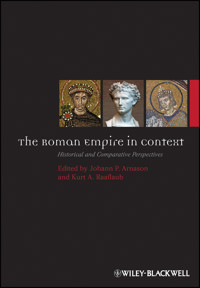
The Roman Empire in Context E-Book
150,99 €
Mehr erfahren.
- Herausgeber: John Wiley & Sons
- Kategorie: Geisteswissenschaft
- Serie: Ancient World: Comparative Histories
- Sprache: Englisch
Through a series of original essays by leading international scholars, The Roman Empire in Context: Historical and Comparative Perspectives offers a comparative historical analysis of the Roman empire’s role and achievement and, more broadly, establishes Rome’s significance within comparative studies.
- Fills a gap in comparative historical analysis of the Roman empire’s role and achievement
- Features contributions from more than a dozen distinguished scholars from around the world
- Explores the relevance of important comparativist themes of state, empire, and civilization to ancient Rome
Sie lesen das E-Book in den Legimi-Apps auf:
Seitenzahl: 996
Veröffentlichungsjahr: 2010
Ähnliche




















Contents
Notes on Contributors
Series Editor’s Preface
1 Introduction Johann P. Arnason
Part I Expansion and Transformation
2 From City-State to Empire: Rome in Comparative Perspective Kurt A. Raaflaub
3 The Transition from Republic to Principate: Loss of Legitimacy, Revolution, and Acceptance Egon Flaig
4 Strong and Weak Regimes: Comparing the Roman Principate and the Medieval Crown of Aragon D. A. Cohen and J. E. Lendon
Part II Late Antiquity: Division, Transformation, and Continuity
5 The Background to the Third-Century Crisis of the Roman Empire Adam Ziolkowski
6 The End of Sacrifice: Religious Mutations of Late Antiquity Guy G. Stroumsa
7 Contextualizing Late Antiquity: The First Millennium Garth Fowden
Part III Destinies of the Roman Legacy
8 The Franks: Rome’s Heirs in the West Matthias Becher
9 The End of Rome? The Transformation of the Eastern Empire in the Seventh and Eighth Centuries CE John Haldon
10 The First Islamic Empire Chase F. Robinson
Part IV Comparative Perspectives
11 From City-State to Empire: The Case of Assyria Mario Liverani
12 China’s Early Empires: The Authority and Means of Government Michael Loewe
13 The Legs of the Throne: Kings, Elites, and Subjects in Sasanian Iran Scott McDonough
14 The King of Kings: Universal Hegemony, Imperial Power, and a New Comparative History of Rome Peter Fibiger Bang
Part V Conceptual and Theoretical Reflections
15 The Roman Phenomenon: State, Empire, and Civilization Johann P. Arnason
16 Roman–European Continuities: Conceptual and Historical Questions Peter Wagner
General Index
Index of Sources (selective)
The Roman Empire in Context
The Ancient World: Comparative Histories
Series Editor: Kurt A. Raaflaub
Published
War and Peace in the Ancient WorldEdited by Kurt A. Raaflaub
Household and Family Religion in AntiquityEdited by John Bodel and Saul Olyan
Geography and Ethnography: Perceptions of the World in Pre-Modern SocietiesEdited by Kurt A. Raaflaub and Richard J. A. Talbert
Epic and HistoryEdited by David Konstan and Kurt A. Raaflaub
The Roman Empire in Context: Historical and Comparative PerspectivesEdited by Johann P. Arnason and Kurt A. Raaflaub
In preparation
Highways and Byways in the Ancient WorldEdited by Susan Alcock, John Bodel, and Richard Talbert
Thinking, Recording, and Writing History in the Ancient WorldEdited by Kurt A. Raaflaub
This edition first published 2011 © 2011 John Wiley & Sons, Ltd., except chapter 4 © D. A. Cohen and J. E. Lendon
Wiley-Blackwell is an imprint of John Wiley & Sons, formed by the merger of Wiley’s global Scientific, Technical and Medical business with Blackwell Publishing.
Registered OfficeJohn Wiley & Sons Ltd, The Atrium, Southern Gate, Chichester, West Sussex, PO19 8SQ, United Kingdom
Editorial Offices350 Main Street, Malden, MA 02148-5020, USA9600 Garsington Road, Oxford, OX4 2DQ, UK The Atrium, Southern Gate, Chichester, West Sussex, PO19 8SQ, UK
For details of our global editorial offices, for customer services, and for information about how to apply for permission to reuse the copyright material in this book please see our website at www.wiley.com/wiley-blackwell.
The right of Johann P. Arnason and Kurt A. Raaflaub to be identified as the editors of this work has been asserted in accordance with the UK Copyright, Designs and Patents Act 1988.
All rights reserved. No part of this publication may be reproduced, stored in a retrieval system, or transmitted, in any form or by any means, electronic, mechanical, photocopying, recording or otherwise, except as permitted by the UK Copyright, Designs and Patents Act 1988, without the prior permission of the publisher.
Wiley also publishes its books in a variety of electronic formats. Some content that appears in print may not be available in electronic books.
Designations used by companies to distinguish their products are often claimed as trademarks. All brand names and product names used in this book are trade names, service marks, trademarks or registered trademarks of their respective owners. The publisher is not associated with any product or vendor mentioned in this book. This publication is designed to provide accurate and authoritative information in regard to the subject matter covered. It is sold on the understanding that the publisher is not engaged in rendering professional services. If professional advice or other expert assistance is required, the services of a competent professional should be sought.
Library of Congress Cataloging-in-Publication Data
The roman empire in context : historical and comparative perspectives / edited by Johann P. Arnason and Kurt A. Raaflaub.
p. cm. – (The ancient world : comparative histories)
Includes bibliographical references and index.
ISBN 978-0-470-65557-3 (hardcover : alk. paper) 1. Rome–Civilization. 2. Comparative civilization. 3. Rome–History. I. Arnason, Johann P., 1940– II. Raaflaub, Kurt A.
DG77.R6712.2010
937’.06–dc22
2010021913
A catalogue record for this book is available from the British Library.
This book is published in the following electronic formats: ePDFs [ISBN 9781444390193]; Wiley Online Library [ISBN 9781444390186]
Editors and contributors dedicate this volume to the memory of S. N. Eisenstadt(Sept. 10, 1923–Sept. 2, 2010)
Notes on Contributors
Johann P. Arnason took his doctoral degree at the University of Frankfurt and later taught sociology at La Trobe University in Melbourne, where he is now Emeritus Professor. He is also Visiting Professor at the Charles University in Prague. His research has focused on historical sociology, with growing emphasis on the comparative analysis of civilizations. Recent publications include Civilizations in Dispute: Historical Questions and Theoretical Traditions (2003); Axial Civilizations and World History (co-edited, 2005); Eurasian Transformations, 10th to 13th Centuries: Crystallizations, Divergences, Renaissances (co-edited, 2005), and Domains and Divisions of European History (co-edited, 2010).
Peter Fibiger Bang holds a PhD from Cambridge and is an Associate Professor of Roman History in the Saxo Institute, University of Copenhagen. His research has focused on the political economy of the Roman Empire, new comparative perspectives on the Greco-Roman world, state-formation, and the character of patrimonial power in tributary empires. In 2005–9 he was chair of a European research network dedicated to historical comparisons of the Roman, Mughal, and Ottoman empires. Besides edited volumes and articles, his publications include The Roman Bazaar: A Comparative Study of Trade and Markets in a Tributary Empire (2008). He is currently working on The Oxford Handbook of the Ancient State (co-edited, forthcoming).
Matthias Becher is Professor of Medieval History at the University of Bonn. He took his PhD at the University of Konstanz (1990) and his Habilitation at the University of Paderborn (1995). One of his main areas of research is the history of the Frankish kingdoms. He is author of Eid und Herrschaft. Untersuchungen zum Herrscherethos Karls des Großen (1993); Rex, Dux und Gens. Untersuchungen zur Entstehung des sächsischen Herzogtums im 9. und 10. Jahrhundert (1996); Karl der Große (1999; English translation, Charlemagne, 2003); and Merowinger und Karolinger (2009).
David A. Cohen, an historian of medieval Spain, has his degrees from Yale University and teaches history at Assumption College in Worcester, Massachusetts.
Egon Flaig has a PhD from the Freie Universität Berlin and Habilitation from the University of Freiburg im Breisgau. He is Professor of Ancient History at the University of Rostock. His main scholarly interests include the constitution of social norms in ancient societies, procedures to take collective decisions and the emergence of majority rule (on which he is currently completing a monograph), semiotic and ritual dimensions of ancient politics, slavery in comparative perspective, equality and inequality in political thought, and theocratic and anthroponomic foundations of political order. Some of his publications that are relevant to the present subject are Den Kaiser herausfordern. Die Usurpation im Römischen Reich (1992); “Entscheidung und Konsens. Zu den Feldern der politischen Kommunikation zwischen Aristokratie und Plebs,” in M. Jehne (ed.), Demokratie in Rom? Die Rolle des Volkes in der Politik der römischen Republik, 77–127 (1995); and Ritualisierte Politik. Zeichen, Gesten und Herrschaft im Alten Rom (2003).
Garth Fowden is a Research Professor at the Center for Greek and Roman Antiquity, National Research Foundation, Athens. His principal interest is in the intellectual history of the Graeco-Arabic world. He has published The Egyptian Hermes: A Historical Approach to the Late Pagan Mind (1986; corr. repr. with new pref., 1993); Empire to Commonwealth: Consequences of Monotheism in Late Antiquity (1993); Qusayr ‘Amra: Art and the Umayyad Elite in Late Antique Syria (2004); and chapters in the new edition of The Cambridge Ancient History, vols. XII and XIII.
John Haldon is Professor of History at Princeton University. He studied in the UK, Greece, and Germany, and currently is a Senior Fellow at the Dumbarton Oaks Center for Byzantine Studies in Washington, DC. His research focuses on the history of the early and middle Byzantine Empire, in particular the period from the seventh to the eleventh centuries; on state systems and structures across the European and Islamic worlds from late ancient to early modern times; and on the production, distribution, and consumption of resources in the late ancient and medieval world, especially in the context of warfare. His publications include Byzantium in the Seventh Century (1990/1997); Three Treatises on Byzantine Imperial Military Expeditions (1990); The State and the Tributary Mode of Production (1993); Warfare, State, and Society in Byzantium (1999); Byzantium: A History (2000); and The Palgrave Atlas of Byzantine History (2006).
J. E. Lendon has a PhD from Yale University and is Professor of History in the Corcoran Department of History at the University of Virginia. He held a Junior Fellowship at the Center for Hellenic Studies in Washington, DC, and an Alexander von Humboldt Research Fellowship in Germany. His interests focus on Greek and Roman foreign affairs and warfare. He is author of Empire of Honor: The Art of Government in the Roman World (1997) and Soldiers and Ghosts: A History of Battle in Classical Antiquity (2005, trans. into Italian and Spanish).
Mario Liverani is Professor of the History of the Ancient Near East at the University of Rome “La Sapienza.” He is honorary member of the American Oriental Society, member of the “Accademia Nazionale dei Lincei,” and of the “Academia Europaea,” and holds honorary degrees from the Universities of Copenhagen and Madrid (Autonoma). He has excavated in Syria, Turkey, and Libya. His main research interests include the Assyrian Empire, Mesopotamian historiography, the Levant in the Amarna letters, and the ancient “oriental” city. Recent monographs include International Relations in the Ancient Near East (2001); Myth and Politics in Ancient Near Eastern Historiography (2004); Israel’s History and the History of Israel (2005); and Uruk: The First City (2006).
Michael Loewe received his PhD from the University of London. He was University Lecturer in Chinese Studies and Fellow of Clare Hall at the University of Cambridge until his retirement in 1990. He has held various visiting professorships and is, among other distinctions, Foreign Honorary Member of the American Academy of Arts and Sciences. His publications include Divination, Mythology, and Monarchy in Han China (1994); A Biographical Dictionary of the Qin, Han, and Xin Dynasties (2000), with a Companion: The Men Who Governed Han China (2004); and The Government of the Qin and Han Empires 221BCE –220CE (2006). Among his several edited volumes is vol. I of The Cambridge History of China (1986).
Scott McDonough is an Assistant Professor of History at the William Paterson University of New Jersey. He received his PhD in History from the University of California, Los Angeles (2005). His research interests lie in the social, institutional, and religious history of late ancient West Asia, especially pre-Islamic Iran. Recent articles include “A Second Constantine? The Sasanian King Yazdgard I in Christian History and Historiography” and “A Question of Faith? Persecution and Political Centralization in the Sasanian Empire of Yazdgard II (438–457 CE).” He is currently completing a monograph: “We Pray for Our Glorious King”: Power, Piety, and Patronage in Sasanian Iran, 220–651CE.
Kurt A. Raaflaub received his PhD from the University of Basel. He is David Herlihy University Professor and Professor of Classics and History Emeritus at Brown University, where he was also Director of the Program in Ancient Studies. His research interests focus on the social, political, and intellectual history of archaic Greece and the Roman republic, war and peace in the ancient world, and the comparative history of the ancient world. Recent publications include The Discovery of Freedom in Ancient Greece (2004, winner of the American Historical Association’s James Henry Breasted Prize); War and Peace in the Ancient World (edited, 2007); Origins of Democracy in Ancient Greece (co-author, 2007); A Companion to Archaic Greece (co-edited, 2009); Epic and History (co-edited, 2010).
Chase F. Robinson was Professor of Islamic History in the Faculty of Oriental Studies at Oxford University and is now Provost and Distinguished Professor of History at the Graduate Center, the City University of New York. He received his PhD from Harvard University. His main research areas are early Islamic history and historiography. His recent publications include Empire and Elites after the Muslim Conquest: The Transformation of Northern Mesopotamia (2000); A Medieval Islamic City Reconsidered: An Interdisciplinary Approach to Samarra (edited, 2001); Islamic Historiography (2003); ‘Abd al-Malik (2005).
Guy G. Stroumsa has a PhD from Harvard University and is Professor of the Study of the Abrahamic Religions and Fellow of Lady Margaret Hall at Oxford University, and Martin Buber Professor of Comparative Religion Emeritus at the Hebrew University of Jerusalem. His current main research interests lie in the shaping of the Abrahamic religions in late antiquity and in the oriental traditions of wisdom in late antiquity. Recent publications include The End of Sacrifice: The Religious Transformations of Late Antiquity (2009), and A New Science: The Discovery of Religion in the Age of Reason (2010).
Peter Wagner received his PhD from the Freie Universität of Berlin. He has recently been appointed ICREA Research Professor at the University of Barcelona. His main research interests are in social and political theory and in comparative historical sociology. In the latter area, he has had a particular interest in the long-run historical trajectories of societies. His recent book publications include Modernity as Experience and Interpretation (2008) and Varieties of World-Making: Beyond Globalization (co-edited, 2007).
Adam Ziolkowski was educated at the University of Warsaw, where he also got his PhD and Habilitation and is now Professor of Ancient History. His research interests include early Rome, the social and economic history of the republic, the topography of the city of Rome in antiquity, Roman imperialism, and early Christianity. He is the author, among other works, of Sacra Via Twenty Years After (2004) and Storia di Roma (2000).
Series Editor’s Preface
The Ancient World: Comparative Histories
The application of a comparative approach to the ancient world at large has been rare. This series, of which the current volume is the fifth, intends to fill this gap. It pursues important social, political, religious, economic, and intellectual issues through a wide range of ancient or early societies, occasionally covering an even broader diachronic scope. “Ancient” will here be understood broadly, encompassing not only societies that are “ancient” within the traditional chronological framework of c.3000 BCE to c.600 CE in East, South, and West Asia, the Mediterranean, and Europe, but also later ones that are structurally “ancient” or “early,” such as those in premodern Japan or in Meso- and South America before the Spanish Conquest. By engaging in comparative studies of the ancient world on a truly global scale, this series hopes to throw light not only on common patterns and marked differences, but also to illustrate the remarkable variety of responses humankind developed to meet common challenges. Focusing as it does on periods that are far removed from our own time, and in which modern identities are less immediately engaged, the series contributes to enhancing our understanding and appreciation of differences among cultures of various traditions and backgrounds. Not least, it thus illuminates the continuing relevance of the study of the ancient world in helping us to cope with problems of our own multicultural world.
Earlier volumes in the series are War and Peace in the Ancient World (ed. Kurt A. Raaflaub, 2007); Household and Family Religion in Antiquity (eds. John Bodel and Saul Olyan, 2008); Epic and History (eds. David Konstan and Kurt Raaflaub, 2010); Geography and Ethnography: Perceptions of the World in Premodern Societies (eds. Kurt Raaflaub and Richard Talbert, 2010). Other volumes are in preparation: Highways and Byways in the Ancient World (eds. Susan Alcock, John Bodel, and Richard Talbert); Thinking, Recording, and Writing History in the Ancient World (ed. Kurt A. Raaflaub).
The current volume has its origin in a colloquium held in 2005 at the European University Institute in Florence, organized by Peter Wagner, Johann Arnason, Bo Stråth, and Björn Wittrock. The papers given and discussed there in a stimulating atmosphere and under ideal conditions were later profoundly revised or rewritten and complemented by others that seemed needed to realize the concept and framework of this volume as they emerged during those discussions. I thank the Institute and the Swedish Collegium of Advanced Study in the Sciences for financial support and generous hospitality, the organizers of the colloquium for their efforts in starting this project, the contributors for their patient and productive collaboration, my fellow editor, Johann Arnason, for his inspiration and leadership, and Al Bertrand and his collaborators at Wiley-Blackwell for their enthusiastic support of this project and the entire series. Johann Arnason would like to thank the Alexander von Humboldt-Stiftung for supporting a research stay at the University of Frankfurt/Main, during which his contributions to this volume were finalized. Both editors thank Jennifer Lewton Yates for compiling the two indices.
Kurt A. Raaflaub
1
Introduction
JOHANNP. ARNASON
Seventy years ago, José Ortega y Gasset began his reflections on the Roman Empire with a very strong claim on behalf of his chosen subject: “The history of Rome, by virtue of its content and of the comprehensiveness of our knowledge of it, may well be called a model history” (Ortega y Gasset 1946: 11; the essay was written in 1940, in exile in Argentina, and reflects a strong inclination to draw parallels between the crisis of the Roman Empire and Europe’s twentieth-century predicament). In fact, the original formulations were even stronger: Ortega declares “esparadigma,” where the English translator suggests a model, and he refers to “madurez” rather than comprehensiveness, thus clearly indicating ripe insight rather than merely extensive knowledge. He was taking a widely held but diffuse view of the Roman record to extreme lengths. It must be added that, as he then saw it, the picture had only just been completed: Rostovtzeff had done for the Principate what Mommsen had done for the Republic, and thus made the period that began with the Augustan settlement and ended with the third-century crisis an integral part of the paradigm. The reassessment of late antiquity was not yet on the agenda. An interpretation in Ortega’s spirit, built on Mommsen and Rostovtzeff, would not necessarily be undermined by this most recent addition to our knowledge of the Roman world: late antiquity could be seen as a phase of resurgence coming after the crisis so memorably portrayed (and, as scholarly consensus now has it, over-interpreted) by Rostovtzeff. But no such approaches are represented in current scholarship; no historical sociologist would subscribe to the claims quoted at the beginning. In fact, the pendulum has swung very far indeed in the opposite direction: there are, as will be shown at greater length below, good grounds to suggest that the Roman experience is one of the relatively neglected areas of comparative history, and that specific themes to be explored must be cleared of assumptions and connotations that have blocked broader perspectives. From that point of view, the most obvious reason for going back to Ortega would be the contrast that highlights present failure to give Rome its due. There is, however (as I will try to show), more to the abandoned view than that. Although there can be no question of reestablishing Roman history as a “paradigm,” a closer look at the key issues will confirm its quite exceptional significance for comparative studies, and thus in the end allow us to extract a grain of truth from Ortega’s overstatement.
A more focused discussion of Rome’s place in comparative history may begin with three conspicuously relevant categories: states, empires, and civilizations. All are recurrent themes of comparative studies, and intuitively applicable to the Roman case. One of the chapters in this book will discuss the Roman pattern of relations between the three historical frameworks at greater length, and thus approach comparative questions from within the specific configuration that is our main topic; here the aim is, rather, to summarize the evidence and clarify the reasons for inadequate accounts of the Roman record. Each of the three perspectives suggests particular lessons to be noted.
Seeing Rome as a State: Flaws and Achievements
The scholarly literature on statehood and state formation is very rich, but a few particularly broadly conceived surveys stand out, and a brief glance at their problems with the Romans will be useful. To understand the difficulties, basic ambiguities besetting the very concept of the state should be borne in mind. As Mogens Herman Hansen argues in his discussion of city-state cultures (Hansen 2000: 11–34), multiple and mutually incompatible definitions of statehood dispute the field of comparative political history, and the question of city-states brings thedisagreement to a head; in fact, those who prefer a modernistic conception of the state will never settle for a general category of city-state, but try to replace it with emic terms borrowed from each particular tradition. However, Hansen’s attempt to solve the problem by allocating divergent notions of statehood to different disciplines is less convincing. It is not the case that historians and social scientists agree on a broad concept of the state, applying to a long premodern history, while legal scholars and political scientists stick to the modern criteria first theorized by Machiavelli and Hobbes. The opinions of historians, including authorities on Greek and Roman antiquity, are divided; a strong current still supports the view that the state, as an impersonal apparatus of domination, is a late medieval and/or early modern European invention. When this ongoing dispute is confronted with the record of the Roman Republic, the ambiguity of the evidence goes beyond the general problematic of city-states. On the one hand, Roman political thought – and the political imaginary behind it – is commonly credited with taking the notion of res publica to a higher level of abstraction than the Greek tradition had done. On the other hand, the Roman political regime was to a very high degree embedded in social hierarchies of status and power. The key role of aristocratic families and their networks of clientelae, formal as well as informal, is the most visible aspect of a general pattern that is often seen as the very opposite of statehood. There are, in other words, obvious reasons for divergent views, and even for changes to conceptual frameworks. Christian Meier’s second thoughts about the crisis of the Republic are a striking example of the latter: in his Res publica amissa, he referred to a “Roman unity of state and society” (Meier 1980: 156), but the introduction to a later edition (1997) expresses radical doubt about this modernizing terminology and argues for an explicit shift from state-centered interpretations to a more general understanding of the political.
Lesen Sie weiter in der vollständigen Ausgabe!
Lesen Sie weiter in der vollständigen Ausgabe!
Lesen Sie weiter in der vollständigen Ausgabe!
Lesen Sie weiter in der vollständigen Ausgabe!
Lesen Sie weiter in der vollständigen Ausgabe!
Lesen Sie weiter in der vollständigen Ausgabe!
Lesen Sie weiter in der vollständigen Ausgabe!
Lesen Sie weiter in der vollständigen Ausgabe!
Lesen Sie weiter in der vollständigen Ausgabe!
Lesen Sie weiter in der vollständigen Ausgabe!
Lesen Sie weiter in der vollständigen Ausgabe!
Lesen Sie weiter in der vollständigen Ausgabe!
Lesen Sie weiter in der vollständigen Ausgabe!
Lesen Sie weiter in der vollständigen Ausgabe!
Lesen Sie weiter in der vollständigen Ausgabe!
Lesen Sie weiter in der vollständigen Ausgabe!
Lesen Sie weiter in der vollständigen Ausgabe!
Lesen Sie weiter in der vollständigen Ausgabe!
Lesen Sie weiter in der vollständigen Ausgabe!
Lesen Sie weiter in der vollständigen Ausgabe!
Lesen Sie weiter in der vollständigen Ausgabe!
Lesen Sie weiter in der vollständigen Ausgabe!




