


7,49 €
Mehr erfahren.
- Herausgeber: Live For Excellence Productions (LFEP)
- Kategorie: Lebensstil
- Sprache: Englisch
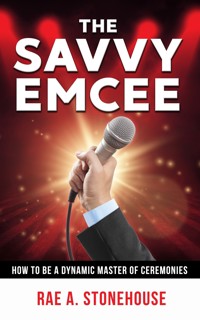
In this practical, easy to use book, Rae A. Stonehouse a.k.a. Mr. Emcee puts the "Master" in Master of Ceremonies. He shares tips & techniques he has learned over the years in becoming a dynamic Master of Ceremonies.
By reading this book you will learn:
* How to take charge of any event.
* How to organize yourself so everyone will know you are in charge!
* How to think logistically, from several different perspectives.
* How to create agendas that work.
* Stage management techniques.
* How to present awards & give recognition.
* How to keep the featured speaker organized.
* About different emceeing opportunities.
* How to get paid for what you do.
As in Rae's other books, he offers a systematic, easy to read approach that provides practical solutions to specific problems.
In The Savvy Emcee: How to be a Dynamic Master of Ceremonies, Rae A. Stonehouse, shares practical advice to help you become a Dynamic Master of Ceremonies, that people will want to pay for your services!
Das E-Book können Sie in Legimi-Apps oder einer beliebigen App lesen, die das folgende Format unterstützen:
Seitenzahl: 246
Veröffentlichungsjahr: 2019
Ähnliche



THE SAVVY EMCEE
HOW TO BE A DYNAMIC MASTER OF CEREMONIES
RAE A. STONEHOUSE
Copyright © 2019 by Rae A. Stonehouse
All rights reserved.
No part of this book may be reproduced in any form or by any electronic or mechanical means, including information storage and retrieval systems, without written permission from the author, except for the use of brief quotations in a book review.
E-book - ISBN: 978-1-9990454-5-6
Paperback - ISBN: 978-1-9990454-6-3
Live For Excellence Productions
1221 Velrose Drive
Kelowna, B.C., Canada
V1X6R7
https://liveforexcellence.com
Created with Vellum
CONTENTS
1. Connect With Us
Introduction
I. Logistics
2. Take Charge: The success of your event depends upon you!
3. Get Organized
4. Getting Organized: Think Logistically
5. Getting Organized: Develop an Agenda
6. Think logistically: What else do you need to prepare for?
7. What to Wear?
8. Working With Speakers
9. Emceeing in Action
10. Speaker Logistics
11. And the Winner is… The Art of Presenting Awards: Practical Tips & Techniques
12. What seating arrangement works best for your audience?
13. Additional Emcee Duties
14. Back-up Plans
II. The Business of Emceeing
15. Overview
16. Introduction to networking
17. Personal Branding
18. What do you stand for?
19. Developing your USP
20. How high does your elevator go?
21. Developing your elevator pitch
22. Elevator Pitch Template
23. Using technology to your advantage
24. Business Card Presentation & Etiquette
25. Wear a name tag
26. Whole Lotta Shakin Goin On
27. Follow-up is everything
28. Social media is here to stay
29. Are you Linkedin?
30. Reach out and link somebody
31. Send messages out
32. Create a database of connections
33. Systemize responding to new connections
34. Participate in Linkedin groups
35. Blow your own horn
36. Strategic planning:
37. Creating Your Business Plan: Overview
38. Conducting a competitive analysis
39. Financial Planning
40. Choosing your business entity
41. Emcee Opportunities
42. Moderating a Panel Discussion
43. Sample Emceeing Contract
44. It’s Showtime!
III. Additional Resources:
45. Question: Master of Ceremonies: What is the best way for an MC to make a noisy crowd go quiet?
46. Question: What are some Emcee Speech Examples?
47. Question: Do you have difficulty applying a safety filter to your speech and overshare personal information?
48. Question: Discuss the factors to consider when preparing for a speech?
49. Question: Is it easy to make an informative speech? Why? Why not?
50. Question: What is a very good speech on why you want to be a leader?
51. Question: What do you think about when you give a speech?
52. Question: How can one improve his voice in presentations, and what are the exercises that enable him to master his voice?
53. Question: How can I create more opportunities for myself to make speeches in different capacities?
54. Question: Discuss the importance of having an opening statement in a speech and why it is necessary to state your three main points?
55. Question: How can I give an impromptu speech?
56. Question: What are some good examples for public speaking?
57. Question: How do I stop shaking when public speaking?
58. Question: What are some great attention getters for informative speeches?
59. Question: What are some topic ideas for a success speech?
60. Question: How do I write a speech about myself in the 3rd person? How would you start off your introduction?
61. Question: What is the importance of speech communication in the business sector?
62. Question: What are the best topics for entertaining speeches?
63. Question: I want to write a two-minute speech. How many characters do I need?
64. Question: What are humorous topics to give a speech on?
65. Question: What is a good prepared speech topic?
66. Question: What distinguishes a good speech?
67. Question: How do I deliver a good impromptu speech?
68. Question As a public speaker, does imagining the audience naked really help with anxiety?
69. Question: What should people stop doing in their presentations?
70. Question: What credentials are needed or of value in order to become a motivational speaker, author, and spiritual teacher?
71. Question: Does my anxiety over public speaking have anything to do with shyness/introversion, how would one best overcome this intense anxiety?
72. Question: Does public speaking require improvisation skills?
73. Question How much should I charge to be the MC/ Host at a medium-sized conference?
74. Question: I want to be heard. What do I do?
75. Question: I have a difficult time speaking loudly enough to be heard in a noisy area. How can I improve the volume of my speech?
Afterword
About the Author
Also by Rae A. Stonehouse
1CONNECT WITH US
Subscribe to ournewsletterto receive sage advice and updates from Rae A. Stonehouse on networking, job searching skills and other self-help professional development training as they become available and receive 52 Power Networking Tips: How to Network Like a Pro, a free e-book.
Sign up url BookHip.com/JDGWKZ
Follow us on Facebookhttps://www.facebook.com/savveyemcee/
Twitter:https://twitter.com/MisterEmceeRae
And our website https://mremcee.com
INTRODUCTION
Meetings, get-togethers and events are happening every day somewhere near you. And probably right now as you are reading this.
Many will be organized and run effectively. Others will leave audience members saying “Well, that was a waste of time!” Poor organization and a lack of leadership can prevent an organization from achieving its purpose.
Meetings are expensive. From the actual cost of running the event, paying employees to attend and incidental costs such as travel, meals and accommodation all add up.
An experienced, master of ceremonies can ensure an event is run smoothly from start to finish.
There is a need for experienced, self-confident speaking professionals to meet the events and meetings industry requirements.
This book is written to fast-track anyone who wants to learn how to emcee events.
Welcome to The Savvy Emcee: How to Be a Dynamic Master of Ceremonies.
The content of this book is derived from my previous book E=Emcee Squared: Tips & Techniques to Becoming a Dynamic Master of Ceremonies published in 2014.
This expanded edition will be helpful to those of you who have been thrust into the position of having to emcee an event with short notice and without experience as well as those who are more experienced and are thinking about earning income and perhaps turning their emceeing into a side-hustle or a full-time business.
Later on in the book I delve into public speaking skills development as it is one of the basic skills required to serve as a Master of Ceremonies. You will notice I use the terms master of ceremonies, MC and emcee interchangeably throughout the book.
Before we get started with all the exciting tips and techniques, let me share with you why I created this book in the first place.
My professional career has been as a Registered Nurse working predominantly in mental health and psychiatry. I can’t recall there being many if any opportunities to practice my craft of emceeing while working in that capacity. In fact, being an Emcee hasn’t even featured on my “bucket list” of things I need to accomplish before I pass on to the afterlife.
You might have noticed I called emceeing a craft in the previous paragraph. I truly believe it is. For me, becoming a proficient master of ceremonies developed incrementally while participating in hundreds, if not thousands of weekly Toastmasters meetings.
I joined Toastmasters to develop my public speaking skills. Before joining, I was terrified of standing and speaking before a group, public speaking as it is commonly referred to.
I quickly learned public speaking and leadership went hand-in-hand. To be an effective leader, you need to be a good communicator. To be an effective speaker, you need to be a good leader.
The Toastmasters program provided me ample opportunities to develop my emceeing skills in their weekly meetings as well as outside of the club environment. The weekly club meeting and program provides as many speaking opportunities for its members as can be packed into the amount of time allotted. The different roles, while providing speaking opportunities, also provide varying levels of leadership skill building. The basic leadership skills you learn are readily usable for the more challenging roles you take on.
My journey to becoming an accomplished Toastmaster has included many leadership roles and positions. Each has brought its own challenges and lessons learned. In my early years in Toastmasters I recall being volunteered to introduce an Area Governor at a speech contest gathering that was being hosted locally. The Area Governor’s role was to officiate at the speech contest, that is, emcee the event.
I recall being terrified having to go up onto the stage, with everyone staring at me while I introduced the Area Governor. The very next year… I was the Area Governor!
A lot can happen in a year. I found I actually liked standing on the stage, with all the audience’s eyes on me.
Since then I have taken on ever-increasingly challenging leadership roles in Toastmasters such as Division Governor, Lieutenant Governor of Education & Training (LGET), District Governor and Past District Governor.
Outside of Toastmasters I have taken on leadership roles as a Director, then the Chair of a local entrepreneur’s society. In that capacity I organized 30 or so Townhall meetings which were panel discussions with local, experienced entrepreneurs discussing issues of importance to those interested in the topic of the meeting.
My role included subject development, speaker recruitment, speaker coaching, marketing and promoting the event, selling registrations, developing the agenda/timeline, moderating the event and providing post event follow-up.
Many of those activities could arguably be described as being an event planner’s duties. As an Emcee, I take a proactive approach and don’t leave anything to chance.
Throughout this book I provide you with tips and techniques I have learned along the way in becoming an effective Master of Ceremonies and turning it into a business venture. As Mr. Emcee(my business name) I provide master of ceremonies and event organizing services in my local market.
The task of emceeing is very much like the proverbial tip of an iceberg i.e. much of what takes place is behind the scenes where the public doesn’t see. Far too many people have the view anyone can walk onto a stage, announce a bunch of names, crack a few jokes and be effective.
Nothing could be further from the truth! As you will see, I share with you the “behind the scenes” details needed to be a dynamic Master of Ceremonies.
Throughout this book you will notice I use a conversational style of writing. Sure, you don’t get to speak back to me but it might be helpful to read the book as if I was coaching you.
This book is written from the perspective that you the reader has a basic concept of what is involved in being a Master of Ceremonies but would like to learn more, so you can do it yourself. An Emceeing for Dummies, if you will. Not that you are a dummy of course…
As in other articles and books I have written, I utilize what I call an “onion” approach. In exploring a topic, we peel layer after layer away, so we get to the essence of the subject. Much like peeling back the layers of an onion but hopefully, without all the tears that often accompany doing so. I hope you find this appealing! Okay, that’s the only pun I will be using… maybe.
In my first edition of this book, I leveraged Albert Einstein’s name recognition with E=MC [squared] and applied it to our topic.
The MC (Emcee) portion should be fairly obvious. But what about the E portion of the formula? Drawing from the field of public speaking and leadership, E can have multiple meanings (all of which you should be):
EntertainingEducationalEnthusiasticEndearingEncouragingEffortlessEconomic [of time]EfficientEarlyEngagingI could likely pull out my dictionary and overwhelm you with a plethora of words that start with E, so I will stop here.
You will see Albert Einstein throughout this book as I have put him to work in introducing sage advice in our Tips From the Pros sections.
One last comment before we get started. While this book provides a systematic approach to serving as a dynamic Emcee, your self-confidence, poise, courage, public speaking skills and courage to take on a role many others would avoid at all costs, will go a long way in ensuring your success.
Those are all factors that are beyond the scope of this book. However, if I can do it… you can too!
Rae Stonehouse a.k.a. Mr. Emcee
LOGISTICS
2TAKE CHARGE: THE SUCCESS OF YOUR EVENT DEPENDS UPON YOU!
Yes, the success of any event falls onto the shoulders of everyone who is organizing it. The challenge can be in identifying who actually is in charge? An event, or even a smaller scale meeting can have several key players.
There may be a Meeting Planner/Organizer involved.
Likely, the event would have to be larger in scale for them to gain revenue from the venture, however many volunteer their time and expertise to worthy causes. Their role is to oversee the logistics of the entire event.
A larger event can be broken down to smaller mini events. They may engage you to take on the role of emceeing a specific portion of the larger scale event. This can provide challenges for you. More about this later.
You can also have a client or event sponsor taking on an active leadership role. While they have a vested interest in the success of the event, after all they are paying for it, they may not have the organizational skills and everything else you bring as a Master of Ceremonies. Their involvement may not be helpful.
Taking charge does not mean acting as a military general where only you know the battle plan. It isn’t about issuing orders that must be followed. It is helpful to think of your role as being that of an orchestra conductor.
While strategy is necessary, the event goes much smoother if everyone is working from the same page. I don’t have a musical background, but I do know the conductor leads the musicians to play from the same page, together and adding to each other’s sound. When that doesn’t happen… I guess that’s what they call Jazz!
A helpful tip is to insist on the client designating a single person to be the go-to-person to solve problems. Quite often there can be last-minute changes to the agenda or on-the-spot input that can change the agenda. Simply insist all changes to the agenda and announcements come from the designated client representative. That way the client is in control of the meeting and you look good in their eyes.
An Emcee should have the ability to “ACE” an event.
The three A’s:
Awake - make them laugh and they will pay attention.Alert - look forward to your next quip.Alive - even if the speaker you introduce bores them, they will anticipate your return, expecting more fun.The three C’s:
Current - talk about today’s news events or this event.Clever - intellectually funny, not silly.Concise - say it quickly, make your point, get off.Should the client request a serious set of introductions then you employ...
The three E’s:
Excitement - about the person or company.Enthusiasm - about what they do.Energy - to keep attention even if the subject is dry.“The right Emcee can make or break your event. It is important to position yourself as the right person.”
Source: Unknown
* * *
3GET ORGANIZED
Event organizing can be a lot like cat juggling.
As the Emcee your role is to create order from chaos. Quite often your client has an idea about the way they want their event to flow but they really don’t know how to make it happen. That’s where you come in. I liken emceeing to cat juggling. Metaphorically of course!
Okay, so they may actually be dogs in the picture above, but I think you get the idea… [I thought they were cats for the longest time.]
Sometimes the cats fly where you want to and sometimes, they have a mind of their own and go where they want to.
Cats are like ideas. Your client likely has lots of them and they are flying all over the place. Your role as Emcee is to get those cats flying in formation i.e. to get all of those ideas to make sense and work together.
* * *
4GETTING ORGANIZED: THINK LOGISTICALLY
Consider all aspects of your event.
The Five Ws and an H provide the framework for writing any good story. They also serve well to perform a strategic analysis of any event you are organizing. We will break them down to logistical questions you should ask as the first step in organizing an event.
Who:
Who is the client? Contact info?Who do you report to?Who do you approach during the event if there is a problem?Who will be participating or speaking in the program? Examples: keynote speakers, VIPs, dignitaries (Note: we talk about introducing speakers later and the information you will need to collect from them.)Who will be in the audience?What:
What is the nature of the event?Is the event intended to be educational, informative, entertaining, thought provoking, to provide recognition? Any of the above, or all?What does the planned program look like i.e. structure, elements?When:
What is the date and time of the event?Will you have any duties to perform before or after the actual speaking portion of the event? Example: Meeting & greeting at a pre-meeting reception or post event get-together. Corralling guests from a reception to the main room.Are there any plans in place for rescheduling the event if unforeseen and insurmountable challenges occur?Where:
What is the location of the event i.e. the street address?What specific room will the event be held in at the location?Where will you be emceeing from i.e. is there a stage, head table etc.Are there any environmental concerns? Example: If your event is outside could weather have an effect on the program i.e. wind, rain, snow etc.Why:
What is the purpose of this event? What does the hosting organization hope to achieve? Are there any hidden agendas?How:
How will the hosting organization determine whether this event is a success or not?How will the hosting organization determine if your participation in the event is a success or not?Think Logistically: What do you need to know that you don’t know but you really should know?
Thinking logistically is very much like being a detective. It can be frustrating to learn a detail that if you had known at the time, it could have saved you a lot of time and effort. This can sometimes result from assumptions people make. “Oh, sorry, I thought you knew that!” On the other hand, there are people who like to control information.
Information can be used as personal power. I’m sure you have heard the term “It’s on a need to know basis.” You do need to know!
In the previous section we discussed the five Ws and an H. The Ws provide us with information we need to work on the How portion of our event. Given the information we have collected, how are we going to make this event work and be successful?
There was a television commercial a few years back, I believe it might have been for Holiday Inn. The commercial used the tagline “The best surprise is no surprise.” I keep that tagline in mind when I am organizing an event. I want to know all the details so I can develop an effective plan of action.
By envisioning how each part of the agenda/program would play out, I can determine the logistics related to each portion.
I think in terms of what does it look like if it works? What has to take place for it to work? What if it doesn’t work out and things go wrong? What can I do to resolve the problem at the time and are there any actions I can take to prevent the problem from happening in the first place?
In the next section we discuss how to keep track of the logistics you have identified, on a spreadsheet. At this point, thinking logistically is about identifying factors, conditions or activities that have to take place for something else to go smoothly.
Later in this book we discuss developing a backup plan should something go wrong.
* * *
5GETTING ORGANIZED: DEVELOP AN AGENDA
It is not that unusual for the event host or organizer to hand you a roughly drawn sequence of events with the comment “Here’s your agenda!”
“Good for them I say!” “Now let’s make a real one.” I’m going to suggest you take their info and develop it into three different documents.
Document One (Minute-by-minute timeline): This is a tool to allow you to strategically develop a plan of action for your event.
To do this, you will create a spreadsheet document in Excel. If you don’t have a version of Microsoft Office, free versions of spreadsheet software are available on-line through Open Office.
Helpful Tip: if you aren’t familiar with how spreadsheets work, columns go down, rows go across.
On the top row of the spreadsheet (above) in the A1 position, type in a heading entitled Time. In the A2 position enter your event start time. Example: 6:00 PM.
Working your way down the A column break the event down to five-minute intervals by entering those times, working your way to the time that the event ends. Example: 6:05 PM, 6:10 PM, etc.
Your second column B1 should be titled Time Allotted. In this column, next to the appropriate time row, you will place the amount of time you have allowed for the activity. Example: Opening & Welcoming Comments 3 Minutes.
Your third column C1 should be labelled Start Time and the next one D1, End Time.
Your fifth column E1 should be labelled Activity. Identify the activity in as few words as you can to describe the activity. Example: Opening Comments. The activity description should be entered in the corresponding time row.
The sixth column F1 will be labelled Who? As you fill out the spreadsheet, you will enter the name of the person who is most responsible for this particular activity. Example: 7:02 PM Welcoming Comments – Emcee.
I am a logistical thinker and I use the sixth column G1, labelled Logistics as a place to identify any logistics or concerns related to a specific activity. Example: Need to place certificates in the lectern, Move lectern out of the way for this speaker. Your comments should be entered into the box that corresponds with the specific activity.
I use the sixth column H1 as a place to fit in any comments that don’t necessarily fit into the Logistics Column.
This document is your working tool to organize your thoughts and all the event’s activities.
Agendas often evolve over time rather than being created in one session. I would suggest you use the Version method of saving your files.
Every time I work on agenda, I save it with the current day’s date. Example: Breakfast With Mayor Event v23-09-19. If I worked on the file a few days later, I would save the file as Breakfast With Mayor Event v26-09-19. This allows you to save your work incrementally so should you need to go back to a specific date you made a change, you can readily do so.
It is not unusual to experience the thought of “What in the world was I thinking when I changed…?” Having access to previous versions is helpful.
If you are sharing your spreadsheet with others, it is advisable to ensure you are all looking at the same version. It can be quite frustrating when discussing a specific line item, only to find you are working on different versions.
In addition, if you are sharing your spreadsheet and they may be making changes to it, it can be helpful if you upload the document to a cloud storage site such as Dropbox or Google Docs. That way a few people can have the same document open on their computer screen in front of them and discuss it while on a telephone conference call, or webinar/screen sharing program.
* * *
Document Two (Program Agenda): From the Document 1 Minute-by-Minute Timeline you have created, copy the Start Time & Activities and paste them into a Word document (or whatever word processing program you have access to.) This will become your working Agenda or Program.
You will probably need to flesh it out with more details such as credentials for different individuals who will be speaking. This document in turn will become the official Agenda/Program for your event.
Here is another example [below] of a timeline derived from both the Minute-by-minute Timeline and a Program Agenda. Note that colour has been added to the spreadsheet to help differentiate the activities on the agenda.
Also note coffee breaks and transition times have been factored in. If your guests have to move from one room to another, you need to factor in time for them to do so.
Document Three (Emcee Notes): While the Minute-Minute Time Line document is a great way to get your thoughts organized, larger spreadsheets tend to be unwieldy when you print them.
Much the same as creating the agenda in Document Two Program Agenda above, I create a word document with the agenda copied into it. This becomes my minute-by-minute script for my role as the Emcee. I don’t leave anything to chance.
I don’t necessarily read it word for word out loud during the event but it is there to keep me organized should I need it. With so many small details, I usually do need it.
In my notes I identify the script I want to say in a bold font. I make use of point form notes to myself. “Remember to…” I will also phonetically spell out a speaker’s name that may be problematic from a delivery perspective.
We will discuss using your Emcee Notes later in this book and two examples will be explored. See Introductory Scripts.
* * *
6THINK LOGISTICALLY: WHAT ELSE DO YOU NEED TO PREPARE FOR?
You will have likely noticed by now I give a lot of importance to thinking logistically. In fact, I had to think logistically in writing this book, making sure I have provided you the reader with enough information so you can perform effectively as an Emcee, yet not too much to bog you down.
In this section we explore the additional Emcee roles of using audio-visuals, handouts, props, bridging, acknowledging specific individuals and providing recognition.
Audio-Visuals:
In these days of rapidly progressing technology, audiences have come to expect state-of -the-art audio-visual equipment being used, or at least as close as you can get to it.
Gone are the days of the overhead projector with its plastic overhead sheets and challenges to keep the content in focus and provide a smooth transition between overheads. However, there were a lot of them sold so don’t be surprised if one shows up at an event you are emceeing.
Handouts:
Handouts may or may not be critical to your role as the Emcee. They could come in the form of an agenda or meeting program or perhaps have relevance to a featured speaker.
The rule of thumb is not to introduce a handout until it is needed. On the other hand, there is the belief that rules [of thumb] are meant to be broken. Rules… not thumbs!
With the rapid evolvement of the internet many event organizers are requiring their speakers to prepare their handouts in advance, allowing them to be uploaded to the internet and then downloaded by the event participants before they attend the event.
The advantage to the event organizers is they can offload the expense of printing massive amounts of copies on to the event participant. In turn, the event organizer would arrange to have a few copies available at the venue for those who hadn’t downloaded or forgot their copies.
The advantage to the event participants is they have access to speaker sessions they may not be able to attend. You can’t be in two places at once, but you can certainly have the speaker’s notes for two sessions at the same time.
The advantage to the speaker is they have an additional source to promote their products or services.




