


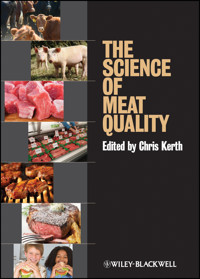
The Science of Meat Quality E-Book
187,99 €
Mehr erfahren.
- Herausgeber: John Wiley & Sons
- Kategorie: Wissenschaft und neue Technologien
- Sprache: Englisch
Meat has been a long sought after source of nutrients in human diets. Its nutrient-dense composition of protein, fats, vitamins and minerals makes it an integral part to healthy and balanced diets. As demand for meat continues to increase globally, a better understanding of efficiently producing quality meat products is becoming increasingly important. The Science of Meat Quality provides comprehensive coverage of meat quality from the biological basis of muscle development to end-product-use topics such as preparation and sensory analysis. The Science of Meat Quality explores the basis of meat quality long before it hits grocery store shelves. The book opens with a look at cellular muscle tissue development, metabolism and physiology. Subsequent chapters look at topics surrounding the development of tenderness, water-holding capacity, lipid oxidation and color in meat products. The final chapters discuss producing a good-tasting end product from preparing meat to preventing food-borne illness. Each chapter contains not only the theory behind that topic, but also detailed lab methodologies for measuring each meat quality trait. The Science of Meat Quality is an essential resource and reference for animal scientists, meat scientists, food scientists, and food industry personnel. Meat has been a long sought after source of nutrients in human diets. Its nutrient-dense composition of protein, fats, vitamins and minerals makes it an integral part to healthy and balanced diets. As demand for meat continues to increase globally, a better understanding of efficiently producing quality meat products is becoming increasingly important. The Science of Meat Quality provides comprehensive coverage of meat quality from the biological basis of muscle development to end-product-use topics such as preparation and sensory analysis. The Science of Meat Quality explores the basis of meat quality long before it hits grocery store shelves. The book opens with a look at cellular muscle tissue development, metabolism and physiology. Subsequent chapters look at topics surrounding the development of tenderness, water-holding capacity, lipid oxidation and color in meat products. The final chapters discuss producing a good-tasting end product from preparing meat to preventing food-borne illness. Each chapter contains not only the theory behind that topic, but also detailed lab methodologies for measuring each meat quality trait. The Science of Meat Quality is an essential resource and reference for animal scientists, meat scientists, food scientists, and food industry personnel.
Sie lesen das E-Book in den Legimi-Apps auf:
Seitenzahl: 635
Veröffentlichungsjahr: 2013
Ähnliche




















Contents
Cover
Title Page
Copyright
Contributors
Chapter 1: Growth of Muscle from the Myoblast to Whole Muscle
Introduction
Overview of Skeletal Muscle Development
Hyperplasia (Prenatal Muscle Development)
Hypertrophy (Postnatal Muscle Development)
Muscle Cell Culture
References
Chapter 2: Animal Growth and Empty Body Composition
Composition of the Empty Body from Birth to Harvest
Chemical Composition
Physical Separation
Magnetic Resonance Imaging
X-Ray Computed Tomography Scanning
Near-Infrared Reflectance
Total Body Electromagnetic Conductivity (TOBEC)
Dual-Energy X-Ray Absorptiometry
Video Image Analysis
40K Liquid Scintillation Counter
Dilution Techniques
Ultrasound Technology
Specific Gravity
Carcass Yields of Closely Trimmed Retail Product or Fat-Free Lean
Summary
References
Chapter 3: Muscle Structure and Cytoskeletal Proteins
Introduction
Connective Tissue
Organizational Structure of Muscle
Muscle Cell Structure
Proteins of the Muscle
Isolating Myofibrillar Proteins
References
Chapter 4: Muscle Metabolism and Contraction
Introduction
Metabolism
Muscle Contraction
Muscle Fiber Types
Fiber Typing Procedure—Combined Stain for Identifying Muscle Fiber Types
References
Chapter 5: Converting Muscle to Meat: The Physiology of Rigor
Introduction
Muscle Metabolism upon Exsanguination
Development of Meat Quality
Antemortem Factors
Postmortem Factors
Analysis of Muscle pH
Analysis of Sarcomere Length
References
Chapter 6: Meat Tenderness
Introduction
What is Tenderness?
Factors that Affect Tenderness
Measuring Tenderness
References
Chapter 7: Water-Holding Capacity of Meat
Introduction
Postmortem Muscle Metabolism and the WHC of Meat
Drip Channels and Postmortem Aging
Manipulating the WHC of Meat
Factors Influencing the WHC of Meat
Methods of Measuring the WHC of Meat
References
Chapter 8: Lipids and Lipid Oxidation
Introduction
Structure, Nomenclature, and Classification of Meat Lipids
Composition of Lipids in Meat
Extraction of Lipids
Analyses
Lipid Oxidation in Muscle Foods
Measurement of Oxidation
Procedures
References
Chapter 9: Meat Color
Introduction
Meat Color Chemistry
Deoxymyoglobin
Oxymyoglobin
Carboxymyoglobin
Metmyoglobin
Oxygen Consumption
Metmyoglobin Reduction
Deoxygenation and Subsequent Reoxygenation
Hemoglobin
Antemortem Factors Affecting Meat Color
Postmortem Factors Affecting Meat Color
Laboratory Analyses of Raw Meat Surface Color
New Developments in Color Research Using Proteomics
Conclusion
References
Chapter 10: Meat Cookery
Cooking Loss
Maillard Reaction and Flavor Impacts
Soluble and Insoluble Collagen
Cookery Methods
Cooked Color
Conclusion
References
Chapter 11: Trained Sensory Panels
Introduction and History
Trained Panels and Sensory Attributes
Panel Training
References
Chapter 12: Untrained Sensory Panels
Introduction
Testing Locations
Panel Considerations
Human Subject
Recruiting Panelists
Panel Selection
Panel Size and Replication
Sensory Methods
Discrimination Testing
Acceptance and Preference Testing
Preference Tests
Hedonic Scales
Summary
References
Chapter 13: Consumer Sensory Panels
Developing an Experimental Approach
Conducting Consumer Testing
References
Chapter 14: Preventing Foodborne Illness
Introduction
Parameters that Affect Microbial Growth
Prevention of Foodborne Illness—Processing Operations and Management Tools
Chemical Food Protection and Preservation
Physical Food Protection and Preservation
Microbial Indicators and Sampling Plans
Common Microbiological Culturing Methods
References
Index
Food Science and Technology
This edition first published 2013 © 2013 by John Wiley & Sons, Inc.
Wiley-Blackwell is an imprint of John Wiley & Sons, formed by the merger of Wiley's global Scientific, Technical and Medical business with Blackwell Publishing.
Editorial Offices:2121 State Avenue, Ames, Iowa 50014-8300, USA The Atrium, Southern Gate, Chichester, West Sussex, PO19 8SQ, UK 9600 Garsington Road, Oxford, OX4 2DQ, UK
For details of our global editorial offices, for customer services and for information about how to apply for permission to reuse the copyright material in this book please see our website at www.wiley.com/wiley-blackwell.
Authorization to photocopy items for internal or personal use, or the internal or personal use of specific clients, is granted by Blackwell Publishing, provided that the base fee is paid directly to the Copyright Clearance Center, 222 Rosewood Drive, Danvers, MA 01923. For those organizations that have been granted a photocopy license by CCC, a separate system of payments has been arranged. The fee codes for users of the Transactional Reporting Service are ISBN-13: 978-0-8138-1543-5/2013.
Designations used by companies to distinguish their products are often claimed as trademarks. All brand names and product names used in this book are trade names, service marks, trademarks or registered trademarks of their respective owners. The publisher is not associated with any product or vendor mentioned in this book.
Limit of Liability/Disclaimer of Warranty: While the publisher and author(s) have used their best efforts in preparing this book, they make no representations or warranties with respect to the accuracy or completeness of the contents of this book and specifically disclaim any implied warranties of merchantability or fitness for a particular purpose. It is sold on the understanding that the publisher is not engaged in rendering professional services and neither the publisher nor the author shall be liable for damages arising herefrom. If professional advice or other expert assistance is required, the services of a competent professional should be sought.
Library of Congress Cataloging-in-Publication Data
The science of meat quality / edited by Chris R. Kerth, Animal Science Department, Texas A&M University, USA. pages cm Includes bibliographical references and index. ISBN 978-0-8138-1543-5 (hardback) – ISBN 978-1-118-53069-6 (epdf) – ISBN 978-1-118-53070-2 (emobi) 1. Meat–Quality. 2. Meat industry and trade–Quality control. I. Kerth, Chris R., editor of compilation. TS1955.S35 2013 641.3′6–dc23 2012040686
A catalogue record for this book is available from the British Library.
Wiley also publishes its books in a variety of electronic formats. Some content that appears in print may not be available in electronic books.
Cover images: © iStock.com/Paul Kline; © iStock.com/Arthur Kwiatkowski; © iStock.com/Lauri Patterson; © iStock.com/Peter Booth; © iStock.com/Jeff Fullerton; © iStock.com/Catherine Yeulet; © iStock.com/NightAndDayImages. Cover design by Nicole Teut
Contributors
Jason K. AppleDepartment of Animal Science, University of Arkansas, Fayetteville, ArkansasChristy L. BratcherDepartment of Animal Sciences, College of Agriculture, Auburn University, Auburn, AlabamaKirk W. BradenDepartment of Agriculture, Angelo State University, San Angelo, TexasTerry BrandebourgDepartment of Animal Sciences, College of Agriculture, Auburn University, Auburn, AlabamaRyan CoxDepartment of Animal Science, University of Minnesota, St. Paul, MinnesotaPatricia C. CurtisDepartment of Poultry Science, College of Agriculture, Auburn University, Auburn, AlabamaMichael A. DavisBaker County Extension Director, University of Florida, Macclenny, FloridaMichael DikemanDepartment of Animal Sciences and Industry, Kansas State University, Manhattan, KansasChris R. KerthDepartment of Animal Science, College of Agriculture and Life Sciences, Texas A&M University, College Station, TexasRichard ManciniDepartment of Animal Sciences, College of Agriculture and Natural Resources, University of Connecticut, Storrs, ConnecticutClinton RoweFood Scientist, ConAgra Foods, Omaha, NebraskaKyle WillianDepartment of Chemistry, Tuskegee University, Tuskegee, Alabama1
Growth of Muscle from the Myoblast to Whole Muscle
Terry Brandebourg
Introduction
Better understanding of the growth and development of skeletal muscle, and to a lesser extent, adipose tissue, is an important endeavor in meat science. This goal is driven by the need for the meat industry to consistently satisfy consumer demand for nutritious, high-quality, lean products in as efficient a manner as possible. Importantly, meat products are primarily derived from the skeletal muscle and associated fat of livestock.
Muscle growth, composition, and metabolism are integrally linked to meat quality through effects on yield, tenderness, and color. Typically, meat-producing animals are grown until an optimal balance between muscle mass and fattening is achieved. Upon slaughter, livestock carcasses are dressed leaving only the bones and edible muscles. Dressed carcasses are then aged in a temperature-controlled environment where biochemical processes such as glycolysis and protein degradation contribute to optimal meat quality.
Undoubtedly, advances in our understanding of factors that regulate the growth and development of muscle and the conversion of whole muscle to meat will lead to strategies that enhance meat quality. With these goals in view, this chapter will focus upon the growth of muscle from the myoblast precursor to whole muscle and upon cell culture techniques that allow these processes to be studied.
Overview of Skeletal Muscle Development
The growth of skeletal muscle can be meaningfully divided into stages by key developmental milestones. Landmarks such as conception, the maturation of the embryo (spanning the eight-cell stage through implantation), parturition, and finally, postnatal growth largely frame periods where specific mechanisms of growth contribute uniquely to muscle development. Thus, such landmarks represent useful points of reference that form a roadmap for better understanding of skeletal muscle development.
Viewed through this paradigm, skeletal muscle development can be divided roughly into two general phases of growth by parturition. Prenatal muscle development occurs primarily through increases in muscle fiber number (hyperplasia). Whereas postnatal growth of muscle is accomplished by increases in the size of preexisting muscle fibers (hypertrophy). In absence of injury, fiber number is essentially maintained during this period as very little new muscle fiber growth occurs after birth.
Alternatively, skeletal muscle development can be broken temporally into three phases of myogenesis. During early gestation, fiber number is increased via embryonic myogenesis (primary fiber formation). A second wave of fetal myogenesis (secondary fiber formation) then occurs during mid- to late-gestation. These two waves of prenatal myogenesis essentially dictate muscle fiber number in the adult. A third wave, satellite cell-related myogenesis mediates the postnatal increase in muscle fiber size that occurs in growing animals. Satellite cell fusion is also responsible for the maintenance of fiber number in the adult by facilitating the regeneration of damaged muscle fibers. Thus, an understanding of the regulation of myogenesis can largely inform all stages of skeletal muscle development (Fig. 1.1).
Figure 1.1 Roadmap for better understanding the skeletal muscle development based upon key developmental milestones. Such landmarks break development into discreet periods that are defined by unique mechanisms of muscle growth.
Types of Muscle
Three types of muscles can be distinguished structurally and physiologically in livestock. Smooth muscle is found in the walls of blood vessels, the lining of the gastrointestinal tract, uterine walls, and walls of respiratory passages. This type of muscle is innervated by the autonomic nervous system, thus its contraction is characterized by slow, but sustained contractile velocity that occurs without conscious thought. A second type of muscle, cardiac muscle, is innervated with an intrinsic nervous system unique to the heart that is specialized for generating highly controlled rhythmic contractions. Finally, skeletal muscle comprises the bulk of muscle in the body and its contraction is controlled by nerves emanating from the spinal cord. Importantly, skeletal muscle represents the primary source of meat from the carcass.
The unique and highly organized structure of skeletal muscle facilitates locomotion, a primary function of this muscle. Skeletal muscle appears striated due to the abundant expression of contractile apparatus proteins and, as discussed later, this muscle can appear reddish or whitish depending upon its fiber composition. Regardless of the anatomical location, skeletal muscles originate on a bone and terminate across the joint of another bone further away from the body's axis in such a way as to allow bones to rotate about the joint and move upon muscle contraction (Engel and Franzini-Armstrong, 2004). Muscles attach either via a tendon or upon a thin sheet of connective tissue (fascia).
Structure of Muscle
It is necessary to first appreciate the structural organization of skeletal muscle in order to understand why its development occurs as it does. The ultra-structure of the muscle cell and components of the contractile apparatus will be discussed in great detail in subsequent chapters. For now, we will focus upon the organization of the myofibril network and how this network interacts with the specialized membrane system of muscle fibers as these interactions are important for both prenatal and postnatal growth.
Lesen Sie weiter in der vollständigen Ausgabe!
Lesen Sie weiter in der vollständigen Ausgabe!
Lesen Sie weiter in der vollständigen Ausgabe!
Lesen Sie weiter in der vollständigen Ausgabe!
Lesen Sie weiter in der vollständigen Ausgabe!
Lesen Sie weiter in der vollständigen Ausgabe!
Lesen Sie weiter in der vollständigen Ausgabe!
Lesen Sie weiter in der vollständigen Ausgabe!
Lesen Sie weiter in der vollständigen Ausgabe!
Lesen Sie weiter in der vollständigen Ausgabe!
Lesen Sie weiter in der vollständigen Ausgabe!
Lesen Sie weiter in der vollständigen Ausgabe!
Lesen Sie weiter in der vollständigen Ausgabe!
Lesen Sie weiter in der vollständigen Ausgabe!
Lesen Sie weiter in der vollständigen Ausgabe!




