


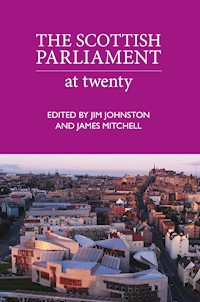
The Scottish Parliament E-Book
9,59 €
Mehr erfahren.
- Herausgeber: Luath Press
- Kategorie: Geisteswissenschaft
- Sprache: Englisch
Jim Johnston and James Mitchell bring authors from various backgrounds together to discuss the Parliament's future. These voices include a feminist and equalities campaigner, the chairman of Brodies LLP and the President of the Convention of Scottish Local Authorities, among many others. This short series of think pieces discusses vital issues such as the increased complexity of devolution, the Parliament's new fiscal and welfare powers and the need to respond to public expectations and demands. Interspersed throughout the book are a number of Dear Scottish Parliament… letters from young people across Scotland articulating their hopes and dreams for Scotland for the next 20 years. The Parliament has established itself as an accepted feature in Scotland's political landscape and there is little, if any, debate about its legitimacy as a representative body. At the same time, however, the goodwill towards the Parliament is likely to be tested as MSPs are faced with significant challenges over the next 20 years. This book explores some of these challenges and signposts key priorities in response.
Das E-Book können Sie in Legimi-Apps oder einer beliebigen App lesen, die das folgende Format unterstützen:
Veröffentlichungsjahr: 2019
Ähnliche




















ON 12 MAY 1999, Dr Winifred Ewing MSP, acting Presiding Officer, announced that ‘the Scottish Parliament which adjourned on 25 March 1707, is hereby reconvened’. In the 20 years since then, we have had a further four Scottish Parliamentary elections. Five First Ministers and five Presiding Officers have been elected from an overall total of 306 MSPs, and of these 18 Members have served continuously. 347 bills have been introduced, of which 291 have been passed, 11 withdrawn, 31 have fallen and 14 are currently in progress. There have been 1,719 petitions lodged and 8,553 committee meetings held. 660 sessions of First Minister’s Questions have taken place and 161,618 written questions have been submitted to Ministers.
Enric Miralles’ vision for the Parliament building was for it to sit in the land among the people its Members represent. It is now firmly rooted.
First published 2019
ISBN: 978-1-912387-58-8 (HBK)
The authors’ right to be identified as authors of this book under the Copyright, Designs and Patents Act 1988 has been asserted.
The paper used in this book is recyclable. It is made from low chlorine pulps produced in a low energy, low emission manner from renewable forests.
Printed and bound by
Bell & Bain Ltd, Glasgow
Typeset in 11 point Sabon by Main Point Books, Edinburgh
Text © the contributors, 2019
Unless otherwise indicated, all diagrams are provided by SPICe. ‘Open the Doors!’ by Edwin Morgan reproduced with the permission of the Scottish Parliamentary Corporate Body.
Contents
Acknowledgements
Open the Doors!EDWIN MORGAN
ForewordKEN MACINTOSH MSP
IntroductionJIM JOHNSTON AND JAMES MITCHELL
1 Doing Right by the Common WealBERNARD PONSONBY
Dear Scottish Parliament… Alicja Hertmanowska
2 A Building Which is More Than a BuildingGILLIAN BAXENDINE
Dear Scottish Parliament…
3 A Tale of Two ParliamentsLEE BRIDGES
4 The MSP’s RoleALAN CONVERY AND DAVID PARKER
Dear Scottish Parliament… Claire Hossack
5 Parliament and Business: An Unfulfilled Relationship?MICHAEL CROW
Dear Scottish Parliament… Dionne Hossack
6 People-Powered PoliticsFIONA DUNCAN
7 Local Government and the Scottish Parliament: Parity of Esteem?ALISON EVISON
Dear Scottish Parliament… Ellie Gauld
8 Scrutiny and TransparencyCAROLINE GARDNER
Dear Scottish Parliament… Emma Cook
9 Raising TaxesCHARLOTTE BARBOUR AND MOIRA KELLY
10 Twenty Years of Devolution: Small Steps Towards Equality, But We Need Big LeapsTALAT YAQOOB
Dear Scottish Parliament… Etieno Essien
11 Some Questions on Sovereignty and Free SpeechCHARLES ROBERT
Dear Scottish Parliament… Ewan Carmichael
12 A New Voice in the LandJIM WALLACE
Dear Scottish Parliament… Hope Teal
13 The Role of LawCHRISTINE O’NEILL
14 The Scottish Economy: Fiscal Challenges and OpportunitiesGRAEME ROY AND DAVID EISER
Dear Scottish Parliament… Quinn Muirhead
15 Principles and Practices of the Good Parliament: Babyleave, Institutional Resistance and ChangeSARAH CHILDS
Dear Scottish Parliament… Robyn Gibson
16 Look, Listen: This is Who We AreJAMES ROBERTSON
Conclusion: The Scottish Parliament in a Changing WorldJIM JOHNSTON AND JAMES MITCHELL
Appendix: A User’s Guide to the Scottish ParliamentELIZABETH CANTLIE AND ANDREW AITON
Contributor Biographies
Acknowledgements
Our aim in this book is to take the opportunity, which the 20th anniversary of devolution provides, to reflect on the role of the Scottish Parliament and to look forward to the next 20 years, not least in terms of future challenges and opportunities. It is not an academic text and we asked all our contributors to write in an open and accessible style in keeping with the core principles of the Parliament. We thank them for doing so and also for their good humour and understanding during the editing process.
We would like to thank our advisory panel, consisting of Sarah Davidson, Christine O’Neill, Louise Macdonald, Sir George Reid, Caroline Gardner and chaired by Sir Paul Grice, who provided helpful advice on the content, purpose and contributors for the book. In particular, we are especially grateful to Louise for her proposal for a letter writing competition and to her team at YoungScot – led by Allan Lindsay – for running the competition. We thank all of the young people who took the time to write a letter and 11 of these have been included in the book, one anonymously.
Finally, we are indebted to our publishers, Luath Press and especially Gavin MacDougall and Carrie Hutchison, for their support, patience and encouragement.
Jim Johnston and James Mitchell
May 2019
Open the Doors!
Open the doors! Light of the day, shine in; light of the mind, shine out!
We have a building which is more than a building.
There is a commerce between inner and outer,
between brightness and shadow,
between the world and those who
think about the world.
Is it not a mystery? The parts cohere, they come together
like petals of a flower, yet they also send their tongues
outward to feel and taste the teeming earth.
Did you want classic columns and predictable pediments? A
growl of old Gothic grandeur? A blissfully boring box?
Not here, no thanks! No icon, no IKEA, no iceberg, but
curves and caverns, nooks and niches, huddles and
heavens syncopations and surprises. Leave symmetry to the cemetery.
But bring together slate and stainless steel, black granite
and grey granite, seasoned oak and sycamore, concrete
blond and smooth as silk – the mix is almost alive –
it breathes and beckons – imperial marble it is not!
Come down the Mile, into the heart of the city, past the kirk
of St Giles and the closes and wynds of the noted ghosts of
history who drank their claret and fell down the steep
tenements stairs into the arms of link-boys but who wrote
and talked the starry Enlightenment of their days –
And before them the auld makars who tickled a Scottish king’s
ear with melody and ribaldry and frank advice –
And when you are there, down there, in the midst of things,
not set upon an hill with your nose in the air,
This is where you know your parliament should be
And this is where it is, just here.
What do the people want of the place? They want it to be
filled with thinking persons as open and adventurous as its architecture.
A nest of fearties is what they do not want.
A symposium of procrastinators is what they do not want.
A phalanx of forelock-tuggers is what they do not want.
And perhaps above all the droopy mantra of ‘it wizny me’ is
what they do not want.
Dear friends, dear lawgivers, dear parliamentarians, you are
picking up a thread of pride and self-esteem that has been
almost but not quite, oh no not quite, not ever broken or forgotten.
When you convene you will be reconvening, with a sense of not
wholly the power, not yet wholly the power, but a good
sense of what was once in the honour of your grasp.
All right. Forget, or don’t forget, the past. Trumpets and
robes are fine, but in the present and the future you will
need something more.
What is it? We, the people, cannot tell you yet, but you will know about it
when we do tell you.
We give you our consent to govern, don’t pocket it and ride away.
We give you our deepest dearest wish to govern well, don’t say we
have no mandate to be so bold.
We give you this great building, don’t let your work and hope be other than
great when you enter and begin.
So now begin. Open the doors and begin.
Edwin Morgan
Foreword
KEN MACINTOSH MSP, Presiding Officer
I HAVE NEVER forgotten the excitement, the optimism, or the sense of anticipation, which accompanied becoming a Member of the Scottish Parliament following those first elections in May 1999. Here was a brand-new institution that would help shape the modern Scotland and build a society of which we could all be proud.
I am pleased to say that, 20 years on, I have lost none of my hope, but I am conscious that, for my children, devolution is no novelty. They have never known this country without its own Parliament and, while I believe that what we have achieved in 20 years is quite remarkable, they are part of a whole generation for whom Holyrood is now simply accepted as the central focus for political and civic debate.
This timely book both looks back at the development of the Scottish Parliament over the last two decades and perceptively outlines some of the challenges that lie ahead. It does so, not as a dry academic textbook, but as an accessible collection of thoughts and observations. Jim Johnston and James Mitchell have pulled together a range of voices, from the winners of a letter writing competition organised by YoungScot to the more reflective comments of some of this country’s most respected political commentators.
We share their journey, from the early ground-breaking legislation on land reform and the smoking ban, to the new choices thrown up by environmental and demographic change. The intervening years have seen some dramatic political ups and downs but, as the writer James Robertson remarks, the ‘new political landscape looks remarkably mature after only 20 years’.
Devolution itself has changed considerably in that time and the Parliament is still wrestling with new powers over taxation and social security. Graeme Roy and David Eiser are amongst those who look to the potential risks ahead as we shape a new fiscal landscape. The Parliament still holds true to the principles of openness and equality on which we were founded but, as our own Gillian Baxendine writes, we have sometimes struggled to fulfil the promise to share power with the people of Scotland and to ‘talk openly about the tensions between the representative democracy of the past and the growing demand for participation’.
On gender representation and diversity, in the way we use social media and encourage respectful dialogue and in the manner in which we establish trust in an era of fake news, there are plenty of political battles still to come. This book touches on all of those subjects and more. At a time when politics is often talked about with cynicism, it is a reminder that the Parliament still has the potential to fulfil all our hopes and dreams.
In the words of one of our young contributors, Alicja Hertmanowska:
I’m hoping for the best of the Scottish Parliament for the next 20 years and I’m very excited and looking forward to what the future brings.
Introduction
JIM JOHNSTON AND JAMES MITCHELL
A PARLIAMENT HAS three main functions in a democracy: linking the people and law-makers; making laws and policies; and legitimising decisions. There are many different ways in which these functions can be performed. The Scottish Parliament was created with the intention of performing its functions differently from Westminster. It succeeded in being a modern, rather than a fundamentally different version of the House of Commons. The electoral system, hemispheric architecture, greater informality and serious efforts to fulfil its linkage function with the public were all built into the design. But the system of parliamentary government in which the Executive is chosen from within the legislature, and the Westminster experience of many leading members in its early years, ensured that the Scottish Parliament was part of the Westminster family of legislatures in its fundamentals.
The Parliament has become part of the everyday political furniture of Scottish politics. It is taken for granted – a sign of becoming legitimate in the eyes of politicians and the public. While debate continues on Scotland’s constitutional status, few question whether the Scottish Parliament should exist. It is the focus of policy debates. Regardless of views on the merits – or demerits – of the policies or competence, the Executives emerging after each election have been accepted and have given Scotland the experience of almost the full range of possibilities: majority coalition, minority single party and majority single party. Relations between the Parliament and Executive have differed, but in each case, there has been no sense that the Executive lacks legitimacy. We have yet to see a minority coalition, but the Parliament is still young.
Parliamentary authorities took pride in their outreach efforts, acknowledging that links with the public needed to extend well beyond elections and the considerable efforts made by individual MSPs. Nearly five million individuals have visited the Parliament since 1999, as well as people from overseas seeking to learn from the Scottish experience. There was also pride in the early years that Holyrood was perceived to have stolen a march on the Commons in creating a modern Parliament.
But political institutions cannot stand still if they are to meet new challenges and take advantage of new opportunities. Not only must any legislature keep up with the times and respond to these changes, but it should attempt to anticipate change. As Lee Bridges, with the experience of working in both parliaments, states in his chapter, in relation to engagement activity, it is difficult to claim now that Holyrood is ahead of the Commons as a modern legislature. Reforms introduced in the Commons over the last 20 years have had a significant impact. Holyrood has considered some of the same reforms, including electing committee conveners; the Commission on Parliamentary Reform recommended that Parliament should put in place procedures for the election of conveners from the start of the next session, as had many commentators over the years. This recommendation is currently being considered by the Standards, Procedures and Public Appointments Committee.
Holyrood’s policy-making potential remains under-developed. In large measure, this is a systemic problem and not due to any weakness on the part of MSPs. The ‘Westminster model’ is described as one in which the executive branch has considerable control over the legislative. This interpretation of both how the Commons and Holyrood operate can be exaggerated. Opposition members and government backbenchers can – and do – influence policy, but often in ways that attract little media attention and are hidden from view. Indeed, there is an inherent paradox in Holyrood, as in many legislatures. US President Woodrow Wilson had a distinguished academic career before entering politics and in one of his books wrote that:
Congress in session is Congress on public exhibition whilst Congress in its committee-rooms is Congress at work.
That observation resonates almost two and a half centuries later. The Holyrood Chamber is the forum of much adversarial debate and it is in committee that much important work is done. But whether the committees have lived up to expectations is another matter. The recent Commission on Parliamentary Reform noted that
while the committees have on occasion been robust in their scrutiny of government and others, overall, they have not been as effective as the CSG [Consultative Steering Group] anticipated in holding government to account.
Again, a point made repeatedly by a number of commentators.
Politics across the globe is contending with the need for greater transparency. This can encourage a more adversarial campaigning style of politics while ensuring that there is limited space for serious policy discussion which requires reaching reasoned discussion and consensus. The campaign mindset on public exhibition squeezes out the essential governing mindset required for serious policy-making. There had been much commentary on the ‘new politics’ which was hoped would accompany the establishment of the Parliament 20 years ago. It would be easy to dismiss this hope as naïve. Removing passion from politics is neither possible nor appealing, but Holyrood has struggled to cut out a significant role for itself as a policy-making institution. Holyrood has settled into the Westminster mould as an institution on exhibition. It will take a significant change in capacity, practices and behaviour of its members for Holyrood to become a serious policy-making institution.
The findings of the Budget Process Review Group illustrate the extent of this challenge. They found that there is little emphasis within the budget process on seeking to influence the formulation of the Scottish Government’s spending proposals. It found that this was unsurprising given that parliamentary scrutiny of the budget began after the Government had set out firm and detailed spending proposals. Prior to that, there is little public consultation or transparency in the formulation of the budget. The group, therefore, recommended that committees carry out pre-budget scrutiny prior to the Government’s publication of firm and detailed spending proposals and suggested this would require cultural change as well as changes to process and procedures.
Another area in which the Parliament has an opportunity to influence policy-making is through pre-legislative scrutiny. The Standards, Procedures and Public Appointments Committee concluded in 2015 that pre-legislative scrutiny has advantages and would give committees the chance to influence the development of a bill before it is introduced. The committee also recommended that all Scottish Government bills are published in draft. But, as noted by the Commission on Parliamentary Reform, committees have undertaken ‘little pre- or post-legislative scrutiny’.
At the same time, as illustrated in this book, there is some evidence of committees effectively influencing policy development. For example, Jim Wallace recognises that he had to water-down proposals for a smacking ban and for raising the age of criminal responsibility in Scotland in response to committee scrutiny. Graeme Roy and David Eiser highlight the important role of the Finance Committee in influencing the structure and independence of the Scottish Fiscal Commission. The latter also point to the Economy, Jobs and Fair Work Committee’s push to abolish pre-release access privileges for Scottish ministers for Scottish economic and fiscal data as a good test of the relative strength of parliament to force the government to respond to the will of msps.
The American Congress is the classic example of a legislature that has cut out a considerable policy-making role, including a role in budgetary matters. It lies at one end of the legislative policy-making spectrum of liberal democracies while Westminster-type legislatures lie at the opposite end. But Members of Congress have the time and capacity to scrutinise budgets in detail and to approve and amend spending plans. While there has been some effort to increase the resources of the Scottish Parliament, including the introduction of the Financial Scrutiny Unit, Holyrood still lacks the capacity of the House of Commons. The Scrutiny Unit in the Commons has significantly enhanced the Commons’ resources in this respect.
But the linkage between parliament and government is not only about policy-making and scrutiny. Its oversight role includes agenda-setting. Members of the Scottish Parliament can set agendas by raising issues without necessarily having a ready-made policy and can push government to consider and develop policy. This is an area where the Parliament has made an impact, with members raising issues through questions and in debates in the Chamber.
Increased Complexity
One of the fundamental challenges facing the Scottish Parliament is the increasing complexity of devolution. This compares to the relatively clear and intuitive nature of the original settlement. This was neatly summed up by Donald Dewar, as noted by James Robertson in his chapter, when he said in a speech in the House of Commons: ‘Everything that is not reserved comes to Edinburgh’. It was never quite so simple. There was remarkable stability with few disputes between the two governments in Edinburgh and London regarding the powers of the Scottish Parliament. However, as devolved government evolved amid more challenging economic and fiscal times, it has become more complex with a much greater scope for dispute. As Christine O’Neill notes in her chapter, while
devolution was never simple, I think it can be fairly argued that over the course of the last 20 years the task of understanding the boundaries of the Parliament’s law-making powers has become progressively more difficult.
While the first ten years of devolution was relatively stable and the establishment of the Scottish Parliament was readily assisted by a favourable fiscal environment and relatively strong economic growth, the second ten years have been considerably more volatile constitutionally, economically and fiscally. The Parliament has faced considerable challenges in navigating waters which have become, simultaneously, increasingly choppy and muddy. At the same time, as the fiscal position has become much more challenging, the Scottish Parliament has taken on much greater responsibility for its own budget through significant new tax powers. This brings much greater risks, as well as opportunities.
Since the Scotland Act 1998, there have been two further pieces of legislation which devolve substantial further powers to the Scottish Parliament. The Scotland Act 2012 primarily implemented the recommendations of the Calman Commission including additional tax and borrowing powers. It also led to the establishment of Revenue Scotland – the tax authority responsible for the administration of Scotland’s devolved taxes. The Scotland Act 2016 implemented the recommendations of the Smith Commission following the independence referendum in 2014, including further tax and borrowing powers and new welfare powers. As Graeme Roy and David Eiser point out in their chapter:
The devolved fiscal landscape is now far more complex than it was in 1999, with new institutions and the transfer of much greater risks.
In a similar vein, Christine O’Neill emphasises the ‘highly complex’ nature of the devolution of the new social security powers.
The pace of constitutional change has again accelerated following the vote to leave the EU in the 2016 referendum. One of the consequences of the UK leaving the EU is the need to reflect on the robustness of the existing devolution arrangements. The first main test of these arrangements after the Brexit referendum was the introduction of the European Union (Withdrawal) Bill at Westminster. This was immediately viewed by the Welsh and Scottish Governments as a ‘power grab’ by the UK Government. The dispute rested on whether the devolved powers within EU competence should be returned to London, or Cardiff and Edinburgh, following Brexit.
The bill alters the legislative competence of the Scottish Parliament by removing the requirement for the Parliament to legislate compatibly with EU law. But it also alters the competence of the devolved parliaments and assemblies by introducing a new legislative constraint. Subsequent amendments to the bill and an accompanying inter-governmental agreement meant that the Welsh Government were able to recommend legislative consent for the bill to the National Assembly for Wales. However, the Scottish Government continues to have concerns regarding the constraint on the legislative and executive competence of the Scottish Parliament and the Scottish Government within the bill. While the Scottish Parliament voted to withhold consent the bill was nevertheless passed by Westminster, including this constraint, which as Christine O’Neill points out,
empowers the UK Government, using secondary legislation, to prohibit the Scottish parliament from changing ‘retained EU law’… in areas specified by the UK Government in regulations.
One of the key challenges for the Parliament is likely to be the extent to which the necessary revisions to devolution can be delivered through consensus and what happens if agreement cannot be reached between all of the UK’s governments.
For the Parliament, this increasing complexity provides challenges in relation to all three of its main functions. First, in relation to the linking the people and law-makers, there is a need to provide clarity and understanding of the Parliament’s new powers and how they work. Second, regarding making laws and policies, there is a risk – primarily arising from Brexit – that where laws and policies are made becomes increasingly contested between the devolved institutions and Westminster. Finally, the Parliament’s role in legitimising decisions is likely to be tested by an increasing emphasis on inter-governmental negotiations and decision-making which will inevitably take place primarily in private. These challenges are discussed in more detail below.
Linking the People and Law-Makers
As the constitutional arrangements across the UK become more complex and uncertain, there is a real challenge for the Parliament in how it fulfils its key function of both facilitating awareness and providing opportunities for public influence in its work. There is also a challenge, as highlighted by Christine O’Neill, in ensuring that both members and parliamentary officials have a good understanding of the evolving constitutional arrangements.
The Calman Commission’s primary rationale for the devolution of further tax powers was to improve the financial accountability of the Scottish Parliament. This requires the Scottish public to understand the new tax powers. However, as Charlotte Barbour and Moira Kelly point out,
a recent poll shows a lack of understanding among the general public as to which Parliament is responsible for specific tax policies [and] work is required in educating the public on the operation of Scottish taxes.
The devolution of significant further financial and welfare powers in the Scotland Act 2016 was accompanied by the introduction of the fiscal framework which sets out a complex set of rules and arrangements governing the interplay between the Scottish Parliament’s powers to raise taxes and the block grant (the element of the devolved administrations’ budget that comes directly from the UK Government). As each new tax is devolved, there is a reduction to the block grant equivalent to the tax revenues in Scotland which will now go directly to the Scottish Government. This initial reduction is then revised annually based on the relative growth of tax revenues in Scotland and the rest of the UK, adjusted for population growth. These calculations are not easy to follow as Graeme Roy and David Eiser highlight in their chapter,
the parliament has had some limited success in bringing clarity to what is a much more complex set of budget arrangements, but there remains much work to be done to broaden public understanding.
At the same time as MSPs have had to develop their understanding of these complex budget arrangements, they have also had to grapple with the impact of Brexit on the devolution settlement. While all of the governments across the UK recognise that there will need to be revisions to the UK’s constitutional arrangements, there are few details setting out how this will work. Despite this, the Parliament has begun to examine the impact of Brexit on its scrutiny role in relation to:
1. UK Ministers’ use of delegated powers to legislate in devolved areas (previously within the competence of the EU);
2. The formulation, negotiation and agreement of international treaties, including trade deals which cover devolved areas, and which would previously have been negotiated by the EU;
3. Common UK frameworks which the UK Government and the Scottish and Welsh Governments agree will be needed post-Brexit.
As well as seeking to develop new processes and procedures to provide meaningful scrutiny in each of these areas, the Parliament also faces the challenge of facilitating wider public understanding and opportunities for engagement with the new areas of competence which will be devolved to Edinburgh following Brexit.
Making Laws and Policies
One of the main advantages of the Scotland Act 1998 was that it was relatively easy to understand which powers were within the competence of the Scottish Parliament and those that were not were primarily set out in Schedule 5 to the Act. This meant that there were relatively few public disagreements between Edinburgh and London about where power lay within the new devolved settlement. There was little attention given to the constraints on the Scottish Parliament’s powers arising from the UK’s membership of the EU or other international treaties and agreements.
There was also little tension regarding the overlap between the devolved competences of the Scottish Parliament and the competences of the EU, even where this meant the UK legislating in devolved areas to meet the requirements of EU law, as it did often. It may well be that the likely constitutional arrangements which will be required following Brexit will work as smoothly but, at present, there is a real lack of clarity regarding what these will look like. There is also likely to be some disagreement between the devolved governments and the UK Government about where power lies in relation to the EU competences. For the Parliament, the key question will be the extent to which it will have the power to make laws and policies in areas currently within the competence of the EU and the extent to which there may be constraints on the use of these powers. For example, through the terms of international treaties agreed by the UK Government, including the future relationship with the EU. In some areas, there is likely to be the need for policy convergence across the UK but, in others, there will be opportunities for policy divergence. A key challenge for the Parliament will be to ensure there is openness and transparency in terms of the decision-making process for agreeing these future arrangements, including clarity regarding both the extent of the new powers and any constraints on their use, both legislative and non-legislative.
Legitimising Decisions
This challenge is bound to be significant for the Parliament given the likely constitutional wrangling over where these powers will sit following Brexit. While there is a clear recognition within the Parliament of the need for a confidential space for governments to negotiate in private, there is equally a clear recognition of the need for effective scrutiny of any changes to the devolution settlement, including on a non-legislative basis. The experience of the process for negotiating the fiscal framework, which was subject to very little parliamentary or wider public scrutiny prior to its publication, demonstrates the difficulties in delivering this.
The extent to which decisions are taken at an inter-governmental level without scrutiny raises questions about the Parliament’s role in providing legitimacy. If the only way to negotiate successfully and reach some kind of agreement requires a degree of private conversations, where does that leave Parliament? Legitimacy, in large part, results from the transparency of the decision-making process, levels of accountability and opportunities for influence within the process. This challenge confronts devolution regardless of which party is in government in London and in Edinburgh.
Conclusion
As the Parliament enters its 21st year, it is clear that its foundations are secure and that it has strong levels of support as a representative body. But, as this book demonstrates, there is no room for complacency and the goodwill towards the Parliament is likely to be tested as MSPs of all political parties are faced with significant challenges over the next 20 years. In this introduction, we have highlighted that the increased complexity of devolution and constitutional change is likely to remain high on the political agenda. Other challenges, as emphasised by a number of contributors in this book, include the impact of a rapidly ageing population on public services and public finances. While there are new incentives for the Parliament to reap the benefit of strong economic growth in Scotland, relative to the rest of the UK, there are also risks if that growth is weaker, and this risk needs to be managed. This will require the Parliament to continue to evolve and develop if it is to fulfil its three fundamental roles of linking the people and law-makers, making laws and policies and legitimising decisions.
CHAPTER 1
Doing Right by the Common Weal
BERNARD PONSONBY
1 JULY 1999 was a brilliantly sunny day. I was perched on a raised platform at the top of the Mound in Edinburgh, anchoring STV’s programme marking the opening of the Scottish Parliament. The day was memorable for the profound sense of celebration led by school children, politicians and ordinary citizens who jelled to forge a carnival atmosphere underscored by hope about the possibility of what might be.
That day, there was no Left and Right or Unionist and Nationalist. That day, perhaps uniquely in modern history, Scotland was as one in accepting that the new Parliament was a settled will that would become the focal point of national life.
The masterly speech made subsequently by the late Donald Dewar drew on his full appreciation of history, politics, culture and the sense of the place that the day would have in the nation’s narrative.
‘We are all fallible, we know that’ he told MSPs,
we will all make mistakes. But I hope, and I believe, we will never lose sight of what brought us here, the striving to do right by the people of Scotland, to respect their priorities, to better their lot and to contribute to the common weal.
His words were a declaration of ambition for the new Parliament and, what’s more, a declaration no-one would possibly dispute.
Twenty years on and Scotland has changed. The Parliament has accelerated the move away from the douce, socially conservative and uptight feel of a post-war country dominated by deference to the monarchy, church and one’s betters.
In recognising the rights of women, children and gay people, and by shining a light on the darkness of abuse whether it is domestic, sexual or sectarian, the Parliament has articulated a very clear sense of what is right and wrong. The rights conferred by the new institution, and its desire to better the lot of the less well-off, has perhaps been an unconscious attempt to define a modern notion of citizenship in which all are equal, and no-one is left behind.
It is worth remembering that Holyrood itself had to find its feet after a rocky, even tempestuous, start. The scandal of the Holyrood building project seemed to suggest that the new MSPs couldn’t manage to oversee the building of a Parliament, never mind do anything useful with its powers. The spiralling costs led to Donald Dewar actively considering resignation after he discovered he had misled Parliament on the scale of the cost over-runs. As the subsequent Fraser inquiry made clear, there was no single villain in this story.
The narrative outlined in Lord Fraser’s 2004 report would contain many salutary lessons for those seeking a better form of government. Dewar, it concluded, had been kept in the dark about much of the procurement process and given hopelessly optimistic assurances over the costs by senior civil servants which, in turn, he was passing onto Parliament.
The design competition was fatally flawed, potentially broke EU procurement rules and was executed by civil servants seemingly hopelessly out of their depth and areas of expertise. If you wanted to write a manual on how not to govern, then the Fraser report speaks volumes to a decision-making process which stood against the principles of openness, transparency and accountability. In some respects, given the timeline of the decision-making, this was the last bungled project of the government of the ‘old’ Scotland.
And then there was Dewar’s untimely death. It was clear to friends that he was not enjoying the experience for which he had waited a lifetime. Cautious and measured by nature, motivated by the very best of intentions and high on social democratic principle, Donald Dewar did not find government easy. This was, in part, because he found it difficult to be a good butcher, to paraphrase Clement Attlee. He hated confrontation and did not deal with the jockeying that was taking place among his colleagues over who might eventually succeed him.
Henry McLeish’s year in charge ended in resignation over an issue that should not have been a resigning matter, had he dealt with questions about the sub-let of a constituency office sooner. Initially, the right-wing press bombarded him with questions desperate to prove wrongdoing. Everyone else then joined in, convinced there must be something in the story given the ultra-defensive nature of the First Minister. Henry retreated to the bunker and, by the time he promised full disclosure over what he called ‘a muddle not a fiddle’, it was too late.
In the early days, the media did not so much scrutinise the Parliament as crucify it. Negativity and ridicule became irresistible themes and, in the issues of the Holyrood building project, the SQA exams fiasco, the errant behaviour of special advisers and the McLeish affair, they were presented with issues to give succour to Billy Connolly’s acidic view that it was a ‘wee pretendy parliament’.
Jack McConnell’s legacy to the government of Scotland is that he steadied the ship at a time when it looked as if it could sink altogether. The media eventually, and not before time, wearied of the ‘scandal narrative’ it had championed for so long and got down to reporting policy.
What the early days of devolution proved was that little thought had been given to what a parliament would actually do. For decades, the agitation had been about the need for a parliament and then, in the run up to its creation, on crafting sound principles on which it should govern.
Whether the governments have been of the Scottish Labour-Lib Dem or SNP variety, all have operated in a comfort zone, rarely – if ever – taking unpopular decisions or seeking to face down a difficult issue. Devolved Scotland has proved adept at saying yes to spending money and a little reserved about initiating any debate about wealth creation upon which undoubtedly popular policies would be sustained.




