


The Secession Talks E-Book
Erhalten Sie Zugang zu diesem und mehr als 300000 Büchern ab EUR 5,99 monatlich.
- Herausgeber: Schlebrügge.Editor
- Kategorie: Geisteswissenschaft
- Sprache: Englisch
The Secession Talks is a collection of artist talks on exhibitions that took place at the Secession from 2011 to 2022. They contextualize the exhibition history of the Secession and allow for a new consideration and evaluation of the program. As a collection, these conversations between artists and well-known art critics, art historians, curators, and artist colleagues form a unique interface between artistic work and art education.
Sie lesen das E-Book in den Legimi-Apps auf:
Seitenzahl: 1169
Veröffentlichungsjahr: 2023
Das E-Book (TTS) können Sie hören im Abo „Legimi Premium” in Legimi-Apps auf:
Ähnliche




















The Secession TalksExhibitions in Conversation2011–2022
Edited by Sylvia Liska,Friends of the Secession
Contents
Sylvia Liska
Foreword
2011
Inés Lombardi with Silvia Eiblmayr
Moritz Küng with Ferdinand Schmatz and Gabriele Mackert
Attila Csörgő with Christian Höller
2012
David Claerbout with Thomas D. Trummer
Liz Deschenes with Florian Pumhösl
Edgar ArceneauxThe Studio, the Social and the Ugly, the Practice of Edgar Arceneaux
Lecture
Payam Sharifi / Slavs and TatarsReverse Joy
Lecture
Yael Bartana with Juli Carson
2013
Robert Irwin with Jennifer Winkworth
Thomas Locher with Annette Südbeck
Ulla von Brandenburg with Markus Schinwald
Joseph Leo KoernerThe Viennese Interior
Lecture and Demonstration
Hannes Böck with Volker Pantenburg
2014
Lisl Ponger with Yvette Mutumba
Heinrich Dunst with Antony Hudek
Diana Al-Hadid with Angela Stief
Chto Delat with Gerald Raunig
Asier Mendizabal, Hilary Lloyd, and Dustin Ericksen with Pablo Lafuente
2015
Vija Celmins with Robert Storr
2016
Lutz Bacher and Peter CurrieShow ’n Tell
Lecture
Francis Alÿs with Catherine Lampert
2017
Svenja Deininger with Ulrich Loock
Jean-Luc Moulène with Corinne Diserens
Alex Da Corte with Kim Nguyen
Nicole Eisenman with Monika Baer
R. H. Quaytman with Joseph Leo Koerner
2018
Olga Chernysheva with Kathrin Rhomberg
Rudolf Polanszky with Andreas Reiter Raabe
Bouchra Khalili with Rike Frank
Anthony Huberman with Noit Banai, Sabeth Buchmann, and Eva Maria Stadler
Anthea Hamilton and Bakani Pick-Up with Carola Dertnig
Ed Ruscha with Kasper König
2019
Gerard Byrne with Willem de Rooij
Peter Doig with Matthew Higgs
Tillman Kaiser with Bob Nickas
Tala Madani with Mark Leckey
2020
John Akomfrah with Osei Bonsu
Edi Hila with Edi Muka
Lawrence Abu Hamdan with Lisa Stuckey
2021
Till Megerle with Ulla Rossek
Tess Jaray with Christian Siekmeier
Maria Hassabi with Andrea Lissoni
Dominique Gonzalez-Foerster with Olga Neuwirth
Danh Vō with Manuela Ammer
2022
Nairy Baghramian with Florian Pumhösl
Foreword
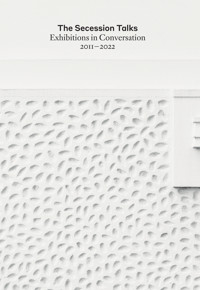
The motif we chose for the cover of this collection of artist talks shows the «Löffelputz» (spoon-finished plaster), a rare structured pattern adorning the lower part of the Secession’s façade. It is the pedestal on which the very idea of the organization and the building rests. While the plaster was still wet, a group of artisans and perhaps even artists got together to imprint an ornament with common spoons, maybe having brought them along from a conversation at a nearby coffeehouse. In a collective action, the design of this base for the new «Temple of the Arts» was created. An idea of communication and collaboration became a metaphor for everything that followed: programing exhibitions, having conversations about art, meeting in person, and acting as a community. After 125 years, this foundation on which the Secession stands proves to be a solid one.
Looking at the existing material of forty-six artist talks in the time frame of 2011 to 2022, regret is what comes to my mind first. Due to unfortunate technical mishaps, we didn’t manage to document all talks by the artists and their invited conversation partners. These were Kerry James Marshall with Christian Kravagna, Laura Owens with Mark Godfrey, and Vincent Fecteau with Bruce Hainley. Their conversations were so memorable, and it is very painful indeed that they could not be included.
Putting this thought aside and moving on, there is an amazing wealth of oral history, which since 2017, when we initiated the video documentation of our talks, also became available on the Secession’s website. This of course evokes questions: Why produce a book of this kind in the first place? Shouldn’t exhibitions speak for themselves? Aren’t they all accompanied by catalogues and artists’ books? And now with this new video format on hand, isn’t it much better to see and listen to the conversations themselves?
By producing this publication, our answers to these questions are evident: A book is a material object that lives with us in our homes and on our shelves. As written word, it also joins the library of the world and enters into our conversations with its precursors to form the most precious intellectual tradition we have.
Every talk went through many stages before becoming ready for print. The spoken word is always far away from the written text. First it has to be transcribed, then edited by at least three to four people. My heartfelt thanks go out to my partners in this labor of love: Johannes Schlebrügge, Georg Bauer, Eva Luise Kühn, Marc Hiatt, Kenneth Loe, and Verena Österreicher. Only after going through these many and competent hands, the written texts were presented to the artists and their partners as a proposition of their conversation. Sometimes they could hardly remember the talk, since it had taken place so many years ago.
Our last publication, The Secession Talks. Exhibitions in Conversation 1998–2010, was designed by Martha Stutteregger and was awarded as one of the most beautiful books in Austria in 2012 («Schönstes Buch»). It goes without saying that we invited Martha to undertake this successive project as well, which she did with her rigorous accuracy and refined aesthetics.
The group around the production of this book loves the printed word, the paper, and the final object. However, we additionally wanted it to be accessible for everyone in the digital format of an e-book.
On behalf of the Friends of the Secession who organize and finance these talks and this publication, I would like to congratulate all the artists from the board for leading and programing this wonderful institution. Most importantly however, I thank all the artists and their conversation partners for their generosity, their trust, and their patience.
Sylvia Liska
President of the Friends of the Secession
Past Present – Close and Distant by Inés Lombardi
February 25–May 15, 2011
Inés Lombardiwith Silvia Eiblmayr
May 2011
SE
Perhaps we should begin with a comment about this image, Hélio Oiticica’s Grand Nucleus from 1960, with which we’ve chosen to initiate this conversation, as an epigraph of sorts for your exhibition. To start with, Inés, I’d like to ask you to say something about this reference.
IL
It came as a surprise to me, but at the same time I found the association incredibly interesting. At first, I wasn’t sure how you saw it, but then I saw the logic in the association—in particular with Lina Bo Bardi and her exhibition display. And on a more general level, it’s very successful in terms of touching upon the aspect of bringing art and life together. It’s not just a question of a display or a form, but also a question of the content and what you want to generate with it.
SE
And it’s a reference to Brazil in the sixties, which is what the exhibition and the works you photographed are about. We’re going to do a short introduction, firstly very briefly with regard to the title—why this title?—and then move on to a brief retrospective of some of your exhibitions. We’ll begin with an exhibition from 1994 and will return to it at the end in order to discuss it in more detail.
Past Present – Close and Distant: these are temporal and spatial concepts, but they are also, I think, highly emotionally charged. This exhibition is replete with emotions, and a certain sensuality too—I would also say that for me as a viewer, there’s a certain sense of yearning that permeates this exhibition.
IL
That sums it up nicely. Past Present for me means inventing a new way of expressing time in language, because I find that the present is often intermingled with the past. Most of the time, the term «past» is used to refer to things that have already happened or that are no longer there, that no longer exist. In this exhibition, I was concerned with mixing, blending, with reaching the point where the past is not a closed, self-contained entity, but rather is mutable—a continuum where it’s still strongly related to the present. And Close and Distant because distance is always depending on how you view things in relation to other things, and how you view yourself in relation to things. In this exhibition, I’m referring to the cultural trends of modernism in Brazil, which started in the twenties and have continued to evolve throughout the fifties and sixties until today.
SE
You’ve chosen a very specific collection of reference points, starting within the incredibly broad field that you just mentioned. The modernist movement in Brazil began in the twenties with an influential manifesto, which we can return to later. But you’ve made another significant reference, namely to the architecture of the Secession building—to this space, which predates that cultural movement in Brazil by roughly twenty years. How significant for your concept was this reference to the architecture that surrounds us here?
IL
This space can be used in a variety of different ways, but what was most relevant for me above all else was its architecture, its historical significance—and by that I mean the Secession as a building from the turn of the century that also marks the advent of a certain modernism.
SE
This concept of Past Present – Close and Distant is a theme that pervades your entire artistic practice, that characterizes your method and your creative approach. I’d like to take a look back at some of your works, especially considering that you just mentioned how the past is always stretching into the present and the present is always reaching back into the past. In 1994 you had an exhibition at Galerie Karin Schorm in Vienna …
IL
The idea was to use the office as an exhibition space and thereby generate a new setting and another mode of perception. I exhibited a series of photographs that referenced an earlier exhibition of mine from the mid-eighties, which was when I first started taking photographs. Back then, I incorporated photography and objects into some of my installation works as a means of providing an additional perspective. But the objects didn’t necessarily have to be present; the photographed objects constitute a work in its own right. The photograph is itself the object.
SE
You manage to create very specific spaces with them; you open up spaces into the past within the gallery space, the same way you do with these spaces here. Windows open up, in a sense; it’s rather illusionistic the way the architectural photographs draw us into these spaces.
IL
For me it’s a process into which I can incorporate not only the distance I’m talking about, but also a new meaning. This is a thread that runs through my creative practice: the way meaning can shift through different situations, like the spatial situations between the studio and the exhibition space, for example. That’s one of a number of pertinent themes that I tackle in my work.
SE
I’d like to quote Jérôme Sans from the text he wrote for the exhibition at Galerie Karin Schorm, in which he speaks of the notion of looking from a distance, and of the conditions of the act of looking itself—themes that you also address, or that contribute to the conception of this exhibition. You could also say that even the perception of an image itself or of an exhibition is a product of a collective process of staging, in a broad sense. The viewers who move through these spaces also experience this moment of reflection: that they are inside an exhibition—inside an exhibition within an exhibition, as it were. This is a motif that often appears in your work: the image within the image within the image.
I’d also like to discuss another exhibition that took place in 1996, curated by Brigitte Huck, to mark the occasion of the 23rd Bienal de São Paulo. In that exhibition, you also make reference to an earlier exhibition that had been held at the Palais Liechtenstein in Vienna one year prior.
IL
There was a constellation of different objects in the exhibition in São Paulo; the stools were important, the display case, the three publications, the table, and also the images that reproduced the composition of the images in the exhibition at Palais Liechtenstein in the form of a cut-out passepartout. And also the design, in which the exhibition space itself becomes a sculpture in its own right. There are a number of different meanings, different levels to the work. I saw my artworks as tools; I used them in the same way that someone might use colors to represent something, to express something. These were the elements that were interrelated, in dialogue with one another, which imbued them with a different kind of meaning. And they’re always related to the viewer. There’s not just the dialogue between the elements, there’s always also the dialogue with the viewer.
SE
Without a doubt! Precisely the architecture of the exhibition, the way you structured the space, and also reconstructed it—Brigitte Huck talks about an interface between presentation and representation. I’m now going to show an image of your 1995 exhibition at the Palais Liechtenstein—in other words, the space that you then recreated for the São Paulo exhibition—and also another element of the exhibition, the catalogue, which constitutes an essential component. And the display cases. The display case is a crucial element, in terms of its being an object that simultaneously keeps objects close and distant, and that also introduces different levels of the historical; like in this exhibition the books or the found objects that you gathered out in the natural world in Brazil. Another example of this key component of construction—that is, the way the respective elements are arranged—can be found in the 2005 exhibition Overlapping Matters, which took place in Tokyo, in an Hermès exhibition space. In that exhibition, too, you once again made reference to a very specific exhibition design. But perhaps you should start by saying something about what was on display in that exhibition.
IL
It was a sixteen-channel video installation composed of two parts. One part was black and white in a single sequence and related to the psychological level of a journey. The other part was in color and consisted of sixteen different sequences, each of which was played on one of the sixteen monitors. The black-and-white sequence was the same on all monitors, the only shift that occurred from monitor to monitor was a temporal one; the colored parts depicted different sequences from outside, from external reality, of the landscape as it rolled by.
SE
You took a journey on board a cargo ship, from Rotterdam to the Black Sea, and you recorded footage of yourself inside the ship—this footage is what makes up the black-and-white images in the exhibition in question. The color videos only depict the water, the river. In Overlapping Matters, the internal and external views are entangled, and then in the exhibition space yet another level is added by allowing the external space—in this case the metropolis of Tokyo—to shine in. To quote Patricia Grzonka, who has written about the work in terms of a stream of consciousness, which she compares to water: we are only ever able to perceive fragments; there’s no thought of this as a coherent totality that might have the capacity to represent you, or your journey, or your intention. And this is precisely what constitutes your methodological approach to representing such a journey—which was not only a very real physical journey, but also a mental one.
I’d now like to talk about another important exhibit that you refer to in the exhibition design, which can be seen here in the display case.
IL
Here I’m presenting, among other things, a photograph of the space in the São Paulo Museum of Modern Art; the architecture and exhibition display are by Lina Bo Bardi. Unfortunately, this display, which was originally designed by Bo Bardi herself, is no longer on show these days, but it’s still very important to me, not least because it forms part of my own personal history, given that I grew up in São Paulo and was able to experience the museum when it looked like this. In a way, it acted as a model for how art could be presented, how to engage with art. I think it was an important period in São Paulo, and this form of presentation—devoid of any sense of chronology or hierarchy—was chosen very deliberately. As a viewer, you’re more or less free to seek out your own paths and pursue your own associations.
SE
I think that’s a crucial reference point; it also happens to coincide with the same period as the work of Hélio Oiticica. A colossal awakening occurred in Brazil in the sixties, which in the art world was propelled by prominent artists such as Oiticica, Lygia Clark, Lygia Pape, and others. In accordance with Lina Bo Bardi’s vision, the images were installed to be free-standing, and on their reverse side were information boards with more detailed art-historical information. It was a nonhierarchical approach; you wanted to approach the people, to bring them into the museum; the intention was for it to become part of popular culture.
IL
That’s right. And regardless of whether or not we were successful in the attempt, the idea was important. Until that point, Brazil had never seen a collection like this before. It’s an enormous collection that includes a number of very important works of art from a range of different eras. The idea was to try to present it in a different manner—not with the values and judgements that had sedimented in Europe, but more openly, in order to allow the viewer to forge their own associations, rather than offering an explanation along the lines of «this is how it is and that’s all there is to it» or «this artist is important because they worked in such and such a manner; because this was an important movement in the twentieth century.» There was a strong connection to the city and to life, which is also present in Oiticica’s work.
SE
That’s precisely why I find this work by Oiticica so interesting. This openness, this structural opening—he also speaks about the end of the image, of the image simply becoming something else. This was an incredibly revolutionary idea in 1960. Another reason why I wanted to show it again is because you also share this aspiration. You would also like for the people who visit the exhibition to be confronted with associative possibilities; like how when they move through the space, they don’t have to immediately decide which direction to walk in, they can go this way or the other, there’s this invitation from you to delve into these associations. I think that’s an interesting parallel.
Let’s return now to the Tokyo exhibition Overlapping Matters, where you can see very nicely how the city lights of Tokyo shine into the space of an evening. Most other artists actively prevented this from happening by covering up this glass wall with a curtain, but for you it was important to bring the external urban world into the internal space of the gallery.
Now to another urban project of yours, which involves art in public space. It’s located in Vienna’s ninth district, at Zimmermannplatz, right next to the former metropolitan railway station—which today is the subway station Alser Straße. Perhaps you’d like to briefly say something about this project.
IL
That was a competition that was held in 2006, for a very narrow stretch of space, the remnants of what was once a large square, which is now intersected by a wide street. In fact, at one time it was even used as a marketplace. One of the tasks assigned as part of the competition was to breathe new life into the square. For example, they wanted a fountain installed in a very specific place on this small square. I opted to use this kind of precise specification as my starting point. I thought, okay, I’m dealing with «fountains,» and with the history and impact of art in public space. And I wanted to explore the relationship between private and public space. In my imaginings, this garden was a private garden with a fountain that had gradually been made public over the years. But a small part of the private garden was forgotten and remained, along with its fountain, as a fragment of sorts in the public square. Hence the use of cultivated plants that you’d be more likely to plant in a private garden. But at the same time, there are also wild plants growing alongside them because the garden hasn’t been tended for a very long time.
SE
Yes, there’s another kind of shift going on here—I think that’s another concept that’s incredibly significant in your work. There are always shifts occurring in your work, for example, you might move from one medium to another, or—as is the case here—from the inside to the outside: a fountain would typically be found in a private courtyard, and yet you perform this shift to the outside, into the public space; it appears to be a garden that has evolved organically, of its own accord, but it only seems that way. The garden is quite the opposite, it’s very precisely composed. And another crucial element, which also recurs in the exhibition, is the fragment. It’s a rather explicit fragment you’ve placed here, even if the viewer has to look very carefully in order to recognize it as such.
Perhaps we’ll jump now from this garden to the gardens that constitute the focus of the exhibition. What’s so special about the gardens you’ve selected?
IL
I chose two gardens, due both to their contrasting nature and their physical location. They’re located very close to one another, in an area that was important in terms of the colonization of Brazil, the Vale do Paraíba, which was traversed from the sixteenth century onward by numerous expeditions as they made their way inland. Both of the gardens were designed by Roberto Burle Marx, but at different points in time: the Residência Olivo Gomes and the Fazenda Vargem Grande. The Residência Olivo Gomes dates from 1950 and was the result of a collaboration with Rino Levi, the architect who designed the house that is attached to the garden, which was incredibly modern for its time. The two of them were very close friends, and they undertook a number of scientific expeditions together to survey the flora. The relationship between inside and outside is particularly well-executed in this house. The garden is not just designed to be a decorative element that surrounds the house but is instead seamlessly merged with the house. This is also reflected in the color concept used for the walls; the wall colors refer to the garden, they correspond to the colors of the surrounding area. A great many things correspond with each other—even the dimensions. I always really liked that, that the natural elements relate to people and also to the building. The architectural proportions are very human, and the dimensions of the natural elements are incredibly large. The other public garden—which is located in the Fazenda Vargem, a disused nineteenth-century coffee estate—wasn’t completed until 1979. So the exhibition features two modern gardens by Burle Marx, one belonging to a colonial building and the other to a modernist house.
SE
You were also interested in exploring the hybridity of Brazilian art and culture, which underwent this significant evolution in the sixties—an evolution that had, as you mentioned earlier, already begun back in the twenties; so in other words, you were interested in this incredibly heterogeneous history of colonized Brazil. Perhaps you’d like to tell us a little more about where you introduce this hybrid element, and how we might encounter it here in the exhibition.
IL
In a sense I’ve emulated Burle Marx. I see him as an artist who has an incredibly broad range; he has a very strong sense of identity, but it’s not homogeneous, he’s always referring to a range of very different things that are nonetheless related. His work is shaped by an abundance of different influences, which you can also recognize and see, and I’ve incorporated these influences into the exhibition, while also incorporating things that are important to me, such as the nineteenth-century concept of the romantic. The colors also function in this exhibition as a means of structuring—not just in terms of the relationship between architecture and nature and the two gardens, but also with regard to the groups of images that are in dialogue with each other.
SE
Which ones?
IL
Well, for example, there’s the very romantic landscape photographs I took near the farm, the Serra da Bocaina series, which are hanging on the blue wall at the back of the exhibition space. Then there’s another group that are all about the construction of the Tropical Garden; Burle Marx very deliberately and selectively cultivated and catalogued native and exotic plants in order to realize his vision for his gardens. Another group deals more with geometric elements and abstraction, and then there’s yet another that explores the relationship between nature and architecture. There’s a variety of smaller topics.
SE
That are also interconnected. I’d now like to pose the question again in a strictly conceptual sense: you have these monochrome walls, and you have two display cases that each contain a monochrome photo, one of which is just black on black, fully exposed photographic paper, and one of which is silver, which is not exposed. I interpret this as a kind of conceptual parenthesis that encloses everything.
IL
These two display cases were important elements for me—well, all of the elements are important, each one is significant in its own way. I’m only now beginning to notice a structural parallel between this exhibition and the one held in São Paulo; although the topic is different here, the dynamic is similar. The display case adds a different kind of temporality, and the two poles of black and white offer an access point to shading, diversity. Like in Aperture, the black-and-white video displayed on this wall here: there are no extremes in the video, it’s nothing but shades of gray, which for me also constitutes an opening of sorts. It refers very specifically to the glass walls of the house in São José dos Campos, to the feeling of the natural world being in the interior space, through highly reduced elements like light and wind.
SE
We witness two things in the change: the light, for one, and then also the movement generated by the wind. You filmed landscapes and pixelated them to such an extent that it’s impossible to see anything representational anymore, but you can still sense the movement of the wind and the light. And that’s also something interesting about Burle Marx, how he works with this in gardens, with the surfaces of bodies of water, with reflections and so forth.
I’d like to touch on another important aspect now: the catalogue, which is a conceptual component of your work here. You employed a very specific concept, in which you invited authors to write brief comments about one or two photos that you sent them. The only thing people knew was that it was about Burle Marx, these two houses, and gardens; but you didn’t reveal what you planned to show in the exhibition. I notice now that a number of people responded with very poetic texts; they quoted poets or composed poetic lines themselves.
IL
Yes, I ended up with a very diverse range of texts, which was incredibly interesting and exactly what I wanted; I hadn’t been expecting any one specific thing, and I didn’t know how the responders would react, but I had definitely hoped for this broad spectrum of different perspectives. And also the opportunity to combine these different perspectives—that then also has something to do with the exhibition. That’s important for me: on the one hand the viewer’s own associations, their own pathways that they find here, but on the other hand also that authorship ceases to be important—at the end of the day there are multiple authors involved in composing a text.
SE
You have a number of vastly different viewers’ perspectives and levels that you bring into the exhibition. What I’m trying to get at here is the question of perception. At face value, this looks like a very rigidly structured exhibition, but it’s also concerned—to invoke this metaphor yet again—with uniting the internal and external space, and with what this evokes for the viewers.
IL
I considered the color and the walls to be an important element of the exhibition. It was possible to create two different settings. First, the viewer directly enters an open spatial situation that is highly reduced and incredibly abstract. Following this initial encounter with the exhibition, it continues to open up as the viewer moves through the space. There’s a similar effect that occurs here as in Overlapping Matters: things shift and move, they’re not static, and neither is the photography. There are no colossally large formats that make the viewer feel almost incapacitated because everything seems so enormous. The things in the exhibition enter into a relationship with the viewer, and this makes it more sensual.
SE
It’s precisely through this process of reduction that you manage to pique our interest and curiosity about this country. If you were to hang hundreds of images here, people would leave the exhibition thinking they’d seen all of Brazil. It’s through the excerpts, the fragments, that something akin to a condensed history of Brazilian modernism begins to emerge, with your own superimposition. And I think that’s precisely what’s so thrilling about this exhibition. Would you like to say a few more words about the significance of Brazilian modernism and also post-war modernism?
IL
Sure, I’d just like to point out that Burle Marx really is a very important figure; his contributions were crucial. He managed to shift our perception of the native flora through his interest in botany. It’s not just about this private house, this tropical garden, even if there hadn’t previously been anything like it; he really changed the face of the city and the regard we have for the natural world that surrounds us. These days you can find small Burle Marx plantations throughout Brazil, and that would never have been possible before. The incredible scope of his influence really is something very special.
SE
It’s also a question of the cultural emancipation of Brazil, which was already addressed with the Manifesto Antropófago, written in 1928, which makes use of the concept of the cannibal—a metaphor for a Brazil that is in the throes of cultural self-emancipation and is wresting itself free from the clutches of colonialism. The manifesto advocates the notion of Brazil assimilating its own culture, but also European culture to a certain extent. But this is a vast thematic area that we could discuss at great length and in great detail.
The Fifth Column, with Luz Broto, Peter Downsbrough, Dora García, Guillaume Leblon, Joëlle Tuerlinckx, Cerith Wyn Evans, Heimo Zobernig, as well as Adolf Krischanitz, Moritz Küng, Ferdinand Schmatz, Margherita Spiluttini; curated by Moritz Küng
September 9–November 20, 2011
Moritz Küngwith Ferdinand Schmatz and Gabriele Mackert
September 2011
GM
We’re sitting here in the exhibition, and it’s as if we form a new object around the exhibited object. Moritz Küng felt that it was important for all of the exhibited objects to remain in place and not be moved aside. That seems to me to be a first indication of his understanding of positioning oneself in the space. But I’d like to begin with Ferdinand Schmatz, about whom I read something lovely, which is that his understanding of language is very corporeal. It has to do with breathing in, inhaling, and exhaling, with where it makes you look, where something is deposited or condenses. Another reason I’d like to begin with Ferdinand Schmatz is that in this case the curator has taken up a position that doesn’t normally belong to them. Usually, the curator interprets what the art says, and the artists pass on the task of speaking for them to the curator. But Moritz Küng has delegated the task of thinking about what «the fifth column» might mean to Ferdinand Schmatz. So this gesture immediately swaps the roles around. I think it’s no ordinary job, but—even setting the bonds of friendship aside—perhaps a very appealing one. How did the text emerge and how do you approach a brief like this?
FS
I wasn’t asked to provide a theoretical explanation. I was at a party with Heimo Zobernig, and this wonderful invitation was extended to me. Moritz told me that there would be an exhibition entitled The Fifth Column and that my task would be to devise a textual contribution; I could do anything I liked. And that’s how I approached it. The topos of «the fifth column» immediately awakened my interest. Usually I have a particular theme, so in this case «the fifth column,» but in working poetically I don’t then prepare substantive elements so much as wait until a sort of sound appears, a tone or a rhythm. Joseph Brodsky once said that there are these inner forces that emerge; he spoke about a roaring in the head, like the wind, that goes looking for the words, and centers the poet’s state of being, opens it, pushes it outward. And then there’s the thematic material, which is of course there too. If I write food poems, for example, then I already know that I want to write a poem about butter, for instance. In my work, the poem is there, but I don’t completely know where it will lead me. In this context the idea of processuality is very important to me, feeling things out, groping my way toward the meaning that the words generate inside me, words that are in relationships of reference to the objects. The play involved in observing these very processes somehow gives rise to the poem. In an important essay that he wrote on problems of poetics, Gottfried Benn said that the poem is already finished before the author knows it. I can only confirm this, but it often sounds as if everything came down from on high and we only needed to surrender to it, like a medium. But it’s important to create certain boundary conditions and to stake the whole thing out. That was on my mind while making this text, although it didn’t end up being a poem. For want of a better idea I called it a tract and approached the theme from the idea of topos. And there two rhetorical figures immediately come into play, which are essential to writing poetry: metaphor and metonymy—inauthentic speech, speaking by way of substitutions. And I tried to generate movements inside of myself that on the one hand initiate a poetological process and, on the other, tend to draw the text nearer to the theme.
In this text, which you’ll be able to read once the catalogue is ready—it’s lovely that right now, in its unfinished state, it still contains these empty pages—I’ve also tried to draw in certain representationalisms that, linguistically, seemed to be on offer, for example, as implied by how the German word Säule (column) is used in literature and proverbs and turns of phrase. On the basis of this scaffolding I’ve attempted to exhibit these expressions, to implant them in the text sculpturally and then to add certain reflections around them.
That basically seems to me to encapsulate the spirit of the exhibition. And for me it’s of course incredibly exciting. I worked together with Franz West and Heimo Zobernig a lot, I was always in close contact with the artists, and it was a challenge to investigate the relationships between image and word, to consider what generates this relation and how we perceive things in the representation of these inner states, where text and object very often have a deep significance and especially where the object is almost linguistic. Images and objectivities arise for me and often the words only appear after that, or I seek out words and then look for the objects—that was basically the process. And I think it’s similar in many areas, in Joëlle Tuerlinckx’s work, for example, or also here, with Dora García’s Die Zukunft muss gefährlich sein («The future must be dangerous»), which immediately presents us with an intact sentence. In the rooms downstairs, this gets incorporated into the way in which the boundaries of the arts are eroded—with what Adorno called their Verfransung, their «fraying» or «confusion.» In Peter Downsbrough’s installation we again witness the emergence of individual words, such as «shift» and «but,» which one can also read anagrammatically, which are installed on the floor, and which seek out contact with the paint on the walls. An objectivation of concepts is brought into play, the dead concept is not the stopping point as was the case, for example, with concrete poetry, in its final, ideological phase. For me it’s very important that concepts retain both a secret and a clarity. And that there is more of a shift into action at this level of the argument. And that is of course the huge positive about an exhibition like this one, that people can walk around and, while taking it in, open the whole thing out into a space that itself refers very powerfully to the space that’s present here. Something quite similar occurs in the production of poetry.
GM
Let’s return to the fifth column, which is of course a fiction—there are only four columns in this room. I also understand the exhibition to have emerged from research that made use of photographic records. The invitation was followed by your looking through a series of old exhibition views, an overview of the spatial possibilities that the Secession has embodied. At the same time, as Ferdinand put it so well, «fifth column» also conjures up something concrete and yet also something possible, utopian, the future, while also raising the question of what this addition might look like. Because of course every exhibition amounts to an addition in space. Now a really lovely story has emerged, such that we know that these columns exist: at the opening yesterday, we met people who can indeed remember the original condition, designed by Adolf Krischanitz in 1986, with highly polished columns clad in sheet metal affixed with rivets. Others didn’t have those memories, but it immediately made present an entirely different history of the institution and the exhibitions here. How do we go from that to saying, «Okay, I have these four columns now, they’re also the columns of my exhibition, of the building»—how does the fiction then become more concrete?
MK
It doesn’t at first. To explain very briefly: having received an invitation to put on a group exhibition, I came and had a look at the space and immersed myself in the history of the Secession. That’s when I noticed this fait divers in the Secession catalogue Secession 1898–1998 where there’s a two-page spread with an exhibition view of Sol LeWitt’s 1988 murals, in which you can see these reflective columns. It was one of the first exhibitions after the renovation in 1986. Then there was a photo of Joseph Kosuth’s 1989 exhibition, Wittgenstein: The Play of the Unsayable, where the columns were now covered with plates, the lower half painted a silvery color, the upper one left white. As far as color was concerned, Kosuth approached the exhibition by treating all of the walls in such a way as to establish a continuous horizon line, which is presumably why he also had the cladding put on the four columns. After that there was a depiction of a Daniel Buren exhibition from the same year, where the columns, apparently still in the wrapping Kosuth had selected, were now given striped motifs, with each side in a different color. And then there were again images showing the silvery columns. Beginning with a Tony Cragg exhibition in 1991, white paint was applied to the columns directly, without any cladding. Then for twenty years they remained white and were continually repainted and freshened up. And I found that strange, but also inspiring. Especially since I’m interested in how we might link an exhibition directly to a site, inscribe it there, and not just treat it as a kind of freight to be brought in and then sent out again. To make an exhibition for a place in a way that it acquires a site-specific anchoring and has a kind of one-off quality—that’s something that interests me at the moment—also in an architectural sense. I was curious to see what kind of impression these elegant silver columns would make, since people had apparently wanted to negate them, hide them, because they created a disturbance and since 1991 had repeatedly been painted white. As a kind of curatorial specification, I had these supports renovated back into their Krischanitz state. By now there was between five and seven millimeters of paint on them. And then I thought, «Ah yes, what’s the effect going to be?» My hypothesis was that they would have a lot of presence in the space, and then this work began, which tends to be more intuitive, not like an intellectual who approaches it with the methods of art history, but like someone navigating their way through history. Another important point in this exhibition is that there are only a few participants, so that multiple works by the same artist correspond to each other. And since the history of the Secession is so rich, more and more aspects—having to do with the architecture, the mentality, and the history of the Secession—emerged and ended up in the exhibition. Numerous artists have had very intensive engagements with this institution in the past or have reflected or copied or interpreted it. Other curators have done so too. Maybe that’s the fate of this place, never to be able to elude its own history.
That history’s potential is so extensive and so rich that it allows for ever renewed or ever-changing approaches. A further important point was that this specification called for the space to be returned to a previous state, that something be scratched off rather than painted on, and hence that there be no further changes made to the space—so not building false walls or compartments or whatever, not even to make my ideas clearer, say, by correcting or optimizing the space, as compared with the bare state it was in when I saw it empty.
GM
The plan from the beginning was for a group exhibition, and I have the impression that it’s really a thematic exhibition.
MK
I’ve noticed that solo exhibitions in particular work very well here. That book about the Secession shows that they’re the strong, defining exhibitions. Group exhibitions are much more difficult, their gestation is much more complex. But it was clear to me that in Vienna it would have to be a small group. And as for the title, I gradually became nervous because for a long time it hadn’t been decided on. Then my article on a fifth wave of modernism in architecture, which looked at Kazuyo Sejima and Ryue Nishizawa from SAANA as examples, led me to the term «fifth column.» And I thought about that for a long time, what that might mean, and that’s how I came into contact with Ferdinand. Things like that develop in parallel, details, where in the moment I don’t know if they’re important but where the sum of all details makes it so beautifully complex. Adolf Krischanitz also appears as one of the participants in the list of artists. Even though he didn’t contribute anything directly, he’s the one who made the space, so to speak. And I was set on having Margherita Spiluttini take the exhibition photos, as she’s been documenting this room for a long time, since the renovation in 1986. I also wanted the catalogue to become a slim, 48-page publication; thick, bloated publications put me off at the moment. I deliberately wanted to make something very modest, but complex.
Just for your information: this pre-publication, whose proportions and scope correspond to those of the catalogue, will be published at the end of September. It already contains Ferdinand’s text. The series of images with twenty-four full-page exhibition views is still empty in this copy, marked with gray placeholders and the captions «Photo: Margherita Spiluttini.»
The 23 × 31 cm format, for example, corresponds to Alexander Rendi’s current graphical design standards, but the old A4 template by Heimo Zobernig was inscribed into it. The typeface for the title, SEZESSION, written with a «Z,» follows Zobernig’s 1997 suggestion for renaming the Secession, which was only used once, in 1998, for Brandl’s catalogue. Or, parallel to the column depicted on the cover, a montage of images, the catalogue has silver edges, an allusion to the Brandl catalogue, which had gilt edges. I have a lot of fun thinking about things like that.
GM
I’d like to return to the topic of group and thematic exhibitions, because the adaptation and anchoring of the works within the space is important to you. Some of the exhibition objects were created here for this site, but some appear to be things that can travel—if not the whole exhibition, then certainly individual works. That’s a unique constellation. The embeddedness of the objects in the space links the process with the «fourth» and «fifth» column back to the concrete situation. The artists need to respond to that. The curatorial activity didn’t consist in the selection of individual works but in confronting the artists with the fun you were having, with your research here in the space.
MK
Yes. Perhaps it’s a mixed form. It has to do with Heimo Zobernig, whom I’ve known since 1986. We’ve worked on a lot of projects together. I knew about his solo exhibition at the Secession in 1995, which had a monumental installation in which he inscribed the year and his initials—9 5 H Z—into the main hall in the form of four rooms that one could enter. For this he used all of the wall panels that the Secession keeps in storage. Krischanitz designed this modular placement system, with points in the floor where it is possible to affix steel elements, to which the panels are then clipped. But there weren’t enough parts, and ultimately four panels were missing that would have been necessary to build the inner square of the «9.» His solution was simply to insert rough wooden boards. Now, of course, that leads to the introduction of a foreign element, a «sculpture» by Heimo, into the institution’s display system—since fiberboard is one of the basic materials of his artistic vocabulary. And so, for the new exhibition it simply occurred to me to reconstruct this inner circle or cube within the space of this white cube.
It’s like a completion, a kind of restitution sixteen years after the fact. Zobernig’s cube stands in the precise spot where it stood previously, this time, however, constituted by four of the Secession’s panels, which of course still exist, without however painting them so that they’re clean, but simply taking them out of storage and leaving them grimy. And I like that about Kosuth’s title The Play of the Unsayable; because that’s where the game begins, isn’t it? Suddenly having a dirty white cube there in the main space, which is often defined, mistakenly, as the original, the paradigmatic white cube. That’s just one of the possible ways of placing oneself in this authoritarian main space and relativizing it at the same time. The monumental sound mobile by Cerith Wyn Evans with sixteen gigantic chrome-plated discs is also something that I thought about early on, due to its power to fragment the strictness of the Secession’s space through its movement. And during the first phase of the installation of the exhibition, as Dora García’s sentence was being applied in gold leaf, Heimo’s cube set in place, and Cerith’s mobile hung, I was disturbed by the fact that everything was so aesthetic—so silvery and golden and white. Then Cerith Wyn Evans’s sound was switched on—a three-and-a-half hour-long composition, in which he himself tickles the ivories a little, Strauss is played backward, and you hear fragments of a conversation with Freddie Mercury. All of a sudden, this eclectic mélange had produced a kind of «now.»
FS
I like that a lot, too, the word «now.»
MK
Yes. I mean, the whole exercise of this exhibition has nothing to do with romanticism. I don’t want to do Back to the Future and return to the nineteen-eighties or celebrate something, and I tried not to fall into this aesthetic trap—but maybe I fell into it anyway.
GM
How did you try to work against that aesthetic?
MK
For example, with the deliberately badly installed, gigantic blue carpet with white paint poured over it, by Guillaume Leblon, which matches the proportions of the big overhead light—I can’t say now whether that’s worked, I need longer to judge something like that. But I knew that there had to be elements that destabilize, like the flash unit by Joëlle Tuerlinckx, which goes off every four or five minutes. That’s also a subtle disturbance, ephemeral things like that that you perhaps don’t see, but you sense. This kind of precision is also something that interests me a lot.
GM
Yes, Krischanitz was saying yesterday evening that he can’t really remember how and why the columns look as they do, and that today he might decide completely differently, that a white column would be the natural, entirely logical thing to do in an exhibition space. But he also said that he very much liked these reflections, this way of playing with the dissolution of the column. Now, in this exhibition, things are often dissolved—the notion of what an image is, or a linguistic message, or a mural. Or whether we’re looking at water or the sky, or how the carpet responds to the overhead light. Is there a skepticism about the space that underlies the way the spatial order is transgressed, or does it express, rather, a way of being in love with the white walls?
MK
I think it’s neither the one nor the other. It’s more banal. I believe that if I’m briefed with doing an exhibition at site X that the site quietly tells you what it needs, so to speak. That sounds esoteric and maybe naïve, but that’s how I approach the site, the space. Of course, that’s a subjective approach and always has to do with one’s own knowledge and history, but it demands an engagement with the «actual» site where the exhibition is in fact taking place. For me that’s not some sort of flexible matter, to which you could react somehow randomly with whatever it is that’s otherwise occupying you at the time.
To give a different example, in Antwerp in 2007 I did an exhibition with the SAANA architects that taught me a lot. In Antwerp I did a lot of solo exhibitions with architects, although in a sense you can’t actually exhibit architecture, because to grasp architecture you actually have to step bodily into it and walk through it or around it. In this case, there were large-format photos showing SAANA projects by Walter Niedermayr that were hung along an eighty-meter corridor and had to be protected from direct sunlight and ultraviolet radiation. The unobtrusive intervention by the architects consisted in stretching a treated white material along the inside of the glass façade, like a 0.2 mm thick, eighty-meter-long wall, without visible details, which was pretty expensive. They also installed prototypes of their «rabbit chair,» which by that time had gone into production, thereby transforming the long corridor back into a foyer.
With very few interventions the architects created a new reality, and also made what was already there more functional. That was the first time that I was aware of experiencing what we call the genius loci. And perhaps that explains how I now read spaces or how the reading of architecture provides such an important basis for dealing adequately with visual art or inscribing it in a space. This inscription is like a literary, writerly act, and that’s very important to me.
FS
I see parallels there, too, with the things I touched on earlier in relation to my own work. Although I must say that what you said just now about stepping inside and moving around in the space—which is to say: extending experience out to all of the possibilities of the senses—not only goes for architecture but also for art, including literature.
Which reveals that the point is not to supplement the Secession and complete it. I tried to show that in the text, and the experiences of looking at the exhibition have reconfirmed that for me. We dissolve everything in a sort of fragmentation of the site, which has happened over and over again throughout the history of this exhibition space. As Otto Kapfinger has often put it: to once again make inscriptions on the wall, knowing full well that they’re destined to be painted over afterward. The columns exemplify that.
MK
Which was brilliantly formulated.
FS
Yes, wasn’t it? Again, the point is that there’s a process that leads to revivification and for things to be set up afresh, something you can describe neither as deconstruction nor completion, but which, again, you can only get at with the concept of process. For me, this implies that the space is overcome in a certain way, the historical space, what gets called the real space. In my literature and in art, I hope for that kind of power of imagination. I was once invited to give a lecture in memory of the Germanist Wendelin Schmidt-Dengler on the topic of «literature and reality.» And I thought, «I can’t do that,» or «I don’t want it like that,» and I simply changed the title—to «literature as reality.» I think that’s what’s going on here too. Of course, literature as reality makes use of rhetorical possibilities, and possibilities that owe their existence to the skill of the writer. But these possibilities don’t spring simply from intuition and wild thinking; on the contrary, they’re concrete processes. Literature has the metaphorical and the metonymic, and the metonymic tends to aim at the moments of contact at the syntagmatic level of a prose work. Certain domains brush up against each other and are expanded, and I’ve witnessed this process of coming into contact and being expanded here, too.
I once said to Franz West that his works were actually phrases. His Passstücke, I always felt, were actually concepts, but obscure ones. And only now, where embodiment and movement have come back in, have a space and a reality emerged that I experience as products of artistic imagination, bearing in mind that in that case I experience them as real. For me that’s what’s beautiful about art, and that’s also why I write. In accepting the Ingeborg Bachmann Prize in Klagenfurt, the Austrian writer Josef Winkler described the town’s lack of a library as something very questionable. But he embedded this idea in his own text, introducing quotations from Ingeborg Bachmann into his own reflections and drawing on his own experiences of Klagenfurt, and then he called for this library, interweaving that with flashbacks, foreshadowings, and so on. And at the end of this straightforward text, which had nothing experimental about it, in the narrower sense of that word, I was suddenly in the library. He succeeded. Obviously, the politicians are a long way from completing the task, they still have to get it built—but I was in the building. Or Friedrich Hölderlin’s famous poem, Hälfte des Lebens («The Middle of Life»)—«Mit gelben Birnen hänget / und voll mit wilden Rosen / das Land in den See …» («With yellow pears the land / And full of white roses / Hangs down into the lake …») Here, too, we have a sentence, so different concepts, just like Guillaume Leblon’s carpet here, and below it Dora García’s video with the fictionalized performance Just Because Everything Is Different, It Does Not Mean That Anything Has Changed: Lenny Bruce In Sydney—also individual objects that accumulate to compose a sentence, which is also a spatial composition. That’s what I find so fascinating, and it makes the whole thing very open and incredibly dynamic. I found those aspects thrilling. What you then said about letting things be dirty, about a certain continuous learning that breaks through the fine and the exalted, is also visible down here in the play of elements. And the gold here also derails that dictum, in a way, and of course it also relates to the columns …
MK
… and to the motto above the main entrance, «To every time its art. To art its freedom.» But that’s not an attempt, starting from the present, to draw attention to history, but rather to construct a new present.
FS
Exactly, that’s the now. But it’s still interesting that the historical enters and plays a role. If you operate responsibly as an artist, there’s no way you can exclude that possibility, it happens automatically, because we also look to the past and to its models. But to change these, that’s the thing!
MK
There’s no such thing as the new.
FS
Yes, precisely. Walter Benjamin put it beautifully in reference to fashion: it’s the eternal return of the new. This newness is always somehow the reception of the old.
MK
Unfortunately, I can never remember quotations like that. (laughs)
GM
How exactly do the three floors work together? Visitors come in at the bottom and enter this gray room, it’s gray like the Kodak photo card that Joëlle Tuerlinckx, in an allusion to photography, has taken up and isolated, «pour faire des bonnes expositions»—which is something like a statement of principle, a condition of entry into the exhibition.
MK
Those really emerged from conversational situations. I knew I wanted to show a light-based work by Joëlle Tuerlinckx. A long time ago, in 2000, I produced one called FAUX SOLEIL, in which she used a computer-controlled disco light to simulate the sun’s light radiation and its movement. The scene was a historical interior. Later she suggested the flash unit, and the idea of defining different rooms at the Secession by means of different colors. The main upstairs room in white, and two downstairs, one in gray, due to this Kodak-gray card, and one in silver, just because. But these three colors have very precise reference objects. For the white room, it was the extremely powerful flash, Flash Vision, the gray room—titre-salle: gris neutral—had the Kodak card, which is in fact used for determining the exposure time and in French is described with the phrase «pour faire des bonnes expositions,» meaning «for a good (or correct) exposure,» or alternatively, «to make good exhibitions.» And the silver room is related to the wrapper produced by a Belgian milk chocolate brand. Afterward I had to think about what to juxtapose to each of those. For example, in the vaulted downstairs gallery I placed an existing floor sculpture by Guillaume Leblon, Les objets meurent aussi, but it was only during the installation work that I realized that his objects are made from a modeling clay whose gray color is almost identical with the gray of the Kodak card—yet another aesthetic trap! And then this week, during the second installation phase, Peter Downsbrough’s words, the SHIFT, BUT, and THEN, were set on the floor, which was a relief because it is precisely the aesthetic that those words relativize and displace.
FS
Is that one there something that you selected?
MK
No, I only thought about the idea—Peter set it in place. The fact that you find SHIFT there, for me that tends to cancel out the aesthetic. Suddenly it’s no longer there. Painting a room gray was done by the Secession. Joëlle wasn’t happy with it and pointed out that the ceiling would also have to be gray. Painting the ceiling four days before the opening is a tall order. Ultimately the ceiling stayed white, but Joëlle painted a horizontal white band over the gray just below the ceiling. Its width was determined by the proportions of her body and the reach of her arm. Doing that painting also then motivated the artist to paint the walls of a small room with brewed tea. That then became the Salle x ans d’âge, or in other words the «old» room, where I then hung Krischanitz’s original drawing for the cladding on the columns.
FS




