


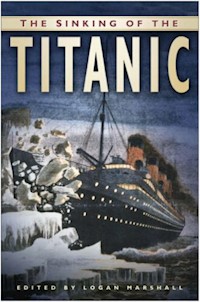
The Sinking of the Titanic E-Book
13,99 €
Mehr erfahren.
- Herausgeber: Nonsuch Publishing
- Kategorie: Lebensstil
- Sprache: Englisch
When she set sail from Southampton on her maiden voyage to New York on 10 April 1912, RMS Titanic, the pride of the White Star fleet, was the largest ocean liner in the world. Deemed 'practically unsinkable' because of her double-bottomed hull and watertight compartments, she carried over 2,000 passengers and crew, although only sufficient lifeboats for just over half that number. Four days out of Southampton, on the night of 14 April, she struck an iceberg in the North Atlantic and sank within a matter of hours; around 1,500 lives were lost. Logan Marshall interviewed the survivors in the immediate aftermath of the disaster and in this book he recorded the facts as they were known. Well established as part of the canon of Titanic literature, this book is a must-have for anyone with an interest in the ship and her sorrowful fate.
Das E-Book können Sie in Legimi-Apps oder einer beliebigen App lesen, die das folgende Format unterstützen:
Veröffentlichungsjahr: 2011
Ähnliche




















To the 1635 souls who were lost with the ill-fated Titanic, and especially to those heroic men, who, instead of trying to save themselves, stood aside that women and children might have their chance; of each of them let it be written, as it was written of a Greater One—
‘He Died that Others might Live’
I stood in unimaginable trance
And agony that cannot be remembered.
COLERIDGE
Contents
Title Page
Epigraph
Dedication
Dr Van Dyke’s Spiritual Consolation to the Survivors of the Titanic
Facts about the Wreck of the Titanic
I First news of the Greatest Marine Disaster in History
II The Most Sumptuous Palace Afloat
III The Maiden Voyage of the Titanic
IV Some of the Notable Passengers
V The Titanic Strikes an Iceberg!
VI ‘Women and Children First’
VII Left to Their Fate
VIII The Call for Help Heard
IX In the Drifting Life-Boats
X On Board the Carpathia
XI Preparations on Land to receive the Sufferers
XII The Tragic Home-Coming
XIII The Story of Charles F. Hurd
XIV Thrilling Account by L. Beasley
XV Jack Thayer’s Own Story of the Wreck
XVI Incidents Related by James McGough
XVII Wireless Operator Praises Heroic Work
XVIII Story of the Steward
XIX How the World Received the News
XX Bravery of the Officers and Crew
XXI Searching for the Dead
XXII Criticism of Ismay
XXIII The Financial Loss
XXIV Opinions of Experts
XXV Time for Reflection and Reform
Copyright
Dr Van Dyke’s Spiritual Consolation to the Survivors of the Titanic
The Titanic, greatest of ships, has gone to her ocean grave. What has she left behind her? Think clearly.
She has left debts. Vast sums of money have been lost. Some of them are covered by insurance which will be paid. The rest is gone. All wealth is insecure.
She has left lessons. The risk of running the northern course when it is menaced by icebergs is revealed. The cruelty of sending a ship to sea without enough life-boats and life-rafts to hold her company is exhibited and underlined in black.
She has left sorrows. Hundreds of human hearts and homes are in mourning for the loss of dear companions and friends. The universal sympathy which is written in every face and heard in every voice proves that man is more than the beasts that perish. It is an evidence of the divine in humanity. Why should we care? There is no reason in the world, unless there is something in us that is different from lime and carbon and phosphorus, something that makes us mortals able to suffer together—
For we have all of us a human heart.
But there is more than this harvest of debts, and lessons, and sorrows, in the tragedy of the sinking of the Titanic. There is a great ideal. It is clearly outlined and set before the mind and heart of the modern world, to approve and follow, or to despise and reject.
It is, ‘Women and children first!’
Whatever happened on that dreadful April night among the arctic ice, certainly that was the order given by the brave and steadfast captain; certainly that was the law obeyed by the men on the doomed ship. But why? There is no statute or enactment of any nation to enforce such an order. There is no trace of such a rule to be found in the history of ancient civilizations. There is no authority for it among the heathen races today. On a Chinese ship, if we believe the report of an official representative, the rule would have been, ‘Men first, children next, and women last.’
There is certainly no argument against this barbaric rule on physical or material grounds. On the average, a man is stronger than a woman, he is worth more than a woman, he has a longer prospect of life than a woman. There is no reason in all the range of physical and economic science, no reason in all the philosophy of the Superman, why he should give his place in the life-boat to a woman.
Where, then, does this rule which prevailed in the sinking Titanic come from? It comes from God, through the faith of Jesus of Nazareth.
It is the ideal of self-sacrifice. It is the rule that ‘the strong ought to bear the infirmities of those that are weak.’
It is the divine revelation which is summed up in the words: ‘Greater love hath no man than this, that a man lay down his life for his friends.’
It needs a tragic catastrophe like the wreck of the Titanic to bring out the absolute contradiction between this ideal and all the counsels of materialism and selfish expediency.
I do not say that the germ of this ideal may not be found in other religions. I do not say that they are against it. I do not ask any man to accept my theology (which grows shorter and simpler as I grow older), unless his heart leads him to it. But this I say: The ideal that the strength of the strong is given them to protect and save the weak, the ideal which animates the rule of ‘Women and children first,’ is in essential harmony with the spirit of Christ.
If what He said about our Father in Heaven is true, this ideal is supremely reasonable. Otherwise it is hard to find arguments for it. The tragedy of facts sets the question clearly before us. Think about it. Is this ideal to survive and prevail in our civilization or not?
Without it, no doubt, we may have riches and power and dominion. But what a world to live in!
Only through the belief that the strong are bound to protect and save the weak because God wills it so, can we hope to keep self-sacrifice, and love, and heroism, and all the things that make us glad to live and not afraid to die.
HENRY VAN DYKE
Princeton, N.J., April 18, 1912
Facts about the Wreck of the Titanic
Number of persons aboard, 2,340.
Number of life-boats and rafts, 20.
Capacity of each life-boat, 50 passengers and crew of 8.
Utmost capacity of life-boats and rafts, about 1,100.
Number of life-boats wrecked in launching 4.
Capacity of life-boats safely launched, 928.
Total number of persons taken in life-boats, 711.
Number who died in life-boats, 6.
Total number saved 705.
Total number of Titanic’s company lost, 1,635.
The cause of the disaster was a collision with an iceberg in latitude 41.46 north, longitude 50.14 west. The Titanic had had repeated warnings of the presence of ice in that part of the course. Two official warnings had been received defining the position of the ice fields. It had been calculated on the Titanic that she would reach the ice fields about 11 o’clock Sunday night. The collision occurred at 11.40. At the time the ship was driving at a speed of 21 to 23 knots, or about 26 miles, an hour.
There had been no details of seamen assigned to each boat.
Some of the boats left the ship without seamen enough to man the oars.
Some of the boats were not more than half full of passengers.
The boats had no provisions, some of them had no water stored, some were without sail equipment or compasses.
In some boats, which carried sails wrapped and bound, there was not a person with a knife to cut the ropes. In some boats the plugs in the bottom had been pulled out and the women passengers were compelled to thrust their hands into the holes to keep the boats from filling and sinking.
The captain, E.J. Smith, admiral of the White Star fleet, went down with his ship.
I
First News of the Greatest Marine Disaster in History
‘THE TITANIC IN COLLISION, BUT EVERYBODY SAFE’—ANOTHER TRIUMPH SET DOWN TO WIRELESS TELEGRAPHY—THE WORLD GOES TO SLEEP PEACEFULLY—THE SAD AWAKENING
Like a bolt out of a clear sky came the wireless message on Monday, April 15, 1912, that on Sunday night the great Titanic, on her maiden voyage across the Atlantic, had struck a gigantic iceberg, but that all the passengers were saved. The ship had signaled her distress and another victory was set down to wireless. Twenty-one hundred lives saved!
Additional news was soon received that the ship had collided with a mountain of ice in the North Atlantic, off Cape Race, Newfoundland, at 10.25 Sunday evening, April 14th. At 4.15 Monday morning the Canadian Government Marine Agency received a wireless message that the Titanic was sinking and that the steamers towing her were trying to get her into shoal water near Cape Race, for the purpose of beaching her.
Wireless despatches up to noon Monday showed that the passengers of the Titanic were being transferred aboard the steamer Carpathia, a Cunarder, which left New York, April 13th, for Naples. Twenty boat-loads of the Titanic’s passengers were said to have been transferred to the Carpathia then, and allowing forty to sixty persons as the capacity of each life-boat, some 800 or 1200 persons had already been transferred from the damaged liner to the Carpathia. They were reported as being taken to Halifax, whence they would be sent by train to New York.
Another liner, the Parisian, of the Allan Company, which sailed from Glasgow for Halifax on April 6th, was said to be close at hand and assisting in the work of rescue. The Baltic, Virginian and Olympic were also near the scene, according to the information received by wireless.
While badly damaged, the giant vessel was reported as still afloat, but whether she could reach port or shoal water was uncertain. The White Star officials declared that the Titanic was in no immediate danger of sinking, because of her numerous water-tight compartments.
‘While we are still lacking definite information,’ Mr Franklin, vice-president of the White Star Line, said later in the afternoon, ‘we believe the Titanic’s passengers will reach Halifax, Wednesday evening. We have received no further word from Captain Haddock, of the Olympic, or from any of the ships in the vicinity, but are confident that there will be no loss of life.’
With the understanding that the survivors would be taken to Halifax, the line arranged to have thirty Pullman cars, two diners and many passenger coaches leave Boston Monday night for Halifax to get the passengers after they were landed. Mr Franklin made a guess that the Titanic’s passengers would get into Halifax on Wednesday. The Department of Commerce and Labor notified the White Star Line that customs and immigration inspectors would be sent from Montreal to Halifax in order that there would be as little delay as possible in getting the passengers on trains.
Monday night the world slept in peace and assurance. A wireless message had finally been received, reading:
All Titanic’s passengers safe.
It was not until nearly a week later that the fact was discovered that this message had been wrongly received in the confusion of messages flashing through the air, and that in reality the message should have read:
Are all Titanic’s passengers safe?
With the dawning of Tuesday morning came the awful news of the true fate of the Titanic.
II
The Most Sumptuous Palace Afloat
DIMENSIONS OF THE TITANIC—CAPACITY—PROVISIONS FOR THE COMFORT AND ENTERTAINMENT OF PASSENGERS—MECHANICAL EQUIPMENT—THE ARMY OF ATTENDANTS REQUIRED
The statistical record of the great ship has news value at this time.
Early in 1908 officials of the White Star Company announced that they would eclipse all previous records in shipbuilding with a vessel of staggering dimensions. The Titanic resulted.
The keel of the ill-fated ship was laid in the summer of 1909 at the Harland & Wolff yards, Belfast. Lord Pirrie, considered one of the best authorities on shipbuilding in the world, was the designer. The leviathan was launched on May 31, 1911, and was completed in February 1912, at a cost of $10,000,000.
Sister Ship of Olympic
The Titanic, largest liner in commission, was a sister ship of the Olympic. The registered tonnage of each vessel was estimated as 45,000, but officers of the White Star Line said that the Titanic measured 45,328 tons. The Titanic was commanded by Captain E.J. Smith, the White Star admiral, who had previously been on the Olympic.
She was 882½ feet long, or about four city blocks, and was 5,000 tons bigger than a battleship, twice as large as the dreadnought Delaware.
Like her sister ship, the Olympic, the Titanic was a four funnelled vessel, and had eleven decks. The distance from the keel to the top of the funnels was 175 feet. She had an average speed of twenty-one knots.
The Titanic could accommodate 2,500 passengers. The steamship was divided into numerous compartments, separated by fifteen bulkheads. She was equipped with a gymnasium, swimming pool, hospital with operating room, and a grill and palm garden.
Carried Crew of 860
The registered tonnage was 45,000, and the displacement tonnage 66,000. She was capable of carrying 2,500 passengers and the crew numbered 860.
The largest plates employed in the hull were 36 feet long, weighing 4½ tons each, and the largest steel beam used was 92 feet long, the weight of this double beam being 4 tons. The rudder, which was operated electrically, weighed 100 tons, the anchors 15½ tons each, the centre (turbine) propeller 22 tons, and each of the two ‘wing’ propellers 38 tons. The after ‘boss-arms,’ from which were suspended the three propeller shafts, tipped the scales at 73½ tons, and the forward ‘boss-arms’ at 45 tons. Each link in the anchor-chains weighed 175 pounds. There were more than 2,000 side-lights and windows to light the public room and passenger cabins.
Nothing was left to chance in the construction of the Titanic. Three million rivets (weighing 1,200 tons) held the solid plates of steel together. To insure stability in binding the heavy plates in the double bottom, half a million rivets, weighing about 270 tons, were used.
All the plating of the hulls was riveted by hydraulic power, driving seven-ton riveting machines, suspended from travelling cranes. The double bottom extended the full length of the vessel, varying from 5 feet 3 inches to 6 feet 3 inches in depth, and added strength to the hull.
Most Luxurious Steamship
Not only was the Titanic the largest steamship afloat but it was the most luxurious. Elaborately furnished cabins opened onto her eleven decks, and some of these decks were reserved as private promenades that were engaged with the best suites. One of these suites was sold for $4,350 for the boat’s maiden and only voyage. Suites similar, but which were without the private promenade decks, sold for $2,300.
The Titanic differed in some respects from her sister-ship. The Olympic had a lower promenade deck, but in the Titanic’s case these staterooms were brought out flush with the outside of the superstructure, and the rooms themselves made much larger. The sitting rooms of some of the suites on this deck were 15 x 15 feet.
The restaurant was much larger than that of the Olympic and it had a novelty in the shape of a private promenade deck on the starboard side, to be used exclusively by its patrons. Adjoining it was a reception room, where hosts and hostesses could meet their guests.
Two private promenades were connected with the two most luxurious suites on the ship. The suites were situated about amidships, on either side of the vessel, and each was about fifty feet long. One of the suites comprised a sitting room, two bedrooms and a bath.
These private promenades were expensive luxuries. The cost figured out something like forty dollars a front foot for a six days’ voyage. They, with the suites to which they are attached, were the most expensive transatlantic accommodations yet offered.
The Engine Room
The engine room was divided into two sections, one given to the reciprocating engines and the other to the turbines. There were two sets of the reciprocating kind, one working each of the wing propellers through a four-cylinder triple expansion, direct acting inverted engine. Each set could generate 15,000 indicated horse-power at seventy-five revolutions a minute. The Parsons type turbine takes steam from the reciprocating engines, and by developing a horse-power of 16,000 at 165 revolutions a minute, works the third of the ship’s propellers, the one directly under the rudder. Of the four funnels of the vessel three were connected with the engine room, and the fourth or after funnel for ventilating the ship including the gallery.
Practically all of the space on the Titanic below the upper deck was occupied by a steam-generating plant, coal bunkers and propelling machinery. Eight of the fifteen water-tight compartments contained the mechanical part of the vessel. There were, for instance, twenty-four double end and five single end boilers, each 16 feet 9 inches in diameter, the larger 20 feet long and the smaller 11 feet 9 inches long. The larger boilers had six fires under each of them and the smaller three furnaces.
One of the most interesting features of the vessel was the refrigerating plant, which comprised a huge ice-making and refrigerating machine and a number of provision rooms on the after part of the lower and orlop decks. There were separate cold rooms for beef, mutton, poultry, game, fish, vegetables, fruit, butter, bacon, cheese, flowers, mineral water, wine, spirits and champagne, all maintained at different temperatures most suitable to each. Perishable freight had a compartment of its own, also chilled by the plant.
Comfort and Stability
Two main ideas were carried out in the Titanic. One was comfort and the other stability. The vessel was planned to be an ocean ferry. She was to have only a speed of twenty-one knots, far below that of some other modern vessels, but she was planned to make that speed, blow high or blow low, so that if she left one side of the ocean at a given time she could be relied on to reach the other side at almost a certain minute of a certain hour.
Life-Boat and Davits on the Titanic
This diagram shows very clearly the arrangement of the life-boats and the manner in which they were launched.
One who has looked into modern methods for safeguarding a vessel of the Titanic type can hardly imagine an accident that could cause her to founder. No collision such as has been the fate of any ship in recent years, it has been thought up to this time, could send her down, nor could running against an iceberg do it unless such an accident were coupled with the remotely possible blowing out of a boiler. She would sink at once, probably, if she were to run over a submerged rock or derelict in such manner that both her keel plates and her double bottom were torn away for more than half her length; but such a catastrophe was so remotely possible that it did not even enter the field of conjecture.
The reason for all this is found in the modern arrangement of water-tight steel compartments into which all ships now are divided and of which the Titanic had fifteen so disposed that half of them, including the largest, could be flooded without impairing the safety of the vessel. Probably it was the working of these bulkheads and the water-tight doors between them as they are supposed to work that saved the Titanic from foundering when she struck the iceberg.
These bulkheads were of heavy sheet steel and started at the very bottom of the ship and extended right up to the top side. The openings in the bulkheads were just about the size of the ordinary doorway, but the doors did not swing as in a house, but fitted into water-tight grooves above the opening. They could be released instantly in several ways, and once closed formed a barrier to the water as solid as the bulkhead itself.
In the Titanic, as in other great modern ships, these doors were held in place above the openings by friction clutches. On the bridge was a switch which connected with an electric magnet at the side of the bulkhead opening. The turning of this switch caused the magnet to draw down a heavy weight, which instantly released the friction clutch, and allowed the door to fall or slide down over the opening in a second. If, however, through accident the bridge switch was rendered useless, the doors would close automatically in a few seconds. This was arranged by means of large metal floats at the side of the doorways, which rested just above the level of the double bottom, and as the water entered the compartments these floats would rise to it and directly release the clutch holding the door open. These clutches could also be released by hand.
It was said of the Titanic that her compartments could be flooded as far back or as far forward as the engine room and she would float, though she might take on a heavy list, or settle considerably at one end. To provide against just such an accident as she is said to have encountered, she had set back a good distance from the bows an extra heavy cross partition known as the collision bulkhead, which would prevent water getting amidships, even though a good part of her bow should be torn away. What a ship can stand and still float was shown a few years ago when the Suevic of the White Star Line went on the rocks on the British coast. The wreckers could not move the forward part of her, so they separated her into two sections by the use of dynamite, and after putting in a temporary bulkhead, floated off the after half of the ship, put it in dry dock and built a new forward part for her. More recently the battleship Maine, or what was left of her, was floated out to sea, and kept on top of the water by her water-tight compartments only.
III
The Maiden Voyage of the Titanic
PREPARATIONS FOR THE VOYAGE—VOYAGE—SCENES OF GAIETY—THE BOAT SAILS—INCIDENTS OF THE VOYAGE—A COLLISION NARROWLY AVERTED—THE BOAT ON FIRE—WARNED OF ICEBERGS
Never was an ill-starred voyage more auspiciously begun than when the Titanic, newly crowned empress of the seas, steamed majestically out of the port of Southampton at noon on Wednesday, April 10th, bound for New York.
Elaborate preparations had been made for the maiden voyage. Crowds of eager watchers gathered to witness the departure, all the more interested because of the notable people who were to travel aboard her. Friends and relatives of many of the passengers were at the dock to bid God-speed to their departing loved ones. The passengers themselves were unusually gay and happy.
Majestic and beautiful, the ship rested on the water, a marvel of shipbuilding, worthy of any sea. As this new queen of the ocean moved slowly from her dock, no one questioned her construction; she was fitted with an elaborate system of water-tight compartments, calculated to make her unsinkable; she had been pronounced the safest as well as the most sumptuous Atlantic liner afloat.
There was silence just before the boat pulled out—the silence that usually precedes the leave-taking. The heavy whistles sounded and the splendid Titanic, her flags flying and her band playing, churned the water and plowed heavily away.
Then the Titanic, with the people on board waving handkerchiefs and shouting good-byes that could be heard only as a buzzing murmur on shore, rode away on the ocean, proudly, majestically, her head up and, so it seemed, her shoulders thrown back. If ever a vessel seemed to throb with proud life, if ever a monster of the sea seemed to ‘feel its oats’ and strain at the leash, if ever a ship seemed to have breeding and blue blood that would keep it going until its heart broke, that ship was the Titanic.
And so it was only her due that as the Titanic steamed out of the harbour bound on her maiden voyage a thousand ‘God-speeds’ were wafted after her, while every other vessel that she passed, the greatest of them dwarfed by her colossal proportions, paid homage to the new queen regnant with the blasts of their whistles and the shrieking of steam sirens.
The Ship’s Captain
In command of the Titanic was Captain E.J. Smith, a veteran of the seas, and admiral of the White Star Line fleet. The next six officers in order of their rank were, Murdock, Lightollder, Pitman, Boxhall, Lowe and Moody. Dan Phillips was chief wireless operator, with Harold Bride as assistant.
From the forward bridge, fully ninety feet above the sea, peered out the benign face of the ship’s master, cool of aspect, deliberate of action, impressive in that quality of confidence that is bared only of long experience in command.
From far below the bridge sounded the strains of the ship’s orchestra, paying blithely a favorite air from ‘The Chocolate Soldier.’ All went as merry as a wedding bell. Indeed, among that gay ship’s company were two score or more at least for whom the wedding bells had sounded in truth not many days before. Some were on their honeymoon tours, others were returning to their motherland after having passed the weeks of the honeymoon, like Colonel John Jacob Astor and his young bride, amid the diversions of Egypt or other Old World countries.
What daring flight of imagination would have ventured the prediction that within the span of six days that stately ship, humbled, shattered and torn asunder, would lie two thousand fathoms deep at the bottom of the Atlantic, that the benign face that peered from the bridge would be set in the rigour of death and that the happy bevy of voyaging brides would be sorrowing widows?
Almost in a Collision
The big vessel had, however, a touch of evil fortune before she cleared the harbour of Southampton. As she passed down stream her immense bulk—she displaced 66,000 tons—drew the waters after her with an irresistible suction that tore the American liner New York from her moorings; seven steel hawsers were snapped like twine. The New York floated toward the White Star ship, and would have rammed the new ship had not the tugs Vulcan and Neptune stopped her and towed her back to the quay.
When the mammoth ship touched at Cherbourg and later at Queenstown she was again the object of a port ovation, the smaller craft doing obeisance while thousands gazed in wonder at her stupendous proportions. After taking aboard some additional passengers at each port, the Titanic headed her towering bow toward the open sea and the race for a record on her maiden voyage was begun.
New Burst of Speed Each Day
The Titanic made 484 miles as her first day’s run, her powerful new engines turning over at the rate of seventy revolutions. On the second day out the speed was hit up to seventy-three revolutions and the run for the day was bulletined as 519 miles. Still further increasing the speed, the rate of revolution of the engines was raised to seventy-five and the day’s run was 549 miles, the best yet scheduled.
But the ship had not yet been speeded to her capacity; she was capable of turning over about seventy-eight revolutions. Had the weather conditions been propitious, it was intended to press the great racer to the full limit of her speed on Monday. But for the Titanic Monday never came.
Fire in the Coal Bunkers
Unknown to the passengers, the Titanic was on fire from the day she sailed from Southampton. Her officers and crew knew it, for they had fought the fire for days.
This story, told for the first time by the survivors of the crew, was only one of the many thrilling tales of the fateful first voyage.
‘The Titanic sailed from Southampton on Wednesday, April 10th, at noon,’ said J. Dilley, fireman on the Titanic.
‘I was assigned to the Titanic from the Oceanic, where I had served as a fireman. From the day we sailed the Titanic was on fire, and my sole duty, together with eleven other men, had been to fight that fire. We had made no headway against it.’
Passengers in Ignorance
‘Of course,’ he went on, ‘the passengers knew nothing of the fire. Do you think we’d have let them know about it? No, sir.
‘The fire started in bunker No. 6. There were hundreds of tons of coal stored there. The coal on top of the bunker was wet, as all the coal should have been, but down at the bottom of the bunker the coal had been permitted to get dry.
‘The dry coal at the bottom of the pile took fire, and smoldered for days. The wet coal on top kept the flames from coming through, but down in the bottom of the bunkers the flames were raging.
‘Two men from each watch of stokers were tolled off, to fight that fire. The stokers worked four hours at a time, so twelve of us were fighting flames from the day we put out of Southampton until we hit the iceberg.
‘No, we didn’t get that fire out, and among the stokers there was talk that we’d have to empty the big coal bunkers after we’d put our passengers off in New York, and then call on the fire-boats there to help us put out the fire.
‘The stokers were alarmed over it, but the officers told us to keep our mouths shut—they didn’t want to alarm the passengers.’
Usual Diversion
Until Sunday, April 14th, the voyage had apparently been a delightful but uneventful one. The passengers had passed the time in the usual diversions of ocean travellers, amusing themselves in the luxurious saloons, promenading on the boat deck, lolling at their ease in steamer chairs and making pools on the daily runs of the steamship. The smoking rooms and card rooms had been as well patronized as usual, and a party of several notorious professional gamblers had begun reaping their usual easy harvest.
As early as Sunday afternoon the officers of the Titanic must have known that they were approaching dangerous ice fields of the kind that are a perennial menace to the safety of steamships following the regular transatlantic lanes off the Great Banks of Newfoundland.
An Unheeded Warning
On Sunday afternoon the Titanic’s wireless operator forwarded to the Hydrographic office in Washington, Baltimore, Philadelphia and elsewhere the following dispatch:
April 14,—The German steamship Amerika (Hamburg–American Line) reports by radio-telegraph passing two large icebergs in latitude 41.27, longitude 50.08.—Titanic, Br. S.S.
Despite this warning, the Titanic forged ahead Sunday night at her usual speed—from twenty-one to twenty-five knots.




