


Erhalten Sie Zugang zu diesem und mehr als 300000 Büchern ab EUR 5,99 monatlich.
- Herausgeber: Pushkin Press
- Kategorie: Gesellschafts- und Liebesromane
- Serie: Pushkin Collection
- Sprache: Englisch
'One of the greatest Japanese writers... his work explores the destructive power of erotic obsessions' Guardian 'Outstanding... rich and mysterious' New York Times Book Review A new selection and translation of short stories by a hugely prominent classic Japanese writer, filled with eroticism and fantasy The rich and mysterious short stories of Jun'ichiro Tanizaki pulse with a restless eroticism. Visiting a kingdom ruled by a weak-willed duke, the sage Confucius finds himself drawn into a battle of wills. A naïve servant boy is compelled down a path of vice and sin by his master's daughter. A young prince finds himself enraptured by his newest possession: a beguiling, enchanting mermaid. These three stories, two of which are here translated for the first time by Bryan Karetnyk, capture the essence of Tanizaki's shorter writings. Drawing on tales from both Japanese and Chinese mythology, combined with poignant psychological realism, Tanizaki reveals and revels in the paper-thin line between the sublime and the depraved.
Sie lesen das E-Book in den Legimi-Apps auf:
Seitenzahl: 208
Veröffentlichungsjahr: 2023
Das E-Book (TTS) können Sie hören im Abo „Legimi Premium” in Legimi-Apps auf:
Ähnliche


















‘It is through… detail plain in language, but poetic in conception, that the blood of Tanizaki’s rich and mysterious art pulses’
EDMUND WHITE, NEW YORK TIMES BOOK REVIEW
‘Tanizaki created a lifelong series of ingenious variations on a dominant theme: the power of love to energize and destroy’
CHICAGO TRIBUNE
‘Tanizaki was meticulous in language, scandalously cautious about sexual politics, masterful in storytelling’
THE NATION
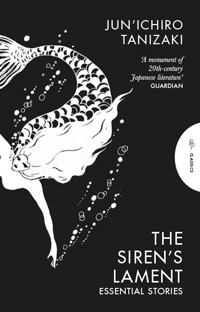
THE SIREN’S LAMENT
ESSENTIAL STORIES
JUN’ICHIRO TANIZAKI
TRANSLATED FROM THE INDONESIAN BY ANNIE TUCKER
PUSHKIN PRESS CLASSICS
Contents
PREFACE
Jun’ichirō Tanizaki (1886–1965) was a titan of Japanese letters. His formidable career, which had an immeasurable influence on the development of modern Japanese literature, spanned more than half a century and three imperial eras, as well as Japan’s rise and precipitous fall as a colonial power. Yet while, throughout those tumultuous years, the bundan, Japan’s literary establishment, was often predominated by so much conventionalism and orthodoxy—first by the bleakly confessional brand of naturalism known as the ‘I-novel’, and latterly by a vogue for Marxism and socially informed ‘proletarian’ writing—Tanizaki’s fiction cut conspicuously, defiantly, perversely against the grain.
Rejecting both the mundane prosaicism of the I-novel and the stringently grim, propagandistic code of proletarian fiction, Tanizaki’s often alarming and disturbing fantasies sooner aimed at something at once more universal and essential: the splendour and horror of man’s desires, paramount among which was an unremitting obsession with love, lust, and longing. Founded on an unshakeable belief in art’s prerogative to transcend the quotidian, Tanizaki’s is an œuvre that delights in portraying, with opulent detail and ruthless penetration, fictional worlds that explore the pathos and violence of humanity’s darker urges, the sado-masochistic yearning to dominate and be dominated, the destructive power of eros and decadence, and the paper-thin line between the sublime and the depraved.
The three stories included in this short collection are taken from the audacious early years of Tanizaki’s career and celebrate the precocious genius of a young author already at the forefront of international literary modernism and on the cusp of artistic maturity. The first piece, ‘The Qilin’ (Kirin), which was first published in the review Shinshichō in 1910, ventures away from Japan—overseas and into the mists of antiquity and legend. Steeped in classical references to the history and philosophy of ancient China, Tanizaki’s narrative places the extremities of desire and caprice in the hands of the powerful, reimagining an episode of Confucius’ travels in the state of Wei, where an oppressed people hopes that the Great Sage may teach its rulers ‘a lesson in grace and wise government’. Finding the sovereign there in thrall to an evil and luxurious woman, Confucius discovers that he must vie for the mind of the virtuous but biddable duke with an individual whose magnificence is matched only by her iniquity. At her command, scenes of extraordinary beauty and sensuality are conjured up, taking on grotesque proportions and culminating in a sadistic ne plus ultra: a garden scene, in which the reader anticipates an earthly paradise filled with exotic rarities, only to find a haunting hellscape fit to rival any nightmare of Hieronymus Bosch. In place of a would-be arcadia, we are made witness to a gruesome vista of the oppressed and terrorized populace, ‘a crowd of the damned in the midst of cruel tortures’, all wantonly maimed and disfigured, ‘soaked in crimson, like peonies in full bloom’—the very sight of which plunges the diabolical consort into a state of ecstasy and rapture. Even virtue, warns Tanizaki, may be corrupted by power and status and bent to such lavish and extravagant obscenity.
‘Killing O-Tsuya’ (Otsuya-koroshi), which debuted in the literary journal Chūō Kōron in 1915, returns the reader to Japan, but to the city of Edo (now Tokyo) in the days of the military government that was the Tokugawa shogunate. There, in Tanizaki’s native city, amid the perilous back-streets and pleasure quarters of the ‘downtown’ Shitamachi and along the moonlit waterways of the Sumida river, we catch a violent glimpse of the culture of geisha and courtesans, gangsters and cut-throats. As we follow the young and naïve Shinsuke while he goes to any and all ends in pursuit of his love for his master’s manipulative daughter O-Tsuya, we observe the pair’s slow descent into a pit of corruption and depravity, by way of illicit love, theft, debauchery, vice, and, eventually, murder. Structured along the lines of a kabuki play and embellished with all manner of overt and subtle references to the theatre and a theatricalized world, the work presents a cat’s cradle of shifting identities, allegiances, and disguises, which are staged and upended with arresting artistic bravura. Moreover, as Tanizaki pushes his characters ever closer to the brink of their own tragedies, he maintains a masterly ambiguity and dramatic tension right until the dark denouement of the final scene, which draws the work to its brutal close by the waterfront in Mukōjima.
In the final piece of this collection, ‘The Siren’s Lament’ (Ningyo no nageki), which appeared in Chūō Kōron precisely two years after ‘Killing O-Tsuya’, Tanizaki transports the reader back to China, although now not to the remote antiquity of the Spring and Autumn Period, but to the decadence of the late imperial era in the eighteenth century, ‘when the House of Aisin-Gioro sat upon the dragon throne and the Qing dynasty still flourished with all the dazzling splendour of peonies in June’. In this fairy tale tinged with a note of tender nostalgia, a handsome and listless prince who has exhausted every extreme of earthly dissipation yearns for new sensations to satiate his desires both subtle and gross. So it happens that, one day, while languishing in his palace, he receives a visit from an outlandish Dutch merchant, who purports to be selling a beautiful and priceless rarity: a European mermaid, which captivates him, heart and soul. In the work’s ostentatious conflation of Chinese, Japanese, and European histories, Tanizaki confects a unique fable that estranges occidentalist and orientalist assumptions and blurs the borders between dream and reality. As the melancholy prince embarks upon his ill-fated final quest for happiness and fulfilment, the reader is left contemplating the sublime pleasures and psychological devastation wrought by such longing for chimeras.
These three works are, of course, essential in that they capture early expressions of the themes for which Tanizaki would later win worldwide acclaim in his major novels; more importantly, however, they are also essential in terms of their exuberant, unflinching exploration of humanity’s darkest impulses and desires, from the most base to the most exquisite. ‘Here is a writer,’ the great Kafū Nagai wrote of Tanizaki’s short fiction as early as 1911, ‘who has successfully explored artistic territory that nobody else in contemporary Japanese literature has yet been able, or dared, to tackle.’ Tanizaki’s writing was indeed an act of daring—one that looked human imperfection in the eye and had the boldness of imagination to transfigure it into the most ravishing, unsettling art.
B.S.K.
THE QILIN
Phoenix! O phoenix!
How thy virtue hath declined.
What hath come to pass cannot be put aright,
but what is still to come may be avoided yet.
Give up thy vain pursuit. Give it up, I say.
Dangerous are those who now administer the affairs of state.
According to the chronicles of Zuo Qiuming and Meng Ke, of Sima Qian and others, at the beginning of spring in the year 493 before the birth of Christ, in the thirteenth year of the Duke Ding’s reign in the state of Lu, when the ruler was celebrating the Festival of the Heavens and the Earth, Confucius, together with a handful of disciples attending his carriage, left the land of his birth to preach the Way abroad.
On the banks of the Sishui river, fragrant green grasses were sprouting, and although the snow was melting on the summits of Mount Fang, Mount Niqiu and Wu Peak, a northern wind that swooped down, like hordes of Huns whipping up the sands of the desert, still brought back memories of a harsh winter. Full of energy, Zilu led the group, his lilac robes with their marten trim flapping in the wind. Behind him followed Yan Yuan, his gaze pensive, and with him the zealous and devoted Zeng Shen, both of their feet clad in shoes of bast. The very embodiment of virtue, the driver Fan Chi gripped the reins of the four horses, and, between furtive glances at the wizened face of the Great Sage riding in the carriage, he would ponder the bitter lot of this wandering teacher and let fall a tear.
One day, when at last they had reached the frontier of the state of Lu, each of the men looked back wistfully towards his native land, but the road by which they had come was hidden in the shadow of the so-called ‘tortoise’ mountain, Mount Gui. Then Confucius, picking up his zither, sang in a mournful, hoarse voice:
I long to see my land of Lu,
But it is shaded by Mount Gui.
Should I now go and bear an axe
And hew its tortoise shell away?
They journeyed further and further to the north and, after three days, found themselves amid a vast plain where they heard a voice singing a peaceful and carefree song. It was an old man garbed in deerskin and with a rope for a belt, humming to himself as he gathered ears of grain that had fallen by the wayside.
‘You, what does this song say to you?’ asked Confucius, turning to Zilu.
‘The old man’s song has not the lofty melancholy that echoes in those of the Master. He sings freely, like a bird in the sky.’
‘Quite so. This is none other than a disciple of the late Laozi. His name is Linlei and he must be a good hundred years old. But, with the arrival of spring each year, he comes out into the fields and sings as he gathers grain. Let one of you go over there and speak to him.’
No sooner had Confucius’ words been spoken than Zigong, one of the disciples, rushed over to the edge of the field and greeted the old man, asking him:
‘You sing your song and gather up the fallen ears of grain, old man, but have you no regrets in life?’
Without turning around, the old man just went on picking the fallen ears of grain diligently, all the while singing in time with the steps he took. Zigong followed him and called out again. The old man finally stopped singing and looked at Zigong intently.
‘What should I have to regret?’ said the old man.
‘In your youth, you were unobservant. As you grew, you did not contest your time. And in maturity, with neither wife nor child, and though the hour of your death approaches, you take some pleasure in gathering ears of grain and singing songs.’
The old man roared with laughter.
‘My pleasures are known to every man, though they turn them into sorrows. Yes, I was unobservant in my youth. Yes, I let my time go uncontested. Yes, I have neither wife nor child in my old age. And yes, the hour of my death does approach at last. This, therefore, is why I am happy.’
‘But if to wish for a long life, as every man does, means to fear death, then how is it that you can rejoice in its approach?’ Zigong asked again.
‘Life and death are but a departure and a return. To die here is to be born there. I know that to cling to life is a futile act. To die today, to be born yesterday: I doubt there is much difference.’
Having said this, the old man carried on singing. Zigong had failed to apprehend the meaning of his words, but when he returned and relayed them to the Great Sage, Confucius said:
‘The old man can certainly talk, but I can see that he has not yet fully understood the Way.’
They journeyed on for many days and more, and crossed the Jishui river. The black cloth hat worn by the Sage was covered in dust, and his fox-trimmed robes had faded in the rain and wind.
‘The Sage by the name of Kong Qiu has arrived from the state of Lu. May he teach our tyrannical sovereign and his consort a lesson in grace and wise government!’
Such were the comments made in the street as the people pointed to the carriage and its procession as it entered the capital of the state of Wei. The people here had grown emaciated with hunger and toil, and the walls of their houses sighed with grief and sorrow. All the lovely flowers of this land had been transplanted to the palace to delight the eyes of the sovereign’s consort, while the plump boars had been taken and served up to please her sophisticated tastes. And so, the tranquil spring sun shone in vain on the grey, deserted streets of the city. And, perched atop a hill in the centre, the palace, shining with the five colours of the rainbow, towered over the corpse of the capital like a beast of prey. The ringing of a bell from the depths of the palace thundered throughout the four corners of the city like the roar of a wild animal.
‘What does the sound of that bell say to you?’ Confucius again asked Zilu.
‘Its sound is unlike the fleeting, spontaneous songs of the Master that call up to the heavens, nor is it like the melodies of Linlei that are freely entrusted to the cosmos. Rather, its tolling speaks of something terrible, glorifying sinful pleasures that run counter to the will of heaven.’
‘Quite so. That is the so-called Grove Bell, which in former days the Duke Xiang of Wei had struck from the treasures and the sweat that he extorted from his subjects. When the bell is rung, its echo reverberates from one grove of the palace garden to the next, producing the most awe-inspiring sound. Its ringing is so dreadful because it contains the curses and tears of those tormented by the tyrant.’
Thus spoke Confucius.
The ruler of Wei, the Duke Ling, had ordered that a mica screen and a sofa inlaid with agate be placed by the parapet of the Tower of Spirits, which looked out over his royal demesne; he stood there in the company of his consort, Nanzi, who was enveloped in a cloud of blue robes with a long, iridescent train, and, while pouring for each other cups of a richly perfumed millet liqueur, they admired the spring fields and mountains slumbering beneath a thick shroud of mist.
‘The beautiful light flows like a stream, flooding both heaven and earth. Yet why do we not see gaily coloured flowers in the houses of our people? Why do we not hear the cheerful singing of birds?’ the Duke asked, furrowing his brow in displeasure.
‘It is because the people, not content with praising the clemency of Your Serene Highness and the beauty of His Serene Highness’s consort, pay homage by bringing all the beautiful plants without exception to adorn the palace gardens; every bird in the land gathers there, attracted by the scent of these flowers,’ answered the eunuch Yong Qu, who was attending his lord and master.
At that moment, breaking the silence of the deserted streets, the jade bell of Confucius’ carriage rang brilliantly as it passed beneath the tower.
The General, Wangsun Jia, who was also in attendance of the sovereign, widened his eyes in surprise. ‘Who is the person riding in that carriage?’ he asked. ‘He has the brow of Yao, the eyes of Shun, the nape of Gao Yao and the shoulders of Zichan! He would have the legs of Yu, as well, were they but three cun longer.’
‘But how sad he looks!’ exclaimed Nanzi, before turning to the officer and pointing towards the speeding carriage. ‘Tell me, General, you who are the fount of all knowledge: from which land does he hail?’
‘In my youth I visited many lands in our realm, but, with the exception of Lao Dan, who served as chronicler at the royal court of Zhou, never have I encountered a man with such a noble mien. This can only be Confucius, the Sage who, having grown disillusioned with the government in his native Lu, has taken to the road to spread his teaching. It is said that at his birth a chimera—a qilin—appeared, harmonious music filled the sky, and a goddess descended from the heavens. The mouth of the Sage evokes the power of the bull, his hands the strength of the tiger, and his back the hardy shell of the tortoise. Standing at a height of nine chi and six cun, he has the bearing and stature of King Wen. It is undoubtedly he,’ Wangsun Jia explained.
‘This Sage of whom you speak, what art does he teach?’ asked the Duke Ling as he drained his cup.
‘Sages hold the key to all earthly knowledge,’ the General replied. ‘But that man, it seems, is interested solely in bringing to rulers the art of governance: that of ensuring order in their houses, of making their nations prosper and of pacifying their realms.’
‘I searched for earthly beauties and found Nanzi. I gathered treasures from the four corners of the world and built this palace. Now I should like to rule supreme, to adorn myself with the authority befitting of such a wife and such a palace. By all means, summon this Sage here that I may learn from him the art of subjugating everything under heaven.’
With these words, the Duke peered directly across the table at his wife’s lips, for ordinarily the words that issued from them expressed his true sentiments more faithfully than did his own words.
‘I should like to see with my own eyes any and all of the extraordinary creatures in this world,’ said Nanzi. ‘If that man of mournful countenance is indeed a sage, he will no doubt be able to show me many wonders.’
With that, she lifted her dreaming eyes and followed the carriage as it raced off into the distance.
Confucius and his disciples were approaching the North Palace when a team of four horses arrived in full force. Accompanied by a large retinue, an official of wise countenance stepped out of the carriage and greeted the wanderers with all due deference.
‘I am your humble servant Zhongshu Yu, sent to welcome you by order of His Serene Highness the Duke Ling. It is known now in every corner of the realm that the Master has taken to the road to spread his teaching. Over the course of your long journey, your jade-coloured canopy has become frayed by the wind, and the axle of your carriage has begun to creak. May it please you to take this new carriage and grace the palace with your presence, so that you might reveal to our sovereign the wisdom of the rulers of antiquity, who knew how to govern and bring peace to their domains. To alleviate your fatigue, the crystal waters of a bubbling hot spring await you at the southern end of the West Garden. To quench your thirst, the orchards of the palace are overflowing with fragrant yuzu, sweet pomelo, bitter orange and tangerine. To amuse your palate, you will find dozing in the cages of the royal park wild boar, bears, leopards, oxen and sheep, all nicely fattened and with bellies like eiderdown. May it please you to stay in our land for two months, three months, a year, ten years even, to dissipate the mists that cloud our minds and open our blinded eyes for to see.’
‘The sincere desire of the sovereign to comprehend the wisdom of the Three Kings pleases me above all his riches and the magnificence of his palace,’ replied Confucius. ‘Just as the rank of Lord of Ten Thousand Chariots was not enough to satisfy the luxurious extravagance of the tyrants Jie of Xia and Zhou of Shang, so a kingdom of only a hundred leagues is not too small to be governed according to the wise precepts of the Emperors Yao and Shun. If the Duke Ling truly desires to put an end to the misfortunes of this world and strive honourably for the happiness of his people, I shall gladly lay my bones to rest in this land.’
Confucius and his disciples were ushered into the palace grounds by and by. Their black lacquered shoes clacked loudly against the polished stone of the floor, upon which not a single speck of dust lingered. Thus, they passed before a workshop, where many women were weaving brocade, their shuttles making a terrific noise and the women themselves singing in unison:
These most delicate feminine hands
Will surely sew the robes…
And from the shade of a peach grove, where the blossom resembled perfectly the brocade, issued the listless lowing of cattle in the royal pasture.
On the wise advice of Zhongshu Yu, the Duke Ling had asked his wife to retire with her attendants and purify her lips, which were yet imbued with the savour of fragrant liquors. Attired in robes befitting the solemnity of the occasion, the Duke welcomed Confucius in one of the many palace chambers and plied him with questions on the means by which to enrich his realm, strengthen his armies and become ruler of everything under heaven.
But to the sovereign’s questions about war—which only harms a country and sacrifices the lives of its people—the Sage did not offer so much as a word in reply. Nor did he speak of the thirst for wealth—which only bleeds a people and robs them of their possessions. Instead, he solemnly preached the primacy of virtue over military victories and material gain. He made known the difference between the way of the conqueror who subjugates nations by force and that of the true sovereign who wins over the world with benevolence.
‘If it is noble virtue that you truly seek, you must first vanquish your own desires.’
Such was the Sage’s lesson.
From that day on, the heart of the Duke was no longer guided by the words of his wife but by those of the Sage. Every morning, in the Great Hall of the palace, he was taught the art of true government, while every evening, having climbed the Tower of Spirits, he learnt to read the movement of the celestial bodies according to the four divisions of time. He no longer visited his wife’s bedchamber at night. The noise of the looms in the workshop was replaced by the whistles of bows, the echoes of hooves and the voice of the flute, for his noblemen were practising the Six Arts. Early one morning, when the Duke climbed alone to the top of the tower and looked over the parapet to survey his demesne, he saw brightly feathered songbirds warbling in the fields and mountains, magnificent flowers adorning every house and peasants singing the praises of their lord and master as they headed out to plough. Hot tears of emotion welled in the Duke’s eyes.
‘Why are you crying like this?’ he heard a voice ask suddenly.
At the same time, a sweet and captivating aroma teased his nose. It was the clove-fragranced Rooster’s Tongue incense that Nanzi always held in her mouth, mingling with the perfume of the rosewater from the Western Regions with which her robes were forever doused. The enchanting spell of these aromas emanating from the long-neglected beauty threatened to pierce the jade serenity of the Duke’s thoughts with sharp, cruel claws.
‘I implore you,’ the Duke replied. ‘Do not search my eyes with that mysterious gaze of yours. Do not enfold my body in your arms. Though the Sage has taught me to overcome evil, I know not yet how to resist the power of beauty.’
With that, brushing aside his wife’s hand, the Duke turned away.
‘Ah, this Kong Qiu has wasted no time in stealing you away from me. It is only natural that I should have stopped loving you a long time ago, but that does not give you the right to stop loving me.’
A furious rage inflamed Nanzi’s lips. In the days before her alliance with the Duke, she had taken a lover by the name of Song Zhao, a young nobleman from the state of Song, so her wrath was not due to the cooling of her husband’s affections now, so much as it was to her loss of power over his heart and mind.




